
A cover that looks fine in a product photo can become a noisy, expensive problem the first time the wind picks up. The hem lifts, the fabric snaps against the body, water collects on the roof, and the mirror pockets pull hard enough to distort the seams. By the time the owner notices paint scuffing or a split zipper, the cover has already done its damage.
That failure usually starts before fabric is cut. The buyer supplies a model name, the maker assumes a standard configuration, and nobody records the lifted suspension, rear seat, brush guard, windshield, or roof-mounted equipment. Custom golf cart covers should be ordered as manufacturing specifications, not selected as oversized accessories.
Table of Contents
- Why Off-the-Shelf Covers Fail Custom Carts
- Measuring Your Cart the Way a Pattern-Maker Does
- Choosing Materials, Coatings, and Construction
- Reading the Spec Sheet Beyond Marketing Claims
- Placing the Order and Working With the Maker
- Fitting, Adjusting, and Living With the Cover
- Pre-Order Checklist and Ownership Mindset
Why Off-the-Shelf Covers Fail Custom Carts
A customer once brought in a cover described as “custom fit” because it matched the cart's base model. On the actual vehicle, the fabric caught on the mirrors, bridged over the brush guard, and stopped short of the lower body. The owner had added a rear seat and different windshield after buying the cart, but the order form had asked only for the make and model.
That cover wasn't poorly sewn. It was made from incomplete information.
A standard pattern assumes a particular vehicle envelope. Change the roof, tires, mirrors, seating, or front accessories and the pattern changes with it. A lifted suspension raises the body and alters the space around the wheel wells. Oversized tires push the side panels outward. A brush guard extends the front profile, while a rear seat or cargo box changes the back section from a simple vertical panel into a deeper, more complicated shape.
A model name identifies the starting point. It doesn't identify the cart sitting in your driveway.
The cover usually fails in one of two ways. If the maker adds too much room, the fabric tents over accessories and flaps in the wind. That movement creates noise and abrasion, and it can force water into gaps around the hem. If the maker cuts too tightly, the material pulls against mirror mounts, zippers, vents, and seams. The elastic edge may never seat below the body, leaving an exposed strip where rain and debris can enter.
The same problem appears on vehicles used outside golf courses. A resort cart may carry a windshield, light bar, rear passenger equipment, and branded accessories. A neighborhood low-speed vehicle may spend more time parked than moving, but its cover still has to clear every protrusion without creating a loose sail. Owners who also compare other forms of electric recreational transport, such as browsing electric trolleys, will recognize the same principle: the accessory must match the equipment's real configuration, not its catalog description.
The market context supports taking the specification seriously. A 2025 commercial estimate placed the global golf-cart-accessories market at approximately $1.62 billion, with covers representing 18.9% of revenue, or an estimated $306.0 million. The report is directional rather than an audited industry total, but it shows that covers are a major accessory category, not an afterthought. (Market estimate and category breakdown)
The rest of the buying process should answer one question: what exact shape and operating conditions must this cover handle?
Measuring Your Cart the Way a Pattern-Maker Does
A pattern-maker doesn't begin with “Which cart model is this?” The first document is a dimensioned sketch of the finished vehicle. Measure the cart with every accessory installed, on a level surface, and with a second person holding the tape square.
Start with the main envelope:
- Length from bumper to bumper. Include the furthest front and rear points, not just the body panels. A brush guard, rear step, tow attachment, or cargo structure can determine the finished length.
- Width at the widest point. Measure across the widest tire span or body projection. Don't measure only the roof, because the cover has to clear the body and wheels below it.
- Height at the tallest point. Include the roof, GPS antenna, light bar, roof rack, or other mounted equipment. A cover that clears the roof but catches on an antenna is still a bad pattern.
- Roof front-to-back run. Record where the canopy begins and ends in relation to the windshield, cowl, rear seat, and body. This helps the maker place panel breaks and avoid unsupported fabric bridges.
- Front and rear overhang. Note how far the roof extends beyond the windshield and rear body. The cover needs to fall around that overhang rather than pull sharply from the roof edge.
- Mirror envelope. Measure mirror-to-mirror width, each mirror's height, and how far the mounts project from the body. Photograph unusual mirror arms and folding mechanisms.
- Front accessory depth. Record the brush guard, bumper, winch, light bar, or other equipment that pushes the front fabric away from the stock profile.
- Rear configuration. Measure the rear seat back, cargo box, flip mechanism, and any folded or unfolded positions that the cover must accommodate.
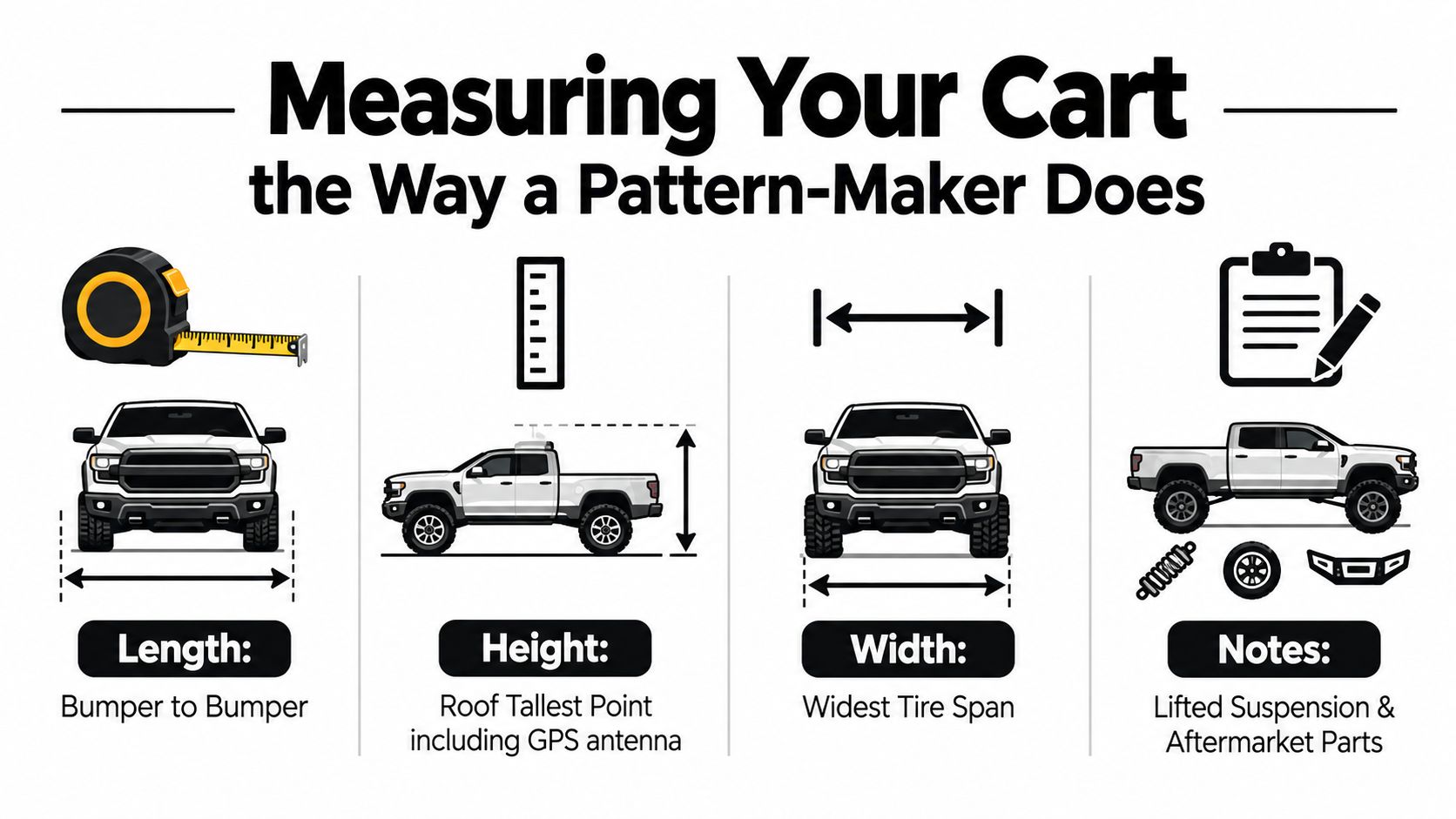
Turn measurements into a usable pattern brief
Label the sketch from A through H and match each label to a measurement or photograph. Add notes beside the dimensions, such as “lifted suspension,” “folding windshield,” or “rear seat remains installed.” A maker who receives only length and width has to guess the rest, and guessed geometry is where custom orders start behaving like universal covers.
Take photographs from all four sides at roughly cart height. Include a front three-quarter image, a rear three-quarter image, close-ups of mirror mounts, and images showing the windshield in every position the cover needs to accommodate. Keep the accessories fitted while photographing. Removing the brush guard for the photo defeats the purpose.
A useful reference point is the manufacturer's published standard golf cart dimensions, but treat those figures as a starting reference rather than a substitute for measuring the delivered vehicle. Factory and dealer options can change the finished envelope substantially.
The spec sheet should also record what the cover must do during storage. Note whether the cart sits beneath trees, in open sun, near salt air, or in a covered structure. Specify whether the owner wants access to charging equipment, doors, controls, or tie-downs without removing the entire cover. Those details affect panel seams, zipper placement, ventilation, and hem design.
Choosing Materials, Coatings, and Construction
A cover that looks perfect on a new swatch can become stiff, noisy, or leaky after a season outside. Material selection starts with the cart's parking conditions and handling routine. A resort cart left in full sun needs color retention and UV resistance. A cart stored under wet trees needs moisture control, abrasion resistance, and enough ventilation to dry between uses.
Solution-dyed polyester and acrylic fabrics suit outdoor carts where color retention and general weather durability matter. They can balance protection, weight, and breathability, but the fabric name does not determine the finished cover. The weave, coating, thread, seam design, and edge treatment all affect service life. Breathable material can reduce trapped moisture, yet heavy rain still reaches the cart if the pattern and seams are not built for it.
Coated polyester creates a stronger water barrier. It also limits air movement, so the pattern needs protected vents in the right locations. Vinyl-like surfaces may lose flexibility after repeated sun exposure and folding. Ask to see an aged sample or inspect covers already in service before choosing from a fresh swatch alone.
Compare the construction, not only the face fabric
Denier helps compare handling weight and abrasion resistance. For outdoor covers, a 600D-or-higher construction is a sensible specification when the cover will be handled often or rub against accessories. Denier still describes yarn weight, not the complete durability of the finished assembly. Technical cover testing guidance also notes that denier alone does not guarantee long service.
| Material | Water Resistance | Breathability | UV Life | Best Fit For |
|---|---|---|---|---|
| Solution-dyed polyester | Moderate to strong, depending on coating | Generally better than fully sealed coatings | Strong when fabric and thread are rated together | Outdoor storage where color retention and manageable weight matter |
| Acrylic outdoor fabric | Good water shedding | Often favorable for reducing trapped moisture | Strong choice for sun-exposed applications | Resorts, communities, and carts that remain outdoors |
| Coated polyester | Strong barrier when seams are sealed | Lower, so ventilation becomes important | Depends heavily on coating and backing | Wet environments where rain exclusion is the main priority |
| Marine-style canvas | Good protection when treated correctly | Varies with weave and finish | Suitable when UV performance is documented | Heavy-use covers where structure and handling matter |
Construction usually decides whether the selected fabric survives real use. Double-stitched seams give more security than a single stitch line. Bound edges slow hem fraying, while reinforced mirror patches spread stress around mounting points that pull during installation. Specify UV-resistant thread, then inspect the binding, elastic, clear panels, and zipper tape with the same care given to the main textile.
Climate changes the specification. Coastal storage exposes the cover to strong sun and salt-laden air. Cold regions require flexibility at low temperatures, along with tear resistance during fitting and removal. High-sun locations may benefit from reflective or light-colored roof sections, provided those sections still meet the required water and abrasion standards.
A fully sealed cover can trap condensation. A more breathable cover may shed ordinary rain while allowing sustained penetration. The workable design uses protected mesh vents below the roof edge, sealed seams, and a close fit that prevents wind from pumping damp air through gaps. Vent placement must also account for mirrors, windshields, and any fixed accessories.
For a cover intended to protect a cart while people continue using it in changing weather, compare the specification with a golf cart rain enclosure. That use demands different access panels, closures, and ventilation than a parked-storage cover. Treat the purchase as a manufacturing specification, not a fabric SKU.
Reading the Spec Sheet Beyond Marketing Claims
“Outdoor,” “all-weather,” “heavy-duty,” and “marine-grade” describe a product category, not its tested performance. A cover still needs evidence for water pressure, ultraviolet exposure, abrasion, folding, and cold-weather handling. Treat the sheet as a manufacturing specification, not a collection of sales labels.
Separate the test from the sales language
Water resistance should include a hydrostatic-head result, reported in millimeters of water column. A spray test shows whether the surface wets quickly. It does not show whether water will pass through the fabric under pressure. AATCC TM22 measures surface wetting, while AATCC TM127 evaluates resistance to water penetration under hydrostatic pressure. See the cover testing methods and specifications for how these methods differ.
For an outdoor cover, a result above 1,000 mm provides a practical baseline. 1,500 mm or more is a stronger specification for a cart exposed to rain. Read the figure alongside the construction. A coated fabric may meet the target while allowing less moisture vapor through than a treated woven fabric. Either fabric can leak through unsealed needle holes, poorly finished seams, or damaged coating.
UV claims also need a test method behind them. Ask whether the supplier used ASTM G154, ASTM G155, or ISO 4892-2, how long the sample was exposed, and what changed afterward. The answer should address retained color, tensile strength, tear performance, seam condition, and coating flexibility. Guidance on evaluating UV-resistant outdoor products offers useful questions for assessing those claims.
| Marketing Term | Test or Standard Behind It | What a Good Number Looks Like |
|---|---|---|
| Water resistant | Surface wetting or spray test | Useful for shedding performance, but not proof against penetration |
| Waterproof | Hydrostatic pressure testing | Above 1,000 mm as a practical baseline, with 1,500 mm or more stronger for exposed rain |
| UV protected | Accelerated weathering or lightfastness test | A documented method, exposure duration, and retained performance |
| Heavy duty | Abrasion, tear, tensile, or construction data | A stated fabric construction and measured test result |
| Marine grade | Product category description | Specific backing, coating, mildew, UV, and seam information |
| Sealed seams | Seam tape, liquid sealant, or welded construction | Confirmation that panel junctions were treated, not just stitched |
Ask for the failure threshold, not just the pass label. Find out what the maker considers unacceptable color change, seam separation, coating flaking, or water penetration.
Put three questions in writing before ordering. Which test standard was used? What result or failure threshold applies to the finished cover, rather than only the raw fabric? What warranty and correction path applies if the cover arrives short, tight, or incompatible with the documented accessories?
Check the small components separately. Thread, elastic, binding, vent mesh, zipper tape, and clear-plastic windows can fail before the main panel. A strong fabric attached with weak thread is still a short-lived cover. A credible specification identifies those components, their outdoor suitability, and the tolerances the maker will hold during production.
Placing the Order and Working With the Maker
The order should move through checkpoints. Each checkpoint exists to catch a different kind of mistake before it becomes expensive.
Begin with a photo package and the completed dimension sketch. Show the roofline from driver height, the mirror-to-mirror span, the front guard, the lift geometry, and the rear seat in every position the cover must support. Include a clean photo of the charging area and any controls that need access while the cover is installed.
The maker should return a written specification, digital sketch, or paper pattern before cutting. Don't approve a drawing that shows only a generic outline. The sketch should identify the roof, front, side, and rear panels, along with openings, vents, zipper runs, hems, and attachment points.
Confirm the pattern before fabric is cut
Ask direct questions about the construction:
- Where are the seam allowances, and which seams receive tape or liquid sealant?
- Does the hem run under the body evenly, or does it stop around the wheels?
- Where do vents sit in relation to the roof edge and likely rain paths?
- How will the cover clear mirror mounts, brush guards, light bars, and rear seat hardware?
- Can the zipper open without contacting paint or trapping a control?
- Where are the tie-down points, and can a person reach them without overstretching the fabric?
- What happens if an accessory changes after production?
A competent maker may recommend a prototype in inexpensive material before the final fabric is cut. That step can reveal a hidden collision with a mirror arm or a rear seat hinge that a digital drawing misses. Test the prototype on the actual cart with the accessories fitted, not on a similar vehicle in the workshop.
Put commercial terms in writing as well. The order should state the deposit, revision rounds, expected production timing, approved materials, pattern dimensions, warranty coverage, and the remedy for a cover that doesn't match the approved specification. Clarify whether the remedy is an alteration, replacement panel, full remake, or return.
No written spec means there's no shared definition of “custom.”
A sample swatch matters because photographs hide hand feel, coating stiffness, color variation, and backing texture. A supplier that refuses to provide a swatch, avoids revision questions, or gives no process for correcting a bad fit is transferring the pattern risk to the buyer.
The same discipline applies when a buyer is comparing appearance-led accessories, such as browsing the MVP white hat. The accessory can be stylish, but the cart still needs a documented fit and use case. For a dealership or resort operation, formalize the information handoff through a clear supplier onboarding process so every order carries the same measurements, photos, and approval record.
Fitting, Adjusting, and Living With the Cover
The first fitting should happen on a dry, clean cart. Put the cover on without forcing zippers or pulling hard on the hem, then walk around the vehicle at eye level. The fabric should follow the body without broad empty pockets that can inflate in the wind.
Check the hem first. It should sit evenly around the base, with enough engagement to stay in place without compressing the body or tire. Look closely at the mirror mounts and brush guard. If the material pulls from those points, don't solve the problem by tightening every strap. The pattern or relief panel needs attention.
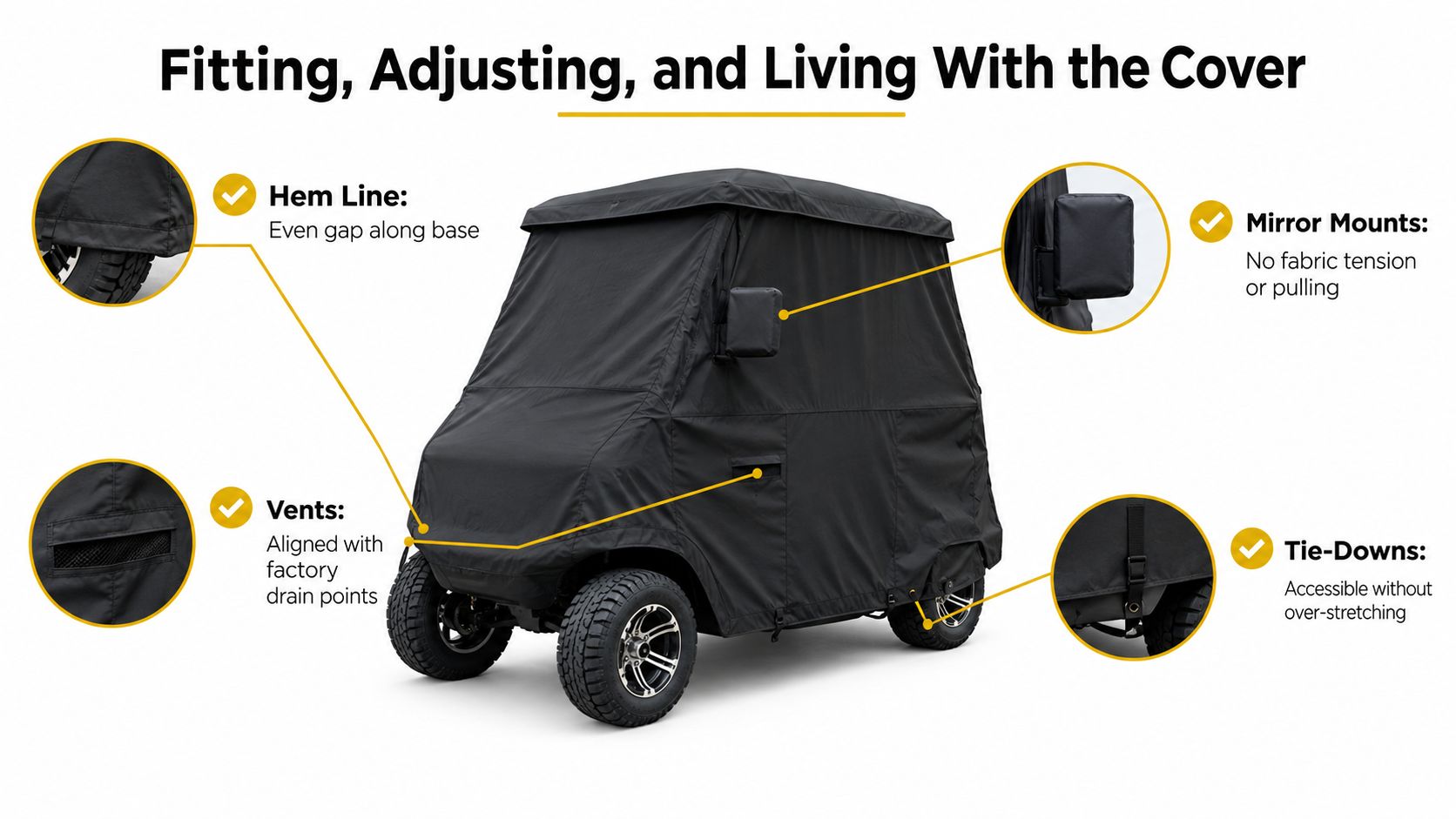
Use a dry-fit checklist
Run the zippers through their full travel. Fold and unfold the rear seat if the cover is meant to remain installed during that movement. Confirm that vents sit below the roof edge but away from direct water entry, and check that tie-downs remain reachable without stretching the fabric into a drum-tight surface.
Small adjustments can save an otherwise good cover. A foam insert inside part of the hem can remove a loose pocket. Rerouting a strap can stop it from rubbing against a painted panel. A vent can sometimes be relocated or shielded with a mesh backing if the original position faces wind-driven rain.
A properly fitted cover stays quiet because it has no large unsupported spans. It also leaves room for normal material movement. Excessive tightness is not a sign of quality. It transfers load to zippers, stitching, mirror patches, and elastic, especially when the cart is exposed to wind.
Watch for early warning signs during ownership:
- Water pooling: A low roof section or loose span is holding water instead of shedding it.
- Paint abrasion: Dirt trapped beneath a moving panel is acting like an abrasive.
- Stretched stitching: The seam is carrying tension that the pattern should have distributed.
- Flutter gaps: Wind is entering around the wheel wells or lower hem.
- Difficult removal: The cover is binding on a control, mirror, hinge, or accessory.
Fold the cover with the coated side protected from rough surfaces and store it dry when the cart is in use. Don't pack away a wet cover and expect ventilation to solve the problem later. Before each installation, shake off grit and inspect the hem, vents, zippers, and mirror areas.
See the fitting principles in motion before putting a new cover into service:
Pre-Order Checklist and Ownership Mindset
Use these gates before paying a deposit. A “no” answer does not automatically stop the order, but it identifies a detail that must be settled in writing.
- Roof envelope verified: Are the roof length, front-to-back run, overhang, and tallest mounted equipment recorded?
- Overall width verified: Did you measure the widest tire or body point, not just the roof?
- Lift noted: Is the suspension height and resulting body envelope documented?
- Brush guard included: Does the sketch show the guard, bumper, winch, and front-mounted lights?
- Rear seating recorded: Has the maker seen the rear seat, backrest, cargo platform, and folding positions?
- Mirror geometry supplied: Are mirror width, height, mount position, and projection shown in photographs?
- Windshield movement checked: Does the pattern clear the windshield in every required position?
- Fabric selected: Are the face fabric, backing, coating, thread, binding, and component specifications identified?
- Water test confirmed: Has the supplier stated the hydrostatic test method and finished-cover target?
- UV performance documented: Is the accelerated-weathering method and retained-performance requirement written down?
- Vent placement approved: Are vents protected from direct rain while still supporting air movement?
- Tie-down points mapped: Can you secure the cover without stretching the fabric or touching painted surfaces?
- Prototype or sample reviewed: Have you examined the material and, where needed, tested the pattern on the actual cart?
- Correction terms agreed: Do the warranty, revision, alteration, replacement, and return terms address a fit failure?
- Production timing recorded: Are expected completion and delivery timings included in the order documentation?
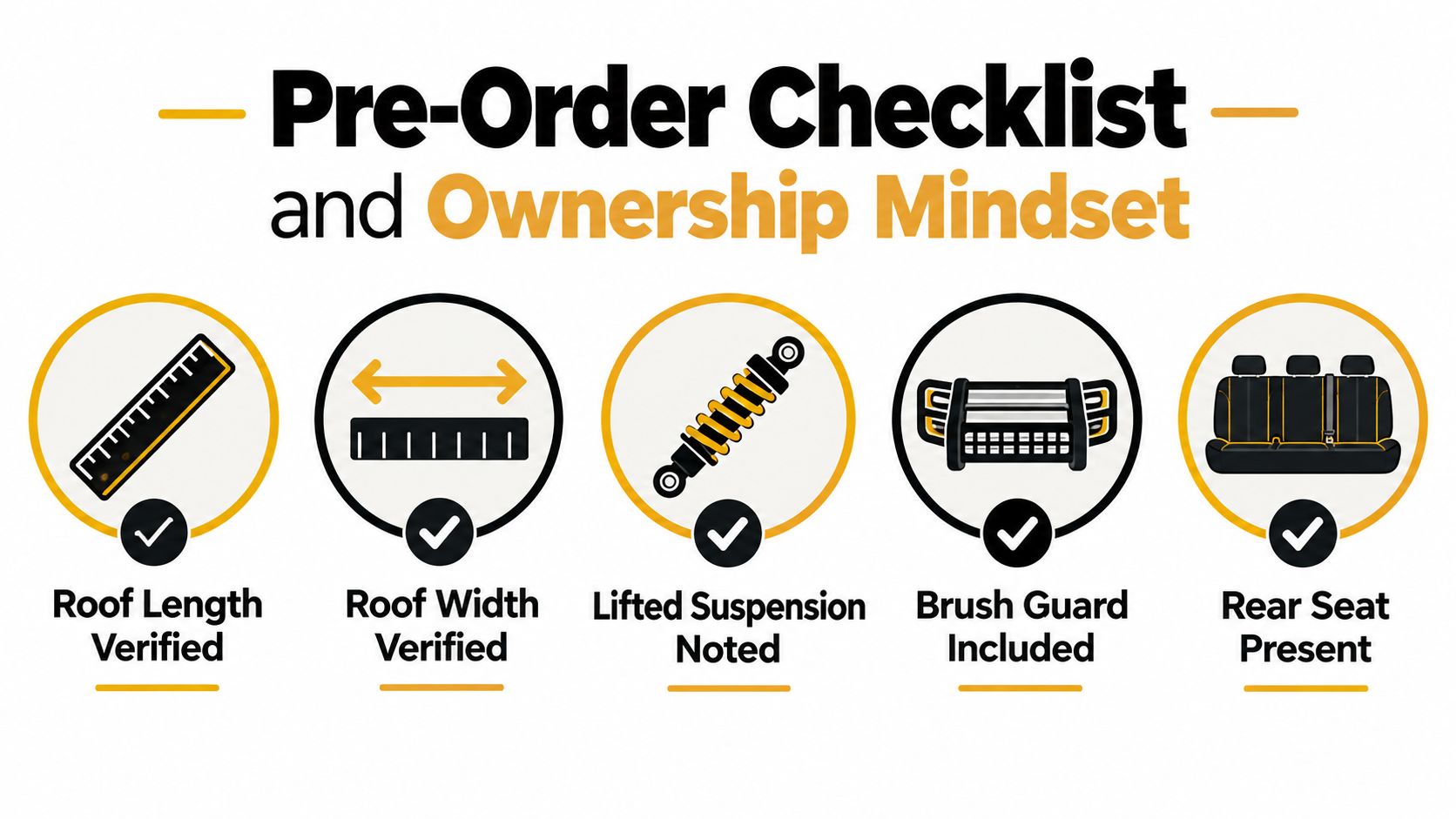
The ownership mindset matters more than a color or logo. A cover protects the seats, body finish, glass, controls, and interior from the conditions the cart faces while parked. Record it in the same maintenance ledger as batteries, tires, charging equipment, and seat repairs.
Customization is becoming a larger part of how buyers view golf carts. A separate estimate from the same publisher reports that 62% of golf-cart purchasers selected some form of customization in 2024–2025, compared with 38% five years earlier, a 24-percentage-point increase in the share choosing customization. The estimate covers golf-cart customization broadly, not covers alone, so use it as an indicator rather than a definitive global penetration rate. (Customization market estimate)
A custom cover is a visual choice and a fitted protection component. Measure twice, specify once, and reject any order that depends on unspoken assumptions.
Solana EV offers premium electric vehicles for neighborhood, resort, campus, and recreational use, including models that need accessories matched to their actual configuration. Review the vehicle lineup and connect with Solana EV before finalizing a cover specification.