
A purchase order is ready, the business needs the goods, and someone says the supplier still isn't active in the system. Finance is waiting for banking details. Legal hasn't approved the contract. Procurement is chasing a tax form buried in an email thread, while the supplier has no idea who owns the next action. The delay looks administrative, but the underlying problem is usually governance.
A reliable supplier onboarding process treats every new supplier as a risk, data, and operational-readiness decision. It determines whether the supplier can be verified, approved, paid, monitored, and used without creating duplicate records or bypassing compliance controls.
Table of Contents
- Why Supplier Onboarding Breaks and What Good Looks Like
- What to Prepare Before You Invite a Supplier
- The End to End Supplier Onboarding Workflow in Action
- How Portals and Automation Cut Cost and Cycle Time
- Timelines KPIs and Pitfalls That Derail Onboarding
- Putting Your Supplier Onboarding Process Into Practice
Why Supplier Onboarding Breaks and What Good Looks Like
Supplier onboarding often breaks because organizations confuse supplier setup with end-to-end approval. An APQC benchmark cited across 3,047 companies reports a median of 3.0 calendar days to set up a supplier in the procurement system, but that narrow task doesn't include the full journey. A benchmark summary of supplier onboarding cycle times explains that broader onboarding includes due diligence, document collection, compliance checks, contract setup, and master-data entry.
That distinction matters in practice. In a 2021 HICX survey, 63% of respondents reported averaging 15 to 28 days to onboard a new supplier, while 31% averaged 29 to 60 days, and only 5% completed onboarding in 14 days or less. These figures describe materially different workflows, not a contradiction. A supplier may be created quickly in an ERP while remaining unable to transact because required checks, approvals, or documents are incomplete.
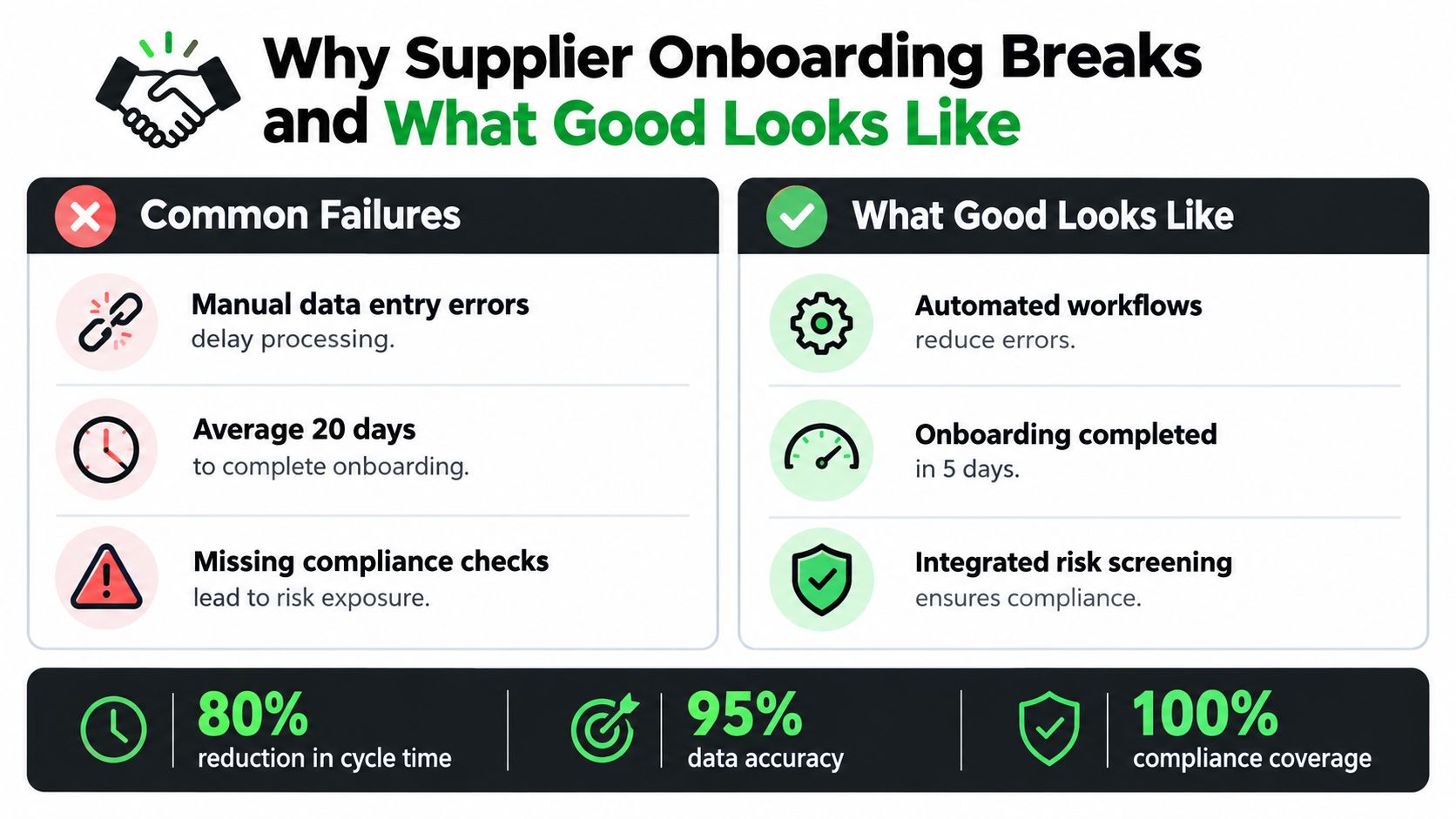
The delay usually sits between teams
The supplier rarely experiences your organizational chart as separate departments. They experience one process, and every unclear handoff feels like the same company asking for the same information again.
Procurement may own the relationship, Legal may own contract language, Finance may own tax and payment validation, and Compliance or Security may own risk screening. If nobody owns the overall case, each team completes its own task without managing the total elapsed time.
Practical rule: One person should own the supplier record from request through activation, even when several functions approve individual gates.
Good onboarding produces more than a completed form. It creates a verified supplier identity, a clean master-data record, an approved commercial relationship, and a documented basis for future monitoring. The supplier can then receive purchase orders, submit invoices, and receive payment without informal workarounds.
For teams managing international vendors, the same logic applies to cross-border supplier management for SMEs, where geographic complexity makes ownership, documentation, and visibility harder to coordinate.
The strongest operating model separates speed from risk. A low-risk supplier with a straightforward scope should not face the same review path as a supplier handling sensitive data, regulated goods, or operations in a higher-risk jurisdiction. At the same time, no supplier should bypass identity, banking, sanctions, or approved-list controls because a business stakeholder needs an urgent purchase.
What to Prepare Before You Invite a Supplier
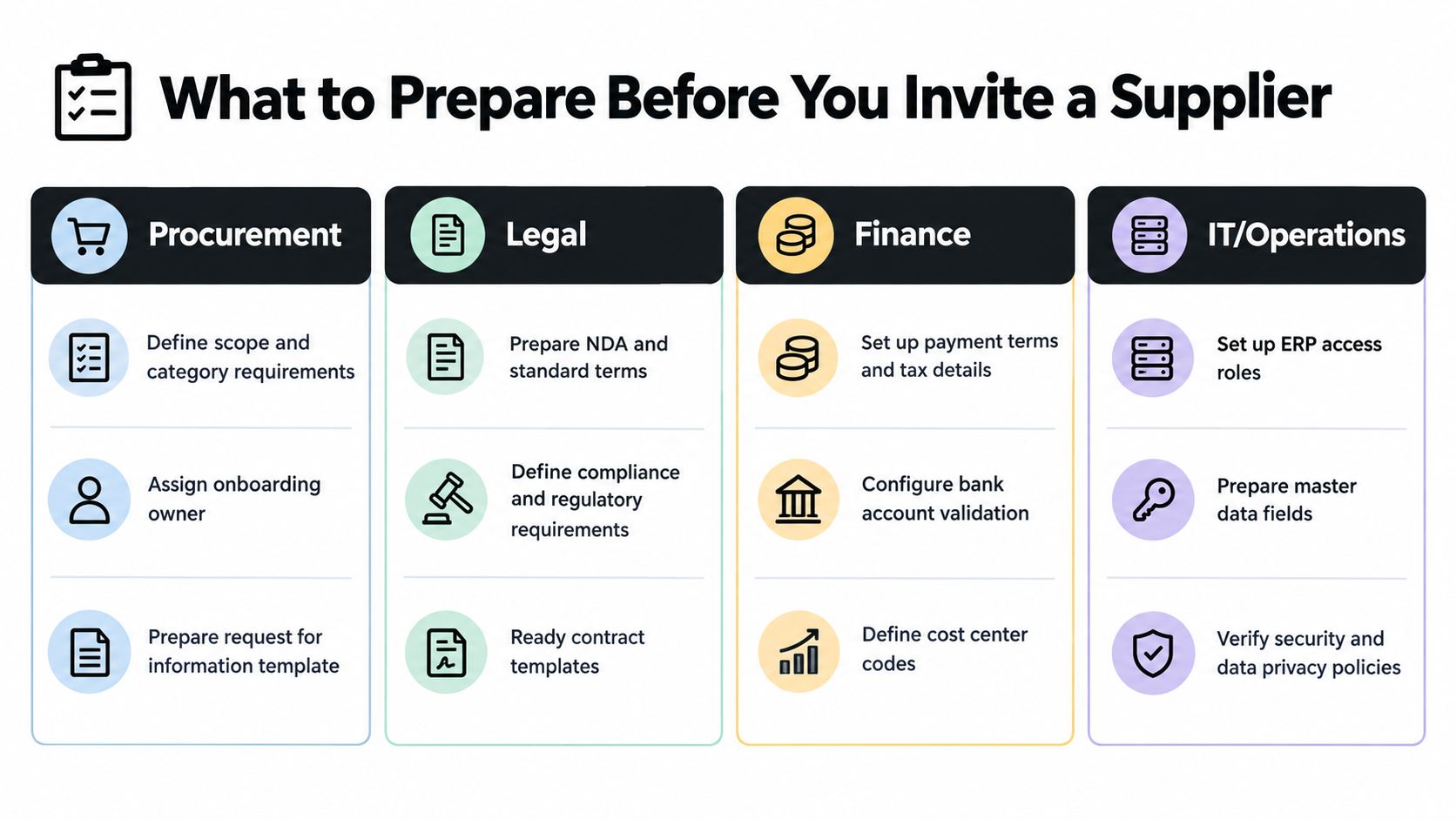
Most onboarding delays are designed into the process before the supplier receives an invitation. If the internal team hasn't agreed on required fields, approval thresholds, document standards, and ownership, the supplier becomes the testing ground for unresolved policy questions.
Start with an intake record that captures the business reason for the supplier, requested category, countries involved, expected transaction route, service or product scope, and internal sponsor. Add the intended payment terms, purchasing entity, cost center, and whether the supplier will access company systems, confidential information, facilities, or customer data.
Assign ownership before collecting documents
Give each function a named responsibility:
- Procurement: Owns the case, supplier communication, category fit, commercial scope, and approved-supplier-list decision.
- Legal: Reviews the NDA, master agreement, service terms, liability language, and regulatory obligations.
- Finance: Validates tax information, banking details, payment terms, invoice requirements, and accounting treatment.
- Compliance or Security: Performs sanctions, anti-money-laundering, data protection, cybersecurity, and other risk checks where relevant.
- IT or Operations: Creates access roles, confirms technical requirements, and maps the supplier record into operating systems.
Define an escalation path for each handoff. A supplier shouldn't have to guess whether a missing insurance certificate belongs with Procurement or Legal, and internal reviewers shouldn't wait indefinitely because the workflow doesn't show who is accountable.
Build a risk-tiered checklist
Use one common core and add requirements by risk. The core should cover legal entity details, tax information, banking data, contact ownership, insurance where applicable, contract status, and screening outcomes.
A higher-risk path may require deeper financial review, enhanced ownership information, security evidence, trade documentation, site validation, or senior approval. The point isn't to make every supplier complete the longest checklist. The point is to make the reason for additional diligence visible and consistent.
Prepare reusable templates before outreach:
- A supplier invitation with clear instructions and a named contact.
- A secure information request form with mandatory fields and validation.
- A document matrix showing what is required, optional, expired, or rejected.
- Standard NDA, master agreement, purchase terms, and compliance acknowledgments.
- An internal approval record that captures decisions and exceptions.
If the supplier operates across borders, document which entity will contract, which entity will pay, what tax forms apply, and which jurisdictional checks are required. For a specialized sourcing example, teams working with electric vehicle parts suppliers should align technical specifications, quality evidence, delivery expectations, and traceability requirements before inviting vendors into the workflow.
The End to End Supplier Onboarding Workflow in Action
A workable workflow has explicit gates. The supplier moves forward only when the current gate is complete, and every exception has an owner, reason, and expiration or remediation path.
1. Create the request and send a controlled invitation
The internal sponsor submits the intake request. Procurement checks that the business need is legitimate, confirms the supplier isn't already present under another name, and assigns the onboarding owner.
The invitation should direct the supplier to a secure portal or controlled form. It should explain the information required, acceptable document formats, contact details, expected response behavior, and what happens after submission. Avoid sending a long, unstructured list of attachments by email. That approach makes version control and completeness difficult.
2. Collect supplier identity and transaction data
The supplier submits its legal name, registered address, tax information, ownership details where required, contacts, product or service scope, insurance evidence, certifications, and banking information. The form should separate legal identity from operational contacts, because the entity that signs the contract may not be the team that fulfills orders.
Banking information deserves special handling. Validate the account through an approved method, compare the account holder with the legal entity, and use a controlled callback or verification procedure for changes. Never treat an emailed bank letter as sufficient proof when the payment destination can be altered without independent verification.
3. Perform first-pass validation
Validation should happen before human reviewers spend time on incomplete records. Check mandatory fields, tax identifier formats, document dates, legal-name consistency, duplicate candidates, and banking mismatches.
The first-pass result should be clear. The record is either complete enough to review, returned to the supplier with specific corrections, or escalated because the data conflicts with existing records. A generic “please provide more information” message creates another cycle of delay.
4. Complete risk screening before activation
Compliance reviews the supplier against the organization's applicable requirements. That can include sanctions screening, ownership checks, anti-money-laundering review, security assessment, insurance validation, trade controls, and category-specific requirements.
OFAC/SDN or equivalent screening must occur before activation when applicable. A supplier with unresolved screening results shouldn't be placed on the approved supplier list merely because a purchase is urgent. Document the result, reviewer, date, source used, and disposition of any potential match.
5. Negotiate and sign the commercial framework
Legal and Procurement finalize the NDA, master agreement, statement of work, service levels, pricing, delivery terms, payment terms, confidentiality, data obligations, audit rights, termination rights, and compliance commitments as relevant to the relationship.
Vague business expectations become enforceable operating rules. If the supplier will provide recurring services, define how performance issues are reported and escalated. If the supplier will handle personal or confidential data, align the contract with the security and privacy review instead of treating those checks as separate paperwork.
6. Approve the record and activate the supplier
Finance confirms the payment setup. Procurement confirms the supplier is approved. IT or the ERP administrator creates or updates the master-data record, applies the correct purchasing entities and payment settings, and grants only necessary access.
The final gate is the approved-supplier-list control. Buyers and requisitioners should be able to transact only with verified, approved records. If users can create vendors directly in the ERP or bypass the approval workflow, duplicate records and uncontrolled payment data will return.
Activation standard: No purchase order, invoice route, or system access should be released until identity, banking, screening, contract, and approval gates show a documented pass.
How Portals and Automation Cut Cost and Cycle Time
Email and spreadsheets feel flexible, but they move work into hidden queues. A supplier sends a document to one employee, Finance stores a different copy, Legal requests a replacement, and nobody has a single view of what remains open. Manual rekeying then introduces errors when the same legal name, tax information, or bank detail is entered into multiple systems.
A supplier portal changes the starting point. The supplier enters its own information once, sees the outstanding requirements, uploads documents against specific fields, and receives structured requests for correction. Procurement can see status without searching inboxes, while reviewers work from the same record.
Automation should remove rework, not judgment
Useful automation handles repetitive control work:
- Field validation: Flags missing values, invalid formats, and inconsistent entries before submission.
- Duplicate detection: Compares legal names, tax identifiers, addresses, and existing records before a new supplier is created.
- Document controls: Tracks expiry dates, missing files, rejected versions, and required approvals.
- Workflow routing: Sends tax and banking tasks to Finance, contracts to Legal, and risk reviews to the right control owner.
- Screening support: Runs required checks before activation and records the outcome for audit review.
- ERP integration: Transfers an approved master record instead of forcing an administrator to re-enter it.
Automation doesn't eliminate judgment. A potential sanctions match, unusual ownership structure, or inconsistent banking record still needs a qualified reviewer. The system should make that judgment easier to perform and easier to prove later.

Compare the economics honestly
One independent source states that manual onboarding can cost up to $35,000 per supplier, while automated onboarding can reduce that cost to about $2,400 or less. The same supplier onboarding metrics analysis reports that U.S. companies may spend around $12,000 onboarding domestic suppliers and up to $50,000 for APAC-based vendors.
Those figures aren't a universal business case. They show why scope, geography, risk, and transaction complexity should shape the investment decision. A small organization with infrequent, low-risk suppliers may start with controlled forms, shared ownership, and a central register. A global enterprise managing many entities needs stronger workflow, identity validation, audit history, and ERP integration.
The best tool isn't the one with the longest feature list. It's the one suppliers will use, reviewers can trust, and Finance can reconcile with the system of record. Teams evaluating the broader economics can also review this guide on how to reduce operational costs for process-level cost considerations.
Timelines KPIs and Pitfalls That Derail Onboarding
Cycle time is a useful measure only when the clock starts and stops consistently. Start at the approved internal request or supplier invitation, then stop when the supplier is fully approved, activated, and available for legitimate transactions. Don't stop when a legal record is created if the supplier still can't receive a purchase order.
The benchmark range is wide. The APQC and HICX data cited earlier shows why managers should separate basic system setup from full onboarding rather than publish one misleading average. Use risk tiers to set expectations, but don't publish invented “industry standard” targets that ignore your own approval model.
Use a small control dashboard
| KPI | What It Measures | Healthy Target |
|---|---|---|
| End-to-end cycle time | Elapsed time from approved request to transactable supplier | A defined target by risk tier, reviewed against internal baseline |
| First-pass yield | Records accepted without correction or resubmission | A rising trend, with rejection reasons categorized |
| Duplicate rate | New records rejected or merged because a supplier already existed | A declining trend toward zero uncontrolled duplicates |
| Time to first purchase order | Time from activation to the first legitimate transaction | A declining trend, excluding cases with no immediate demand |
| Supplier response time | Time suppliers take to submit or correct information | A defined response window with automated reminders |
| Internal queue time | Time waiting with Procurement, Legal, Finance, or Compliance | A named owner and escalation threshold for every queue |
The table's healthy targets should come from your own baseline, risk appetite, and service commitments. A target without an owner is only an aspiration.
Fix the failure points at their source
Supplier non-responsiveness needs deadlines, reminders, and escalation. Send a clear request, identify the missing items, state the consequence of inactivity, and route stalled cases to the internal sponsor for a decision to continue, pause, or close.
Unclear ownership requires a case owner and a RACI-style responsibility map. The supplier should have one contact for status questions, even when several specialists perform reviews.
Incomplete or inaccurate data calls for mandatory fields, validation rules, and specific rejection reasons. A vendor onboarding survey source reports that 52% of organizations identified compliance risks as a major challenge, while 45% reported long cycle times associated with waiting for tax forms, banking details, approvals, and sanctions screening.
Uncontrolled vendor creation needs a hard system gate. Users should request a supplier through the governed workflow, and only approved records should be available for purchasing and payment.
Weak risk assessment creates especially long delays for complex suppliers. The same source notes that high-risk suppliers can take up to 50 days without formal risk assessment. Risk-tiering early prevents teams from discovering late in the process that a supplier requires additional review.
Putting Your Supplier Onboarding Process Into Practice
Start with three moves, in this order.
First, standardize intake. Create one request form, one supplier-facing checklist, one owner, and one definition of “ready for review.” This removes ambiguity before automation enters the picture.
Second, enforce the control gates. Validate tax and banking information on the first pass, complete sanctions screening before activation, check for duplicate records, and block purchasing outside the approved supplier list. These controls protect payment data and master-data quality while keeping exceptions visible.
Third, pilot a portal and workflow with a supplier group that has enough repetition to expose problems but isn't the most complex category in the business. Measure correction reasons, queue time, supplier response time, and activation readiness. Fix the process before expanding the technology footprint.
Build the next 90 days around evidence
- First 30 days: Map the current workflow, assign owners, document required fields, and classify suppliers by risk.
- By 60 days: Introduce controlled intake, validation gates, escalation rules, and a weekly KPI review.
- By 90 days: Launch the portal pilot, integrate approved data with the ERP where practical, and establish recurring reviews for sanctions, trade, tax, insurance, ESG, and security obligations.
Initial approval is only the beginning for suppliers with changing risk profiles. Recent industry commentary highlights that visibility often stops at Tier 1, while tracing origin requires structured master data and upstream validation. The dealer onboarding process offers a useful example of why partner readiness should include support, responsibilities, and operating access beyond a signed form.
You'll know the process is working when buyers stop creating workarounds, reviewers can see exactly what they own, suppliers receive fewer repeated requests, payment holds become easier to explain, and approved records remain trustworthy after activation.
Solana EV supports dealer partners with onboarding, training, marketing resources, a 24/7 parts portal, technical assistance, and dealer floor-plan financing through Dealer Direct. If you're assessing how a structured partner onboarding model should work for an electric mobility network, visit Solana EV to review the vehicles and dealer partnership options.