
You've found a wheel package that looks perfect for your golf cart. The diameter is larger, the spokes fill the fenders, and the tire looks ready for the street. Then the cart turns into a driveway and the tire rubs the fender, the steering feels heavier, or the total vehicle height no longer matches the setup you intended.
That problem usually isn't caused by the wheel alone. A proper wheel golf cart fitment depends on the rim, tire, hub, suspension, fender clearance, intended terrain, and legal status working together. The right package for a turf cart may be wrong for a neighborhood LSV, even when both vehicles use the same basic four-wheel layout.
Table of Contents
- Why Your Golf Cart Wheel Choice Matters More Than You Think
- What Counts as a Golf Cart Wheel and What Actually Fits
- Common Wheel Sizes and What Each One Is Built For
- Wheel Materials Compared for Real-World Use
- Off-Road Wheels Versus Street-Legal Wheel Setups
- Matching Wheels to Your Solana EV Cart Model
- Installing and Maintaining Cart Wheels the Right Way
- Bringing It All Together for the Right Wheel Decision
Why Your Golf Cart Wheel Choice Matters More Than You Think
A buyer once chose a 14-inch package for a street-oriented Solana EV, expecting a sharper stance without changing how the cart operated. The rim diameter looked suitable on the order sheet. After installation, the complete package told a different story. The taller tire and altered backspacing pushed the tires farther outward and expanded the vehicle's overall envelope beyond the intended LSV setup. The wheels and tires needed to be refitted as a matched system.
That service-counter mistake is common. Wheel size is only one measurement. A wheel may bolt to the hub and still create problems if the tire rubs the fender, the sidewall touches a steering component, or the offset moves the contact patch too far outward.
The real effects of a poor fit
Backspacing and offset control where the tire sits relative to the suspension and fender. A small change can create inboard contact with suspension parts or outboard contact with the body. Steering lock and suspension compression expose those clearance problems quickly, leading to rubbing, damaged sidewalls, or reduced steering travel.
Tire height also changes the cart's operating characteristics. Taller tires, especially on a lifted cart, can raise the center of gravity and suit an all-terrain build while making a street cart less predictable. Added unsprung weight asks more from the suspension. An aggressive or unsuitable tread can bring more noise, rolling resistance, and braking demand.
Street use requires a separate check. Under U.S. federal low-speed vehicle regulations, a four-wheeled vehicle capable of more than 20 mph but not more than 25 mph falls into the LSV category and must meet requirements associated with FMVSS 500. Those requirements cover equipment such as lights, mirrors, seat belts, a windshield, a parking brake, and a VIN. A wheel and tire change does not by itself set the vehicle's classification, but it can alter the operating envelope and make the complete setup unsuitable for its intended street use.
Practical rule: Choose the tire and wheel package for the cart's job first. Choose the finish and spoke design second.
A turf cart needs low ground disturbance and dependable clearance. A neighborhood LSV needs controlled height, stable handling, and compliant equipment. A trail cart needs clearance and traction, while a utility cart needs load capacity and durable construction. Diameter, tire height, width, backspacing, offset, and bolt pattern must support that use together, or the package becomes a repair problem instead of a useful upgrade.
What Counts as a Golf Cart Wheel and What Actually Fits
A wheel is the metal rim, while a tire is the rubber mounted to it. Sellers often package both together, but fitment depends on separate checks. The wheel must attach securely to the hub. The tire must clear the body, suspension, steering linkage, and ground through the cart's full range of movement.
A reliable fitment check uses five wheel measurements and the tire's overall height. Diameter identifies the rim size, and width shows how much space the rim occupies from side to side. Backspacing measures the distance from the mounting face to the wheel's inner lip. Offset shows where that mounting face sits relative to the wheel's centerline. Bolt pattern confirms whether the wheel matches the hub.
For many carts, including the Solana EV models described in the supplied fitment information, the bolt pattern is a 4-bolt pattern, with some models using 4×101.6mm. Verify that measurement against the specific hub. Matching the appearance of the original wheel is not enough.
The measurements that decide fit
| Variable | What It Controls | Consequence If Wrong |
|---|---|---|
| Diameter | Rim size and tire sidewall space | Incorrect brake clearance or unsuitable tire profile |
| Width | How much wheel and tire occupy laterally | Fender or suspension contact |
| Backspacing | Inboard position from the hub | Rubbing against suspension or steering parts |
| Offset | Inboard or outboard wheel position | Changed stance, scrub, or fender clearance |
| Bolt pattern | Hub-to-wheel attachment | Wheel won't mount safely if mismatched |
| Tire overall height | Ground clearance and total vehicle height | Altered gearing, handling, and possible LSV concerns |
How a poor fit affects performance
Tire height deserves close attention. Two tires mounted on the same diameter wheel can create different overall heights. A taller tire raises the cart and increases rolling circumference, which can change acceleration, braking response, and behavior on slopes. That trade-off matters differently on a street-legal cart, a turf-only cart, and an all-terrain build.
Before ordering, record the cart model, current wheel and tire measurements, bolt pattern, hub bore, brake clearance, wheel width, backspacing, offset, and tire overall height. Check clearance with the steering turned in both directions. On a lifted cart, also check with the suspension compressed. If the seller cannot confirm these measurements, do not order the package yet.
Common Wheel Sizes and What Each One Is Built For
Golf cart wheels commonly appear in 8, 10, 12, 14, and 15-inch diameters. The diameter is only the starting point, because the tire profile determines the final height and the wheel's width and offset determine how the package sits under the cart.
| Diameter | Best Use Case | Notes |
|---|---|---|
| 8-inch | Turf, golf-course paths, stock replacement | Low rolling resistance and generous fender clearance |
| 10-inch | Mild street upgrade | Slight ride-height increase without automatically requiring a lift |
| 12-inch | Neighborhood LSV use | Good balance when paired with a controlled tire profile |
| 14-inch | Lifted carts and off-road use | Often paired with all-terrain tires and more outward offset |
| 15-inch | Show builds and demanding trails | Requires careful lift and fender-clearance inspection |
Why the smallest package still works
An 8-inch setup remains the sensible choice for turf and course work. The smaller rim leaves more sidewall for cushioning and typically preserves the original clearance envelope. It also avoids turning a utility decision into a styling project that adds unnecessary weight or rolling resistance.
A 10-inch wheel is a common street-oriented step up. It can sharpen the appearance and provide a modest change in ride height, but the complete tire diameter still needs checking. A 12-inch package is often the practical middle ground for a neighborhood cart, particularly when the tire remains relatively low profile.
Where larger diameters create new work
Fourteen-inch wheels suit lifted carts, rough pavement, ranch roads, and trail-oriented builds. They're also popular for appearance, which is why a 14-inch golf cart wheel and tire package can look right while still being mechanically wrong if the tire is too tall or the offset is too aggressive.
Fifteen-inch wheels need the most scrutiny. The larger rim leaves less sidewall, and the associated tire packages can create clearance issues at full steering lock or suspension compression. A size jump can also change the required backspacing, hub-centric fit, and effective gearing. Don't order by diameter alone. Order by the complete wheel, tire, and vehicle combination.
Wheel Materials Compared for Real-World Use
Material affects more than appearance. It changes unsprung weight, impact behavior, corrosion maintenance, and replacement cost. The best choice depends on whether the cart spends its life on maintained turf, paved neighborhood roads, salty coastal property, or rocky trails.
| Material | Weight (relative) | Strength | Corrosion Resistance | Typical Price |
|---|---|---|---|---|
| Steel | Heaviest | Dent-resistant and practical | Vulnerable where coating is damaged | Lower |
| Aluminum alloy | Lighter than steel | Strong but less forgiving of severe impacts | Generally good with proper finish care | Medium to higher |
| Composite | Light to moderate | Impact-tolerant in suitable applications | Generally resistant to rust | Higher and less commonly stocked |
Steel for utility and controlled budgets
Steel wheels are inexpensive, easy to replace, and less likely to crack from an ordinary impact. That makes them useful on utility carts and work vehicles, especially where a dented wheel is more likely than a cosmetic concern.
The drawback is mass. Extra unsprung weight can make acceleration feel less responsive and asks more from the suspension. Steel also rusts once a chip or scrape breaks through the protective coating, a concern for carts used near salt air or wet storage areas.
Aluminum alloy for paved use
Aluminum alloy wheels reduce weight compared with steel and offer good corrosion resistance when the finish remains intact. They're a natural fit for street-oriented carts because the lighter construction can support a more responsive feel without using a heavy wheel.
Alloy isn't indestructible. A sharp trail impact can damage it differently from steel, and a polished or machined finish may require more cleaning in a coastal environment. Inspect the inner barrel and bead area, not just the visible spokes.
Composite for specialized terrain
Composite wheels occupy a narrower part of the market. They can offer a useful combination of lower weight and impact tolerance, but availability and replacement options may be limited. That matters for a resort or commercial fleet, where downtime and parts consistency often matter more than a unique material choice.
For a broad range of styles and applications, custom wheels for golf carts should still be evaluated by load rating, finish, and serviceability. A wheel that looks ideal but has an uncertain replacement path is a poor fleet choice.
Off-Road Wheels Versus Street-Legal Wheel Setups
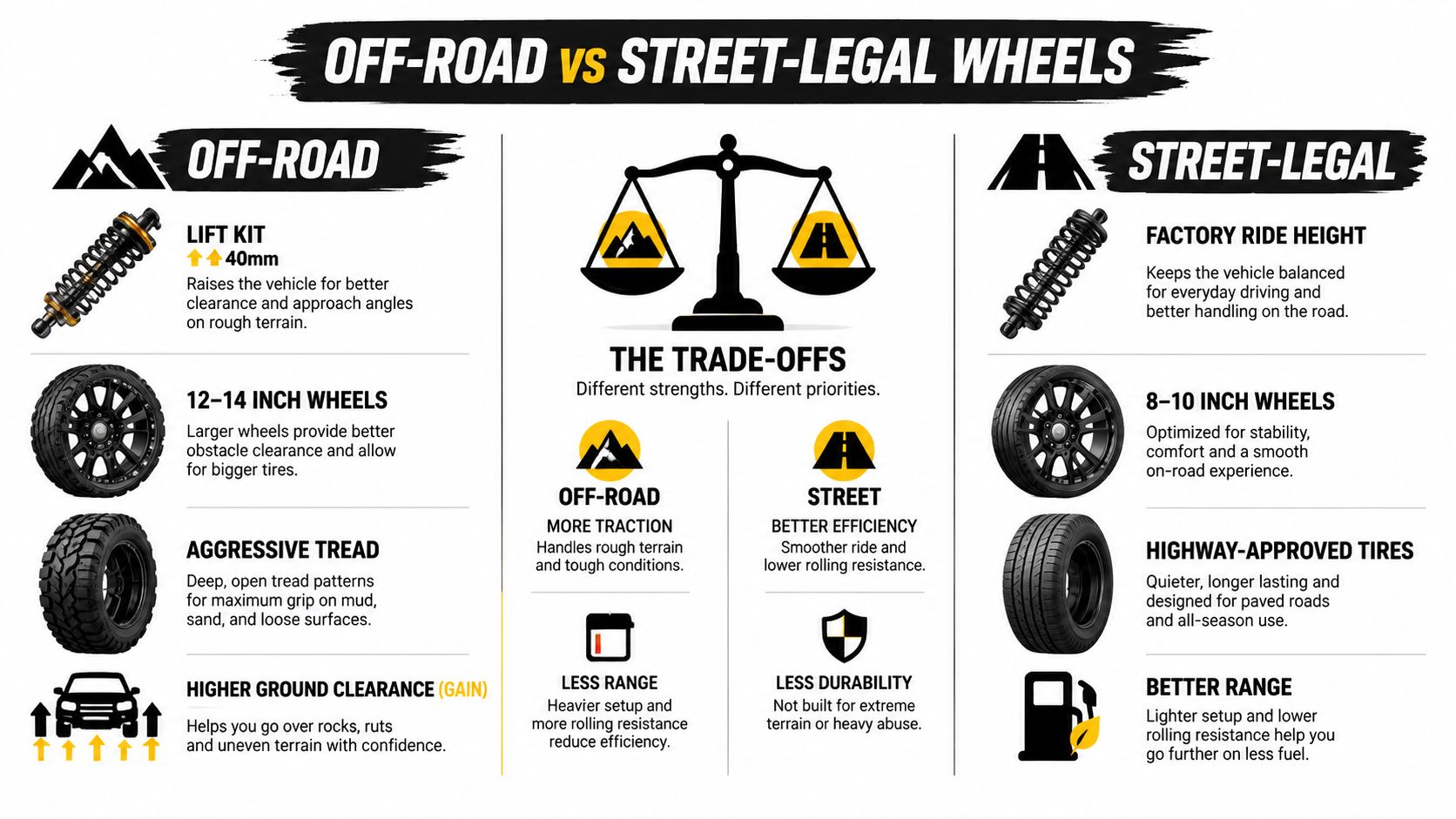
A cart that works well on a trail can feel poorly controlled on pavement. Off-road and street-legal packages use the same fitment system, but each choice serves a different job. Diameter, tire height, backspacing, offset, bolt pattern, and load rating must match whether the cart is turf-only, all-terrain, or operated as a street-legal LSV.
The off-road trade-off
Off-road carts commonly combine a lift kit with larger wheels and all-terrain or knobby tires. The extra clearance helps on trails, rough pavement, ranch property, and uneven access roads. Deeper tread can maintain traction where a turf tire spins or collects debris.
The trade-off is added weight and altered steering geometry. A taller, heavier tire can reduce acceleration and make the steering feel heavier. Aggressive tread is louder and usually less comfortable on pavement. Negative offset may provide suspension clearance and a wider stance, but it moves the tire outward, increases fender exposure, and can add steering load. Check backspacing as well as offset, because the two measurements determine where the wheel sits relative to the suspension and bodywork.
The street-legal priority
A street-legal LSV setup generally stays near the cart's intended ride height and uses a measured offset. Low-profile or turf-friendly tires help preserve clearance around fenders, windshield, lights, and steering components. They also support more consistent braking and handling than an oversized trail package.
Federal LSV requirements under FMVSS 500 classify a four-wheeled vehicle capable of more than 20 mph and not more than 25 mph as an LSV, with specified equipment requirements. Local rules can add restrictions, so a tire that changes the vehicle's overall envelope may create a compliance problem even when its bolt pattern fits.
A tire can fit the hub and still be wrong for the road.
Before street use, inspect the complete vehicle. Confirm tire height, steering clearance, braking behavior, lighting position, mirrors, belts, windshield, parking brake, VIN, and local registration requirements. A trail package belongs on a cart used for trails, not as a universal street upgrade.
Matching Wheels to Your Solana EV Cart Model
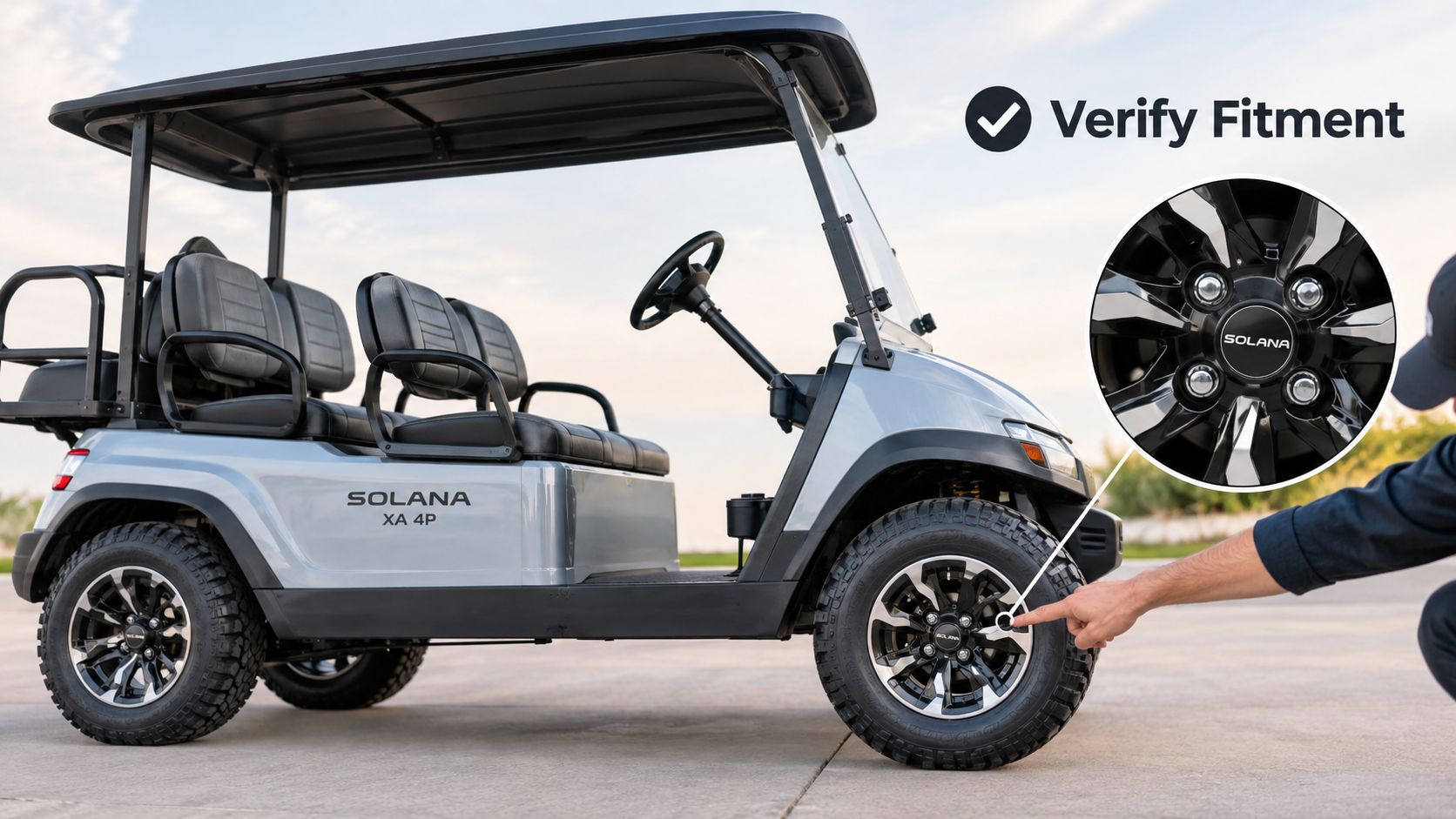
Model-specific fitment starts with the hub, not the catalog photograph. Confirm the bolt pattern, hub bore, brake arrangement, wheel width, offset, tire height, and any existing lift before selecting a finish or spoke design.
Passenger models
The XA 4P and XA 6P passenger platforms share a four-bolt arrangement and can accept smaller wheel packages without a lift when the tire height and clearance remain within the intended range. Moving beyond that range can require a lift or spindle change to preserve steering geometry and prevent contact during compression.
Passenger load matters here. A setup that clears an empty cart may rub once people are seated. Check the rear wheel openings, front steering lock, and suspension travel rather than relying on static clearance alone.
Utility models
F-series carts carry a different workload. Cargo, tools, and wide turf tires place greater emphasis on load rating and sidewall support. Steel wheels can make sense for a utility application because they're practical and dent-resistant, but the wheel and tire must be rated for the cart's actual operating demands.
Do not treat a passenger-cart package as a utility upgrade because the bolt pattern matches. Confirm the wheel load rating, tire load rating, sidewall construction, and clearance with the cart loaded.
The off-road platform
The G-series is the natural candidate for a larger alloy wheel and all-terrain tire combination. A 14-inch package can suit an off-road build, but the owner still needs to inspect clearance at full steering lock and full suspension compression. Lift height alone doesn't guarantee that the tire clears the spindle, steering linkage, or inner fender.
This video can help owners visualize the wheel mounting and lug area before installation:
Before ordering any wheel golf cart setup, send the dealer the exact model, current tire markings, wheel measurements, lift status, and intended use. Written confirmation is worth more than guessing from a similar-looking cart.
Installing and Maintaining Cart Wheels the Right Way
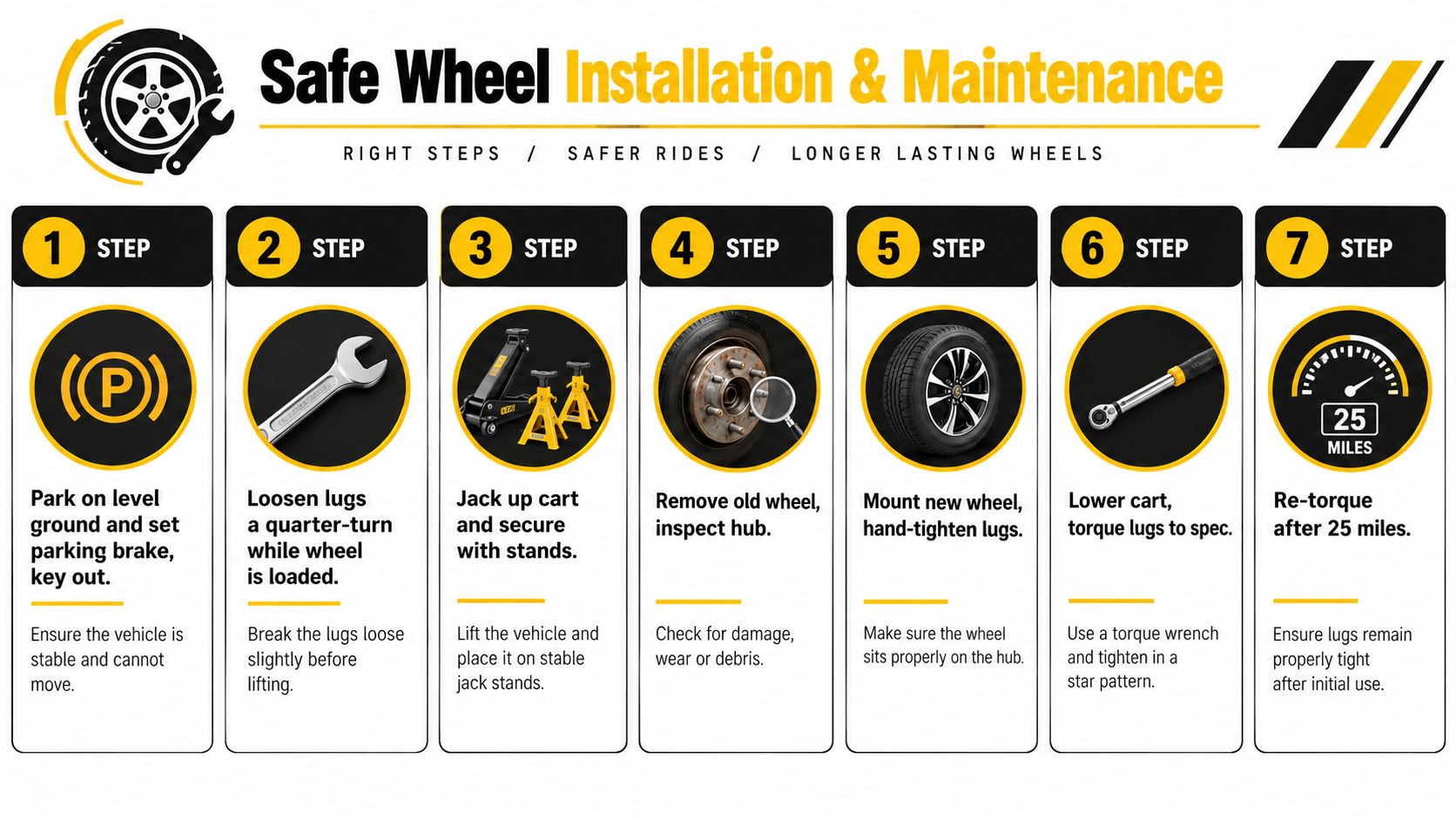
A safe installation begins before the jack moves. Park on level ground, set the parking brake, remove the key, and loosen each lug slightly while the wheel remains loaded. Use the manufacturer's lift point and secure the cart properly. Don't jack under the axle tube or floor pan unless the manufacturer specifically identifies that location.
After removing the old wheel, clean the hub mounting face and inspect the studs, lug seats, and brake area. Place the new wheel over the hub, hand-thread every lug, and stop if a nut doesn't turn smoothly by hand. Cross-threaded lugs can damage the stud and create a false sense of tightness.
The installation sequence
- Load the wheel first: Loosen lugs only slightly before lifting.
- Lift at the approved point: Support the cart with stands before working beside or beneath it.
- Inspect the mounting surfaces: Remove rust, debris, and damaged hardware.
- Seat the replacement wheel: Hand-start every lug to protect the threads.
- Torque in a star pattern: Use the wheel and cart manufacturer's specification. The supplied Solana EV service guidance identifies a typical range of 55 to 80 ft-lb for most Solana EV models.
- Recheck after use: Re-torque after the initial driving period and inspect the seating again.
The wheel should sit flush against the hub, with no rocking or visible gap. After installation, turn the steering from lock to lock and inspect the inner sidewall, tie rods, brake components, and fender edges. On a lifted cart, check clearance again with the suspension loaded and compressed.
Maintenance that catches problems early
Check tire pressure monthly and inspect the sidewalls for cracking or dry rot if the cart sits outdoors. Uneven tread wear can point to alignment problems, an unsuitable offset, incorrect pressure, or a tire that's rubbing under load.
For replacement planning, use a documented golf cart tire replacement process rather than ordering a tire by diameter alone. Before street driving, confirm that the replacement tire's overall diameter remains appropriate for the vehicle's speed, braking, clearance, and legal setup.
Bringing It All Together for the Right Wheel Decision
The right wheel package comes from four questions, answered in order.
Where will the cart run? Turf and cart paths favor smaller, lighter packages with gentle tread. Neighborhood streets call for stable, predictable tires and controlled overall height. Rough property and trails justify more sidewall, stronger protection, and clearance that won't disappear when the suspension compresses.
Is the cart operating as an LSV? If it is, the wheel and tire package must support the vehicle's intended speed, braking, visibility, and equipment envelope. The federal LSV threshold is more than 20 mph but not more than 25 mph, while state and local authorities may impose additional restrictions. Registration and street-use decisions should be confirmed locally before modifying the cart.
What does the specific model require? Verify bolt pattern, hub bore, offset, backspacing, brake clearance, wheel width, tire height, and lift status. A catalog that filters only by make and model may not account for a custom spindle, spacer, lift, or previously installed tire.
What environment will the wheel live in? Coastal salt air demands close attention to finish damage and corrosion. Rocky trails reward impact tolerance. A paved community may justify a lighter alloy package that's easier to clean and quieter in daily use.
The best wheel golf cart upgrade is the one that matches the cart's work, not the largest diameter available.
Write down those four answers, then ask a Solana EV dealer to confirm the complete fitment in writing. Budget for professional mounting, correct torque, a clearance inspection, and a post-installation recheck. That process costs less than correcting a wheel that looked right in a product photo but failed on the vehicle.
Solana EV offers electric golf carts and related parts and accessories across models such as the XA, F, and G platforms, giving buyers a starting point for matching wheels and tires to passenger, utility, neighborhood, or off-road use. Visit Solana EV with your cart model and intended terrain ready, and ask for fitment guidance before ordering.