
You've outgrown the stock wheels on your golf cart, but the online listings make every option look interchangeable. One package promises a clean street stance, another shows a lifted cart with aggressive tread, and both are labeled as 14 inch golf cart wheels tires. The problem is that the wheel diameter tells only part of the story. Tire height, sidewall profile, tread, load rating, and lift requirements determine whether the cart feels refined or awkward after the upgrade.
A 14-inch package can be an excellent middle ground, but only when the full combination matches how you drive. Use the guidance below to choose for comfort, clearance, efficiency, and capability, not just appearance.
Table of Contents
- Why 14 Inch Golf Cart Wheels Tires Are the Sweet Spot
- Decoding Tire Sizes for 14 Inch Wheels
- Fitment and Lift Kit Requirements by Tire Height
- Choosing Tires by Terrain and Use Case
- The Hidden Trade-Offs of Larger Wheel Packages
- Understanding Load Ratings and Carrying Capacity
- Building Your Ideal 14 Inch Wheel and Tire Package
Why 14 Inch Golf Cart Wheels Tires Are the Sweet Spot
The appeal of 14-inch wheels becomes obvious when a cart owner wants more presence without turning the vehicle into a harsh, oversized project. Stock utility setups can look narrow and low, while an aggressive lifted build may sacrifice easy entry, turf manners, and everyday comfort. A properly selected 14-inch package sits between those extremes.
Industry coverage identifies the mid-2010s as the point when 14-inch golf cart wheels became a mainstream upgrade category, with one source describing the market as signaling increased popularity since 2015. That same guide lists common combinations ranging from about 20 to 23 inches overall tire height, which gives buyers several distinct ways to use the same rim diameter. The 14-inch golf cart wheel and tire guide from Extreme Kartz provides the useful fitment context behind that shift.
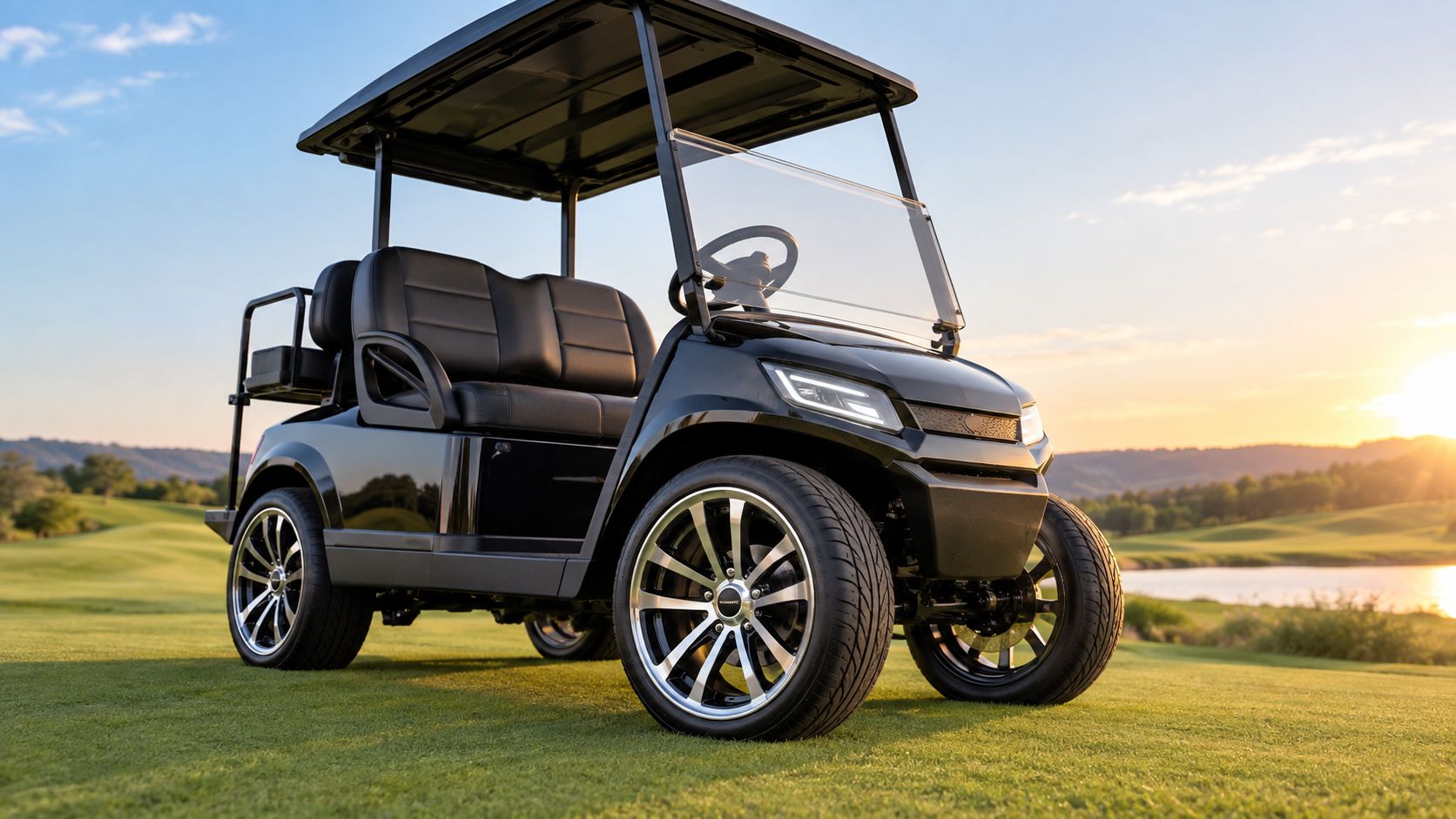
The buyer usually has three competing goals
A homeowner in a gated community may want a sharper stance but still needs the cart to turn cleanly, ride smoothly, and avoid rubbing. A resort manager may care more about turf protection and predictable handling than aggressive styling. An outdoor enthusiast may accept more noise and steering effort in exchange for clearance and traction.
The strength of the 14-inch platform is its range. A street-oriented tire can preserve a relatively composed ride, while an all-terrain or off-road tire can support a lifted recreational build. That flexibility is why a buyer comparing electric golf cart wheels should evaluate the tire package, not just the wheel finish or spoke design.
Practical rule: Choose the overall tire height first, then choose the wheel style that supports it.
The wrong approach is to select a dramatic wheel, add the largest tire that appears compatible, and discover later that the cart needs a lift, different gearing, more steering effort, or more frequent battery charging. The right approach starts with the driving environment and acceptable ride quality. Fourteen inches gives you room to make that decision without locking every build into the same low-profile or lifted formula.
Decoding Tire Sizes for 14 Inch Wheels
A 14-inch rim does not determine how the cart will drive. The tire code controls width, sidewall height, rolling circumference, and much of the package's comfort and steering behavior. In 205/40-R14, the first number, 205, is the approximate section width in millimeters. The second number, 40, is the aspect ratio, so the sidewall height equals a percentage of the tire width. The final number, 14, identifies the rim diameter in inches, and R indicates radial construction.
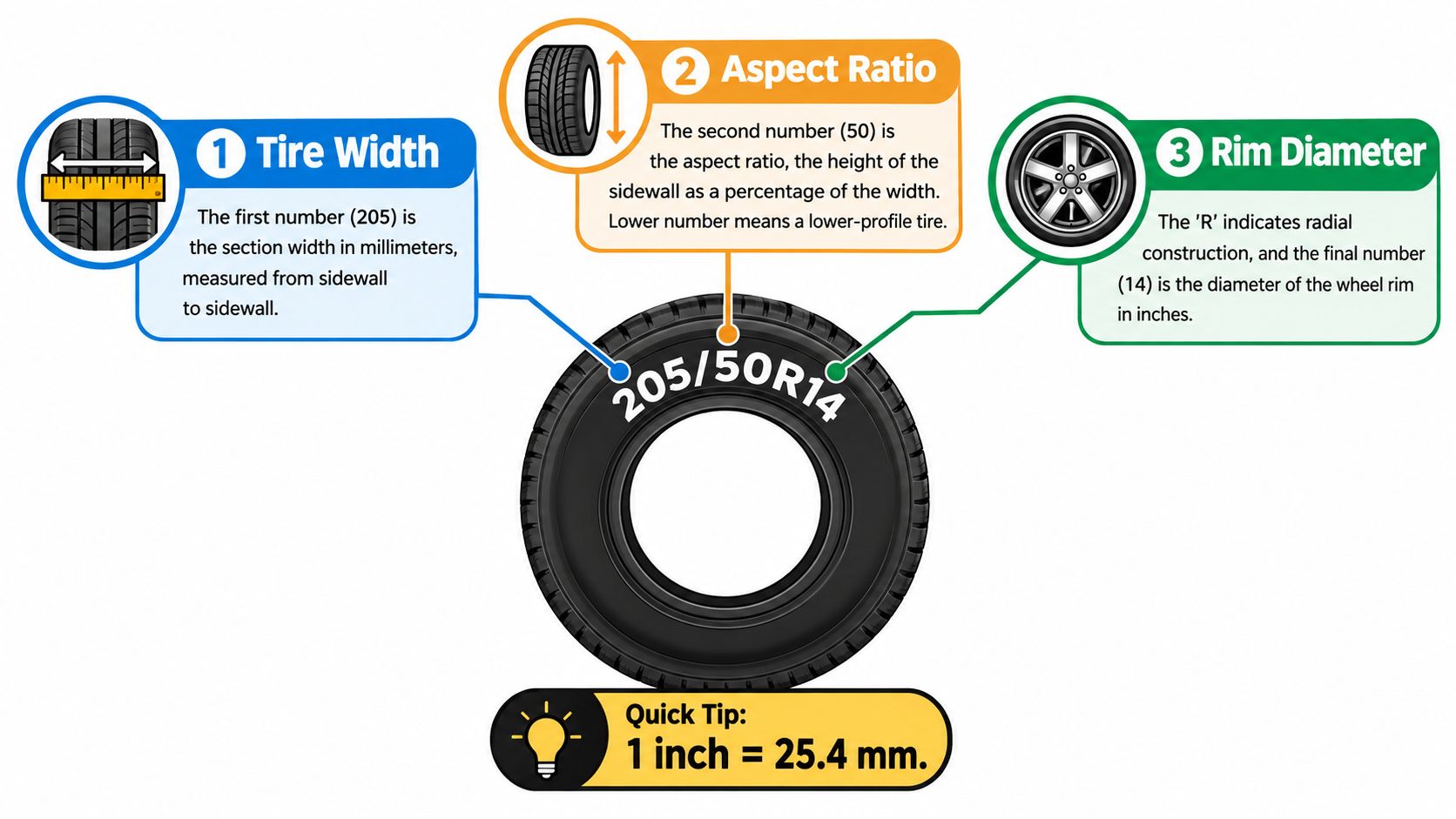
Read the code from left to right
A lower aspect-ratio number creates a shorter sidewall. That sharpens steering response and gives the cart a more automotive appearance, but leaves less rubber to absorb bumps. A higher aspect ratio adds sidewall flex and can make broken pavement more comfortable when the wheel and tire are matched correctly.
Metric and flotation-style formats present the measurements differently. In 225/40-R14, 225 describes width, 40 describes sidewall proportion, and 14 confirms the rim diameter. In 23×10-14, the first number indicates an overall height of about 23 inches, the second indicates a width of about 10 inches, and the final number confirms a 14-inch rim.
For a deeper walkthrough of sidewall codes, see our golf cart tire size guide.
Common 14-inch combinations include 205/30-14, 205/40-14, 215/35-14, 225/30-14, 20×8-14, 20×8.5-14, 22×10-14, and 23×10-14, as summarized in this golf cart wheel size explanation. A 205/30-14 and a 23×10-14 both mount to the same rim, but the second raises the rolling circumference by roughly four inches, which changes gearing and clearance.
Width and height affect different parts of the cart
Width influences side clearance, steering effort, and the chance of contact with suspension or bodywork. Height affects fender clearance, rolling circumference, effective gearing, and lift requirements. A 14-inch rim alone does not answer the fitment question.
Before ordering, verify:
- Rim diameter: The final tire number must match the wheel diameter.
- Overall height: Compare advertised height with fender and suspension clearance.
- Section width: Check inner clearance and outer body clearance.
- Construction: Match radial, turf, all-terrain, or off-road construction to the surface.
- Load index: Confirm the rating supports the cart, passengers, and cargo.
A listing that says “14-inch tire” confirms only the rim interface. It does not confirm clearance, steering feel, or the comfort you expect.
Fitment and Lift Kit Requirements by Tire Height
Overall tire height is the fitment decision that causes the most expensive mistakes. The same 14-inch rim can support a compact street tire near 19 inches tall or a much larger off-road combination. Those packages place very different demands on the body, suspension, steering, and drivetrain.
A 20×8.5-14 tire is about 20 inches tall and can fit many carts without a lift. By contrast, a 23×10-14 tire is about 23 inches tall and typically requires a 5-inch or 6-inch lift kit for proper clearance, according to Extreme Kartz's fitment guide for 14-inch rims and tires.
| Tire Size | Overall Height | Lift Kit Required |
|---|---|---|
| 20×8.5-14 | About 20 inches | Often no lift on many carts |
| 23×10-14 | About 23 inches | Typically a 5-inch or 6-inch lift |
| 26×12-14 | About 26 inches | Requires a substantial lifted off-road build |
The 26×12-14 example belongs to a more demanding off-road category. Golf Cart Tire Supply's wheel size guide identifies it as a combination that can reach 26 inches tall, which makes it inappropriate for a casual bolt-on upgrade.
Clearance involves more than the parked cart
A tire may appear clear while the cart is sitting still and still contact the body during steering or suspension compression. Check the front wheel wells at full steering lock, the rear fender area, and the space around shocks, leaf springs, and other suspension components. A wider tire can create interference even when its height seems manageable.
A lift kit isn't merely a styling accessory. It changes suspension geometry and raises the center of gravity, so installation quality matters. A poorly matched lift can create vague steering, uneven tire wear, or an awkward stance that looks better in photographs than it drives.
A tire that clears the fender in the driveway can still rub when the suspension works.
If you want to move into a larger combination, review golf cart lift kits before buying wheels. Confirm the lift's intended tire range, the cart's make and model, and whether the package requires additional steering or suspension components. For a straightforward street upgrade, staying near the 20-inch range is usually the sensible choice. For a lifted trail build, a 23-inch package makes sense when the cart is equipped to support it.
Choosing Tires by Terrain and Use Case
A wheel doesn't determine where a cart drives. The tire's tread, sidewall, and construction do. The most aggressive-looking 14-inch tire is often the wrong choice for a cart that spends nearly all its time on pavement, concrete, or manicured grass.
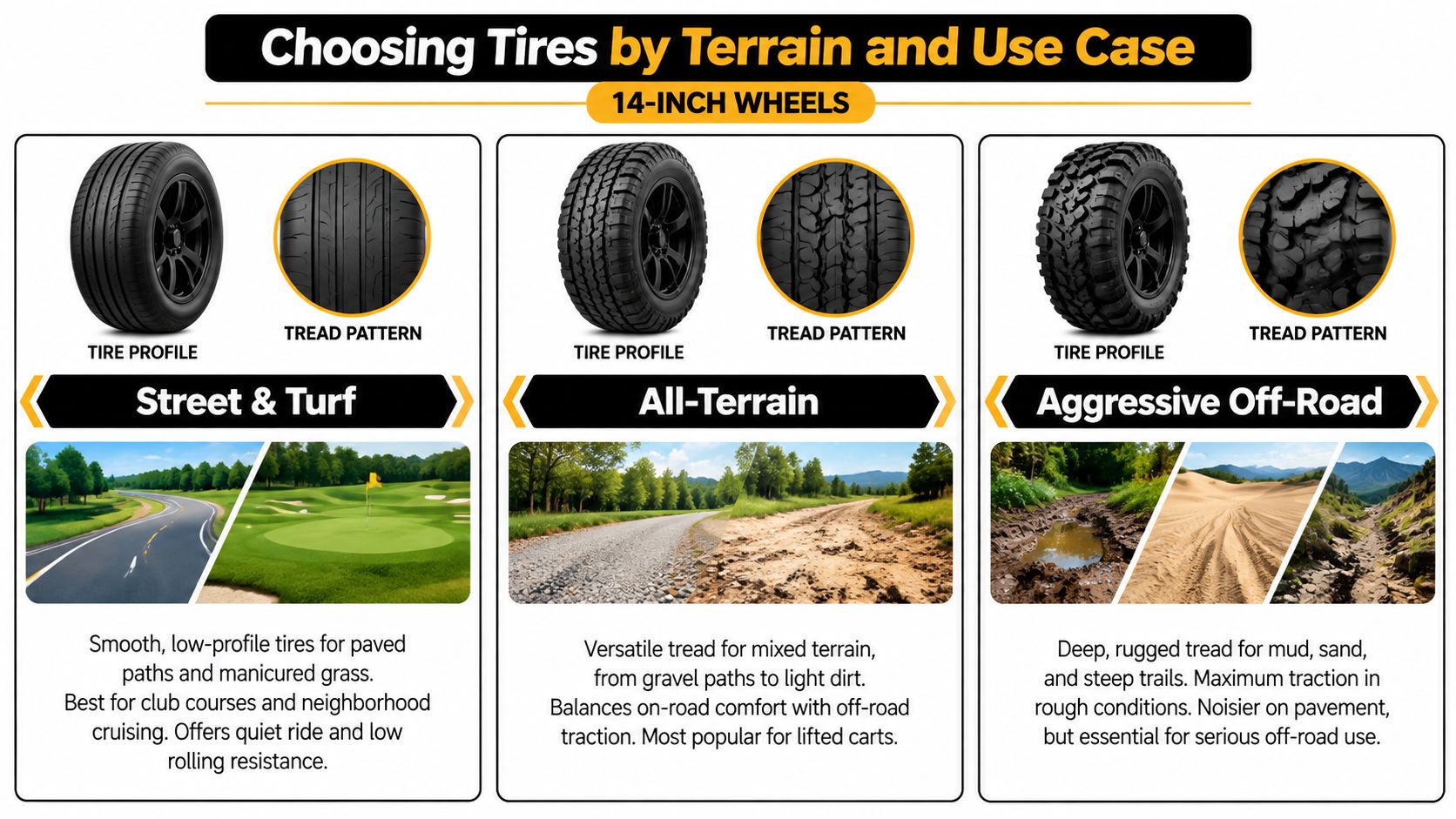
Street and turf tires favor refinement
Street and turf tires use smoother tread patterns and are the logical fit for neighborhoods, resorts, campuses, paved paths, and maintained courses. They generally produce less road noise and reduce the harshness associated with chunky tread blocks. Turf-friendly designs also reduce the chance of leaving visible marks on soft or carefully maintained surfaces.
Some 14-inch street and turf radials advertise DOT approval, turf-friendly operation, maximum speeds around 62 mph, and load capacities from 675 lb to 910 lb per tire, depending on construction and inflation pressure, as shown by this 23-inch 14-inch wheel and tire package. Those advertised figures don't override the cart's own speed, chassis, axle, or legal limits.
All-terrain tires cover mixed routes
All-terrain tread is the practical compromise for owners who alternate between pavement, gravel, packed dirt, and light trails. The blocks offer more bite than a street pattern, but the tread remains usable on roads without the constant hum and vibration of a mud-oriented design.
This is the category I recommend for many lifted recreational carts. It gives the cart a purposeful appearance and useful traction without forcing every pavement drive to feel like an off-road expedition. Keep the tire height reasonable for the lift and avoid choosing a large casing solely because it looks tougher.
Aggressive off-road tires have a clear cost
Deep, open tread is valuable in mud, sand, loose terrain, and steep trails. It also creates more noise, more vibration, and often more steering effort on hard surfaces. Chunky tread can feel busy on pavement, while heavier construction may increase rolling resistance.
Terrain decision: If your cart spends most of its time on pavement, buy the quietest tire that can handle your occasional detour. If it spends most of its time on trails, prioritize sidewall protection and traction instead.
The best package reflects actual use, not an imagined weekend adventure. A resort cart needs predictable manners. A neighborhood cart needs low noise. A trail cart needs clearance and grip. The 14-inch wheel can serve all three, but the tire cannot be selected by appearance alone.
The Hidden Trade-Offs of Larger Wheel Packages
Larger wheels don't automatically improve performance. The complete package determines whether the cart feels more stable and composed or more brittle and demanding. A short sidewall may make the wheel look substantial, but it has less air volume and less rubber available to absorb potholes and broken pavement.
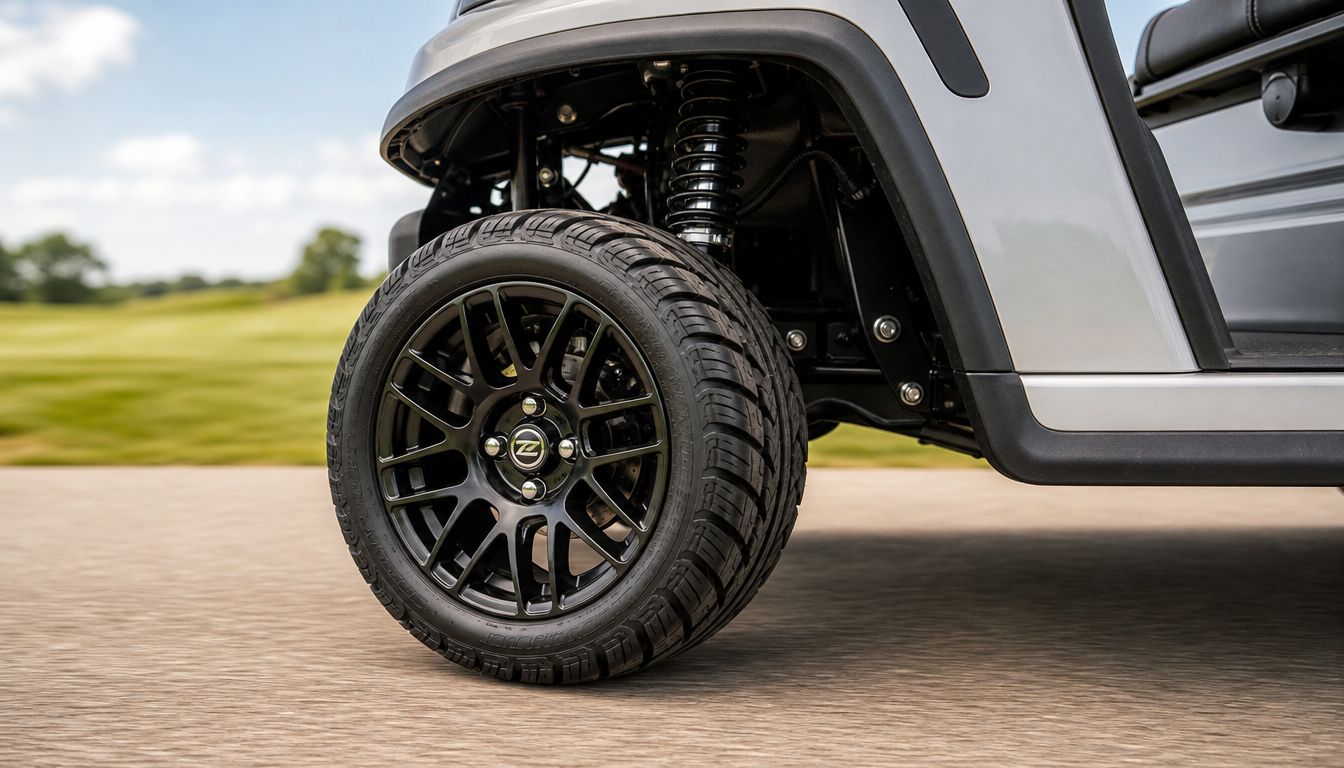
A 205/30-14 combination is roughly 19 inches tall, while a 23×10-14 combination is about 23 inches tall, according to the complete golf cart tire and wheel guide from Golf Cart Search. Those are not small variations. They change the cart's gearing, clearance, steering response, and ride character.
Rolling diameter changes the drivetrain's workload
A taller tire travels farther with each revolution. That can lower effective gearing, which may reduce low-speed pulling strength and place more demand on the motor, controller, or drivetrain, especially on inclines. The cart may also show a speedometer reading that no longer matches actual road speed because the system is calibrated around a different rolling circumference.
Electric carts face another practical concern. A heavier wheel and tire assembly, combined with a larger rolling radius, can require more energy to accelerate and maintain speed. That can reduce usable battery range in real driving, particularly when the cart carries passengers, climbs grades, or runs on soft terrain. The exact result depends on the vehicle, tire pressure, terrain, and driving habits, so don't accept a promised range outcome without testing the complete setup.
A low-profile street package may feel responsive but transmit more impact. A taller all-terrain tire may cushion rough ground better while adding noise and steering weight. Bigger isn't better if the cart spends its life on surfaces that punish the upgrade.
The video below offers a visual reference for evaluating wheel and tire choices alongside the rest of the cart.
Choose based on the drive you want after the installation, not the photograph that convinced you to buy. If comfort and quiet operation matter, resist the urge to maximize height and tread. If clearance and trail control matter more, accept the compromises and build the suspension, steering, and drivetrain around them.
Understanding Load Ratings and Carrying Capacity
Load index is not decorative information. It tells you how much weight an individual tire can support under its specified conditions. Golf Cart Tire Supply's load and speed rating guide lists several useful examples for 14-inch golf cart tires:
- Load index 67: Supports 677 lb per tire.
- Load index 73: Supports 805 lb per tire.
- Load index 77: Supports 908 lb per tire.
- Load index 80: Supports 992 lb per tire.
A four-tire set with load index 73 can therefore carry up to 3,220 lb at the tire level. That figure is a tire-capacity calculation, not permission to load the cart to that weight. The chassis, axles, suspension, brakes, wheels, frame, and tire pressure can impose lower limits.
Match the rating to the real assignment
A lightly used neighborhood cart may not need the same tire construction as a vehicle carrying several passengers, equipment, or cargo. A resort or hospitality operator should account for repeated loading, uneven surfaces, and frequent starts and stops. An off-road owner should also consider sidewall durability, because a tire can have sufficient vertical load capacity and still be poorly suited to sharp rocks or rough trail edges.
Check the vehicle manufacturer's payload guidance, axle limits, and recommended inflation pressure before treating the tire rating as the deciding number. Never use a higher load index to justify exceeding the cart's structural limits.
Pressure is part of the rating
The stated capacity depends on the conditions associated with the tire specification, including inflation pressure. Underinflation can create excess heat, vague handling, and sidewall stress. Overinflation can make the ride harsh and reduce the contact patch on some surfaces.
Load-rating rule: The tire's capacity is a ceiling for the tire, not a payload recommendation for the vehicle.
Select the rating before you finalize the wheel finish. If two otherwise suitable packages differ in construction and load index, choose the one that gives your actual operating conditions appropriate support without ignoring the cart's own limits. Then verify pressure after installation and during regular use, especially when the cart's passenger or cargo load changes.
Building Your Ideal 14 Inch Wheel and Tire Package
Start with the cart's job. A quiet resort or neighborhood cart should use a street or turf-oriented tire with a moderate overall height and no unnecessary lift. A homeowner who wants more visual impact without major suspension work should look first at a roughly 20-inch package such as 20×8.5-14, provided the specific cart has adequate clearance.
A lifted trail cart needs a different plan. A 23×10-14 package delivers a taller, more aggressive stance, but it typically belongs with a 5-inch or 6-inch lift, suitable steering and suspension components, and a tire pattern that matches the terrain. The combination is capable, but it isn't the sensible choice for every pavement-focused buyer.
Use this purchasing sequence
- Define the surface: Pavement and turf favor smooth radials. Mixed routes suit all-terrain tread. Serious trails justify aggressive construction.
- Set the height limit: Decide whether you want a no-lift installation or accept the changes that come with a lifted cart.
- Check the complete code: Confirm rim diameter, width, aspect ratio or flotation dimensions, overall height, and load index.
- Inspect the cart: Verify fender, suspension, steering, axle, and body clearance at rest and through movement.
- Evaluate comfort: Choose sidewall and tread for the ride you want, not only the appearance you want.
- Confirm the vehicle limits: Tire capacity never replaces chassis, axle, brake, or manufacturer payload limits.
For buyers who want broader background before selecting a package, this guide to upgrading your golf cart wheels is a useful supplemental resource. It can help frame the wheel upgrade as part of a larger system rather than an isolated cosmetic change.
Solana EV offers street-legal golf carts and electric UTVs for neighborhood, resort, campus, and recreational use, with models that include features such as Apple CarPlay and Android Auto on durable aluminum chassis. Visit Solana EV to review vehicle options, locate a dealer, or discuss a cart platform that fits the wheel and tire package you need.
Visit Solana EV to compare electric vehicles suited to resort, neighborhood, campus, and off-road use. Ask a dealer to match the vehicle, suspension, and intended driving environment before you commit to a 14-inch wheel and tire package.