
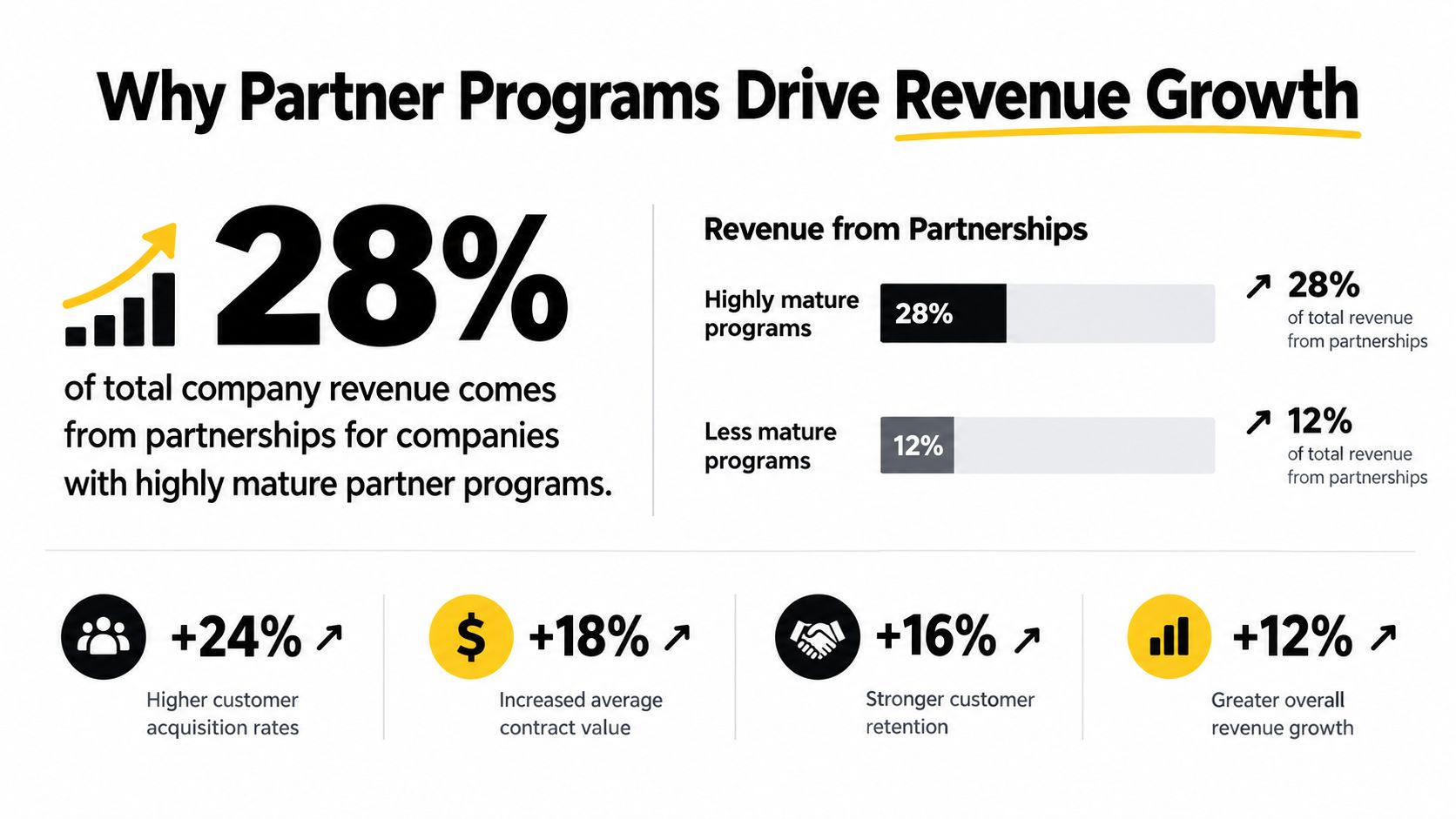
Companies with highly mature partnership programs receive 28% of total company revenue through partnerships, and that partnership revenue grows 28% annually versus 12% for low-maturity programs. That gap turns a partner program from a side channel into a real growth engine.
In practice, the companies that win with partnerships do not just recruit more names into a directory. They build a system that gives dealers, resellers, and referral partners a reason to invest time, inventory, and local relationships because the economics are clear and the operating rules are stable.
Table of Contents
- Why Partner Programs Drive Revenue Growth
- Understanding the Partner Program Concept
- Types of Partner Programs Explained
- Benefits Partners Receive and Why They Matter
- Measuring Partner Program Success
- How Solana EV Partner Program Works
- Frequently Asked Questions About Partner Programs
Why Partner Programs Drive Revenue Growth
A mature partner program changes the shape of a business. Instead of relying only on direct sales staff, the company uses independent partners to extend market coverage, local credibility, and service capacity without carrying every cost itself. The commercial result is not theoretical, as the Impact research shows, where highly mature programs averaged 28% of total revenue through partnerships compared with 18% for low-maturity programs, and partnership revenue grew 28% annually versus 12% for low-maturity programs, a 2.3-times difference in growth rate Impact research.
For a manufacturer, that can mean a dealer in one region is carrying the local selling work while the brand team focuses on product, pricing, and support. For a hospitality operator, it can mean trusted channel partners bring in equipment, service, or guest-experience solutions with less friction than a central sales team could manage alone. The point is simple, partnerships scale reach.
Practical rule: if a partner program cannot show how it drives revenue, pipeline, or service capacity, it is probably a relationship list, not a growth channel.
Why maturity matters more than participation
The same research estimated that for companies averaging $1.55 billion in annual revenue, the maturity gap represented about $162 million in additional partnership-channel revenue Impact research. That is why businesses looking at franchise development often study partner programs closely, because the structure behind the network matters as much as the network itself franchise development.
A mature partner system gives each party a clear business case. The partner gets protection, enablement, and a route to profit. The company gets expansion without building every market from scratch.
Understanding the Partner Program Concept
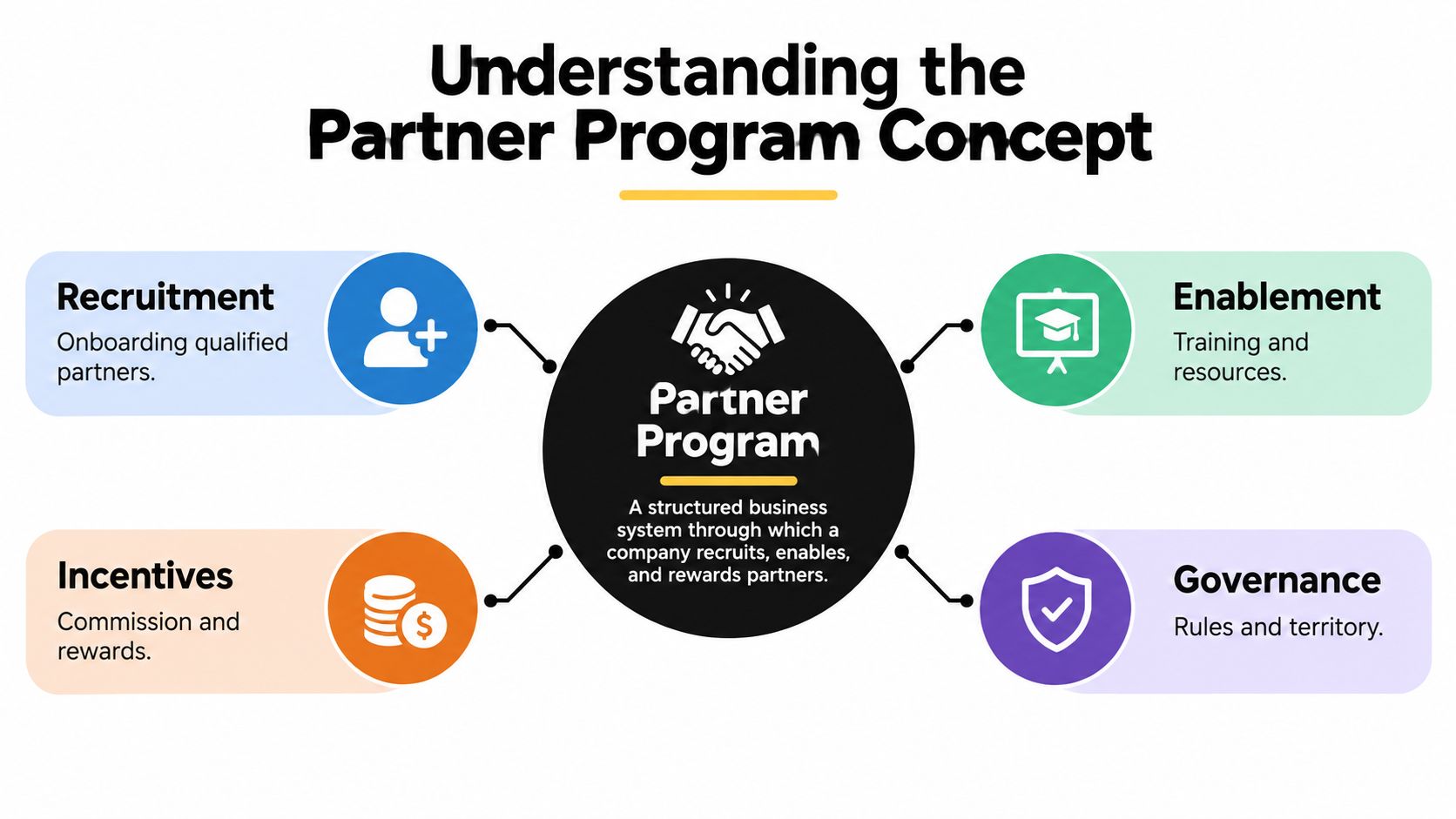
A partner program is a structured business system that recruits, enables, manages, and rewards independent organizations or individuals who help sell, refer, implement, integrate, distribute, or support a company's products. The formal version is different from a casual business relationship because it defines partner types, eligibility, onboarding, training, sales rules, territory or account protection, marketing support, incentive structures, reporting, and performance standards.
That structure is what makes the channel scalable. Without rules, partners guess. With rules, they invest.
What formal programs control
A formal partner program usually answers a set of operational questions that informal partnerships leave vague. Who can join. What kind of partner they are. What territory they can work in. How they register opportunities. What support they get. What happens if they miss standards.
A partner program only works when both sides can describe the rules in the same way.
Microsoft is a useful historical example because it shows how a partner program can become a core route to market. Microsoft launched its Certified Solution Provider program in 1992, later brought OEMs, independent software vendors, value-added resellers, integrators, and consultants into a broader partner structure, and by March 2022 the Microsoft Partner Network was reported to include about 400,000 partners, vendors, and service providers Microsoft Partner Network. A frequently cited ecosystem measure also reported that in 2009 partner companies generated $8.70 in revenue for every $1 Microsoft made Microsoft Partner Network.
For operators, the lesson is straightforward. The strongest partner programs behave like operating systems, not marketing campaigns. They define how partners join, how they sell, how they get paid, and how performance is measured.
That same research also estimated that for companies averaging $1.55 billion in annual revenue, the maturity gap represented about $162 million in additional partnership-channel revenue Impact research. A mature partner system gives each party a clear business case. The partner gets protection, enablement, and a route to profit. The company gets expansion without building every market from scratch.
For a closer look at how partner intake can be organized in practice, the supplier onboarding process shows how structured onboarding supports consistency across partners.
Types of Partner Programs Explained
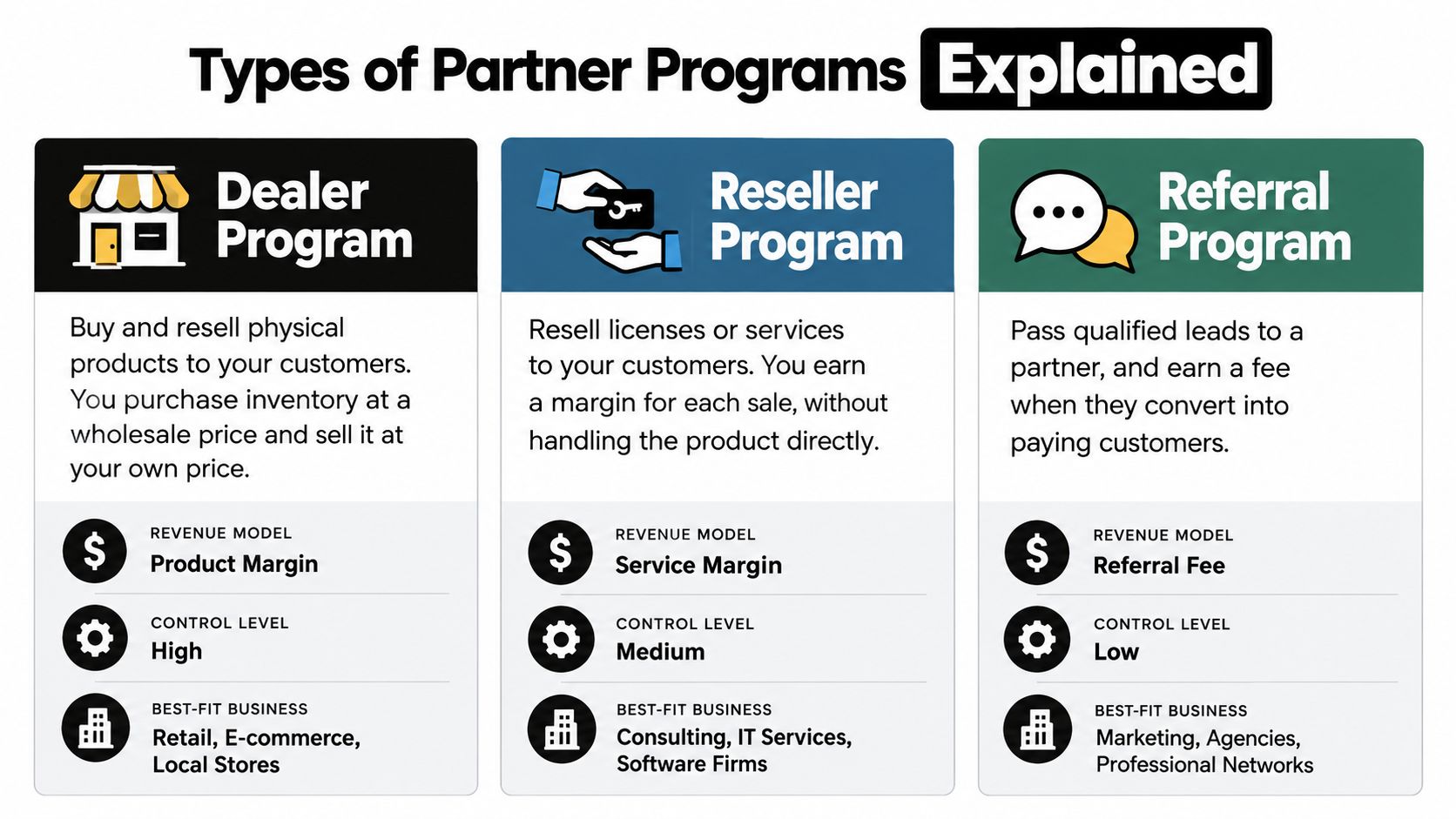
Dealer, reseller, and referral programs all sit under the partner-program umbrella, but they do very different jobs. A dealer model fits businesses that need local inventory, customer handoff, and after-sales support. A reseller model fits companies that want existing channel firms to carry the product and earn margin. A referral model is lighter, rewarding qualified introductions instead of inventory movement or direct sales labor.
Dealer, reseller, and referral compared
A dealer program usually gives the partner a stronger role in the market. The dealer may hold inventory, operate within a protected geography, and handle service or customer education. That works well when the product needs local explanation, retail presence, or post-sale support.
A reseller program is more transactional. The reseller buys or licenses the product and sells it through its own channel, often supported by margin structures and co-marketing materials. This model works well when the product can move through an existing sales motion without much customization.
A referral program is the simplest of the three. The partner sends qualified leads or introductions, and the company closes the deal. This is useful when the partner has reach or trust, but not the desire to own inventory or a sales process.
For businesses choosing among these models, the key question is not which sounds best. It is which model matches the economics of the product, the complexity of installation or service, and the level of control the brand wants to keep. That is why managing a repair franchise often resembles dealer-program thinking more than referral thinking, because service-heavy businesses depend on process, responsiveness, and clear handoffs.
Decision rule: if the partner must carry inventory, manage service, or protect a territory, the program needs deeper governance than a referral arrangement.
The distinction matters for operators looking at channel expansion through a site like how to start a dealership business, because dealership economics depend on support systems that a referral partner never touches. Dealerships need territory clarity, financing support, and product knowledge. Referral partners need speed and simplicity.
Benefits Partners Receive and Why They Matter
Partners do not join a serious program for the logo alone. They join because the program gives them commercial tools that lower risk and make revenue easier to earn. Protected territories, financing, training, marketing assets, parts access, and technical support are not perks. They are operating infrastructure.
The benefit only works if it solves a friction point
A protected territory reduces internal competition and makes a partner more willing to spend on local selling. Floor plan financing reduces the cash strain of holding inventory. Retail financing helps close the sale by making the customer's purchase easier. Training gives the partner confidence with the product and sales process.
Marketing support matters for a different reason. It helps partners create local demand instead of waiting for the manufacturer to do all the work. Parts portals and technical assistance matter after the sale, when uptime and customer satisfaction shape repeat business.
The cause-and-effect relationship is direct. Better training improves product knowledge. Clear opportunity rules reduce channel conflict. Predictable incentives make partners more willing to invest time and money.
Protected opportunity changes behavior. Partners invest more when they can see how their effort turns into something defensible.
For operators in vehicle, resort, or service-heavy markets, that means a partner program should be built around what the partner needs to sell, deliver, and support the product. A glossy welcome packet is not enough. The partner needs a workable system.

Measuring Partner Program Success
A mature partner program is managed like a performance system. If the team cannot measure activation, conversion, retention, and revenue contribution, then it cannot tell whether the program is helping or just busy.
The metrics that actually expose problems
Useful measures include active-partner rate, time from enrollment to first revenue-generating deal, registered-opportunity conversion, certification completion, marketing-fund utilization, partner retention, channel-sourced pipeline, channel revenue growth, program cost as a percentage of channel revenue, and incremental return on partner investment ZINFI channel partner management guidance.
Each metric points to a different failure mode. Low activation usually means onboarding friction. Long ramp time often means weak inventory readiness, poor training, or slow lead flow. High registrations with weak conversion can indicate poor qualification or weak sales execution. Strong revenue concentration can point to territory or portfolio risk.
For a dealer network, the dashboard should not stop at the company level. It should segment by dealer, territory, vehicle model, lead source, financing option, and service case volume, then compare certified with non-certified dealers. That makes the next move obvious. A team can add technical training, shift marketing support, or adjust parts stock instead of giving everyone the same incentive.
| Metric family | What it reveals | Typical action |
|---|---|---|
| Activation and ramp | Onboarding friction or weak readiness | Add training, improve setup, tighten lead handoff |
| Conversion and pipeline | Sales execution quality | Fix qualification, improve opportunity routing |
| Retention and concentration | Territory or portfolio risk | Rebalance coverage, review account rules |
Measure the channel at the dealer level, not just the program level. The details usually show where the money is leaking.
How Solana EV Partner Program Works
Solana EV shows how a dealer-oriented partner system works when the commercial terms are made clear. Dealers operate inside large, protected territories, which gives them a defined market area instead of a vague promise. They also get dealer floor plan financing through Dealer Direct, retail financing options that can include 0% APR for up to 60 months, onboarding, training, marketing resources, a 24/7 parts portal, and technical assistance.
The partner journey starts with application and certification, then moves into territory assignment, financing setup, and product training. That order matters because a dealer cannot sell confidently if inventory, support, and the sales process are still unclear.
Solana EV's lineup includes models such as the XA 4P, XA 6P, F, and G, built around modern features like Apple CarPlay and Android Auto and engineered on durable aluminum chassis. For a dealer, product clarity shapes how the team explains use cases, retail positioning, and after-sale support.
Operational value comes from the workflow, not the brochure. Dealers need to know how financing works, where support questions go, how parts are ordered, and how the manufacturer expects leads and territory rules to function. A structured program reduces uncertainty because those rules are defined before the first sale.
The fastest path to failure is when dealers understand the product but lack clarity on territory rules, financing workflows, and support escalation paths.
Practical partner management also depends on education beyond the vehicle itself. For dealers who want more customer guidance around charging and ownership, stories on home charging equipment can support the broader sales conversation without forcing the dealer to invent every answer.
For a dealer-facing workflow, the dealer onboarding process is the kind of operational reference that turns a partnership into a repeatable business motion. It shows how applications, training, territory, and support fit into one system.
In mature ecosystems, partners also receive clearer measurement. Microsoft's partner network is often cited as a large example of that model, with more than 400,000 partners and a frequently cited 2009 figure showing partner companies generating $8.70 in revenue for every $1 Microsoft made Microsoft Partner Network. That kind of structure matters because dealers can see whether the program is creating pipeline, not just activity.
Frequently Asked Questions About Partner Programs
Protected territories are not automatically exclusive. Protection often depends on minimum sales, geography, customer type, or channel conflict rules. If those terms are unclear, the partner is taking on more risk than the agreement probably suggests.
What does onboarding usually include
Onboarding usually covers application review, certification, training, and territory assignment. In stronger programs, it also covers lead routing, inventory setup, marketing access, and escalation paths for service or parts issues.
Financing is another area where definitions get fuzzy. Floor plan finance supports inventory, while retail finance supports the end customer. A partner program that offers both gives the dealer more control over working capital and the buyer more flexibility at the point of sale.
What should happen in the first 90 days
The first 90 days should show movement, not just paperwork. A partner should complete certification, activate the territory, and reach the first revenue-generating deal or first qualified pipeline movement. If none of that happens, the program probably has a design problem, not a motivation problem.
Forrester reports that 67% of surveyed B2B ecosystem and channel-marketing decision-makers expect indirect revenue to grow more than 30% above the prior year, and partner-influenced revenue is also expected to grow at a similar rate Forrester partner ecosystems 2025. That makes partner economics a planning issue, not a side project.
The cleanest test is simple. If the partner can explain what they receive, what they must do, and how success will be measured, the program is real. If those answers are vague, the relationship is still informal.
If you're building a dealer network, Solana EV gives you a clear model for protected territories, financing support, training, and parts access inside a structured partner system. Visit Solana EV to review the dealer opportunity and see how a practical partner program is organized around sales, support, and long-term channel growth.