
So, you’re on the hunt for a used street-legal golf cart. The good news is, there are more of them out there than ever before. The trick is knowing where to look to find the right cart at the right price. Your best starting points will almost always be a trusted local dealer for peace of mind, or online marketplaces like Facebook for a potential bargain.
How To Find The Best Local Deals On Used Carts

Kicking off your search for a pre-owned Low-Speed Vehicle (LSV) is all about having a smart game plan. A quick search will throw dozens of listings at you, but the real key is to focus your efforts where they’ll count the most. The goal here isn't just finding any cart; it's about finding the right one for you—one that fits your lifestyle and budget without any nasty surprises down the road.
Your first objective should be to build a solid shortlist of 3-4 promising carts to go see in person. If you're looking for broader tips on finding any kind of new or used golf cart for sale near me, we have other guides that can help with that, too.
Starting Your Local Search
I always tell people to start by checking out the pre-owned inventory at certified golf cart dealerships in their area. These shops often take in trade-ins, and they usually inspect and service them before putting them on the lot. Some might even offer a limited warranty, which is a level of security you simply won’t get from a private seller on the side of the road.
While you're checking with dealers, jump onto the online marketplaces. Facebook Marketplace and Craigslist can be absolute goldmines for local deals, but you have to know what you’re looking for. To cut through the clutter, use very specific search terms:
- "Street legal LSV"
- "Used neighborhood electric vehicle"
- "Titled golf cart"
- "Low speed vehicle with VIN"
Using these phrases helps filter out the standard golf carts that just have a few lights slapped on and brings you closer to a genuine, registrable LSV.
Expanding Your Search Radius
Don't box yourself in! Sometimes the best deals are just a short drive away. Expanding your search to neighboring towns or counties can open up a whole new set of options you wouldn't have seen otherwise.
It’s also a smart move to look in popular tourist spots and beach communities. For instance, a quick look at a guide to Siesta Key shows how carts are a primary mode of transport for residents and vacationers. These areas are often hotspots for used inventory when people upgrade or move.
Key Takeaway: The single most important thing to understand is the difference between a real LSV and a regular golf cart with an aftermarket light kit. A genuine LSV leaves the factory with a 17-digit VIN and meets specific federal safety standards, making it infinitely easier to register and insure.
Where to Find Used Street Legal Golf Carts Locally
Deciding where to focus your search can be tough. Each option has its own set of advantages and disadvantages. This table breaks down the most common places to look so you can figure out which one is the best fit for you.
| Search Location | Pros | Cons | Best For |
|---|---|---|---|
| Certified Golf Cart Dealers | Inspected inventory, potential warranties, expert advice, trade-in options. | Higher prices, potentially limited brand selection. | Buyers seeking peace of mind and are willing to pay for reliability. |
| Facebook Marketplace | Huge local selection, direct contact with sellers, great potential for deals. | High risk of scams, no inspections or guarantees, inconsistent quality. | Savvy buyers who know what to look for and are comfortable negotiating. |
| Craigslist | A classic for local classifieds, simple interface, direct seller communication. | Can be outdated, fewer photos/details, similar scam risks as Marketplace. | People looking for basic, no-frills deals from private sellers. |
| Local Golf Course Pro Shops | Carts are often well-maintained fleet vehicles, sold at predictable times. | Usually sold "as-is," may have high hours of use, not always street legal. | Finding mechanically sound "fleet" carts that can be converted. |
| Auctions & Estate Sales | Potential for extremely low prices. | Very high risk, no test drives, "as-is, where-is" condition, intense competition. | Experienced buyers and mechanics who can spot value and fix issues. |
Ultimately, a mix-and-match approach often works best. Start with a dealer to set a baseline for quality and price, then scan the online marketplaces to see if you can find a better deal.
The great thing is that the market is on your side. With the global golf cart industry projected to hit USD 4.18 billion by 2032, more new carts are being sold, which means more trade-ins are hitting the used market. This growth makes it much more likely your search will turn up some fantastic local options. Your job is to use these sources to find those few gems worth a closer look.
So, Is It Actually Street Legal?
You've found a promising ad, but now for the most important part: making sure the seller's claims are legit. I've seen it countless times—someone lists a cart as "street legal" when it's really just a standard golf cart with a few aftermarket lights bolted on. There's a massive difference between a cart like that and a true, federally-regulated Low-Speed Vehicle (LSV), and that difference can have huge legal and insurance consequences.
This all comes down to one single, non-negotiable item: the 17-digit Vehicle Identification Number (VIN).
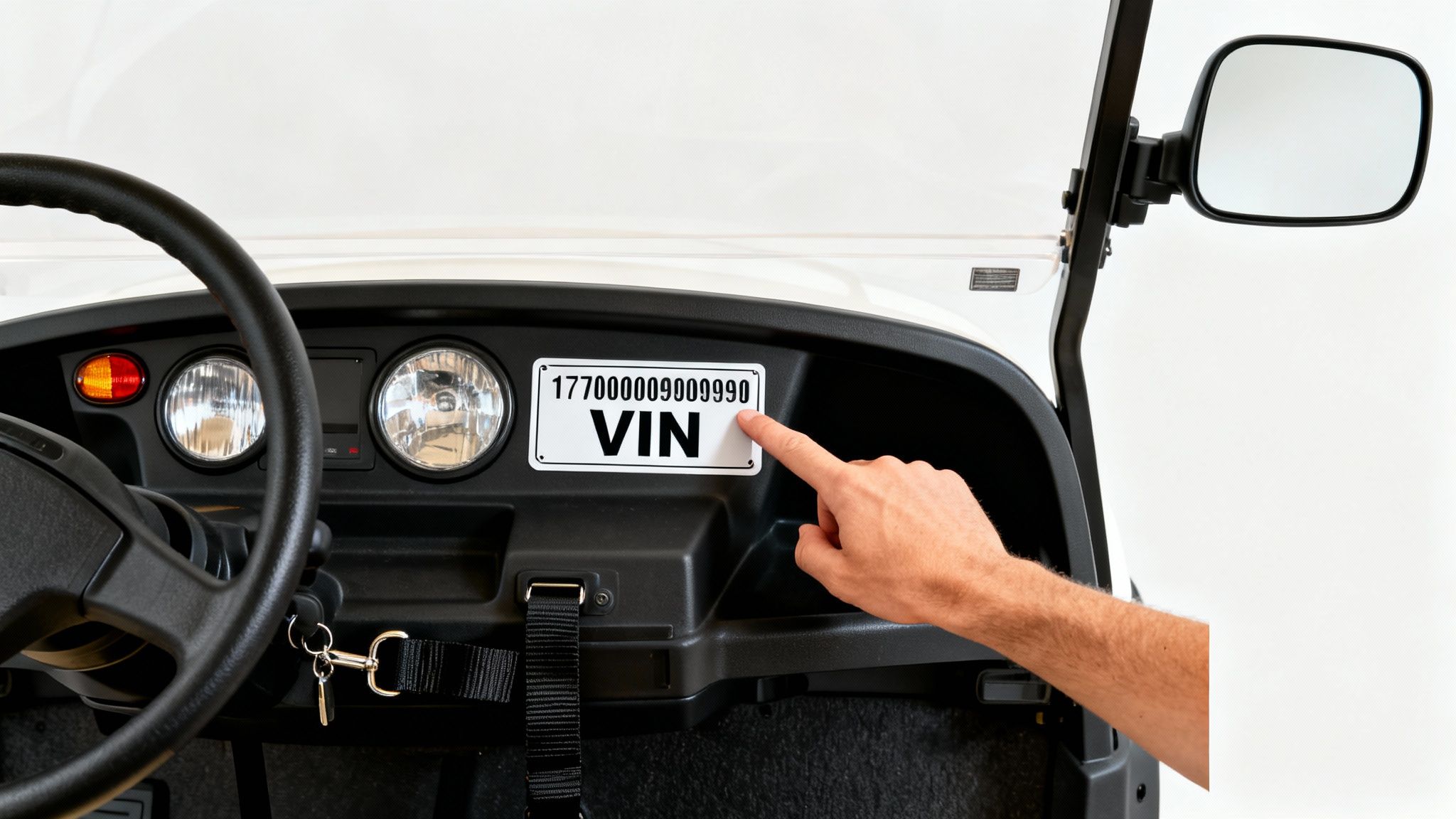
A regular golf cart just has a short serial number. An LSV, built from the factory to be road-ready, has a proper VIN just like your car. If you don't see a 17-digit VIN, walk away. It's that simple.
What a Real LSV Looks Like
So, what exactly separates a genuine LSV from a modified cart? The federal government has a checklist called the Federal Motor Vehicle Safety Standard 500 (FMVSS 500). Every single one of these items must be present and working.
- Proper Lighting: We're talking headlights, taillights, and functional brake lights.
- Turn Signals: Both front and rear signals are required and must work.
- Reflectors: You should see them on all four corners of the vehicle.
- Mirrors: It needs a rearview mirror plus exterior mirrors on both the driver and passenger sides.
- Seat Belts: Every single seat needs its own seat belt. No exceptions.
- A Real Windshield: This isn't just a flimsy piece of acrylic. It must be an automotive-grade safety glass windshield.
- The Right Speed: A true LSV is built to reach speeds between 20 and 25 mph.
Be wary of sellers who say things like, "It has everything you need to get a tag." That's a classic red flag. A legitimate LSV already has its credentials from the manufacturer. You shouldn't have to do anything to "make" it legal. If it wasn't born with a 17-digit VIN, it's not an LSV.
Checking the VIN and Paperwork
Once you've found the VIN (usually on a sticker inside the dashboard or stamped on the frame), ask the seller to show you the title or the original Manufacturer's Certificate of Origin (MCO). The number on the paperwork must be an exact match to the VIN on the cart.
Take a close look at the title. Under "Body Style" or "Vehicle Type," it should clearly say "LSV" or "Low-Speed Vehicle." If it just says "Golf Cart" or something generic, you're looking at a world of hurt trying to get it registered at the DMV. We go into much more detail on the specifics in our complete guide to street legal golf cart requirements.
The good news for buyers is that finding these vehicles is getting much easier. North America is the largest market for LSVs and is projected to hold about 58% of the market share by 2035. As resorts and large communities upgrade their fleets, more of these factory-built LSVs are hitting the second-hand market, giving you more solid options to choose from locally.
Getting Your Hands Dirty: The Pre-Purchase Inspection
Alright, you've done the paperwork check and confirmed the cart is a real-deal Low-Speed Vehicle (LSV). Now comes the fun part—and the most important step before you even think about talking numbers. This is where a thorough, hands-on inspection separates a great find from a total money pit. It's also where you'll find your best negotiation leverage.
Think of this as a methodical teardown, without actually taking anything apart. We'll start with the single most expensive and critical component of any electric cart: the battery pack. From there, we'll work our way through the cart's bones and muscles.
The Heart of the Cart: The Electric Powertrain
On any electric cart, the batteries are everything. A full replacement set can easily run you $800 to over $2,000, so their health is the make-or-break factor in most used deals. Never, ever just take the seller's word for it. You have to play detective.
First, pop the seat and find the date codes on the batteries. Most lead-acid batteries have a simple letter-number stamp, like 'J-2' for October 2022. If you see batteries pushing four or five years old, you should mentally budget for a replacement soon, no matter how good they seem on a test drive. Their time is almost up.
Next, get a good look at the terminals and cables. You're hunting for corrosion—that crusty white or greenish buildup. A little bit of fuzz isn't a deal-breaker, but heavy corrosion is a huge red flag for poor maintenance and can signal damage to the expensive wiring harness. For a much deeper dive, our guide on what to look for in used golf cart batteries has a complete checklist.
Pro Tip: Ask to see the charger. If they pull out a modern, digital "smart" charger, that's a great sign. If they wheel out a heavy, humming, old-school transformer charger, it suggests the batteries may have lived a harder life with less-than-optimal charging.
Kicking the Tires (and Checking the Frame)
Once you've sized up the power situation, it's time to check the cart's foundation. Get low and look underneath. The frame is the skeleton, and you’re looking for any serious rust or cracks, paying close attention to the welds and the area under the battery tray where acid can spill. A bit of surface rust is one thing; deep, flaky rust that compromises the metal is another.
While you're down there, give the suspension a once-over. Push down hard on each corner of the cart. It should feel firm and bounce back smoothly just once. If it's bouncy like a pogo stick or you hear a lot of groaning and creaking, you’re likely looking at worn-out shocks or bushings. Don't forget to eye the leaf springs for any visible cracks or sagging.
Brakes, Steering, and the All-Important Test Drive
Now for the systems that keep you safe. Before you even turn the key, pump the brake pedal. It needs to feel firm and solid. If it feels spongy or sinks slowly to the floor, that’s a classic sign of air in the lines or a leak in the system—a non-negotiable safety issue.
Next, check the steering. With the cart sitting still, turn the steering wheel back and forth. You want to see the front wheels respond almost immediately. If there's a lot of "slop" or "play" where you can turn the wheel an inch or two before the tires react, it points to worn-out components like tie rods. That's a repair you don't want to foot the bill for.
Finally, the moment of truth: the test drive.
This isn't just a joyride. It's your final exam for the cart. Acceleration should be smooth and silent, without any weird whining from the motor. Listen carefully for clunks or rattles from the suspension when you go over small bumps. And most importantly, find a safe spot to test the brakes from a decent speed. The cart should stop straight and true, without pulling to one side.
This is how you truly discover if that "street legal golf cart near me" is a hidden gem or a future headache.
Key Inspection Points for Used Electric Golf Carts
A detailed inspection can feel overwhelming, so here’s a quick-reference table to guide you through the most critical checkpoints. Use this to make sure you don’t miss anything important when you’re looking at a potential cart.
| Component | What to Check | Signs of a Problem |
|---|---|---|
| Batteries | Date codes, terminal corrosion, water levels, cable integrity | Dates older than 4-5 years, heavy white/green buildup, low water, frayed cables |
| Motor | Listen for unusual noises during the test drive | Loud humming, grinding, or whining sounds under acceleration |
| Controller | Smooth acceleration, no burning smell | Jerky or hesitant acceleration, acrid electrical smell after a drive |
| Frame | Look for rust or cracks, especially at weld points and under batteries | Deep, flaking rust (not just surface rust), visible stress cracks |
| Suspension | Push down on corners, look at leaf springs and shocks | Excessive bouncing, loud creaks, cracked leaf springs, leaking shocks |
| Brakes | Pedal feel (firm vs. spongy), stopping performance | Spongy pedal, pulling to one side when braking, grinding noises |
| Steering | Check for "play" in the steering wheel | More than an inch of free play before wheels turn, clunking sounds |
| Tires | Tread depth, inspect for uneven wear patterns | Bald spots, wear on only the inner/outer edges (indicates alignment issues) |
Taking the time to go through each of these points gives you a complete picture of the cart’s health and provides you with the solid facts you need to either walk away or make a confident, well-negotiated offer.
Navigating the Paperwork, Registration, and Insurance
So, the test drive was a success and you've settled on a price. Great! But hold on—the deal isn't quite sealed. The final hurdle is the paperwork, and this is where you need to be meticulous to make that used street-legal golf cart truly yours. It might seem like a hassle, but it's a straightforward process if you know what to look for.
The single most important document you need is the title. A genuine Low-Speed Vehicle (LSV) is titled just like a car. If the seller can't produce one, or tries to hand you a simple bill of sale instead, that's a major red flag. Trying to register a cart without a title is a bureaucratic nightmare you don't want.
The Non-Negotiable Documents
Before a single dollar leaves your wallet, you need to have two specific documents in hand. These are your proof of ownership and what the DMV will demand to see.
- The Vehicle Title: Make sure the seller whose name is on the title is the one signing it over to you. I can't stress this enough: carefully compare the 17-digit VIN on the title to the VIN plate on the cart's frame. They must match perfectly.
- A Bill of Sale: This is your official receipt. It should clearly state the date, final sale price, the cart's year, make, and model, plus the full names and signatures of both you and the seller. A thorough bill of sale protects everyone involved.
Don't fall for the "I lost the title" excuse. A serious seller can easily get a duplicate from their local DMV. If they won't, it's best to walk away.
Your purchase isn't complete until that title is legally in your name. Think of the paperwork as the final checkpoint. Get this part right, and your new cart is ready for the road, not just a permanent spot in your garage.
The paperwork stage only comes after you're completely satisfied with the cart's condition.
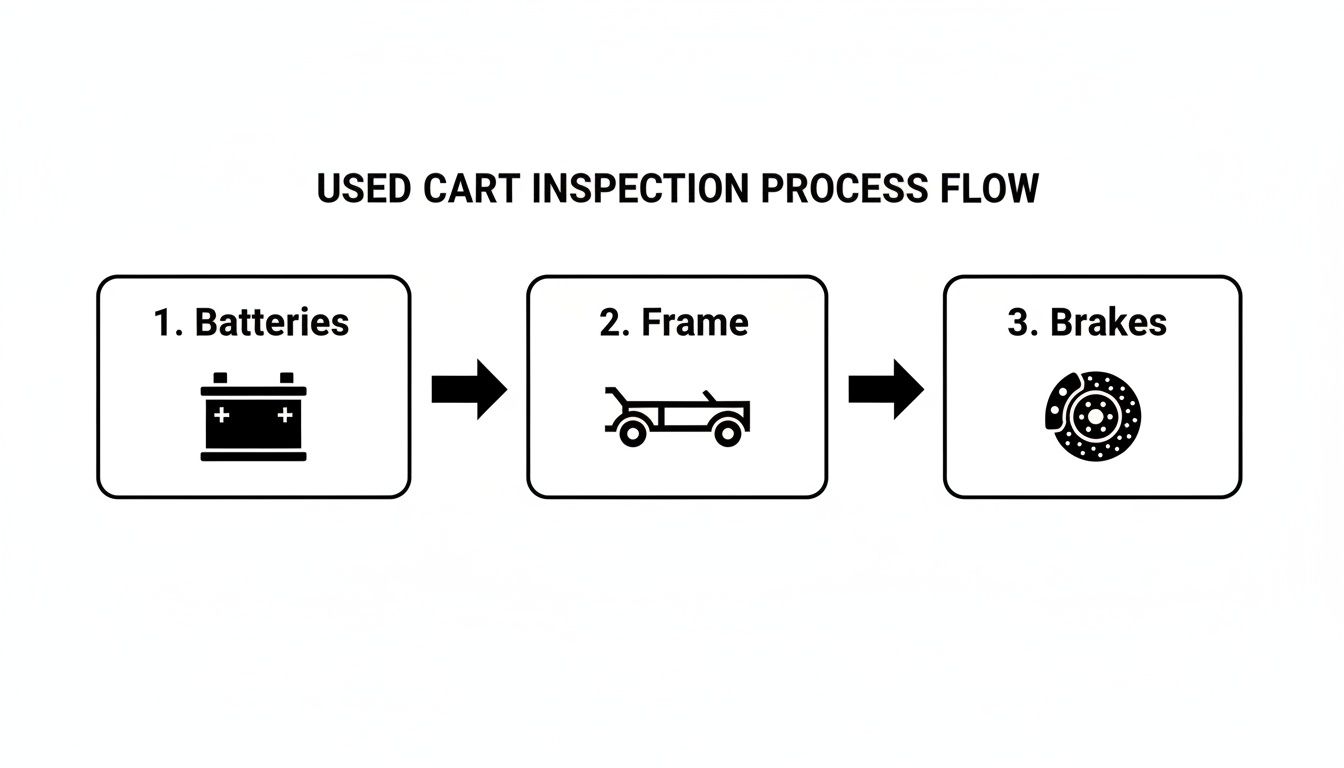
Remember, a solid mechanical inspection—from the batteries to the brakes—is the foundation of any good purchase. You sort that out before you ever think about signing on the dotted line.
Getting It Registered and Insured
With the signed title and bill of sale secured, it's time for a trip to the DMV. You'll need to bring those documents, your driver's license, and proof of insurance to get the cart officially registered and pick up your license plate.
And on that note, you can't drive an LSV on public roads without insurance. It’s not optional. Most states require, at a minimum, the same kind of liability coverage you'd carry for your car.
My advice? Start shopping for insurance quotes before you finalize the deal. That way, you can build the cost into your overall budget. A good first step is to call your current auto insurance agent; they can often add an LSV to an existing policy without too much fuss. Taking care of these details ensures your new ride is 100% legal from day one.
Negotiating a Fair Price and Closing the Deal
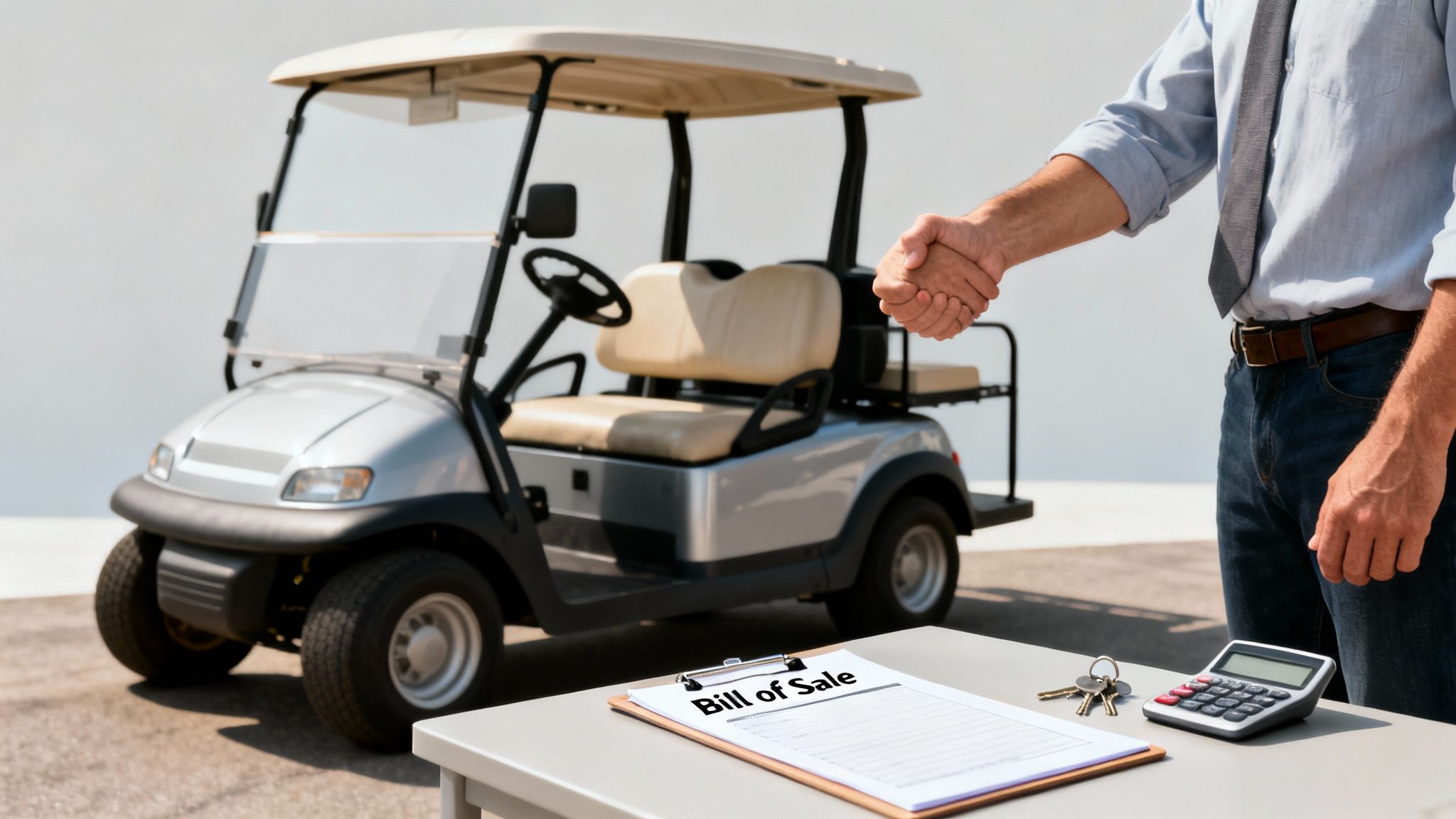
So, you’ve found a promising cart and given it a thorough once-over. Now comes the part that makes many people sweat: talking about the price. But it doesn’t have to be intimidating. If you’ve done your homework, negotiating is just a conversation where you lay out the facts.
Your confidence here comes from research, not guesswork. Before you even think about making an offer, take 30 minutes to scout online listings for the same make, model, and year. Knowing that a similar 2019 Club Car Onward is listed for $8,500 across town gives you a powerful benchmark. This isn't about opinions; it's about what the market says the cart is worth.
Using Your Inspection as Leverage
Remember that detailed inspection checklist? This is where it becomes your most valuable negotiation tool. Every flaw, worn part, or upcoming maintenance issue you spotted has a dollar value, and it's completely fair to bring it up.
The trick is how you frame it. Instead of just pointing out a problem, tie it to a real-world cost.
Don't just say, "The batteries are old." Try this instead: "The cart runs well, but I got a quote, and a new set of Trojan batteries is going to run me about $1,200. I have to account for that immediate out-of-pocket expense in my offer." See the difference? You’ve turned a general complaint into a specific, documented cost that justifies a lower price.
A few high-impact negotiation points usually include:
- Aging Batteries: This is the big one. Always get a quote for a full replacement set.
- Worn Tires: Simple to price out and a very straightforward reason for a deduction.
- Cosmetic Damage: Cracked body panels or torn seats might not affect performance, but they absolutely affect value.
- Pending Maintenance: If the brakes felt spongy or the steering was loose, mention the service costs you're about to inherit.
This isn't about trying to lowball the seller or nitpick every tiny scratch. The goal is to land on a price that honestly reflects the cart's actual condition, not just the asking price. A calm, respectful, fact-based approach almost always gets a better reception than an aggressive one.
Making the Offer and Finalizing the Sale
Once you have your numbers straight, it's time to make an offer. Start with a figure that’s below your absolute maximum but still reasonable enough to be taken seriously. This leaves you both some room to meet in the middle.
Let's say the seller is asking $9,000, but your inspection revealed about $1,500 in necessary repairs (like those new batteries and a set of tires). An opening offer around $7,000 is a strong, justifiable starting point. Be prepared to walk them through your math, calmly and without emotion.
After you’ve settled on a price, it's all about a clean, secure transaction. For a private sale, the safest bet is to meet at a bank. You can get a cashier's check on the spot, and they often have a notary available. Handing over a large stack of cash in a stranger's driveway is never a good idea.
Get a comprehensive bill of sale that lists the final price, VIN, date, and includes signatures from both you and the seller. This document, the signed title, and proof of insurance are your golden tickets at the DMV. Speaking of insurance, this is a must-have for any street-legal vehicle. Looking into something like the general California auto insurance requirements can give you an idea of the coverage you'll need.
Once the title is signed over and the keys are in your hand, you're officially done. Congratulations on the new ride
Answering Your Top Questions About Used Street-Legal Carts
Even after doing your homework, a few questions always seem to surface right when you're ready to buy. Let's walk through some of the most common sticking points people run into when searching for "used street legal golf carts near me." Getting clear on these details now can save you a world of trouble later.
One of the biggest sources of confusion is the language sellers use. You'll often see a cart advertised with a "street legal kit," which usually just means someone added lights, a horn, and some mirrors after the fact. That’s a whole different ballgame from a true, factory-built Low-Speed Vehicle (LSV).
A genuine LSV is built from the start to meet federal safety standards (specifically, FMVSS 500). It’s engineered to travel between 20-25 mph and, most importantly, it leaves the factory with a 17-digit Vehicle Identification Number (VIN). While a DIY kitted cart might squeak by a local inspection in some towns, a true LSV is recognized as a motor vehicle nationwide, which makes registering and insuring it infinitely easier.
Budgeting for Future Costs
When it comes to a used electric cart, the elephant in the room is always the battery pack. This will be the single most expensive replacement part you ever have to deal with, hands down.
For a standard lead-acid setup, a brand-new set of quality batteries will run you anywhere from $800 to $2,000. The final price depends on the cart's voltage (36v, 48v, etc.) and the brand you choose. Thinking about upgrading to lithium? The initial hit is steeper—expect $2,000 to $4,000+—but you're buying a much longer lifespan (often up to 10 years), quicker charging, and zero maintenance.
Here's a pro tip: When you're looking at a cart, check the date codes stamped on the lead-acid batteries. If they're more than three or four years old, you need to build the full cost of a new battery pack right into your offer. That bill is coming, sooner rather than later.
Handling the Transaction
Financing a private sale often trips people up. Most traditional auto lenders simply won't write a loan for a private-party LSV purchase, which catches a lot of buyers off guard.
If you need to finance a cart from an individual seller, your best bet is usually a personal loan from your own bank or a local credit union. Since these loans aren't secured by the vehicle itself, the interest rate might be a tick higher, but it’s a pretty straightforward process.
Of course, this is a non-issue if you buy from a certified dealer. They have financing relationships already in place and can walk you through the entire application. The key is to get your financing figured out before you start making offers. It gives you all the power when it's time to negotiate.
Ready to skip the uncertainty of the used market? Solana EV offers a premium lineup of brand-new, factory-built street-legal LSVs that come with a full warranty and peace of mind. Explore our models and find a dealer near you.