
So, you're on the hunt for a used street-legal golf cart. The key is to look beyond a simple web search for "used street legal golf carts for sale near me." The best deals and hidden gems are often found by exploring local dealers, digging through online classifieds like Facebook Marketplace, and even checking out local auctions.
Let's break down how to tackle each of these avenues to find the perfect low-speed vehicle (LSV) for your neighborhood.
How to Find the Best Local Deals
Finding the right used cart starts with knowing where to look. While a quick Google search is a decent starting point, the real value is uncovered by blending a few different approaches. Each source—dealers, private sellers, and auctions—has its own pros and cons, and knowing how to navigate them will save you time and money.
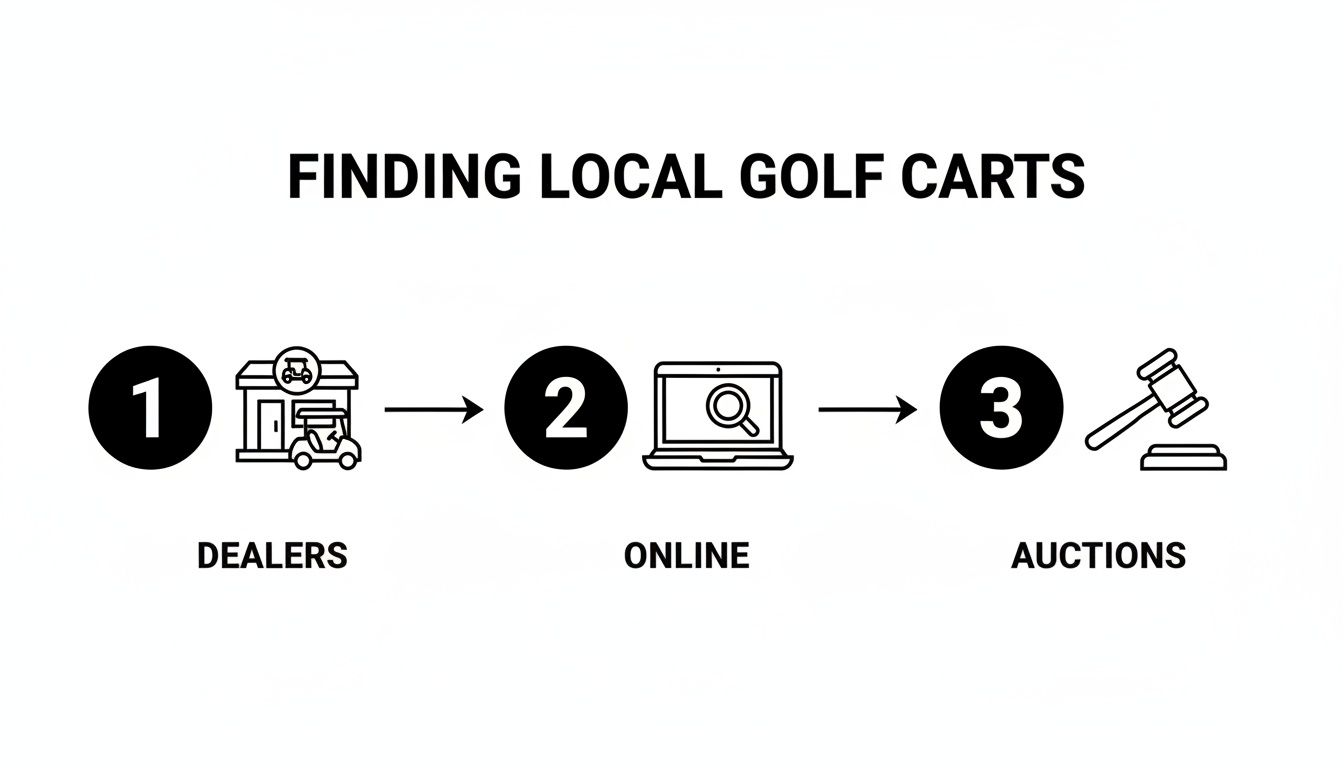
A successful search really comes down to combining these professional sources with direct-from-owner listings. This strategy maximizes your chances of finding a great deal on a cart that fits your needs perfectly.
To help you decide where to focus your energy, here’s a quick breakdown of the most common places to find local listings.
Where to Find Used Street-Legal Golf Carts Locally
| Listing Source | Pros | Cons |
|---|---|---|
| Local Dealers | Inspected/certified carts, potential for warranties, one-stop shop for viewing multiple models, post-sale support. | Higher prices due to overhead, less room for negotiation. |
| Online Marketplaces | Lower prices, direct communication with the owner, wide variety of listings, potential for great deals. | Higher risk of scams or misrepresentation, carts are sold "as-is," requires more due diligence. |
| Auctions | Opportunity for significant savings, access to fleet vehicles that were often well-maintained. | "As-is" sales with no test drives, competitive bidding can drive up prices, requires quick decisions. |
Each path has its merits. If you value peace of mind and support, a dealer is a great choice. If you're a savvy buyer looking for the best possible price, online marketplaces and auctions are where you'll want to spend your time.
Exploring Reputable Local Dealers
Starting your search with established golf cart dealers in your area is often the safest route. These shops usually offer certified pre-owned (CPO) models that have already been inspected by a mechanic. Some even come with a limited warranty, which is a huge plus when buying used.
The biggest advantage is being able to see multiple carts in one place. You can compare models from top brands like Club Car, E-Z-GO, and Yamaha side-by-side, which is much harder to do when dealing with private sellers. Dealers are also a great source for finding a quality golf cart for sale near you because they've already vetted their inventory.
Uncovering Gems on Online Marketplaces
Platforms like Facebook Marketplace, Craigslist, and OfferUp are absolute treasure troves if you know what you’re looking for. These sites connect you directly with the owner, which often means lower prices since there’s no dealer markup.
To find the good stuff, you need a smart search strategy:
- Use Specific Keywords: Don't just search "golf cart." Try terms like "street legal golf cart," "LSV golf cart," and "neighborhood electric vehicle (NEV)" to narrow down the results.
- Set Up Alerts: Most platforms let you save searches and get notifications. Set one up for your criteria (e.g., "4 seater street legal cart") so you’re the first to know when a new listing goes live.
- Scan for Details: Good listings have clear photos from all angles, a detailed description, and specifics about battery age and any upgrades. Be wary of listings with one blurry photo and a one-sentence description.
Pro Tip: When you contact a private seller, ask pointed questions like, "When were the batteries last replaced?" or "Do you have the title in hand and is it clear?" Vague, evasive answers are a major red flag.
Considering Local and Specialized Auctions
Don't sleep on auctions as a source for a great deal. Golf courses, resorts, and local municipalities often sell off their fleets, and these carts are typically well-maintained, even if they have higher hours.
Government surplus auctions can also be a goldmine for LSVs that were used on large properties or campuses. Check out local auction house websites and government surplus sites for upcoming sales in your area. This route takes a bit more effort—carts are almost always sold "as-is" with no chance for a real inspection—but the potential savings can be massive.
The demand for these vehicles isn't slowing down. The global used golf cart market hit USD 976.6 million in 2024 and is expected to keep growing, largely thanks to their popularity in resorts and master-planned communities. With over 16,000 golf courses in the U.S. alone, there's a steady stream of used carts hitting the secondary market.
The Essential Pre-Purchase Inspection
Alright, you've found a promising local listing. This is where the real work begins. Photos and a friendly chat with the seller are a good start, but nothing beats a thorough, hands-on inspection to protect you from buying someone else’s headache.
This isn't just about kicking the tires. It’s a methodical deep dive to uncover hidden problems that could turn your great deal into a money pit.
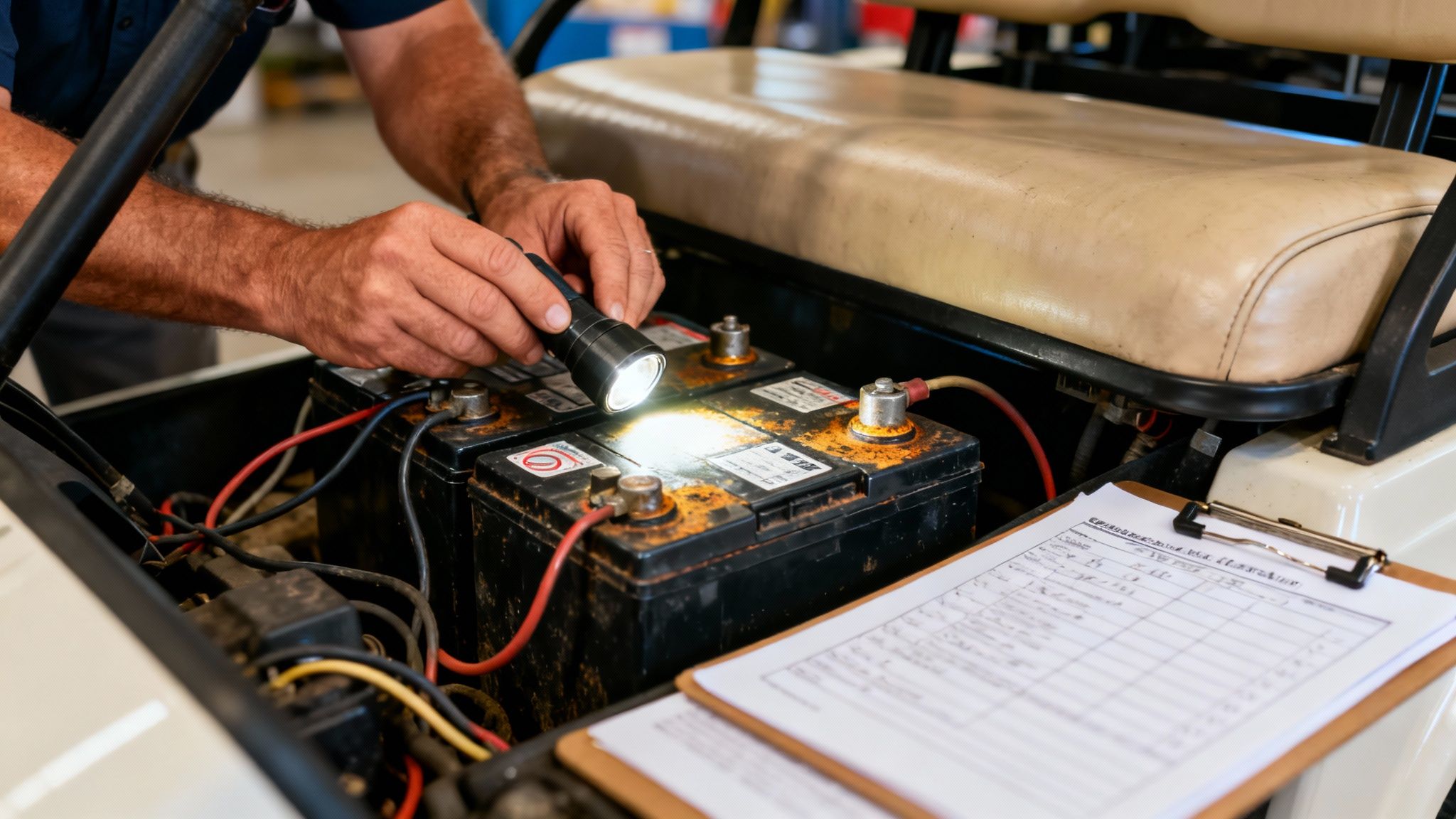
Think of yourself as a detective for the next 30 minutes. Your job is to look past the shiny paint and assess the parts that truly matter for the cart's health, safety, and real value. A systematic approach means you won't miss any critical red flags.
Decoding the Battery Compartment
For any electric golf cart, the batteries are everything. They're the single most expensive component to replace, and their condition is a massive factor in the cart's worth. A brand-new set of lead-acid batteries can run you $800 to $1,500, so you need to know exactly what you're looking at.
First, find the date code stamped on one of the battery terminals. It's usually a letter and a number, like G-2, which would mean July of 2022. If those batteries are pushing four years or older, you should factor the cost of a new set right into your offer price.
Now, get your eyes (and a flashlight) on the batteries themselves:
- Corrosion: Look for that tell-tale white or bluish fuzz building up on the terminals and cable ends. Heavy corrosion is a classic sign of poor maintenance.
- Cables: Wiggle the cables. Are they tight? Check for any fraying, cracking, or signs of overheating.
- Battery Cases: Inspect the plastic casings for any swelling, bulges, or cracks. A bloated battery is a dead battery waiting to happen.
- Water Levels: If they're standard lead-acid batteries, pop the caps and check the water levels. If they're bone-dry, it’s a sure sign of neglect.
For a deeper dive, check out this guide on used golf cart batteries. Arming yourself with this knowledge is your best negotiating tool when a seller claims the batteries are "practically new."
Examining the Frame and Drivetrain
With the battery check done, it's time to get a little dirty. Grab your flashlight and get low to inspect the cart’s bones—the frame and suspension.
Check for rust, especially on steel-framed carts common in older models. A little surface rust is no big deal, but deep, flaky corrosion can compromise the whole structure. On newer aluminum frames, check the welds for any hairline cracks or signs of stress. This is absolutely critical for carts from coastal areas where salty air does a number on metal.
Next, let's check the drivetrain. With the cart off, give it a good rock back and forth. Do you hear any clunking from the rear end? That could mean worn-out gears or bearings. While you're back there, look for any signs of oil leaks around the differential housing. A greasy film is a bad sign and points to a repair job you don’t want to inherit.
A cart might look great, but a compromised frame or a noisy drivetrain are potential deal-breakers. These foundational problems are far more serious than cosmetic flaws and often cost more to fix than the cart is worth.
Verifying Street-Legal Compliance
This part is non-negotiable. A seller can call a cart "street-legal" all day long, but it’s up to you to confirm it has all the right equipment—and that it all works. Your local DMV sets the final rules, but the federal LSV standards are a fantastic starting point.
Go through this checklist methodically. Test everything.
- Lighting: Flip on the headlights (check high and low beams), taillights, and brake lights. Have the seller step on the brake while you watch from behind.
- Turn Signals: Test both front and rear signals, left and right.
- Horn: Give it a good press. Is it loud enough to actually be heard in traffic?
- Mirrors: The cart must have a rearview mirror and a driver-side mirror. Make sure they’re secure.
- Windshield: It should be AS1 or AS5 safety glass (the marking is usually in a corner) and free of any large, vision-obstructing cracks.
- Seat Belts: There must be a working seat belt for every seat. Buckle and unbuckle each one.
- Reflectors: Look for red reflectors on the rear and amber ones on the sides/front.
If any of these components are missing or broken, the cart can't be legally registered for the road. Fixing these issues can add hundreds of dollars to your purchase, quickly turning that "great deal" into a frustrating and expensive project.
Mastering the Test Drive and Safety Check
Forget a quick spin around the block—that’s not a test drive. This is your single best chance to get a real feel for the cart's mechanical and electrical soul. You’re moving past what it looks like and finding out how it actually runs.

Think of yourself as a detective. Every little sound, weird vibration, or sluggish response is a clue to the cart’s past life and potential future headaches. What you notice here will either seal the deal or give you every reason you need to walk away.
Evaluating Performance and Handling
Start on a nice, flat stretch of pavement where you can get your bearings without any surprises. Don't just punch it. Ease into it and pay attention.
Gently press the accelerator. Does it glide forward smoothly, or does it lurch and hesitate? A buttery-smooth takeoff points to a healthy motor and controller. Any stuttering is a classic sign of electrical gremlins, which can be a nightmare to track down and fix.
Now, open it up a bit. A true street-legal LSV should have no problem hitting 20-25 MPH. As you get up to speed, listen. You want to hear a steady, low-pitched hum from the motor. Any loud whining, grinding, or clunking noises are serious red flags. That’s the kind of sound that often means expensive problems with motor bearings or differential gears are just around the corner.
Next, get a feel for the steering and suspension.
- Steering Feel: The wheel should feel connected and responsive, not like you're stirring a pot of soup. Weave a little from side to side. If there's a lot of "play" before the wheels actually turn, you could be looking at worn-out tie rods or other steering components.
- Suspension Check: Try to find a few bumps or an uneven patch of road. A good suspension will soak them up. If the cart feels like it's bouncing all over or bottoms out easily, the shocks or bushings are likely shot.
Here's a pro tip: always do a "hill test" with a used electric cart. Find the steepest, safest hill you can and drive up it. If the cart slows to a crawl or feels like it's struggling, that’s a dead giveaway for weak batteries or a tired motor that can't deliver the torque anymore.
Testing the Brakes and Safety Systems
The brakes are, without a doubt, the most important safety feature. They have to work, and they have to work well every single time.
Start by testing them at different speeds. First, do a few slow, gradual stops to feel for smoothness. Then, from a safe speed like 15 MPH, hit the brakes firmly. The cart needs to stop straight and true. If it pulls hard to one side, you might have a seized caliper or unevenly worn brake pads.
Listen closely, too. A high-pitched squeal usually just means the brake pads are getting thin. But a harsh, grinding noise? That's metal on metal, my friend. That means the pads are gone, and you're already looking at a more involved and costly repair.
While you’re driving, make it a point to test all the other street-legal gear:
- Brake Lights: Have the seller stand back and watch as you tap the brakes. Do they light up instantly?
- Turn Signals: Use your signals for every turn you make. Make sure they blink consistently on both sides.
- Horn: Give the horn a couple of quick beeps. Is it loud enough to actually get someone's attention?
Testing these things while the cart is moving is key. Sometimes a faulty wire or connection only acts up when the cart is bouncing down the road. Running through this checklist on the move is the most efficient way to confirm the cart isn't just visually complete, but truly road-ready.
Smart Pricing and Negotiation Strategies
Alright, you’ve done the inspection, you've taken it for a spin, and you know the cart’s condition inside and out. That knowledge is your biggest asset now because it's time to talk numbers.
Negotiation doesn't have to be a confrontation. Think of it more as a calm, informed conversation. The goal is simple: to land on a price that feels fair to both you and the seller, based on the cart's actual value, not just the sticker price.
Researching The Fair Market Value
Before you even think about making an offer, you need a solid grasp of the fair market value. You're looking for the going rate for that specific make, model, and year. This single step will keep you from overpaying and give your offer the credibility it needs.
Start by jumping on local online marketplaces. Facebook Marketplace and Craigslist are great places to see what similar carts are listed for in your area. Look for the same brand (Club Car, E-Z-GO, etc.), a similar age, and—most importantly—street-legal status.
The age of the batteries is the biggest wildcard here. A cart with a brand-new set is worth a lot more than one with batteries from five years ago. Jot down the asking prices for a few comparable carts to get a realistic range. This research will immediately tell you if the seller's price is in the right ballpark or way off base. For a really deep dive into all the factors that influence what you should pay, this complete buyer's guide on golf cart pricing is an excellent resource.
Don't forget, you're buying into a hot market. The North American golf cart scene is expected to grow from USD 0.72 billion in 2025 to a whopping USD 1.13 billion by 2033. Street-legal models are a huge part of that boom, which keeps the used market strong. In the U.S. alone, the used cart market is projected to clear USD 995 million by 2034. That's a lot of carts changing hands!
Using Your Inspection As Leverage
That checklist you ran through earlier? It wasn’t just to avoid buying a lemon; it’s your best negotiation tool. Every single issue you uncovered, big or small, represents a real cost you’ll have to eat after you buy it. That's your leverage.
I always make a quick list of the problems I find and ballpark the cost to fix them.
- Old Batteries (4+ years): This is your number one bargaining chip. A new set of batteries will run you anywhere from $800 to $1,500.
- Worn Tires: If the tread is getting low, that's a future $200-$400 expense waiting to happen.
- Cracked Windshield: A non-DOT windshield or one with a big crack has to be replaced for safety and legality.
- The Small Stuff: Don't brush off a torn seat or a busted taillight. Those little repairs add up quickly.
When you bring these up, your tone is everything. Be respectful. Instead of saying, "These batteries are shot," try something like, "I saw the batteries are dated 2019, so they’re getting close to the end of their lifespan. I'll need to budget around $1,000 for a new set pretty soon." This frames it as a future cost for you, not an attack on their cart.
The whole point is to justify your offer with cold, hard facts. By tying your price to specific, tangible issues, you shift the conversation from a back-and-forth haggle to a logical discussion about the cart’s true value today.
Making Your Offer And Navigating The Conversation
Now for the main event. A good starting point is to offer 15-20% below what you’re ultimately willing to pay. Just be careful not to throw out a ridiculously low number that might shut down the conversation before it even starts. Let your market research be your guide.
When you make your offer, immediately explain why. For instance: "Based on what similar carts are selling for locally, and factoring in the cost of new batteries and tires, my offer is $X."
Expect a counteroffer—it’s just part of the dance. Stand your ground, stay polite, and keep bringing the conversation back to the facts from your inspection. If you're dealing with a private seller, having cash ready to go can be a powerful tool. The sight of cash often convinces a seller to accept a lower price for a quick, drama-free sale.
Dealerships usually have less wiggle room on the price, but you can still negotiate for value. Ask if they can throw in a 30-day warranty, deliver it with a full charge and detail, or give you a discount on future service. Sometimes the best deals aren't about the price tag. By being prepared, professional, and confident in your research, you put yourself in a great position to get a fantastic deal.
Finalizing the Deal with Paperwork and Insurance
So you've found the perfect cart, taken it for a spin, and settled on a price. You shake hands, but don't pull out your wallet just yet. The deal isn't truly done until the paperwork is squared away and that golf cart is legally yours.
This is the part where a great deal can turn into a huge headache. Getting the paperwork right is crucial for a smooth transfer, so let’s walk through exactly what you need to do to get your new ride on the road without any frustrating trips to the DMV.
The Essential Document Checklist
Before any money changes hands, you need to have the right documents in your possession, all properly filled out and signed. It’s amazing how a missing signature or the wrong form can bring everything to a grinding halt.
Here's what you absolutely must get from the seller:
- The Certificate of Title: This is the big one. The seller's name must be on the front, and they need to have signed their name in the designated "seller" section on the back. No title, no deal.
- A Bill of Sale: Even if your state doesn't technically require it, always get one. It’s your official receipt. It should clearly list the cart's year, make, model, Vehicle Identification Number (VIN), the price you paid, and the date. Make sure both you and the seller sign it.
- Lien Release Letter: If the seller originally had a loan on the cart, you need official proof it’s been paid off. This is a formal letter from their bank stating the loan is satisfied. Sometimes the title itself isn't enough if the DMV’s system hasn't been updated yet.
Pro tip: The very first thing you should do is match the VIN on the title to the VIN plate on the golf cart frame. If they don't match exactly, walk away. This is a non-negotiable red flag.
Registering Your LSV with the DMV
With a folder full of the right paperwork, your next stop is the local DMV (or whatever your state calls its motor vehicle agency). This is where you'll officially make the cart yours by transferring the title and getting it registered as a Low-Speed Vehicle (LSV).
The process is pretty similar from state to state. You'll need to bring the signed title, your bill of sale, and proof of insurance. Don't forget your driver's license, either. You’ll have to pay a few fees for the title transfer, registration, and any sales tax due on the purchase price. For a deeper dive into state-specific rules, our guide on golf cart registration is a great resource.
Securing the Right Insurance Coverage
You can't legally drive your street-legal golf cart on a public road without proper insurance. Period. At a minimum, most states require the same basic liability coverage you'd have for a car, which covers bodily injury and property damage if you're at fault in an accident.
But I'd strongly suggest going beyond the bare minimum. Think about adding comprehensive and collision coverage. This protects your investment from things like theft, vandalism, or damage from a fender-bender.
Your first call should be to your current auto insurance agent. They can often add an LSV to an existing policy for a pretty reasonable cost. If that's not an option, plenty of major carriers offer specific policies for golf carts. Get a few quotes to see who offers the best coverage for the price.
It's no surprise these vehicles are so popular. Electric street-legal golf carts are poised to capture 95.3% of the global market by 2025, largely because they are so cheap to run. With electricity costs often 70-80% less per mile than gas, the savings really start to add up. And the market is hot—a recent check showed nearly 42,000 used listings, proving there's a healthy supply out there for savvy buyers. You can learn more about the rise of electric carts at Future Market Insights.
Got Questions? We’ve Got Answers.
Even after doing your homework, a few questions always seem to pop up when you're deep in the search for a used street-legal golf cart. It's completely normal to have some last-minute hesitations before you pull the trigger. Here, we'll tackle the most common questions we get from buyers, giving you clear, no-nonsense answers to help you buy with confidence.
Think of this as your go-to cheat sheet for all those "what if" moments that can creep in. We'll clear up some important distinctions and get into the practical details that matter most.
What Really Makes a Golf Cart Street-Legal?
This is a big one. A lot of people wonder what the actual difference is between a regular golf cart and one you can legally drive on the road. A street-legal golf cart isn't just a cart with a few extras; it's a specific class of vehicle called a Low-Speed Vehicle (LSV). To earn that title, it has to meet a strict checklist of federal and state safety standards.
It’s not just a suggestion box—these features are mandatory for an LSV:
- Headlights, taillights, and working brake lights
- Front and rear turn signals
- A horn and proper rearview mirrors
- A DOT-approved windshield (not just a flimsy plastic one) and seatbelts for all passengers
- A registered Vehicle Identification Number (VIN)
- A top speed between 20 and 25 MPH
Your standard golf course cart won't have any of this. It's designed for private property, period. Taking one out on a public road is a surefire way to get a hefty fine, and more importantly, it's just not safe.
The Truth About Battery Life and Replacement Costs
When it comes to electric carts, the batteries are everything. It’s the single biggest concern for most buyers, and for good reason. The old-school lead-acid batteries, which are still very common, will typically give you 3-5 years of service. But that number depends entirely on how the previous owner treated them.
When you're looking at a cart, find the date codes stamped on the battery terminals. If they're pushing four years or older, you need to budget for a full replacement, and soon. This isn't pocket change—you're looking at anywhere from $800 to over $1,500 for a new set. This should absolutely be a bargaining chip in your negotiation.
The real value of a used electric cart is tied directly to the health of its batteries. A cart with a brand-new set is worth a whole lot more than the exact same model with a pack on its last legs.
Now, if you stumble upon a used cart with lithium-ion batteries, pay attention. They’re a significant upgrade, often lasting 8-10 years with almost no maintenance. Finding a cart with a newer lithium pack is like hitting the jackpot.
Can I Just Convert a Regular Golf Cart Myself?
Technically, yes, you can convert a standard cart into an LSV, but it’s rarely a simple weekend project. You'll have to buy and install a street-legal kit with all the required safety gear, and that's just the start.
Once the parts are on, the real fun begins: bureaucracy. The cart has to be officially inspected to certify it meets every LSV requirement. If it passes, you then have to navigate the DMV to get it retitled as a Low-Speed Vehicle. The rules, costs, and headaches for this process vary wildly from state to state. Before you even think about it, do some serious research on your local laws. Honestly, it's often cheaper and a whole lot easier to just buy a cart that was built and titled as an LSV from the factory.
At Solana EV, we specialize in premium, street-legal electric vehicles that are ready for the road from day one. Explore our lineup of new and pre-owned models designed for performance, safety, and style. Visit us online to find the perfect vehicle for your community or business at https://solanaev.com.