
If you want to boost operational efficiency, the first real step is to get a clear picture of what’s actually happening on the ground. You need to map your existing workflows to see where the snags, slowdowns, and unnecessary steps are hiding. This isn't just busywork; it's the essential diagnostic that lets you make smart, targeted changes that genuinely save time and cut costs.
Pinpoint Inefficiencies by Mapping Your Workflows
Before you can fix anything, you have to understand how it works right now—not how you think it works. So many businesses run on old assumptions, only to find a huge gap between the process on paper and the day-to-day reality. The goal here is to stop guessing and build a true-to-life blueprint of your operations.
This is often called workflow mapping or a process audit. Think of it as the foundation for everything else. Without this clarity, any effort to improve is just a shot in the dark. It’s not about finding someone to blame; it’s about understanding the system.
Start with High-Impact Workflows
Don't boil the ocean. Trying to map your entire company's operations at once is a recipe for disaster—it’s overwhelming and usually ends in analysis paralysis. Instead, pick one or two core workflows that are either mission-critical or a known source of headaches.
Good places to start often include:
- Customer Onboarding: From the moment a client signs on the dotted line to when they're actively using your service.
- Order Fulfillment: The entire journey of an order—from click to doorbell ring—including picking, packing, and shipping.
- Invoice Processing: The full cycle of getting paid, from creating and sending an invoice to chasing it down and closing it out.
When you focus on a high-volume or notoriously clunky process, any improvement you make delivers an immediate, visible payoff.
Document Every Single Step
Once you've picked a workflow, it’s time to get granular. The goal is to document every single action, decision, and handoff. The most important thing you can do here is talk to the people who live and breathe this process every day. Their on-the-ground perspective is pure gold.
For example, a logistics company mapping its delivery process wouldn't just write "pick up package" and "deliver package." A real map gets into the nitty-gritty: logging the pickup, scanning the barcodes, updating the system, planning the route, talking to dispatch, capturing proof of delivery, and finally, closing out the task in the software. Each of those tiny steps is a potential point of failure or a place to gain efficiency.
Visualizing it all helps immensely. Laying out the process on a whiteboard, as shown below, can turn a complex set of tasks into a flowchart that anyone can understand.
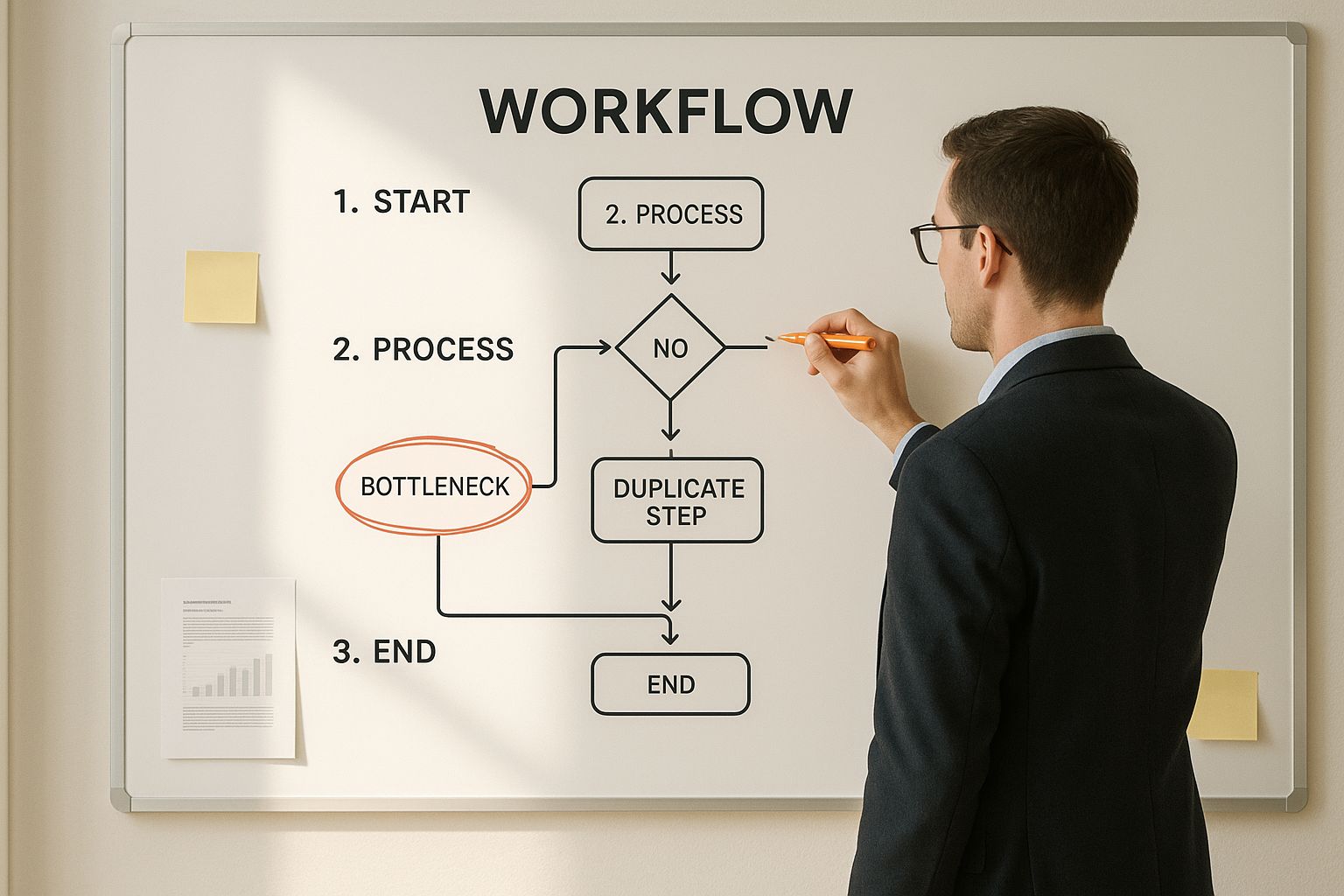
This kind of visual map makes it so much easier to spot where things are going wrong.
Identify the Bottlenecks and Redundancies
With your workflow mapped out visually, the analysis can begin. You're hunting for the usual suspects that kill efficiency. Is there a point where work constantly piles up, waiting for one person's approval? That's a classic bottleneck. Do your people have to enter the same customer data into three different systems? That's a painful redundancy.
A recent study on business processes revealed that 74% of respondents felt that automating manual tasks offered the greatest potential for improvement. That tells you just how much opportunity is locked away in those repetitive, manual steps you’re about to uncover.
Look at your map and start asking the tough questions:
- Is this step really necessary? Why?
- Could a machine do this faster and more accurately?
- Is there a simpler way to get the same result?
- Where do mistakes happen most often?
The answers will point you straight to the low-hanging fruit—the changes that will give you the biggest bang for your buck. This map isn't just a one-time exercise; it becomes your strategic guide for making every subsequent improvement deliberate and impactful.
Use Smart Automation to Eliminate Repetitive Work

After mapping out your workflows, you’ll probably start to see a few patterns emerge. Many of the hang-ups, bottlenecks, and just plain frustrating parts of the day often boil down to high-volume, repetitive tasks that your team has to slog through. This is exactly where automation can make a massive difference.
Let's be clear: this isn't about replacing talented people. It's about freeing them from the monotonous work so they can focus on what humans do best—solving tricky problems, thinking strategically, and connecting with customers. By handing off the repetitive stuff to software, you speed things up and drastically cut down on the risk of human error.
Identifying Prime Candidates for Automation
The trick is to start small. Don't try to automate everything at once. Look for the low-hanging fruit—tasks that will give you the biggest bang for your buck without a ton of complex setup. You're searching for work that is predictable and doesn't need a human's judgment call.
Think about the daily grind. What are the tasks that make your team’s eyes glaze over?
Here are a few tell-tale signs that a process is begging to be automated:
- It’s High Volume: Is it something that happens dozens, or even hundreds, of times a day? Think sending out order confirmations or updating a spreadsheet.
- It’s Rule-Based: If you can map it out with simple "if this, then that" logic, a machine can almost certainly handle it.
- It’s Prone to Errors: Manually entering data or copying information from one system to another is a classic recipe for costly mistakes.
- It’s a Time Sink: Any task that eats up a significant chunk of your team's day without adding real strategic value is a perfect candidate.
I've seen firsthand how impactful automation can be. One of the most effective ways to increase operational efficiency is by letting tools handle the repeatable work, which drives consistency and helps you scale without adding headcount. For anyone serious about digital transformation, this is a must. If you're interested in future trends, SDocs has a great piece on what's coming for operational efficiency in 2025.
Real-World Automation Scenarios
Let's get practical. Imagine a delivery company that automates sending a text message with a tracking link the second a package gets scanned onto a truck. That one simple action can eliminate hundreds of "Where's my order?" calls, freeing up your customer service reps to handle the genuinely complex issues.
Or think about an accounting team that spends hours every month manually matching invoices to purchase orders. An automation tool can scan incoming invoices, pull the key data, check it against the PO system, and just flag the exceptions for a human to review. A process that once took days becomes a quick check-in that takes a few minutes. This is a perfect example of how to reduce operational costs with smart tech.
Automation is the key to unlocking human potential. When you automate the mundane, you empower your team to focus on innovation and growth—the very activities that drive a business forward.
Ultimately, you want to build a system where technology handles the predictable, leaving your team with the mental space to manage the exceptions and push the business forward.
High-Impact Automation Opportunities
Every department has its own flavor of repetitive work just waiting to be automated. To give you some ideas, this table breaks down a few common business functions and the specific tasks that are often great starting points.
| Business Function | Task to Automate | Expected Efficiency Gain |
|---|---|---|
| Sales & Marketing | Sending lead follow-up emails | Increased lead engagement; 20% reduction in manual outreach time |
| Customer Service | Answering common support questions with a chatbot | 24/7 support availability; 30% fewer routine tickets for agents |
| Human Resources | Onboarding paperwork and system access setup | Faster new hire integration; 50% reduction in administrative onboarding tasks |
| Operations | Generating weekly performance reports | Real-time data access; eliminates 5-10 hours of manual compilation weekly |
By being strategic about where you apply automation, you create a ripple effect. It's not just about saving time on one task; you're improving the speed and accuracy of the entire workflow. This builds momentum and shows your team the real-world value of working smarter.
Unify Your Operations with Integrated Technology

If you've ever watched a team member copy-paste data from a sales report into an operations spreadsheet, you've witnessed the damage of siloed data firsthand. It’s a slow, error-prone process that just kills momentum.
When your essential business tools don't talk to each other, you create invisible walls between departments. This forces your staff into the frustrating job of manually piecing together information that should be readily available.
This information gap is more than just an annoyance; it's a major roadblock. Decisions get made with incomplete data, and what should be smooth handoffs between teams become clumsy, multi-step procedures. The solution is to create a single source of truth where information flows seamlessly across your entire organization.
The High Cost of Disconnected Systems
Fragmented technology is surprisingly common. Research shows that about 50% of businesses use an average of 17 disconnected work tech solutions, while a mere 4% have fully integrated platforms.
This forces 37% of organizations to hire 11 or more full-time employees just to compile and analyze operational data. When you unify your tech stack, you're not just buying software; you're buying back your team's time and focus. You can dig into this research and its impact on the 2025 workplace statistics on Eptura.com.
Let's apply this to a fleet management scenario. If your dispatch software, vehicle maintenance logs, and accounting system are all separate, a fleet manager has to jump between three different screens just to answer a simple question: "Is this vehicle profitable?"
With an integrated system, that data is all connected. You can see a vehicle's route history, fuel consumption, and repair costs in one place, giving you a clear, immediate view of its contribution to the bottom line. This is a core part of effective fleet management best practices.
A unified system transforms data from a historical record into a real-time decision-making tool. Instead of asking, "What happened last month?" you can ask, "What's happening right now?" and get an immediate, accurate answer.
Choosing Your Integration Strategy
Creating this unified view doesn't mean you have to throw out all your existing software and start from scratch. There are two main paths you can take, and the right one really depends on your company's size, complexity, and budget.
1. The All-in-One ERP Approach
An Enterprise Resource Planning (ERP) system is a massive software suite designed to be the single platform for everything—from finance and HR to supply chain and customer relationships. This approach is incredibly powerful because it guarantees seamless data flow by design.
- Best for: Larger companies or those with highly complex operations that need a single, tightly controlled system.
- Pros: Guarantees a single source of truth; eliminates data duplication; dramatically simplifies reporting.
- Cons: Can be expensive and time-consuming to implement; often requires changing your business processes to fit the software, not the other way around.
2. The Best-of-Breed Integration Approach
This strategy is about keeping the specialized tools your teams already know and love—like a specific CRM for sales or a particular accounting software—and connecting them with a modern integration platform. These platforms, often called iPaaS (Integration Platform as a Service), act as a central hub that translates data between your different applications.
- Best for: Small to mid-sized businesses that want flexibility and need to connect existing tools without a massive overhaul.
- Pros: More affordable upfront; lets teams use best-in-class tools for their specific functions; much faster implementation.
- Cons: Requires managing multiple vendor relationships; the whole system is only as good as the integration platform holding it together.
No matter which path you choose, the goal is the same. You want to ensure that when a salesperson closes a deal, the operations team is instantly notified, and the finance team can generate an invoice without re-entering a single piece of data. This is how you drive operational efficiency at its most fundamental level.
Gain a Competitive Edge with Digital Transformation
Implementing new software is just one piece of the puzzle. Real digital transformation is about fundamentally changing how your business runs and delivers value to customers. It’s a strategic shift that moves you from simply putting out fires to proactively preventing them, turning your operations into a true source of competitive advantage.
This shift is fueled by modern tools that generate a constant stream of usable data. Instead of guessing, you start making decisions based on what’s happening in real-time. This is a core principle for any business serious about figuring out how to increase operational efficiency.
From Reactive Fixes to Proactive Management
Let's look at equipment maintenance. The old way is to wait for a critical piece of machinery to break down. Production grinds to a halt, you rack up expensive delays, and everyone scrambles to fix it. This is purely reactive and, frankly, a terrible way to run a business.
Now, imagine a different approach. By installing simple Internet of Things (IoT) sensors on that same equipment, you can monitor its performance around the clock. These sensors track vibration, temperature, and other vital signs, feeding data into a system that can predict a potential failure weeks before it happens. This means you can schedule maintenance during a planned shutdown, completely avoiding that costly downtime.
This proactive model works across the entire business:
- Customer Relationship Management (CRM): A good CRM does more than just store contact info. It tracks every single customer interaction, building a complete picture of their journey. Your sales and support teams can then anticipate needs, spot upsell opportunities, and solve problems before they escalate. It smooths out the whole customer lifecycle.
- Supply Chain Visibility: Instead of tracking shipments with outdated manifests, digital tools give you real-time location data. You can see exactly where your inventory is, predict delivery times with much better accuracy, and pivot quickly if a delay pops up. This keeps operations running smoothly and your customers in the loop.
When you use technology this way, you’re not just patching holes—you’re building a smarter, more resilient operation from the ground up.
Building an Advantage with Data-Driven Innovation
Companies that go all-in on digital transformation don't just get more efficient; they get more innovative. The data you gather from these integrated systems offers deep insights into your processes and customer behaviors, revealing opportunities you would have otherwise missed.
For an industry-specific look at using technology to stay ahead, check out these automotive digital transformation strategies. The core ideas of using data to build a competitive edge apply almost anywhere.
The numbers really drive this point home. The digital transformation market in manufacturing alone is projected to hit $642 billion globally by 2025. This growth is happening for a reason: 35% of manufacturing companies have already brought in IoT technologies, and about 60% of them are seeing direct improvements in their operational efficiency. On top of that, businesses using tools like CRM systems see productivity jump by as much as 34%. You can find more stats like these at repordermanagement.com.
True digital transformation is when data stops being a record of what happened and starts being the engine for what happens next. It’s the difference between looking in the rearview mirror and having a clear view of the road ahead.
Ultimately, this shift is about more than just technology. It’s a change in mindset. When your entire organization buys into data-driven decision-making, you empower your teams to spot inefficiencies, test new ideas, and constantly improve. This creates a culture of innovation that doesn't just boost your efficiency today but also positions you to adapt and win for years to come.
Empower Your Team to Drive Efficiency
Even the most advanced technology is only as good as the people using it. You can invest in slick new software and automated systems, but if your team isn't on board and properly trained, those tools will just gather digital dust. The real key to operational efficiency lies with your people.
It’s about more than just showing someone how a new dashboard works. You need to build genuine buy-in and create a culture where your staff becomes an active part of the push for improvement. When you get this right, your team doesn’t just use the new systems—they champion them.
Cultivate a Culture of Continuous Improvement
Your goal should be to build an environment where efficiency isn't just a directive from management; it's a shared mission. This all starts with being open and honest about why changes are happening.
Frame new tools or processes around how they will make your team's day-to-day work better.
- Less Tedious Work: "This new software automates our weekly reports, which means you get those hours back from being stuck in a spreadsheet."
- Fewer Headaches: "We're connecting these systems to stop manual data entry. That's going to slash the number of frustrating errors we have to track down."
- More Engaging Tasks: "By automating this workflow, you can focus on solving bigger customer problems where your experience really matters."
When your staff can clearly see what’s in it for them, you’ll find that resistance fades and engagement skyrockets.
Your team is on the front lines. They see the little hiccups and hidden bottlenecks that managers completely miss. Giving them a voice is one of the quickest ways to find easy wins for efficiency.
This approach turns change from something that's forced on them into something they help shape. It builds a powerful feedback loop where ideas are heard and acted on, proving that their input truly matters.
Invest in Upskilling and Targeted Training
As you bring in more automation, the jobs your team does will naturally evolve. They'll need new skills to manage these smarter systems and tackle the more strategic work that technology frees them up to do. This is where investing in the right training pays off big time.
For example, you can't just toss the keys to a new electric truck to a driver and expect them to know everything. They need specialized training on how to operate the vehicle efficiently, understand charging protocols, and recognize new maintenance cues. For logistics staff, exploring dedicated electric vehicle training programs can provide the exact knowledge needed to get the most out of your EV investment.
And don't stop at technical skills. Focus on building up your team's abilities in areas like data analysis, problem-solving, and process improvement. When you upskill your people, you're not just preparing them for the next software rollout—you're building a more capable, adaptable, and valuable workforce for the long haul.
Adopting top fleet management best practices is another fantastic way to give your team the confidence and the framework to drive efficiency on their own.
Answering Your Top Questions About Operational Efficiency
As you start dialing in your processes, you're bound to run into a few common questions and roadblocks. It happens to everyone. Getting straight answers to these can keep you from losing steam. Let's tackle some of the most common questions I hear from businesses trying to boost their operational efficiency.
Where Should I Even Start?
This one's easy: start where it hurts the most.
It's really tempting to try and overhaul everything at once, but that's a surefire way to get overwhelmed and end up with a bunch of half-finished projects. Instead, look for a quick, meaningful win.
Pick a single, high-impact workflow—maybe it's your customer onboarding process or how you handle order fulfillment. Map it out from start to finish, and pinpoint the one or two biggest bottlenecks holding things up. By focusing all your energy there, you'll see a real difference, fast.
That first success acts as a proof of concept. It builds the confidence and momentum you need to take on bigger challenges across the company.
Don't get bogged down trying to create the perfect plan right out of the gate. The goal isn't perfection; it's progress. Find one problem, solve it, see what happens, and then move to the next.
This targeted approach beats a massive, company-wide initiative every time. Pick your battle, win it, and use what you learned to plan your next move.
How Do I Get My Team On Board with New Processes?
Getting your team to actually want to change is all about inclusion, not mandates. Nobody likes having a new process forced on them, especially when they don't understand why it's happening.
The secret is to bring your team into the conversation from day one.
Instead of cooking up new workflows in a boardroom, ask the people on the front lines for their take. They live with the current process every single day, so they know exactly where the holdups and frustrations are. Their insights are pure gold.
When you talk about the changes, frame them in a way that matters to your team:
- Less Frustration: "This will get rid of that tedious data entry you have to do every afternoon."
- More Interesting Work: "Automating this report means you'll have more time to focus on client strategy."
- A Bigger Impact: "By fixing this, we can get products to customers two days faster, and you're a key part of making that happen."
When you're ready to launch, make sure the training is solid and be available to answer every question. And don't forget to celebrate the wins, no matter how small. Once the team sees the new way is genuinely better, buy-in will take care of itself.
What's the Real Difference Between Efficiency and Productivity?
People often use these words interchangeably, but they're measuring two very different things. Getting the distinction right is key to setting the right goals.
Productivity is all about output. It’s a raw measure of how much you get done. For instance, if one team assembles 100 widgets an hour and another assembles 80, the first team is more productive. It’s a simple ratio of quantity over resources (like time).
Operational efficiency, on the other hand, is about the quality and cost of the process behind that output. It’s laser-focused on cutting out waste—wasted time, wasted materials, and wasted money. It answers the question, "Are we doing this in the smartest, leanest way possible?"
Here's the catch: you can be highly productive within a wildly inefficient system. A team could be working their tails off to hit that 100 widget-per-hour mark, but if their process creates a ton of scrap material, uses redundant steps, and burns through electricity, it's not efficient.
Ultimately, making your operations more efficient is the only sustainable path to long-term productivity. When you streamline a process, you reduce the drag, which naturally allows your team to achieve more without burning out. Efficiency builds the foundation for productivity that lasts.
Ready to enhance your fleet's performance with eco-friendly, high-performance vehicles? Solana EV offers a range of premium, street-legal electric vehicles designed to meet the demands of any commercial or recreational environment. Explore our models and discover how our dealer program can help you lead the charge in sustainable transportation. Visit us at SolanaEV.com.