
Your golf cart's wheels do more than just get you from A to B. They are single-handedly the most powerful upgrade you can make to dial in its performance, safety, and overall style. The right set of golf cart wheels can take a basic utility vehicle and completely transform it into a machine built for the fairway, neighborhood cruises, or even rugged backwoods trails.
Why Your Golf Cart Wheels Are a Game Changer
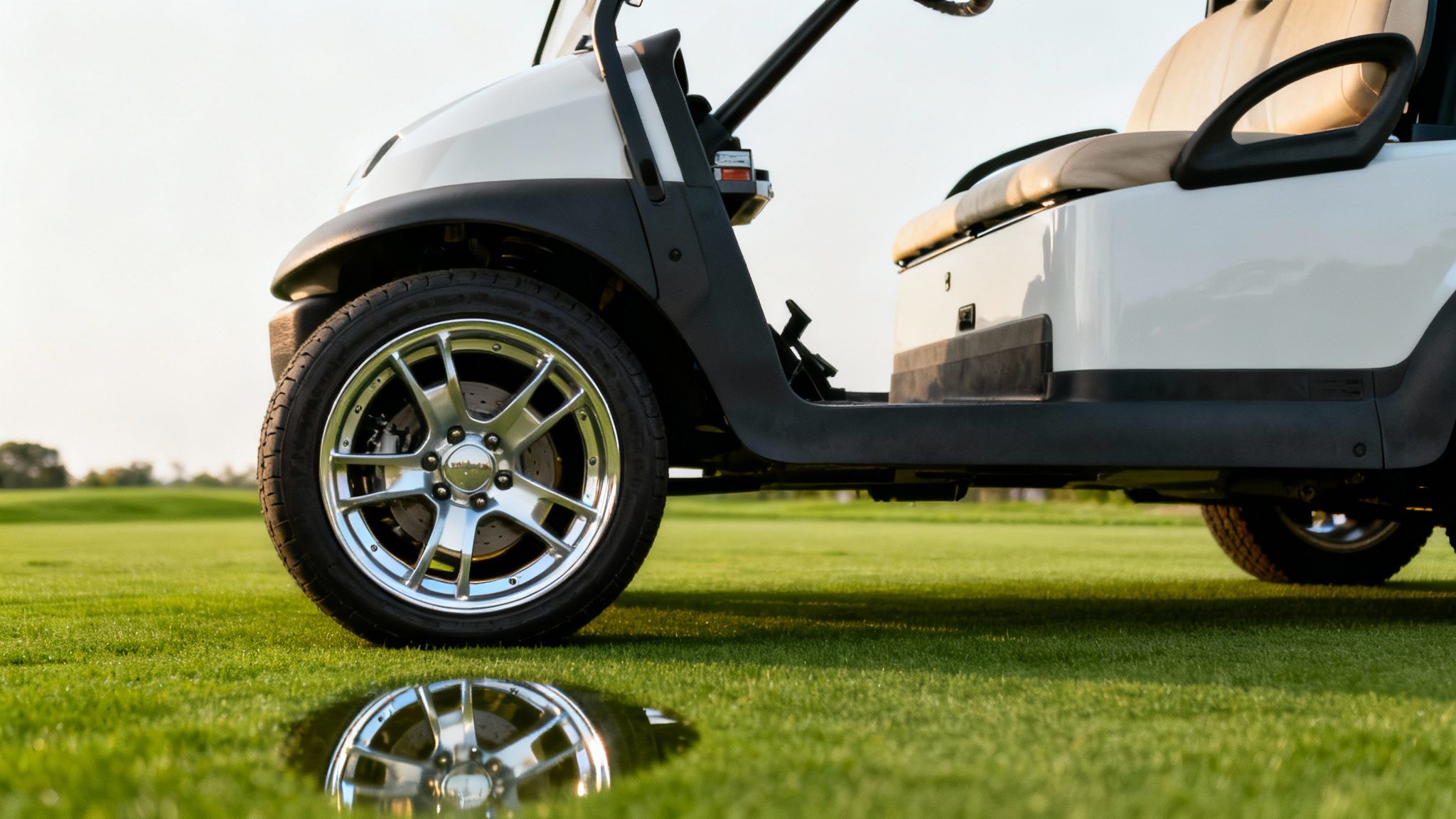
Think of your cart’s wheels as its shoes. You wouldn't wear flip-flops to go hiking, and the same logic applies here—the wheels have to match the job. They're a critical component that directly impacts how your cart handles, how fast it can safely go, and, of course, how it looks. It's where smart engineering meets your personal taste.
This guide is here to break it all down for you. We'll get into the core components, explain the ins and outs of sizing and fitment, and help you pick the perfect set of wheels to completely elevate your ride.
More Than Just a Replacement Part
Swapping out your golf cart wheels isn't just about replacing something that's old or worn out. It's a chance to fundamentally change what your vehicle can do. A thoughtfully chosen wheel and tire combination can deliver some serious upgrades across the board.
- Enhanced Performance: The right tires can give you incredible traction on slick morning grass, a better grip on pavement, or more stability over bumpy ground. This changes everything from how quickly you accelerate to how well you can brake.
- Improved Safety: A wider stance from a different wheel offset can make your cart much more stable and less likely to tip over, which is a huge deal for lifted carts. Properly load-rated tires also ensure you can carry passengers and gear without worry.
- Personalized Style: Let's be honest, custom wheels are one of the best ways to make your cart your own. They can turn a cookie-cutter model into something that truly stands out.
The demand for carts that can do it all has pushed wheel technology forward in big ways. The global golf cart market was recently valued at around USD 2.2 billion and is expected to hit nearly USD 3.4 billion by 2033. Tough, efficient wheels are a massive part of that growth.
Choosing the right wheels is the first step in unlocking your cart’s true potential. It’s where function meets aesthetics to create a better, safer, and more enjoyable ride.
By getting a handle on the options out there, you can make a smart choice that lines up perfectly with how you use your cart. This knowledge ensures your investment doesn't just improve the look of your cart, but its core functionality and how it contributes to your golf cart's speed and handling.
Understanding Rims and Tires
To really get what makes a set of golf cart wheels tick, you have to look at its two main parts: the rim and the tire. It’s a lot like a good running shoe. The rim is the sole—it’s the rigid structure, the foundation that everything else is built on, and where you get a lot of the style. The tire is the tread—that’s your connection to the ground, giving you grip, a smooth ride, and the durability you need for different terrains.
They come together to form the complete wheel, but each one has a very specific and equally important job. Knowing what each part does is the first step to making a smart choice for your cart.
The Rim: Your Cart’s Foundation
The rim is the metal heart of your wheel. It’s the part the tire sits on and what bolts directly to your cart’s axle. But rims do a lot more than just hold up the tire; they have a huge impact on your cart's weight, how it handles on the move, and of course, how it looks.
Your first big decision is the material, and there are really two main games in town: steel and aluminum alloy.
- Steel Rims: Think of these as the reliable workhorses. Steel is tough as nails, super durable, and easy on the wallet, which is why you see it on a lot of standard utility carts. The trade-off? All that strength comes with extra weight, which can make acceleration and handling feel a tiny bit sluggish.
- Aluminum Alloy Rims: This is where things get exciting. Aluminum alloy is way lighter than steel, which cuts down on the "unsprung weight" your suspension has to manage. What that means for you is a noticeably smoother ride, faster get-up-and-go, and steering that feels more responsive. On top of that, aluminum can be shaped into all kinds of incredible designs and finished with chrome, matte black, or machined accents.
While steel definitely gets the job done, switching to aluminum alloy wheels is probably the single biggest upgrade you can make to boost both performance and style. As you start looking at different options, it helps to know what separates quality from junk. Learning about finding the best aftermarket car parts for optimal performance and style offers some great principles that apply just as well to golf carts.
Decoding the Tire: Your Connection to the Ground
If the rim is the skeleton, the tire is the muscle. It’s what delivers traction, cushions your ride, and stands up to wear and tear. Golf cart tire specs can look like a secret code at first, but once you know a few key terms, you’ll be able to pick the perfect set for your needs.
A tire’s specs are its resume, telling you exactly what job it was designed to do. Reading them correctly ensures you get the performance you expect, whether you're on turf, pavement, or a dirt trail.
Let's break down the language of tires.
Tire Terminology You Need to Know
- Ply Rating: This number tells you how strong the tire is and how much weight it can handle. Back in the day, it literally meant the number of cotton layers in the tire. Now, you’ll usually see a letter rating (B, C, or D). The higher the letter, the stronger the tire, meaning it can take more weight and higher air pressure. A higher ply rating is a must for any 4-seater or 6-seater cart.
- Tread Pattern: This is all about the design of the grooves on the tire's surface. Each pattern is engineered for a specific job:
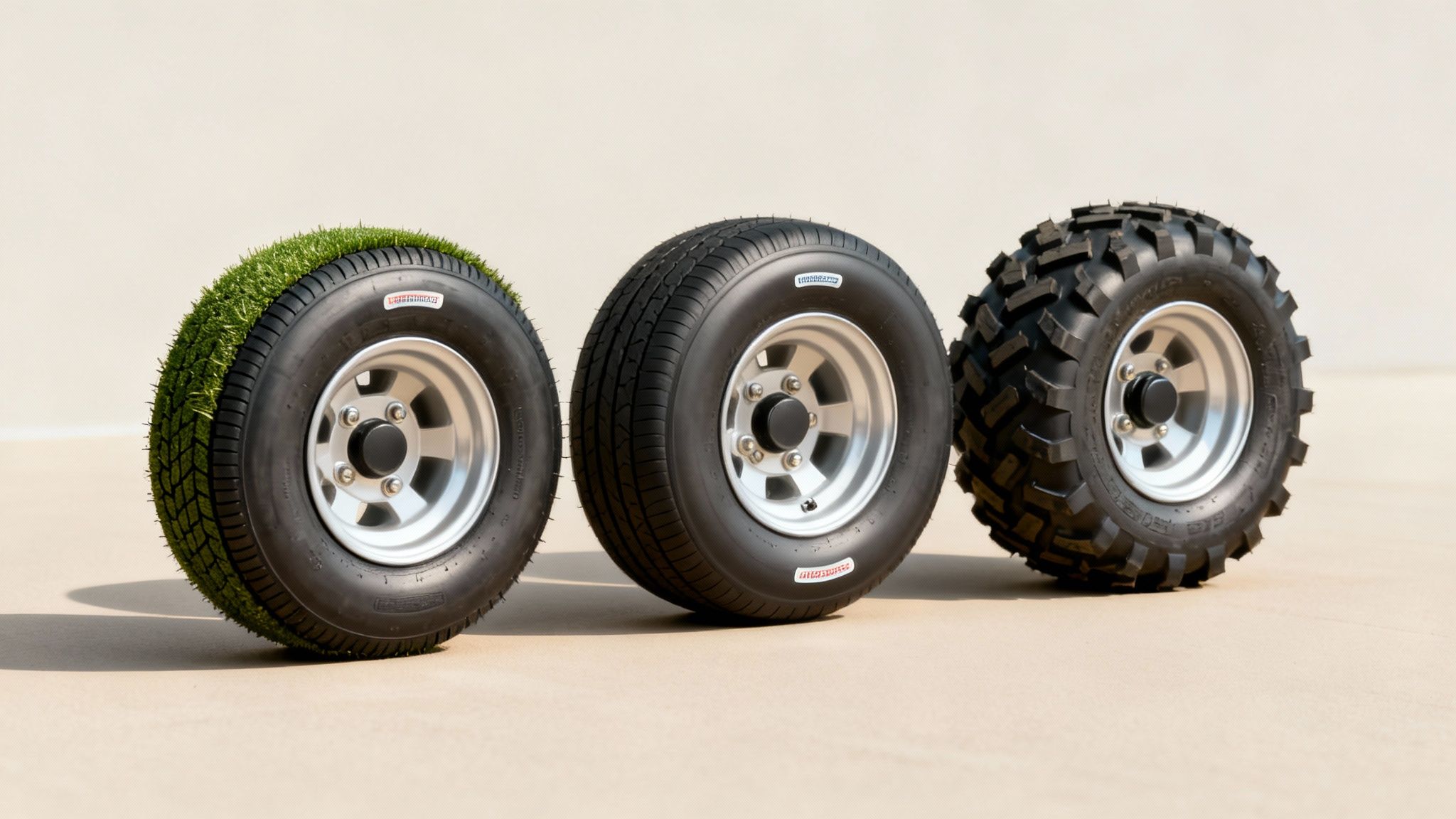
- Turf/Street: Has a very shallow, gentle pattern. It's designed to be kind to grass on the golf course while giving you a quiet, smooth ride on asphalt.
- All-Terrain: This is your do-it-all hybrid. The lugs are deeper for better grip on dirt, gravel, and grass, but not so aggressive that they feel rough on pavement.
- Off-Road/Mud: These are the big boys. They have super deep, aggressive treads designed to dig into loose dirt, mud, and sand for maximum possible traction.
- Sidewall Height: This is simply the distance from the edge of the rim to the top of the tread. A taller sidewall (a "high profile" tire) has more air and rubber to absorb bumps, giving you a softer ride. A shorter sidewall ("low profile") is stiffer, which gives you a sportier look and a more responsive, connected-to-the-road feel. To really see how these numbers fit together, check out our comprehensive golf cart tire size guide, where we lay it all out.
Getting the Perfect Fit for Your Cart
Picking out new golf cart wheels that don't fit is more than just a headache—it’s a costly mistake that can bring your entire project to a screeching halt. To avoid that frustration, you just need to nail three critical measurements: wheel size, bolt pattern, and offset.
Think of it like a combination lock. You need all three numbers to be right for the lock to open, and you need all three of these measurements to line up for the wheels to mount correctly on your cart. Get just one wrong, and the whole setup fails.
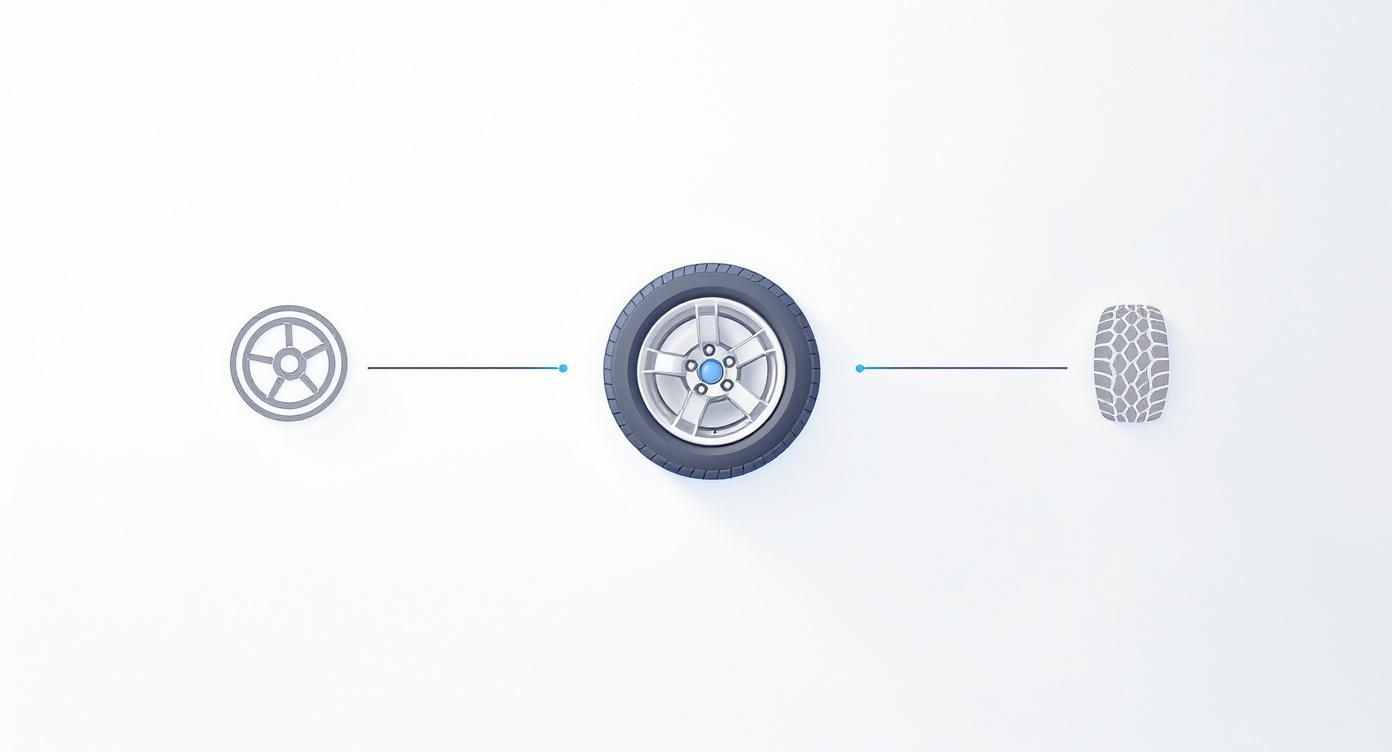
This image helps visualize how the rim and tire work together as a single unit, but each has its own unique sizing to consider.
H3: Cracking the Tire Size Code
That string of numbers you see on a tire’s sidewall—something like 205/50-10—can look like a foreign language. But it’s actually a simple code that tells you everything you need to know about the tire's dimensions. Once you know how to read it, you can tell instantly if a tire will fit your cart and how it will affect your ground clearance.
Let's break down that 205/50-10 example piece by piece:
- 205 (Tire Width): This first number is the tire's width in millimeters, measured from one sidewall to the other. In this case, it's 205mm wide. A wider tire usually means a larger contact patch with the ground, which can boost stability.
- 50 (Aspect Ratio): The second number is all about the sidewall height, but it's shown as a percentage of the width. So, this tire's sidewall is 50% as tall as it is wide (50% of 205mm is 102.5mm). A higher aspect ratio means a taller, cushier sidewall, while a lower number gives you that sportier, low-profile look.
- 10 (Rim Diameter): The last number is the diameter of the wheel rim (in inches) that the tire is designed to fit. This tire is made for a 10-inch rim.
These numbers are crucial because they determine the tire’s overall height. Taller tires can give you more ground clearance, but if they’re too big, they'll rub against the wheel wells and you'll likely need a lift kit.
H3: The Non-Negotiable Bolt Pattern
Next up is the bolt pattern, which is simply the arrangement of the lug holes on the wheel. This is an exact measurement with absolutely no wiggle room. If the bolt pattern on your new wheels doesn't match the hub on your cart, you can't mount them. It's that simple.
The bolt pattern is the handshake between your wheel and your cart. If they don’t match up perfectly, they can’t connect.
Luckily, most modern golf carts from the big names—Club Car, E-Z-GO, and Yamaha—use a standard 4×4 bolt pattern. This means the wheel has four lug holes arranged in a circle with a diameter of four inches.
- The first 4 tells you the number of lug studs on your cart's hub.
- The second 4 is the diameter of the circle formed by those studs, measured in inches.
While 4×4 is incredibly common, it's not a universal rule. Some older carts or less common brands might use something different. The only way to be 100% sure is to measure what you have before you buy. If you want a deep dive into measuring, you can learn how to confirm your golf cart lug pattern with our detailed guide.
To help you get started, here's a quick reference for the major brands.
Common Golf Cart Bolt Patterns and Sizing Guide
This table breaks down the standard bolt pattern for the most popular golf cart manufacturers, along with the typical wheel and tire sizes you'll find from the factory and what people often upgrade to.
| Golf Cart Brand | Standard Bolt Pattern (inches) | Common Stock Tire Size | Popular Upgrade Sizes |
|---|---|---|---|
| Club Car | 4×4 | 18×8.5-8 | 205/50-10, 23×10-12, 23×10-14 |
| E-Z-GO | 4×4 | 18×8.5-8 | 205/50-10, 215/40-12, 22×11-10 |
| Yamaha | 4×4 | 18×8.5-8 | 20×10-10, 22×11-10, 23×10.5-12 |
| Star EV | 4×4 | 205/50-10 | 215/35-12, 215/50-12, 23×10-14 |
| ICON | 4×4 | 215/40-12 | 23×10-12, 23×10-14 |
Remember, this is just a guide. Always double-check your specific cart's measurements before making a purchase, especially if you own an older model.
H3: Understanding Wheel Offset
Finally, let's talk about offset. This measurement determines how your wheels and tires are positioned inside the wheel wells. It's what dictates whether they sit tucked underneath the cart for a classic look or get pushed outward for a wider, more aggressive stance.
Offset is measured in millimeters and comes in three flavors:
- Zero Offset: The wheel's mounting surface is perfectly aligned with the rim's centerline.
- Positive Offset: The mounting surface is shifted toward the front (or "face") of the wheel. This pulls the whole wheel inward, tucking it under the fender.
- Negative Offset: The mounting surface is shifted toward the back of the wheel. This pushes the entire wheel outward from the cart, creating a wider footprint.
Most aftermarket golf cart wheels are designed with a negative offset. That wider stance isn't just for looks; it significantly improves stability, which is a big deal on lifted carts with a higher center of gravity. A typical aftermarket offset is around -25mm, which pushes the wheels out by about an inch on each side.
How to Select Wheels for Your Terrain
Alright, you’ve got the technical specs down. Now for the fun part: picking the right golf cart wheels for your world. The best set of wheels isn’t just about what bolts on; it’s about what works for how and where you actually drive. A cart that lives on the golf course has completely different needs than one used for exploring trails or just cruising around the neighborhood.
Think of it like choosing shoes. You wouldn't wear hiking boots on a basketball court or dress shoes on a muddy trail. Your golf cart's wheels and tires follow the exact same logic—the right setup depends entirely on the job you need them to do.
For the Avid Golfer Protecting the Green
If your cart’s natural habitat is the fairway, your top priority is keeping the turf pristine. Course superintendents are serious about protecting their greens, and for good reason. The wrong tires can chew up the grass, leaving ugly ruts that cost a fortune to fix. That's why turf-safe tires aren't just a suggestion; they're a requirement.
These tires are designed with a wide footprint and a very shallow, non-aggressive tread. This spreads the cart's weight out, reducing the pressure on the delicate grass and preventing damage.
- Recommended Rim: Stick with a lightweight 8-inch or 10-inch aluminum alloy rim. It helps keep the overall weight down to minimize turf compaction and gives you a subtle style boost over basic steel wheels.
- Recommended Tire: Look for a classic "sawtooth" or "turf-saver" tread. A tire with a higher profile sidewall, like an 18×8.5-8, adds extra cushioning for a buttery-smooth ride across the course.
For the Neighborhood Cruiser and Street Driver
Is your golf cart your go-to for running errands, visiting friends, or just enjoying a spin around the community? If so, your focus should be on comfort, safety, and durability on pavement. You need a setup that handles confidently on asphalt, rides quietly, and is street-legal if you're on public roads.
The key here is a DOT-approved street tire. These are built to handle higher speeds and provide much better grip on paved surfaces than a standard turf tire. Many are radial tires, which makes for a noticeably smoother and more stable ride.
For street use, your tires must be DOT-approved. This isn't just a recommendation; it's a legal requirement for street-legal carts, ensuring the tires meet federal safety standards for on-road vehicles.
A low-profile tire on a larger rim is the popular choice here. The shorter, stiffer sidewall delivers more responsive steering and a sharp, modern look that perfectly complements a customized cart.
For the Off-Road Adventurer and Trail Blazer
If you get your thrills by leaving the pavement in the rearview mirror, you need wheels that can handle business. For dirt trails, hunting paths, and rugged terrain, traction and toughness are everything. This is the domain of aggressive, all-terrain, or even purpose-built mud tires that are made to claw their way over anything in their path.
These tires have deep, widely spaced lugs designed to grip hard on loose dirt, gravel, mud, and sand. Their sidewalls are also much thicker to fend off punctures from rocks, roots, and sticks.
This is actually the fastest-growing corner of the golf cart world. The entire market for golf accessories, which includes golf cart wheels, recently hit USD 377 million and is projected to grow by 5.7% each year. This boom is driven by owners who want their carts to be more than just carts, fueling the demand for bigger, tougher wheels. You can read more about the expansion of the golf accessories market and see how customization is changing everything.
- Recommended Rim: A tough 12-inch or 14-inch aluminum alloy rim, often in a rugged matte black or machined finish, gives you the strength you need and the clearance for those bigger tires.
- Recommended Tire: An all-terrain tire (like a 23×10-14) is a great all-rounder, but for the really messy stuff, you'll want a dedicated mud tire. Just know that aggressive treads will be louder and a bit rougher on pavement.
Golf Cart Wheel and Tire Selection Guide by Use Case
Feeling a little overwhelmed by the options? This quick-reference table breaks down the best wheel and tire combos based on how you use your cart.
| Use Case | Recommended Rim Type | Recommended Tire Tread | Key Considerations |
|---|---|---|---|
| Golf Course | 8"-10" Aluminum | Turf-Safe / Sawtooth | Priority: Protects grass. Offers a quiet, smooth ride. Not ideal for street or rough terrain. |
| Neighborhood | 10"-14" Aluminum | DOT-Approved Street/Radial | Priority: Smooth ride and safety. Must be DOT-rated for street-legal use. Provides excellent pavement grip. |
| Off-Road | 12"-14" Heavy-Duty Alloy | All-Terrain or Mud Tread | Priority: Maximum traction. Requires a lift kit for larger sizes. Can be noisy and rough on pavement. |
At the end of the day, the best golf cart wheels are the ones that are a perfect match for your lifestyle. Figure out where you'll be spending most of your time, and you'll be able to choose a setup that delivers the performance, safety, and look you're after.
Essential Installation and Maintenance Tips
Your new golf cart wheels are on, and they look incredible. But the job isn’t quite finished. Proper installation and consistent maintenance are what truly protect your investment, keep your cart safe, and squeeze every last mile out of your tires.
This isn't about becoming a master mechanic. It’s about building a few simple habits that pay off in a big way. Think of it as the final, crucial step of your upgrade—just like you’d care for a new set of clubs, your wheels need a little attention to stay in top shape.
Secure and Safe Installation
Getting your new wheels installed correctly is, without a doubt, the most critical step for your safety. A loose wheel is a recipe for disaster, potentially causing serious damage to your cart and creating a dangerous situation for everyone.
The secret isn't just cranking down on the lug nuts until you can't turn them anymore. It’s about applying even, consistent pressure.
- Start by Hand: Always thread the lug nuts on by hand first. This simple move prevents cross-threading, which can ruin both the lug nut and the stud it screws onto.
- Use a Star Pattern: When you grab a wrench, don't just go in a circle. Tighten one lug nut, then move to the one directly across from it. This crisscross pattern ensures the wheel mounts perfectly flush against the hub, eliminating wobble.
- Torque to Spec: Now, break out the torque wrench. Over-tightening can actually warp your wheels or brake components, while under-tightening is a huge safety risk. Most golf cart lug nuts need to be torqued to between 50-70 ft-lbs, but double-check the recommendations for your specific cart and wheels.
- Re-Check After a Short Ride: Take your cart for a quick spin around the block, then head back to the garage and re-check the torque on every lug nut. Wheels can settle after their first few rotations, and this final check ensures they’re snug and secure.
Following the star pattern for tightening lug nuts is non-negotiable. It distributes pressure evenly across the mounting surface, creating a secure, vibration-free connection that is essential for safe operation.
This careful process is your best defense against warping and vibration, setting you up for a smooth ride from day one.
Building a Simple Maintenance Routine
Once your wheels are on right, a simple, regular maintenance routine will keep them performing flawlessly. You don’t need a specialized toolset; you just need to be observant. Catching small issues early stops them from snowballing into bigger, more expensive problems.
Essential Maintenance Checklist
- Check Tire Pressure Monthly: Improperly inflated tires are one of the biggest culprits of premature wear. Use a reliable pressure gauge to check each tire once a month, inflating them to the PSI stamped on the tire’s sidewall. Under-inflation makes for sluggish handling and wears out the tire's edges, while over-inflation gives you a bone-jarring ride and wears a bald strip down the center of the tread.
- Inspect for Uneven Wear: Every couple of months, give your tire treads a good look. Is one side of the tire wearing down faster than the other? That's a classic sign of an alignment problem that needs to be fixed.
- Clean Your Wheels Regularly: This is about more than just good looks. A regular wash removes corrosive brake dust, dirt, and mud that can eat away at the finish over time. If you want to give your wheels ultimate protection and make cleaning a breeze, you might want to look into whether ceramic coating your golf cart wheels is worth it.
It's also worth noting how the dominance of electric carts, which hold around 81.81% of the market, has changed wheel design and maintenance. Wheels for electric vehicles are often engineered for maximum efficiency. Their materials and tread patterns are chosen specifically to reduce rolling resistance, which helps conserve battery power and protect delicate turf—another factor to keep in mind during your checks.
The Importance of Tire Rotation
Just like on your car, rotating your golf cart wheels is a simple but incredibly effective way to extend their life. The tires on the drive axle—usually the rear, especially on electric carts with all that instant torque—tend to wear out faster than the ones up front. Swapping their positions every so often helps them all wear down at the same, even rate.
A good rule of thumb is to rotate your tires every 50-100 hours of use, or at least once a year if you're a more casual driver. A basic front-to-back rotation is all you need. Just move the front wheels straight to the back and the back wheels straight to the front. This quick and easy task can add hundreds of miles to the life of your tires, saving you money and keeping your cart's handling safe and predictable.
Got Questions About Golf Cart Wheels? We've Got Answers.
Even after you've got a good handle on rims, tires, and fitment, a few specific questions always seem to pop up. Think of this section as your quick-reference guide, where we tackle the most common and practical concerns owners run into when choosing new golf cart wheels.
We’ll give you the straight-up, no-fluff answers you need. This is the place for those last few pieces of the puzzle that will give you the confidence to get your wheel project done right.
Do I Really Need a Lift Kit for Bigger Wheels?
This is probably the number one question we get, and the short answer is almost always yes if you're going for a noticeable size upgrade. Factory golf carts just don't have much room to spare in the wheel wells. They were designed for small, 18-inch turf tires and that’s about it.
If you’re planning on mounting tires taller than 20 inches in diameter, you are definitely going to need a lift kit. Without one, those bigger tires will rub against the frame, suspension parts, or even the body, especially when you turn or hit a bump. That rubbing isn't just an annoying sound—it's a fast way to shred your brand-new tires and damage your cart.
- For 20-inch to 22-inch tires: A 3-inch lift kit is usually the bare minimum to get the clearance you need.
- For 23-inch or larger tires: You'll have to jump up to a more serious 6-inch lift kit to avoid any contact.
A quick pro-tip: Always double-check that your specific cart model, your new wheels, and the lift kit are all designed to work together before you click "buy." A mismatched setup is a recipe for a major installation headache and can ruin your cart's handling.
What's the Real Difference Between Bias Ply and Radial Tires?
The difference comes down to how they're built on the inside, and that internal construction completely changes how they feel on the road or trail. It’s the classic battle of old-school toughness versus modern-day performance.
Bias-ply tires are the old guard, built with crisscrossing layers of nylon cords. This makes for an incredibly stiff and tough sidewall.
- Best for: They're fantastic in rough, low-speed, off-road terrain where you're worried about punctures. They also tend to be a bit friendlier on the wallet.
Radial tires, on the other hand, are the modern choice. Their internal cords run straight across the tire, allowing the tread and the sidewall to flex and work more independently.
- Best for: This construction gives you a much smoother and quieter ride, better grip on pavement, and a longer, more even tread life. Radials are the clear winner for any cart that sees a lot of time on neighborhood streets or paved paths.
Here’s a simple way to think about it: a bias-ply is like a rugged work boot, while a radial is like a high-performance running shoe. Both are great, but for very different jobs.
How Do I Figure Out My Cart's Bolt Pattern?
Finding your bolt pattern is absolutely critical for a proper fit, but thankfully, it couldn't be easier. The vast majority of modern carts from the big three—Club Car, E-Z-GO, and Yamaha—all use the same standard 4×4 bolt pattern.
So what does "4×4" actually mean?
- It means there are 4 lug holes on the wheel.
- Those holes are arranged in a circle that measures 4 inches in diameter.
You can confirm this yourself in about 30 seconds with a tape measure. Just measure from the center of one lug stud straight across to the center of the stud on the opposite side. While 4×4 is the industry standard, taking a moment to measure is always a smart move before ordering. It’s the only way to be 100% sure your new wheels will bolt right on.
Are All Golf Cart Tires Legal for Street Use?
No, and this is a big one that many people miss. For a tire to be legally driven on public roads, it has to be approved by the Department of Transportation (DOT).
It's easy to check. Just look for the "DOT" stamp molded right into the tire's sidewall. That little stamp is your proof that the tire was built and tested to meet the strict federal safety standards for highway vehicles.
- Non-DOT Tires: Most of the standard turf tires and many aggressive mud or off-road tires are not DOT-approved. They are meant for "off-highway use only."
- DOT-Approved Tires: These are made specifically for pavement. They provide much better handling, braking, and durability at the higher speeds you'll see on the street.
If you plan on registering your cart as a Low-Speed Vehicle (LSV) or driving it on any public road, you absolutely must have DOT-approved tires. Using the wrong tires isn't just unsafe—it can also get you a ticket.
Ready to transform your ride with the perfect set of wheels? At Solana EV, we offer a premium selection of high-performance wheels and accessories designed to elevate your electric vehicle's style and capability. Explore our options and find the ideal match for your cart today.