
When something on your golf cart breaks or it's time for an upgrade, your first instinct might be to order a brand-new part. But before you do, a quick search for "golf cart used parts near me" could save you a ton of money and time. It’s a genuinely smart way to get your cart back on the path without emptying your wallet.
Why Savvy Owners Choose Used Golf Cart Parts
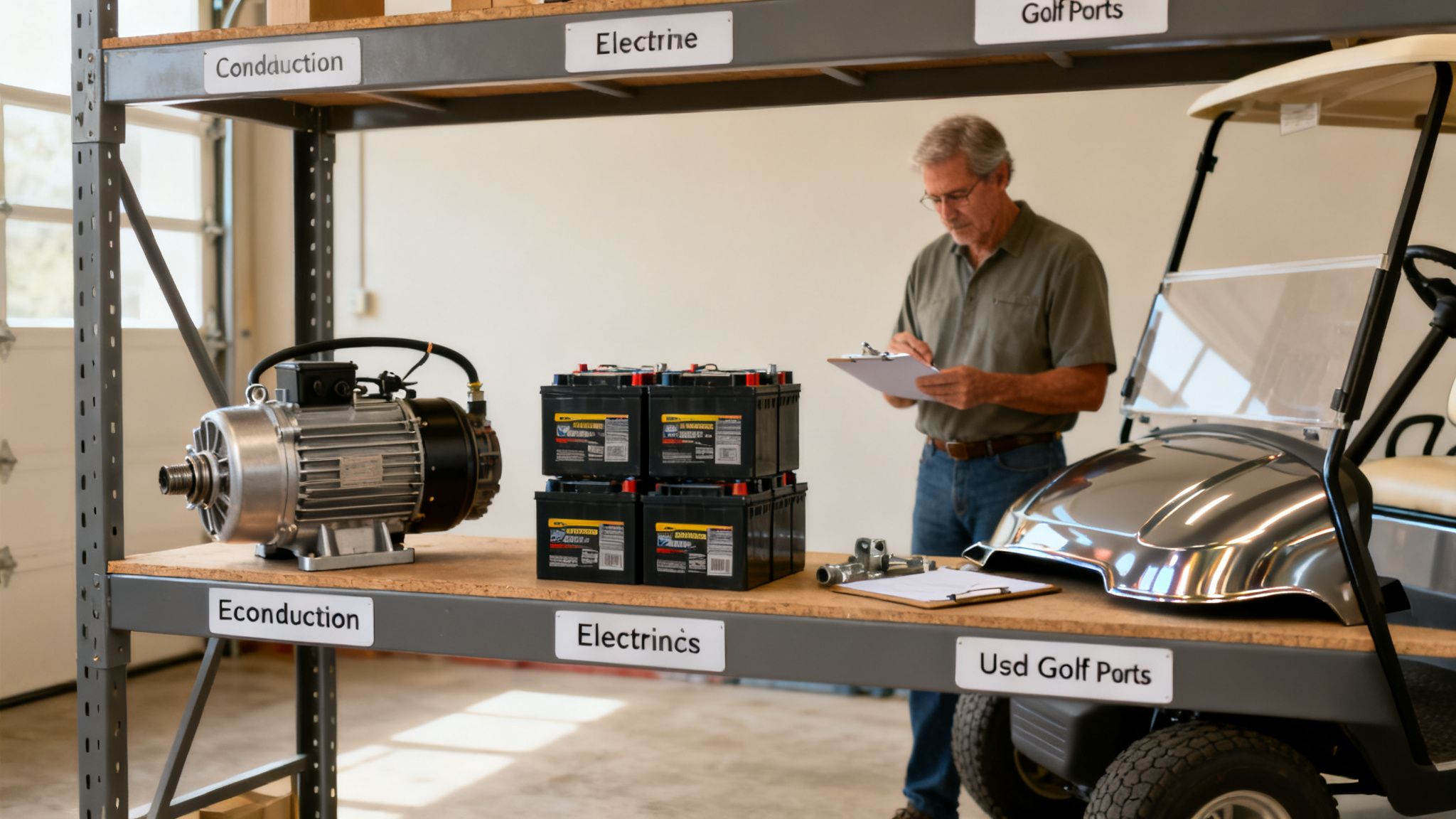
Let's be clear: buying used parts isn't just about being cheap. It's a strategic move that resourceful golf cart owners have been making for years. Whether you're a DIYer tweaking your ride in the garage or a facilities manager keeping a whole fleet running, pre-owned components deliver a mix of value, availability, and sustainability that new parts just can't touch.
The most obvious win here is the cost. We're talking serious savings. Big-ticket items like motors, controllers, or entire axle assemblies can often be found for a tiny fraction of their brand-new price. That kind of financial breathing room can turn a project-killing repair into a manageable fix.
The Booming Market for Pre-Owned Parts
The golf cart world is growing fast, especially with the huge shift toward electric models. This isn't just a trend; it's great news for anyone on the hunt for used parts. The electric golf cart market was already valued at USD 2.04 billion back in 2020 and is on track to hit USD 2.71 billion by 2026.
What does that mean for you? As more courses and businesses upgrade their fleets, a steady stream of high-quality, perfectly good components hits the secondary market. A simple search for golf cart used parts near me now pulls up a treasure trove of reliable parts—from battery packs to body panels—pulled from carts that are simply being replaced. You can dig into the numbers yourself in this comprehensive golf cart market analysis.
But it's not always about the savings. Sometimes, the used market is the only place to find what you need. If you're bringing an old, classic cart back to life, good luck finding a new, factory-original part. A salvage yard or a private seller is your best bet for that period-specific component that’s been out of production for decades. This keeps those vintage carts rolling and out of the scrapyard.
For many of us, buying used is simply about smart resource management. You're giving a perfectly functional part a second chance, extending the life of your own cart, and keeping waste out of the landfill. It just makes sense.
Think about the practical advantages here, whether you own one cart or twenty:
- Eco-Friendly Approach: Reusing parts cuts down on manufacturing demand and waste. It’s a simple way to be a little greener.
- OEM Quality at a Discount: You can often score Original Equipment Manufacturer (OEM) parts, which almost always fit and perform better than cheap, new aftermarket knock-offs, for a much lower price.
- Get It Now: Local sellers and salvage yards let you put your hands on the part today. That means less downtime and a faster return to the trail compared to waiting for a shipment to arrive.
Finding Local Sellers and Salvage Yards
Alright, let's get down to business. Your hunt for "golf cart used parts near me" is going to be part digital sleuthing, part old-fashioned legwork. A simple Google search is a decent first step, but the real gems are often hiding just out of sight. I’ll walk you through a strategy that covers all the bases.
First up is the digital deep dive. This is where you cast a wide net using platforms like Facebook Marketplace and Craigslist. These sites are absolute goldmines for parts from private sellers and small, under-the-radar shops.
Mastering Your Digital Search
The key to avoiding a frustrating rabbit hole of irrelevant listings is getting specific. Vague searches will just waste your time. You need to think like an expert and use targeted phrases to zero in on what you actually need.
- Go for the model: "used Club Car Precedent front axle"
- Search by part type: "48v golf cart motor for sale"
- Zero in on location: "golf cart salvage yard [Your Town Name]"
Here's a pro tip: save your best searches on these platforms. You’ll get a notification the second a matching part pops up, putting you ahead of the competition.
The Power of Picking Up the Phone
Online listings are great, but they only tell part of the story. So many of the best sources—dealerships with trade-in piles, dedicated salvage yards, and busy repair shops—simply don't have the time to list every nut and bolt online. This is where a quick phone call can pay off big time.
I’ve found that the best-kept secrets are often sitting on a shelf in a local shop. These guys deal with a constant stream of trade-ins and retired fleet carts, creating a huge, unlisted inventory. One phone call can be more productive than a full day of scrolling online.
Start by making a quick list of these potential local sources. A search for "golf cart dealers near me" or "golf cart repair shops" will give you a solid call sheet. For more ideas, you can also check out our guide on finding reputable electric vehicle parts suppliers. When you call, have a plan.
Your Quick-Call Script
Here’s a simple script to get right to the point:
- "Hi, do you happen to sell used parts from trade-ins or salvaged carts?"
- "Great. I'm looking for a [specific part, e.g., 48-volt controller] for a [your cart's make/model, e.g., Solana EV XA]. Is that something you might have?"
- "Okay, thanks. If you don't have it, could you recommend any local salvage yards or other shops that specialize in used parts?"
That third question is your secret weapon. The golf cart community is surprisingly tight-knit, and one friendly mechanic can often point you straight to the person who has exactly what you need.
Remember, this industry is huge. North America is expected to grab a 58.5% global market share by 2035, and with 26.6 million golfers in the U.S. in 2023, there's a constant turnover of carts. This means a steady stream of used parts is always hitting the market. The perfect component you're looking for is probably sitting on a local shelf right now—you just have to find it.
Comparing Your Local Parts Sources
So, you've got a few leads from your search for "golf cart used parts near me." Great. Now comes the important part: figuring out which source is right for your project. Where you buy your parts can make a huge difference in price, quality, and your overall sanity.
Honestly, choosing the right spot comes down to what you're comfortable with. It’s a classic balancing act between what you’re willing to spend and how much risk you're willing to take.
Dealers Versus Private Sellers
Heading to an authorized dealer is usually your safest, albeit priciest, option. Dealers often get a steady stream of used parts from trade-ins or retired fleets from local golf courses. These are typically genuine OEM (Original Equipment Manufacturer) parts that have been inspected and sometimes even come with a short-term warranty. That peace of mind is what you're paying for.
On the flip side, you have private sellers on sites like Facebook Marketplace or Craigslist. This is where the real bargains live, but it's also where you'll find the most risk. Every part is sold "as-is," so what you see is what you get—no returns, no guarantees. This route is perfect for simple stuff like body panels or cosmetic pieces you can easily check out in person.
My rule of thumb? Consider how catastrophic it would be if the part failed. For something complex like a motor controller on a Solana EV, paying the dealer's premium is cheap insurance. For a simple seat cushion or a scuffed-up bumper, a private seller is a fantastic, low-risk way to save a ton of cash.
The Salvage Yard Advantage
For the true DIY enthusiast, nothing beats the thrill of a golf cart salvage yard. These places are like a goldmine if you're not afraid to get your hands dirty. Prices are rock-bottom because you're doing all the work. It’s a "you-pull-it" system: you find the cart, take the part off yourself, and walk away with an incredible deal.
Comparing Local Sources for Used Golf Cart Parts
To make it a little clearer, I've put together a quick table breaking down the pros and cons of each source. This should help you decide where to start your hunt.
| Source | Best For | Typical Cost | Pros | Cons |
|---|---|---|---|---|
| Official Dealers | Critical parts (controllers, motors), hard-to-find components | High | Parts are often inspected, may have a short warranty, expert advice available | Most expensive option, limited used inventory |
| Salvage Yards | Major components (axles, frames), budget builds, common parts | Low | Unbeatable prices, huge selection of various models | "You-pull-it" model, no guarantees, parts are sold as-is |
| Online Marketplaces | Cosmetic items, accessories, simple mechanical parts | Low to Medium | Great deals can be found, wide variety of sellers, convenient searching | High risk of scams, no warranty, condition can be misrepresented |
| Local Classifieds | Wheels, tires, seats, common accessories | Low to Medium | Can find local bargains, deal in person and inspect the part | Limited selection, hit-or-miss availability, buyer beware |
Ultimately, there's no single "best" place—it all depends on the part you need and your comfort level. A dealer gives you security, a private seller offers a bargain, and a salvage yard provides the parts and the adventure.
Your On-Site Parts Inspection Checklist
So, you found a local seller with the part you need. That’s the easy part. Now comes the moment of truth: the on-site inspection. This is where a great deal is made and a future headache is avoided. A thorough hands-on check is your best and only defense against buying someone else's problem.
Think of yourself as a detective. You're looking for clues that tell the real story of the part's life. Don't just give it a quick once-over. Pick it up, turn it over, feel the weight of it. A little wear and tear is expected on a used part, but you're hunting for deal-breakers—major damage, shoddy repairs, or anything that just doesn't feel right.
This diagram lays out the typical thought process for sourcing parts, from a dealer to a salvage yard to a private seller.
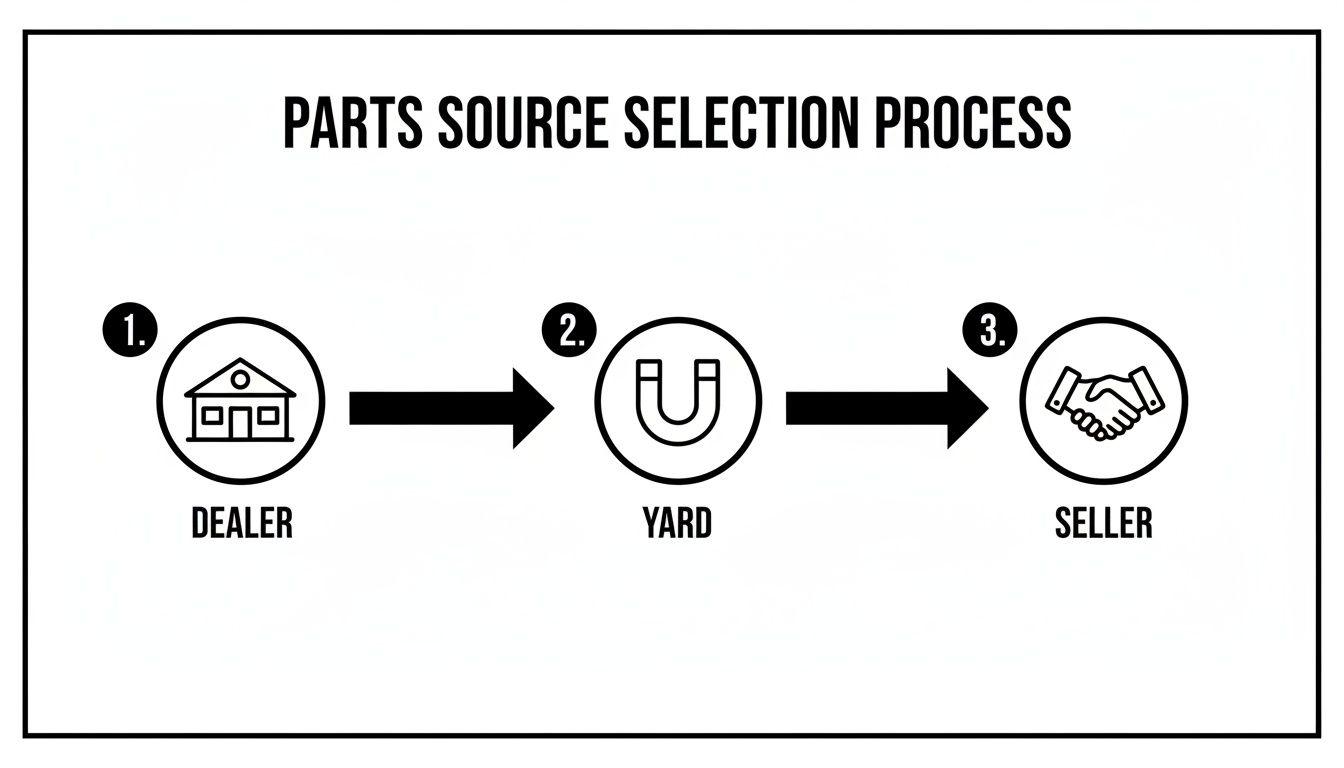
Each option has its own trade-offs between cost, convenience, and risk. The right choice really depends on what you're looking for and how confident you are in your inspection skills.
Inspecting Major Electrical Components
Electrical parts are tough because the real damage is often hidden inside. This is where you need to be extra careful, especially with modern carts like a Solana EV that depend on sensitive electronics.
- Batteries: First, look for any bulging or cracked cases—these are tell-tale signs of overheating or internal failure. Check the terminals. A bit of corrosion is normal, but a thick, crusty buildup is a major red flag. Most importantly, ask the seller if they can run a load test or at least give you recent voltage readings for each battery. For a deeper dive, check out our guide on used golf cart batteries.
- Motors: Look over the casing for any signs of extreme heat, like discolored paint or warped plastic. Grab the main shaft and try to wiggle it; there should be no play at all. Make sure the electrical connection posts are clean and aren't stripped or damaged.
- Controllers: Give the controller a good visual inspection. Are there any melted wires or burn marks on the casing? Confirm the voltage (48V, for example) is correct for your cart's system. Then, get the part number off the unit and make sure it's an exact match for your original.
Pro Tip: Never go to an inspection empty-handed. Bring your old part with you for a side-by-side comparison. If that’s not possible, have clear photos and all the necessary part numbers written down. Compatibility is everything.
The good news is that the entire golf cart market is booming. It's expected to grow from USD 1.79 billion in 2025 to USD 1.87 billion in 2026. This means more courses and communities are upgrading their fleets, flooding the second-hand market with quality used electric components. You can often find motors and chargers for 50% below the price of new parts. This golf cart global market report has some great insights on this trend.
Checking Mechanical and Body Parts
Thankfully, mechanical and structural parts are a lot more straightforward. What you see is usually what you get.
With things like frames, axles, or suspension components, you're looking for cracks, especially around the welds where stress is highest. Check for rust that’s more than just surface-level. As for body panels, look for hidden cracks under the paint or signs of plastic repair kits on the underside. A few scuffs are fine, but you can’t compromise on structural integrity.
Being meticulous here is what ensures your search for golf cart used parts near me ends with a purchase you can rely on for years to come.
Alright, you’ve tracked down the part you need and given it a solid once-over. Now for the fun part: agreeing on a price that doesn't make your wallet cry. Getting a good deal isn't about being a hard-nosed negotiator; it's about walking in prepared.
Before you even throw out a number, pull out your phone. A quick search for the price of that same part new is your single most powerful tool. It’s hard for a seller to argue when you know a brand-new controller costs $350, making your $150 offer on their used one look pretty darn reasonable.
Smart Ways to Talk Price
Whether you're dealing with a guy from an online ad or sifting through parts at a salvage yard, there’s almost always room to negotiate. Your approach is everything.
- Make it a Package Deal: If you spot a few things you need, ask for a bundle price. Sellers are usually happier to knock a few bucks off a multi-part sale than they are on a single item.
- Use Your Inspection Findings (Politely): Remember that scuff mark or the light rust you spotted? Now's the time to bring it up. Saying something like, "I noticed some cosmetic wear and a bit of rust here, would you be flexible on the price because of that?" works a lot better than just demanding a discount.
- Show Them the Money: Cash talks. Showing up with bills in hand proves you’re serious and ready to close the deal right now. A seller is often willing to accept a slightly lower offer to avoid the hassle of waiting for another buyer.
The whole point is to land on a price that feels fair for everyone, not to win a fight. For more tips on checking out pre-owned gear, our guide on buying a used golf cart has some great advice that's just as useful for individual parts.
Closing the Deal Without Getting Burned
Once you’ve shaken on a price, don't rush off just yet. A couple of final steps can save you a major headache down the road. It’s the small stuff that often gets overlooked.
It sounds old-school, but always ask for a simple handwritten receipt. Just a piece of paper with the date, the part, the price, and the seller's name gives you a record of the transaction. It can be a lifesaver if any issues pop up.
It never hurts to ask about a return policy, even an informal one. With a private seller, you're likely buying "as-is," but you have nothing to lose by asking, "Hey, if I get this home and find it's not compatible, can I bring it back within 24 hours?" The worst they can say is no.
Finally, be smart about how you pay. If you're paying in person, cash is perfect. For bigger purchases where you aren't face-to-face, think twice before sending money through apps that don't offer any kind of buyer protection.
Still Have a Few Lingering Questions?
Alright, so you've done your homework, you've scouted some potential parts, but a few questions are probably still bouncing around in your head. That's completely normal. Before you pull the trigger and hand over your cash, it’s smart to run through a final mental checklist.
Getting these last few details ironed out can be the difference between scoring a fantastic deal and ending up with a headache. Let's walk through the most common questions that pop up, so you can buy with total confidence.
Are Used Electric Golf Cart Batteries a Smart Buy?
This is a big one. Used batteries can save you a serious chunk of change—we're talking hundreds of dollars compared to a brand-new set. But, and this is a big but, they are probably the riskiest used part you can buy. A bad set isn't just a poor value; it's a completely worthless, heavy pile of junk that could even fry other components on your cart.
The only way to approach this is with a healthy dose of skepticism and a thorough inspection. Always ask how old the battery pack is. If you can, push for a proper load test. At the very least, you need recent voltage readings for each individual battery after a full charge. A healthy set will have readings that are nearly identical across the board.
Then, use your eyes. Look for these absolute deal-breakers:
- Swelling or Bulging Cases: This is a non-starter. It's a clear sign of internal damage and a serious safety risk. Walk away immediately.
- Corrosion on Terminals: A tiny bit of white or green fuzz can be cleaned, but heavy, crusty buildup is a sign of neglect and potential acid leaks.
- Cracked Casings: Any crack, no matter how small, means the battery's integrity is shot. Don't even consider it.
A good set of used batteries from a source you trust is a huge win. Just never, ever take a seller’s word for it without some form of proof.
How Can I Be 100% Sure a Used Part Will Fit My Cart?
Compatibility isn't just important—it's everything. The single most effective way to guarantee a part will fit is to bring the old, busted one with you. Holding them side-by-side is a foolproof method that eliminates all the guesswork.
If you can't lug the old part along, your smartphone is your next best friend. Snap clear photos of your original component from every conceivable angle. Get close-ups. And most importantly, write down every single number you see on it—serial numbers, model numbers, anything that looks like an identifier. For electrical parts like motors or controllers, the system voltage (e.g., 48V) is non-negotiable; it must match.
When you're not sure, don't guess. A part that's "close enough" is almost always the wrong part. The gold standard is matching the part number from your old component directly to the one you're looking at.
What's the Single Biggest Mistake People Make?
Easy. The biggest mistake you can possibly make is skipping the in-person inspection. It's so tempting to rely on a few good-looking photos online, but pictures can lie. They can easily hide hairline cracks in a frame, deep corrosion on a terminal, or the kind of wear and tear that tells you a part is on its last legs.
Never, ever buy a major mechanical or electrical component—think motors, controllers, transaxles, or especially a full battery pack—sight-unseen. The only time I'd even consider it is if you're buying from a well-known, reputable dealer who offers a clear, written warranty and a no-questions-asked return policy.
That thirty minutes you spend physically touching, turning, and examining a part is the best investment you can make. It's what separates a great find from a costly mistake.
Ready to upgrade your ride with reliable, high-performance parts and vehicles? Solana EV offers premium, street-legal electric vehicles and the support you need to keep them running perfectly. Explore our lineup and find a dealer near you today.
Find your perfect electric vehicle at https://solanaev.com.