
Your golf cart is sitting dead in the garage, a resort vehicle needs a replacement before the weekend rush, or you've found the perfect lift kit but aren't sure it fits your cart. You search for “golf cart parts and accessories near me” and get a map full of dealers, repair shops, and parts counters. The nearest result isn't automatically the right source.
Treat the search as a sourcing project, not a single Google Maps query. First identify the cart, then verify the part, compare lead times and support, check whether the upgrade is legal where the cart operates, and only then place the order. That process prevents the two mistakes I see most often: assuming proximity means the part is in stock, and assuming a familiar brand name guarantees correct or street-legal fitment.
Table of Contents
- When Local Sourcing Makes Sense and When It Does Not
- What to Know About Your Cart Before You Search
- Comparing Local Dealers, Shops, Big-Box Stores, and Online Retailers
- Verifying Fitment Before You Buy
- Street-Legal Parts and What Your State Actually Requires
- Warranty, Installation, and Dealer Support Without the Runaround
- Your Five-Minute Buying Plan and Action Checklist
When Local Sourcing Makes Sense and When It Does Not
Local sourcing earns its keep when the cart is down, the part is safety-critical, or installation requires diagnosis. A nearby shop can inspect a wiring fault, confirm a brake problem, match an unusual body panel, and sometimes get a vehicle back into service without waiting for a shipment. That matters to a resort, golf facility, gated community, or hospitality fleet where downtime affects daily operations.
It makes less sense when you already know the exact part number, the component is a common commodity, and the local seller has no meaningful stock advantage. An online warehouse may offer more tire sizes, battery configurations, chargers, mirrors, lighting kits, and trim options than a small counter can carry. The right question isn't “Who is closest?” It's “Who can supply the correct part with the least total risk?”
Use four decision factors
- Spec accuracy: Can the seller verify the model, year, voltage, dimensions, and connector before taking payment?
- Lead time: Is the part physically available, or does “available” mean the shop can order it?
- Warranty handling: Who diagnoses a failure, files the claim, and pays return freight?
- Post-purchase support: Can someone help with programming, wiring, installation, or a fitment problem?
Local search visibility can help you discover nearby providers, but visibility isn't proof of inventory or technical competence. A practical explanation of how businesses compete for local map placement is available in this map pack visibility guide. Use that knowledge to find candidates, then call and qualify them.
Before visiting a counter, photograph the cart and its identification plate. If you're comparing used components, start with this guide to golf cart used parts near me, then apply the same verification standards you'd use for new parts. A cheap component that needs another trip, a second shipment, or an uncertain return is rarely cheap in practice.
What to Know About Your Cart Before You Search
A parts counter can't identify the right component from “older Club Car” or “a green EZGO.” Before you call, record the manufacturer, model family, production year, power system, and serial or VIN information. Club Car plates commonly appear below the passenger-side seat or near the frame, EZGO identification information is often found in the glovebox area or on the frame, and Yamaha plates may appear beneath the seat or around the rear frame. Locations vary, so photograph the plate rather than relying on memory.
The year matters because manufacturers change frames, suspension, wiring, body panels, controllers, and mounting points within the same model family. “TXT,” “RXV,” “Precedent,” or “Drive” narrows the search, but it doesn't finish the job. Record the full code, not just the badge.
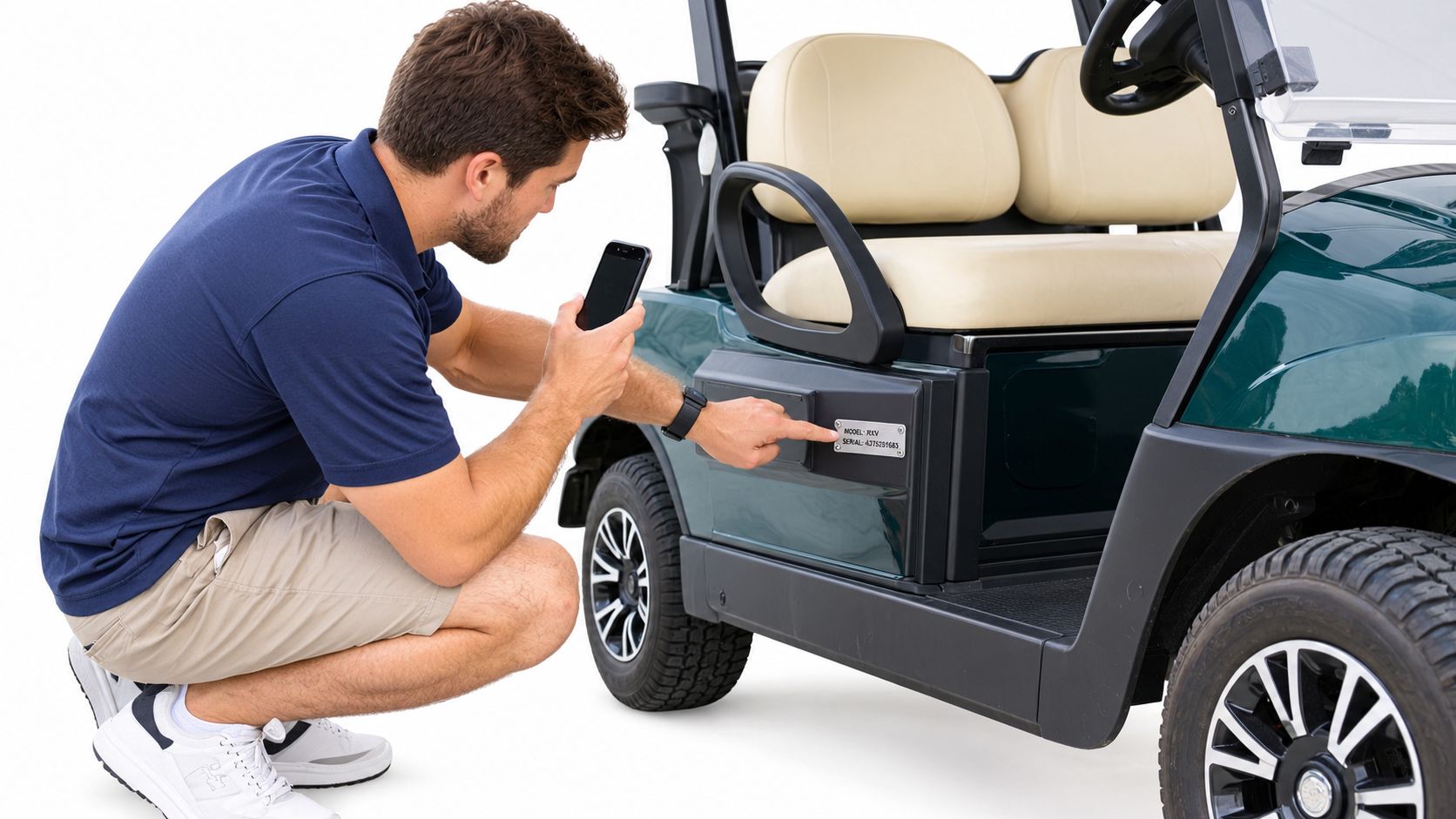
Photograph the information a technician needs
Take clear, well-lit photos of:
- Serial plate or VIN: Include every character and the surrounding mounting location.
- Battery compartment: Capture battery labels, cable arrangement, terminal layout, and charger connector.
- Controller and motor: Photograph manufacturer labels, model codes, and visible wiring.
- Tire sidewalls: Record the complete size marking, not only the brand.
- Existing accessories: Include DC-DC converters, fuse blocks, light harnesses, stereo wiring, winches, and aftermarket switches.
- Mounting points: Photograph damaged brackets, bolt patterns, and clearance around the part being replaced.
For Club Car, EZGO, and Yamaha carts, the serial or model code can narrow the parts catalog, but a technician still needs to know what has already been modified. A stock cart and a lifted cart with different wheels, a replaced controller, and aftermarket lighting may no longer match the original configuration.
The historical scale of the vehicle base explains why model-specific demand persists. A 1990 estimate from the National Golf Foundation counted approximately 800,000 to 850,000 electric and gasoline-powered golf carts operating on U.S. golf courses, with about 115,000 new carts manufactured annually at that time, as documented in this National Golf Foundation historical source. Those figures are historical context, not a current market estimate.
Keep this one-page checklist on your phone:
- Manufacturer and model family
- Year or serial number
- Electric or gasoline power
- Battery chemistry and system voltage
- Controller and motor labels
- Tire size and wheel specifications
- Existing lift, lighting, or accessory modifications
- Photos of all labels and connection points
For a more focused lookup, use the golf cart serial number lookup before you ask a seller to quote parts.
Comparing Local Dealers, Shops, Big-Box Stores, and Online Retailers
Each source wins in a different situation. An authorized dealer usually has the strongest access to brand catalogs, technical bulletins, programming tools, and OEM warranty channels. An independent golf-cart shop often provides better diagnosis and installation flexibility. Big-box and auto-parts stores can be convenient for basic supplies, while online retailers usually win on selection and price for known, noncritical components.
| Source | Best For | Price Level | Lead Time | Warranty Handling |
|---|---|---|---|---|
| Authorized local dealer | OEM electrical parts, model-specific repairs, programming | Higher | Immediate if stocked, otherwise ordered | Usually the clearest path through the brand |
| Independent repair shop | Diagnosis, installation, modified carts, fleet service | Mid to higher | Depends on shop inventory and workload | Shop may coordinate, but terms vary |
| Big-box or auto-parts store | General hardware, connectors, tools, some batteries and supplies | Low to mid | Immediate for shelf stock | Standard retail process, limited golf-cart expertise |
| Online warehouse retailer | Known part numbers, tires, cosmetic accessories, broad selection | Low to mid | Shipment required | Return process may involve the seller or manufacturer |
For OEM electrical parts, start with an authorized dealer or a specialist that can verify the controller, charger, solenoid, motor, or harness against the cart's exact configuration. Electrical parts that look interchangeable often aren't. A wrong component can create diagnostic work that costs more than the original price difference.
For cosmetic accessories, online retailers often make more sense. Seat covers, mirrors, storage accessories, windshields, trim, and some lighting kits are easier to compare online, provided you confirm the model and mounting pattern. For commodity items, such as tires and batteries, compare local installed pricing against online delivered pricing. Local service may be worth paying for if disposal, mounting, balancing, wiring, or programming is included.
Practical rule: Buy locally when diagnosis, safety, or downtime matters more than the sticker price. Buy online when the specification is certain and the return process is clear.
Don't confuse “in stock” with “ready for your cart.” Ask the seller to read the part number, confirm the voltage or dimensions, and explain whether installation is included. If the local supplier can't answer those questions, a specialist online retailer with a detailed fitment process is the safer source.
Verifying Fitment Before You Buy
Most wasted money in golf-cart parts comes from components that almost fit. A tire clears the fender but rubs during steering. A charger plugs in but has the wrong output. A lighting kit works until the accessory load exceeds the converter. The seller may call the part compatible, but you still own the installation problem.
Start with tires and wheels
Use this four-step process:
- Record the cart's maximum gross weight, passenger capacity, and intended cargo.
- Verify the replacement tire's exact diameter, section width, wheel diameter, maximum load per tire, and maximum inflation pressure.
- Multiply the tire load rating by four, then confirm the result exceeds the vehicle manufacturer's permitted axle and gross-weight limits.
- After installation, torque the lug nuts to the vehicle specification, set cold pressure to the tire or vehicle specification, and inspect for rubbing through full steering and suspension travel.
The “4-ply” label isn't enough. Tires with that same designation can have materially different capacities, including examples around 677 pounds and 908 pounds per tire, according to this tire ply rating explanation. Higher-capacity tires don't increase the cart's approved payload, repair weak brakes, or make an unsuitable lift kit safe.
Check electrical compatibility as a system
For batteries and chargers, match the chemistry, nominal system voltage, output, connector polarity, communications requirements, and battery-management-system limits. For controllers and motors, confirm voltage, current rating, programming requirements, solenoid compatibility, cable size, and whether the cart's existing wiring can handle the change.
Lithium systems need extra discipline. Identify the battery chemistry and voltage, calculate accessory current draw, and verify that wiring, fuses, switches, and DC-DC converters exceed continuous and peak demand. Avoid bypassing the battery-management system, and don't add high-draw lighting, stereos, winches, or refrigerators without checking converter capacity. A practical lithium operating benchmark is keeping normal charge between approximately 20% and 80% when the vehicle manufacturer permits it, as discussed in this lithium battery service research.
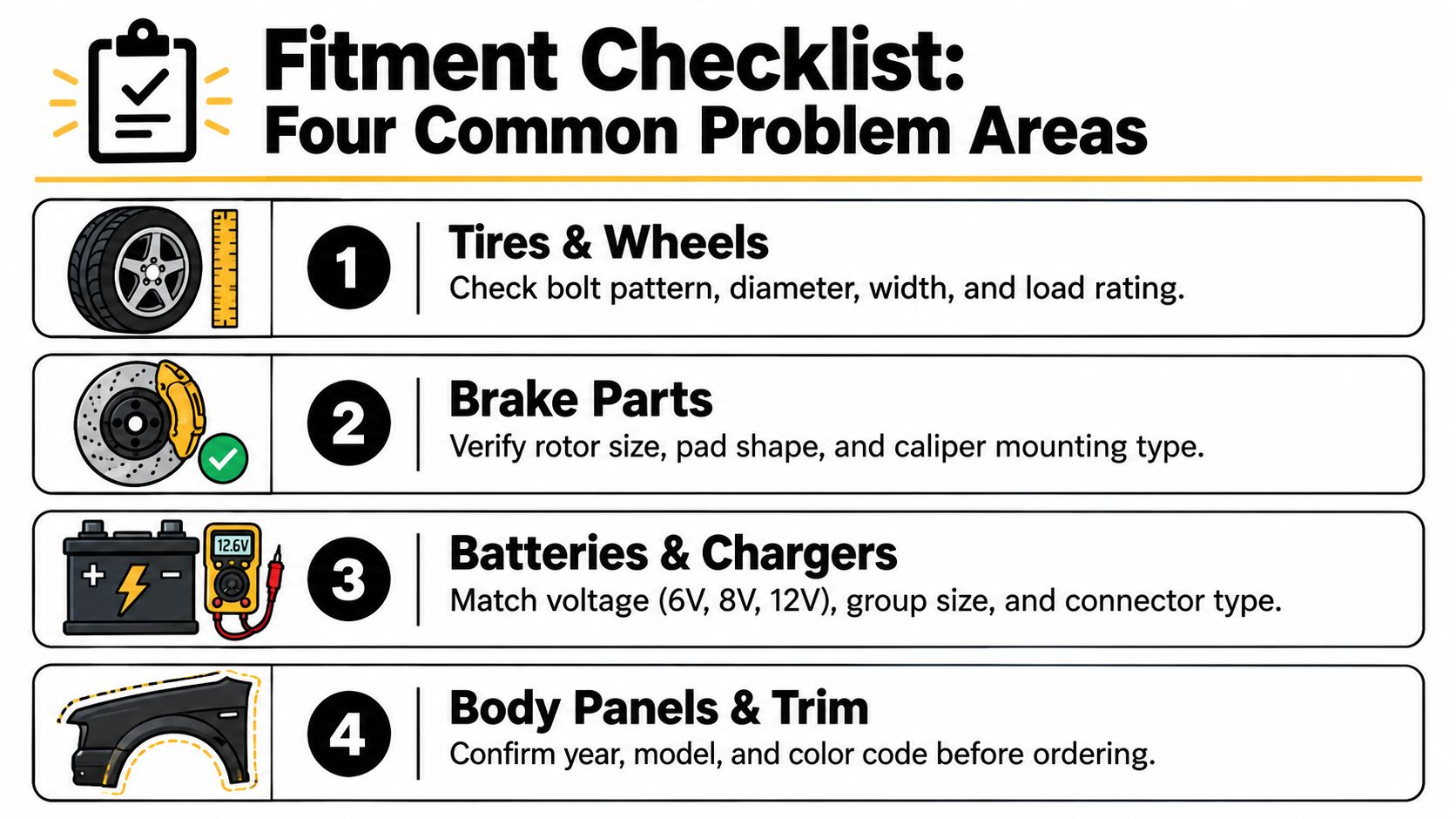
Before checkout, confirm:
- Cart identity: Model family, year, serial number, and modifications
- Physical fit: Dimensions, bolt pattern, clearance, and mounting points
- Electrical fit: Voltage, polarity, connectors, fuse size, and converter capacity
- Safety margin: Load rating, braking, steering clearance, and operating environment
- After-install check: Torque, pressure, rubbing, heat, warning lights, and function
Street-Legal Parts and What Your State Actually Requires
A golf cart with headlights and mirrors isn't automatically a lawful low-speed vehicle. Federal guidance defines an LSV as a four-wheeled vehicle capable of 20 to 25 mph, while state and local rules determine equipment, registration, insurance, licensing, and where the vehicle may operate. The classification and the road environment matter as much as the accessory list.
For example, Florida requires LSV equipment including headlamps, stop lamps, turn signals, taillamps, reflectors, parking brakes, mirrors, windshields, seat belts, and vehicle identification numbers, and limits operation to roads posted at 35 mph or less. South Carolina separately requires registration, liability insurance, a permit decal, and a valid driver's license. These requirements are summarized in the federal and state alternative-fuel vehicle law database.
Match the parts conversation to the legal checklist
- Lighting: Ask whether the headlamps, taillamps, brake lamps, and turn signals are designed for the intended road use.
- Visibility: Confirm mirrors, windshield equipment, reflectors, and any required horn or marking equipment.
- Occupant protection: Verify seat belts and mounting points, not just whether belts are included in the box.
- Running gear: Check tires, brakes, parking brake, steering, and wheel fitment for the vehicle's operating environment.
- Documentation: Ask how the VIN, registration, insurance, certification, and inspection requirements will be handled.
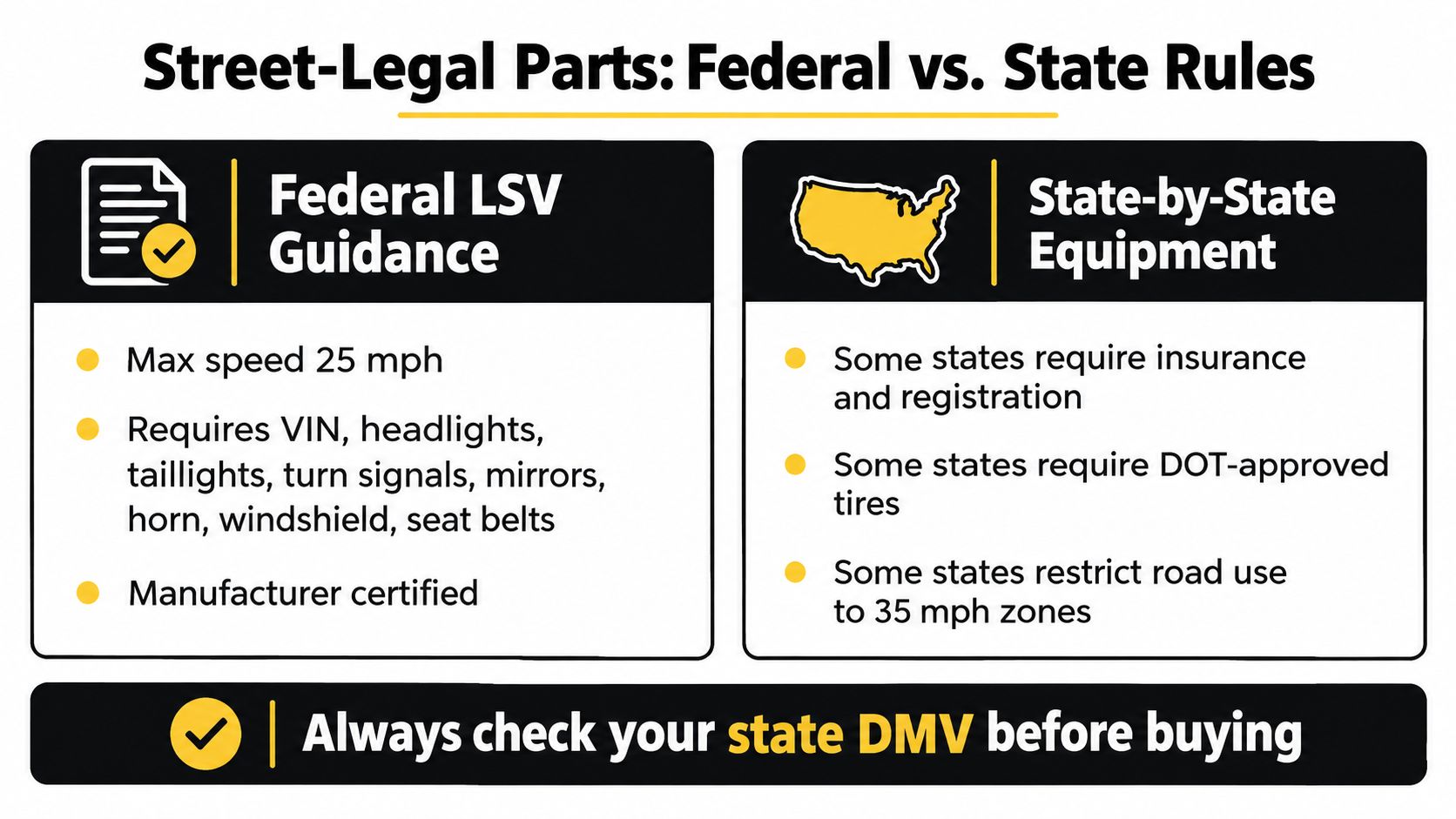
A retrofit that works on a private road may not qualify as an LSV for public roads. Local governments can add operating restrictions, and a cart accepted in one county may be restricted in the next. A dealer should tell you which rule applies, but you should verify the specific jurisdiction with its motor-vehicle authority before buying expensive equipment.
For resort and gated-community fleets, create a written compliance file for every vehicle. Include the cart identity, equipment list, installation records, insurance information, and the roads or property where the vehicle will operate. Don't let a seller's use of “street legal” replace a jurisdiction-specific check.
Warranty, Installation, and Dealer Support Without the Runaround
The part is only one part of the purchase. Cost appears when a controller fails, a charger won't communicate with the battery, a brake component needs adjustment, or a warranty provider asks who installed the system. Authorized dealers generally provide a cleaner path for OEM claims because they can verify the vehicle, source, and installation. Third-party sellers may still offer valid coverage, but you need to understand who pays shipping, who approves the claim, and whether labor is excluded.
For a useful comparison of coverage language, review this guide to warranty info for your online store. Then ask the seller to explain the actual process for your part, not just point you to a generic policy page.
Pay for installation when the system is critical
I recommend professional installation when a part connects to the battery-management system, controller, or brake system. That includes controller programming, high-current cable work, brake adjustment, safety-belt mounting, lighting modifications tied to a converter, and any change that could affect the cart's certification or road equipment.
A CPSC analysis estimated more than 10,000 golf-cart accident emergency-room visits each year, with roughly 40% involving a fall, while separate federal data estimated 27,000 golf-cart emergency-department injuries among adults aged 65 and older from 2017 through 2021. The figures don't prove that one accessory prevents an accident, but they do show why safety-related parts deserve careful installation and inspection. The source is the CPSC older-adult hazards report.
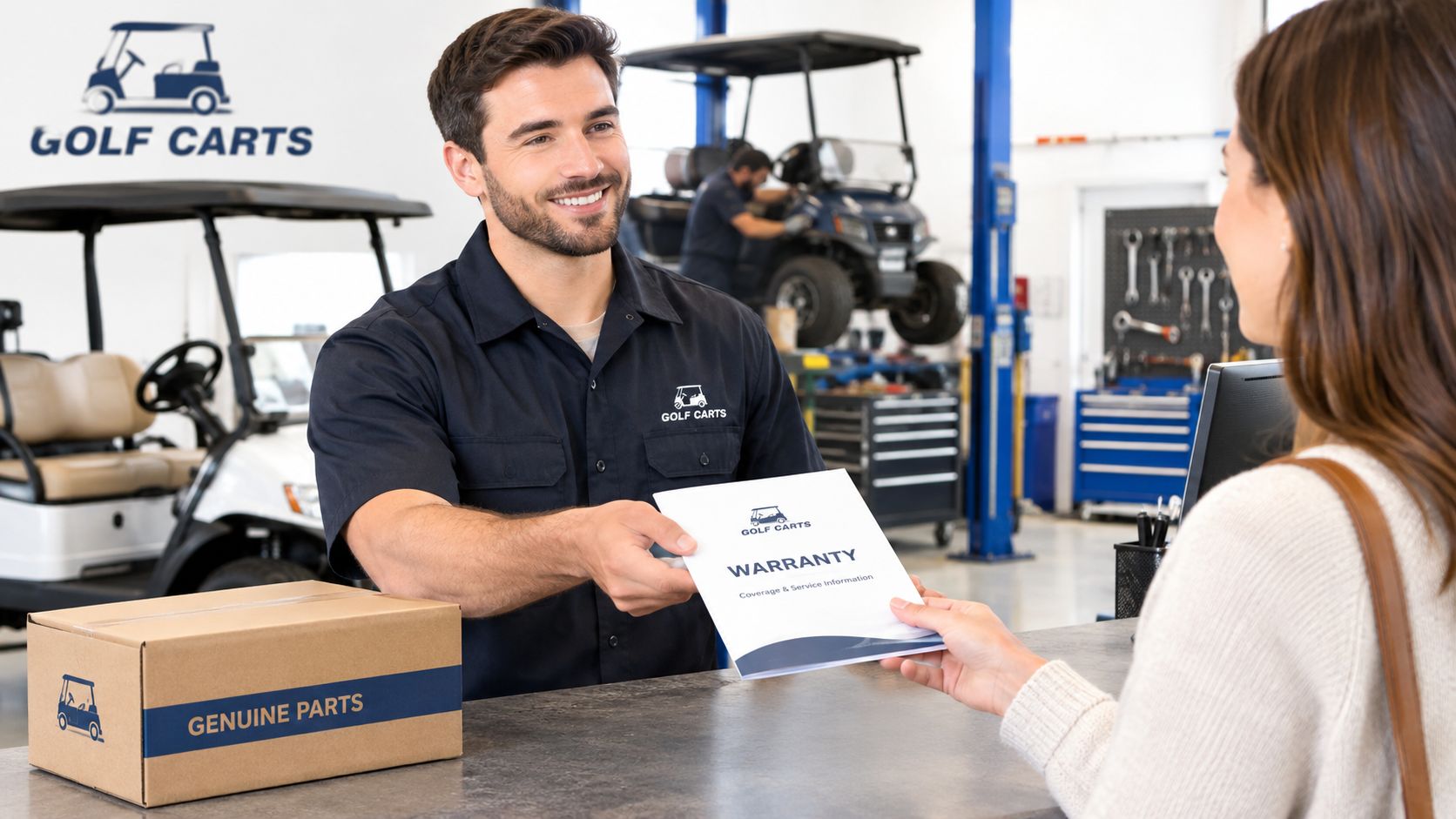
Before paying, use this phone script:
“Please confirm the exact part number, what vehicle information you used to verify fitment, the warranty term, who handles a failure, whether labor is covered, who pays return shipping, and whether installation by your shop is required for coverage.”
Get the answer in writing. A local part that costs more can still be the better purchase when the seller includes diagnosis, installation, programming, and a direct warranty path. If you want a brand-supported purchasing route, review the golf cart warranty terms before assuming every component carries the same coverage.
Your Five-Minute Buying Plan and Action Checklist
Run this sequence before every purchase. It works for a single replacement mirror and for a fleet order of batteries, chargers, tires, or lighting kits.
First, search locally and identify more than one source. Then send each seller the same cart photos, serial information, part request, and required delivery date. Ask whether the item is physically in stock, whether it fits the exact configuration, and what installation or programming is included.
Next, compare the complete cost. Include shipping, mounting, disposal, wiring, return freight, diagnostic time, and realistic downtime. If the local premium is greater than the cost of one additional day out of service, and the online specification and warranty are clear, order online. If the part affects brakes, steering, battery management, controller programming, or legal road equipment, keep the installation with a qualified shop.
| Step | Action | Done? |
|---|---|---|
| 1 | Photograph the serial plate, VIN, battery labels, controller, motor, tires, and existing accessories | ☐ |
| 2 | Write down model, year, voltage, chemistry, dimensions, and modification details | ☐ |
| 3 | Ask local sellers to confirm stock, part number, fitment, and installation timing | ☐ |
| 4 | Compare local total cost with delivered online cost and downtime | ☐ |
| 5 | Check road-use requirements with the exact state and local authority | ☐ |
| 6 | Confirm warranty coverage, labor terms, returns, and shipping responsibility | ☐ |
| 7 | Schedule professional installation for critical electrical, brake, or safety work | ☐ |
| 8 | Plan removal, storage, and recycling of the old battery or component | ☐ |
Battery planning shouldn't stop at replacement. Lead-acid batteries have mature collection systems, with U.S. recycling rates reported above 99%, while lithium take-back channels are less established in many regions. A 2025 market estimate places the golf-cart battery market at $167.24 million, with a projected $224.97 million by 2030 and a 6.11% compound annual growth rate, as reported by Mordor Intelligence's golf-cart battery market coverage. Treat those figures as a market estimate and projection, not a quote for your vehicle's ownership cost.
The best local search ends with a documented decision. You know the cart, the part, the legal use, the support path, and the exit plan if the component fails. That's how you find golf cart parts and accessories near you without paying for a nearby mistake.
Solana EV provides street-legal golf carts, official parts and accessories, a dealer locator, a 24/7 parts portal, and technical assistance for supported vehicles and dealers. Visit Solana EV to review vehicles, locate a nearby dealer, and start a parts conversation with the right specifications in hand.