
A resort guest steps into a parked cart and immediately regrets wearing shorts. The vinyl seat is hot, the steering wheel is uncomfortable to hold, and a sudden afternoon shower is already moving across the property. For a gated-community owner, the same problem appears on a smaller route, from the driveway to the clubhouse or the neighborhood market.
A golf car canopy solves more than the obvious shade problem. The roof, frame, fabric, and mounting hardware work as one system to manage solar exposure, light rain, glare, passenger comfort, and the long-term condition of the cart. The right choice can reduce replacement work and service interruptions. The wrong choice can add wind load, loosen brackets, and create another maintenance item.
Table of Contents
- What a Golf Car Canopy Actually Does for Your Ride
- Comparing Canopy Styles and Configurations
- Material Choices That Determine Canopy Lifespan
- Mounting Hardware and Sizing for Your Cart Model
- Street-Legal and Resort Compliance Considerations
- Maintenance Routines and Wind Safety Thresholds
- Choosing the Right Canopy for Your Situation
What a Golf Car Canopy Actually Does for Your Ride
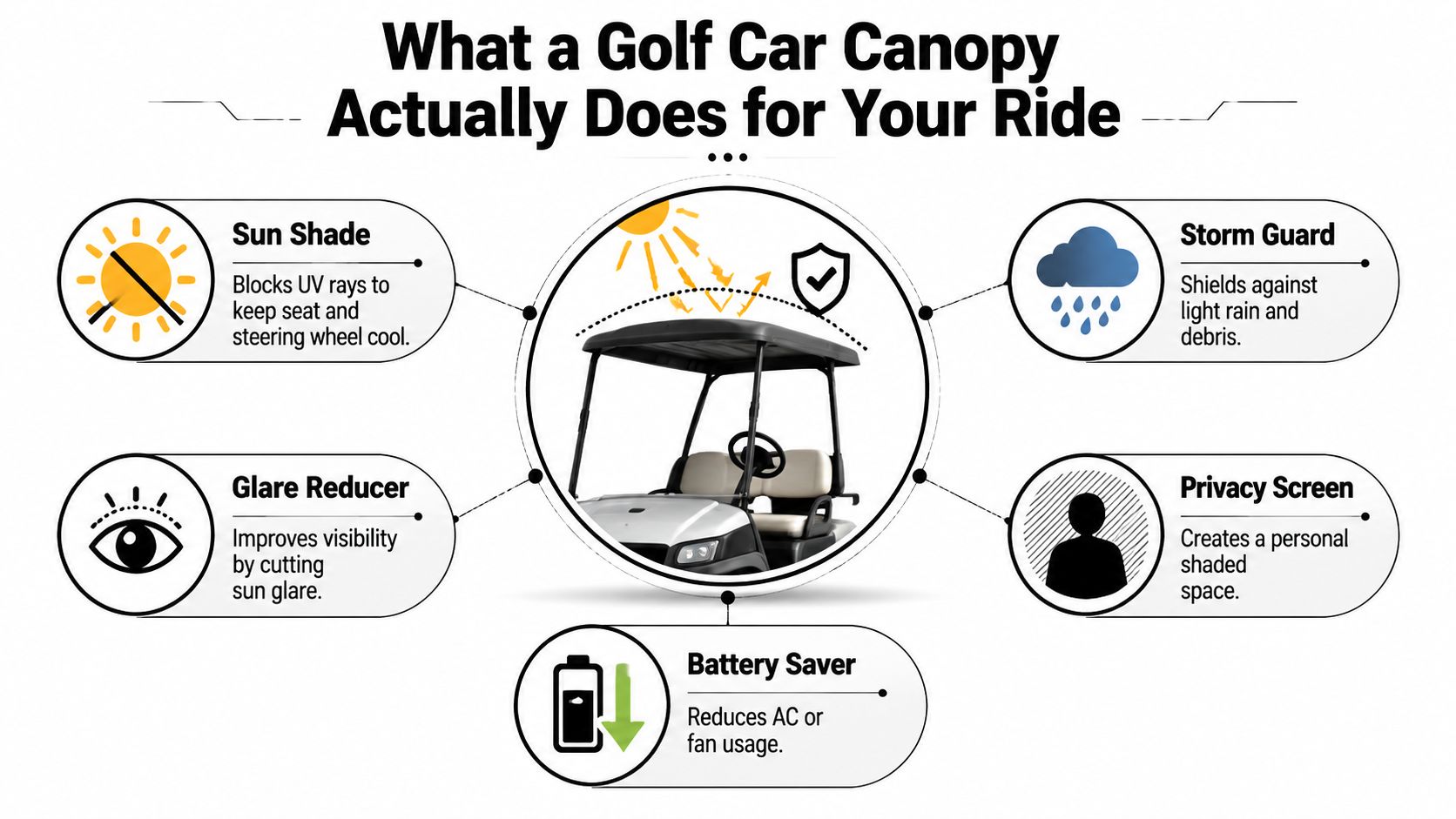
The immediate benefit is thermal comfort. A canopy blocks direct sunlight from reaching the seats, steering wheel, dashboard, and passengers. A woven shade material can also reduce glare, which matters when a cart travels along bright pavement, open fairways, or reflective resort paths.
That protection extends to the vehicle itself. Upholstery, dashboard surfaces, switches, and exposed trim all face repeated UV exposure when a cart stays outdoors. A roof won't stop every form of wear, but it limits direct solar loading and gives light rain and airborne debris less opportunity to reach the cabin.
Shade is only one part of the job
A canopy affects several operating conditions at once:
- Passenger comfort: The roof keeps direct sun off the seating area and helps the cart feel more usable during hot daytime trips.
- Weather protection: Fabric and coated surfaces can shield occupants from light rain, leaves, and small debris.
- Visibility: A properly positioned front edge can reduce overhead glare without blocking the driver's sight lines.
- Interior preservation: Less direct sunlight reaches vinyl, plastics, and electronic surfaces.
- Vehicle appearance: A clean, well-fitted roof makes an older cart look maintained, while faded fabric and sagging brackets make even a premium vehicle appear neglected.
The canopy also changes how owners use the cart. Golf carts now serve as neighborhood transportation, resort shuttles, campus vehicles, and street-legal low-speed vehicles, not just course equipment. That wider use raises expectations for rain coverage, mirror clearance, passenger protection, and a consistent appearance across a fleet.
Practical rule: Treat the canopy as a vehicle system, not a loose accessory. A strong fabric won't compensate for weak brackets, and a rigid roof can't correct poor alignment.
Why the roof influences ownership cost
The golf accessories market was estimated at USD 398.5 million in 2025 and is projected to reach USD 693.7 million by 2035, with a 5.7% CAGR, according to Future Market Insights' golf accessories market report. Golf cart covers were the leading segment in that market in 2025, with a 27.6% share, which places canopy-related protection within a substantial accessory category rather than a minor add-on.
For a resort manager, the practical implication is straightforward. A roof must withstand repeated passenger use, cleaning, loading, and outdoor storage. For a homeowner, the calculation is different but still important. A canopy that protects seating and trim, remains tight on the frame, and can be repaired rather than discarded may deliver better value than the cheapest replacement.
Comparing Canopy Styles and Configurations
Style should follow duty cycle, not appearance alone. A soft fabric roof may suit a lightly used neighborhood cart, but a high-turnover resort fleet usually needs a surface that tolerates constant handling and straightforward cleaning. A hard shell costs more in weight and installation effort, yet it can provide a stable roofline and a consistent fleet appearance.
Soft fabric tops
Fabric canopies are usually the easiest option to replace and adapt. They offer a lighter profile, can provide good ventilation, and often suit owners who want a less imposing roof. The trade-off is exposure to stretching, seam wear, flapping, and UV degradation, especially when the cart stays outside without regular inspection.
A soft top works well for a homeowner who wants shade and light weather coverage without adding a rigid roof. It also makes sense where the cart is stored under cover and the owner values easy removal. It isn't the first choice for a busy rental fleet that sees constant passenger turnover and frequent contact with the roof.
Hard-shell roofs
Molded or composite hardtops provide a rigid barrier against sun and light precipitation. They don't fold, and they add weight, but they hold their shape and usually present a cleaner appearance over long service. A hard shell is often the practical choice for resort fleets, premium street-legal carts, and owners who leave the vehicle outdoors.
The mounting system deserves close attention. A rigid roof transfers wind and vibration into the brackets, so poor fitment can create cracking, rattles, or loose fasteners. The roof's strength doesn't remove the need for periodic hardware checks.
Full enclosures and mesh shades
A full enclosure offers more complete protection in rainy or cold conditions, but it reduces the open-air feel and can restrict ventilation. Roll-up panels provide flexibility, although the zippers, snaps, and seams become additional inspection points.
Mesh shade sits at the opposite end of the spectrum. Woven mesh allows airflow and reduces solar load, but it isn't the right answer when the main requirement is heavy rain or strong wind protection. Buyers comparing a complete enclosed vehicle can review Solana EV's enclosed electric golf carts to see how enclosure decisions affect the broader vehicle configuration.
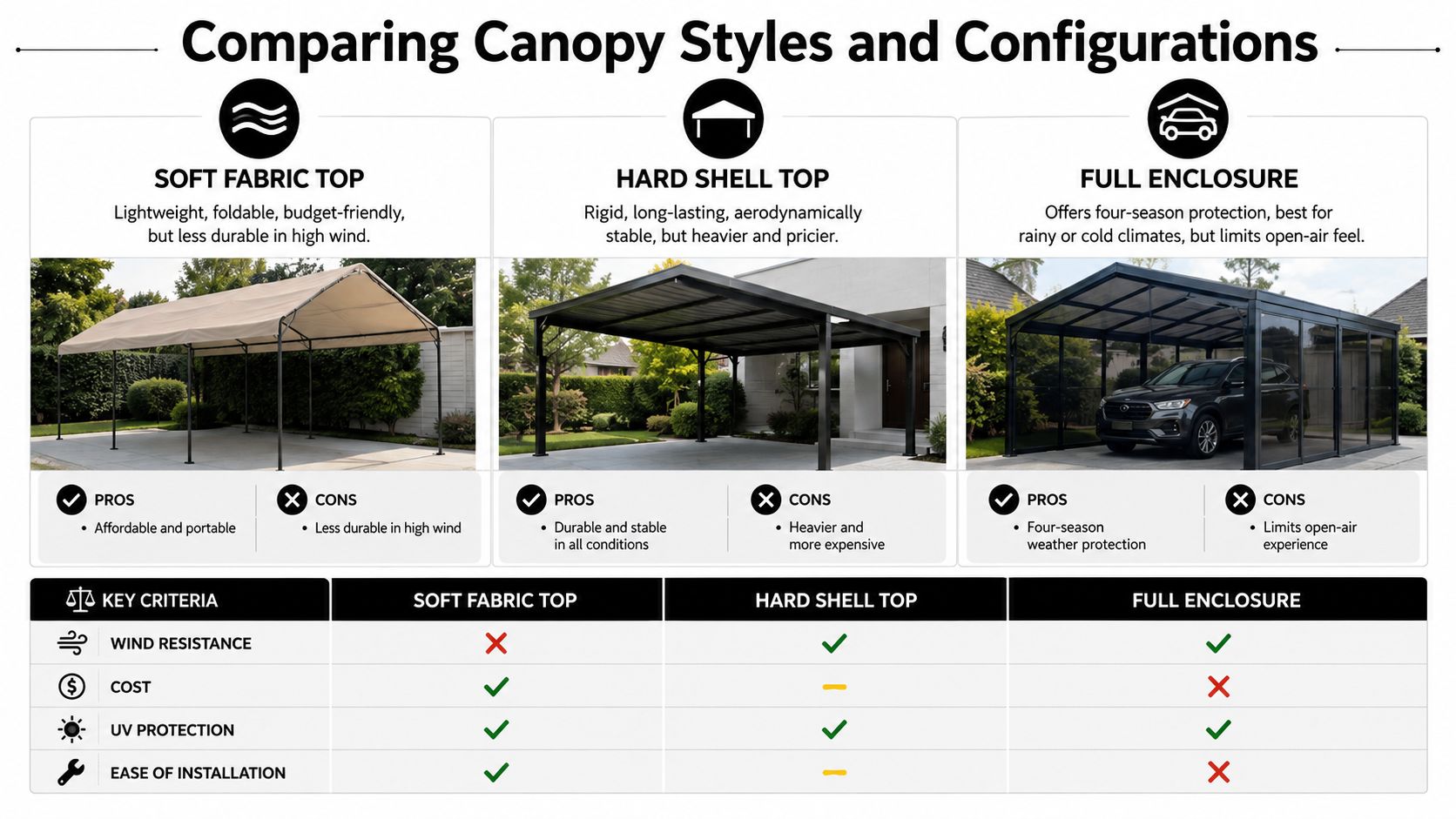
| Configuration | Strengths | Limitations | Suitable application |
|---|---|---|---|
| Soft fabric top | Light, adaptable, ventilated | More vulnerable to flapping and fabric wear | Gated communities and lightly used carts |
| Hard shell | Stable roof shape, durable surface, consistent appearance | Heavier and more demanding on brackets | Resort fleets and premium daily-use carts |
| Mesh shade | Airflow and solar screening | Limited rain protection | Hot, dry environments |
| Full enclosure | Broad weather coverage | Less ventilation and more components | Seasonal or wet-weather operation |
A hybrid setup can bridge these categories. A rigid frame with replaceable fabric panels gives an operator a dependable structure while allowing seasonal changes. It only works if the panels, fasteners, and frame are designed to work together. Mixing unrelated parts often creates gaps, uneven tension, and incompatible attachment points.
Material Choices That Determine Canopy Lifespan
Fabric selection determines much of a canopy's service life. Color matters to buyers, but fiber construction, coating, weave, and UV resistance matter more once the cart spends long periods outside.
How common materials behave
600D Oxford polyester and PVC-coated polyester are commonly positioned in the 2 to 5 year service-life range, while solution-dyed acrylic fabrics such as Sunbrella are commonly cited at 5 to 7 years, according to the Golf Cart Search canopy buyers guide. The same guidance identifies the reason solution-dyed acrylic performs differently. The dye is embedded in the fiber, which helps the material resist UV-related fading and fiber breakdown.
UV exposure is usually the dominant degradation mechanism. Sunlight gradually damages polymer chains and surface coatings. As the material becomes brittle, it loses tensile strength, water repellency, and colorfastness. A canopy may still look acceptable from a distance while its seams, folded edges, and attachment points are already becoming vulnerable.
| Material | Service life | UV blocking | Best use case |
|---|---|---|---|
| 600D Oxford polyester | 2 to 5 years | Depends on weave and coating | Cost-conscious residential use |
| PVC-coated polyester | 2 to 5 years | Strong protection when coating remains intact | Rain and general outdoor exposure |
| Solution-dyed acrylic | 5 to 7 years | Strong resistance to UV fading and fiber breakdown | High-sun residential and resort use |
| Woven polyester mesh, such as SunTex80 | Not specified as a service-life range in the available guidance | About 70 to 75% of UV rays, according to Outdoor Cover Warehouse's SunTex80 guidance | Hot, dry use where ventilation matters |
The same shade guidance reports that SunTex80 blocks about 80% of heat transfer. That makes mesh attractive in hot, dry conditions, but mesh isn't a substitute for a coated rain roof. The tighter the weave and the heavier the coating, the more solar and water protection the canopy may provide. Those same features can increase drag and stress on mounting hardware during gusts.
Material decision: Spend more on fabric when the cart stays outdoors, operates in a high-sun market, or belongs to a fleet where replacement labor costs matter. Choose mesh when airflow is the priority, not when all-weather shelter is required.
Read specifications critically. “Weather resistant” doesn't explain whether the product resists UV degradation, sheds rain, maintains seam strength, or tolerates repeated folding. Ask about the fiber, coating, thread, edge binding, and replacement-panel availability before comparing colors or patterns.
Mounting Hardware and Sizing for Your Cart Model
A canopy that fits poorly becomes a mechanical problem. An oversized roof catches more wind, an undersized roof leaves passengers exposed, and misaligned brackets place stress on roof rails or chassis attachment points.
Measure before ordering
Start with the cart's actual roof footprint and mounting locations. Record the distance between the front and rear supports, the side-to-side rail spacing, the roof height, and the location of mirrors, lights, windshield frames, and passenger grab points. The Solana XA 4P, XA 6P, F, and G may have different proportions and rail geometry, so model name alone shouldn't replace a fitment check.
Confirm four things with the dealer or manufacturer:
- Roof dimensions: The replacement roof must cover the intended seating area without excessive overhang.
- Bracket location: The hardware must land on structural mounting points, not thin body panels or unsupported trim.
- Accessory clearance: Mirrors, lights, windshields, enclosures, and communication equipment must remain usable.
- Chassis compatibility: Aluminum chassis construction requires compatible fasteners and isolation materials to reduce the risk of galvanic corrosion where dissimilar metals meet.
OEM roofs are designed around the vehicle's specific dimensions and attachment points. For Solana vehicles, the extended golf cart roof guide is a useful reference when comparing coverage requirements and roof options.
Hardware is part of the fit
Universal kits can work when their dimensions and bracket geometry match the cart. “Universal” doesn't mean every hole will line up or every clamp will tolerate the same load. Avoid drilling new holes into structural members without confirming the manufacturer-approved method.
Old hardware is another common failure point. Brackets may have hidden fatigue, corrosion, flattened rubber isolators, or threads damaged by repeated removal. Reusing them transfers an unknown condition to the new canopy.
Tighten fasteners according to the kit's specified torque rather than relying on feel. Over-tightening can crush plastic, deform rails, or strip threads. Under-tightening allows vibration and wind movement to enlarge holes over time. After installation, inspect the roof from the front and rear, confirm even gaps, and check that the frame doesn't twist when the cart moves over uneven ground.
Street-Legal and Resort Compliance Considerations
Once a cart travels on neighborhood streets or resort roads, the canopy becomes part of a broader safety package. It must provide protection without blocking mirrors, lighting, driver sight lines, passenger access, or required equipment.
U.S. reporting from 2010 said golf cart-related accidents sent about 13,000 people to emergency rooms each year, and about 40% of those cases involved children under 16, as reported by Insurance Journal. The same report described Palm Desert, California, adopting its first golf cart street ordinance in 1974 and later requiring equipment such as seat belts, turn signals, and brake lights.
Those historical details illustrate the operational shift from course-only use to neighborhood travel. As municipalities addressed street use, owners and fleet managers had to think about carts as vehicles operating around pedestrians, bicycles, and traffic. The canopy itself may not establish street legality, but its design can support or interfere with the equipment that does.
Check the complete vehicle, not just the roof
Before approving a canopy, confirm that it:
- Preserves sight lines: The front edge shouldn't sit low enough to obstruct the driver.
- Clears mirrors: Side and rear-view mirrors need unobstructed adjustment and visibility.
- Leaves lights visible: Brake lights, turn signals, and marker lamps shouldn't disappear behind an overhanging panel.
- Works with restraints: Seat belts and passenger handholds must remain accessible.
- Matches local rules: Street-use requirements vary by jurisdiction, so verify them with the relevant municipality or vehicle authority.
Resort managers also need a consistent fleet standard. Matching roof profiles, clean fabric, secure fasteners, and predictable visibility help staff identify poorly maintained carts before guests use them. A scheduled appearance and safety inspection can be paired with professional detailing, including a service such as your auto detailing cart when the fleet needs cleaning beyond a routine wipe-down.
A canopy that looks attractive but covers a lamp or interferes with a mirror creates an avoidable liability concern. Compliance starts with the complete cart configuration and the place where the vehicle operates.
Maintenance Routines and Wind Safety Thresholds
Canopy maintenance is mostly simple, but it has to be regular. Dirt holds moisture against fabric, salt accelerates corrosion, and small tears spread when passengers pull on a loose edge or wind catches an open seam.
A practical care routine
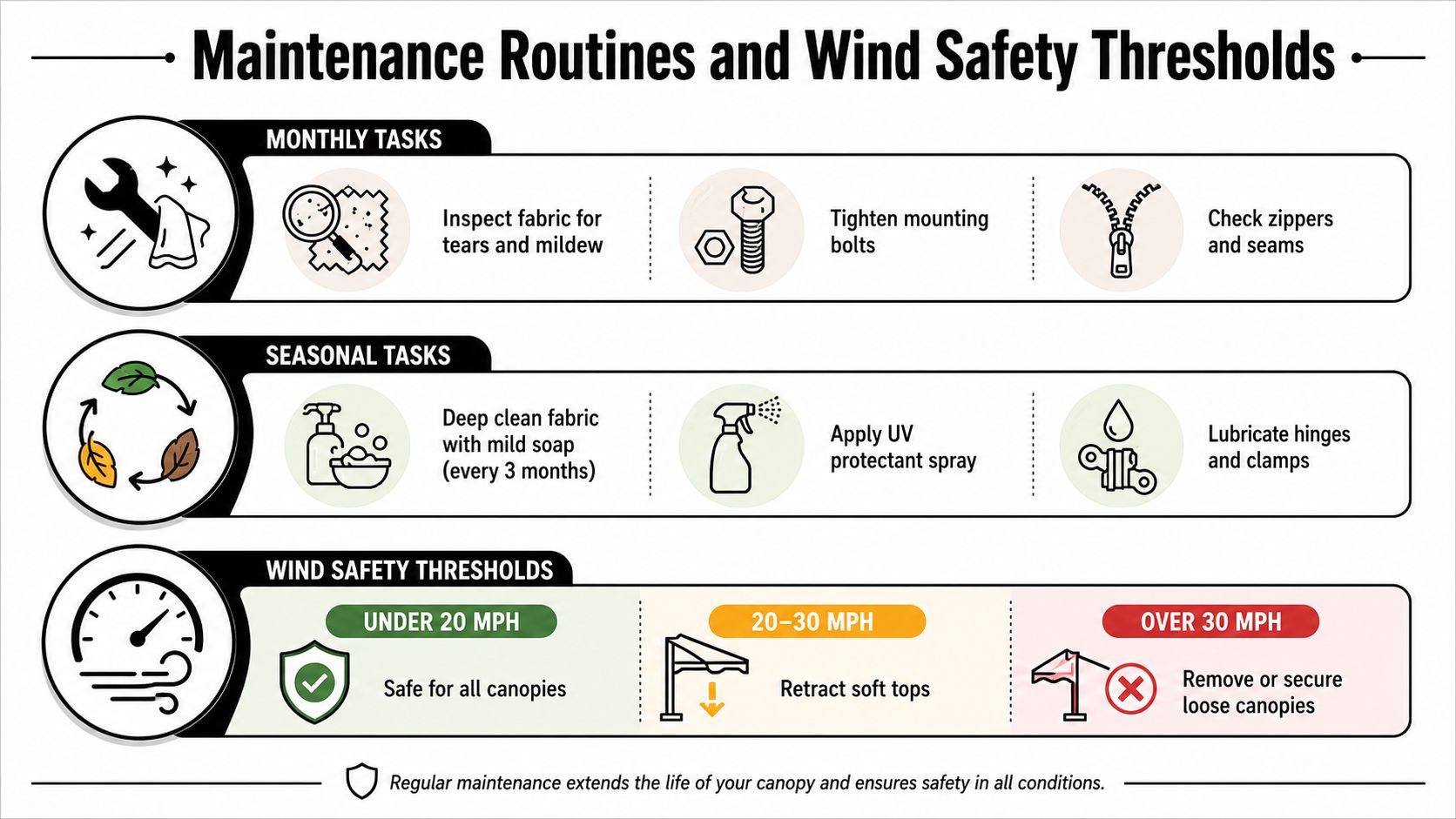
Clean the canopy with mild soap and water. Avoid bleach and abrasive detergents, which can damage fibers, coatings, stitching, and surface treatments. Rinse thoroughly and let the material dry completely before folding or storing it.
Inspect the fabric, seams, edge binding, zippers, snaps, clamps, and brackets. Patch small tears early. A short split at a seam can become a larger failure when the roof vibrates or catches wind. In humid environments, look for mildew at folded areas and around hardware. In salty coastal environments, rinse exposed fasteners and inspect for corrosion.
The Home Depot canopy care guidance supports the basic cleaning and storage approach. The practical extension is to make inspection part of the operating routine rather than waiting for visible failure.
Wind changes the decision
Heavy fabric, enclosed sides, and rigid panels increase the area that wind can push against. That load travels into the frame, clamps, bolts, and chassis attachment points. A canopy that's secure in calm weather can become a liability when gusts lift the roof or repeatedly flex the brackets.
Independent event-setup guidance recommends removing canopy structures when winds exceed roughly 35 mph, with heavy anchoring and top-down securing used below that level, as described in the wind-condition securing guide from Exhibit Supply. Golf cart roofs aren't identical to event tents, so operators should follow the canopy and vehicle manufacturer's instructions where they differ.
Wind protocol: Don't wait for visible movement. If severe weather is approaching, park the cart under cover or remove and store a detachable soft canopy before gusts load the structure.
For resort fleets, assign responsibility for weather decisions. Check fastener tightness, bracket alignment, strap condition, and corrosion before the season begins. If a roof rattles, lifts, or shifts, take the cart out of service until the mounting system is corrected. Owners replacing damaged fabric can review the Solana EV golf cart roof replacement guide while checking whether the frame and hardware also need attention.
Choosing the Right Canopy for Your Situation
The right purchase depends on exposure, workload, weather, and how much downtime the owner can tolerate. Price matters, but lifecycle cost also includes installation, inspections, replacement fabric, cleaning labor, and the consequences of a roof failure during operation.
Match the canopy to the operator
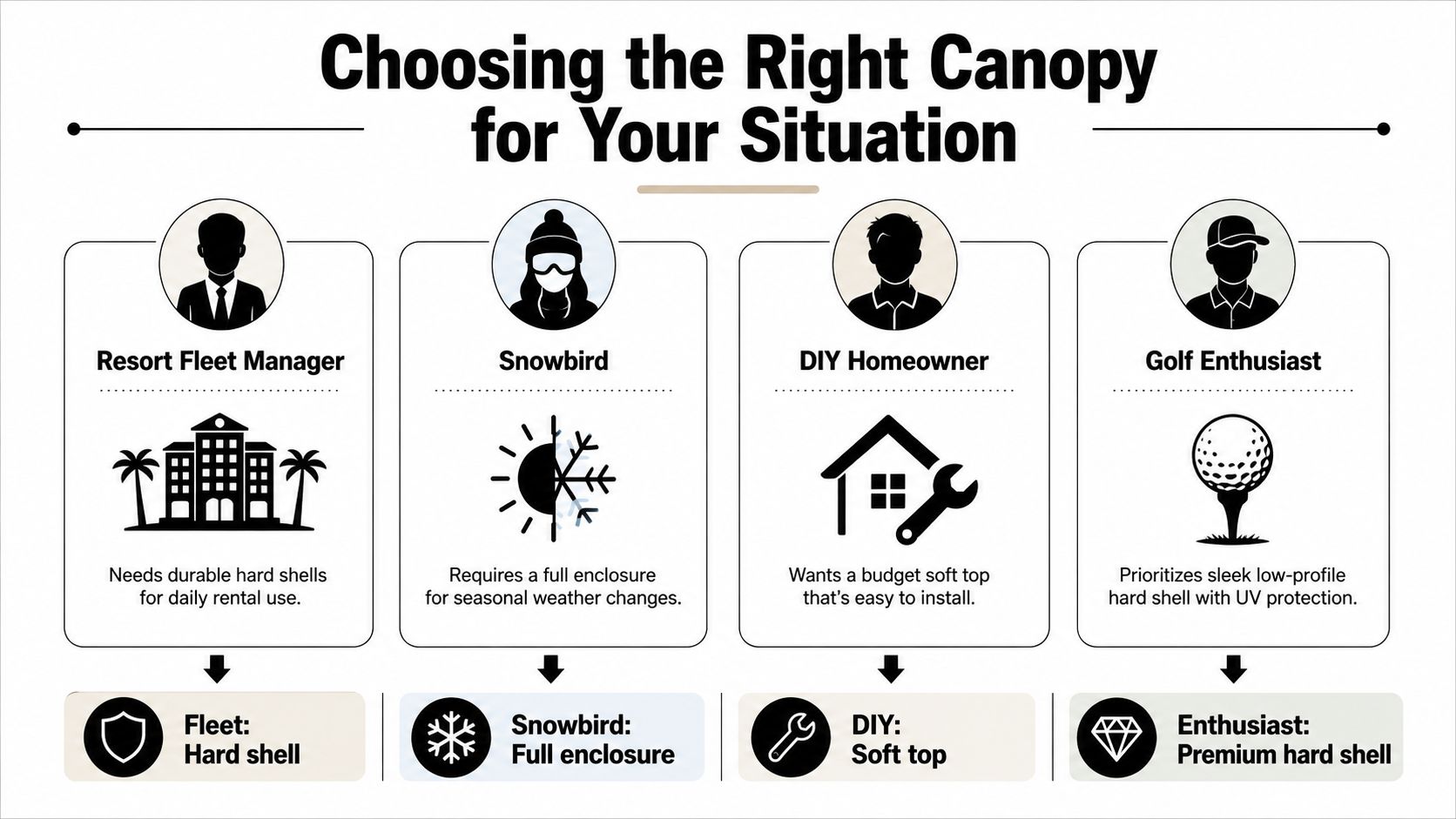
Resort fleet manager: Choose a hard-shell roof or a rigid-frame system with durable coated material when carts run daily, stay outdoors, and need a uniform appearance. Standardize brackets and replacement parts across the fleet, then add scheduled inspections to the cleaning program. A consistent configuration makes training and parts management easier.
Gated-community homeowner: A fitted soft fabric top is often sufficient for neighborhood trips, especially when the cart is stored under cover. Choose a UV-resistant fabric if the vehicle sits in the driveway, and confirm mirror, windshield, and light clearance before ordering.
Golf course superintendent: Prioritize ventilation, cleanability, and quick service. Mesh can work in hot, dry operating conditions, while coated fabric is more suitable when the cart regularly faces rain. Keep replacement panels and hardware available so one damaged roof doesn't sideline a working vehicle.
Off-road enthusiast: Select a low-profile hard shell or reinforced fabric roof with securely isolated mounting points. Off-road vibration makes loose clamps and reused hardware poor choices. If the route includes changing weather, a removable enclosure can add flexibility, but inspect every zipper, strap, and seam.
Use this buying checklist
Before placing the order, verify:
- Vehicle fit: Confirm the exact model, roof footprint, rail geometry, and bracket pattern.
- Material purpose: Choose mesh for airflow, coated fabric for rain resistance, or a hard shell for a stable fleet roof.
- Hardware condition: Replace questionable brackets, isolators, clamps, and corroded fasteners instead of hiding them under new fabric.
- Weather plan: Decide how the canopy will be secured or removed during strong wind.
- Service access: Check whether panels, zippers, brackets, and replacement hardware can be purchased separately.
- Compliance clearance: Confirm mirrors, lights, restraints, windshield visibility, and local street-use requirements.
- Maintenance commitment: Make sure staff or household members can clean, dry, inspect, and store the canopy correctly.
A future replacement decision should be based on observed wear, not the calendar alone. Fading, brittle fabric, stretched seams, loose brackets, water intrusion, and recurring repairs all indicate that the current setup has reached the end of its useful service. This video can provide another visual reference as you compare roof and enclosure configurations:
For a resort or daily-use owner, the most economical canopy is the one that fits correctly, matches the weather, and can be maintained without constant retrofitting. Buy for the cart's real duty cycle, then protect that investment with inspections and a clear wind protocol.
Solana EV offers street-legal electric golf carts and related roof options for applications around neighborhoods, resorts, campuses, and recreational properties. Review the vehicle lineup, compare canopy fitment requirements, and visit Solana EV to find a nearby dealer or discuss the right configuration for your cart.