
When you get right down to it, the debate between an electric vehicle and a hybrid is pretty straightforward. An EV runs purely on a battery and an electric motor—that’s it. This means zero tailpipe emissions. A hybrid, or HEV, pairs a traditional gasoline engine with an electric motor, using the battery to improve fuel economy instead of being the main power source. For anyone managing a fleet of low-speed vehicles, this distinction is everything.
EV vs Hybrid Powertrains: The Core Differences
Choosing between an EV and a hybrid isn't just about fuel; you're picking between two completely different engineering philosophies. This one decision has a domino effect on everything that follows: daily operations, routine maintenance, and the total cost of ownership over the vehicle's life. This is especially true in contained environments like resorts, gated communities, or large business campuses.
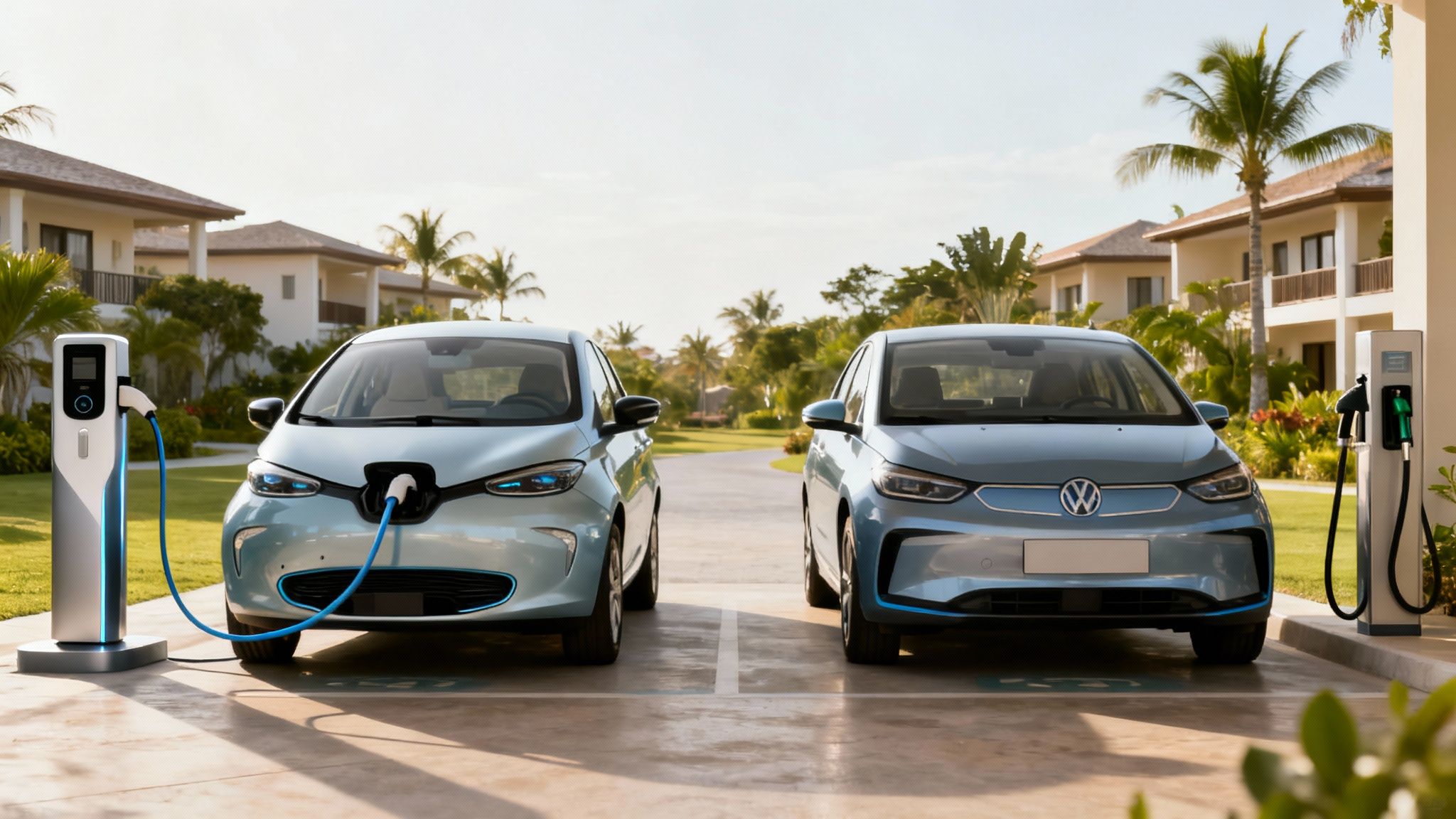
Mechanical Simplicity vs. Complexity
One of the biggest wins for an all-electric powertrain is its beautiful simplicity. An EV has just a handful of major moving parts: a battery, an inverter, and the electric motor. This clean design gets rid of the need for oil changes, spark plugs, exhaust systems, and all the headaches that come with a complex transmission.
A hybrid, on the other hand, is essentially carrying two powertrains under one hood. You have the entire mechanical burden of an internal combustion engine (ICE) plus all the components of an electric drive system. While this dual setup is clever, it also introduces more complexity, more potential points of failure, and ultimately, higher service costs over the vehicle's lifetime.
For fleet managers, the EV's mechanical simplicity is a game-changer. It translates directly to more vehicle uptime and lower operational budgets. Fewer parts mean fewer things can go wrong.
To put it simply, here’s a quick look at the core differences that set these two vehicle types apart.
At a Glance: EV vs Hybrid Key Distinctions
| Attribute | Electric Vehicle (EV) | Hybrid (HEV) |
|---|---|---|
| Primary Power Source | 100% battery and electric motor | Gasoline engine assisted by an electric motor |
| Refueling/Recharging | Recharges via electrical outlet or charging station | Refuels with gasoline at a gas station |
| Tailpipe Emissions | Zero | Reduced, but still present |
| Mechanical Parts | Minimal (motor, battery, inverter) | Numerous (engine, transmission, plus electric motor) |
| Routine Maintenance | Low (tires, brakes, cabin filters) | High (oil changes, engine service, plus electrical) |
This fundamental difference in how they're built is just the beginning. It directly influences how each vehicle performs in the real world, what it actually costs to own, and which one makes more sense for your specific needs, particularly in the low-speed vehicle market.
How Each Powertrain Actually Works
To really get to the bottom of the electric vs. hybrid debate, you have to look past the body panels and understand what makes each vehicle go. The way these machines generate and deliver power isn't just a topic for mechanics; it directly impacts how they perform, how reliable they are, and what they'll cost you in the long run.
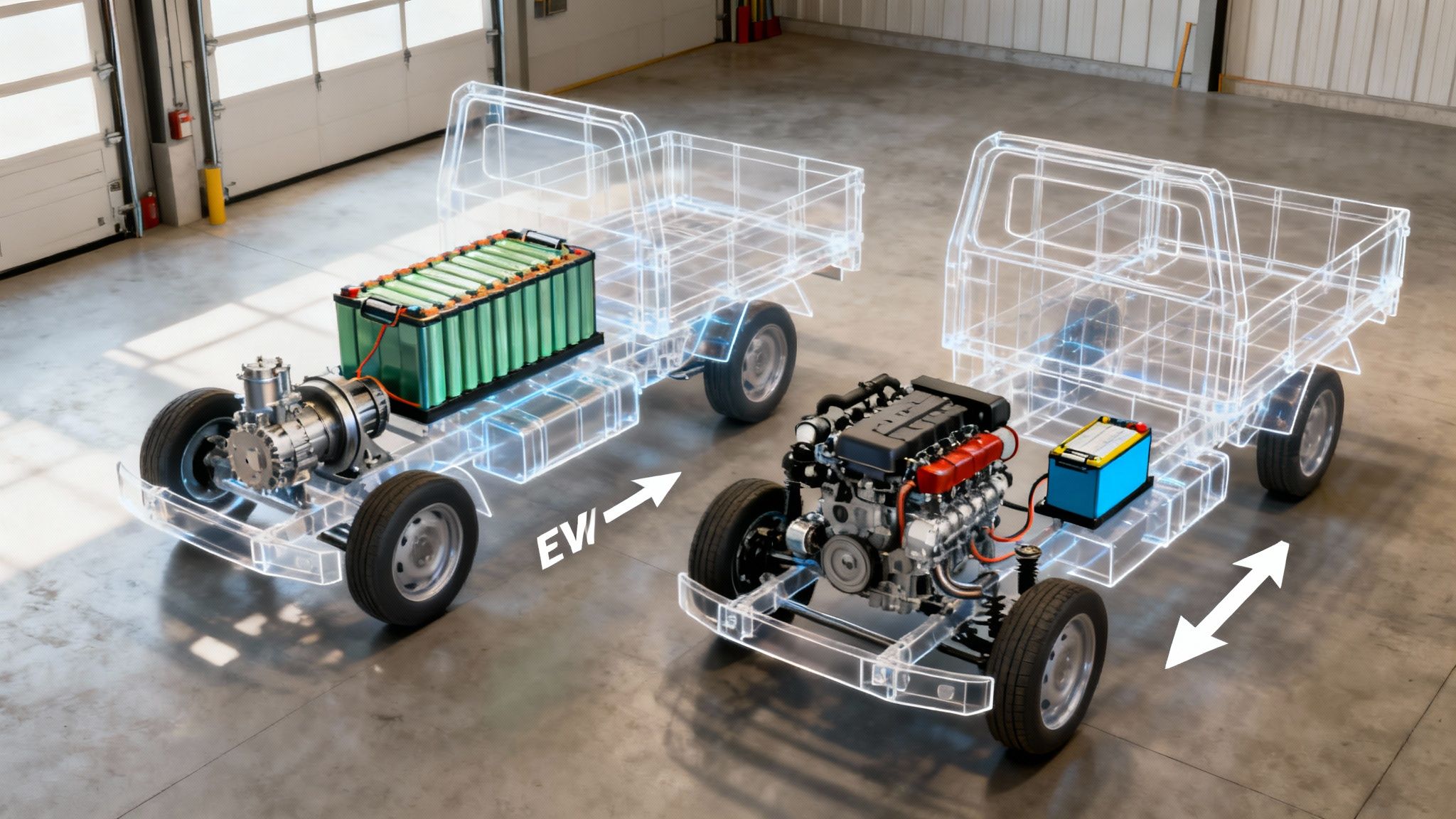
At its core, an EV powertrain is beautifully simple. You have a big battery pack, an inverter that flips the battery’s direct current (DC) to alternating current (AC), and an electric motor to spin the wheels. That's pretty much the whole story. This clean design gets rid of hundreds of moving parts you’d find in a gas engine—no pistons, no valves, no fuel pumps, and no exhaust systems.
The All-Electric Advantage: Simplicity and Instant Power
This minimalist engineering is an EV's secret weapon. Fewer parts mean fewer things can break, which is a massive plus for utility vehicles getting a workout every day on resort grounds or rugged trails. The way it delivers power is also a game-changer. Step on the accelerator in an EV, and the reaction is immediate.
The electric motor gives you 100% of its torque right from a standstill, resulting in quick, quiet, and incredibly smooth acceleration. It’s perfect for climbing a steep cart path on a golf course or handling stop-and-go routes around a community, all without the clatter and vibration of an engine.
Another key piece of the puzzle is regenerative braking. When you lift your foot off the accelerator or hit the brakes, the electric motor works in reverse. It becomes a generator, capturing the car's forward momentum and converting it back into energy to store in the battery.
Regenerative braking is more than a cool tech feature; it’s a practical range-extender. On a resort shuttle route or in a neighborhood with lots of stops, this system can recover a surprising amount of energy, boosting overall efficiency and stretching the time between charges.
The Hybrid Powertrain: A Complex Partnership
A hybrid, on the other hand, is a much more complicated beast. It's constantly juggling power from two different sources: a traditional internal combustion engine (ICE) and at least one electric motor. Sophisticated software manages this delicate dance to maximize fuel economy, but it can't escape the mechanical baggage of having both systems on board.
You’ll generally run into two types of hybrid systems:
- Parallel Hybrids: This is the most common setup you'll see. Here, the gas engine and the electric motor can power the wheels together or work independently. The vehicle's computer decides which is best, typically using the electric motor for low-speed driving and firing up the engine when you need more speed or power.
- Series Hybrids: In this less common configuration, the gas engine never turns the wheels directly. Its only job is to act as a generator, creating electricity to either recharge the battery or send power straight to the electric motor. The motor does all the heavy lifting to move the vehicle.
While the technology is impressive, this dual-system design means a hybrid still needs oil changes, new spark plugs, and exhaust system maintenance. A deeper dive into electric vehicle battery technology really highlights why the single-source power in an EV leads to a more straightforward ownership experience. The added complexity in hybrids just introduces more potential failure points and maintenance needs over the life of the vehicle.
Ultimately, the choice comes down to this: the elegant simplicity of an all-electric design versus the intricate, two-headed approach of a gas-electric hybrid. For jobs that demand rock-solid reliability, minimal upkeep, and quiet operation, the EV’s straightforward engineering makes a very strong case.
Calculating the True Cost of Ownership
The price on the window sticker is just the first chapter of a vehicle's financial story. When you're weighing an electric vehicle against a hybrid, the hybrid often looks like the cheaper option upfront. But that initial savings can be a bit of a mirage. To get the real picture, you have to look at the Total Cost of Ownership (TCO)—everything from fuel and maintenance to repairs and even resale value over the vehicle's life.
For anyone running a commercial fleet, whether at a resort, golf course, or a sprawling campus, TCO isn't just a number; it's the only number that really matters. The higher sticker price of an EV is often wiped out by massive long-term savings, making it a much smarter investment over a 3- to 5-year horizon.
Upfront Purchase Price: The First Hurdle
Let's be honest: EVs typically cost more to buy than comparable hybrids. It’s a fact of the current market, and it’s why hybrids often win over buyers who are focused on the immediate, short-term cost.
But that landscape is shifting, and fast. Battery technology is getting better and cheaper, and as manufacturers build more EVs, the prices are coming down. On top of that, a variety of federal and state incentives can chop a significant amount off an EV's initial price, making it a much closer race right from the start.
A recent analysis highlighted that while hybrids are capturing significant market share, the long-term economics tell a different story. In the electric vehicle vs hybrid debate, EVs can cut lifetime operational costs by 30-40%, a compelling figure for any business.
The upfront cost is just one piece of a much larger puzzle. The real savings with an EV start piling up the second it leaves the lot.
Fuel Costs: Electricity Versus Gasoline
Here’s where you’ll see the most dramatic and immediate difference: fuel. Electricity is just plain cheaper than gasoline, and usually by a wide margin. For a commercial fleet that’s running vehicles all day, every day, these savings add up incredibly quickly.
Think about a resort shuttle running 10 hours a day. With a hybrid, you’re still making daily trips to the gas station, subject to whatever wild price swings are happening that week. An EV, on the other hand, can be plugged in overnight, right on-site, sipping low-cost electricity. That creates a predictable, stable, and much, much lower operating expense.
- EV Fueling: You charge on-site with electricity that can cost as little as one-third the price of gasoline. This means no more fuel runs, no fuel storage liabilities, and no price volatility.
- Hybrid Fueling: You're still tied to the pump. While it's more efficient than a gas-only car, you can't escape the higher costs and unpredictability of fossil fuels.
This basic difference in energy cost is the main reason an EV's TCO is so much lower, especially for high-use commercial vehicles. For a deeper dive into the numbers, check out our comprehensive electric vehicle cost comparison.
Maintenance and Repairs: The Hidden Costs
When it comes to maintenance, the financial argument for EVs becomes almost impossible to ignore. An all-electric powertrain is beautifully simple. It has a tiny fraction of the moving parts found in an internal combustion engine, which translates directly to fewer trips to the mechanic and smaller repair bills.
An EV has zero need for:
- Oil changes
- Spark plug replacements
- Exhaust system repairs
- Fuel filter changes
- Transmission servicing
A hybrid, however, has to maintain two systems. You still have a gasoline engine that needs all the traditional upkeep, plus the added complexity of its electric motor and battery. When you’re figuring out the true cost, you have to account for these long-term expenses, including potential repairs and understanding the difference between OEM and aftermarket parts.
For a fleet manager, this simplicity means more uptime for your vehicles, fewer scheduling headaches, and a drastically smaller maintenance budget. This isn't just about saving money; it's about reliability. Your vehicles are on the job, not in the shop. Over a 3-5 year lifespan, these savings make the EV the clear financial winner for most commercial operators.
Comparing Performance and On-Road Feel
Let’s move past the spec sheets and cost breakdowns for a moment. The real decider in the electric vs. hybrid debate often comes down to something you can't find on paper: the actual driving experience. How a vehicle responds, the sounds it makes (or doesn't make), and the overall feel from the driver's seat can make all the difference, especially in places like resorts or planned communities where experience is everything.

The first thing you’ll notice in an all-electric vehicle is the quiet. It’s not just quiet; it’s silent. With no gas engine to rumble to life, the noise, vibration, and general harshness you’ve unconsciously associated with driving are just gone. This creates a peaceful, almost luxurious atmosphere that a hybrid, by its very nature, can’t fully deliver.
Imagine a resort shuttle gliding guests to their rooms or a neighborhood vehicle making its rounds. This silent operation is a huge win. It keeps the environment tranquil, letting people hold a conversation or just enjoy the scenery without the background drone of an engine.
Instant Torque and Effortless Acceleration
The other defining trait of an EV is its instantaneous torque. The second your foot touches the accelerator, the electric motor gives you all its power. The result is quick, perfectly smooth acceleration. There's no lag, no waiting for gears to shift, no engine roaring—just a confident and immediate surge of movement.
This on-demand power isn't just for show; it's incredibly practical in day-to-day use:
- Hilly Terrain: An EV doesn't struggle up steep inclines. It just goes, without the strained engine sounds or clunky downshifts you get from gas or hybrid vehicles.
- Stop-and-Go Traffic: Navigating constant stops and starts is completely seamless, which is perfect for campus patrols or community trams.
- Heavy Loads: That consistent power means the vehicle stays responsive and capable, even when it’s full of passengers or hauling equipment.
This kind of responsiveness gives the driver a feeling of total control, which improves both safety and confidence behind the wheel.
In hospitality, the guest experience is paramount. An EV’s silent, smooth ride doesn't just transport people; it elevates their experience, reinforcing a sense of luxury and calm from the moment they step on board.
The Hybrid Experience: Refined, but Still a Compromise
To be fair, modern hybrids have come a long, long way. The handoff between the electric motor and the gas engine is often so smooth you barely notice it during normal driving. The engineering that goes into masking those transitions is impressive.
But you can’t escape the fact that it’s a compromise. Ask for a burst of power to get up a hill or accelerate quickly, and the gas engine has to kick in. When it does, you get that familiar engine noise and subtle vibration—the very things that are completely absent in a pure EV.
While a hybrid is a world away from a traditional gas-powered car, it simply can’t compete with the deep quiet of an all-electric powertrain. The difference is most obvious in low-speed environments, where an intermittent engine is much more noticeable and disruptive.
Let’s look at a few specific scenarios:
- Golf Course: An EV glides across the course in near silence, keeping the game peaceful. A hybrid, while an improvement over a gas cart, will still fire up its engine when accelerating between holes.
- Resort Property: A fleet of EVs can move about almost unnoticed, preserving the serene vibe for guests at the pool or on their balconies. The stop-and-start engine noise from hybrids can easily chip away at that tranquility.
- Off-Road Trails: The EV's instant torque gives you incredible control and climbing power on tough terrain. A hybrid’s engine noise, on the other hand, can disturb wildlife and take away from the natural experience.
Ultimately, the choice comes down to the kind of experience you want to provide. A hybrid offers a much more efficient version of a familiar feeling. But an all-electric vehicle delivers something fundamentally different and, in these environments, superior: a ride defined by silence, smoothness, and immediate response.
How Range, Charging, and Refueling Actually Work in the Real World
"Range anxiety" is a term thrown around a lot, but for a low-speed vehicle fleet, it’s mostly a non-issue. The big selling point for a hybrid is that you can fill it up at any gas station in a few minutes. That’s a huge advantage on a cross-country road trip, but it loses its shine in a controlled environment like a resort, campus, or planned community.
For fleet managers, EV charging isn't a bug; it's a feature. Think about it: a vehicle with over 100 miles of range can run all day long—shuttling guests, patrolling grounds, or handling maintenance tasks—and still have juice to spare. At the end of the day, you just plug it into a regular wall outlet. It’s that simple. This routine turns fueling from an ongoing headache into a predictable, set-it-and-forget-it part of your closing duties.
This overnight charging model does more than just simplify things. It gets rid of expensive, time-wasting trips to the gas station, eliminates the safety risks of storing fuel on-site, and frees your budget from the rollercoaster of gas prices. You’re taking back control over your fleet's energy supply.
A New Way to Think About Charging
The trick is to stop thinking about public charging stations and start thinking about on-site power management. Your low-speed vehicles aren't driving from city to city; they're operating within a known, defined area. This is the perfect setup for a centralized, overnight charging strategy.
Imagine a designated charging hub where every vehicle gets plugged in at the end of a shift. It’s a clean, reliable system that ensures every vehicle is at 100% and ready to go first thing in the morning, with almost no extra work for your staff. This approach fits right into your existing operational flow. You can even map out the most efficient routes for the day with our electric vehicle range calculator and know you have more than enough range to get the job done.
The Bigger Picture: Where the Market is Headed
This isn't just a trend for niche communities; it's a massive global shift. In 2025, worldwide electric vehicle sales hit an incredible 20.7 million units—that’s a 20% jump from the year before. While hybrids are still a popular bridge for drivers not quite ready for full electric, the explosive growth of EVs tells the real story.
In places like China, EVs now make up 50% of all new car sales. For anyone considering Solana EV models, this trend is a powerful confirmation. Hybrids offer a familiar process, but the momentum and innovation are squarely on the side of EVs, especially for eco-conscious communities that value sustainable, low-fuss transportation. You can dig deeper into these global EV sales trends at source.benchmarkminerals.com.
The reason for this global adoption comes down to the same practical benefits that make EVs a perfect fit for managed environments.
Daily Logistics: A Side-by-Side Look
Let's get down to brass tacks. Here’s how the day-to-day operations really stack up in a commercial setting.
| Logistical Task | Electric Vehicle (EV) | Hybrid Vehicle (HEV) |
|---|---|---|
| Daily Fueling | Plug it in on-site overnight. Wake up to a full "tank." | Requires sending an employee off-site to a gas station. |
| Fuel Management | Consistent, predictable electricity costs. | Chasing volatile, unpredictable gasoline prices. |
| Infrastructure | Works with the standard electrical outlets you already have. | Requires access to gas stations or risky on-site fuel storage. |
| Labor Costs | Zero. The vehicle charges itself during downtime. | You pay an employee's wage for time spent driving and refueling. |
| Environmental Risk | None. No fuel spills, no fumes, no storage hazards. | Constant risk of fuel spills and exposure to fumes. |
When you look at the day-to-day reality, the hybrid’s so-called advantage—quick refueling—actually becomes a recurring operational cost and a logistical pain. In contrast, the EV’s charging routine, when managed correctly, becomes a smart, self-sufficient system that saves money and gives you total control over your fleet’s readiness and budget.
Which Vehicle Is Right for You?
Deciding between an electric vehicle and a hybrid isn't about picking the "best" technology—it's about finding the right fit for your world. The choice really boils down to your daily operations, what kind of experience you want to offer, and your long-term budget. Each powertrain shines in different situations.
To get started, think about one simple thing: what do you have easier access to? Gas stations or a place to charge overnight? This flowchart breaks it down.
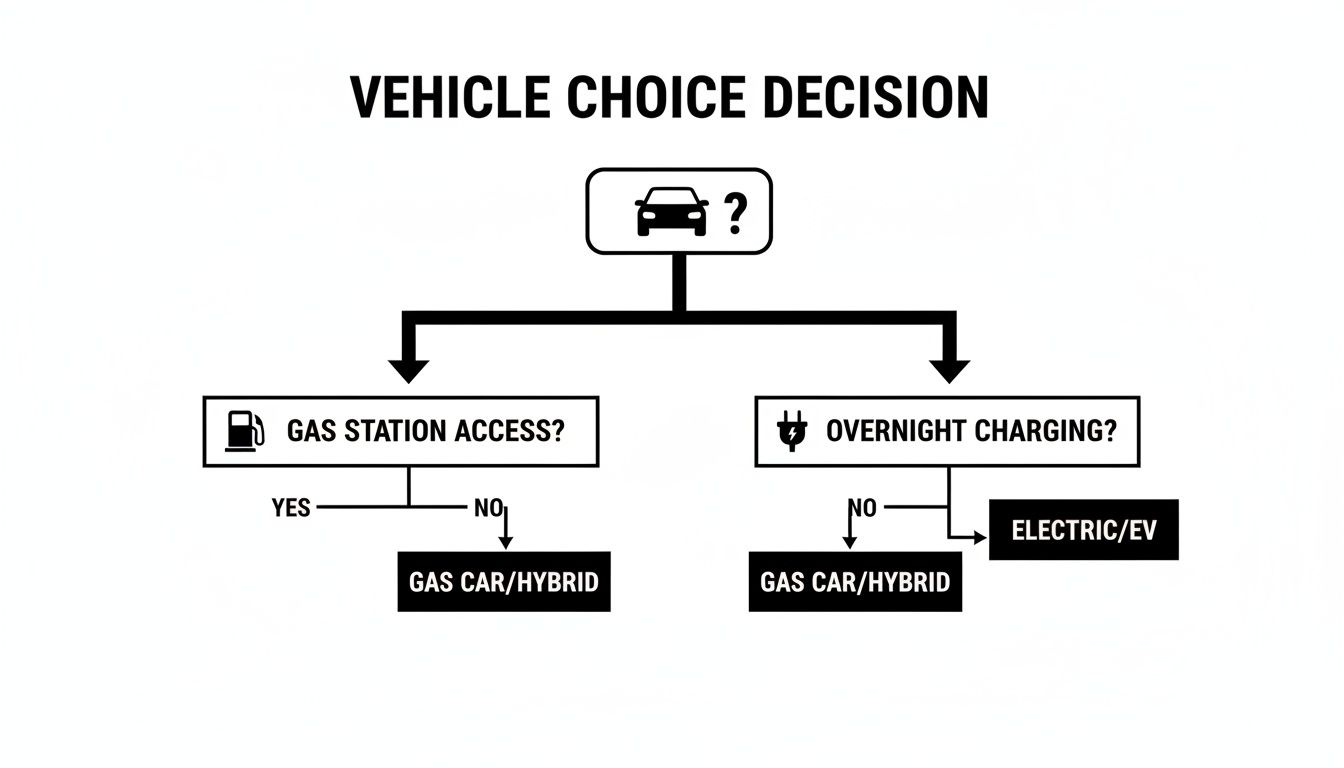
This visual guide cuts through the noise. It focuses on the fundamental logistics of your environment, which often points you straight to the most practical vehicle.
Recommendations for Hospitality and Resorts
For anyone managing a resort or hotel, the argument for a fully electric fleet is incredibly strong. It really comes down to two things: a better guest experience and serious operational savings. An EV's silent ride preserves the quiet, peaceful atmosphere guests are paying for. A hybrid, with its gas engine kicking on and off, simply can't compete with that.
Beyond the ambiance, the total cost of ownership for EVs is significantly lower. You get to cut gasoline from your budget entirely and say goodbye to most engine maintenance. Setting up a centralized charging station for overnight use creates a seamless, predictable workflow. Your vehicles are always topped up and ready to go, without the time and expense of sending staff to the pump.
For any business where ambiance is part of the product, the silent, smooth ride of an EV is not just a feature—it's a competitive advantage. It directly enhances the guest environment, reinforcing a premium, peaceful brand identity.
Guidance for Off-Road and Property Use
If you’re using a vehicle for off-road trails or managing a large property, an EV’s design gives it a natural edge. The instant torque you get from an electric motor delivers fantastic control and climbing power on rough ground. You can navigate tricky terrain without the loud, disruptive noise of a gas engine.
The mechanical simplicity is another huge plus. An all-electric vehicle like a Solana EV has no complex engine, transmission, or exhaust system to worry about. That makes it far more durable and reliable in tough conditions, which means less downtime and fewer repair bills. For those still weighing their options, a detailed Honda Jazz Hybrid review can provide some real-world perspective on a popular hybrid.
Best Choice for Gated Communities
For residents in gated communities looking for a street-legal, low-speed vehicle, a pure EV is almost always the smarter pick. The convenience is unbeatable—you just plug it in at home and forget about ever visiting a gas station again. The quiet operation and smooth, easy acceleration also make for a safer and more pleasant ride around the neighborhood.
While hybrid sales have been surprisingly strong—electrified vehicles (hybrids, BEVs, PHEVs) made up 22% of US light-duty sales in Q1 2025—the global trend is clear. In 39 countries, EVs now account for over 10% of new car sales, which suggests hybrids are a bridge technology, not the final destination. For low-speed use, an EV from Solana's lineup can slash your running costs by up to 50% compared to a gas-powered alternative.
Still on the Fence? Let's Tackle Some Common Questions
Even after weighing the pros and cons, a few lingering questions can make the final call between an electric and a hybrid vehicle feel tricky. Let's clear up some of the most common points of confusion to help you decide with confidence.
Is an EV or a Hybrid Better for a Commercial Fleet?
For almost any commercial fleet operating at low speeds—think resorts, sprawling university campuses, or master-planned communities—an EV is almost always the smarter long-term investment. The quiet, smooth ride immediately enhances the atmosphere for guests and residents, creating a more peaceful, premium-feeling environment.
But the real win for businesses is the bottom line. The dramatically lower running costs, thanks to zero fuel and minimal maintenance, slash the total cost of ownership over the vehicle's lifespan. Setting up a central, overnight charging depot streamlines your operations, completely removing the hassle and expense of storing gasoline and managing refueling trips.
For any business, reliability is king. An EV's simple powertrain has so few moving parts, which translates directly into more vehicle uptime and a maintenance budget you can actually predict.
What's the Real Difference in Maintenance?
This is one of the biggest differentiators, and it’s not even close. A pure electric vehicle is ingeniously simple. There are just far fewer things that need regular attention.
With an EV, you can say goodbye to:
- Oil changes
- Spark plug replacements
- New air or fuel filters
- Exhaust system repairs
A hybrid, on the other hand, is the opposite. It has both an internal combustion engine and an electric system, meaning you have to service both. You're still on the hook for all the routine engine maintenance of a standard gas car, making it fundamentally more complex and expensive to keep on the road.
Which One Is More Reliable Over the Long Haul?
Modern hybrids are well-built, but when it comes to long-term reliability, simplicity usually wins. An EV's powertrain just has fewer components that can wear down, degrade, or fail over years of use.
This clean, all-electric design naturally leads to greater durability, especially in the kind of demanding, daily-use environments common in commercial settings. The very nature of a hybrid—marrying a gas engine to an electric motor—creates more potential points of failure than a straightforward EV. When there are fewer things that can go wrong, you can depend on your vehicle, day in and day out.
Ready to experience the superior performance, reliability, and low ownership cost of an all-electric vehicle? Explore the premium lineup of street-legal EVs from Solana EV and find the perfect model for your resort, community, or personal use.