
When you hear the term "street-legal electric vehicle," what comes to mind? For many, it's a golf cart with a license plate, but the reality is much broader. At its core, a street-legal EV is any electric-powered vehicle—be it a compact cart or a full-sized truck—that's been properly equipped to meet federal and local safety standards for use on public roads.
What Makes an Electric Vehicle Street Legal?
Think of it this way: a "street legal" designation isn't just a casual label. It’s a formal classification that signals a vehicle has met a specific set of safety and equipment rules. It’s the difference between a go-kart you can only use on private property and a car you can legally drive to the grocery store.
The most common type you'll see in planned communities, on university campuses, and around large commercial properties is the Low-Speed Vehicle (LSV). You might also hear it called a Neighborhood Electric Vehicle (NEV). These vehicles are designed for a specific purpose and are federally regulated to travel at speeds between 20 and 25 mph. To earn that street-legal status, they must come equipped with essential safety gear.
Key Classifications at a Glance
Let's break down the main categories to get a clearer picture of the landscape:
- Low-Speed Vehicles (LSVs/NEVs): These are the true champions of local, short-range transport. They are typically restricted to roads with speed limits of 35 mph or less, making them perfect for getting around a neighborhood, managing a resort property, or navigating a large corporate campus efficiently and quietly.
- Highway-Capable Electric Vehicles (EVs): This is the category everyone knows. Think Tesla, the Ford Mustang Mach-E, or a Rivian truck. These vehicles are built to meet all Federal Motor Vehicle Safety Standards (FMVSS) and can be driven on any public road, from a quiet suburban street to a major interstate highway, right alongside gas-powered cars.
Knowing the difference is absolutely crucial. An LSV is a fantastic tool for its intended environment, but you can't legally take it on a 55-mph highway. Figuring out which category suits your operational needs is the first step toward making a smart purchase.
In short, the "street legal" badge means a vehicle is certified to operate safely alongside regular traffic because it has all the required safety equipment—headlights, turn signals, seatbelts, and more—as defined by government standards.
For anyone looking to convert a standard golf cart into a road-ready vehicle, getting these details right is non-negotiable. You can dive deeper into the specific rules with a good guide on street legal golf cart requirements.
And if you're planning to use these vehicles for business, don't forget about insurance. Understanding the commercial vehicle insurance requirements is just as important as the vehicle's hardware. It ensures you’re not just compliant, but fully protected.
Comparing Street Legal Electric Vehicle Types
To make the distinctions even clearer, here’s a quick breakdown of how these vehicle types stack up against each other.
| Vehicle Type | Top Speed Range | Where You Can Drive Them | Primary Use Cases |
|---|---|---|---|
| LSV / NEV | 20-25 mph | Roads with posted speed limits of 35 mph or less | Campus transport, property maintenance, resorts, planned communities |
| Standard EV | 65+ mph | Any public road, including highways and interstates | Daily commuting, long-distance travel, commercial deliveries |
As you can see, the right choice really comes down to where and how you plan to use the vehicle. Each category is designed to excel in its specific environment.
Navigating the Rules of the Road
So, you understand the different types of electric street-legal vehicles. That’s step one. Now comes the important part: getting a handle on the specific rules that let you actually drive them on public roads.
Think of it this way—you can’t just show up to a baseball game and start playing without knowing the rules. Driving is the same. Federal and local authorities set the rulebook to keep everyone safe, and knowing that book is essential before you get behind the wheel.
At the highest level, the National Highway Traffic Safety Administration (NHTSA) sets the standard for what qualifies as a Low-Speed Vehicle (LSV). These aren't just helpful suggestions; they are strict, mandatory requirements. For a vehicle to be sold as street-legal right from the factory, it must meet these federal safety and performance benchmarks.
The Federal Safety Checklist
For a vehicle to earn the official LSV classification, it needs to hit a specific speed window: it must be able to go at least 20 mph but no faster than 25 mph. But speed is only half the story. The real litmus test is the factory-installed safety equipment.
A true, federally compliant LSV will always roll off the assembly line with:
- Headlights, Taillights, and Brake Lights: Absolutely crucial for being seen, day or night.
- Turn Signals: So other drivers know what you’re doing next. It's basic road etiquette and a must-have for safety.
- Mirrors: A full set—rearview and side-view—to give you a complete picture of your surroundings.
- A Windshield: Not just any plastic shield, but proper safety glass to protect you from road debris.
- Seat Belts: A dedicated seat belt for every single seat. No exceptions.
- A Registered VIN: A unique Vehicle Identification Number is essential for getting your vehicle registered, titled, and insured.
This isn't just a list of nice-to-haves. This is what fundamentally separates a legitimate LSV from a golf cart someone tried to modify in their garage. If a vehicle is missing even one of these factory-installed items, it doesn't meet the federal standard.
State and Local Laws: The Next Layer
While federal law sets the manufacturing blueprint, state and local laws dictate where you can actually drive. This is where you need to pay close attention. The most common rule you'll find is that LSVs are restricted to roads with a posted speed limit of 35 mph or less.
This limitation is purely for safety. It prevents a massive speed gap between your 25 mph LSV and cars that might be doing 50 mph or more. Creating a "slow-moving roadblock" on a busy street is incredibly dangerous for everyone.
On top of state laws, your local city or even your homeowner's association might have its own specific rules, like prohibiting LSVs in certain downtown areas or restricting driving hours.
Here’s the key takeaway: Federal law tells manufacturers how the vehicle must be built. State and local laws tell you, the driver, where and how it can be driven.
This two-tiered system means you have to do your homework. A vehicle that's good to go in a planned community in Arizona might have different restrictions in a New England town. And just like any other car, your LSV will need to be registered, titled, and properly insured. You can dig deeper into the insurance requirements by checking out dedicated guides on low-speed vehicle insurance to make sure you're fully covered.
The Real-World Benefits and Applications
So, we've covered the technical side, but let's get to the real question: why would you actually choose an electric street-legal vehicle? It’s not just about being trendy. These vehicles are a powerhouse combination of financial sense, smart operation, and environmental responsibility that makes them a perfect fit for a surprisingly wide range of jobs.
The first thing you'll notice is the impact on your wallet. Imagine completely wiping out the fuel budget for your business or community fleet. With an electric vehicle, "refueling" is as easy as plugging it in overnight, and the cost is just a fraction of a tank of gas. This isn’t pocket change; for a commercial operation, these savings add up fast and lead to a much lower total cost of ownership.
On top of that, the maintenance is refreshingly simple. An electric motor doesn't have oil to change, spark plugs to replace, or a complicated exhaust system to fix. That means less time in the shop, fewer repair bills, and a more dependable fleet that’s always ready to get to work.
Where Electric Street Legal Vehicles Shine
These vehicles are true workhorses, built to thrive in places where regular cars and trucks are just too big, loud, or inefficient. They’re problem-solvers.
Here are a few places where they make a huge difference:
- University and Corporate Campuses: Think about it—maintenance crews, security patrols, and staff moving across large grounds. These quiet, zero-emission vehicles can navigate pathways and buildings without the noise and fumes of a gas engine.
- Resorts and Hospitality: Moving guests and their luggage or delivering supplies across a sprawling resort becomes a smooth, quiet experience. They help maintain that peaceful atmosphere everyone is there for.
- Last-Mile Delivery: In busy downtown areas, an electric street legal vehicle is the perfect tool for zipping through tight streets to deliver packages, food, or groceries quickly and efficiently.
- Municipal and Parks Departments: From landscaping in city parks to code enforcement patrols in neighborhoods, their small size and low running costs make them an ideal choice for public service fleets.
The Rise of the Electric Utility Vehicle
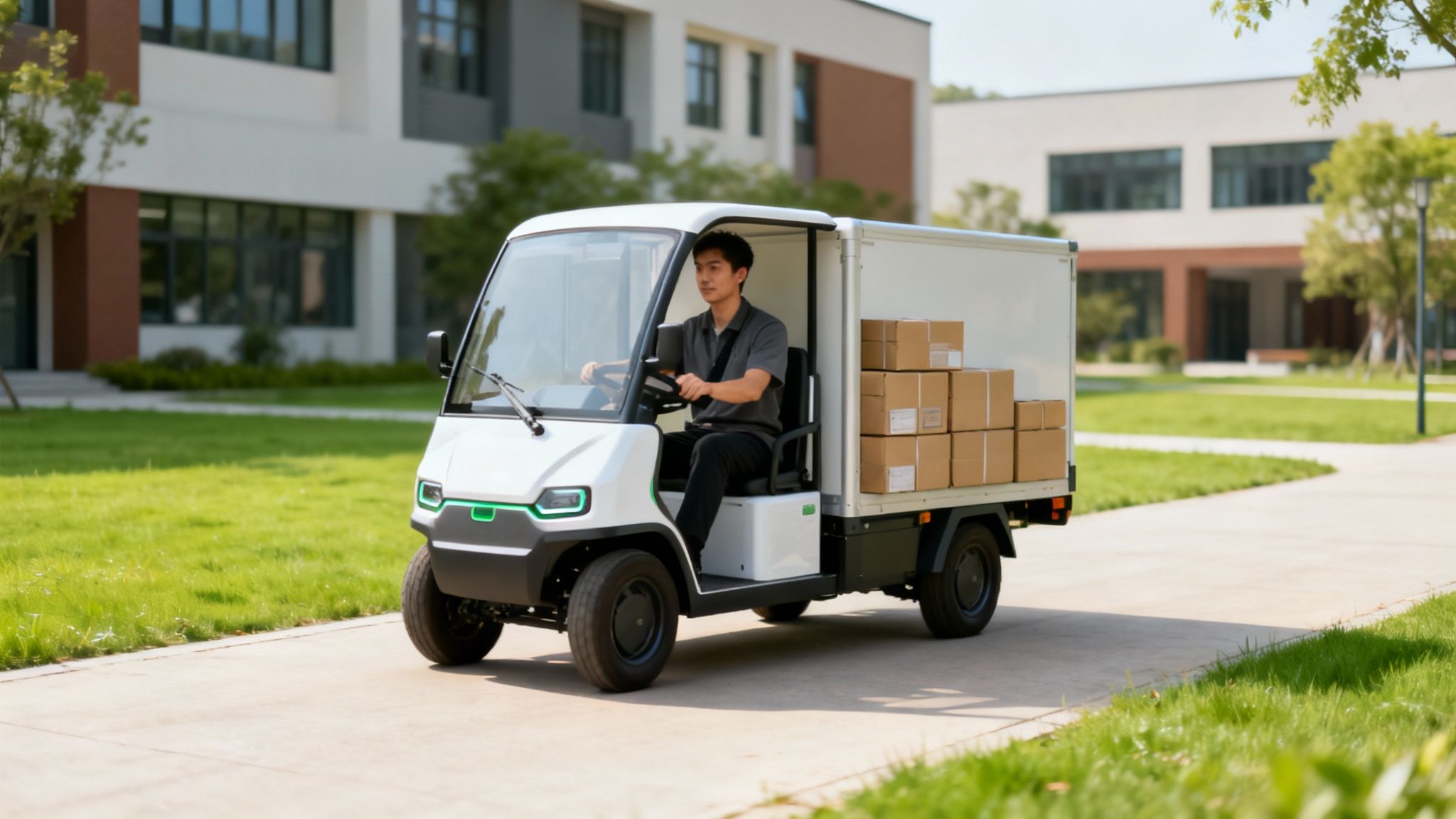
One of the biggest areas of impact is in the commercial world, where the Electric Utility Vehicle (EUV) has become an essential tool for logistics and fleet management. These aren't just for getting around; they're built for work, with options for flatbeds, enclosed cargo boxes, and tool racks to handle specific jobs.
The real power of an EUV is its ability to deliver a tangible return on investment. By slashing fuel and maintenance expenses while boosting operational productivity, these vehicles don't just perform a task—they actively contribute to a healthier bottom line.
This growing reliance on EUVs isn't just anecdotal. The global market for them was valued at around $14.92 billion in 2024 and is on track to hit $21.31 billion by 2029. A huge driver behind this growth is the e-commerce explosion, which has created a massive need for efficient and affordable last-mile delivery. You can dig into the numbers yourself in this electric utility vehicle market research.
Whether it’s a private owner enjoying a quiet drive through their gated community or a fleet manager overseeing a dozen vehicles on a commercial site, the benefits are crystal clear. Bringing electric street-legal vehicles into the fold isn't just an eco-friendly move; it's a strategic one that pays off daily in efficiency, savings, and sheer practicality.
A Closer Look at Top Street Legal Models
Knowing the rules and benefits of electric street legal vehicles is a great start, but the real "aha!" moment comes when you see them in action. Let's take a look at a few specialized models to bring these concepts to life. After all, not all vehicles are built the same, and the best choice always comes down to the job at hand.
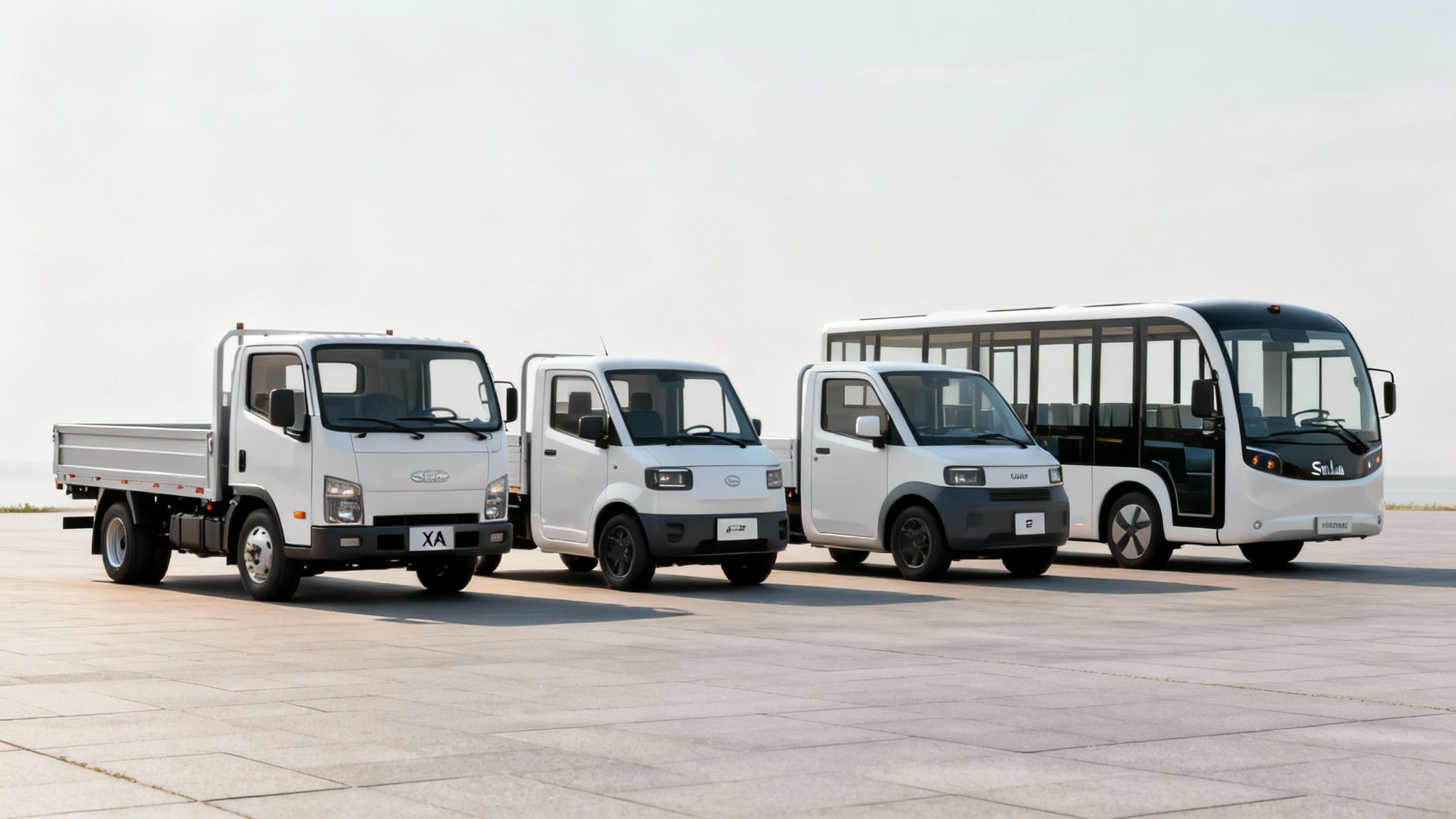
Think of it like picking the right tool from a toolbox—you wouldn't grab a hammer to turn a screw. In the same way, you need a vehicle that’s perfectly matched to your environment, whether that's a sprawling university, a busy resort, or a rugged industrial site. The Solana EV family—including the XA, F, G, and Campus E—is a perfect example of this purpose-built philosophy.
The Solana XA: The Versatile Workhorse
Meet the Solana XA, your quintessential multi-purpose utility vehicle. It’s built tough and designed for versatility, making it the go-to for maintenance crews, groundskeepers, and facilities teams who need a reliable ride that can do a little bit of everything. With its sturdy frame and generous cargo space, it’s perfect for hauling tools, equipment, and supplies.
Picture a university maintenance team getting a work order from the other side of campus. With the XA, they can load up their ladders and toolboxes and zip down narrow pathways where a traditional truck could never go. Its silent electric motor is a huge bonus, allowing them to work early in the morning without waking up the dorms.
The Solana F: The Heavy-Duty Hauler
When the job calls for more muscle, the Solana F is ready to step in. This model is a true flatbed utility vehicle, engineered from the ground up to transport heavy or bulky loads. It’s the powerhouse of the fleet, ideal for landscaping projects, construction sites, or any scenario where payload capacity is king.
Imagine a large resort setting up for a big event. The Solana F can effortlessly move stacks of chairs, tables, and decorations across the property. Its flatbed design makes loading and unloading a breeze, saving time and reducing physical strain on your staff. This vehicle is all about getting demanding jobs done efficiently. To see how models like this compare to others, checking out a guide on the best low speed vehicles can offer some great insights.
The Solana G: The Cargo Specialist
While the Solana F is the master of open-air hauling, the Solana G specializes in secure, enclosed transport. This model features a protected cargo area, making it the perfect choice for delivering sensitive materials, packages, or supplies that need to be kept out of the elements. It's a natural fit for on-campus mail services, catering operations, or secure logistics.
Think about a corporate campus with several buildings. The Solana G can act as an internal courier, safely moving documents, IT equipment, and mail between departments. The enclosed design guarantees everything arrives safe and dry, no matter what the weather is doing.
The Campus E: The People Mover
Finally, we have the Solana Campus E, a vehicle with one clear mission: moving people comfortably and efficiently. As a multi-passenger shuttle, it's the ideal solution for guest transportation at resorts, employee shuttles at corporate parks, or tours in planned communities. Here, safety and a smooth ride are the top priorities.
This vehicle truly excels in hospitality. A hotel can use the Campus E to ferry guests from the lobby to their villas or to amenities like the pool and golf course. It offers a quiet, pleasant ride that elevates the guest experience and signals a real commitment to premium service.
To help visualize how these models differ, here’s a quick comparison.
Solana Vehicle Model At-a-Glance
| Model | Primary Use | Passenger Capacity | Key Features |
|---|---|---|---|
| Solana XA | General Utility & Maintenance | 2-4 | Versatile cargo bed, rugged construction, all-purpose design |
| Solana F | Heavy-Duty Hauling | 2 | Large flatbed, high payload capacity, easy loading/unloading |
| Solana G | Secure Cargo Transport | 2 | Enclosed and secure cargo box, weather protection |
| Campus E | Passenger Shuttle | 4-8+ | Multiple seating rows, safety features, comfortable ride |
Each model is clearly designed with a specific set of tasks in mind, making it easier to find the perfect fit for your operation.
The key takeaway is that selecting the right electric street legal vehicle isn't about finding a one-size-fits-all solution. It’s about carefully analyzing your daily operations and choosing a model purpose-built to meet those specific needs, maximizing efficiency and return on investment.
By matching a vehicle's strengths to your operational demands, you get a tool that doesn’t just do the job—it excels at it.
Unlocking Your Vehicle's True Potential with Customizations
Think of a base model electric vehicle as a blank canvas. It's perfectly functional right out of the box, but its real value shines through when you start tailoring it to your specific needs. The magic really happens when you move past the standard features and begin customizing your vehicle for the jobs it needs to do, day in and day out. This is how a good vehicle becomes an absolutely indispensable tool.
Smart customization is about so much more than just adding cool features; it’s about solving real-world problems. By outfitting a vehicle for its specific environment and tasks, you can see dramatic boosts in efficiency, a big improvement in safety, and a much faster return on your investment.
Tailoring for Specific Job Functions
Every job site has its own set of challenges, and your vehicle's accessories should be chosen to meet them head-on. A maintenance crew, for example, might need a utility vehicle with secure, lockable bed enclosures to keep expensive tools safe from weather and theft. For a groundskeeping team, adding specialized ladder racks could be a game-changer, allowing them to safely transport equipment for tree trimming or light fixture repairs.
These aren't just minor tweaks; they're force multipliers. A properly equipped vehicle means fewer trips back to the workshop, which saves a ton of time and cuts down on labor costs.
Here are a few popular functional upgrades to consider:
- Secure Bed Enclosures: Perfect for protecting tools, equipment, and sensitive materials from rain, dust, and theft.
- Ladder or Equipment Racks: A must-have for utility workers, landscapers, and maintenance crews who need to carry bulky items safely.
- Advanced Lighting Packages: LED light bars, spotlights, and strobe lights are crucial for operating safely in the early morning, at night, or in any low-light conditions.
Enhancing Operator Comfort and Professional Branding
Customization isn't just about utility. It also plays a huge part in your team's comfort and how your brand is perceived. Upgrading to premium, ergonomic seats can make a world of difference for staff who spend hours driving, helping to reduce fatigue and keep them focused.
And don't forget, your vehicle is a mobile billboard for your brand. Custom paint jobs that match your company's colors or professional vinyl wraps with your logo can turn your fleet into a cohesive, recognizable part of your operation. It’s a simple but incredibly effective way to project professionalism to clients, guests, or residents.
The real goal of customization is to transform a standard vehicle into a specialized asset. Every modification should be a direct answer to a specific operational need, turning your electric vehicle into a perfectly crafted solution for the job at hand.
For those looking to bolster the security of their electric street legal vehicle, there are plenty of aftermarket solutions available. You might consider advanced electronic security options that integrate with your car's electronics, offering solid protection against modern theft methods, such as a Ghost Immobiliser system.
As the market for these vehicles expands, so does the innovation in accessories and parts. This growth reflects a much larger global trend. China, for instance, has a massive presence in the market, having sold approximately 5.4 million electric light-duty vehicles in the first half of 2025 alone. That number represents 72% of global EV production, giving you a sense of the sheer scale of manufacturing and development happening in the sector.
So, you're looking into street-legal electric vehicles? Good. You’ve picked the perfect time to get in on one of the biggest shifts happening in transportation right now, all across the globe.
This isn't just some passing fad. We're talking about a genuine, ground-up change in how people and businesses get around, driven by real-world pressures—from environmental regulations to some serious leaps in technology. The move to electric is happening fast, and it’s completely redrawing the map for mobility.
What’s fueling this fire? A few things have come together perfectly. On one hand, you have governments offering some pretty sweet incentives to go electric, while at the same time, they're tightening the screws on emissions from gas engines. Then there’s the tech itself—battery advancements are making EVs cheaper to buy and own, with ranges that make them practical for everyday use.
The Numbers Don't Lie
If you need proof, just look at the sales figures. They tell a story of an industry that’s not just growing, but exploding.
Back in 2022, global sales of electric vehicles shot past the 10 million mark. That brought the total number of EVs on the road to over 26 million—a whopping 60% increase from the year before. And it didn’t stop there. In 2023, sales jumped another 35% to almost 14 million, pushing the worldwide total to around 40 million. You can dig deeper into these trends by checking out the data on the global electric vehicle market surge on virta.global.
This kind of momentum makes one thing crystal clear: electric isn't just the future, it's the present.
When you see the bigger picture, it becomes obvious that choosing an electric vehicle is a solid, forward-thinking move. You're not just getting a new set of wheels; you're becoming part of a worldwide movement that’s changing how we all live and work.
This massive shift also means you can count on a growing support system. The market for parts, skilled technicians, and new innovations is only going to get bigger, making it easier and more rewarding to own an EV for years to come.
Got Questions? We've Got Answers.
Diving into the world of street-legal electric vehicles can feel like learning a new language. If you're weighing your options for a personal ride or building out a commercial fleet, you probably have a few questions. Let's clear up some of the most common ones so you can feel confident behind the wheel.
We hear these questions all the time from people just like you. Think of this as your personal cheat sheet for getting on the road.
What’s the Real Difference Between a Golf Cart and an LSV?
This is easily the number one question we get, and it’s a crucial distinction. A typical golf cart is built for one thing: cruising around a golf course or private property. A true electric street legal vehicle, on the other hand, is a federally regulated Low-Speed Vehicle (LSV) built from the ground up for public roads.
Here’s where they part ways:
- Safety First: LSVs come standard with headlights, taillights, turn signals, seat belts, mirrors, and an automotive-grade windshield. A golf cart doesn't.
- Official ID: Just like your car, every LSV gets its own Vehicle Identification Number (VIN) for titling, registration, and insurance.
- Need for Speed: LSVs are designed to hit a top speed between 20 and 25 mph. Standard golf carts are usually capped at a much lower speed.
The bottom line? An LSV is a recognized vehicle class. A golf cart is built for the fairway, not the roadway.
So, Can I Drive My Street-Legal EV on Any Road?
That’s a definite no, and it's a rule you really need to know. Federally compliant LSVs are almost always limited to roads with a posted speed limit of 35 mph or less. It's a common-sense safety rule to keep traffic flowing smoothly and prevent slow-moving vehicles from becoming a hazard on high-speed routes.
Always double-check your local city and state ordinances. Some areas have their own specific rules that might be even stricter.
The golden rule for LSVs is simple: Federal law says how it's built, but state and local laws say where it can be driven. Don't risk a ticket by getting it wrong.
Do I Need a Special License or Insurance?
You don't need a special license, but you absolutely need a standard, valid driver's license—no different than driving a car.
Insurance is also a must. Since an LSV is a registered vehicle for public roads, you’ll need to carry at least the minimum liability coverage your state requires. The good news is that many major insurance carriers offer specific LSV policies. It’s worth calling your agent to find the right fit for your vehicle.
Ready to see what a premium, purpose-built electric vehicle can do for you? The team at Solana EV is here to match you with the perfect model for your needs. Check out our full lineup and see the difference at https://solanaev.com.