
Dealer floorplan financing is a revolving, inventory-secured credit line that pays for each vehicle as it arrives and is repaid when that vehicle sells. A $20,000 unit at a 12% annual rate accrues roughly $6.58 in interest per day on the lot.
That daily drip is easy to ignore when a truck backs up to your dock in March. The carts look ready for resort season, the street-legal models are already spoken for by a gated-community buyer, and the lot finally looks full. The cash that paid for those units is no longer sitting in the operating account.
Table of Contents
- Why Golf Cart Dealers Tie Up Cash in Inventory
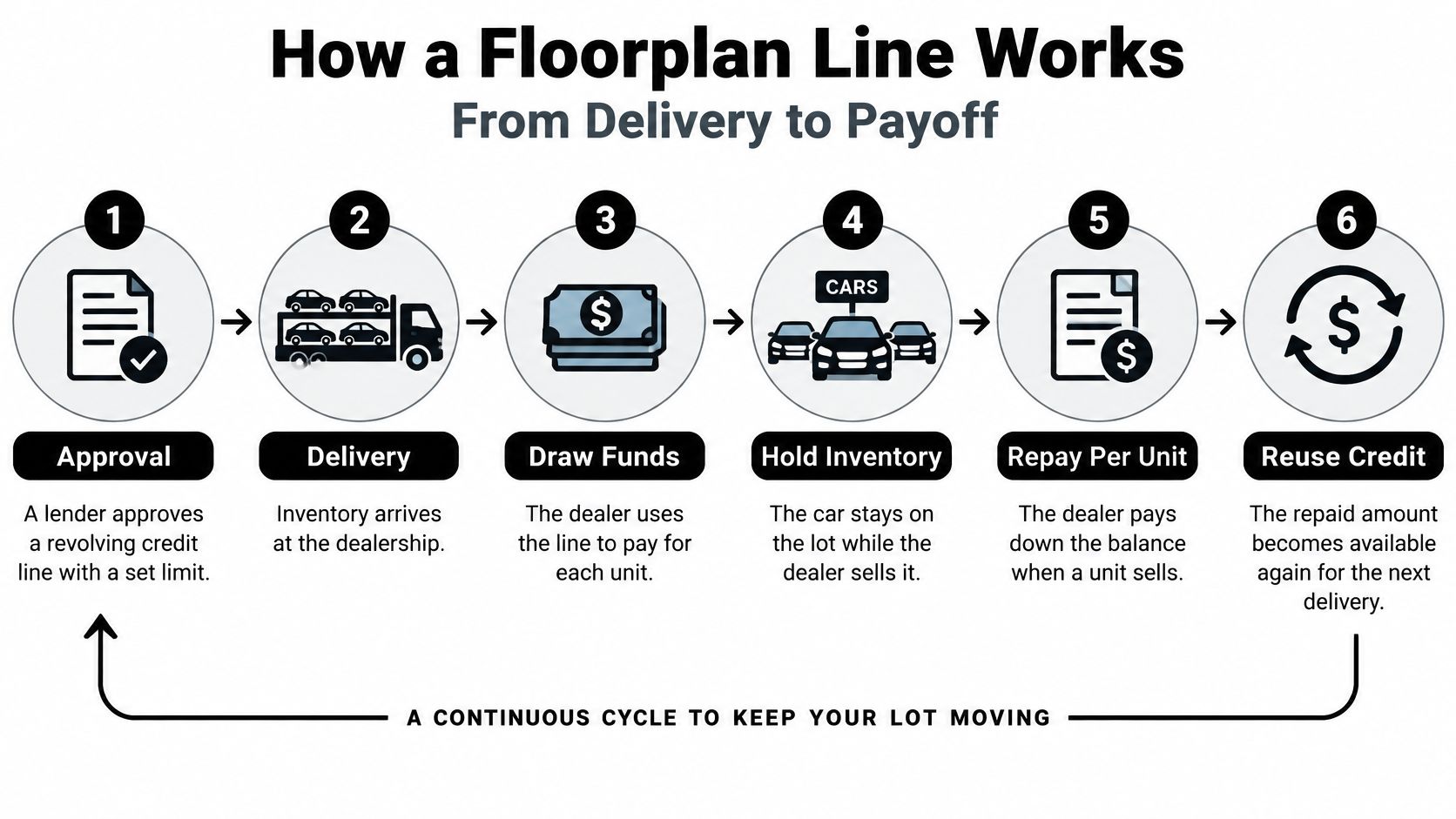
- How a Floorplan Line Works From Delivery to Payoff
- Calculating the True Cost of Floorplan Interest
- Benefits Beyond Cash Flow for Dealers
- Risks Lenders Watch and How Dealers Respond
- Eligibility Requirements for Golf Cart Dealers
- Choosing a Floorplan Partner and Taking the Next Step
Why Golf Cart Dealers Tie Up Cash in Inventory
A spring delivery feels like progress until payroll hits. One shipment of golf carts, low-speed vehicles, and a couple of higher-priced street-legal models can lock up more cash than a month of wages, demo fuel, parts, and local ads combined. Each unit is a finished product you can't sell until a buyer walks the lot, and until that sale the money is parked on rubber tires.
Inventory becomes the largest cash commitment when models are expensive, slow to move, or offered in several seat counts and accessory packages. A four-seat neighborhood cart and a six-seat resort shuttle don't share the same buyer, yet both have to be on the ground if you want the sale. Backup stock for the busy weeks makes the pile bigger still.
Dealer floorplan financing doesn't cut the invoice. It buys time. Think of a library card. The lender writes down each unit you check out, keeps the record by serial number, and expects the book back when someone buys it. You keep the showroom open with your own cash while the financed carts stay available to sell.

This structure isn't new to vehicle retail. A 1999 industry report on floorplan receivables described floorplanning as common wherever a business must hold substantial display and backup inventory, and it noted that U.S. floorplan receivables were already measured in the billions of dollars then. Golf cart and low-speed dealers face the same squeeze on a smaller lot: stock the season, or watch buyers drive to the store that did.
If you're still mapping how a cart store opens its doors, the practical sequence in how to start a dealership business shows where inventory cash hits before the first retail deal.
How a Floorplan Line Works From Delivery to Payoff
Follow one cart from the approval letter to the day it leaves. The mechanics are the same whether the unit is a neighborhood LSV or a lifted off-road model.
The line, the draw, and the serial number
A lender first approves a revolving limit. That ceiling is the most you can have outstanding at once, not a lump sum dumped into your account. When a unit arrives and qualifies, you draw against that specific cart. The advance is tied to the VIN or serial number, so the lender always knows which machine its money is sitting on.
Interest doesn't wait for month-end in a vague bucket. As inventory-secured floorplan lending is commonly structured, interest accrues daily on each unit's outstanding balance, and the principal comes due when that unit sells.
What moves the rate
Most lines float. The price is a benchmark such as prime or SOFR, plus the lender's spread. If the benchmark rises, your daily cost on every unsold cart rises with it, even if you didn't order another unit. Slower sales do the same job from the other side: the balance just stays outstanding longer.
Curtailment, sale, and the floor check
A curtailment is a scheduled principal paydown after a cart ages past a set threshold, whether or not a buyer has appeared. It's the lender saying the unit has sat long enough that you must put some cash back in, then keep paying interest on what's left.
A retail or wholesale sale works differently. You pay off that unit's balance, the lender releases its claim, and the repaid dollars reopen room under the limit for the next delivery. Sell a cart on Saturday and the line can fund Monday's inbound truck.
Lenders also walk the lot. A floor check confirms the financed serial numbers are physically there, not sold and unreported. Accurate stock records and same-day payoff notices are controls, not paperwork for its own sake.
On the lot: Treat every curtailment date like a second due date. Price, merchandise, and call leads before the cash leaves, not after the notice arrives.
Calculating the True Cost of Floorplan Interest
Rate quotes hide the bill. The useful number is what one cart costs you at the speed you sell.
One cart, four clocks
Start with a $20,000 cart at a 12% annual rate. That balance accrues about $6.58 a day. Sixty days of interest alone is about $395. Add an illustrative $150 flooring fee and $50 administration fee and the financing charge is about $595, as laid out in this unit-level floorplan cost breakdown. The same guidance describes structures around prime plus 2% to 6%, per-unit fees of roughly $10 to $100, and principal paydowns of 5% to 10% at scheduled aging points. Fees in the table below stay flat because they aren't a daily charge. Interest is.
| Days on Floor | Interest Accrued | Flat Fees | Total Financing Cost |
|---|---|---|---|
| 30 | about $197 | $200 | about $397 |
| 60 | about $395 | $200 | about $595 |
| 90 | about $592 | $200 | about $792 |
| 120 | about $790 | $200 | about $990 |
Thirty days looks manageable next to a healthy gross. One hundred twenty days can eat a large slice of the same gross before curtailment cash, storage, or a price cut. A lower advertised rate still loses if its per-unit fees are fatter or its curtailments hit sooner.
The whole lot
Scale the same idea. A dealership carrying $12 million of financed inventory at an 8% annual rate would incur about $960,000 a year, or about $80,000 a month, before fees, curtailments, or rate moves, according to dealer gross and floorplan expense guidance. That guidance commonly treats floorplan interest as roughly 3% to 5% of gross profit. Results above that band usually mean too much stock, weak turns, a high rate, or all three.
Operators who want the wider math on storage, insurance, and obsolescence can use inventory carrying costs for operators as a worksheet, then subtract daily floorplan interest from expected gross on each Solana-style model and season.
Ask this before you sign: at my real turn rate, what share of each unit's gross does the line consume, and on which day does paying cash cost less?
Benefits Beyond Cash Flow for Dealers
The obvious win is stocking carts without writing a check for the full invoice. The stronger win is what that freed cash does next.
Showroom people, Saturday demo rides, a parts bin that has the common wear items, and a spring ad push are what turn a full lot into repeat buyers. Floorplan keeps those expenses on operating cash while the financed units wait for a resort shuttle order or a neighborhood LSV buyer. Liquidity is the product. The cart's cost doesn't shrink.
Breadth the buyer can see
A line also lets you hold more than one configuration. Four-seat and six-seat layouts, a basic package and a loaded one, plus a few units aimed at campus and off-road use, give a walk-in a match instead of a rain check. Cash-only buying often forces a thinner mix, and the lost sale never shows up as interest expense. It just doesn't show up.
The relationship that outlasts one cart
Floorplan often becomes the anchor for the rest of a lender relationship. In J.D. Power's look at commercial lending satisfaction, covered by Auto Dealer Today, nearly 70% of auto dealers choose a credit-facilities partner partly because an inventory-finance relationship already exists. The same report tracks GM Financial's floorplan program from 100 net dealers at the end of 2012 to 1,764 dealers by the end of the first quarter of 2022, a 41% penetration rate, including 282 dealers added in 2021 alone.
That pattern matters for a cart brand recruiting stores. A credible inventory line helps a new partner stock several models without freezing every dollar, and it gives the lender a reason to stay when the dealer later needs another facility. Retail tools sit beside that wholesale line. Dealers comparing customer payment options can review financing golf carts as a separate conversation from how the store itself funds the lot.
Risks Lenders Watch and How Dealers Respond
A floorplan line is not a safety net. It's a secured loan with a clock, and the lender's first move in a slow season is to shrink its own exposure.
Where the lender steps back
Lenders commonly advance only about 75% to 90% of a vehicle's value, so you fund the gap on day one. Once a unit reaches roughly 90 to 120 days, curtailments or extra charges often start even though the cart is still unsold. Harney Partners' review of dealer floorplan trends also reported that net floorplan expense per vehicle rose about 39% in Q2 2025, roughly $139 a unit, as higher rates met slower turns. Broader lots told the same story: U.S. new-vehicle supply sat near 90 days in December 2025, which keeps more collateral outstanding for longer.
Slow turns don't just add interest. They can tighten the next advance, cap how many units of one model you may floor, and force cash out through curtailments while revenue is flat.
Questions to ask before the first draw
New golf cart and low-speed brands don't always get the same terms as a high-volume auto franchise.
- Unfamiliar models: Will the lender floor a newer electric line, or only brands with a long resale history?
- Demos and accessories: Are demonstrators, chargers, and add-on packages eligible, or only complete retail units?
- Seasonal stock: Do curtailment clocks pause for a resort winter, or do they run straight through the slow months?
- Concentration: Is there a cap on one model so a missed season doesn't fill the whole line?
Resort and outdoor demand bunches up. A strong April doesn't rescue a cart floored in October if the curtailment lands in January.
Build a weekly sheet with VIN, funded balance, days on floor, accrued interest, next curtailment date, and the likely retail or wholesale exit. Cap replenishment when projected days-to-sale push units into the expensive tier, and keep a cash reserve sized for the slow quarter rather than the peak month.
Eligibility Requirements for Golf Cart Dealers
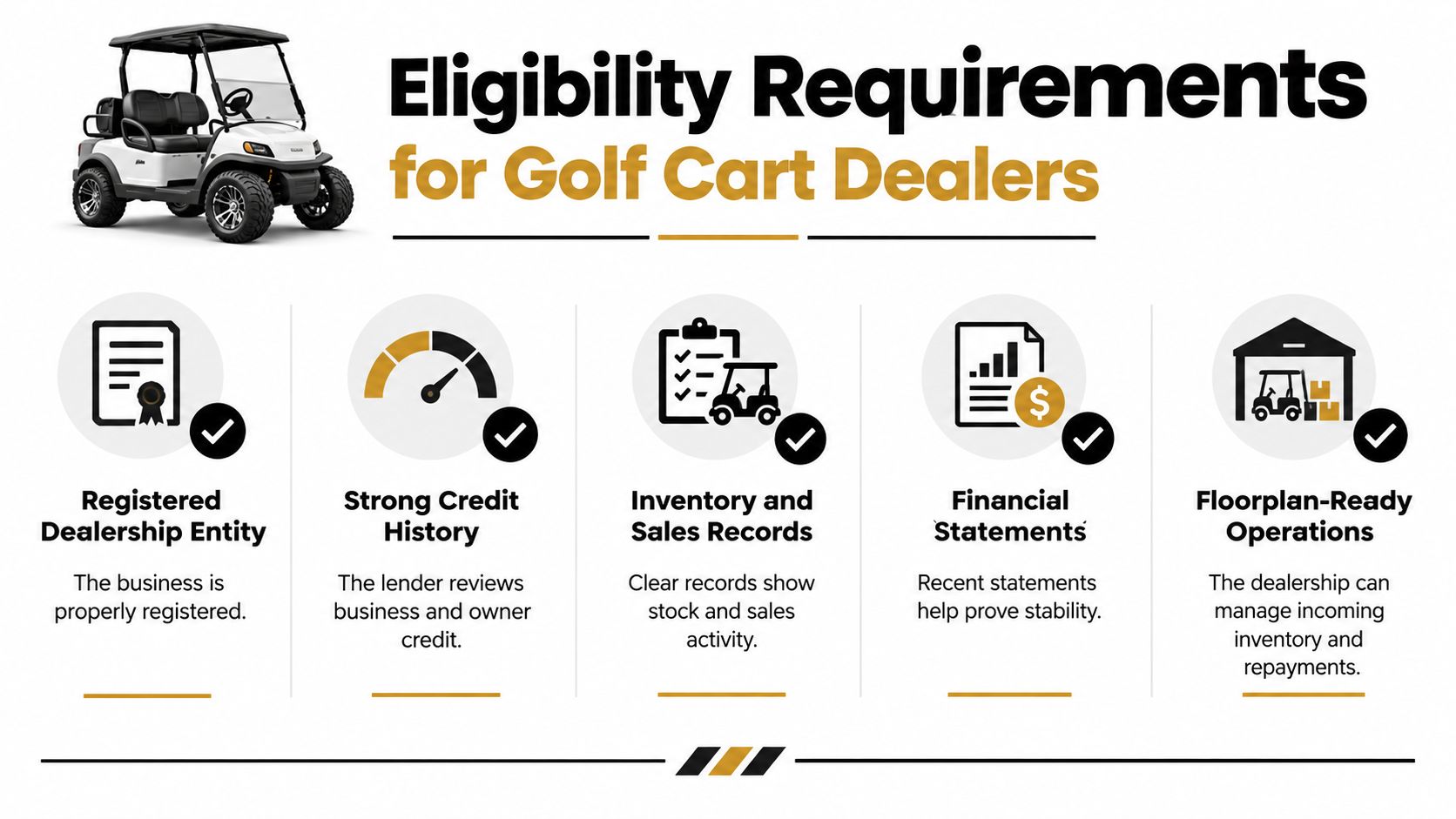
Approval is a file review plus a lot review. Lenders differ, so confirm each item with the one you're applying to before you spend a week assembling paper they don't want.
The business file
You typically need a registered dealership entity, not a personal side project. A dealer agreement or manufacturer authorization shows you're allowed to sell that brand. Operating history and recent financial statements answer the lender's real question: can this store service the debt if carts sit an extra month?
The owner file
Personal credit still matters at this size of business. Many lenders also want a personal guarantee, which means slow inventory can follow you home. Read that clause before you celebrate the limit.
The lot itself
- Insured, lockable storage: The collateral has to be protectable, and the policy should be ready to name the lender as loss payee.
- VIN-level records: A system that shows each unit's arrival, location, and sale date is what makes a floor check boring instead of painful.
- Payoff habit: Same-day reporting after a sale is part of eligibility in practice, even when it isn't on the application checklist.
Extra questions for newer cart brands
Golf cart and low-speed dealers often get a second round of questions that franchise auto stores skip. Expect to show product documentation, something that supports value (invoice, price guide, or recent sold units), and a short sales history if the brand is new to the lender. Demos and seasonal pre-builds may need their own note in the file. None of this is a secret test. It's the lender deciding whether an unfamiliar electric cart is collateral they can track and, if needed, recover.
Choosing a Floorplan Partner and Taking the Next Step
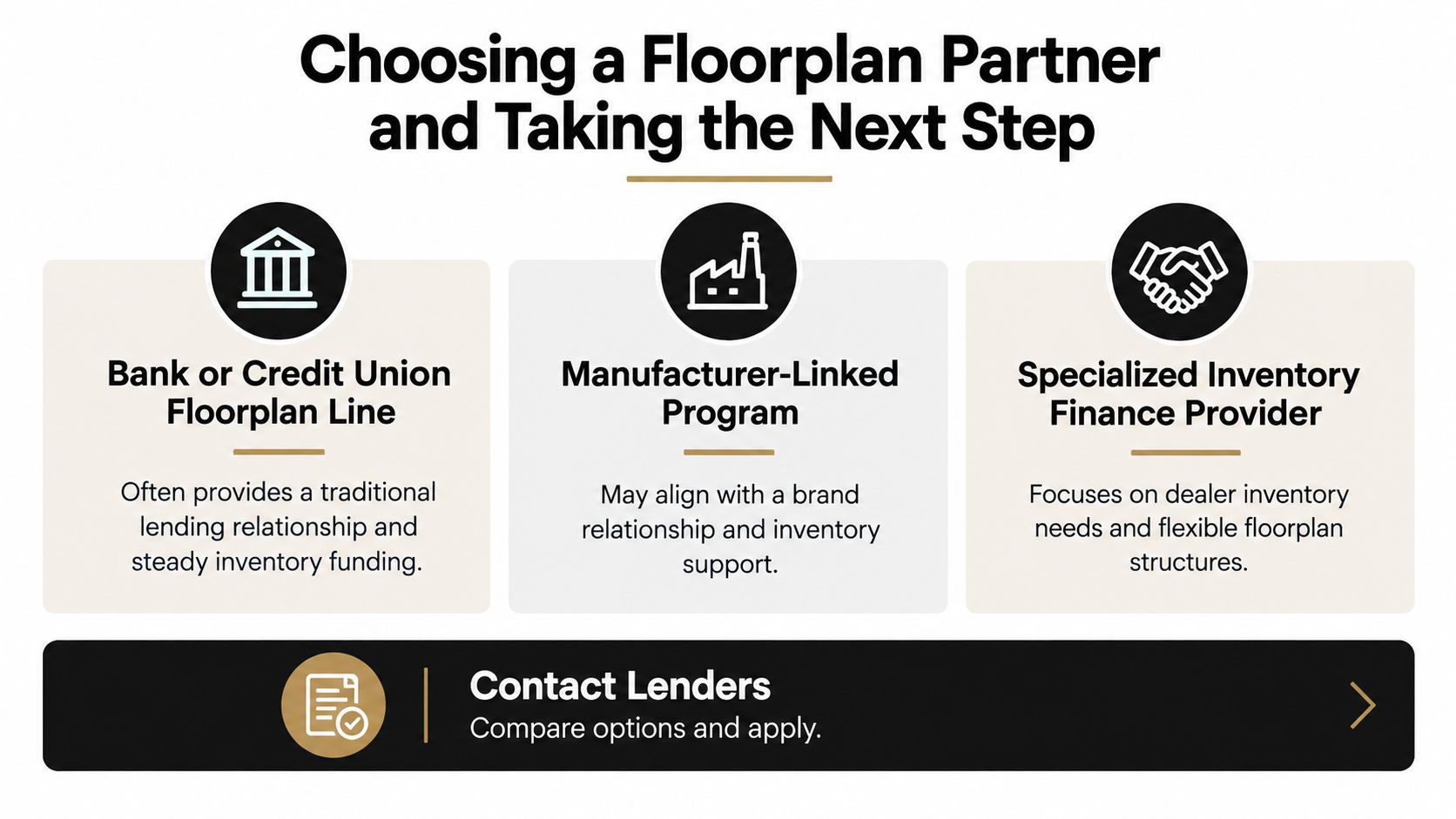
Three ways to fund the same cart compete on the same scorecard: all-in cost at your real turn rate, advance rate, curtailment timing, per-unit fees, comfort with a newer brand, and how often you must report.
Bank or credit union line
A local or regional lender already knows your deposit history. The line is often straightforward, and the relationship can extend past inventory. The tradeoff is flexibility. Banks sometimes treat floorplan as a small slice of a big portfolio, so terms can tighten, or the program can shrink, when their priorities shift. Price the full path, not the teaser: daily interest at 30, 60, 90, and 120 days, plus every flat fee.
Manufacturer-linked program
A brand-tied line can be easier to open if you're already an authorized dealer, and it exists to keep that brand's units on the ground. Ask whether demos, accessories, and a second model year share the same advance and the same aging clock. A program that only loves fast, familiar units won't help a seasonal resort market.
Paying cash
Cash wins when your turns are long, fees are chunky, or the advance rate leaves you funding most of the cart anyway. It loses when a full pre-season order would empty the account you need for payroll and parts. Run your own days-to-sale against the unit math from earlier. If the financing charge at your typical hold is a small slice of gross, the line is doing its job. If it swallows the gross before curtailment, write the check or order fewer units.
A specialized inventory partner
Some providers exist only to floor dealer stock. They tend to understand aging, audits, and auction-style or shipment-style intake better than a general commercial lender. You still compare the same six items. Specialization isn't a discount.
Solana EV is one brand path that pairs inventory support with the rest of a dealer setup: floor plan financing through Dealer Direct, protected territories, onboarding and training, marketing resources, a 24/7 parts portal, technical help, and 0% APR retail financing for up to 60 months. The retail offer helps a buyer say yes. It doesn't change what the floored unit costs you per day. The dealer onboarding process is where those pieces get sequenced after you're accepted.
A short walkthrough of how inventory credit is explained to dealers sits here if you want the idea in another voice before you call a lender.
Pull last quarter's sold units. Write days on lot, gross, and what a 12% daily accrual plus your fees would have taken. Then ask two lenders and, if you want a brand program in the mix, one manufacturer partner for advance rate, curtailment dates, and per-unit charges on the models you stock.
Solana EV builds street-legal golf carts and electric recreational vehicles for resort, neighborhood, and off-road use, and it backs dealers with inventory floor plan financing through Dealer Direct plus retail options that help close the sale. If you're weighing a line against cash for your own lot, start with the unit-level cost worksheet in this article, then visit Solana EV to compare vehicles, find a dealer, or apply as a partner.