
You've found the cart you want, the dealer has run the numbers, and the monthly payment on the screen looks surprisingly manageable. That's exactly where most buyers stop thinking. Don't. A payment can fit your monthly budget and still be a bad deal once you add up interest, fees, and what you'll owe when the cart is worth less than the balance. Financing golf carts well means judging the full repayment, not the friendliest number on the worksheet.
Table of Contents
- Why the Right Golf Cart Loan Matters
- Understand the Core Financing Terms
- Compare the Main Golf Cart Financing Options
- See How Loan Term Changes the Cost
- Evaluate APR Fees and Equity Risk
- Use a Practical Financing Checklist
- Match Financing to How You Will Use the Cart
- Choose With the Total Cost in Mind
Why the Right Golf Cart Loan Matters
You're standing in the showroom comparing two offers on the same premium electric cart. One gives you a low monthly payment spread over a long term. The other costs more each month and ends much sooner. On payment alone, the first offer wins. On total cost, it usually doesn't.

The problem is that a small down payment, a long term, and financed accessories can leave you owing money on a depreciating specialty vehicle for years. The cart gets used, its resale value falls, and your balance falls more slowly. If you sell, trade, or total it during that gap, you cover the shortfall from your own pocket.
Judge the Deal on More Than the Payment
Before you talk to a dealer or lender, decide four things. First, what's the total amount you're willing to repay, not just the monthly figure. Second, how long will you keep and use this cart. Third, how much cash can you put down without draining money you need elsewhere. Fourth, is this a household vehicle, a recreational toy, or a commercial asset that has to earn its keep.
My rule: If a cart only becomes affordable when you stretch the term to its maximum, you're buying too much cart or financing too many add-ons.
Those answers change the right loan completely. A basic neighborhood cart bought for occasional use doesn't justify the same structure as a premium street-legal model driven daily. A resort fleet purchase shouldn't be judged like a household purchase at all, because utilization, insurance, charging, and residual value drive the return. Get the use case clear first, then shop the loan. Buyers who reverse that order end up with a payment plan built around a sales pitch. That's the mistake this guide helps you avoid, so you can sign knowing the total cost, the risk, and the payoff path all make sense.
Understand the Core Financing Terms
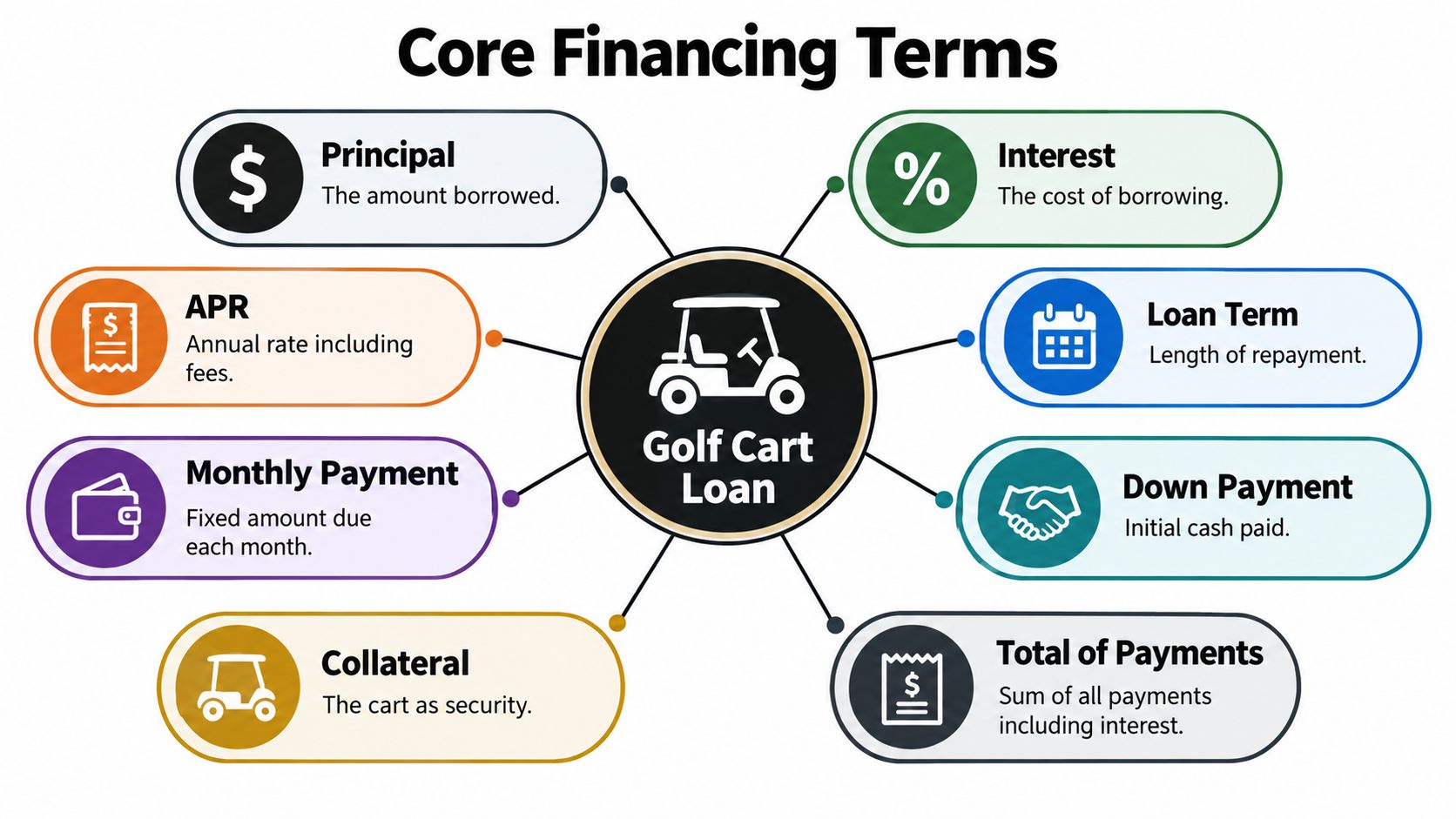
Most financing confusion comes from sellers using six different words for money and buyers assuming they all mean the same thing. They don't. Learn the vocabulary and a financing proposal becomes readable in minutes.
The Terms That Actually Control Your Cost
- Principal: The amount you borrow, which may include the cart price plus taxes, fees, delivery, and accessories if you finance them.
- Interest: What the lender charges you for borrowing, calculated on the balance over time.
- APR: The annual percentage rate. It's the better comparison number because it reflects interest plus mandatory loan fees.
- Loan term: How long you take to repay. Longer terms lower the payment and raise total interest.
- Down payment: Cash you pay upfront. It reduces the amount financed and protects you against depreciation.
- Collateral: The cart itself on a secured loan. If you default, the lender can take it.
- Total of payments: Everything you'll hand over across the full loan. This is the number sellers least want to lead with.
- Payoff amount: What you still owe at any given moment, which matters when you sell or trade.
Financing golf carts is commonly structured through the broader recreational vehicle and powersports lending market rather than a single standardized golf cart loan category, and credit unions describe these as secured loans where the vehicle serves as collateral and can be repossessed if you default, according to Greater Nevada Credit Union's recreational loan overview. That secured structure is why lenders care about the cart's age, title, and condition. It's not just your credit backing the loan. The vehicle is.
Why Negative Equity Deserves Your Attention
Negative equity means you owe more than the cart is worth. It happens fastest when you put little down, choose a long term, and finance add-ons that add cost without adding proportional resale value. You're then stuck either keeping the cart or paying cash to exit the loan.
If you already carry a vehicle loan and wonder whether restructuring debt helps or hurts, The Money Maniac's refinancing breakdown walks through that trade-off in plain language. The same logic applies here. Lowering a payment by extending repayment isn't the same as saving money.
Compare the Main Golf Cart Financing Options
There's no automatically cheapest channel for financing golf carts. Anyone who tells you otherwise is selling something. Each route trades convenience, collateral requirements, speed, and cost differently, and your credit, the cart's age, and its intended use can flip the ranking.
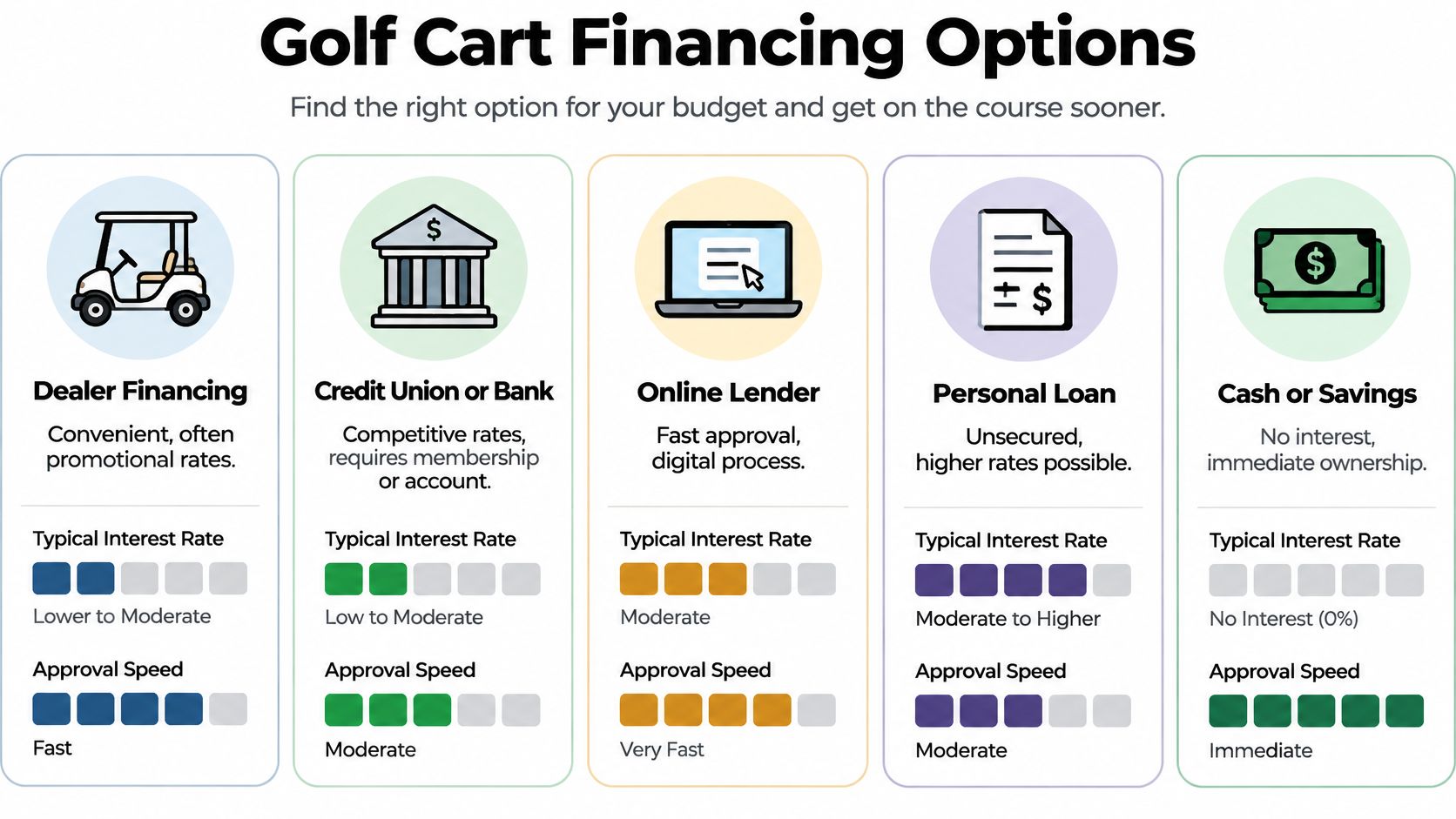
Dealer financing is the most convenient path because the cart and the loan are handled in one place, and dealers can sometimes offer promotional rates. The catch is that convenience can blur the vehicle price and the loan price together. Always separate them. Negotiate the cash price first, then evaluate the financing.
Credit unions and banks often compete well on rate, especially if you already have a relationship, but they'll apply their own eligibility rules to the vehicle. One credit union, for example, finances street-legal carts only up to three years old, covers 95% of the purchase price, and requires at least 5% down, per Experian's golf cart financing guidance. If your cart is older, bought from a private seller, or lacks clean ownership documents, an otherwise attractive rate may be unavailable.
Where the Other Options Fit
Online lenders compete on speed and a digital process, which helps when you want a quote fast. Compare their fees and collateral rules carefully, because fast approval says nothing about total cost. A personal loan is unsecured, so the cart isn't collateral and you get flexibility on how funds are used, but that freedom can come with higher pricing because the lender takes more risk.
Cash or savings eliminates interest entirely and gives you immediate, unencumbered ownership. It isn't automatically smart, though. Draining liquidity you need for a business, a home project, or an emergency reserve to avoid a cheap promotional rate can be the worse decision.
The short video below adds useful context on how buyers weigh these routes before committing.
Before you compare rates, confirm each lender will finance your exact cart under its conditions. Ask about vehicle age limits, title and registration requirements, private party purchases, insurance, and whether permanently installed options and warranties can be included in the amount financed. Solana EV's own page on electric vehicle financing options is a reasonable starting point for seeing how one manufacturer structures retail offers. Get eligibility in writing, then compare total cost among lenders who will fund your deal.
See How Loan Term Changes the Cost
Term length is the single most powerful lever in financing golf carts, and it's the one most often used to make an expensive purchase look cheap. Stretch repayment and the payment drops. The loan doesn't get cheaper. It gets more expensive, slowly.
Consider the clearest illustration available from consumer finance comparisons. On a $50,000 recreational vehicle loan at 7.9% interest, a five year term produces a monthly payment of $1,011, $10,686 in total interest, and $60,686 in total repayment, while extending to 10 years cuts the payment to $604 but raises total interest to $22,480 and total repayment to $72,480, according to Charles Schwab's recreational vehicle buying analysis. Read that again. Same amount borrowed. Same rate. The longer term more than doubles the interest bill.
What That Means at Golf Cart Scale
Your cart loan will likely be smaller than that example, but the math behaves identically. Every extra month of repayment is another month you pay interest on a balance that's declining slowly. Meanwhile the cart keeps depreciating on its own schedule, indifferent to your loan.
Published recreational loan schedules also show that longer terms can carry higher advertised rates, which compounds the effect. You pay more interest for more months at a potentially worse price. That's a triple cost hiding behind one smaller payment.
A lower monthly payment is a cash flow decision, not a savings. Treat it that way and you'll rarely be fooled.
None of this means you should always pick the shortest term. A household preserving cash for other priorities, or a resort spreading a fleet purchase across its useful working life, may rationally choose a longer structure. The payment relief is real. Just price it carefully before you accept it.
Do this with every offer. Write down the payment, then write down the total of payments beside it, then subtract to see what the convenience costs. If the longer term buys you breathing room you need, fine. If it only buys you permission to add accessories you barely want, shorten the term, increase the down payment, or choose a less expensive cart. Affordability and financing cost are two separate outcomes. A good loan respects both.
Evaluate APR Fees and Equity Risk
Sellers quote the number that sounds best. Your job is to find the number that's true. That's why APR should be your primary comparison metric, because it incorporates both interest and mandatory loan fees, while a nominal interest rate shows only part of the cost.
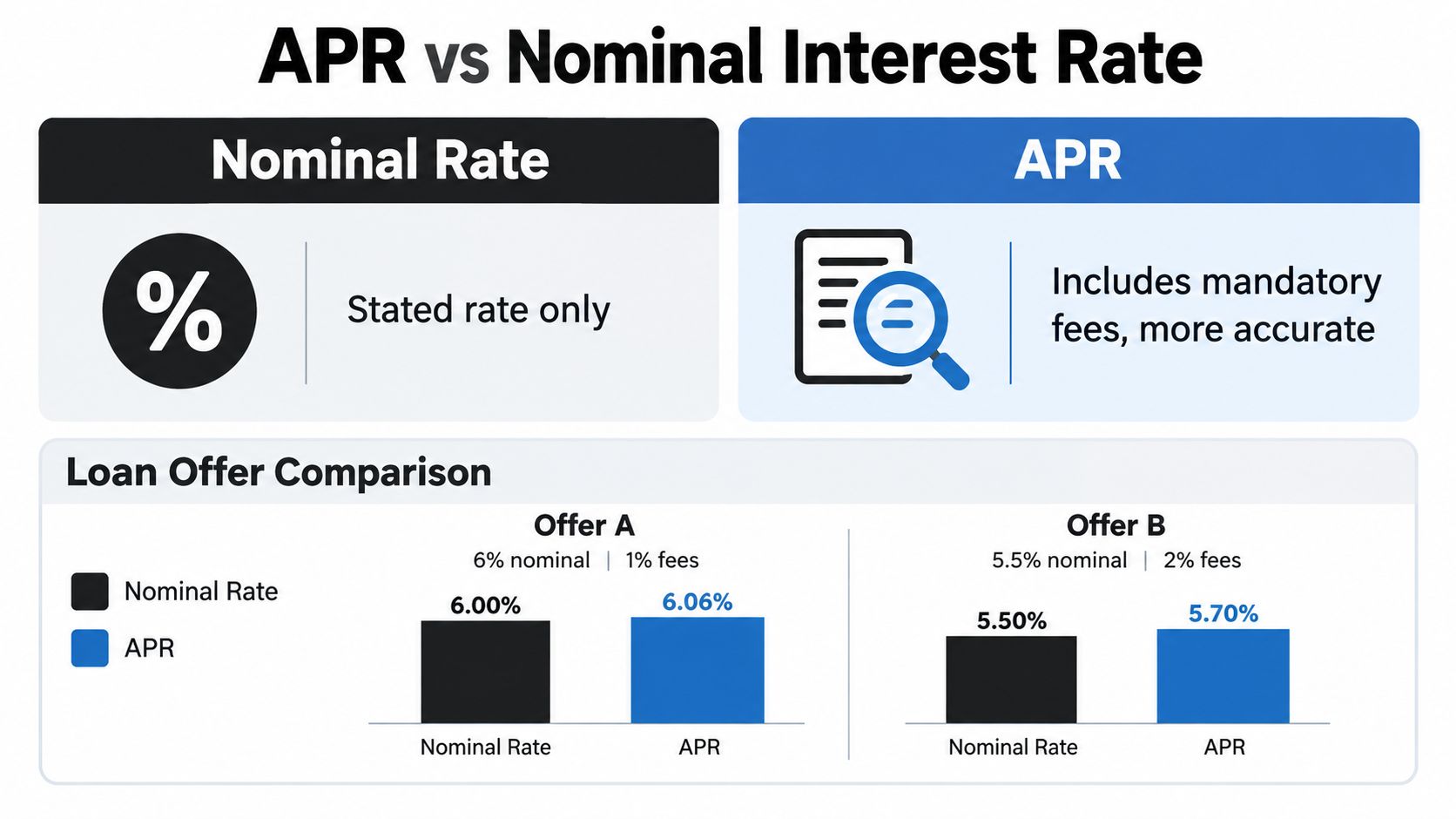
Two offers can show similar rates and produce very different costs once fees are financed into the balance. Financed fees are especially sneaky because you then pay interest on the fees themselves, month after month. APR exposes most of that. It doesn't reveal everything, though, so you still need the contract details, including prepayment conditions and what happens if you miss a payment.
The Equity Problem Nobody Mentions at the Desk
The Consumer Financial Protection Bureau illustrates negative equity as owing $10,000 on an asset worth $8,000, leaving a $2,000 shortfall that must generally be resolved when the vehicle is sold or traded, as explained in the CFPB guide to key auto loan terms. Golf carts are exposed to exactly this risk. Optional equipment, delivery charges, registration, and accessories increase your amount financed without increasing resale value proportionally, and the resale market for specialty vehicles is narrower than the market for a mainstream car.
A larger down payment and a shorter term are your two defenses. Both reduce the balance exposed to depreciation. GAP coverage can also be worth asking about, since it may help if the cart is totaled or stolen before your balance drops below its depreciated value, but eligibility and exclusions vary by policy, so read the actual terms rather than accepting a summary.
What to Compare in a Golf Cart Financing Offer
| Offer element | What to check | Why it matters |
|---|---|---|
| Cash price | Price before any financing incentive | A subsidized rate paired with a higher price may save nothing |
| APR | Rate including mandatory fees | Best single basis for comparing loan offers |
| Monthly payment | Amount due each month | Shows cash flow fit, not total cost |
| Term | Full repayment length | Longer terms raise total interest and equity risk |
| Down payment | Cash paid upfront | Reduces principal and depreciation exposure |
| Financed fees | Fees added into the loan balance | You pay interest on fees, not just on the cart |
| Total of payments | Sum of every payment over the loan | The true price of the financing decision |
| Estimated payoff balance | Balance at future intervals | Reveals whether you'll owe more than the cart is worth |
Demand every row of that table in writing for each offer. A promotional payment with no payoff schedule and no total of payments isn't an offer. It's marketing. When a lender shows you all eight elements without being asked twice, you've found someone worth doing business with.
Use a Practical Financing Checklist
Good financing decisions happen in sequence. Follow this order and you remove most of the ways buyers get surprised later.
Before You Apply
- Set your budget and down payment first. Decide what total repayment you accept and how much cash you can put down without hurting liquidity.
- Check your credit position. Approval, pricing, and term all depend on creditworthiness, so know where you stand before a lender tells you.
- Confirm vehicle eligibility. Ask whether the lender finances your exact new or used cart, its age, its ownership documents, and your intended use, and whether it accepts private sellers.
- Sort out title, registration, and insurance. Street-legal use can change documentation requirements, and lenders may require coverage that protects their collateral.
When You Receive Offers
- Get complete written terms. APR, payment, term, total of payments, financed fees, and any promotional or prepayment conditions, all on paper.
- Compare the cash price against the financed price. A subsidized rate only benefits you if the vehicle's cash price hasn't risen to pay for it. If there's a cash discount alternative, price both paths fully.
- Verify what can be financed. Permanently installed options, taxes, title fees, dealer fees, and warranties may or may not qualify, and financing items with no resale value deepens equity risk.
Business buyers have one extra step. For resort, hospitality, campus, or rental fleet purchases, financing treatment depends on documented business use rather than the vehicle's marketing category, and owned equipment used in an income-producing activity can generally be depreciated when placed in service if it has a determinable useful life and is expected to last more than one year, according to IRS Publication 946 on depreciation. Document that use early, with professional advice, rather than reconstructing it at tax time.
Before You Sign
- Read the contract, not the summary. Confirm the amount financed, every fee, the collateral described, default consequences, and repossession terms match what you were quoted.
If you want to see how dealers present these options in practice, browsing Solana EV's golf car dealer network shows the retail side of the conversation. Walk in with this checklist completed and you'll negotiate from knowledge instead of hope.
Match Financing to How You Will Use the Cart
Treating every golf cart as an automobile equivalent loan is the most common analytical error in financing golf carts. Intended use changes your documentation, your lender options, your insurance, and the economics that decide whether the loan was worth it. Sort yourself into the right category first.
Household and Gated Community Buyers
Your priorities are title, registration, insurance, and resale. A street-legal cart used for neighborhood trips may need documentation a purely private property cart doesn't, and your lender will care. Because you'll likely resell into a local market someday, protect your equity with a sensible down payment and a term that doesn't outrun the cart's value.
- Confirm street-legal status: Title and registration requirements before financing, not after.
- Insure it properly: Coverage that satisfies both your lender and your community's rules.
- Finance the cart, not the catalog: Pay cash for accessories that won't return value at resale.
Recreational and Off-Road Buyers
Your central question is collateral eligibility. Confirm the lender accepts the vehicle type and your intended terrain and use, since a loan approved for a street-legal neighborhood model may not extend to a different configuration. Occasional use also argues for discipline. A cart ridden on weekends shouldn't carry a repayment schedule built like a daily driver's.
Resort, Campus, and Fleet Buyers
Your analysis is a business case, not a purchase. Separate vehicle principal, interest, insurance, charging infrastructure, maintenance, and expected residual value, then weigh financing cost against measurable operating benefits such as reduced fuel, labor, and shuttle expense. Utilization is everything. A heavily used fleet cart can justify financing terms that would be wasteful for a household, because the asset produces value while you repay it.
Fleet warning: Don't treat the full purchase price or the full loan payment as an immediate tax deduction. Classification and timing rules govern what you can claim.
On that point, classify the asset with a tax professional based on its actual design, roadway status, and use, rather than assuming it shares a category with ordinary autos and trucks. Depreciation generally begins when the asset is placed in service, meaning ready and available for its intended income-producing use, and mixed personal and business use must be allocated so only the business portion counts. Get those determinations documented before the fleet rolls out, not after your first filing.
Choose With the Total Cost in Mind
Two offers can carry the same monthly payment and still differ substantially in total repayment. That gap is why the payment figure alone never settles the decision.
Run each written offer through the same final test: APR, term, cash price, down payment, financed fees, total of payments, and the estimated payoff balance as the loan ages. Then ask three honest questions. Does a shorter term or larger down payment protect you better against depreciation? Does the promotional rate still save money once the cash price is held constant? Do the collateral, title, and insurance terms match how you will use the cart?
Promotional offers deserve that scrutiny. Solana EV, for instance, lists retail financing options that include 0% APR for up to 60 months, subject to applicable terms and approval conditions. An offer like that is valuable if you qualify, the cash price stays put, and the term fits your plans. It becomes the wrong choice when a cash discount from another seller beats it. Run both numbers. Sentiment does not repay loans.
If you are still calibrating what the vehicle itself should cost before financing enters the picture, Solana EV's guide to how much a golf cart costs helps you anchor the vehicle price separately from the loan price. Keep those two negotiations apart and you will always know what you are paying for the cart and what you are paying for the money.
My closing recommendation: get at least two complete written offers, compare them on total repayment and payoff path, and pick the structure whose cost and risk fit your actual use. Confident financing means knowing, before you sign, exactly what the payment convenience costs and deciding that cost is worth it.