
You've signed a promising dealer agreement, ordered your first units, and told local buyers that deliveries are coming. Then the first serious lead arrives. A resort manager wants multiple vehicles for a seasonal fleet, but your protected territory hasn't been mapped, your floor plan approval is still pending, the sales team hasn't completed certification, and the service manager can't order parts. The dealership is technically open, yet it isn't ready to sell.
That gap is what a disciplined dealer onboarding process closes. A new partner needs more than documents and a welcome email. They need territory protection, legal clearance, inventory financing, retail finance options, trained staff, approved marketing, service readiness, and measurable checkpoints that move the operation from signed agreement to first sale.
Table of Contents
- Why a Structured Dealer Onboarding Process Changes Everything
- Setting Up Territory, Legal, and Floor Plan Financing
- Choosing the Right Retail Financing for Your Customers
- Training Your Sales and Service Team the Right Way
- Using Marketing Resources and the 24/7 Parts Portal
- Measuring Success at the 30, 60, and 90 Day Milestones
- Your First 90 Days as a Solana EV Dealer at a Glance
Why a Structured Dealer Onboarding Process Changes Everything
On Monday morning, a new Solana EV dealer's phone starts ringing. A resort manager is asking for three units for a Memorial Day fleet, but the dealer number isn't attached to the floor plan, the salespeople don't have training certificates, and nobody knows which co-op funds are available. The dealer principal can answer product questions, but can't confidently promise a delivery date or explain the financing menu.
That isn't a sales problem. It's an onboarding failure.
A paperwork-only setup creates a dealer record. A structured process creates a functioning retail operation. The distinction matters because dealership turnover is expensive and early exits happen quickly. A widely cited dealership workforce benchmark reports 39% annual employee turnover and 72% turnover among car sales consultants; the same dealership-focused source says a 10-percentage-point increase in turnover costs about $7,500 in gross profit per employee per year. The dealership onboarding cost benchmark also cites an estimate that new hires typically need eight months to reach full productivity.
A new dealer needs a 90-day operating arc, not a one-day orientation. A 2026 workforce study found that 58% of dealerships run structured new-hire orientation, 53% involve senior leaders in interviews, 25% operate a mentor program, and only 24% report a defined career path. The same study identifies training windows of about 25 days for sales consultants and 18 days for service advisors, supporting a multi-week approach to readiness. (2026 CADA National Workforce Study)
The four stalls that cost the first sale
Territory gets signed but not mapped. The dealer agreement is countersigned, but the protected market remains unclear. Marketing spend then goes out before the dealer knows which accounts and geographies are protected.
Floor plan financing launches without a retail rate sheet. Inventory financing keeps units on the floor. It doesn't help a buyer choose between a promotional offer, a standard captive-lender term, or an alternative credit pathway.
Salespeople start before service certification. A salesperson can close a unit, but the customer still needs credible answers about battery care, warranty handling, maintenance, and service scheduling.
The parts portal is treated as a website. A 24/7 portal only creates value when the service manager uses it to check stock, confirm fitment, monitor backorders, and place orders before a vehicle is immobilized.
Practical rule: Don't measure onboarding by the number of forms submitted. Measure whether the dealer can quote, demonstrate, finance, deliver, and support the first unit.
For teams building their internal training calendar, Overvue's sales onboarding playbook offers useful context on turning onboarding into a repeatable sales workflow. The rest of this roadmap applies that operational discipline to territory, financing, training, parts, and dealer performance.
Setting Up Territory, Legal, and Floor Plan Financing
The pre-launch checklist should run in a fixed order. A dealer shouldn't spend heavily on local advertising until the brand has confirmed the territory, and the first wholesale order shouldn't move until the financing file is complete.
Start with the agreement and territory
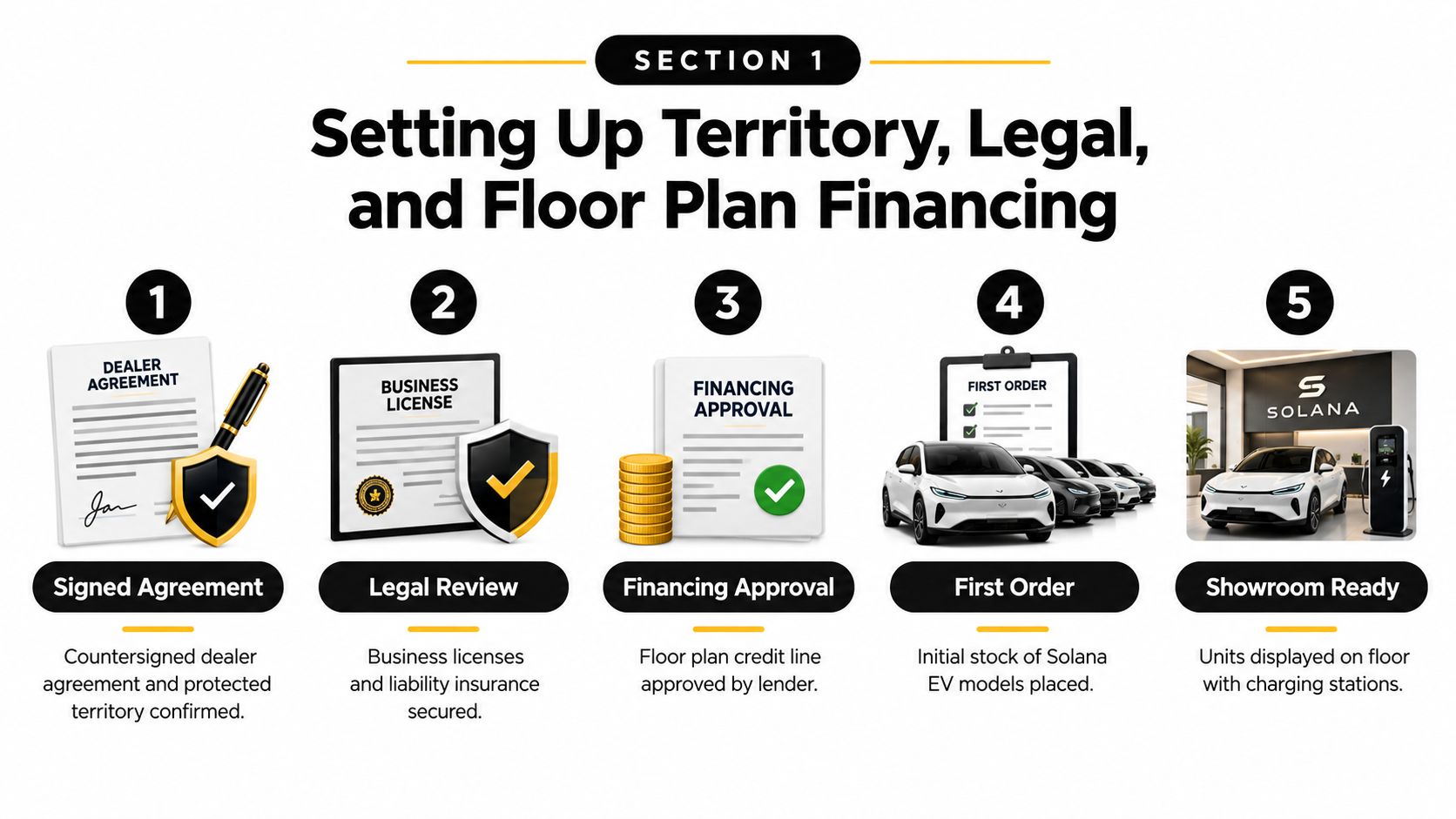
First, confirm that the dealer agreement is fully countersigned. Then file the protected territory map with the brand. Depending on the market, that map may use a DMA, county boundary, or defined radius. The dealer principal should save the final PDF in a shared drive and record the approving contact.
That checkpoint prevents a common mistake. A dealer begins buying signs, event materials, and digital advertising before knowing whether the territory is protected or how overlapping inquiries will be handled.
Next, complete state and local requirements. Those may include dealer licensing, sales tax registration, liability insurance, and classifications for low-speed EVs or UTVs. Titling and registration rules vary by jurisdiction, so the dealer's legal or compliance adviser should confirm which forms apply before a customer takes delivery.
Secure the inventory line
Open the Dealer Direct floor plan application after the agreement and territory file are complete. Review the interest rate, curtailment schedule, insurance binder requirements, eligible models, and documentation required for the first wholesale order. The approval letter belongs in the dealer's launch file, alongside the lender contact and escalation process.
Dealer Direct floor plan financing funds inventory held by the dealership. It isn't the same product as customer retail financing, and confusing those two applications creates avoidable delays. Keep the lender approval and the initial purchase order together so the operations team can confirm that the planned units qualify for flooring.
For a deeper explanation of the inventory side of the process, review Solana EV's dealer floor plan financing guide.
Finish the physical setup
Before the opening order arrives, verify showroom signage, display standards, charging arrangements, test-drive routes, and customer paperwork. Install the parts portal login on the service manager's workstation, not only on the owner's laptop. Then place the opening inventory order and document the expected arrival of each unit.
The dealer principal should be able to answer four questions without searching through email:
- Is the territory map approved and stored?
- Is the business legally cleared to sell and register the vehicles?
- Is the floor plan approval letter on file?
- Can the service manager order a part today?
If any answer is no, the launch isn't ready.
Choosing the Right Retail Financing for Your Customers
Dealers often confuse inventory financing with customer financing because both appear in the same sales conversation. They solve different problems.
Dealer Direct floor plan financing helps the dealership acquire and hold inventory. A retail finance product helps the customer purchase a selected vehicle. The first supports stock availability. The second supports the buyer's payment structure and approval path.
A qualifying low-speed EV promotion such as 0% APR for 60 months can make a strong offer easier to understand, but it still has eligibility rules and documentation requirements. The salesperson must present it as one option within a finance menu, not as an automatic promise to every buyer.
| Financing Type | Who It Funds | Typical Term | Paperwork Required |
|---|---|---|---|
| Dealer Direct floor plan | The dealership's vehicle inventory | Set by lender terms | Dealer credit application, lender approval, insurance binder, wholesale order documents, and curtailment requirements |
| Promotional retail financing | The customer's purchase of a qualifying low-speed EV | 0% APR for 60 months when the offer and buyer qualify | Credit application, selected unit details, proof of insurance, lien documents, and applicable registration forms |
| Standard captive-lender financing | The customer's vehicle purchase | Set by the captive lender and approved application | Credit application, buyer identity and income documentation as required, insurance, lien paperwork, and delivery documents |
| Credit union or RTO pathway | The customer's purchase through an outside provider | Set by the third-party provider | Provider application, vehicle information, insurance, lien documents, and state-specific forms |
The dealer should load every approved option into the CRM. Each option needs its own eligibility notes, document checklist, approval contact, and customer-facing explanation. The F&I or designated finance lead should rehearse the handoff so the customer doesn't hear one payment estimate from sales and a different explanation from finance.
Solana EV's electric vehicle financing resource can support that customer-facing discussion, but the dealer still owns the final documentation and compliance review.
Match the offer to the buyer
A resort operator may care about predictable fleet costs and delivery timing. A gated-community resident may prioritize a manageable monthly payment, registration requirements, and warranty support. A buyer outside the prime credit band may need a credit union or RTO pathway rather than a promotional offer.
Don't quote a monthly payment before the customer selects a unit and term. The payment depends on the vehicle, approved program, applicable eligibility, and final paperwork. Quote the structure first, then calculate the payment after the customer has made a specific selection.
Collect proof of insurance, lien paperwork, and any low-speed vehicle registration forms before delivery day. Missing documents don't create a better customer experience because the buyer is standing beside a completed vehicle. They create a preventable delay at the point when confidence should be highest.
Training Your Sales and Service Team the Right Way
Training belongs on the calendar, with owners assigned to each milestone. A curriculum binder sitting in the manager's office won't prepare a salesperson for a battery-care objection or a technician for a warranty claim.
The sales and service tracks should begin together but diverge by role. Sales staff need product fluency, buyer discovery, demonstrations, trade-in judgment, and finance handoff skills. Service staff need system knowledge, diagnostics, warranty procedures, parts identification, and documentation discipline.
Use a real operating calendar
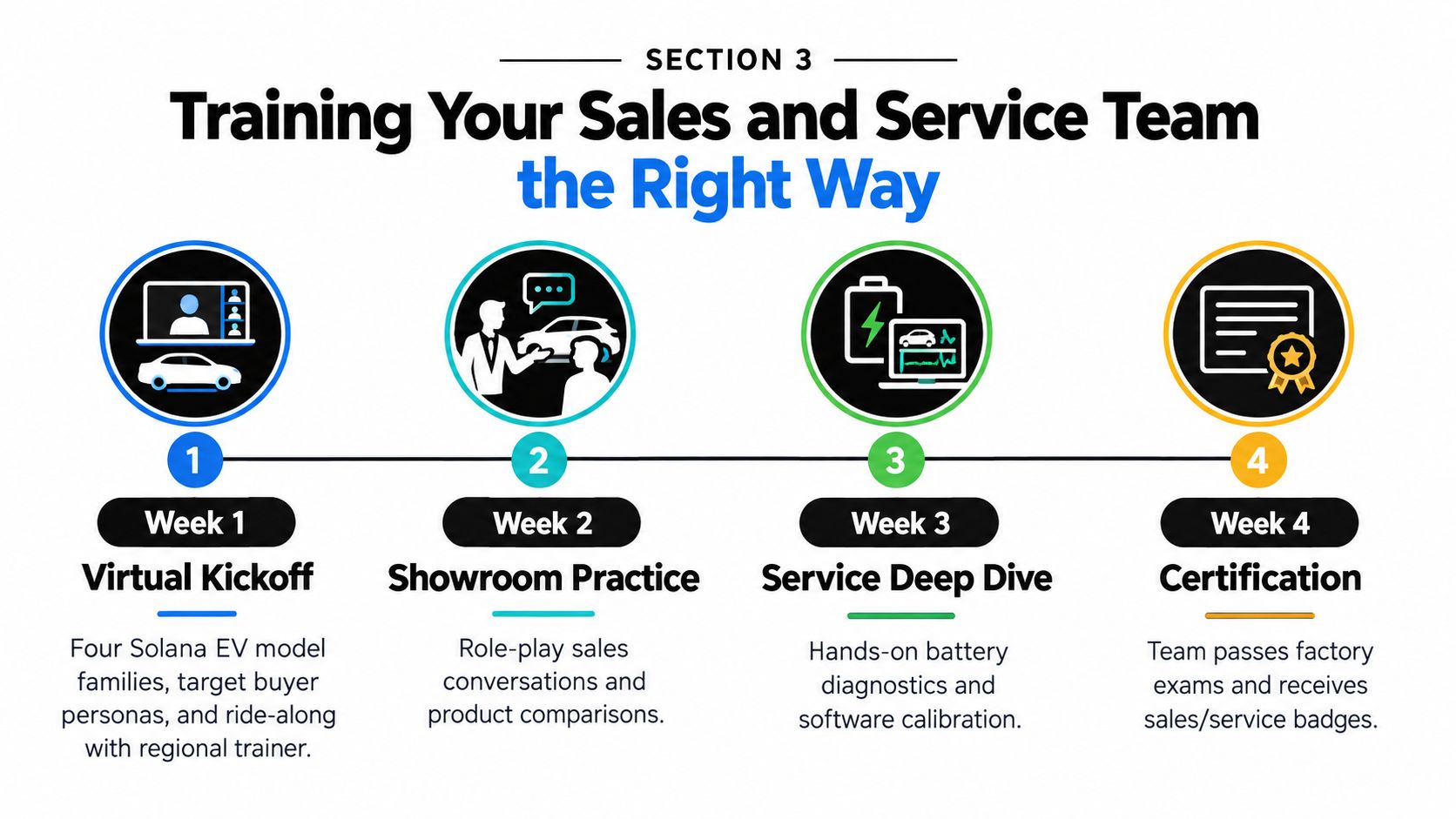
Week one starts with a virtual kickoff. Cover the four Solana EV model families, target buyer personas, territory expectations, customer qualification, and the basic path from inquiry to delivery. Add a ride-along with a regional trainer so the new team sees how a test drive is controlled, how objections are handled, and how the salesperson records the next step.
Month one adds in-person floor coaching. Spend two focused days on test-drive objection handling, battery-care demonstrations, feature comparisons, customer walkarounds, and trade-in valuation for used low-speed EVs. The manager should observe live conversations and document coaching points, rather than relying on a quiz score.
Month two brings the service technician certification on the 48V and 72V systems, followed by a warranty workflow walkthrough. The technician needs to know what information belongs on the repair order, how to identify the vehicle, when to contact technical support, and how to order the correct part.
The 60-day refresher should be a half-day ride-along. Compare each salesperson's first ten closes with the dealer's network benchmark, then coach the gap. If a salesperson explains features well but loses buyers during financing, the coaching should address the handoff, not repeat product training.
Make completion visible
Set up LMS access before the first virtual session. The manager should send each employee an individual login, confirm that the employee can open the required modules, and export completion records into the dealer's onboarding file. Certificates and role badges must be visible to the manager before the first unit is sold.
A practical weekly cadence looks like this:
- Monday: Product or service module, followed by a short knowledge check.
- Tuesday: Role-play, including a buyer objection and a finance handoff.
- Wednesday: Demonstration practice or technician lab work.
- Thursday: Ride-along, repair-order review, or parts lookup exercise.
- Friday: Manager review of completions, open questions, and next-week assignments.
Solana EV's electric vehicle training programs can sit inside that calendar as the formal learning track. The dealer still needs to enforce attendance, observe behavior, and block customer-facing work until the required sales and service certifications are complete.
Using Marketing Resources and the 24/7 Parts Portal
A resort-area dealer preparing for spring traffic should connect marketing activity to service readiness. Ordering brochures without stocking maintenance parts creates demand the operation can't support. Booking a demo day without an approved finance menu leaves buyers interested but uncommitted.
In the first month, the dealer should open the asset library, identify approved vehicle photography and campaign copy, and confirm the co-op reimbursement rules with the dealer success manager. The marketing lead can then request point-of-sale kits, plan a local Meta or Google campaign, and submit the event request before spending begins.
Turn co-op into a launch workflow
The dealer's marketing file should contain the approved creative, campaign dates, vendor invoice process, proof-of-performance requirements, and reimbursement contact. Don't assume that any local ad qualifies. A dealer can use a brand asset and still lose reimbursement if the placement, wording, timing, or documentation falls outside the program rules.
A sensible resort launch sequence is straightforward:
- Week one: Request approved brochures, signage, digital assets, and product sheets.
- Week two: Submit the co-op request for the preview event and local campaign.
- Before the event: Confirm demo units, trained staff, finance materials, registration forms, and lead capture.
- After the event: Upload invoices, campaign evidence, lead records, and the follow-up plan.
Treat parts access as an operating system
The 24/7 parts portal should be part of the service manager's daily workflow. Use real-time stock visibility before promising a repair date, VIN-based fitment lookup before ordering, and backorder ETAs when a requested part isn't available. The shipping cutoff matters when a Saturday service ticket depends on an overnight order.
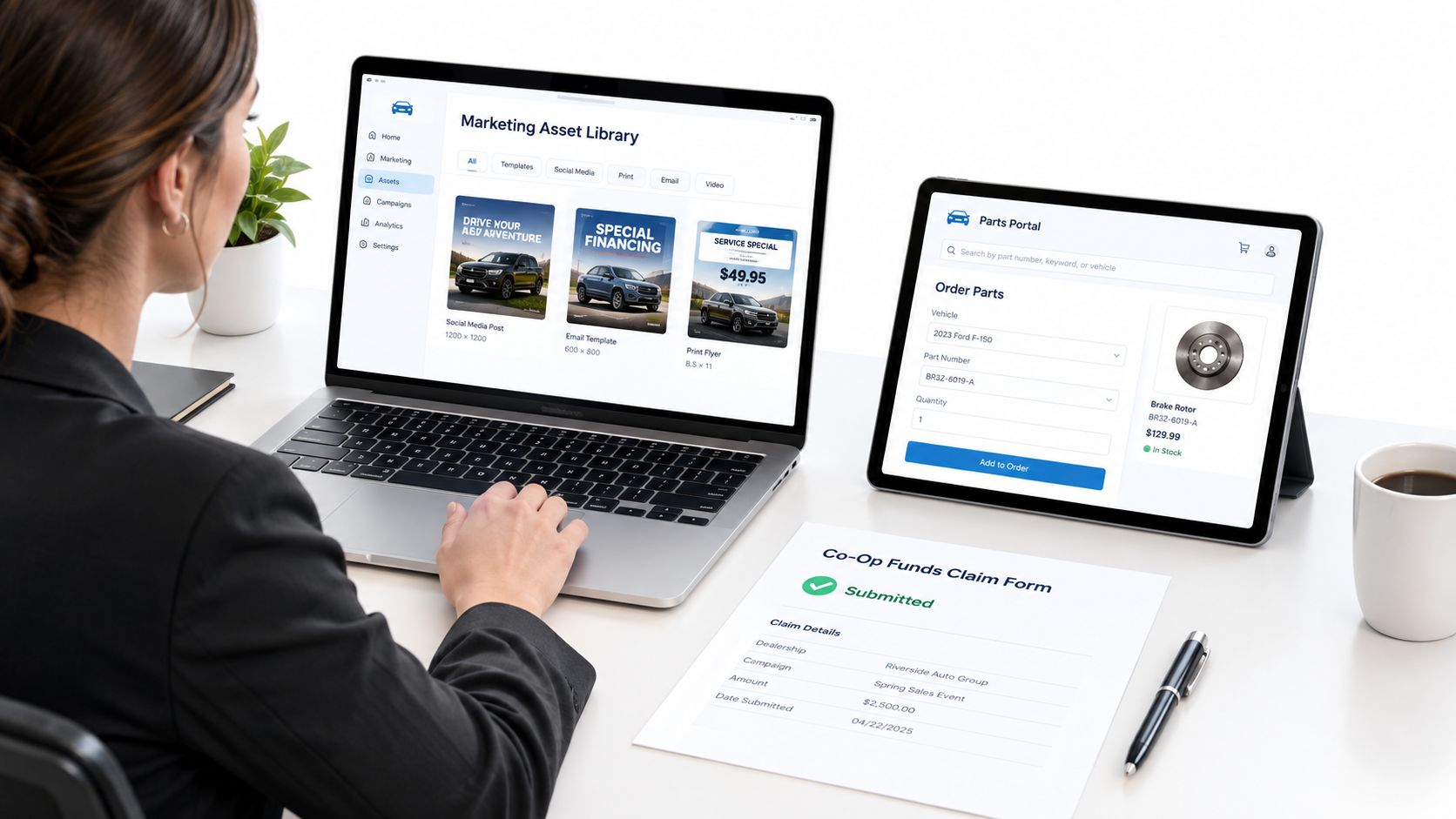
Before the first customer vehicle arrives, stock the maintenance SKUs the service manager expects to use. Confirm who can approve substitutions, who handles backorders, and when the dealer should escalate a technical issue. The portal login should be bookmarked on the service workstation and included in the technician's onboarding checklist.
For markets that require stronger digital controls, identity and document workflows may include PAN, Aadhaar OTP, GST validation, bank verification, e-sign, e-stamp, audit trails, and ERP integration. SignCare Studio's digital onboarding workflow provides relevant context for evaluating which compliance steps can be automated and which still require local review.
Measuring Success at the 30, 60, and 90 Day Milestones
A dealer can look busy and still be stalled. The regional director needs leading indicators that reveal whether the partner can operate without constant rescue. Completion, access, demonstrations, sales activity, service readiness, parts execution, and customer feedback belong in the review.
The first 90 days deserve special attention because dealership onboarding guidance identifies 11.4% of all turnover in the first 30 days and 27.6% of exits in the first 90 days. The dealership onboarding checklist guidance recommends a 90-day arc with checkpoints at day one, week one, and days 30, 60, and 90.
| Milestone | Key KPIs | Target Threshold | Intervention Trigger |
|---|---|---|---|
| Day 30 | Training completion, portal activation, first five demo rides logged, territory and legal file complete | All required access and certifications active, five demos recorded, launch documents verified | Any required certification missing, parts portal inactive, or demo activity absent |
| Day 60 | Closed deals, units retailed, service tickets opened, warranty workflow used correctly | Sales and service teams demonstrate independent execution, with activity recorded in the CRM and service system | No meaningful retail activity, no service workflow usage, or repeated parts-ordering errors |
| Day 90 | First-sale velocity, co-op dollars spent versus claimed, customer satisfaction survey averages, inventory decisions | First-sale process is repeatable, marketing claims are documented, and customer feedback is reviewed | No repeatable sales cadence, unclaimed eligible co-op activity, or unresolved customer complaints |
“Target threshold” should mean a verified operating condition, not an arbitrary number. A dealer can log activity without understanding the product, and a salesperson can complete training without conducting a competent walkaround. The regional director should inspect evidence, including CRM records, LMS completions, service tickets, parts orders, and customer files.
Watch the two predictable stalls
The first stall is under-trained service staff. It appears as delayed repair orders, uncertain warranty handling, and technicians who call for help on routine work. The second is slow parts ordering, which appears as missed cutoffs, incorrect fitment, unmanaged backorders, and customers waiting for information.
Operational guidance also places sales roles at 60 to 90 days for basic productivity and management roles at 120 or more days for full competency. Dealership onboarding benchmarks support measuring time to competency, onboarding completion, dealer engagement, and first-year retention rather than treating onboarding as a single completion event.
The monthly business review should include inventory on hand, open leads, test drives, retail deliveries, service tickets, parts exceptions, training status, marketing claims, customer feedback, and next-month actions. If numbers slip, the escalation path should be explicit: salesperson or technician to department manager, department manager to dealer principal, and dealer principal to the regional director or dealer success manager.
Your First 90 Days as a Solana EV Dealer at a Glance
Print this roadmap and pin it above the dealer principal's desk. Every trigger should produce a visible action, an owner, and a proof point.
The launch sequence
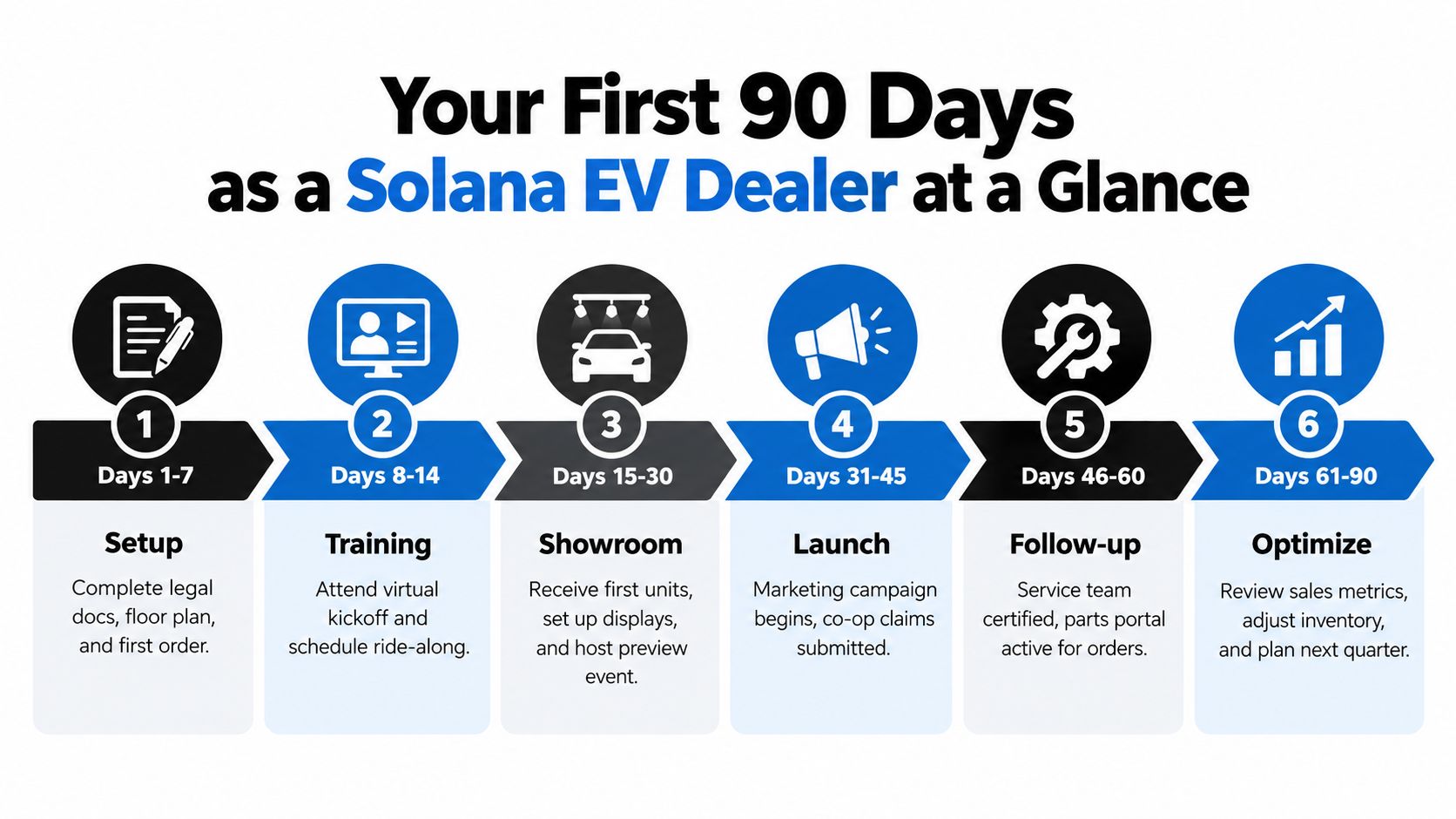
Days 1 to 7, setup. The signed agreement triggers territory mapping, legal review, insurance verification, floor plan credit setup, and the first order. Save the approved territory file and financing letter where every department can find them.
Days 8 to 14, training. Give the sales team access to the virtual kickoff, schedule the regional ride-along, and load the approved product and finance materials into the CRM. Submit the co-op marketing request during week two, not after the launch window has passed.
Days 15 to 30, showroom readiness. Receive the first units, install displays and charging stations, confirm test-drive routes, and host a preview event. The first 30-day review should verify training completion, portal activation, legal readiness, and the first five demo rides logged.
Days 31 to 45, retail launch. Start the local campaign, follow up with every event lead, and work toward the first retail delivery before day 45. That deadline forces the dealer to resolve finance, registration, insurance, sales certification, and delivery-document problems while the launch team is still engaged.
Days 46 to 60, service activation. Complete service certification, open the parts portal, place the initial maintenance order, and close the first service workflow correctly. Parts access should trigger a real lookup and order exercise, not just a login confirmation.
Days 61 to 90, optimization. Review sales activity, inventory mix, parts exceptions, customer feedback, co-op claims, and next-quarter demand. The dealer should know which model families draw attention, which objections slow the sale, and which service questions require more coaching.
The habit that keeps the launch moving
Thriving dealers don't wait for the monthly review to discover a stalled department. They conduct a weekly 30-minute review of the onboarding checklist against measured activity. The meeting should answer what was completed, what is blocked, who owns the next action, and whether the evidence has been saved.
That habit is more valuable than another generic onboarding binder. It keeps protected territory, financing, training, marketing, parts, and customer follow-up in the same operating conversation. It also gives the regional director an early signal when the dealer needs help.
The practical standard is simple: the agreement should lead to territory and credit setup, demo-unit arrival should lead to training, portal access should lead to a parts order, and the first customer inquiry should lead to a documented path toward delivery.
Solana EV offers protected dealer territories, Dealer Direct floor plan financing, retail financing support, training, marketing resources, a 24/7 parts portal, and technical assistance for partners building this operating foundation. Review the partner options and start the conversation through Solana EV, then bring your territory plan, financing needs, showroom timeline, and first-90-day targets to the application.