
You've just watched a delivery truck unload a full row of vehicles, golf carts, or electric utility vehicles onto your lot. The inventory looks like growth, but your operating account sees a different picture: every unsold unit ties up cash, accrues financing expense, and competes with payroll, advertising, service, and rent for working capital. The practical question is simple: how can you stock enough inventory to sell without funding every unit entirely from cash?
That's the problem dealership floor plan financing is designed to solve. It connects borrowing capacity to individual inventory units, charges carrying costs while those units remain unsold, and restores availability as the dealer repays each advance. Used properly, it can support a larger and more responsive lot. Used casually, it can turn slow-moving inventory into a steady drain on margin.
Table of Contents
- Why Dealers Need a Different Kind of Funding
- What Dealership Floor Plan Financing Actually Is
- Key Terms Every Dealer Should Understand
- What It Costs to Carry Inventory on a Floor Plan
- How Lenders Underwrite and Secure a Floor Plan
- Floor Plan Financing Compared to Other Funding Options
- Steps to Obtain Dealership Floor Plan Financing
- Best Practices for Managing a Floor Plan Responsibly
Why Dealers Need a Different Kind of Funding
A dealer walks onto the lot and counts forty freshly delivered pre-owned SUVs. Each one has a wholesale cost of $28,000, creating a total inventory requirement of $1.12 million. The dealer can pay for the vehicles from the operating account, but doing so would leave far less cash for reconditioning, payroll, taxes, marketing, and unexpected repairs.
Keeping the vehicles off the lot creates a different risk. Customers may want a particular body style, price range, or equipment package, and an understocked dealer can lose the sale before the conversation starts. The dealer needs enough selection to attract buyers, but not so much cash locked into metal that the business becomes fragile.
A general business line of credit can help with operating gaps, but it usually isn't built around rolling, VIN-level collateral. A conventional term loan is even less flexible because it delivers a lump sum and expects repayment according to a fixed schedule, whether the underlying inventory has sold or not. Dealers need financing that follows the movement of each unit.
Practical rule: Inventory funding should match the way inventory converts into revenue. If units arrive, sit, and sell individually, the credit facility should track those same events.
Why cash alone creates pressure
Paying cash gives the dealer full control over the units and avoids interest on borrowed funds. It also consumes liquidity immediately. That liquidity may be more valuable when the dealer needs to acquire a desirable trade, repair a vehicle quickly, or absorb a seasonal slowdown.
The opposite mistake is relying on too little inventory. A dealer might preserve cash but lose sales because the lot lacks range. The right answer isn't always “borrow more.” It's a financing structure that lets the dealer decide how much inventory to carry, measure how quickly it turns, and reduce exposure when a unit ages.
Dealership floor plan financing is a revolving wholesale inventory credit line. The lender advances funds for qualifying units, secures the facility with the inventory, and makes repaid capacity available for new purchases. Industry explanations commonly describe these arrangements as short term, often 90 to 180 days, with balances becoming available again after repayment, as outlined in this guide to starting and structuring a dealership business.
That revolving design supports seasonality. A dealer can draw for inventory ahead of a busy selling period, repay units as customers buy them, and reuse the released capacity rather than applying for a new loan for every purchase. The economics still depend on rate, fees, advance terms, and aging discipline, but the product fits the inventory cycle far better than a generic loan.
What Dealership Floor Plan Financing Actually Is
Dealership floor plan financing is a revolving credit facility secured by inventory. Each vehicle, golf cart, EV, or other approved unit is treated as a specific collateral item rather than as an indistinguishable part of a general borrowing pool.
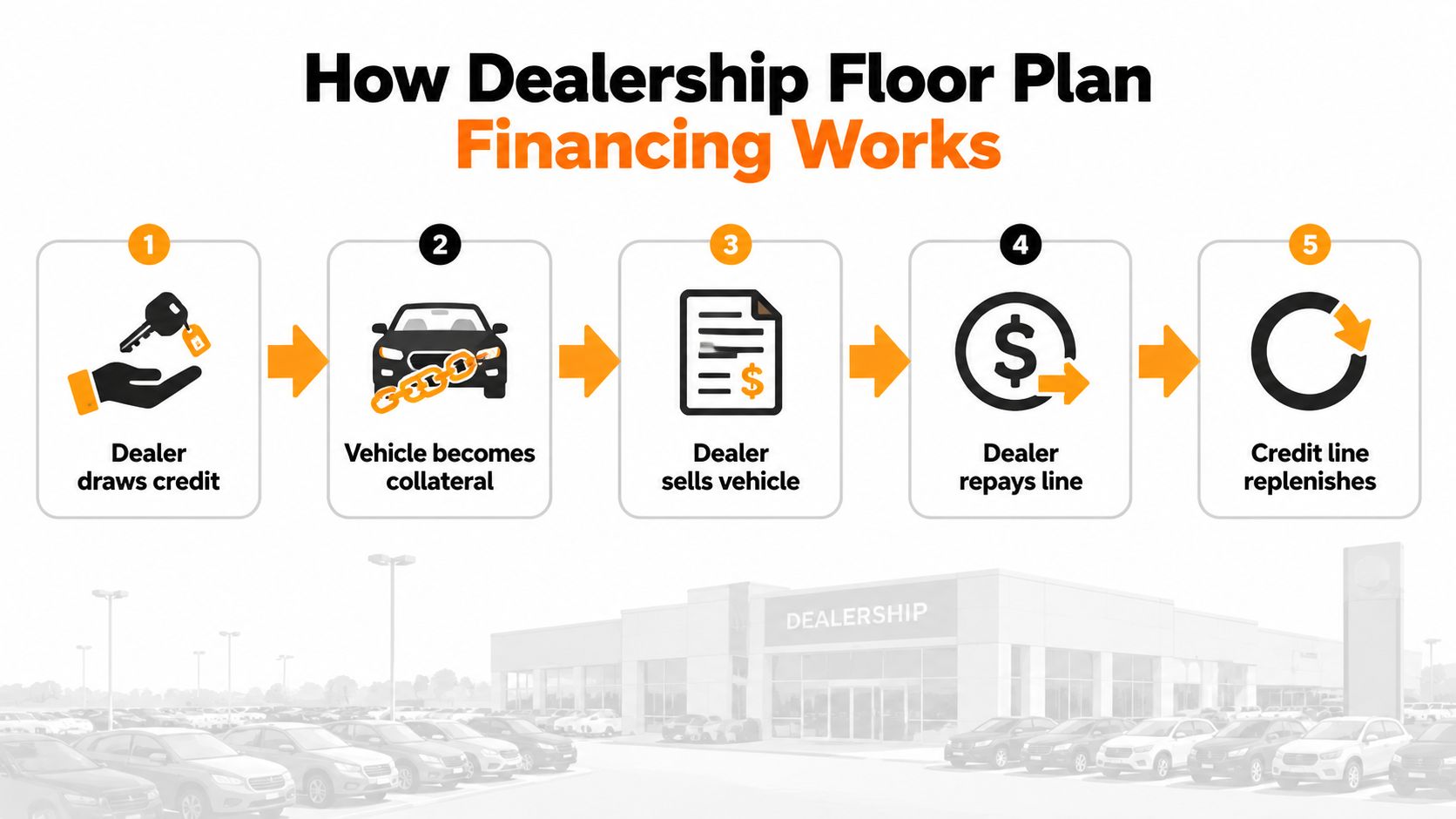
The process usually follows a clear sequence.
- The dealer identifies a unit. The dealer submits the VIN or equivalent identifying information, purchase documentation, and seller details.
- The lender approves the advance. Depending on the agreement, the lender may wire funds to the seller or pay the seller directly.
- The unit becomes collateral. The lender records its security interest through title control, assignment, or related documentation.
- Interest accrues during the hold. The dealer pays the agreed interest on the outstanding balance while the unit remains unsold.
- The dealer sells and repays. Sale proceeds repay the lender's principal and accrued interest for that unit. The repaid portion becomes available again.
A simple unit-level example
Suppose a dealer draws $25,000 against one vehicle and holds it for 45 days. The requested example rate is roughly 1.5% per month, so the interest calculation would depend on the lender's exact daily or monthly convention and the agreement's billing rules.
At sale, the dealer must clear the lender's principal claim and the accrued financing charge before treating the remaining gross margin as available business revenue. If the vehicle sells for more than its funded cost, the difference can contribute to gross profit after interest, reconditioning, sales commissions, transport, and other costs.
The key point is that the dealer doesn't repay a fixed installment on a separate loan unrelated to the vehicle. The unit itself drives the transaction. That alignment is why a floor plan line is revolving rather than a one-time advance.
What happens when the unit sells
The dealer must coordinate payoff and title release correctly. A sale without prompt repayment can create an “out of trust” problem, because the lender's collateral has left the lot while the related debt remains outstanding.
Lenders use title control, inventory records, audits, and sale reporting to reduce that risk. The Office of the Comptroller of the Currency's floor-plan lending guidance explains that repayment and curtailment provisions should reduce debt in line with collateral depreciation. In practice, accurate unit tracking is not clerical housekeeping. It protects the lender, the dealer, and the customer waiting for clean title.
Key Terms Every Dealer Should Understand
A lender's proposal can look familiar while hiding important cash-flow consequences. Dealers should read each term as an operating instruction, not just a credit definition.
The vocabulary behind the facility
Line size is the maximum total amount the dealer may borrow under the facility. It isn't automatically the amount the dealer should use. A line can be large enough to support growth but still become expensive if the dealer fills it with aged units.
Advance rate is the portion of an eligible unit's cost or approved value that the lender will fund. Any unfunded portion comes from dealer equity or another approved source. A lower advance rate increases the cash required at acquisition.
Curtailment is a required principal reduction on a unit that has remained unsold beyond the lender's specified aging point. It forces the dealer to put more cash into an aging unit instead of allowing the full balance to remain outstanding indefinitely.
Interest indexing describes how the rate moves. Many facilities price above SOFR or Prime, so a benchmark change can alter the dealer's carrying cost even when the unit itself has not changed.
Aging measures how long a unit has remained in inventory or on the facility. Aging can trigger curtailments, additional charges, approval restrictions, or demands for payoff.
Other terms deserve equal attention:
- Floor rate: The minimum interest rate that applies even if the benchmark falls. It limits how far the dealer's borrowing cost can decline.
- Recourse: The lender may pursue the dealer or guarantors for an unpaid shortfall after collateral liquidation. Non-recourse structures place more recovery risk on the lender, although availability and pricing depend on the agreement.
- Curtailment schedule: The calendar or formula that determines when principal reductions begin and how they are calculated.
- Inventory audit: A physical or electronic verification that financed units exist, remain eligible, and match the lender's records.
- Wholesale versus retail tracking: Wholesale records show acquisition cost and lender funding. Retail records show the customer sale, payoff, title release, and gross profit. Mixing the two can conceal an unpaid floor plan balance.
| Term | Plain-English Meaning | Dealer Impact |
|---|---|---|
| Line size | Total borrowing capacity | Limits how much inventory can be financed at once |
| Advance rate | Percentage of eligible cost or value funded | Determines the dealer's cash contribution |
| Curtailment | Required paydown on an aging unit | Creates cash outflow before sale |
| Interest index | Benchmark used to set the floating rate | Makes carrying expense sensitive to rate changes |
| Aging | Time a unit remains unsold | Can trigger fees, paydowns, or payoff demands |
| Inventory audit | Verification of financed collateral | Requires accurate lot and system records |
| Recourse | Responsibility for an unpaid deficiency | Affects personal and business exposure |
What It Costs to Carry Inventory on a Floor Plan
A unit can look profitable on the day it arrives and become less attractive each day it remains unsold. Floor plan interest consumes borrowing capacity while adding to that unit's cost basis, so the lot's clock matters as much as the sticker price.
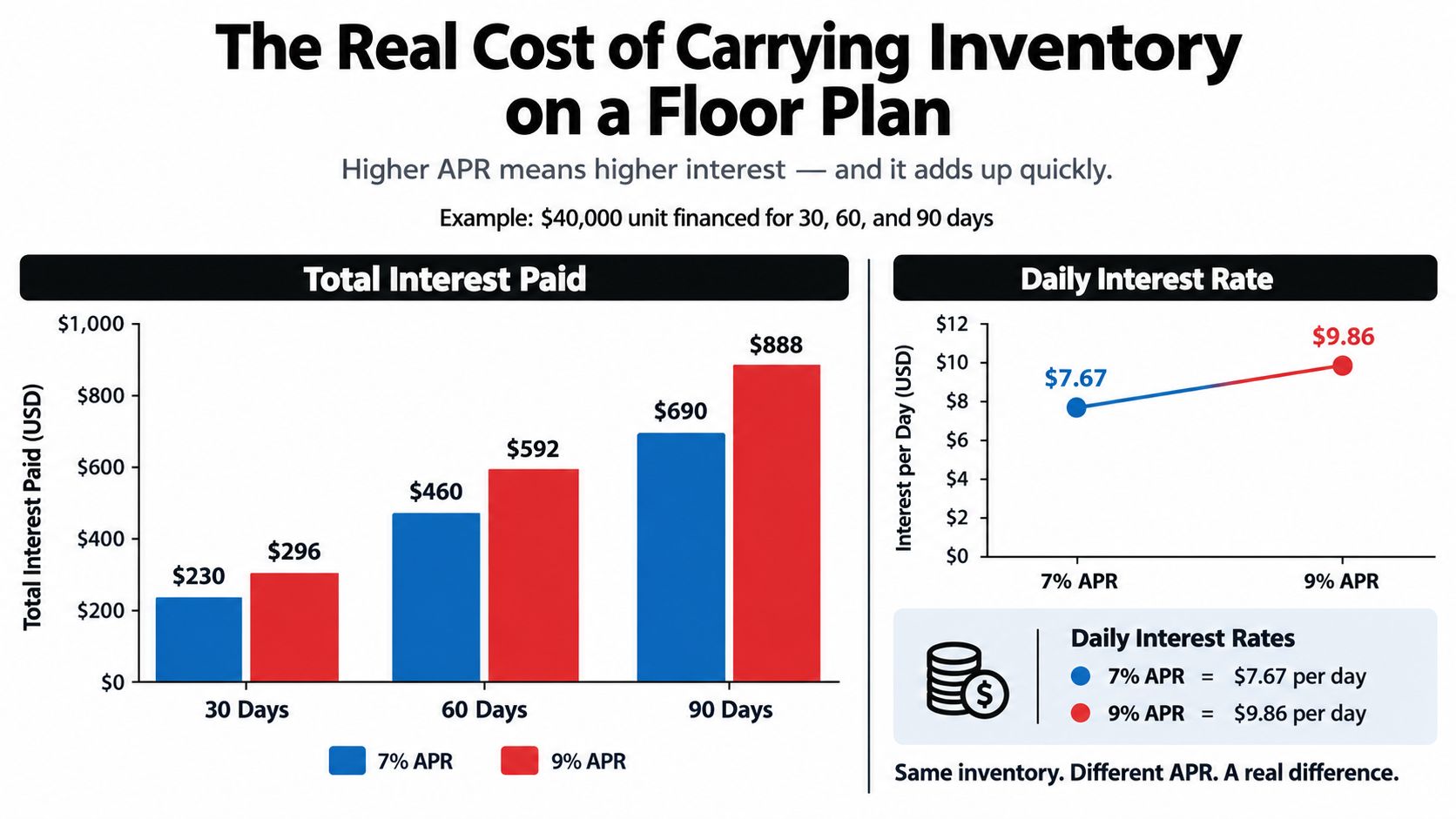
For a $40,000 unit, the supplied comparison estimates:
- At 7% APR, about $7.67 per day, $230 over 30 days, $460 over 60 days, and $690 over 90 days.
- At 9% APR, about $9.86 per day, $296 over 30 days, $592 over 60 days, and $888 over 90 days.
The estimates come from the floor plan calculator and dealer carrying-cost benchmarks. Actual charges depend on the invoice balance, rate convention, fees, curtailments, and payoff date.
Why the daily number matters
A dealer may defend gross margin during a price discussion yet overlook the holding cost created while the unit waits. If a price reduction comes late, interest, reconditioning, storage, advertising, and depreciation can absorb much of the expected spread.
Industry explanations commonly place a vehicle's time on a dealer lot at 30 to 90 days, according to inventory finance guidance on carrying costs. That range is not a forecast for every operation. Used-car stores, franchise dealers, golf cart dealers, and EV retailers face different demand patterns, customer decision cycles, and seasonal exposure.
The same arithmetic applies across the facility. A $4 million floor plan balance at 7% interest would produce about $23,000 per month, or approximately $767 per day, in the cited example. A dealer therefore needs to monitor both unit-level aging and the total balance across the lot.
For adjacent mobility segments, facility-wide capital can be more practical than treating every golf cart or EV as an isolated advance. The lender can set an approved borrowing base for eligible inventory, while the dealer tracks each unit's funded balance, sale, payoff, and any required curtailment. That structure keeps capital available across product lines, but it still requires accurate records and prompt repayment when a unit sells.
Dealers should include interest in ownership and lifecycle calculations alongside energy, service, insurance, and depreciation. A structured total cost of ownership analysis helps compare units that have different holding periods and operating costs. Clear controls also matter, including UAE stock accounting best practices as a reference point for reconciling inventory records with financed balances.
How Lenders Underwrite and Secure a Floor Plan
A floor plan lender underwrites two related risks. First, can the dealer operate profitably and repay obligations? Second, will the lender be able to identify, control, and liquidate the inventory if the relationship fails?
The financial package usually includes business tax returns, interim financial statements, debt schedules, projected unit sales, and current inventory records. Lenders also review the owners' personal credit profiles, dealer licenses, franchise agreements where applicable, and prior floor plan history.
What the lender is trying to measure
Liquidity shows whether the dealer can absorb a slow month, a repair surprise, or a required curtailment. Working capital indicates whether the business can fund the parts of each transaction that the facility doesn't cover. Debt-to-worth helps the lender judge how much risk the balance sheet can support.
Turn velocity matters because inventory is the collateral and the repayment source. A dealer that consistently sells units, reports them accurately, and pays the related balance promptly presents a different risk from a dealer whose aging schedule is unclear.
| Category | Typical Lender Expectations |
|---|---|
| Financial strength | Current statements, tax returns, liquidity, and sustainable working capital |
| Ownership | Personal financial information, credit history, and possible guarantees |
| Operating authority | Valid dealer license and any required manufacturer agreements |
| Inventory quality | Clearly identified units with verifiable cost, title, and location |
| Repayment behavior | Clean payoff history and timely curtailment compliance |
| Collateral controls | UCC filings, title control, insurance, and audit access |
| Reporting | Aging reports, inventory reconciliations, and sales updates |
| Business plan | Reasoned unit volume, inventory mix, and growth assumptions |
Collateral and reporting requirements
The lender may file a blanket UCC financing statement while also taking a specific security interest in each financed VIN. Floor plan insurance protects against covered physical losses, but insurance doesn't replace accurate records or repayment discipline.
Expect periodic inventory audits. The auditor may compare vehicles physically present on the lot with the lender's system, title files, and dealership management system. A missing unit, an incorrectly recorded payoff, or a vehicle sold without proper release can become a serious covenant issue.
Dealers can strengthen an application by presenting clean aging reports, consistent financial statements, documented turn cycles, and evidence that management acts quickly on stale units. Manufacturer co-op commitments may also help in a franchise setting, but the lender will still focus on the dealer's own liquidity and controls.
Floor Plan Financing Compared to Other Funding Options
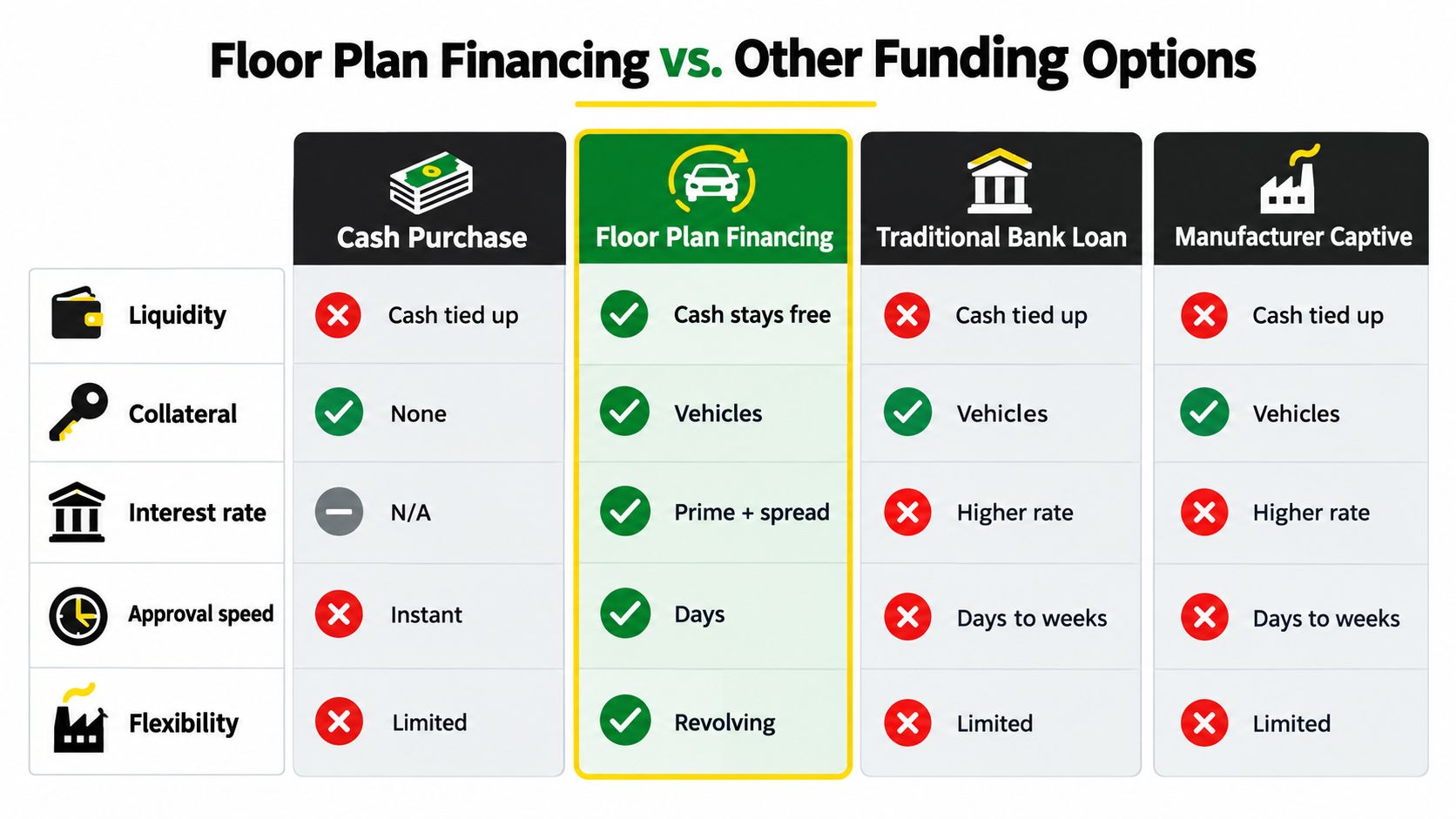
A dealer buys a unit for $30,000 and sells it after several weeks. Cash keeps the transaction simple, but it also leaves $30,000 unavailable for reconditioning, marketing, or the next purchase. A floor plan line finances that unit while it sits on the lot, then expects payoff when the unit sells.
The right option depends on the inventory cycle and the dealer's operating needs.
| Funding Option | Main Strength | Main Trade-Off | Best Fit |
|---|---|---|---|
| Cash purchase | No financing charge on the inventory | Ties up liquidity immediately | Smaller lots with deep reserves |
| Floor plan financing | Revolving, unit-level funding | Interest, audits, aging rules, and collateral controls | Dealers carrying rolling inventory |
| Traditional term loan | Predictable lump-sum funding | Fixed amortization may not match unit sales | One-time inventory or facility needs |
| Manufacturer captive | Often aligned with franchise inventory | Limited to eligible brands and program rules | Franchise volume buyers |
Cash avoids an inventory financing charge, provided the dealer has enough reserves. Its cost is the capital no longer available for facility improvements, advertising, repairs, or an attractive acquisition. A dealer should compare that lost flexibility with the daily carrying cost of a floor plan advance.
A conventional term loan suits a one-time expansion or major facility project. Inventory turns unit by unit, so a fixed repayment schedule can create pressure before a particular vehicle sells. A revolving facility better matches purchases and payoffs, though interest, audits, aging rules, and curtailments still apply.
A manufacturer captive lender may fit franchise inventory well, with programs built around approved brands and models. Independent dealers and specialty retailers may need a commercial facility that accepts mixed inventory instead.
Why specialty inventory needs careful structuring
Golf carts, low-speed vehicles, EVs, accessories, demo units, and conversion packages can require different collateral treatment. Ask whether the lender can identify each financed asset, manage title requirements, and separate the vehicle from add-ons with different resale characteristics.
The facility's structure affects how quickly a dealer can buy, demonstrate, and replace inventory. A unit-by-unit line may fund each asset separately, while a broader facility can give the dealer more room to manage several related product categories, subject to the lender's controls.
Dealers comparing financing with insurance should also review this floor plan and inventory policy comparison before finalizing collateral and risk controls. Insurance addresses covered physical losses. It does not replace accurate records, timely payoffs, or disciplined inventory management.
For electric-mobility retailers, electric vehicle financing options can help distinguish inventory funding from retail buyer financing. These products serve different purposes. Clear reporting keeps the dealer's floor plan facility focused on inventory while customer financing remains a separate process.
Steps to Obtain Dealership Floor Plan Financing
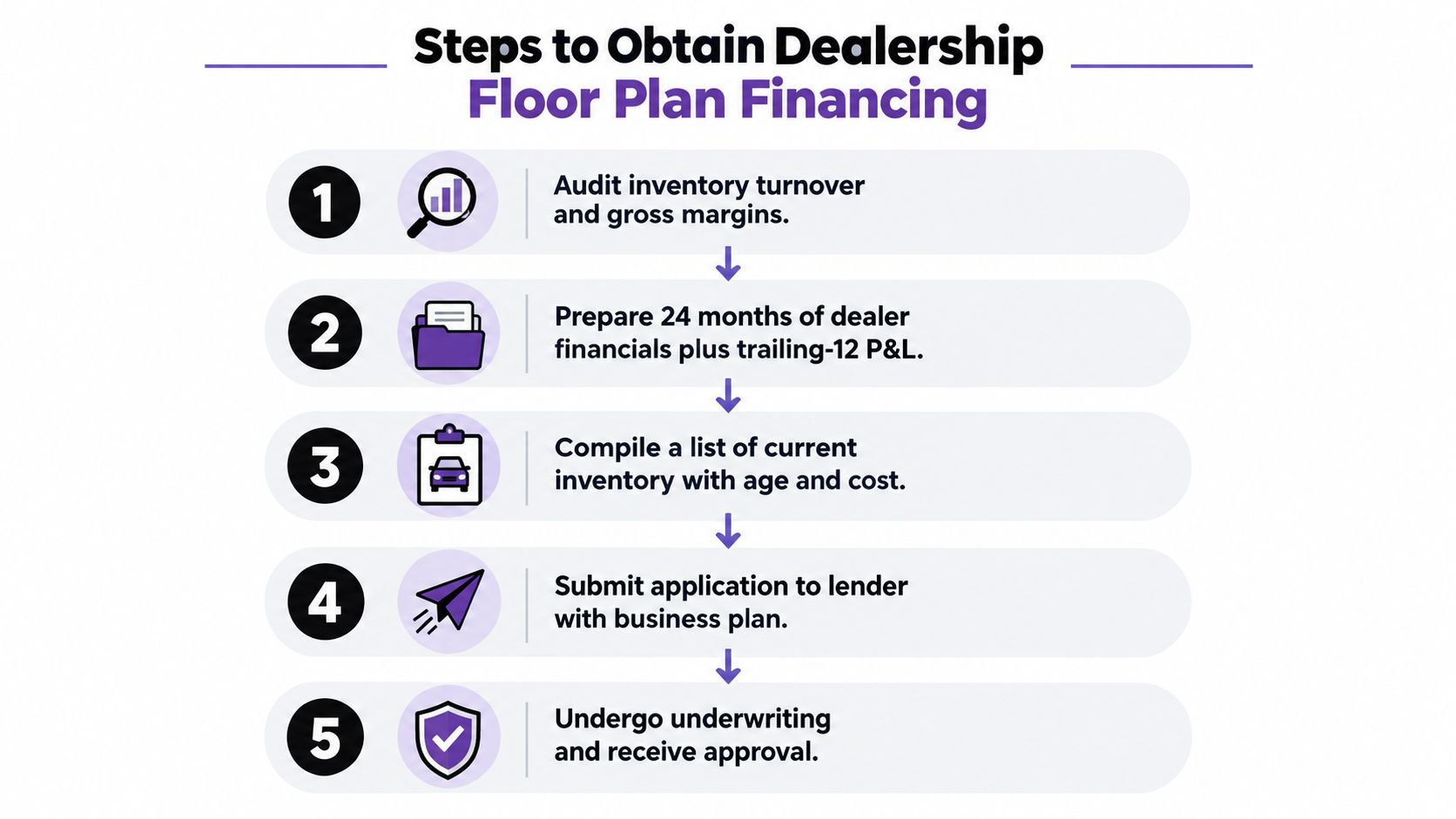
A strong application begins before the lender sees it. The dealer should understand current inventory behavior, prepare reliable records, and request a facility that reflects actual purchasing needs rather than an arbitrary target.
Start with operating evidence
Review recent unit sales, average inventory age, gross margins, reconditioning expense, and the timing between acquisition and retail sale. Separate fast-moving categories from units that routinely require price reductions.
Prepare the financial package early. The requested materials should include 24 months of dealer financials, a trailing-12-month profit and loss statement, current interim statements, debt schedules, personal financial statements for principals, licensing documents, prior floor plan history, and current aging reports.
Match the lender to the inventory
Franchise dealers may start with a captive lender connected to the manufacturer. Independent used-car dealers typically need a commercial or specialty floor plan lender. Dealers handling golf carts, EVs, and related mobility products should ask specifically about mixed fleets, demo units, title control, accessory treatment, and facility-wide reporting.
Submit a concise application that explains:
- Inventory mix: Identify the vehicle or mobility categories the dealer expects to carry.
- Purchase rhythm: Explain how often the business buys and replenishes units.
- Projected sales: Connect expected volume to historical performance and local demand.
- Requested line size: Show how the requested capacity relates to average cost and turn.
- Risk controls: Describe aging reviews, pricing actions, audits, and payoff procedures.
The lender may conduct a site inspection, collateral audit, management interview, and covenant negotiation before closing. A clean application can move through underwriting more efficiently, while inconsistent inventory records usually create delays and additional questions.
Before signing, review rate adjustments, floor rates, curtailment timing, audit rights, insurance requirements, title procedures, fees, and events of default. The cheapest headline rate isn't necessarily the least expensive facility if its curtailment terms or reporting burden don't fit the lot.
Best Practices for Managing a Floor Plan Responsibly
Treat the floor plan as a working-capital engine, not as permanent financing. The facility should help the dealer acquire and sell inventory through a controlled cycle. It shouldn't fund unrelated expenses, conceal operating losses, or justify keeping stale units on the lot.
Set written turn targets by category. A used-vehicle dealer may manage its inventory differently from a new-vehicle franchise, golf cart retailer, or EV specialist. The target should reflect actual customer demand, reconditioning time, seasonality, and the lender's aging rules, not an optimistic sales assumption.
Build aging discipline into daily operations
Post an aging report that management can act on. Each unit should have an owner, a next action, and a decision date.
- Price stale units early: Adjust pricing before accumulated interest and depreciation consume the expected margin.
- Wholesale when appropriate: A controlled wholesale exit can be better than carrying a unit that no longer fits local demand.
- Reconcile weekly: Compare lender statements with the dealership management system and title records.
- Track the rate index: A facility priced above SOFR or Prime can become more expensive as the benchmark moves.
- Protect unused capacity: Keep room for attractive purchases rather than filling the line with weak inventory.
- Separate uses of cash: Don't draw floor plan capacity for payroll, advertising, or facility expenses unless the agreement expressly permits it.
Curtailments should match the dealer's cash-conversion pattern. If a lender requires principal reductions as units age, management should forecast those payments before approving new purchases. A unit that needs a curtailment shouldn't surprise the controller at month-end.
Management test: Every financed unit should answer three questions clearly. When should it sell, what is the maximum acceptable carrying cost, and what action follows if it misses that date?
For adjacent mobility segments, a facility-wide approach can be more practical than arranging disconnected advances for every golf cart, low-speed vehicle, EV, demo unit, and accessory package. Solana EV offers dealer floor plan financing through Dealer Direct, giving eligible dealers a way to evaluate inventory funding alongside the broader operational needs of an electric mobility dealership.
The dealer should still review advance rates, collateral rules, reporting, insurance, title procedures, fees, and curtailment provisions before accepting any facility. A revolving line only creates value when the dealer can turn inventory, report it accurately, and repay each unit promptly after sale.
Solana EV offers dealers access to inventory funding through Dealer Direct for eligible electric mobility products, including golf carts and EVs, so you can evaluate a facility-wide approach instead of relying only on isolated advances. Visit Solana EV to review the vehicle lineup, dealer support resources, and partnership information.