
When you look at the top electric vehicle manufacturers today, you see a fascinating mix of old-guard automotive giants and nimble, EV-first innovators. You’ve got the heavy hitters like Tesla and BYD who dominate global sales and constantly push the boundaries of what's possible. At the same time, legacy brands like Volkswagen Group and General Motors are pouring billions into electrifying their fleets, and they're catching up fast.
But the real story isn’t just about the big names. Specialized manufacturers are finding their footing and solving problems in crucial areas like low-speed and commercial vehicles.
Mapping the Electric Vehicle Revolution
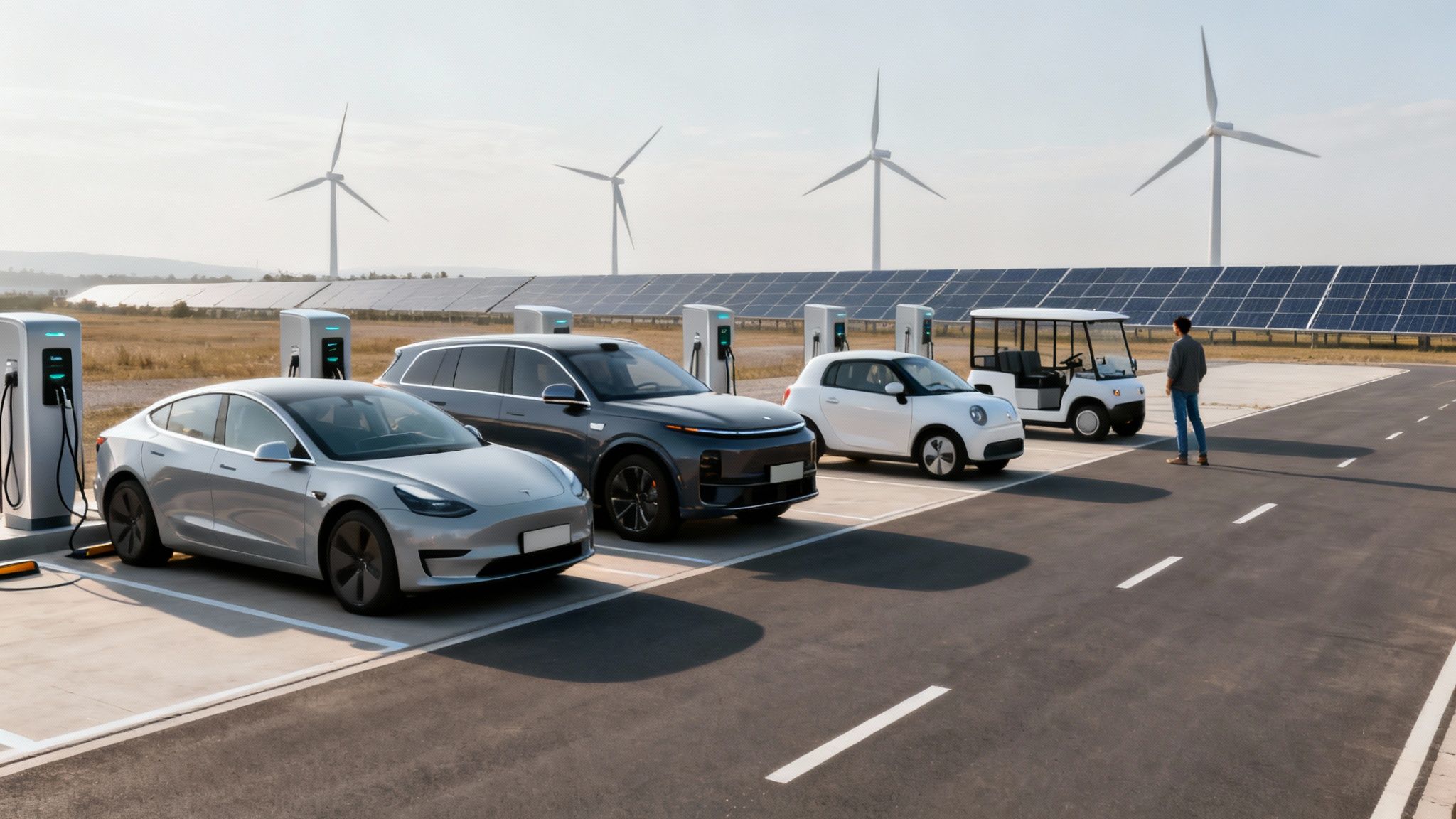
The car world is in the middle of a massive shake-up. Electric vehicles have officially gone from a curiosity to a mainstream movement. This isn't just another trend; it’s a complete rethinking of how we get around, both for personal and business use, and it's all happening because several key things have aligned at once.
At the core of it all is the incredible progress in battery technology. Batteries are becoming more powerful and less expensive, which means EVs can go farther on a single charge and are finally within financial reach for more people. Worried about longevity? Don't be. The average degradation rate for a modern EV battery is a surprisingly low 2.3% per year, proving these vehicles are built to last.
The Forces Driving EV Adoption
It’s not just about the tech, though. People's priorities are changing. There's a real, growing desire for sustainable transportation, and that has put a lot of pressure on automakers to build cleaner, more efficient cars. This shift in public opinion gets a major boost from government policies around the world, including things like:
- Consumer incentives, such as tax credits and rebates, that make buying an EV a lot more affordable.
- Infrastructure investments in public charging stations, which helps put "range anxiety" to rest.
- Emissions regulations that are slowly but surely phasing out traditional gas-powered cars.
What makes a "top manufacturer" in this new landscape? It's not just about who sells the most cars. You have to look at the whole picture: their innovation in battery science, how well they control their supply chain, and the strength of their brand.
Redefining Mobility Across Segments
This new environment has opened the door for everyone from industry titans to focused innovators. While the giants battle it out for the everyday passenger car market, other companies are making waves in specific, often-overlooked sectors.
Take a company like Solana EV, for instance. They're focused on the premium low-speed vehicle (LSV) market, creating vehicles specifically designed for places like resorts, planned communities, and large commercial campuses. It’s a specialized approach that solves unique problems mass-produced cars can't touch, and it shows just how diverse the EV world has become. Digging into the benefits of electric vehicles really helps you understand why these niche markets are expanding so quickly.
In this guide, we'll walk you through the top EV manufacturers across the board, from the global leaders to the niche specialists. By looking at what they do well, where they're headed, and how they fit into the market, you'll get a clear map of this exciting and constantly changing industry.
Analyzing the Global EV Market Leaders
To really get a feel for the electric vehicle market, it helps to imagine it as a high-speed race with several distinct lanes. You've got the volume kings battling it out for mass-market appeal, the tech pioneers obsessed with premium features and software, and of course, the legacy automakers who are throwing their immense manufacturing weight into an electric reinvention.
Each of these top electric vehicle manufacturers is running a different race with a unique strategy. By taking a closer look at their playbooks, dealership owners, property managers, and buyers can see what’s driving the industry and find the right partner for their own goals. For a great head-to-head comparison, just look at BYD and Tesla.
The Volume Leader: BYD
BYD, which stands for "Build Your Dreams," has pulled off a brilliant strategy centered on vertical integration. That’s a fancy way of saying they control nearly their entire supply chain, from the raw materials all the way to the finished car. They don't just put cars together; they make their own batteries, semiconductors, and electric motors.
This gives them an incredible edge. While other car companies are constantly scrambling for battery supplies, BYD has a stable, in-house pipeline. This lets them keep a tight grip on costs, offer competitive pricing, and scale up production at a dizzying speed.
And has it ever paid off. BYD is now the undisputed global volume leader, especially in China, and they're expanding aggressively into Europe and Latin America. Between January and August 2025 alone, BYD delivered a staggering 2.6 million plug-in vehicles. That’s nearly 20% of the entire global EV market, a testament to their smart pricing and reliable, cost-effective battery technology.
The Technology Pioneer: Tesla
While BYD conquers with manufacturing muscle, Tesla wrote a completely different script. At its heart, Tesla acts more like a tech company that just happens to make cars. Their true strength is in their software, the user experience, and a brand built on a powerful vision of the future.
Tesla’s advantage is deep and layered. It starts with the cars themselves—known for their clean design, jaw-dropping acceleration, and an intuitive interface that gets better over time with over-the-air updates.
Tesla’s true genius wasn't just building a great electric car; it was building an entire ecosystem around it. The Supercharger network remains the gold standard for fast, reliable charging, effectively eliminating range anxiety for its drivers and creating a closed-loop system that competitors struggle to match.
This software-first approach, combined with an almost fanatical customer base, gives the brand a pull that goes far beyond the typical auto market. It’s this blend of vehicle, charging network, and brand identity that keeps them a leader. It also proves that winning isn't just about hardware; it's about the entire ownership experience and having a deep understanding of electric vehicle battery technology.
Global EV Manufacturer Snapshot
To make sense of these different approaches, it helps to see the key players side-by-side. This table breaks down the core strengths and strategies of the leading manufacturers, giving you a quick snapshot of the competitive landscape.
| Manufacturer | Primary Strength | Key Geographic Markets | Core Strategy |
|---|---|---|---|
| BYD | Vertical Integration & Cost Control | China, Europe, Latin America | Dominate through volume and affordability by manufacturing key components in-house. |
| Tesla | Software & Charging Ecosystem | North America, Europe, China | Lead with technology, a superior charging network, and strong brand loyalty. |
| Volkswagen Group | Manufacturing Scale & Brand Portfolio | Europe, China | Leverage existing production expertise and diverse brands (Audi, Porsche) to electrify their lineup. |
| General Motors | Ultium Battery Platform | North America | Drive adoption through a flexible, modular battery platform across a wide range of vehicle types. |
Looking at these different paths, it's obvious there's no single "right" way to lead the EV charge. For fleet managers and dealers, understanding these strategies is the first step. It helps you pick a partner that doesn’t just offer a great product but also aligns with where your business is headed.
How Legacy Automakers Are Racing to Catch Up
For a century, the automotive world ran on a playbook written by giants like General Motors, Ford, and Volkswagen. They set the rules. They set the pace. But when the electric revolution kicked into gear, these titans suddenly found themselves in an unfamiliar position: playing catch-up.
This isn't just about launching a few new models. It's a fundamental reinvention. Imagine trying to convert a massive, diesel-powered cargo ship into a sleek, electric speedboat—while it's still navigating the open ocean. These companies are re-engineering everything from their factory floors to their corporate DNA, pouring billions into a future they were once slow to embrace.
Flexing Decades of Manufacturing Muscle
If legacy automakers have an ace up their sleeve, it's their unparalleled manufacturing power. These companies know how to build cars at a staggering scale with rock-solid quality. They've spent over a hundred years perfecting the incredibly complex dance of global supply chains and distribution.
Building a modern vehicle means coordinating thousands of parts from hundreds of suppliers, ensuring everything shows up exactly when and where it's needed. Newcomers can't just flip a switch and replicate that kind of operational mastery. Plus, the established dealer networks of the legacy players give them a massive, built-in advantage for sales and service that EV-only brands are still scrambling to create.
The Volkswagen Group Strategy
Take the Volkswagen Group, for instance. They are making serious headway by leaning on their diverse portfolio of brands, which includes Audi, Porsche, and Škoda. This lets them attack multiple market segments at once, from high-end performance cars to affordable family EVs. Their strategy is to build electric vehicles that feel solid, familiar, and impeccably finished—perfect for buyers who want the benefits of electric without a jarring, futuristic learning curve.
And it’s working. The Volkswagen Group has cemented itself among the world's top electric vehicle manufacturers, delivering a whopping 465,500 battery-electric vehicles in the first half of 2025 alone. These numbers show that their blend of old-school manufacturing prowess and new-school tech is a potent formula for success. You can explore the latest EV manufacturing trends to see how their performance compares to the rest of the field.
Navigating a Tough Transformation
Despite these strengths, the road ahead is full of bumps. The biggest hurdle is overhauling factories built for internal combustion engines (ICE). An assembly line designed around engines and exhaust systems is fundamentally different from one that centers on a massive battery pack and electric motors. The cost and complexity of this retooling process are astronomical.
The real fight for legacy automakers isn't just about bending sheet metal; it’s about mastering software. Today’s EVs are essentially computers on wheels, and competing with nimble, software-first companies demands a cultural pivot from mechanical engineering to digital innovation.
This transition throws up several major challenges:
- Software Integration: Building a smooth, intuitive user interface that gets better with over-the-air updates is a whole new ballgame for most traditional car companies.
- Supply Chain Pivot: They have to stop thinking about sourcing engines and transmissions and start securing massive quantities of batteries and semiconductors, which means building entirely new supplier ecosystems.
- Pace of Innovation: Legacy automakers are used to multi-year development cycles. Now, they have to learn to move at the speed of a tech company, where innovation happens in months, not years.
For property managers, dealers, and fleet owners, the story of these automotive giants offers a powerful lesson in adaptation. It proves that even the biggest, most established players have to evolve or risk being left behind. It also underscores the importance of a strong partnership, much like how a modern dealer program from a specialized manufacturer like Solana EV provides the focused training and support needed to navigate a market that demands both deep expertise and agility.
A Practical Framework for Evaluating EV Manufacturers
Trying to pick from the top electric vehicle manufacturers can feel overwhelming. It’s a crowded field, and it’s tough to know who to trust just by looking at sales charts or flashy ads.
Whether you're a dealer looking for a new brand to carry, a property manager sourcing a fleet, or just a buyer searching for the right EV, you need a solid game plan. This four-pillar framework is designed to help you cut through the noise and zero in on what really matters for a manufacturer's long-term value.
Think of it like building a house—you wouldn't start pouring concrete without a blueprint. Choosing an EV partner is no different. Each of these pillars is a critical part of the foundation, ensuring your final decision is stable, reliable, and a perfect fit for your needs.
Pillar 1: Product Fit and Application
This is the first and most fundamental question: Does this company actually build vehicles for your world? A one-size-fits-all approach rarely works. The needs of a resort manager shuttling guests around are worlds apart from a daily commuter navigating city traffic.
Before you get lost in specs, define the "job" the vehicle needs to do. Ask yourself:
- Operating Environment: Will it be driven on manicured community roads, bumpy trails, or across a massive commercial property?
- Payload and Capacity: Are you moving people, cargo, or a mix of both? How much do you need to carry?
- Legal and Regulatory Needs: Does the vehicle need to be street-legal, like a Low-Speed Vehicle (LSV), to operate on public roads with specific speed limits?
A specialized manufacturer like Solana EV, for instance, is laser-focused on premium LSVs. Their vehicles are engineered for the specific demands of communities and resorts, offering a level of durability and a feature set that a mass-market car just can't match.
Pillar 2: Technology and Innovation
Once you know the vehicle fits your world, it's time to look under the hood—at the tech. The underlying technology stack is what really separates the leaders from the laggards. This pillar is all about evaluating the core components that dictate performance, usability, and whether the vehicle will still be relevant in a few years.
Key areas to investigate are the battery technology, charging capabilities, and the software that holds it all together. A manufacturer's approach here reveals its commitment to a seamless and reliable ownership experience.
A vehicle's true technological strength isn't just its battery range, but the intelligence of its entire system. How efficiently does it use power? How intuitive is it to operate? That’s the difference between just having technology and truly mastering it.
This decision tree shows the strategic crossroads that legacy automakers face. They have to balance the massive challenge of retooling their entire operation with the advantage of their existing dealer and supply networks.
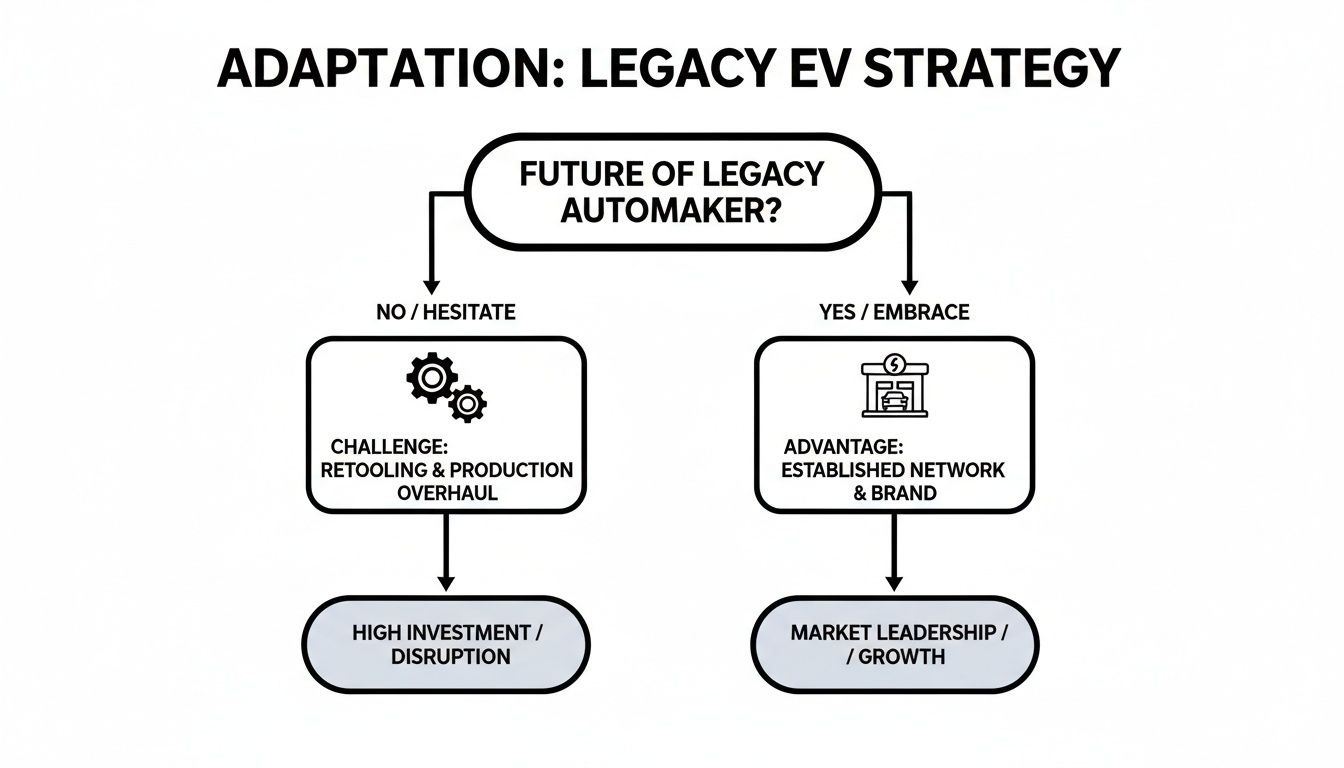
The key takeaway is that adaptation is everything. Established brands are being forced to make some tough calls to stay competitive.
Pillar 3: Sustainability and Vision
A company's commitment to sustainability should be more than just marketing fluff about producing zero-emission vehicles. A truly forward-thinking manufacturer weaves green practices into its entire operation, from sourcing materials responsibly to building energy-efficient factories.
Look into their corporate vision. Are they just reacting to what the market is doing, or are they trying to proactively shape a cleaner future? This long-term perspective is often a great sign of a company’s stability and ethical foundation, which makes for a much more reliable partner.
Pillar 4: Partnership and Support
For anyone in a B2B relationship, this might be the most important pillar of all. The vehicle itself is just one piece of the puzzle. The support structure behind it is what will ultimately determine your success. A strong partnership program is a clear sign the manufacturer is invested in your growth, not just in moving units.
When sizing up a manufacturer’s B2B program, here’s what to look for:
- Comprehensive Dealer Training: Do they give your team the deep product knowledge and technical skills they need to succeed?
- Reliable Parts and Service Support: How fast and easy is it to get spare parts or expert help? A solid electric vehicle warranty is a great way to gauge a manufacturer's confidence in its own products.
- Marketing and Sales Enablement: Do they provide quality marketing materials and sales tools to help you actually attract and close customers?
At the end of the day, a great partner acts like an extension of your own team. Using this four-pillar framework helps you systematically evaluate any of the top electric vehicle manufacturers, ensuring you land a partner that aligns with your operations, your standards, and your long-term goals.
The Rise of Specialized and Niche EV Innovators
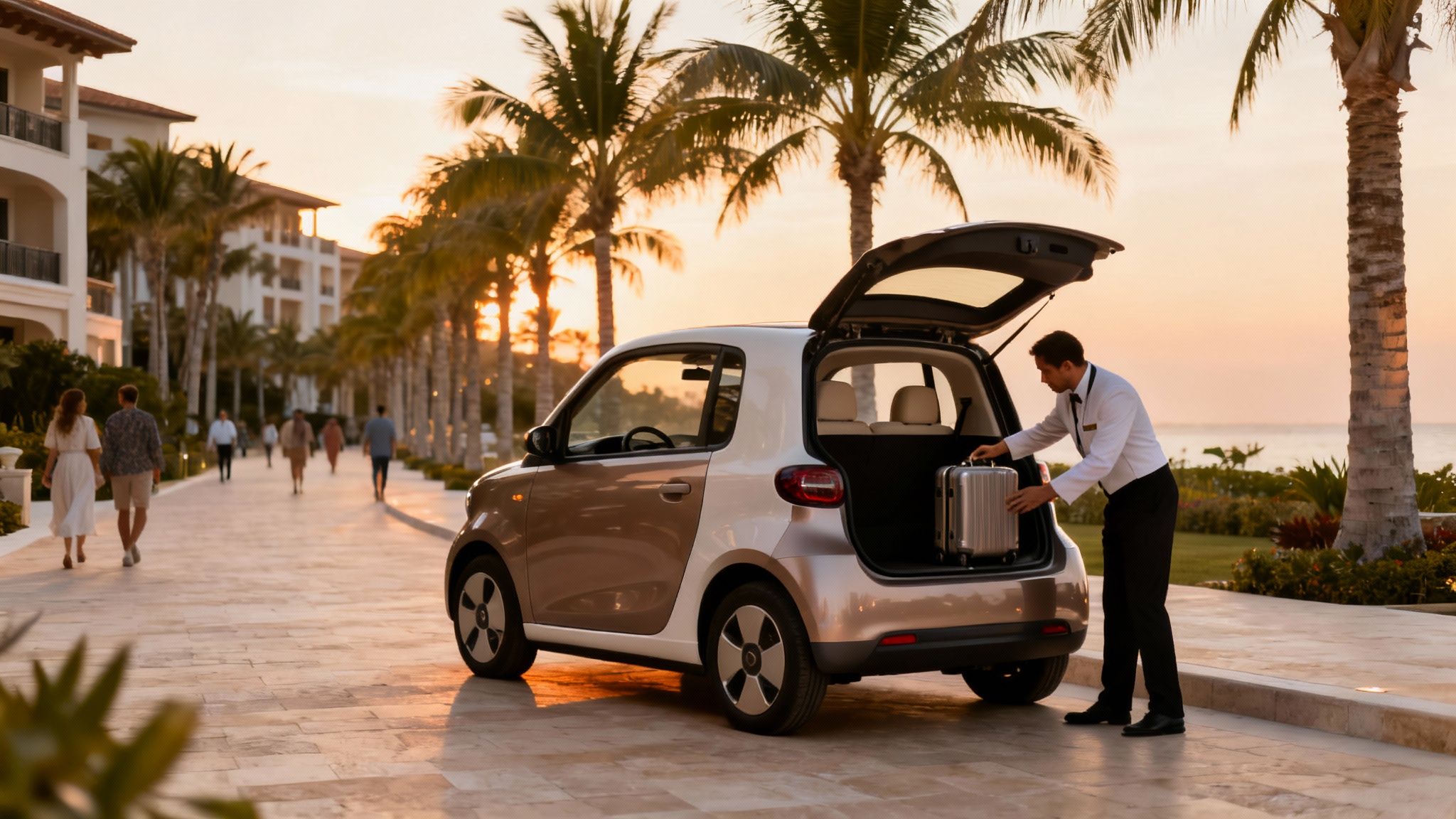
While the big names in the auto industry battle it out for control of the passenger car market, a quieter, more focused revolution is underway. Not every transportation problem can be solved with a standard five-seat sedan or SUV. A different breed of innovator is emerging, and they're winning by mastering specific niches with vehicles built for a purpose, not just a category.
These companies get it: the right tool for the job always beats a one-size-fits-all approach. You wouldn't use a sports car to haul equipment, right? In the same way, a typical consumer EV just isn't cut out for the daily grind of a massive resort, a master-planned community, or rugged off-road trails.
This is where purpose-built design makes all the difference. Specialized manufacturers aren't trying to be everything to everyone. Instead, they pour all their energy into solving a specific set of problems, which leads to vehicles with better durability, the right features, and a premium feel that mass-market models can't touch.
Purpose-Built for Premium Environments
Solana EV is a perfect example of this focused mindset, carving out a name for itself in the premium, street-legal low-speed vehicle (LSV) space. While the broader EV market is obsessed with highway speeds and cross-country range, Solana EV builds its vehicles to thrive in controlled environments where quality, reliability, and aesthetics are non-negotiable.
You can see this philosophy baked right into their product line, with each model designed to tackle specific operational needs:
- The Solana XA: A stylish and adaptable vehicle, it's ideal for shuttling guests around a luxury resort or for personal transport within a planned community.
- The Solana F: This is their rugged utility workhorse, built to handle the tough stuff—from maintenance runs to hauling cargo across large properties.
These are far more than just glorified golf carts. They’re meticulously engineered vehicles, built with robust frames, advanced battery technology, and high-end finishes that match the upscale environments they’re designed for.
The real value of a specialized manufacturer is that they obsess over the details the big companies ignore. For a property manager, this translates into a fleet that not only works flawlessly but actually elevates the brand's image.
The Power of a Strong Partnership
For any business, the vehicle itself is only part of the puzzle. Niche manufacturers often deliver a level of partnership and support that larger corporations simply can't. A strong dealer program becomes a huge advantage, giving business owners the training, responsive tech support, and marketing tools they need to succeed.
It's this dedicated strategy that allows niche players to claim their spot among the top electric vehicle manufacturers. While the giants chase sales volume, innovators like Solana EV are building lasting loyalty by delivering exceptional quality and truly understanding their customers' worlds.
This approach is proving its worth as the entire market continues to boom. Take Tesla, for example, which remains a force in the U.S. despite growing competition. It held an impressive 41% market share in Q3 2025, a quarter where EV sales hit a record 437,487 units. That surge pushed U.S. EV penetration to 10.5% of all new car sales, showing a massive appetite for electric power in every corner of the market. You can dig into more EV market share and sales trends to see the full picture of this incredible growth.
Where Do We Go From Here?
It's clear the electric vehicle world isn't a one-horse race. It's more like a thriving ecosystem, with global giants and specialized players all carving out their own space. What we've learned is that the "best" EV manufacturer really depends on the job at hand. There's no single winner—just the right tool for the right purpose.
Whether you're looking for a dependable car for the daily grind, a tough fleet for a commercial property, or a stylish ride for a planned community, there's a manufacturer out there that fits the bill. The trick is to look past the flashy sales numbers and really dig into what a company offers in terms of product fit, smart innovation, and the potential for a solid partnership.
Finding the Right EV Partner
The split between mass-market giants and purpose-built specialists is the key takeaway here. While the big names are masters of churning out massive volumes, the specialists are the ones delivering true excellence for specific needs.
For anyone who isn't willing to settle—be it a business or an individual—the right manufacturer is more than just a vendor. They're a partner who is just as obsessed with quality, performance, and the overall experience as you are. Purpose-built design isn't just a nice-to-have; it's how you guarantee long-term value and success.
This is exactly where Solana EV comes in. We’re laser-focused on delivering uncompromising quality and style for the specialized EV market. Our vehicles aren't just designed to get people from point A to point B; they're engineered to elevate the very environments they operate in.
If your priority is finding premium, reliable electric vehicles built for a specific mission, the path forward is pretty clear. We invite you to explore the Solana EV lineup and see for yourself how our dedication to specialized design can solve your challenges. And for business owners, our dealer program provides the support and framework you need to grow alongside a leader in this unique space.
Your Questions About EV Manufacturers, Answered
The world of electric vehicles is getting bigger and more complex every day. When you're trying to choose the right manufacturer, a few key questions always seem to pop up. Let's clear the air.
What’s the Real Difference Between Old-School Automakers and New EV Companies?
It really comes down to their starting point and their DNA. Think of an EV-native company like Tesla as a tech company that happens to make cars. Their entire world was built from the ground up around batteries, software, and a totally connected user experience. It's all one seamless system.
Now, look at legacy automakers like Volkswagen or Ford. These companies are masters of manufacturing, with a century of experience building quality vehicles. They're now pivoting that incredible expertise toward electric technology. They often nail the traditional build quality and can tap into massive, existing dealer networks. The flip side is they sometimes struggle to make their software as intuitive and have to overhaul enormous supply chains built for gas engines.
The core distinction is mindset: one company was born from code and batteries, while the other is adapting a hundred years of mechanical engineering to a digital age. This difference shapes everything from vehicle design to how fast they can innovate.
Why Not Just Go with a Big, Famous Brand?
It's tempting, but consider this: the major brands are all fighting for the same thing—the mainstream passenger car market. While they're battling it out, specialized manufacturers are quietly solving very specific problems with vehicles built for a single purpose. A company like Solana EV, for example, isn't trying to build a car for everyone; they're engineering vehicles for distinct jobs, like moving guests around a resort, navigating a gated community, or handling tough work on a commercial property.
This laser focus means you get a better tool for the task at hand. You get practical advantages that a standard consumer EV just can't match:
- Tougher Construction: These vehicles are built to handle the specific wear and tear of their intended environment, day in and day out.
- Purpose-Built Features: You get options that actually make sense for the job, like specific cargo setups or features designed for guest comfort.
- Proper Certification: They often come with the right street-legal LSV (Low-Speed Vehicle) status, making them safe and legal for use in designated areas.
Choosing a specialist isn't about compromise; it’s about getting the exact right vehicle for the job instead of a one-size-fits-all solution that doesn't quite fit anyone.
How Much Does a Dealer Support Program Really Matter?
For a business, it's everything. A strong dealer support program is the difference between just buying a product and forming a true partnership. When a manufacturer invests in a solid program, it’s a clear sign they’re committed to your success long after the sale is made.
A great dealer program gives you the resources you need to actually succeed. For example, the program at Solana EV includes things like dedicated technical support, detailed product training for your team, professional marketing materials to help you sell, and pricing that makes sense for your business. It ensures your people are knowledgeable, your service is top-notch, and your business is equipped to grow.
Ready to work with a leader in specialized electric vehicles? Take a look at the Solana EV lineup and learn about our dealer program built for your success at https://solanaev.com.