
Let's be honest, the term "golf cart" doesn't quite do these vehicles justice anymore. What used to be a simple buggy for the back nine has grown into a seriously versatile and efficient ride for all sorts of places—gated communities, sprawling resorts, and even busy corporate campuses. Many of them are now sophisticated electric vehicles, with some models fully equipped to be driven on public roads.
Your Guide to Choosing the Perfect 2 Seat Golf Cart
Far beyond the fairway, the classic two-seater has found a new life. It's become the go-to personal transport for everything from a quiet ride through the neighborhood to managing a large commercial property. The goal here is to help you sort through the options and figure out if this compact vehicle is the right fit for you.
We'll look at the different flavors they come in, from tough off-road models ready for the trail to street-legal Low-Speed Vehicles (LSVs) perfect for running local errands. Getting a handle on these differences is the first big step. Think of this guide as your roadmap to understanding the features, rules, and performance specs that really matter before you make a purchase.
What to Expect in This Guide
To make your decision a whole lot easier, we're going to break down the most important points:
- Types of Carts: We'll compare the basic golf-only models against recreational and street-legal versions.
- Key Features: You'll learn what to look for in batteries, motors, and how much weight a cart can handle (payload).
- Legal Considerations: We'll cover the rules of the road for driving your cart in public.
- Premium Options: We'll highlight what makes top-tier carts, like the ones from Solana EV, stand out from the crowd.
Key Decision Factors for Your 2 Seat Golf Cart Purchase
Making the right choice comes down to a few key areas. If you're just starting to look, this table is the perfect quick-glance summary of what you need to think about. It’s designed to help you match your needs with the right kind of cart.
| Factor | What to Consider | Why It Matters for You |
|---|---|---|
| Primary Use | Will you be on a golf course, private trails, or public roads? | This is the biggest factor. It determines if you need a basic model, a rugged off-road version, or a street-legal LSV. |
| Power Source | Are you choosing between a traditional lead-acid battery or a modern lithium-ion system? | Lithium batteries give you more range, charge faster, and last way longer. This impacts your daily convenience and the cart's lifetime cost. |
| Legal Status | Do you need a vehicle that can be registered and driven on streets with speed limits of 35 mph or less? | Only factory-built LSVs are truly street-legal. Trying to upgrade a standard golf cart often isn't possible or compliant with the law. |
| Terrain | Will you navigate paved paths, steep hills, or uneven ground? | The ground you'll cover dictates whether you need features like a lifted suspension, all-terrain tires, and a motor with enough power for climbs. |
Ultimately, thinking through these points will put you on the fast track to finding a two-seater that doesn't just work, but that you'll absolutely love driving.
Matching Your Cart to Your Lifestyle
Picking the right 2-seat golf cart is a lot like choosing any other vehicle. It’s not about getting the one with the most bells and whistles; it’s about getting the one with the right features for your actual life. After all, not all two-seaters are built the same. Some are specialized tools for the manicured greens of a golf course, others are ready for rugged trails, and a growing number are perfectly at home on public streets.
Think of it this way: you wouldn't take a sports car mudding, and you wouldn't enter a tractor in a street race. The same common-sense logic applies here. The very first step on your buying journey is to get really honest about where and how you’ll be using your cart. That single decision shapes everything that comes next, ensuring you end up with a vehicle that feels like a natural extension of your world, not a constant source of frustration.
To help you map this out, the flowchart below walks you through the key questions about your intended use, the terrain you'll be on, and your budget.
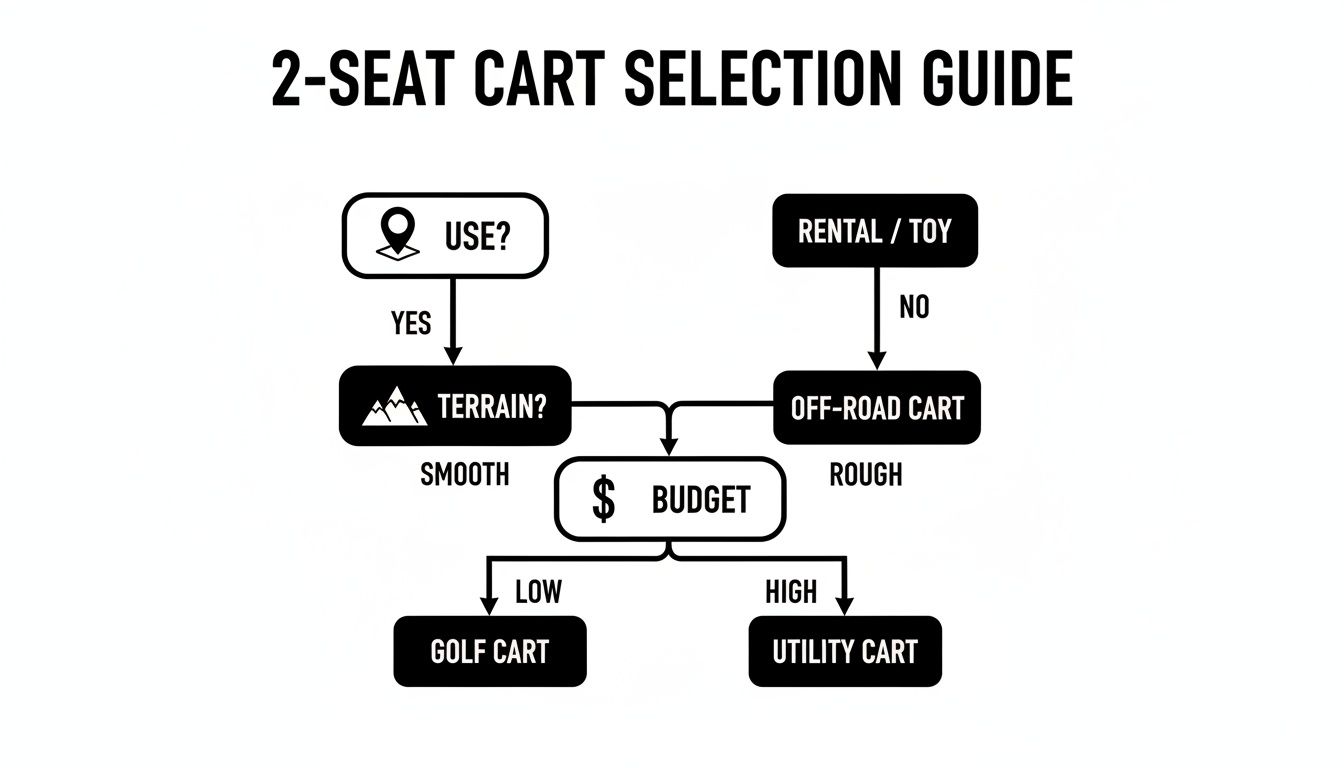
As you can see, figuring out your main purpose is the launching point. It’s what will tell you whether you need a basic, off-road, or street-legal model.
The Classic Golf Course Cart
This is the one that started it all—the quintessential 2-seat golf cart. It was engineered with a singular mission: get two golfers and their clubs across delicate turf quietly and efficiently. Its entire design is focused on being turf-friendly, from specialized tires that won’t tear up the fairways to a smooth, gentle acceleration.
The feature list is simple and purpose-driven:
- Quiet Electric Motors: Absolutely essential for keeping the peace on the course.
- Basic Suspension: It’s built for smooth, paved cart paths and manicured grass, not for bumpy rides.
- Limited Speed: Most are governed to a safe 12-15 mph, which is plenty for navigating the links.
- Minimalist Design: You typically won't find headlights, turn signals, or seatbelts because they simply aren't needed in its controlled environment.
If your world is the golf course or a similar private property with smooth surfaces, this traditional model is a reliable, no-frills workhorse. It’s the specialist, perfectly tuned for its job.
The Rugged Off-Road and Recreation Cart
Ready to venture off the paved path? The off-road or recreational 2-seat golf cart is the adventurous cousin in the family. It’s built for folks who need to tackle tougher environments, like a sprawling farm, a wooded hunting lease, or a large property with varied terrain. These aren't just golf carts with bigger tires; they're fundamentally re-engineered for durability.
Honestly, calling these "golf carts" is a bit of a stretch. They're much closer to compact utility vehicles (UTVs), blending the small footprint of a cart with the rugged heart of an ATV.
Here’s what sets them apart:
- Lifted Suspension: This gives you much more ground clearance to get over rocks, roots, and ruts without getting hung up.
- Aggressive, All-Terrain Tires: The deep treads provide serious grip on dirt, mud, and gravel.
- More Powerful Motors: They deliver the torque needed to climb steep hills and muscle through tricky spots.
- Sturdier Frames: They have to be. They’re built to handle the bumps, jolts, and stress of off-road use.
If your plans involve anything more challenging than a flat, paved path, this is where you need to be looking. They offer the go-anywhere versatility that a standard cart just can't touch.
The Versatile Street-Legal LSV
Finally, we have the most flexible and increasingly popular option: the street-legal Low-Speed Vehicle (LSV). An LSV isn't just a golf cart with a license plate; it's a specific federal vehicle classification. To earn that title, a cart must meet strict safety standards, allowing it to be legally driven on most public roads with speed limits of 35 mph or less. This feature transforms it from a simple utility vehicle into a true second car for local trips.
A key thing to know is that a cart must be built as an LSV from the factory to qualify. You can't just bolt on a few parts later and call it good.
Mandatory LSV Safety Equipment
- Headlights, Taillights, and Brake Lights: For being seen day or night.
- Turn Signals and Reflectors: To signal your intentions to other drivers.
- A Horn: A must-have for alerting pedestrians and cars.
- A Windshield: Made from automotive-grade safety glass.
- Seatbelts: Crucial for occupant protection on the road.
- A Vehicle Identification Number (VIN): The unique 17-digit number needed to register and insure it.
- Mirrors: You’ll need rearview and side-view mirrors.
These vehicles are a game-changer for people in gated communities, for running quick errands, or for getting around large corporate or college campuses. They give you all the convenience and low operating costs of an electric cart, plus the freedom to hit the road.
Decoding the Features That Truly Matter
Once you've figured out what type of cart fits your life, it's time to look under the hood—so to speak. The spec sheet for a 2 seat golf cart can look a little intimidating at first, full of numbers and technical terms. But don't get bogged down in the jargon.
The goal isn't to memorize stats; it's to understand how those numbers translate into real-world performance. Think of it like buying a new laptop. You care about the processor because you want speed, and you look at the battery life because you want portability. A golf cart is exactly the same. Getting the right combination of features makes all the difference between a cart you love and one that becomes a constant headache.
Let’s break down the components that really define a quality ride.
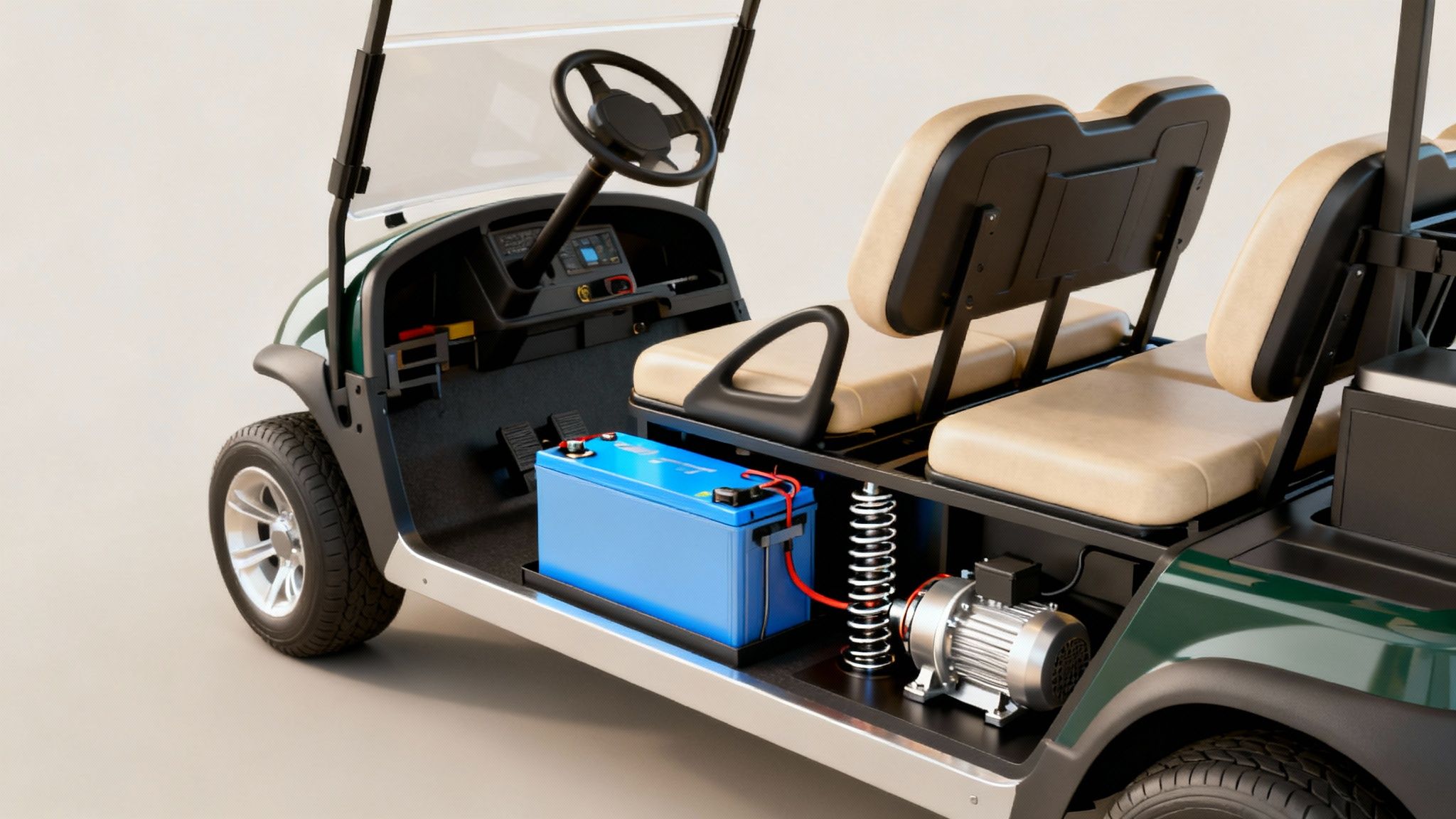
Battery Technology: The Heart of Your Cart
If there's one component that dictates your entire experience, it's the battery. This is what determines your range, how long you'll wait for a charge, and ultimately, how long the cart will last. For decades, the old-school choice was lead-acid batteries, just like the ones in a traditional car. They're heavy, need regular maintenance (like topping off water levels), and can only be charged so many times before they give up the ghost.
But today, modern, high-quality carts have made the switch to Lithium-ion batteries, and the improvement is dramatic.
- Go Farther: Lithium batteries pack more power into a lighter package. This means you can get a serious range of 30-50 miles (or even more) from a single charge.
- Charge Faster: Forget overnight charging. A lithium battery can often get a full charge in just 2-3 hours, compared to the 8-10 hours needed for lead-acid.
- Forget Maintenance: They are completely sealed. No water checks, no corrosion to clean up. It’s a true set-it-and-forget-it system.
- Lasts for Years: A good lithium battery can handle up to 5,000 charge cycles. For most people, that means it could easily last the entire life of the cart.
While a cart with a lithium battery might cost a bit more upfront, the savings in time, maintenance, and replacement costs make it the smarter financial choice in the long run.
Motor Power: More Than Just Speed
It’s easy to look at a motor's power rating and just think about top speed. But for how a cart feels day-to-day, the most important thing is torque. Torque is the twisting force that gets you moving from a standstill and, crucially, powers you up hills. A cart with weak torque will feel sluggish and will struggle on any kind of incline, especially with a passenger.
A quality AC (alternating current) motor, like the ones in Solana EV carts, delivers that torque instantly. You feel it in the snappy acceleration and the steady, confident climb up hills. It's the difference between a cart that feels capable and one that feels like it's always working too hard.
A cart's motor is like an athlete's legs. Speed is great, but strength (torque) is what carries you through the tough parts of the course—or the steep hill on the way home.
Payload Capacity and Suspension: The Ride and the Load
Every 2 seat golf cart has a payload capacity—that’s the maximum weight it can safely carry, including you, your passenger, and all your gear. Pushing past this limit doesn't just slow you down; it puts serious strain on the motor, brakes, and frame. Always check this number and be realistic about what you'll be hauling.
Just as important is the suspension system. A basic cart often uses simple leaf springs, which can make for a jarring, bouncy ride on anything other than perfect pavement. A better cart will feature a more advanced setup, like an independent front suspension with proper shock absorbers. This allows each wheel to handle bumps on its own, giving you a much smoother, more car-like feel that's essential for comfort on trails or neighborhood streets.
Personalizing Your Ride with Accessories
This is the fun part. The right accessories can transform a standard cart into one that’s perfectly tailored to you. These aren't just for show; they add real-world function that can make you love your cart even more.
Popular and Practical Add-Ons:
- All-Weather Enclosures: A simple vinyl enclosure protects you from wind and rain, letting you use your cart comfortably for more of the year.
- Upgraded Wheels and Tires: Custom wheels add style, but a good set of all-terrain tires can give you the grip you need for gravel paths or wet grass.
- Integrated Sound Systems: Who doesn't want tunes? Bluetooth speakers let you stream music right from your phone.
- Storage Solutions: From rear cargo boxes to under-seat trays, extra storage is always a good idea for groceries, gear, or tools.
- USB Charging Ports: A small but critical feature for keeping your phone charged while you’re out and about.
Thinking about these add-ons from the beginning helps you build a cart that's truly yours. For more ideas on outfitting your new ride, you might find some good insights on choosing the right golf gear that can help round out your setup.
How to Navigate Street-Legal Requirements
Taking your 2 seat golf cart from the fairway to a public street unlocks a whole new level of convenience, but it also means you’ve got a new set of rules to play by. This isn't just about bolting on a license plate; there's a specific legal framework designed to make sure everyone stays safe on the road.
First, you need to get familiar with a key distinction: the difference between a standard golf cart and a street-legal Low-Speed Vehicle (LSV). Think of the LSV classification as a federal stamp of approval. To earn it, a vehicle has to be built from the ground up to meet strict safety standards laid out by the National Highway Traffic Safety Administration (NHTSA).
And this isn't something you can just cobble together in your garage. A genuine LSV rolls out of the factory with all the required safety gear already in place.
The Federal Foundation for LSVs
Before your state or city even gets a say, a street-legal cart must clear the federal hurdles first. These are the non-negotiable, nationwide rules that every LSV manufacturer, including Solana EV, has to follow.
- Speed Limits: The cart must be able to hit at least 20 mph but can’t go faster than 25 mph. This specific speed window is what defines the entire LSV category.
- 17-Digit VIN: Just like any car, every LSV gets a unique 17-digit Vehicle Identification Number. You'll need this for titling, registration, and getting insurance.
- Safety Gear: A factory-built LSV comes standard with headlights, taillights, turn signals, seatbelts, mirrors, reflectors, and a proper automotive-grade windshield.
These federal rules create a consistent safety baseline, ensuring the vehicle is actually prepared for public road use. Without meeting these specs, it’s just a golf cart, not an LSV.
State and Local Laws Take the Wheel
Once a vehicle is certified as a federal LSV, your state and local governments add their own rules to the mix. This is where it can get a little tricky because what's legal in one town might get you a ticket in the next.
Your local Department of Motor Vehicles (DMV) is your single most important resource. They have the final say on everything from the paperwork you’ll need to the minimum insurance you have to carry.
When you get in touch with the DMV, have your questions ready. For a deeper dive before you call, you can learn more by reading our article on the essential street-legal golf cart requirements.
Here’s a checklist of what you absolutely need to figure out:
- Where Can You Drive? Most places limit LSVs to roads with a posted speed limit of 35 mph or less. Some states add their own twists; South Carolina, for instance, has a "four-mile rule" that restricts how far you can travel from your registered address.
- What Insurance Is Required? You’ll need to show proof of liability insurance to get your LSV registered and on the road. Be sure to ask about the minimum coverage amounts your state requires.
- What Are the Registration Steps? Find out exactly what documents, fees, and inspections are needed to get your title and license plate.
By starting with the federal foundation and then zeroing in on your local rules, you can handle all the legal stuff with confidence and get to the fun part—driving your street-legal 2 seat golf cart without any headaches.
Meet the Premium Solana EV Models
It’s one thing to talk about what makes a great 2-seat golf cart in theory, but it’s another thing entirely to see those ideas come to life in a real vehicle. This is where Solana EV comes in. They’ve built their entire reputation on transforming those ideal features—like battery life and build quality—into a tangible, high-end driving experience.
Think about a cart where every detail just works. That advanced lithium battery isn't just a number on a spec sheet; it's what gives you the freedom to explore your entire community without constantly checking the charge level. In the same way, solid engineering isn't just about a strong frame; it’s what delivers that smooth, confident ride on any surface.
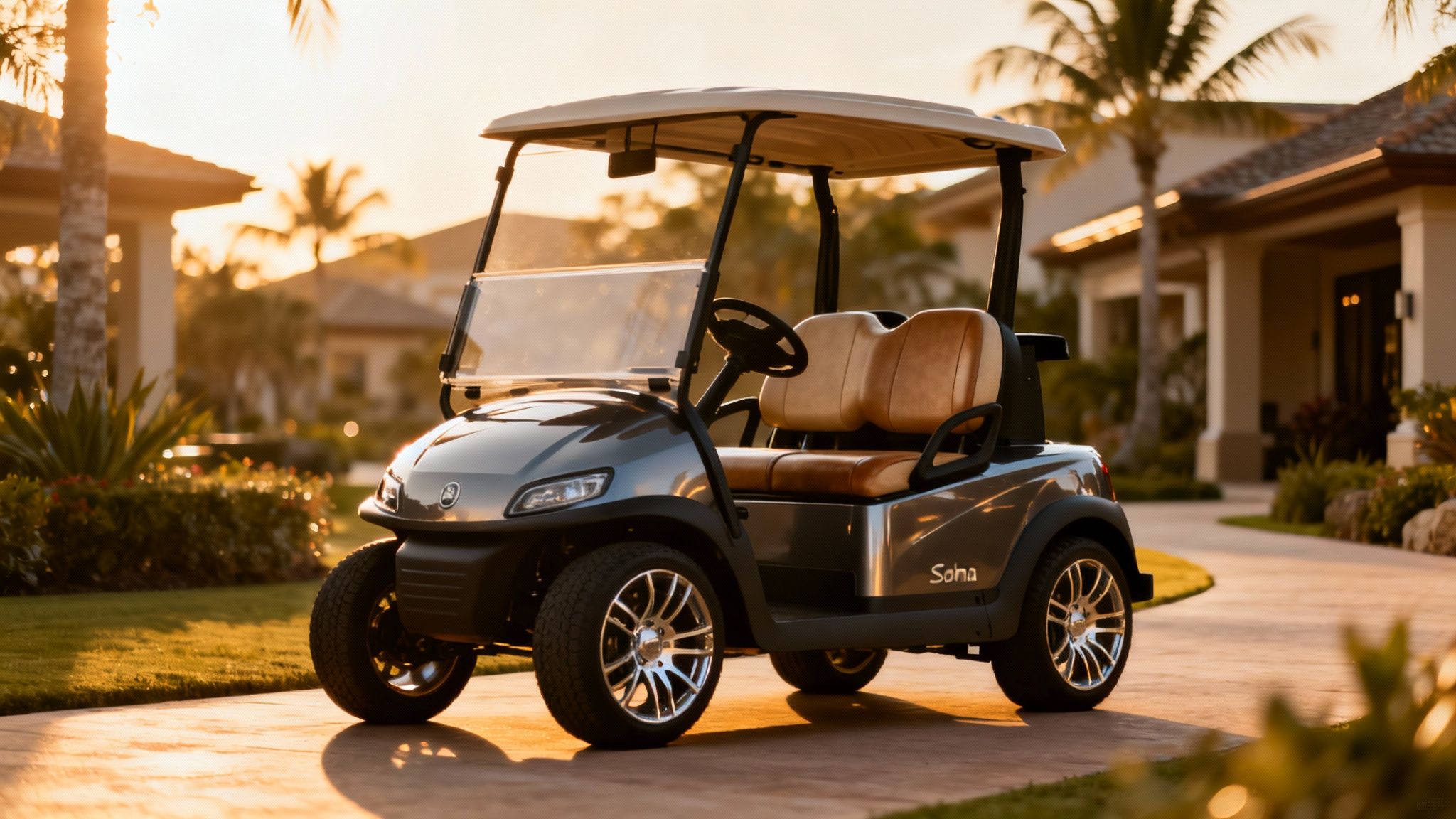
This obsessive focus on quality is why a Solana EV is such a great fit for so many different people, from a resort manager who needs a reliable fleet to a homeowner looking for a stylish ride that won’t cause headaches.
The Solana G: A Masterclass in Performance
Let's get specific and look at a model like the Solana G. It’s a perfect example of a top-tier 2-seat golf cart. It wasn’t just built to get a job done; it was engineered for a better ownership experience, showing exactly how premium parts create superior performance on the road.
The real magic is under the hood—or, in this case, the seat. A high-efficiency AC motor works in tandem with a state-of-the-art lithium battery system. This combo gives you instant torque to climb hills without a hint of hesitation and a seriously impressive range that leaves old-school lead-acid batteries in the dust. The end result? A cart that feels quick, powerful, and ready for whatever you throw at it.
The two-seater golf cart isn't just a niche product; it's a powerhouse in the global market, expected to capture a 39.3% market share by 2025. This incredible popularity shows just how much people value these compact, versatile vehicles for all sorts of uses. You can dive deeper into these market trends over at Future Market Insights.
This market dominance is exactly why a brand like Solana EV pours so much effort into perfecting the two-seat design. They know their customers have high expectations, and they’re determined to meet them.
Built for the Real World: Versatility and Reliability
Whether you’re buying for yourself or for a business, you need a cart you can count on. Solana EV models are designed to handle the grind of daily use, with features that focus on both toughness and comfort. The chassis is built to last, and the suspension is tuned to smooth out the bumps on everything from paved community paths to light trails.
For a business owner thinking about a fleet, that means less downtime and lower repair bills. For a homeowner, it means pure peace of mind and a vehicle that just works, every single time. To see how different models compare head-to-head, check out our in-depth Solana EV golf carts review.
Here's a quick look at how a model like the Solana G is designed for different real-world situations.
Solana EV 2-Seat Models at a Glance
This table gives a comparative overview of Solana EV's premier 2-seat offerings, highlighting key specifications for different use cases.
| Model Feature | Solana G (Example Model) | Ideal Use Case |
|---|---|---|
| Power System | High-Capacity Lithium Battery & AC Motor | Provides long-range, maintenance-free power ideal for large communities, resorts, and all-day recreational use. |
| Chassis/Suspension | Reinforced Frame & Independent Suspension | Delivers a smooth, car-like ride suitable for both paved streets and moderately uneven private property. |
| Legal Status | Street-Legal (LSV) Option Available | Perfect for homeowners in gated communities or for commercial use on campuses where public road access is required. |
| Customization | Wide Range of Accessories | Can be equipped with custom wheels, enclosures, and storage to meet specific personal or business needs. |
As you can see, the features are thoughtfully designed to match the demands of both personal and commercial owners, ensuring performance where it matters most.
Partnering for Success with the Dealer Program
Solana EV doesn't just stop at building great carts; they also have a fantastic dealer program. It’s designed for business owners who want to offer their customers a premium electric vehicle from a brand they can trust. It’s more than just selling a product; it’s about giving partners the tools they need to succeed.
Here’s what that looks like:
- Comprehensive Training: Dealers get a deep dive into the Solana EV lineup, so they can speak with real expertise and guide customers to the perfect vehicle.
- Dedicated Support: You get a direct line to the Solana EV team for any help you need with sales, service, or tricky technical questions.
- Premium Products: You’ll have access to a lineup of high-quality, in-demand electric carts that truly stand out from the competition.
By becoming a dealer, you’re aligning your business with a brand known for quality, putting you in a great position to meet the soaring demand for high-performance electric carts.
Simple Maintenance to Protect Your Investment
A quality 2 seat golf cart is a real investment, and just like your car, a little bit of regular upkeep makes a huge difference. It's the key to protecting its value and making sure it runs like a top for years to come. The best part? You don’t have to be a mechanic to handle the basics.
Think of it as a quick check-in, not a weekend-long project. Spending just a few minutes every so often on these key areas will stop small problems from turning into big, expensive headaches. This simple approach keeps your cart reliable, safe, and ready to go whenever you are.
Mastering Battery Health
In an electric cart, the battery is the heart of the machine. Taking good care of it is easily the most important thing you can do for its lifespan and performance. Modern lithium-ion batteries are pretty low-maintenance, but the right habits are still crucial.
- Charge Smart: Try not to let the battery run down to empty. The best habit is to simply plug it in after every decent drive.
- Keep It Clean: Every now and then, take a look at the battery terminals. If you see any white or bluish powder (corrosion), just wipe it off with a clean, dry cloth to keep the connection solid.
The goal is to maintain a consistent state of charge. This prevents stress on the battery cells and ensures you get the maximum number of charge cycles—and years of service—out of your power source.
Essential Checks for Safety and Efficiency
Beyond the battery, a few other quick inspections will keep your cart in peak condition. These are simple to-dos that have a direct impact on your safety and how well the vehicle performs.
First up, your tires. Check the pressure regularly, because underinflated tires kill your range, wear out unevenly, and can make handling feel sloppy. You can usually find the right pressure stamped right on the tire’s sidewall.
Next, give your brakes a quick check before you head out. Just press the pedal—it should feel firm, not soft or spongy. This little test makes sure you have the stopping power you need, when you need it. For a deeper dive into these tasks, check out our complete guide to golf cart maintenance.
Finally, a good cleaning does more than just make your cart look great. Washing off dirt, dust, and grime actually protects the paint and bodywork. Since these carts live outdoors, you'll also want to guard against the elements. For some great pointers on this, take a look at these expert tips on protecting your vehicle from sun damage.
A Few Final Questions About 2-Seater Golf Carts
As you narrow down your options, a few practical questions usually come to mind. It's completely normal. To make sure you're 100% confident in your choice, we’ve put together some quick answers to the things buyers ask us most often.
Think of this as your final gut check. We'll cover the real-world details on performance, price, and road rules, tying together some of the key points we've already covered.
What’s the Actual Battery Range I Can Expect?
This is a big one. A cart's real-world range all comes down to its battery type, the terrain you’re driving on, and even how you drive. Some carts will barely give you 20 miles, but a modern rig with a lithium battery—like the ones we use in Solana EV carts—can comfortably get you 30-50 miles on a single charge.
This is more important than most people think. If you’re just zipping around the block, a shorter range might cut it. But if you plan on using your cart all day on a big property or at a resort, that extra lithium power isn't just a luxury; it's a necessity for reliable, stress-free use.
A classic rookie mistake is underestimating how much you'll actually use your cart. Trust me on this: it’s always better to have more range than you think you need. It completely eliminates "range anxiety" and makes sure your cart is always ready to go when you are.
Can I Just Buy a Regular Golf Cart and Make It Street Legal Later?
In a word: no. This is probably the most critical distinction to understand. For a cart to be legally driven on most public roads, it has to be built from the start as a Low-Speed Vehicle (LSV). It’s not a weekend DIY project.
An LSV is different because it leaves the factory with a 17-digit VIN and all the federally mandated safety gear already installed—headlights, turn signals, seatbelts, the works. Trying to convert a standard golf cart is a huge headache. It’s expensive, complicated, and almost never meets the strict safety standards. The only smart, safe way to go is to buy a vehicle that's already certified as an LSV.
So, What's a Good 2-Seater Actually Going to Cost Me?
The price tag can swing wildly depending on what you’re looking for. You can definitely find a basic, used golf cart for a few thousand dollars, and that can be a great way to get started.
However, if you're looking for a new, top-of-the-line street-legal LSV with a powerful lithium battery, an AC motor, and all the bells and whistles, you should expect to be in the $10,000 to $15,000 range, sometimes more. While that's a bigger initial investment, you're buying so much more than a cart—you're getting incredible performance, a vehicle that will last for years, and significantly lower maintenance costs down the road. It's simply a better value over the long haul.
Ready to see what premium quality and performance feel like in person? Take a look at the full lineup of stylish and powerful 2-seat models at Solana EV and find the one that’s a perfect fit for you.