
When we talk about payload capacity, we're talking about the total weight your vehicle can safely carry. Simple, right? It's everything you add after it leaves the factory—that means you, your passengers, your luggage, and any gear you've tossed in the back.
Think of it like this: your vehicle is a backpack. The manufacturer tells you it can safely hold 30 pounds. That 30-pound limit is its payload capacity. If you stuff 40 pounds into it, the straps might strain, the zipper could bust, and your back is going to be very unhappy. The same principle applies to your vehicle, just with much higher stakes.
Decoding Your Vehicle's True Weight Limit
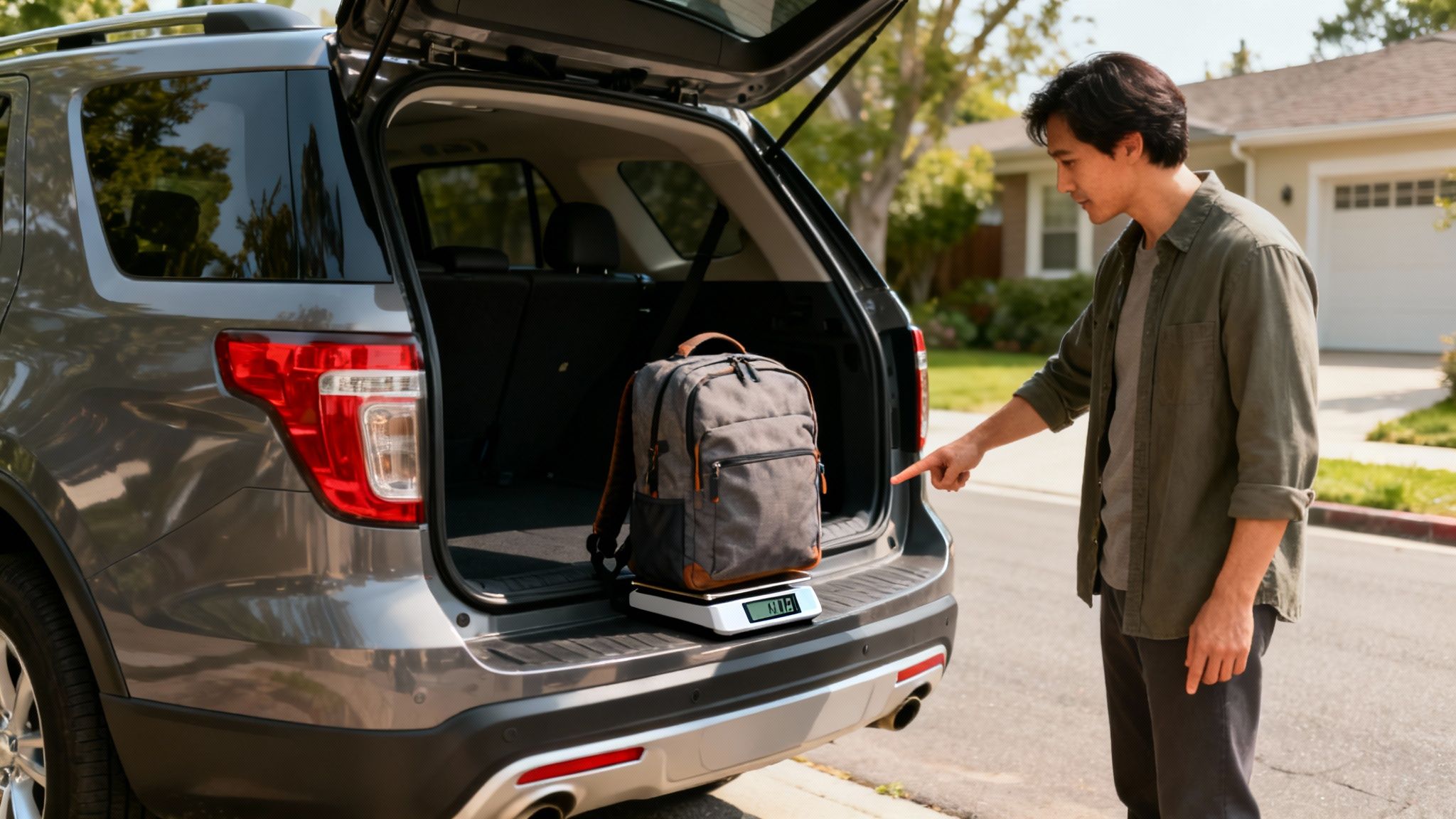
Knowing your payload capacity isn't just for commercial truck drivers or people hauling heavy equipment. It’s a critical number for anyone who owns a vehicle. Whether you're loading up the kids and coolers for a beach trip or just making a big run to the hardware store, that number dictates how your vehicle handles, brakes, and performs.
Ignoring it is a recipe for trouble. Overloading puts immense stress on your vehicle's frame, suspension, tires, and brakes. This isn't just about causing premature wear and tear (though it definitely does that). It's about safety. An overloaded vehicle is an unpredictable one.
The Building Blocks of Payload Capacity
To really get a handle on payload, you have to know a few other key terms. These aren't just industry jargon; they are the fundamental specs that manufacturers use to define your vehicle's limits. These are hard-and-fast numbers engineered to keep you safe on the road.
Let's break down the three most important ones:
- Gross Vehicle Weight Rating (GVWR): This is the big one. It's the absolute maximum weight your vehicle can be, period. That includes the vehicle itself, every person inside, all your cargo, and even the dog. It's the final, non-negotiable weight limit.
- Curb Weight: This is the starting point. It’s what your vehicle weighs sitting empty in the driveway with all its standard equipment and a full tank of gas (or a full charge), but with no one and nothing inside it.
- Payload Capacity: This is simply the difference between the first two numbers. It’s all the "room" you have left for people and stuff before you hit that all-important GVWR.
These three specs are all interconnected. They work together to define how your vehicle was designed to operate safely. Even a tough electric utility vehicle built for work has a payload capacity that must be respected.
Key Takeaway: Your vehicle's payload capacity isn't just about the cargo in the back. It is the combined weight of everything and everyone you add to the vehicle after it rolls off the factory line.
To help you keep these straight, here's a quick cheat sheet.
Key Vehicle Weight Terms at a Glance
This little table breaks down the most important terms you'll encounter when looking at your vehicle's weight limits. It’s a handy reference to keep these concepts clear.
| Term | What It Means | What It Includes |
|---|---|---|
| Curb Weight | The weight of an empty vehicle. | The vehicle, standard equipment, and all necessary fluids. |
| Payload Capacity | The maximum weight you can add. | Passengers, cargo, pets, and any optional accessories. |
| GVWR | The total maximum allowed weight. | Curb Weight + Payload (passengers, cargo, etc.). |
Once you understand how these three pieces fit together, calculating and managing your vehicle's weight becomes much more straightforward.
How GVWR and Curb Weight Determine Your Truck’s Real-World Payload
To get a real handle on what your truck can actually carry, you need to know two key numbers set by the manufacturer: the Gross Vehicle Weight Rating (GVWR) and the Curb Weight. These aren't just arbitrary figures; they're the bedrock of your vehicle's safety and performance limits.
Think of the GVWR as the absolute maximum weight your vehicle can handle, period. This is the total weight of the truck itself, plus every single thing you put in it—passengers, gear, fuel, and even the tongue weight from a trailer pushing down on the hitch. It’s the red line you never want to cross.
Then you have the Curb Weight. This is simply what your truck weighs when it’s empty, parked, and ready to go with a full tank of gas but without any people or cargo. It's your starting point.
The Simple Math for Max Payload
Figuring out your payload capacity is surprisingly straightforward. It’s just the difference between your truck’s maximum allowed weight (GVWR) and its empty weight (Curb Weight).
The Payload Formula: GVWR – Curb Weight = Payload Capacity
This little formula tells you exactly how much weight you can add before hitting that critical GVWR limit. Every passenger who hops in and every piece of gear you throw in the back eats into this number.
Let’s say a truck has a GVWR of 7,000 lbs and a curb weight of 5,200 lbs. The math is simple: its maximum payload is 1,800 lbs. That means the combined weight of everyone and everything you load up can't top that 1,800 lb figure. It’s also important not to mix this up with towing specs. For a deeper dive, understanding the difference between GVWR vs. GCWR is key, as GCWR (Gross Combined Weight Rating) accounts for the total weight of your vehicle plus the trailer it's pulling.
Let's Talk a Real-World Camping Trip
Theory is one thing, but let's see how this plays out on a typical family camping trip.
Imagine that same truck with the 1,800 lb payload capacity. You’d be surprised how fast the weight adds up once you start loading for the weekend.
- Two adults: 350 lbs
- Two kids: 150 lbs
- Camping gear (tent, chairs, sleeping bags): 250 lbs
- Cooler loaded with food and ice: 100 lbs
- Duffel bags and personal items: 120 lbs
- Rooftop cargo carrier and its contents: 175 lbs
When you tally that all up, the family has already loaded 1,145 lbs into their truck. Now we just subtract that from the max payload.
1,800 lbs (Max Payload) – 1,145 lbs (Current Load) = 655 lbs of available payload.
They’re still in the clear with plenty of room for firewood, a dog, or a few other last-minute items. But this simple example shows just how quickly people and gear can eat up your payload. Running these numbers isn't just a good idea—it's what keeps you safe on the road.
Calculating Your Available Payload for Any Trip
Alright, let's move from theory to practice. Knowing your payload capacity is one thing, but figuring out how much you actually have available for any given trip is where safety really clicks into place. It’s not complicated, but it does require a little bit of simple math.
Your starting point is the single most important number: your vehicle's official payload capacity. You'll find this printed on the Tire and Loading Information sticker.
Pop open your driver's side door and look for a yellow and white sticker on the doorjamb. It will have a line that says something like, "The combined weight of occupants and cargo should never exceed XXX kg or XXX lbs." That number is your magic number—the absolute maximum you can add to your vehicle.
Finding Your Real-Time Capacity
With that maximum figure in hand, the next step is to account for every single thing you plan to put in the vehicle. The best way to think about it is like a budget. You start with your total allowance and subtract every item you add to see what you have left.
This process is all about tallying up the weight of two things: people and their stuff. That means you, your passengers, your pets, every suitcase, and every piece of gear that wasn't bolted to the car when it left the factory.
Crucial Reminder: Your vehicle's payload is a fixed limit. Any aftermarket gear you add—like a beefy roof rack, a toolbox, or a winch—becomes a permanent part of the vehicle's weight. That means it permanently reduces your available payload for everything else.
The diagram below breaks down the simple formula behind all of this.
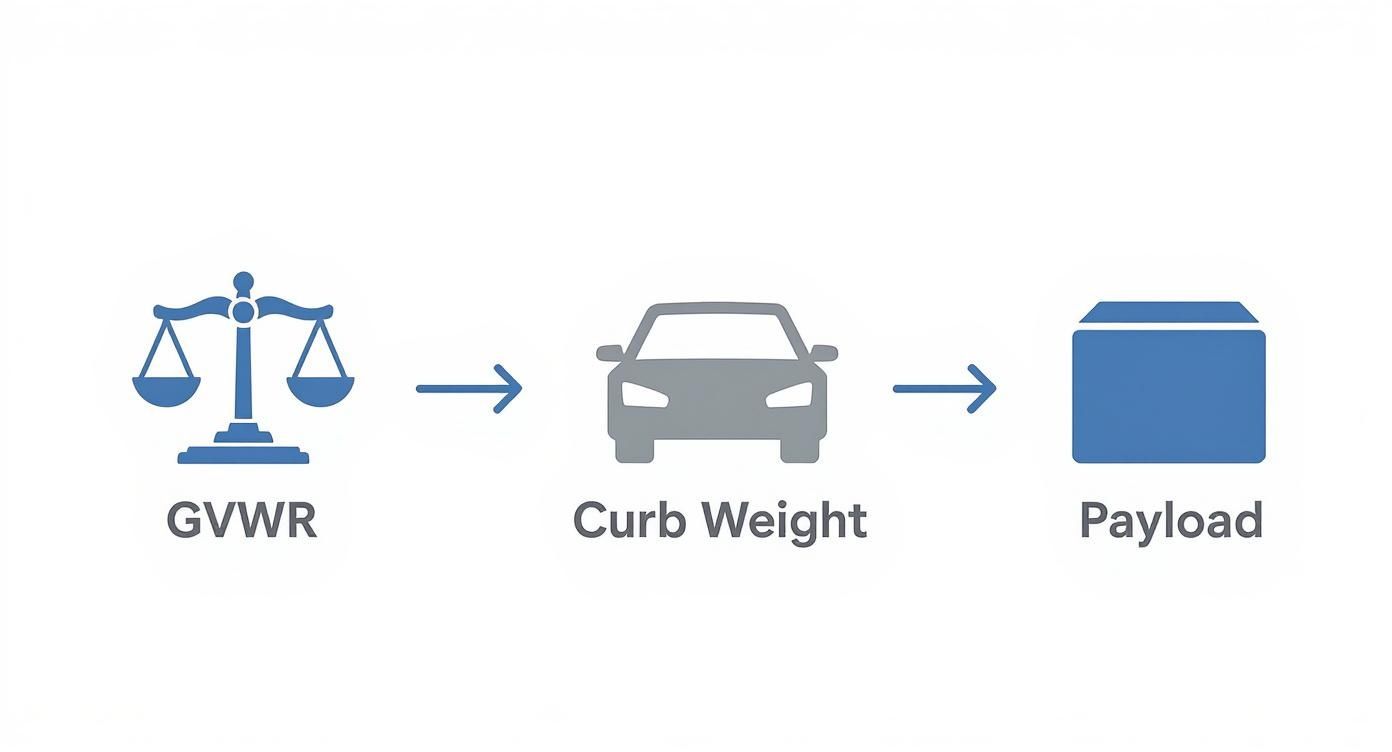
As you can see, your payload is just what’s left over when you subtract the vehicle's empty weight (Curb Weight) from its maximum safe operating weight (GVWR).
Your Step-by-Step Payload Worksheet
Ready to see how much room you have for your next road trip or hardware store run? Just follow these steps.
- Start with Your Max Payload: Find the number on your doorjamb sticker and write it down. This is your starting budget.
- Add All Occupant Weight: Tally up the weight of yourself and everyone else coming along for the ride. A reasonable estimate is fine, but don't fudge the numbers too much.
- Calculate All Cargo Weight: Now, add up the weight of everything you’re packing. We're talking luggage, coolers, sports gear, tools—if it’s going in the vehicle, it goes on the list.
- Factor in Tongue Weight (If Towing): This is a big one people miss. If you're towing a trailer, you have to add the trailer's tongue weight to your payload calculation. This is the downward force the trailer puts on your hitch, typically 10-15% of the total trailer weight.
- Do the Final Math: Subtract the grand total of your occupants, cargo, and tongue weight from your maximum payload capacity.
The number you're left with is your remaining payload. If it's positive, you're good to go. If it's zero or a negative number, you’re officially overloaded and need to take some weight out before hitting the road.
Putting Payload Capacity to the Test with Real-World Examples
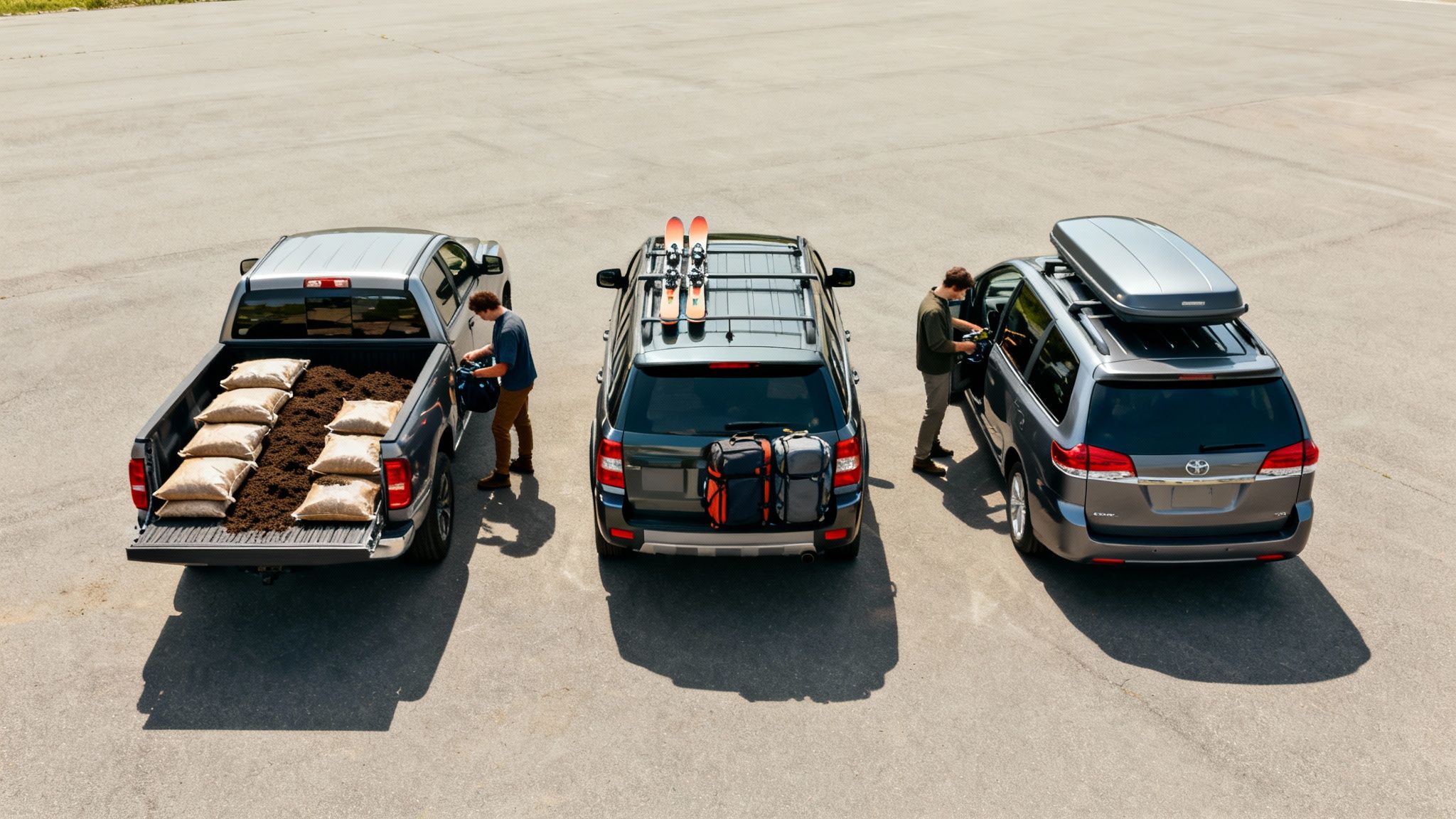
Knowing the formula for payload capacity is a great start, but the real "aha!" moment comes when you apply it to everyday situations. Let’s walk through a few scenarios with some hypothetical Solana EV models to see just how quickly the weight of people and gear adds up.
These examples really highlight how different lifestyles demand different capabilities. A work truck and a family SUV both follow the same payload math, but the numbers they're dealing with are worlds apart.
The Landscaper’s Solana Terra Truck
Let's say a landscaper is getting their Solana Terra truck ready for a big job. This truck is built to work, with a maximum payload of 1,750 lbs. But even with a high capacity, you'd be surprised how fast it gets used up.
- Driver: 190 lbs
- Landscaping tools (shovels, rake, leaf blower): 65 lbs
- Ten 50-lb bags of topsoil: 500 lbs
- Five 60-lb bags of mulch: 300 lbs
- Heavy-duty wheelbarrow: 45 lbs
After loading everything, the total weight comes to a solid 1,100 lbs. Subtract that from the truck's max capacity (1,750 lbs – 1,100 lbs), and the driver still has 650 lbs of payload to play with. That’s plenty of buffer for an extra helper or more materials without putting safety at risk.
A vehicle’s payload isn't just a number—it’s a critical design specification that ensures stability, braking performance, and structural integrity. Pushing past this limit can turn a routine job into a hazardous situation.
For smaller, routine jobs around a large property or business campus, a more compact vehicle might make more sense. You could even explore options like a golf cart with a utility bed that gives you hauling power without the size of a full truck.
The Ski Trip in the Solana Apex SUV
Next up, let's load a Solana Apex SUV for a weekend on the slopes. This model has a respectable payload capacity of 1,200 lbs.
- Four adult passengers: 680 lbs (averaging 170 lbs each)
- Four sets of skis and boots: 120 lbs
- Luggage for four people: 160 lbs
- Rooftop cargo box (empty weight): 50 lbs
- Snacks and drinks in a cooler: 30 lbs
The grand total for this trip is 1,040 lbs. Once we subtract this from the Apex’s 1,200 lb limit, we see there’s only 160 lbs of capacity left. They're safely within the limit, but they'll need to think twice before adding any more heavy gear.
Family Vacation in the Solana Odyssey Minivan
Finally, picture a Solana Odyssey minivan with a 1,400 lb payload, packed to the gills for a week-long family getaway.
- Two adults: 340 lbs
- Two children: 130 lbs
- Family luggage: 200 lbs
- Camping gear: 250 lbs
- Rooftop cargo box filled with gear: 150 lbs
- Family dog and supplies: 80 lbs
All told, this adventure adds up to 1,150 lbs. This leaves them with a comfortable 250 lbs of available payload (1,400 lbs – 1,150 lbs), giving them a nice safety margin for any souvenirs they pick up along the way.
The concept of payload isn't just for cars and trucks; it’s fundamental to all forms of transportation. In the aerospace industry, for instance, an aircraft's payload is a massive factor in its design and efficiency. In 2024, Airbus delivered 766 commercial planes and had a backlog of over 8,600, largely because airlines are clamoring for models with optimized payload-to-range capabilities to maximize both passenger and cargo revenue. You can read the full report on how payload shapes aircraft manufacturing on aerospacemanufacturinganddesign.com.
The Hidden Dangers of Exceeding Your Payload Limit
It’s tempting to think of your vehicle's payload capacity as just another number on a sticker. What's the harm in squeezing in a few extra things, right? But ignoring that limit isn't a minor oversight—it's a serious gamble with safety that sets off a dangerous and costly chain reaction.
The first thing you'll notice is a loss of control. An overloaded vehicle simply doesn't handle the way it should. Steering suddenly feels heavy and sluggish. The suspension, compressed beyond its limits, can't keep the tires planted on the road. This makes the vehicle dangerously unstable, especially when you need to corner or swerve unexpectedly.
Compromised Braking and Tire Failure
One of the scariest consequences of overloading is how it wrecks your braking performance. Your brakes are designed to stop a specific maximum weight—the GVWR. For every extra pound you pile on, you're demanding more force and a longer distance to come to a stop. That extra distance can easily be the difference between a near miss and a serious crash.
Your tires also take a massive hit. Excess weight makes them bulge and flex in ways they aren't designed for, generating a ton of heat. This constant stress dramatically increases the risk of a catastrophic blowout, which is a terrifying prospect at highway speeds.
Key Insight: Think of it this way: all of your vehicle's safety systems—the brakes, suspension, even stability control—are calibrated to work together within the specified payload capacity. Overloading undermines every single one of them, turning a safe vehicle into an unpredictable one.
Long-Term Damage and Financial Fallout
Even if you avoid an accident, consistently overloading your vehicle causes slow, silent damage. The constant strain puts premature wear and tear on everything from the suspension and wheel bearings to the axles and drivetrain. This invisible damage slowly adds up, eventually leading to expensive and unexpected repair bills that could have been avoided.
The fallout doesn’t stop there. Getting pulled over with an overloaded vehicle can lead to hefty fines. Worse, if you’re in an accident, your insurance company could deny your claim, leaving you with massive personal liability. This is why proper load management is a cornerstone of effective transportation risk management.
Respecting capacity limits is a universal rule in transportation. The airline industry, for instance, lives by it. Global passenger-kilometers (a measure of payload) hit 23.9 billion in July 2025, while available seat-kilometers (a proxy for capacity) grew even faster to 27.6 billion. It's a constant balancing act. You can find more details on how payload impacts transportation trends on www150.statcan.gc.ca.
Ultimately, respecting your payload isn’t just about following rules; it’s about making sure your vehicle is safe and reliable every single time you get behind the wheel.
Tips for Safe Loading and Weight Distribution
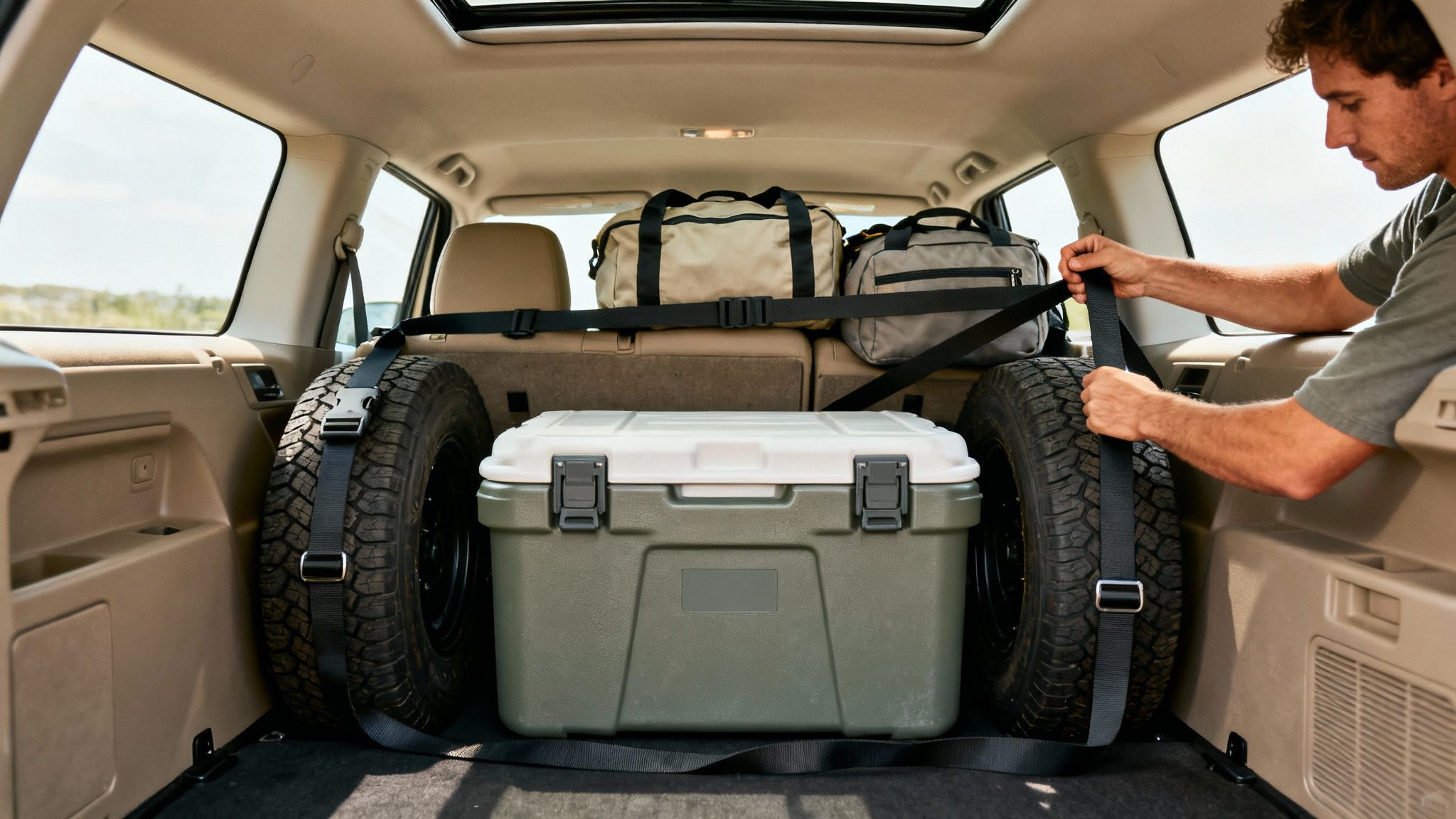
Knowing your payload capacity is the first step, but how you load your vehicle is just as critical. Proper weight distribution isn't just about fitting everything in—it's about maintaining stability, control, and ultimately, your safety on the road.
The golden rule is simple: place the heaviest items as low to the floor as possible and centered between the vehicle’s axles. Think of it like a ship's ballast. Keeping the weight low and central lowers your vehicle’s center of gravity, which is exactly what you want.
A lower center of gravity prevents that top-heavy, unstable feeling you sometimes get with a full load. It dramatically improves how your vehicle handles turns and sudden maneuvers and reduces the risk of a rollover—a serious concern for any loaded vehicle.
Mastering Your Load
Beyond smart placement, securing your cargo is absolutely non-negotiable. During a sudden stop or turn, unsecured items can become dangerous projectiles. They can also shift the vehicle's balance unpredictably, putting you and your passengers at risk.
Here are a few best practices to follow every time you load up:
- Heaviest Items First: Always load your heaviest cargo first. Get it low and in the middle.
- Distribute Evenly: Try to balance the load from side to side. This prevents the vehicle from leaning and helps avoid uneven tire wear.
- Secure Everything: Use tie-down straps, cargo nets, or braces to lock everything in place. Nothing should be able to shift while you're moving.
- Re-Check Your Load: On a long trip? It’s a good idea to pull over and periodically check your cargo to make sure it's all still secure.
Following these steps isn't just about good packing—it's a core component of responsible driving. A well-distributed and secured load is a safe load.
Proper load management is a fundamental principle in every form of transport. The aviation industry, for example, strategically manages payload to expand its market reach. By 2025, global airline seat capacity is projected to hit 507.6 million, a 4.7% annual increase driven by aircraft with optimized payload capabilities. You can discover more insights about global airline capacity on oag.com.
Mastering these loading principles is also a key part of our detailed guide on golf cart safety training.
Got Questions? Let's Clear Things Up
As we wrap up, it's natural to still have a few questions floating around. Let's tackle some of the most common ones I hear about payload capacity to make sure everything is crystal clear.
Does Towing a Trailer Affect Payload?
You bet it does. This is a big one that catches a lot of people by surprise.
While the trailer and everything on it fall under your towing capacity, a portion of that weight pushes down directly on your vehicle's hitch. This is called the tongue weight, and it counts as payload. Forgetting to factor in tongue weight is one of the easiest ways to accidentally overload your vehicle.
Do Aftermarket Accessories Reduce My Payload?
Absolutely. Every single thing you add to your vehicle eats into its available payload. We're talking about those beefy off-road bumpers, winches, roof racks, and heavy-duty toolboxes.
These add-ons become part of your vehicle's curb weight, which means you have less capacity available for people and gear.
Remember, the payload number on your door jamb sticker is for the vehicle as it came from the factory. Every pound of accessories you bolt on is a pound of payload you can no longer use.
Can I Increase My Vehicle’s Payload Rating?
I get this question all the time, and the answer is a firm no. You can't officially increase your payload capacity. That rating is set by the manufacturer and is based on the limits of the frame, suspension, axles, and brakes working together as a system.
Sure, you can add stiffer springs or heavy-duty shocks, but these upgrades do not legally or safely change your vehicle's GVWR or its payload rating. They might help the vehicle handle the weight better, but they don't change the fundamental limits of the chassis and braking system.
Ready to find an electric vehicle with the right payload for your needs? Explore the versatile lineup at Solana EV and discover the perfect model for work or play at https://solanaev.com.