
You're standing in a dealer's lot, comparing two used electric golf carts that appear to fit the same budget. One has cleaner seats, brighter lights, and a polished dashboard. The other looks older, but the seller has a VIN record, service history, and a recent battery report. If you choose by appearance alone, you may drive home with the prettier cart and the larger repair bill.
That's the problem with shopping for used street legal electric golf carts for sale. The visible upgrades are easy to notice. The expensive risks are usually hidden in the legal classification, battery condition, title, charger, wiring, and prior use. A smart purchase comes down to three questions: Can you legally drive it where you intend to go? Is the vehicle mechanically and electrically sound? Does the total ownership cost make sense?
Table of Contents
- The Moment You Decide a Used Cart Has to Work
- What Street Legal Electric Golf Carts Actually Mean
- Inspecting the Cart Like a Technician Would
- Why Battery State of Health Beats Battery Age
- Where Used Street Legal Carts Actually Come From
- Used Versus New and Where Solana EV Fits
- Negotiating Price, Paperwork, and the Walk-Away List
- Pre-Purchase Checklist and Smart Next Steps
The Moment You Decide a Used Cart Has to Work
A resort manager might need a cart for guest transport between buildings. A gated-community resident might want a quiet vehicle for local errands. A family shopper may want a practical second vehicle that handles neighborhood roads without the operating routine of a full-size car. Those uses sound similar, but they place different demands on registration, seating, range, road access, and service support.
The lot comparison becomes clearer when you stop treating the carts as products and start treating them as working vehicles. The newer-looking cart may have a tired battery pack, missing documentation, or aftermarket equipment that never made it a compliant low-speed vehicle. The less glamorous cart may have better records and a battery that performs consistently under load.

Start with the job, not the accessories
Write down the routes the cart must handle before you compare colors, wheels, stereo systems, or upholstery. A cart intended for private resort roads has a different compliance question from one intended for public streets. A vehicle carrying guests or family members also deserves more scrutiny of seat belts, brakes, tires, steering, and weather protection.
Dealer's rule: If the seller can explain the paint and accessories but can't produce the VIN history, battery information, and ownership paperwork, you're looking at decoration, not value.
The best buying process is deliberately boring. Confirm the vehicle's legal status, inspect the chassis and running gear, demand a written battery State of Health review, verify the title, and calculate the cost of making the cart usable in your jurisdiction. Only then should you negotiate.
What Street Legal Electric Golf Carts Actually Mean
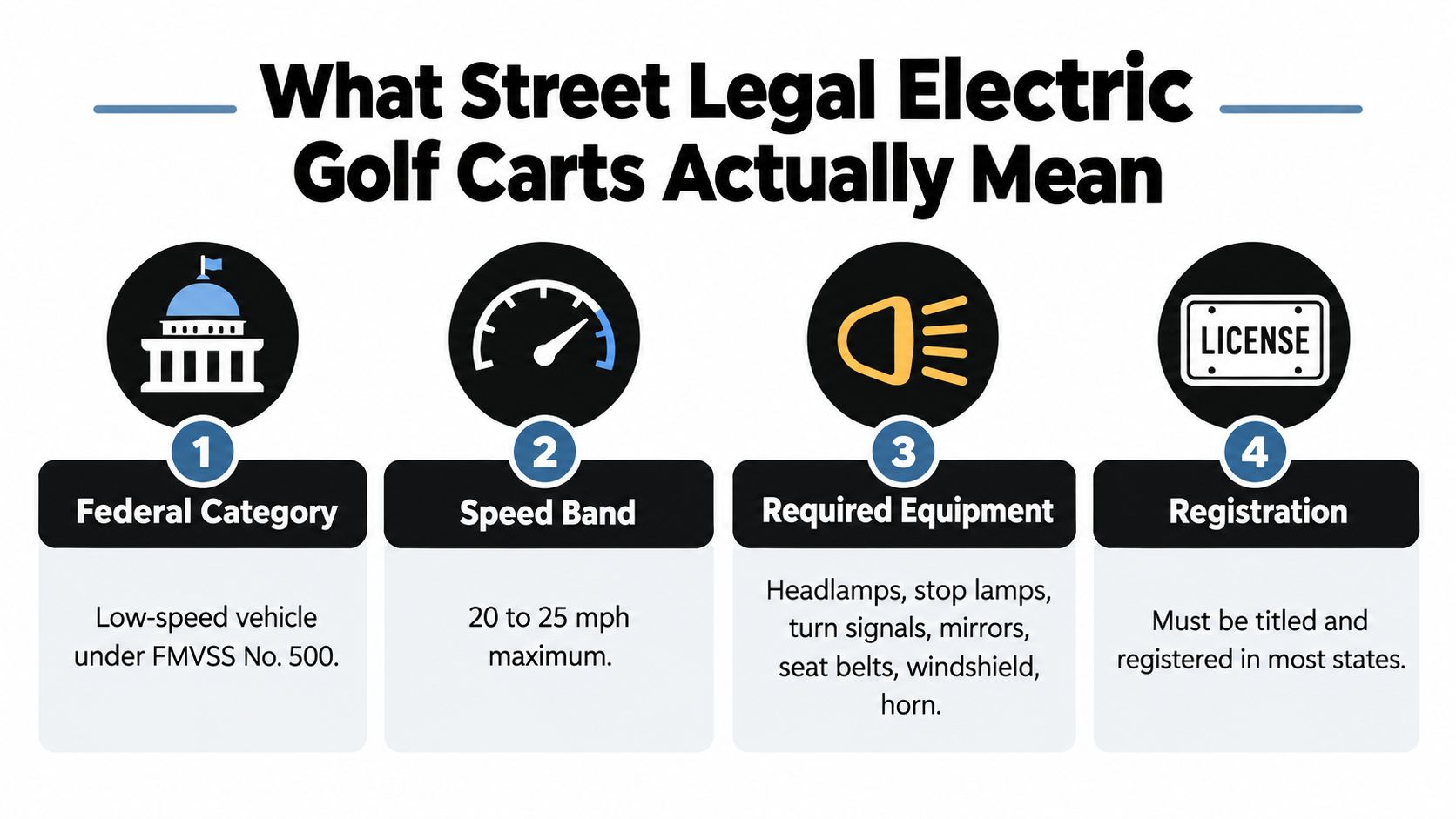
“Street legal” isn't a universal equipment package. In the United States, a used street-legal electric golf cart is generally sold under the federal low-speed vehicle, or LSV, category, rather than being treated as an ordinary golf cart. Federal Motor Vehicle Safety Standard No. 500 defines an LSV as a four-wheeled motor vehicle, other than a truck, with a maximum speed greater than 20 mph but no higher than 25 mph. NHTSA's LSV interpretation explains the federal framework and its safety limits.
A qualifying vehicle must meet equipment requirements that include headlamps, stop lamps, turn signals, taillamps, reflex reflectors, a parking brake, rearview mirrors, a windshield, seat belts, and a vehicle identification number. NHTSA also states that an LSV must have a gross vehicle weight rating below 3,000 pounds. These requirements are why bolting lights and mirrors onto an ordinary golf cart doesn't automatically create a federally certified LSV.
Ask for proof before you drive
Request the VIN and title first. Then ask the seller whether the manufacturer built and certified the vehicle as an LSV, or whether someone later added road equipment. A professionally converted cart may be usable in some jurisdictions, but the conversion paperwork and inspection path matter.
Your research should answer four separate questions:
- Federal category: Is the vehicle manufactured and certified as an LSV under FMVSS No. 500?
- Equipment: Are the required lamps, reflectors, mirrors, windshield, parking brake, seat belts, and VIN present and functional?
- Registration: Can your state title and register this specific vehicle?
- Route access: Are the roads you plan to use permitted for this vehicle?
That last question is where many buyers get caught. Federal LSV status doesn't automatically determine where you may drive. State and local governments can add rules for registration, licensing, insurance, minimum driver age, road access, and equipment. A vehicle may be registered yet unsuitable for a particular arterial road or route.
For a broader explanation of low-speed vehicle categories and use cases, review Solana EV's low-speed electric vehicle guide. Also remember that LSV compliance is not the same as passenger-car crash protection. NHTSA cautions that LSVs meet only a limited set of safety requirements and aren't subject to the more extensive crashworthiness standards applied to passenger cars.
Inspecting the Cart Like a Technician Would
A competent inspection starts with the structure, not the touchscreen. Bring a flashlight, a notepad, and a short checklist. Give the vehicle enough time for a proper evaluation, and walk away if the seller refuses a meaningful inspection or independent review.
Start underneath
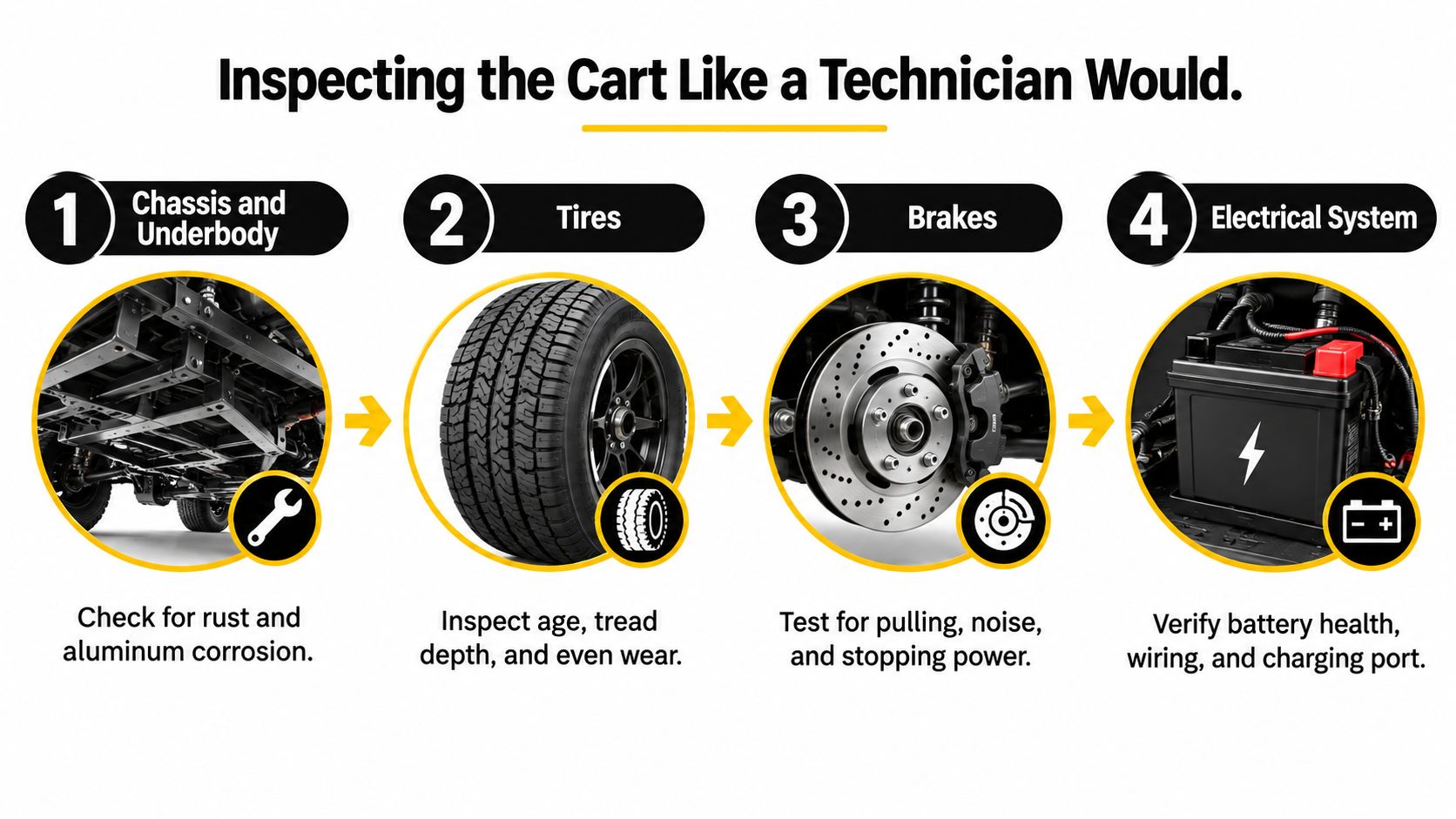
Look along the frame, suspension mounts, floor structure, and battery compartment. Surface corrosion may be manageable, but deep rust, cracked welds, bent rails, and aluminum corrosion around mounting points deserve a hard pass. Check for water ingress, damp insulation, and stains around the battery area. A cart that has lived outdoors without proper storage can hide electrical trouble beneath clean body panels.
Move to the wheels and steering. Inspect the tires for cracking, uneven wear, and mismatched replacements. Uneven wear can point to alignment, suspension, or frame problems. Turn the steering wheel through its range and note excessive play, binding, or knocking from the linkage.
Test the systems that stop and control the vehicle
The brake pedal should feel firm and should stop the cart without pulling, grinding, or excessive travel. Engage the parking brake and confirm that it holds the vehicle securely on a slope. Test the horn, headlights, brake lamps, turn signals, taillamps, mirrors, windshield, and seat belts. Don't accept “that's an easy fix” as a substitute for working equipment when the cart is advertised as street legal.
Drive slowly, then accelerate smoothly. Listen for motor whine, controller noise, clunks, and vibration. Check the charging port, charger communication, wiring, and high-voltage connectors for looseness, heat damage, amateur splices, or exposed conductors. Warning codes should be explained and documented, not erased before you arrive.
A practical inspection video can help you recognize the sequence and sounds to watch for:
For a printable buying routine, use Solana EV's used golf cart buying guide. The pass-or-walk decision should be made on the chassis, brakes, steering, suspension, tires, and controls before you spend time arguing about battery price.
Why Battery State of Health Beats Battery Age
Battery age is useful, but it isn't the verdict. A well-documented older cart can be a better purchase than a newer cart with no service history because chronological age doesn't tell you how the pack was charged, stored, loaded, or maintained.
Demand a dated battery State of Health report before the test drive. The report should identify the chemistry, pack age, measured capacity, test conditions, and any imbalance between cells or modules. Ask for the last capacity test date, charger output, service records, cycle count if available, and warranty transferability.
Compare the pack to the vehicle
Lead-acid and lithium-ion packs behave differently. Lithium-ion batteries generally provide more usable energy per unit mass and steadier voltage than aging lead-acid packs, but the buyer still needs to verify battery-management-system compatibility, charger communication, replacement availability, and warranty terms. Don't assume a lithium label means the pack is healthy or easy to replace.
A dashboard percentage is not a battery test. Check voltage at rest and under acceleration, then perform a range test with a representative load. Passenger weight, hills, tire pressure, and stop-and-go driving change energy consumption, so a lightly loaded demonstration can make a weak pack look acceptable.
The U.S. Department of Energy explains that low ambient temperature slows electrochemical reactions, reducing battery output voltage and available capacity. That means cold weather can reduce usable range even when the displayed charge level appears normal. DOE's technical report on cold ambient temperature and battery-electric vehicle performance supports treating cold-weather range loss as a physical battery effect, not automatically a controller or motor fault.
Put emissions and replacement risk in the same calculation
Electric propulsion has an operating-emissions advantage, but the size depends on the regional power mix and the condition of the vehicle. The Department of Energy reports that Argonne National Laboratory estimated electricity generation for operating an all-electric vehicle produced 53% fewer emissions than the tailpipe emissions from operating a gasoline vehicle in its 2010 to 2019 assessment of U.S. light-duty plug-in electric vehicles. DOE's electricity research summary also discusses modeling in which electric-vehicle adoption scenarios reduced pollutants by 22% to 36%.
Those figures don't remove the need for a battery inspection. If measured capacity is substantially below the model's original specification, include replacement planning in your offer. Solana EV's guide to used golf cart batteries is a useful starting point for understanding pack chemistry, testing, and ownership questions.
Where Used Street Legal Carts Actually Come From
The seller type changes the risk more than many buyers expect. A used cart from an authorized dealer, an independent lot, a private owner, and an ex-rental auction may look similar in a listing, but the paperwork, inspection standard, and after-sale support can be very different.
Authorized dealers
An authorized dealer usually offers the clearest path to service, title support, inspection records, and a limited warranty. The trade-off is a firmer price and less tolerance for undisclosed defects because the dealer has already invested in reconditioning. Ask exactly what the inspection included, what the warranty covers, and whether the dealer will help with registration in your jurisdiction.
Independent lots
Independent sellers can offer strong value, but standards vary widely. Some shops know electric carts well and document their work. Others focus on cosmetics and sell vehicles with unresolved battery or compliance problems. Ask for the inspection sheet, invoice history, battery report, and the name of the technician who performed the work.
Private-party sales
Private sellers may offer the lowest asking price, but you carry the full burden of verifying the title, lien status, VIN, registration path, insurance availability, and mechanical condition. Use an independent technician if you can. Never let a friendly owner or a short drive replace documentation.
Ex-rental and ex-fleet auctions
Resort, campus, and rental fleets can produce good vehicles when maintenance logs are complete. They can also produce heavily used carts with frequent stops, passenger loading, outdoor storage, and shallow charging cycles. Inspect the battery more aggressively and ask how the fleet handled charging, storage, and scheduled service.
| Source | Usually helps with | Main buyer risk |
|---|---|---|
| Authorized dealer | Documentation, service, limited warranty | Higher price |
| Independent lot | Selection and negotiation | Uneven reconditioning |
| Private seller | Lower overhead and direct history | Buyer handles compliance |
| Ex-fleet auction | Potential value and maintenance records | Heavy use and limited recourse |
Choose the channel that matches your tolerance for uncertainty. A buyer who needs immediate, dependable resort operations shouldn't shop like a hobbyist rebuilding a private-property cart.
Used Versus New and Where Solana EV Fits
Used and new carts solve different problems. A used vehicle can absorb the initial depreciation and reduce upfront cost, but the buyer accepts more uncertainty around the battery, charger, suspension, electronics, title, and prior repairs. A new vehicle costs more at purchase, yet it typically provides a clearer battery baseline, current equipment, factory support, and warranty coverage.
The right choice depends on how costly downtime would be. A homeowner using a cart occasionally on private roads may accept a documented older vehicle with cosmetic wear. A resort manager moving guests every day may value predictable service, parts availability, and a warranty more than the lowest purchase price.
Buy used when evidence is stronger than the discount
Choose used when the cart has a clean title, verifiable LSV status, complete equipment, a written battery report, a working charger, and a reasonable inspection result. Cosmetic wear is acceptable. Missing paperwork and uncertain battery condition are not. A lower price doesn't compensate for a vehicle you can't register or a pack you'll need to replace immediately.
Choose new when certainty carries the value
New makes more sense when you need the latest safety equipment, a battery warranty, integrated technology, or predictable financing. Modern vehicles such as the Solana EV XA lineup combine an aluminum chassis with infotainment features including Apple CarPlay and Android Auto, while authorized dealers can assist with local pricing, test drives, equipment, and registration requirements. That package won't make every new cart the right choice, but it gives buyers a clearer baseline than an undocumented used conversion.
Features should serve the route, not replace the inspection. Apple CarPlay won't solve a title problem, and a fresh-looking dashboard won't reveal battery capacity. Compare the complete ownership package, including service access, warranty terms, charger compatibility, insurance, registration, and expected use.
The best used cart is not the cheapest listing. It's the one whose condition and legal status you can prove.
Negotiating Price, Paperwork, and the Walk-Away List
Negotiate from evidence, not emotion. Start with the inspection findings and turn each unresolved issue into a documented cost or risk. A damaged tire, weak brake, missing lamp, corroded connector, absent service record, or questionable battery report should affect the offer because you'll be responsible for the outcome after delivery.
The paperwork must support the vehicle's identity and your ability to register it. Ask for:
- Title: It should be in the seller's name and match the VIN.
- Bill of sale: Include the vehicle description, VIN, purchase amount, date, and signatures.
- Lien release: Require proof when a prior loan or lien may exist.
- Compliance records: Collect manufacturer certification, conversion documentation, inspection results, and registration materials required by your state.
- Service evidence: Keep battery reports, charger details, repair invoices, and warranty documents.
State rules can differ sharply. California, for example, uses Vehicle Code §385.5 for its low-speed-vehicle definition and registration framework. Don't treat one state's process as a universal template. Call the relevant motor-vehicle agency and your insurer before handing over funds.
Walk away when the seller blocks verification
No VIN is a deal-breaker. So is a refusal to permit a test drive, an independent inspection, or a battery evaluation. Undisclosed accident damage, a title that doesn't match the seller, exposed high-voltage wiring, severe frame corrosion, and a claimed street-legal status supported only by aftermarket accessories should end the conversation.
A seller who says “as-is” can still provide records and allow inspection. The problem isn't the phrase itself. The problem is using it to prevent you from discovering what you're buying.
Pre-Purchase Checklist and Smart Next Steps
Run this checklist from your phone before delivery:
- Confirm the use tier: Is the cart street legal for public roads, neighborhood legal under local rules, or permitted only on private property?
- Verify identity: Match the VIN, title, bill of sale, and seller details.
- Inspect the structure: Check the frame, underbody, suspension, tires, steering, brakes, and parking brake.
- Test the equipment: Operate every lamp, horn, mirror, windshield, seat belt, charger, and charging connection.
- Review battery health: Get a dated SoH report, identify chemistry and age, test under load, and ask about replacement support.
- Price total ownership: Include registration, insurance, repairs, charger compatibility, service, and any battery work.
- Confirm the route: Check local road restrictions, speed limits, driver requirements, and private-property permissions.
A used street-legal electric golf cart is still a real motor vehicle with registration, insurance, maintenance, and occupant-protection responsibilities. If you're reviewing a dealer's terms or service agreement alongside the purchase documents, resources covering legal terms for golf growth services can help you recognize why precise written obligations matter, even though your vehicle transaction will have its own documents.
Before delivery, schedule an independent inspection, secure financing pre-approval if needed, verify that an insurer will cover an LSV in your ZIP code, and confirm the roads you plan to use. Buy the cart only after the legal category, battery condition, and complete ownership cost all make sense together.
Solana EV offers street-legal electric golf cart options with modern features, aluminum chassis construction, and dealer support for test drives and local requirements. Visit Solana EV to compare available vehicles, locate a dealer, and discuss the right fit for your routes.