
You’re probably here because you’ve seen one of the newer TEKO carts in the wild and had the same reaction many buyers do. It doesn’t look or feel like the golf carts many people grew up with. It looks more like a compact EV built for short trips, guest transport, neighborhood driving, or light commercial work.
That first impression matters, but it’s not enough to make a smart buying decision.
A good teko golf cart purchase isn’t just about style, seating, or speed. It’s about what happens after the test drive. How long will the battery last? What kind of dealer support will you have? What does charging look like in daily use? If you’re buying for a resort, HOA, or rental operation, how do you judge long-term value when public ownership cost data is still thin?
Those are the questions experienced buyers ask. They look past the brochure and start evaluating the full ownership picture.
Table of Contents
- Why Everyone Is Talking About the Teko Golf Cart
- Decoding the 2026 Teko EV Lineup
- Under the Hood Performance Battery and Engineering
- Practical Ownership Guide for Teko Carts
- The Business Case for Property Managers and Dealers
- Teko Golf Carts vs Solana EV A Strategic Comparison
- Conclusion Making the Smart Mobility Choice
Why Everyone Is Talking About the Teko Golf Cart
A buyer walks onto a dealer floor expecting to compare seat colors and wheel options. Ten minutes later, the core question has changed. Which cart will still look like a smart purchase three years from now, after charging cycles, service visits, parts orders, and daily use have exposed the difference between a polished launch and a dependable vehicle?
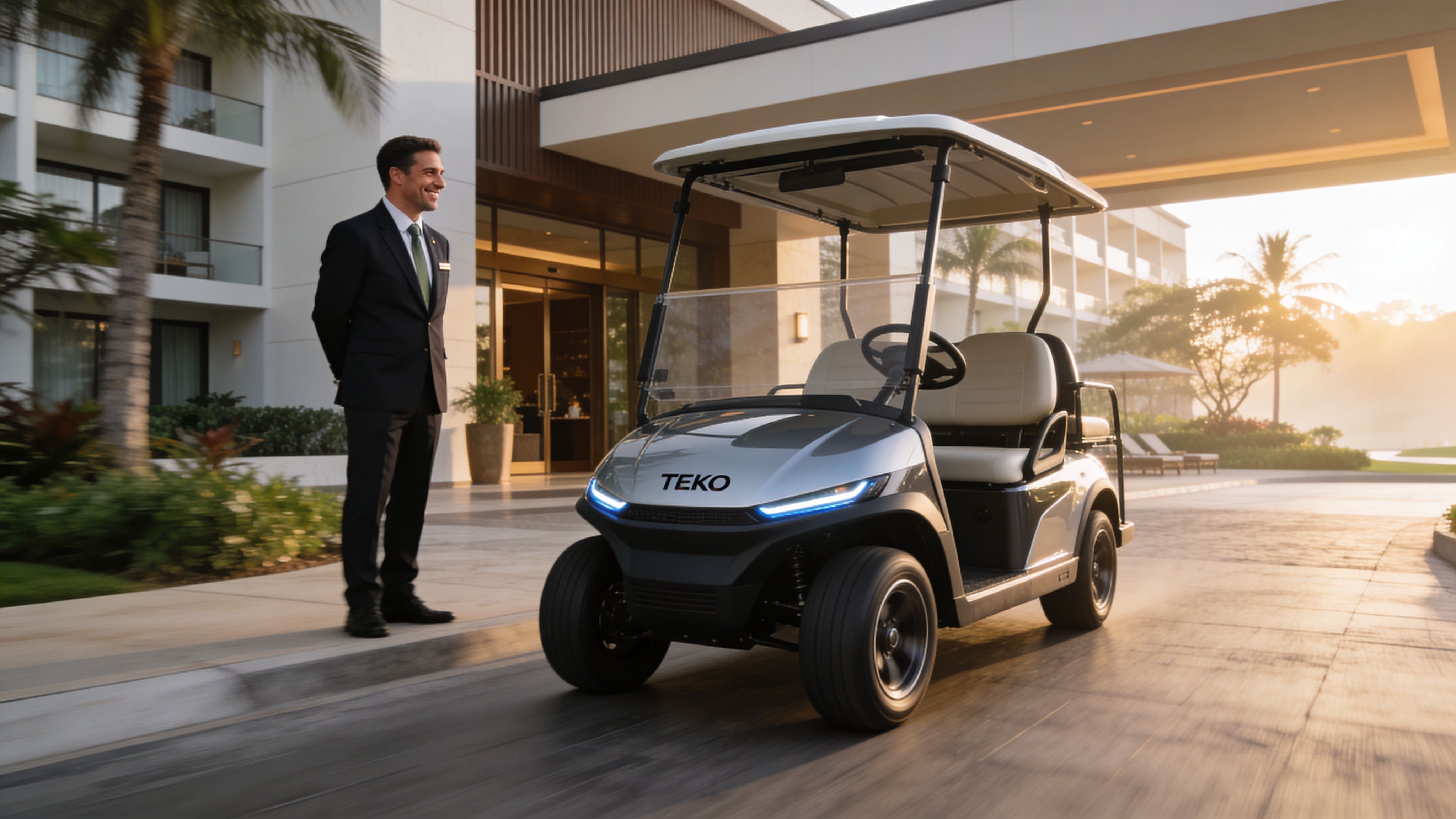
That is a big reason TEKO gets so much attention. Public coverage of the brand says TEKO entered the market in 2025, arriving at a moment when buyers were already expecting golf carts to act more like modern electric vehicles. The appeal is easy to understand. Clean styling draws people in first, but the larger conversation is about what buyers now expect from the whole category.
The shift is similar to what happened in the auto market when drivers stopped judging vehicles only by horsepower and started asking about charging, software, warranty support, and long-term operating cost. Golf cart shoppers are doing the same thing now. A family wants a neighborhood vehicle that feels current. A property manager wants equipment that keeps guests moving without creating extra maintenance headaches. A dealer wants a product that generates demand and can still be supported after the sale.
That helps explain why TEKO feels bigger than a typical new-brand launch.
Older carts taught buyers to accept tradeoffs as normal. Slower charging, more battery attention, and a more utilitarian ride were often treated as part of ownership. TEKO entered the conversation with a more polished promise, one that suggests a cart can be practical, attractive, and easier to live with at the same time. For shoppers comparing categories, this broader guide to an advanced EV golf cart helps show why the market is now evaluating more than appearance.
The smart buyer stops there and asks a second set of questions.
A good test drive can hide weak economics. A sharp-looking cart can still become expensive if local service is thin, warranty handling is vague, or published performance claims leave out the conditions behind them. That is where experienced buyers, fleet managers, and dealers separate surface appeal from real value.
They usually press on four points:
- Total cost of ownership: What will charging, battery life, routine service, and replacement parts look like over several years?
- Support ecosystem: Is there a dependable dealer and service network nearby, or are you buying a product first and solving service later?
- Transparent performance data: Are range, speed, and battery claims presented with enough context to judge real daily use?
- Fit by use case: Does the cart make sense for a household, a hospitality property, a community shuttle role, or a larger fleet purchase?
Those questions matter because the best purchase is rarely the one with the loudest buzz. It is the one with the clearest long-term picture. That is also where brands like Solana EV tend to stand out, by giving buyers more than a design story and helping them judge ownership, support, and operating value with fewer blind spots.
Decoding the 2026 Teko EV Lineup
A buyer walks onto a dealer lot expecting to compare carts by color, wheels, and top speed. Ten minutes later, the pertinent question differs. Which model fits how people will use it every day, and which one still makes financial sense after the newness wears off?
TEKO’s 2026 lineup makes more sense once you sort it by job instead of trim name. Public model listings describe the Turbo, Trophy, and Trophy Plus as a compact four-passenger cart, a premium four-forward model, and a larger six-passenger option in the TEKO EV lineup listing.
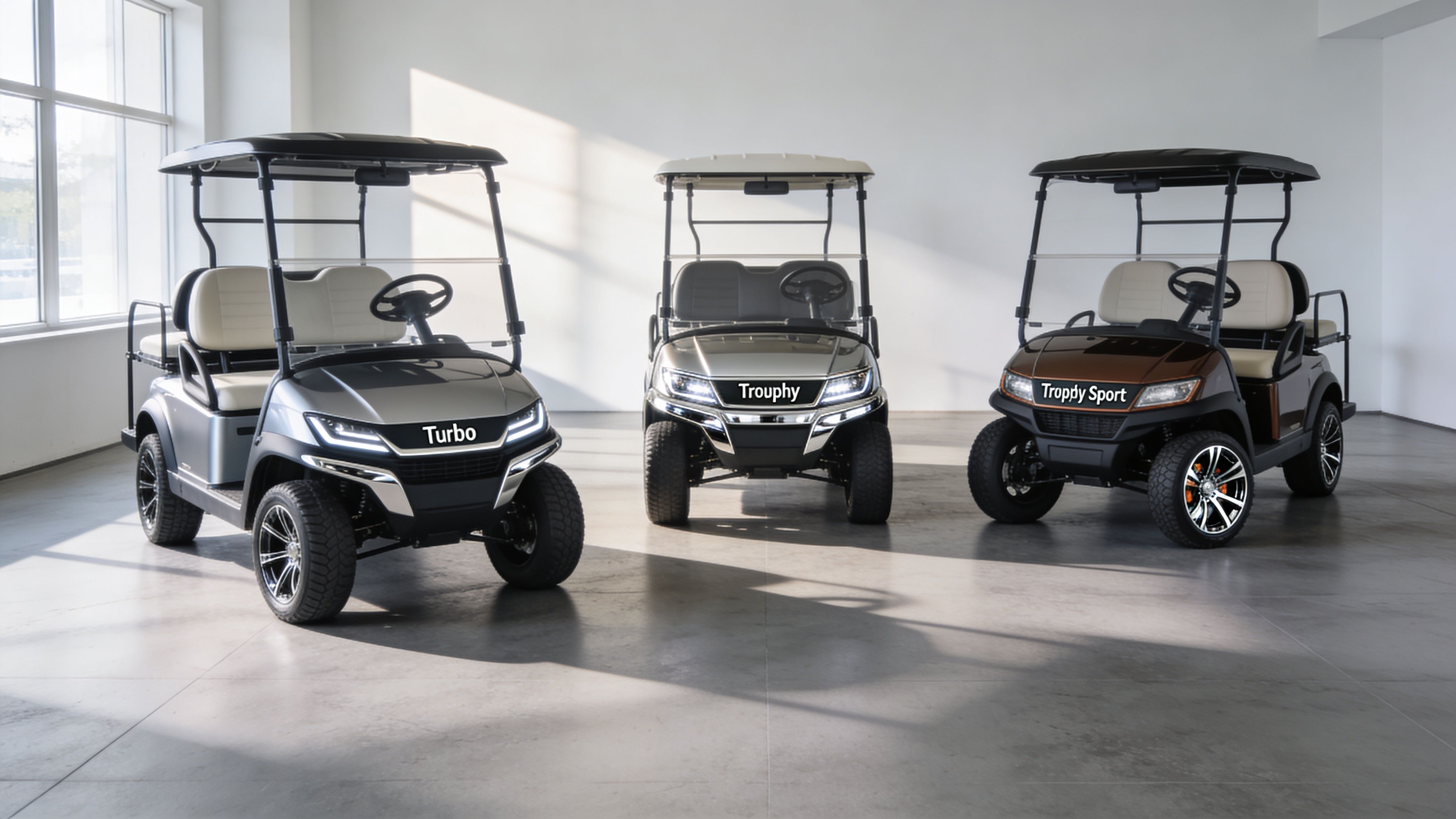
That framing matters because smart buyers rarely stop at “Which one looks best?” They ask the second-level questions. Which layout cuts unnecessary trips on a property. Which seating plan guests will prefer. Which model gives a household flexibility without paying for capacity it will never use. For readers comparing the category more broadly, this guide to an advanced EV golf cart helps explain why the best choice usually comes from matching the vehicle to daily duty, long-term support, and ownership costs.
Turbo for flexible everyday use
The Turbo is the easiest model to place because its purpose is broad. It uses a 2+2 seating layout, so it can carry four people while still giving owners some flexibility when the rear area is not fully occupied.
For a household, that usually means evening rides, quick errands around a community, and room for bags or gear. For a small property, it can cover light guest movement, maintenance check-ins, or supply runs without stepping up to a larger cart too early.
The same source also notes features such as LED lighting, AM/FM radio, Bluetooth, Android Auto, CarPlay, adjustable steering, 4-wheel disc brakes, a lightbar, soundbar, and backup camera in the Turbo. That list matters for a reason beyond comfort. It suggests TEKO is trying to position the Turbo closer to a small neighborhood EV than a stripped-down utility cart.
A buyer should still pause here and ask a practical question. Are those convenience features helping the cart do real work, or are they mainly adding purchase price? For a family, infotainment and a backup camera may improve daily use. For a fleet buyer, service access, replacement parts, and downtime often matter more.
Trophy for premium passenger comfort
The Trophy shifts the focus from flexibility to passenger experience. Its four-forward seating changes how people interact with the vehicle because every rider faces ahead. On neighborhood trips, resort loops, or community shuttles, that setup often feels more natural and more polished than a rear-facing bench.
The same public source describes the Trophy with a high-resolution digital dashboard, one-touch start, rotary gear selector, and auto-reset signals. Those details may sound minor on paper. In practice, they shape the ownership experience in the same way a well-laid-out car interior does. Controls are easier to understand. Guests need less explanation. The cart feels less like a recreational add-on and more like a purpose-built people mover.
That distinction is easy to miss during a quick walkaround. It becomes clearer over months of use, especially for owners who carry visitors, residents, or family members who care about comfort and ease of entry.
Speed and range attract attention first. Seating direction, control layout, and day-to-day usability often decide whether owners still like the purchase a year later.
If the Turbo works like a multi-use household tool, the Trophy works more like the upgraded daily vehicle in the garage. It is less about doing everything and more about doing passenger trips well.
A quick walkaround helps show how these models present in practice.
Trophy Plus for larger groups and property work
The Trophy Plus changes the buying math because capacity changes operations. Public descriptions position it with seating for six, using a 4-forward + 2-rear-facing layout.
That matters most to large families, hospitality operators, HOA managers, and dealers advising commercial buyers. One extra row can reduce repeat trips, keep groups together, and make a cart useful for light shuttle duty instead of simple personal transport. In a business setting, that can affect labor efficiency as much as convenience.
The tradeoff is familiar in every vehicle category. More seats can create more value, but only if those seats are used often enough to justify the larger footprint, higher purchase cost, and storage demands. A property manager should ask whether the Trophy Plus will replace two shorter runs each day or spend most of its life carrying empty seats.
How to read the lineup like a long-term buyer
Each model has a clear role.
- Turbo: Best for mixed household use and flexible passenger or light cargo duty.
- Trophy: Best for buyers who want a more refined passenger experience and all-forward seating.
- Trophy Plus: Best for larger groups, light shuttle patterns, and properties that benefit from higher seating capacity.
That is the first layer of analysis. The second layer is where sharper buying decisions happen. A dealer, fleet manager, or careful homeowner should compare each model against support coverage, parts availability, warranty handling, and the clarity of published performance information. A strong spec sheet helps at the point of sale. A strong ownership system matters for years.
TEKO has drawn attention because the lineup reflects what the market now expects from modern low-speed EVs: better interfaces, better feature packaging, and a more automotive feel. Buyers who want the clearest long-term value should still go one step further and compare how well each model is supported after delivery. That is often the dividing line between an attractive purchase and a smart one.
Under the Hood Performance Battery and Engineering
A test drive can fool buyers. A cart may feel quick in a short loop around the lot, then prove far less impressive on a long incline, a busy property, or a weekend of repeated charging. The smarter questions sit one layer deeper. How is the power delivered, how does the battery behave over years of use, and what information is clear enough to trust before you buy?
That is the fundamental engineering conversation.
Public TEKO model data lists the Turbo and Trophy with a 5 kW AC high-torque electric motor and a 51.2 V lithium-ion battery, with published figures of up to 25 mph for the Turbo, 19 mph for the Trophy, 40 miles of range per charge, and 3.5-hour fast charging in the TEKO Turbo and Trophy powertrain listing.
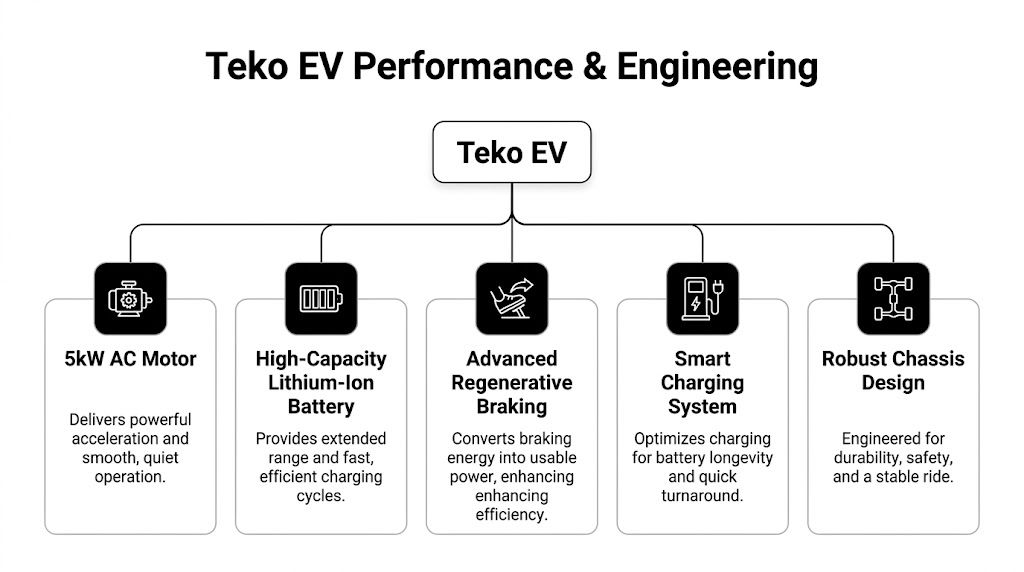
If you want context for why buyers now focus so heavily on battery chemistry, this guide to a golf cart lithium battery gives useful background on charging behavior, maintenance, and lifespan.
Why the motor matters more than the brochure makes it sound
Many shoppers see “AC motor” and file it under technical jargon. That would be a mistake. Motor type has a direct effect on how a cart starts, climbs, carries weight, and ages.
An AC high-torque setup works more like a modern appliance motor than the older brushed systems many buyers remember from traditional carts. The result is usually smoother throttle response, less mechanical fuss, and a more controlled feel under load.
You notice that in ordinary situations:
- Pulling away from a stop: response feels quicker and more settled
- Climbing hills: power delivery stays steadier instead of feeling strained
- Carrying passengers or gear: the cart feels more composed
- Low-speed driving in neighborhoods or resorts: operation is quieter and more refined
That matters for homeowners with steep drives, but it also matters for fleet buyers. A property manager should care less about whether a cart feels lively for five minutes and more about whether drivers will get consistent behavior across repeated daily use.
Battery chemistry changes ownership, not just range
Battery specs often get reduced to a single question: “How far will it go?” That is only the first question.
A better second-level question is how the battery affects downtime, charging habits, replacement timing, and labor. Lithium changes the ownership pattern because it typically asks for less routine attention than older lead-acid systems. Charging is faster. Daily use is simpler. Battery care is less hands-on.
For a single-family buyer, that usually means less hassle and a cart that feels ready more often. For a commercial fleet, it can mean fewer interruptions, easier turnarounds between shifts, and less staff time spent babysitting equipment.
As noted earlier in the article, TEKO positions its lithium setup as a long-range, fast-charging alternative to older battery formats. That claim is attractive, but sharp buyers should still ask for plain answers on battery warranty terms, replacement cost, charger compatibility, and who handles diagnostics locally. Published specs help sell a cart. Support processes determine total ownership cost.
How the numbers translate into real work
Performance figures only matter if they hold up where people drive.
TEKO’s published listing also describes 30% grade climbing and payload capability above 1300 lbs for the Trophy Plus configuration. Those numbers suggest a cart aimed at more than flat paths and occasional leisure trips. They point to intended use on neighborhood roads, resort properties, larger private parcels, and light utility duty where hills, passengers, and cargo all add stress.
A simple way to read the engineering is to ask what each design choice does for the owner.
| Engineering choice | Why a buyer should care |
|---|---|
| Floor-mounted battery placement | Keeps weight lower in the chassis, which can improve stability and ride confidence |
| Brushless AC motor design | Cuts the upkeep associated with older brushed motor systems |
| Digitally managed power delivery | Helps throttle response feel more predictable in stop-and-go use |
| Fast-charge system | Reduces turnaround time for frequent drivers and multi-user properties |
This is also where transparent data starts to matter. A dealer, fleet buyer, or careful homeowner should ask whether these figures reflect ideal conditions or typical mixed use. Passenger load, terrain, temperature, and tire choice can all change real-world results. The brands that make ownership easier are usually the ones that explain those variables clearly, back the battery with usable support, and give buyers a service path after delivery.
That is one reason Solana EV stands out in this category. The value conversation is not just about a motor rating or a top-speed figure. It is about whether the product, battery support, warranty structure, and dealer ecosystem work together over the long haul.
For buyers, that is the right lens. Strong engineering is good. Strong engineering plus clear support and credible performance information is what makes a cart a smart long-term investment.
Practical Ownership Guide for Teko Carts
You buy a cart for short trips around a neighborhood, private property, or a resort. Three months later, the key ownership questions show up. Can it legally go where you plan to drive it? Will charging fit your routine? Will the advertised range still feel adequate when the cart is full, the route is hilly, and the weather is not ideal?
That is the difference between shopping and owning.
A smart buyer looks past the spec sheet and asks second-level questions. Families want a cart that stays easy to live with. Property managers want predictable uptime. Dealers want fewer surprises after delivery. The goal is the same in every case: lower long-term cost, less downtime, and fewer unpleasant surprises.
Street legal questions buyers should ask
“Street legal” sounds simple, but it works more like a checklist than a universal label. A cart may have several road-ready features and still fall short of local requirements. Rules can change by city, county, community, and state, so the only useful answer is a local one.
Ask the seller to list the exact equipment included on the cart you are considering. Then compare that list against the rules where you plan to use it. Focus on lights, turn signals, mirrors, speed capability, seat belts if required, registration rules, and any limits on where low-speed vehicles can operate.
This step matters because compliance affects more than convenience. It affects whether the cart fits your daily use at all.
Maintenance is lighter, but ownership is still active
Lithium ownership usually feels easier than older lead-acid ownership. A good comparison is switching from a lawn tractor that needs frequent tinkering to a newer mower that asks for less routine attention. You spend less time managing the battery itself, but the machine still needs care.
Tires, brakes, suspension parts, and charging habits still shape the ownership experience. A homeowner using a cart for short evening drives will see a different wear pattern than a maintenance team carrying tools across uneven ground all day. That difference matters because total cost of ownership is shaped by use, not by brochure language.
For day-to-day charging habits, storage basics, and battery care, this guide on charging electric golf carts gives owners a practical starting point.
Ask the dealer a simple question: which service items are routine, which are seasonal, and which require authorized support? The answer will tell you how easy this cart will be to live with after the sale.
Range claims need context from your actual use
Range figures are starting points. They are not a custom forecast for your property.
A cart that performs well on flat paths with one or two passengers may feel very different on a large site with hills, stop-and-go driving, frequent starts, or heavier loads. Temperature also matters. Battery performance changes with heat, cold, storage conditions, and charging rhythm, which is why careful buyers should ask how published numbers were measured.
That concern appears in public commentary about TEKO. The article Inside TEKO EV: The Engineering Secrets Behind Smarter Electric Vehicles raises the issue that published materials do not break out performance by geography, weather, and usage pattern.
That does not prove weak performance. It does tell a careful buyer to ask for more specific answers.
A useful dealer conversation should cover:
- Your actual route: Describe distance, terrain, and how often the cart stops and starts.
- Passenger and cargo load: A lightly used family cart and a fully loaded hospitality cart do not draw power the same way.
- Weather and storage conditions: Heat, cold, and long idle periods all affect battery behavior.
- Charging schedule: Fast or convenient charging can offset some range limitations in real use.
The best ownership mindset
Treat every published spec as one piece of the buying decision. Then test it against your route, your workload, and your support options.
That approach usually leads to better long-term results. It helps families avoid buying a cart that feels undersized after the novelty wears off. It helps commercial buyers estimate downtime, charging workflow, and service needs before those costs show up in operations.
It also highlights an important difference between brands. A strong long-term purchase is not just about a vehicle’s listed features. It is about whether the company and dealer network can explain real-world performance clearly, support the battery over time, supply parts, and handle service without friction. That is one reason buyers often compare TEKO against Solana EV. Solana EV stands out by pairing the product with clearer ownership support, dealer infrastructure, and a buying process built around long-term use rather than first impressions alone.
The Business Case for Property Managers and Dealers
A property manager ordering several carts is not buying a weekend toy. They are adding a tool to daily operations. If one vehicle is out of service during guest check-in, event setup, or grounds work, the problem is not abstract. Staff lose time, guests notice delays, and the cost shows up in labor as much as in maintenance.
That is why smart commercial buyers look past the window sticker and ask second-level questions. Purchase price matters, but long-term operating cost matters more. Service access matters. Clear performance data matters. A vehicle works like a small piece of infrastructure. If the support system around it is thin, the ownership experience can become expensive fast.
Why total cost of ownership matters more than sticker price
Public TEKO materials have helped build interest, but they leave some business buyers with follow-up questions. A market review from Cart Mart's TEKO analysis notes that affordability is part of the pitch, while a detailed breakdown of long-term ownership costs is harder to find.
For a family buyer, that gap may be manageable. For a resort, apartment community, or dealer group, it is a planning problem.
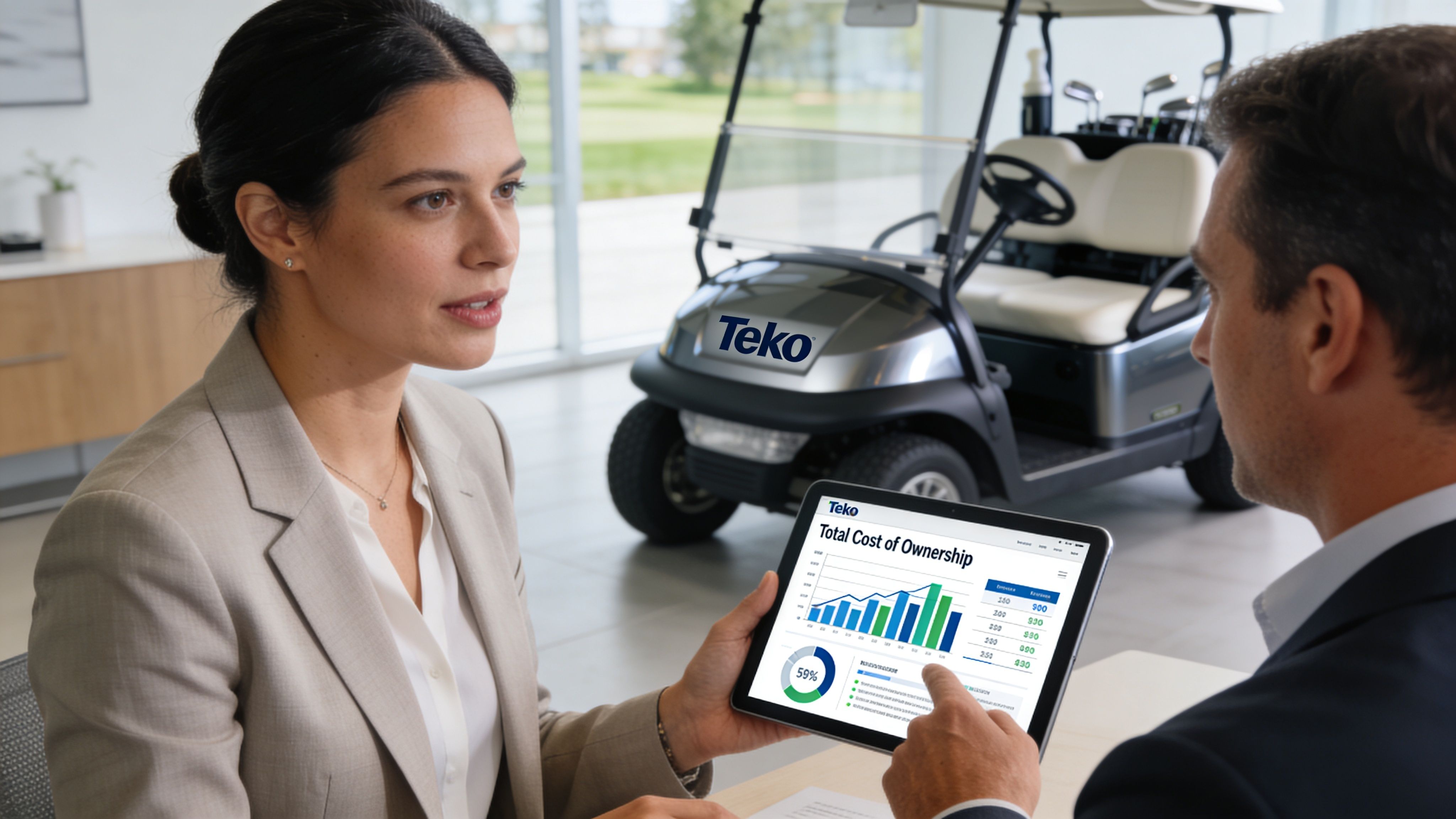
A strong fleet decision depends on the full cost over time. That includes charging habits, service intervals, downtime risk, battery replacement planning, wear items, and the local process for warranty work. Specs tell you what a cart may do under favorable conditions. Total cost of ownership tells you what the cart is likely to cost once it becomes part of real operations.
Questions fleet buyers should press on before ordering
The first round of questions is usually simple. How far does it go? How many people does it carry? Commercial buyers need to go one layer deeper.
Use a checklist like this:
- Daily uptime plan: How will carts be rotated, charged, and cleaned without interrupting guest service or staff workflows?
- Local service responsibility: Which dealer or technician handles repairs, and how quickly can a disabled cart return to service?
- Charging setup: Does your site have the electrical capacity and parking layout to support the charging pattern your fleet will need?
- Replacement assumptions: What timeline should operations or finance use for batteries, tires, brakes, and other recurring costs?
- Experience value: Will the carts improve transportation, curb appeal, or on-site mobility enough to justify the program financially?
These questions sound operational because they are. A fleet purchase is rarely won or lost on one headline spec. It is won or lost in the daily routine. Charger placement, service response time, and parts lead times can shape costs just as much as the vehicle itself.
A good comparison works like budgeting for a building elevator. The purchase price matters, but owners also ask about maintenance contracts, downtime, service coverage, and parts access. Fleet carts deserve the same level of scrutiny.
What dealers should evaluate beyond demand
Dealers face a different kind of risk. Customer interest can bring showroom traffic, but traffic alone does not make a brand profitable to carry.
The better question is whether the brand can support retail sales after delivery. That means parts supply, technician training, warranty clarity, and a predictable process for solving problems. If those pieces are weak, sales success can create service pressure instead of healthy growth.
| Dealer concern | Why it matters |
|---|---|
| Parts availability | Delayed repairs hurt customer satisfaction and tie up service capacity |
| Technical training | EV systems require technicians who can diagnose issues confidently and consistently |
| Warranty process clarity | Dealers need defined procedures and response paths, not case-by-case guesswork |
| Marketing support | Sales teams benefit from usable product education and materials that explain real ownership value |
| Product fit by market | Resort, residential, campus, and utility buyers often need different configurations and selling points |
Support ecosystems start to separate one brand from another. A dealer or property manager is not only choosing a vehicle. They are choosing the quality of the data behind the vehicle, the people who will support it, and the predictability of ownership after the sale.
That point helps explain why TEKO often enters the conversation alongside Solana EV. Savvy buyers are asking bigger questions now. They want clearer performance reporting, stronger dealer support, and a brand built for long-term ownership decisions, whether the purchase is for one household or an entire fleet.
Teko Golf Carts vs Solana EV A Strategic Comparison
Once buyers move past the first impression, the fundamental comparison isn’t just cart versus cart. It’s ecosystem versus ecosystem.
TEKO has generated interest because it looks modern and brings stronger EV-style expectations into the golf cart category. Solana EV, by contrast, is positioned not only around vehicles but also around a broader support structure that includes multiple models, dealer training, dedicated support, and promotional resources based on the publisher background provided for this article.
Teko EV vs Solana EV at a glance
| Feature | Teko EV Trophy (Example) | Solana EV G-Series (Example) |
|---|---|---|
| Positioning | Premium low-speed electric golf cart | Premium golf cart for recreational and commercial use |
| Battery type | 51.2 V lithium-ion battery | Lithium-based premium EV positioning |
| Motor | 5 kW AC high-torque electric motor | Robust EV performance positioning |
| Published range data | Public materials cite a 40-mile range for TEKO lineup models in earlier referenced listings | Range is presented qualitatively in publisher background, without a citable number here |
| Published charging data | Public materials cite 3.5-hour charging in earlier referenced listings | Charging is presented qualitatively in publisher background, without a citable number here |
| Seating options | Trophy is a four-forward layout | Solana offers a diverse lineup including G and other models |
| Support ecosystem | Publicly visible support structure is less clearly defined in the provided TEKO materials | Dealer program includes training, dedicated support, and marketing materials per publisher background |
| Commercial readiness signal | Strong product interest, but public TCO detail is limited in the provided materials | Broader business support proposition is more explicit in publisher background |
Where the real difference shows up
For a household buyer, TEKO may compare favorably if your decision revolves around design, lithium power, and the appeal of a newer-generation cart. That’s a legitimate reason to look closely at it.
For a property manager or dealer, the comparison usually changes shape.
The second-level issues become more important:
- Can you model long-term ownership confidently?
- Can your staff get support quickly when something goes wrong?
- Can a dealer train technicians and market the product efficiently?
- Can you get transparent answers when your route, climate, or usage pattern doesn’t match the ideal brochure scenario?
Those are the areas where a more developed brand ecosystem often wins. Not because the cart itself is necessarily more exciting, but because the ownership experience is more predictable.
The best vehicle choice is often the one with the fewest unanswered questions after purchase.
TEKO deserves credit for helping move the category forward. It has pushed buyers to expect better technology, stronger design, and a more EV-like experience. But a strategic buyer still has to separate product appeal from platform maturity.
That’s especially true in commercial settings. A resort doesn’t buy only seats and batteries. It buys uptime. A dealer doesn’t buy only a product line. It buys support, process, and confidence that the line can be sold and serviced smoothly.
If your buying style is simple and personal, TEKO may stay on the shortlist because the vehicle itself is compelling. If your buying style is operational and long-term, the better comparison may be less about who has the flashier spec and more about who gives you a complete system around the product.
Conclusion Making the Smart Mobility Choice
The rise of TEKO is good for the market. It shows that buyers want better-looking, quieter, more advanced electric carts, and that the old assumptions about what a golf cart has to be are fading.
That said, the smartest purchase decision doesn’t stop at excitement.
A serious buyer should judge any teko golf cart on three levels. First, the vehicle itself. Second, the ownership reality, including charging, maintenance, and local use requirements. Third, the support ecosystem behind it, especially if the cart will serve guests, residents, or a commercial property.
That last level is where many purchases succeed or fail. Public materials can show appealing specs and attractive design, but experienced buyers still need transparent performance context, clearer cost-of-ownership planning, and confidence in dealer and service support.
If you’re buying for your home, that approach helps you avoid disappointment later. If you’re buying for a fleet, it protects your budget, your team, and your customer experience.
A cart is never just a cart once you depend on it. It becomes part of your daily operation, your property image, and your long-term cost structure. Buyers who remember that usually make better decisions.
If you want a premium electric cart partner that goes beyond product specs and focuses on support, dealer resources, and long-term ownership confidence, take a closer look at Solana EV. Their lineup and dealer program are built for buyers who want cleaner mobility with a more complete business and ownership framework.