
When you hear "golf cart," you probably picture cruising down a fairway. But what if you could take that same easy, open-air feeling onto your neighborhood streets? That's exactly what a street-legal golf cart is all about. It’s a classic golf cart that’s been beefed up with specific safety features, officially classifying it as a Low-Speed Vehicle (LSV) so it can be legally driven on many public roads.
Think of it as the perfect hybrid for local travel—more capable than a course cart, but way more convenient and fun than firing up your car for a short trip.
Why Street Legal Carts Are More Than Just a Trend
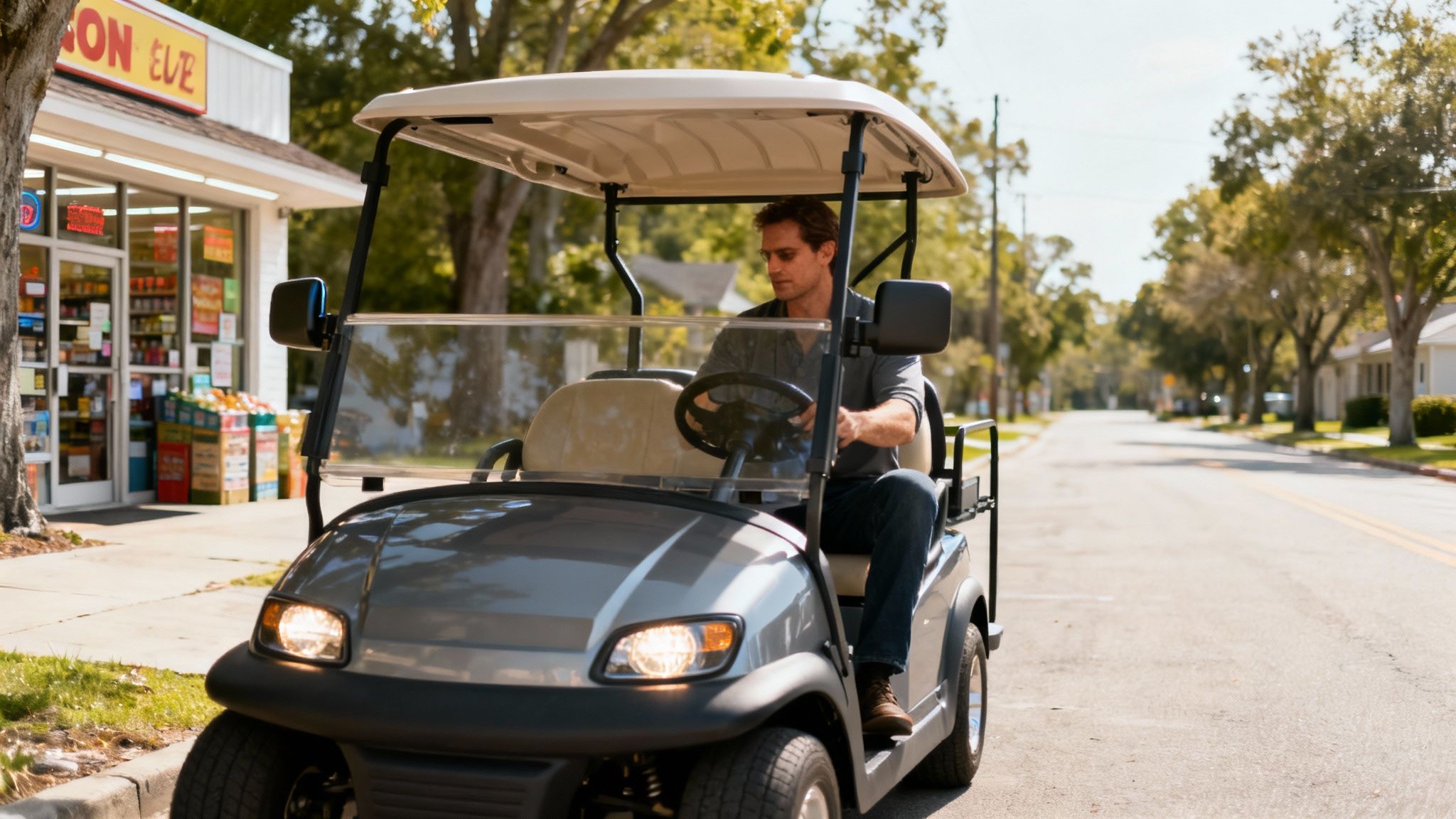
Imagine a smarter, more enjoyable way to run errands or visit friends around the neighborhood. Street-legal golf carts are popping up everywhere for a reason. They aren't just a novelty; they're a practical solution that bridges the gap between a recreational vehicle and your everyday car. Let's break down why these zippy vehicles are becoming so popular.
The Rise of the Low-Speed Vehicle
You’ll often hear the term Low-Speed Vehicle (LSV) used to describe a street-legal cart. This isn't just a casual nickname; it's an official vehicle classification. To earn that LSV title, a cart must meet a specific set of federal and state safety standards, which is what allows it to share the road legally. It's a formal step up from a basic cart.
To get the full picture of what this classification entails, our guide on what a Low-Speed Vehicle is dives into all the details.
This isn’t a niche market, either. The move from the golf course to the community lane is happening fast. The global street-legal golf cart market is booming, with projections hitting around $2.454 billion by 2025. You’re seeing them more and more in master-planned communities, around shopping centers, and even on college campuses.
Key Advantages of Going Street Legal
Choosing an LSV isn't just about the fun factor; it comes with some serious real-world perks that make everyday life a little bit easier.
- Cost-Effective: You’ll see big savings right away. Forget about gas prices, and enjoy lower insurance premiums and cheaper maintenance compared to your car.
- Eco-Friendly: Electric LSVs run clean with zero emissions. That means quieter streets, cleaner air, and a much smaller carbon footprint for your household.
- Seriously Convenient: They are purpose-built for short trips. Zipping to the grocery store, dropping by a neighbor's house, or cruising to the community pool becomes totally hassle-free.
- A Better Lifestyle: There's just something about an open-air ride. It’s a more relaxed, connected, and enjoyable way to experience your own neighborhood.
Consider this your complete roadmap. We're here to walk you through everything you need to know about LSVs—from the must-have features and legal rules to how one can genuinely add a new layer of convenience and fun to your daily life.
Understanding the Rules of the Road
So, what’s the real difference between a standard golf cart you see on the links and one you can legally drive to the store? It all comes down to a clear set of rules, from the federal level right down to your local town, that transform a simple cart into a registered Low-Speed Vehicle (LSV).
Think of it this way: a basic golf cart is like a riding lawnmower—perfect for a specific property, but you wouldn't take it on a main road. An LSV, on the other hand, is more like a moped. It's built, certified, and registered to share the road safely with cars in certain situations. It's earned its place.
The Federal Foundation for LSVs
The journey to becoming street legal starts with the federal government. The National Highway Traffic Safety Administration (NHTSA) lays down the law on what qualifies as an LSV. These aren't just suggestions; they're strict requirements that manufacturers like Solana EV must follow to the letter.
The biggest rule is about speed. To be classified as an LSV, a vehicle has to be able to hit at least 20 mph, but it can't go faster than 25 mph. This specific speed window is what defines the entire vehicle class and keeps it safe for its intended environment.
An LSV is purpose-built for local, low-speed travel. The federal classification ensures it can keep up with neighborhood traffic without needing the heavy-duty crash safety features of a full-sized car.
Essential Safety Equipment: A Checklist
Speed is just the beginning. Federal law also demands a whole suite of safety features—the same kind of equipment you’d expect to find on your car. This gear is non-negotiable, ensuring the LSV is visible, predictable, and safe for everyone on the road.
- Headlights, Taillights, and Brake Lights: A must-have for being seen, especially after dark. They let other drivers know you're there and when you're slowing down.
- Turn Signals: You need front and rear turn signals to clearly communicate your intentions at intersections and prevent any dangerous guesswork.
- Mirrors: A street-legal cart needs both a rearview mirror and a driver-side exterior mirror. You have to be able to see what's happening around you.
- Windshield: This isn't just any piece of plastic. It has to be an automotive-grade windshield to protect you from wind, road debris, and the elements.
- Seat Belts: Every single seat must have a DOT-approved seat belt. This is one of the most critical safety features for protecting passengers.
On top of all that, every federally-approved LSV gets its own 17-digit Vehicle Identification Number (VIN). This is the vehicle’s official birth certificate. Just like the VIN on your car, it’s essential for getting a title, registering the vehicle, and obtaining insurance. It’s the final stamp of approval.
Navigating State and Local Laws
While the feds create the blueprint, it's your state and local authorities that finalize the rulebook. This is where you'll find the specific "rules of the road" for your area. Most states will limit LSVs to roads with a posted speed limit of 35 mph or less.
But it can get even more specific. One coastal town might allow LSVs on a scenic beach road, while the next one over might ban them from the busy downtown core. Since these rules can change from one zip code to the next, your best bet is to always check with your local DMV.
We know this part can seem complicated, which is why we put together a guide on getting your golf cart properly registered. It walks you through the whole process to make sure you're good to go.
To make it even clearer, here's a quick side-by-side look at what separates a standard cart from a true, street-legal LSV.
Standard Golf Cart vs Street-Legal LSV Checklist
| Feature | Standard Golf Cart | Street-Legal LSV (Required) |
|---|---|---|
| Top Speed | ~15 mph | 20-25 mph |
| Vehicle Identification Number (VIN) | No | Yes, 17-digit federal VIN |
| Seat Belts | Optional | Yes, for all seats |
| Headlights & Taillights | Optional | Yes, required |
| Turn Signals | No | Yes, front and rear |
| Mirrors | Optional | Yes, rearview and side mirrors |
| Registration & Insurance | Not Required | Yes, mandatory |
| Road Access | Private Property | Public roads (35 mph or less) |
At the end of the day, being "street legal" isn't about slapping on a few accessories. It's about meeting a tough set of safety and manufacturing standards that make your vehicle a legitimate, responsible, and welcome part of your community’s traffic.
Features That Define a Quality LSV
Meeting all the legal requirements is really just the starting point for a street legal golf cart. Beyond the basic checklist, certain design choices and high-quality components are what separate a merely compliant Low-Speed Vehicle (LSV) from one that’s actually a joy to drive and built to last. Knowing what to look for helps you see past the price tag and understand the real value of what you’re buying.
Think about it like choosing a bicycle. Sure, a basic cruiser gets you around the neighborhood just fine. But a well-designed road bike with a lightweight frame, precise gears, and powerful brakes delivers a completely different—and better—experience. The same logic applies to LSVs.
The Heart of Performance: The Battery
If there's one feature that truly defines an LSV's day-to-day usability, it's the battery. This is where you see the biggest difference between old-school tech and modern innovation. For decades, heavy lead-acid batteries were the only option, but they come with a lot of baggage: they're incredibly heavy, take forever to charge, and need constant maintenance like checking water levels.
Today, forward-thinking brands like Solana EV build their carts with advanced lithium-ion batteries. This isn't just an upgrade; it's a total game-changer.
- Longer Range: Lithium-ion packs a bigger punch, giving you a reliable range of 30 to 60 miles on a charge. That's a huge leap from the 20 to 40 miles you might get with lead-acid.
- Faster Charging: You can get back on the road in a fraction of the time. Less waiting, more driving.
- Zero Maintenance: These batteries are completely sealed. No more topping off with distilled water or cleaning terminals. Ever.
- Extended Lifespan: They last significantly longer and hold their charge through thousands of cycles, making them a much smarter investment over the life of the vehicle.
A quality LSV is built around its power source. Choosing a model with a lithium-ion battery is one of the best decisions you can make for both performance and sheer convenience.
Engineering for a Superior Ride
A smooth, controlled ride doesn't happen by accident. It’s the direct result of smart engineering specifically for paved roads. A standard golf cart is designed for the soft, forgiving turf of a fairway, but a quality LSV needs a much tougher setup to handle the real world.
First up is a premium suspension system. This is what soaks up bumps, potholes, and rough patches in the road, giving you and your passengers a stable, comfortable trip. Without it, you’d feel every single imperfection, turning a pleasant drive into a jarring chore.
Just as critical is the braking system. You’re sharing the road with cars, so you need stopping power you can count on. High-quality LSVs come with responsive hydraulic or mechanical brakes, giving you the confidence to navigate neighborhood traffic safely. This is a massive improvement over the simple, less effective brakes on a typical course cart.
Finally, you need DOT-approved and road-rated tires. These are specifically designed for durability and grip on asphalt, offering far better traction than standard turf tires, especially when the roads are wet.
If you’re thinking about upgrading a cart you already own, looking into what's included in a street legal golf cart kit gives you a great checklist of these must-have components. When you prioritize these engineered features—from the battery to the brakes—you’re getting a cart that’s not just compliant, but genuinely safe and fun to drive.
Why Choose a Street Legal Cart
Thinking about a street legal golf cart? It's more than just a fun new toy—it's a choice to make local travel smarter and way more convenient. These Low-Speed Vehicles (LSVs) come with a whole list of perks that make them a surprisingly practical and enjoyable solution for your daily trips.
From saving a ton of money to being kinder to the environment, an LSV brings real, tangible benefits that fit perfectly with today's lifestyle. It's really about a shift toward efficiency, feeling more connected to your community, and just having a little fun on short journeys.
A Smart Economic Decision
One of the first things you'll notice is how much kinder an LSV is to your wallet. When you stack it up against a regular car for local errands, the savings start to add up fast, making a pretty strong case for the switch.
For starters, you can basically forget about the gas station. Electric models, like the ones from Solana EV, run completely on electricity, which costs way less than gas. Charging your LSV at home overnight is a drop in the bucket compared to filling up a car's tank, easily saving you hundreds of dollars in fuel every year.
On top of that, insurance and maintenance are much cheaper. Insuring an LSV usually costs less than a standard auto policy. And since electric motors have so few moving parts, there’s not much to maintain. No oil changes, no spark plugs, no exhaust systems—just basic checks on things like brakes, tires, and batteries.
The Environmental Advantage
Going electric with an LSV is a great way to do your part for a cleaner, quieter neighborhood. With everyone more conscious of air quality and carbon emissions, these carts are a simple and effective way to shrink your personal environmental footprint.
The real magic of electric street legal golf carts is that they produce zero emissions. This doesn't just help clean up the air in your community; it also makes for a more peaceful environment by getting rid of all that engine noise.
This move toward electric power is a huge trend. The entire global golf cart market, which includes these street-ready models, is set to grow from USD 2.30 billion in 2025 to USD 3.68 billion by 2035. And electric carts are poised to take over, grabbing about 95.3% of the market share because they're so affordable, quiet, and eco-friendly. You can read more about these market trends and see how they're shaping the future of how we get around town.
Enhancing Your Lifestyle and Community
Besides all the practical stuff, a street legal golf cart offers a lifestyle boost that a car just can't match. It’s not just about getting from point A to B—it’s about enjoying the trip and connecting with what's around you.
-
Unmatched Convenience: Need to make a quick run to the store or drop a package at the post office? Just hop in and go. There’s no waiting for an engine to warm up or trying to squeeze a big car into a tight parking spot.
-
Fostering Connection: The open-air design just makes you feel more a part of things. It’s easy to wave to neighbors, pull over for a quick chat, or simply feel more present in your community as you cruise down the street.
-
Pure Fun: Let’s be real—driving an LSV is just plain fun. It can turn a boring errand into a pleasant little ride, letting you soak up some sunshine and fresh air along the way.
Choosing an LSV is about embracing a more relaxed, efficient, and sustainable way to live. It simplifies your daily routine and adds a bit of adventure to every local trip, making it an investment that pays you back in more ways than one.
How to Choose Your First Street Legal Golf Cart
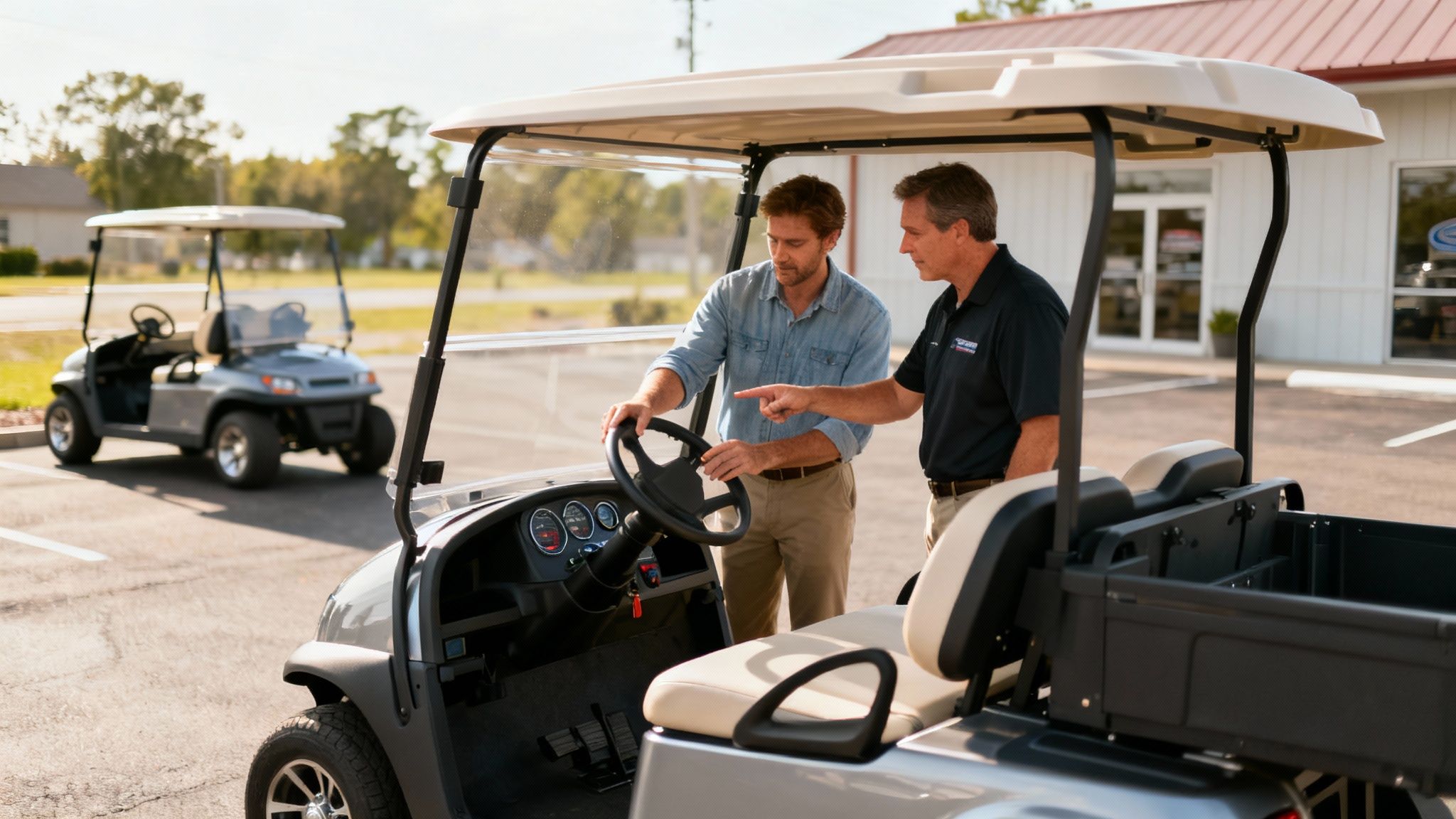
Ready to find the perfect Low-Speed Vehicle (LSV) for your life? Choosing your first street legal golf cart is a fun experience, but it’s about more than just picking your favorite color. A bit of thoughtful planning goes a long way in making sure you end up with a cart that fits your daily routine and serves you well for years.
Think of it like buying a new car or even a major appliance. You wouldn't get an industrial-sized oven for a tiny kitchen, right? The same logic applies here. The best LSV for you is the one that’s the right size and has the right features for your lifestyle, not necessarily the one with the flashiest bells and whistles.
Start by Assessing Your Needs
Before you even start browsing different models, take a step back and think about how you'll really use your new cart. Just answering a few simple questions can help you zero in on the perfect fit and avoid getting something that doesn't quite work.
-
How many people are you driving? Will it mostly be you and a spouse zipping to the community pool, or do you need space for the kids and their friends? The Solana EV lineup, for example, offers two, four, and even six-seat models to fit any family size.
-
How far will you go? Map out your typical trips. Are you just heading to the local market and back, or do you plan on longer jaunts across the neighborhood? This will tell you whether a standard battery will do the job or if you should invest in a premium lithium-ion battery for extended range.
-
What's the terrain like? Think about your community's roads. Are they flat and paved, or are you going to be tackling some hills? The landscape makes a big difference in the kind of power and suspension you’ll need for a smooth, safe ride.
New Versus Used Carts
One of your first big decisions is whether to buy a brand-new cart or a pre-owned one. A used cart can look like a bargain at first glance, but it's important to weigh the pros and cons carefully. You might find hidden mechanical problems or discover it has old lead-acid batteries that are on their last leg and will be expensive to replace.
Buying new, especially from a trusted brand like Solana EV, gives you something invaluable: peace of mind. You’re getting a vehicle in perfect condition, loaded with the latest technology, a full manufacturer's warranty, and the assurance that it meets all current safety standards from day one.
A new LSV is a known quantity. The warranty coverage, modern features, and reliable performance provide a level of security that’s often worth the initial investment, protecting you from unexpected repairs down the road.
The Importance of a Reputable Dealer
Where you buy your cart matters just as much as what you buy. Working with an authorized dealer is a game-changer for service, support, and getting good advice. A great dealer doesn't just make a sale; they build a relationship. They can walk you through financing, explain the warranty, and provide the professional maintenance needed to keep your cart in top shape.
This kind of support network is a must, especially in a booming market like the United States, which accounts for over 40% of all street-legal golf cart sales worldwide. With so many carts on the road in states like Florida and Arizona, having a local dealer you can count on is crucial.
As you consider your purchase, don't forget about security. It's always a good idea to brush up on general vehicle theft prevention tips, as many of the same principles apply. Finally, the most important step is taking a test drive. It's your chance to get a real feel for the ride, see how it handles, and make sure it’s truly the perfect fit for you.
Common Questions About Street Legal Carts
As you get closer to picking out the perfect ride, it's natural for a few last-minute questions to pop up. Nailing down the practical details of owning street legal golf carts is the final step to feeling confident in your choice. Let's walk through some of the most common things we get asked by new owners.
Can I Make My Existing Golf Cart Street Legal?
In many cases, yes. You can usually get a standard golf cart road-ready by installing a street-legal kit. These kits bundle all the required safety gear: headlights, turn signals, mirrors, a horn, and seatbelts.
Once the parts are installed, your cart will need to pass an official inspection and be registered with your local DMV. This is what officially changes its classification to a Low-Speed Vehicle (LSV) and gets you a Vehicle Identification Number (VIN). Before you buy a single part, though, be sure to check your specific state and local laws, as the rules can vary quite a bit from one town to the next.
How Fast Can a Street Legal Golf Cart Go?
Federal law caps an LSV's top speed at 25 mph on a flat, paved road. While you might be tempted to modify your cart to go faster, that’s a bad idea. Doing so would make it illegal for on-road use, which could get your registration and insurance voided. It’s also important to remember they are generally restricted to roads with speed limits of 35 mph or less.
Think of the 25 mph cap not as a limitation, but as a core safety feature. It keeps the vehicle predictable and safe within local traffic, making it perfect for neighborhood trips without needing the heavy-duty safety systems of a car.
Do I Need a Driver's License and Insurance?
Yes, you absolutely do. Since a street-legal golf cart is a registered motor vehicle, you need a valid driver's license to operate it on public roads. You'll also need to carry auto insurance that meets your state’s minimum liability coverage. When it comes to licenses and insurance, treat it just like you would a car.
What Is the Average Range on a Single Charge?
How far you can go on one charge really depends on the battery, the terrain, and how you drive. A modern cart with a high-quality lithium-ion battery, like the ones in our Solana EV models, can typically get you 30 to 60 miles. Carts with older lead-acid batteries will have a shorter range, usually somewhere between 20 to 40 miles. The best bet is to always check the manufacturer's specs for the exact model you're looking at to know what it’s truly capable of.
Ready to explore a smarter way to travel around your community? Solana EV offers a premium lineup of stylish, reliable, and fully-equipped street legal golf carts designed for modern life. Discover our models and find a dealer near you today!