
So, you're thinking about a street-legal golf cart. It’s important to understand this isn't just a regular cart with a few extra bells and whistles. It's a completely different class of vehicle, officially known as a Low-Speed Vehicle (LSV) in the eyes of the federal government. To earn that title and get permission to drive on public roads, it has to meet some pretty specific standards for safety, speed, and equipment set by the National Highway Traffic Safety Administration (NHTSA).
From the Fairway to the Pavement
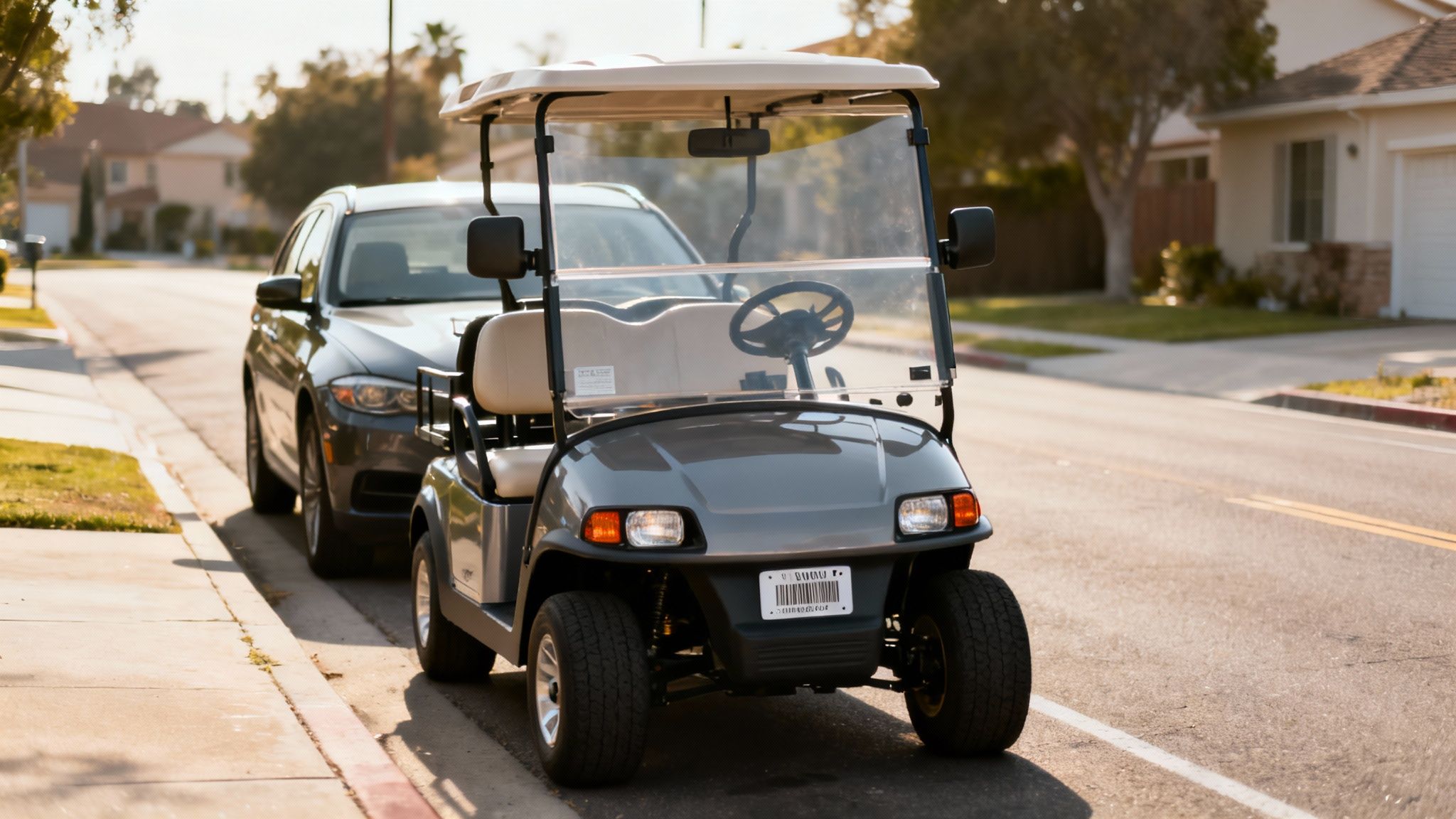
The difference between a standard golf cart and a street-legal one is night and day. A good way to think about it is that a regular golf cart is like a bicycle—it's perfect for its intended environment, whether that's a golf course or private property. A street-legal LSV, on the other hand, is built more like a moped or a small car, engineered from the ground up to safely share the road with other vehicles.
This isn't just a minor upgrade; it's a fundamental shift in both design and regulation. These vehicles are moving beyond recreation and becoming a genuinely practical, eco-friendly way to get around. They're popping up everywhere, from master-planned communities and sprawling college campuses to breezy coastal towns where a full-size car just feels like overkill.
Understanding the Low-Speed Vehicle Classification
At the heart of it all is the federal LSV classification. This isn't just a nickname; it's a specific designation with strict rules. To officially qualify as an LSV, a vehicle must:
- Have four wheels.
- Be able to reach a top speed between 20 and 25 miles per hour.
- Come equipped with a whole list of federally mandated safety features.
This is the key distinction. It’s what transforms a cart from an off-road utility vehicle into a registered motor vehicle that has to obey traffic laws. Getting a handle on these specific street legal golf cart requirements is the absolute first step for anyone looking to buy.
The rise of the LSV reflects a bigger trend toward sustainable, convenient micro-mobility. As our towns and cities get more crowded, the need for efficient, short-range transportation is exploding. Street-legal carts are stepping up to fill that gap perfectly.
A Growing Market for Neighborhood Mobility
This boom in popularity isn't just something you're imagining; it's a massive, growing market. Street-legal golf carts are carving out a serious niche. Projections show the global market is on track to hit $2,454 million in 2025, and it's expected to expand at a compound annual growth rate of 6.1% through 2033. North America is leading the charge, largely thanks to the thousands of golf course communities that made these vehicles a normal part of daily life.
This huge surge in demand proves they've made the leap from a fun novelty to a mainstream transportation choice. As we go on, we'll break down all the specific rules, safety gear, and buying tips you need to know before you get behind the wheel of your own street-legal ride.
Where Can I Actually Drive This Thing? A Guide to Cart Laws
Before you even think about buying a street-legal golf cart, you've got to wrap your head around the rules of the road. And trust me, it's not one simple rulebook. It's a patchwork of regulations that starts at the federal level and trickles all the way down to your local town hall or even your homeowner's association.
Think of it like this: the federal government sets the basic recipe for what a street-legal cart is, but your state and city decide which ingredients you can use and where you can cook.
It all starts with the National Highway Traffic Safety Administration (NHTSA). These are the folks who set the baseline safety standards for every vehicle on the road, including what they officially call Low-Speed Vehicles (LSVs). Their big rule, the Federal Motor Vehicle Safety Standard 500 (FMVSS 500), defines an LSV and lists the non-negotiable safety gear it must have to be sold for on-road use.
This federal standard is a good thing—it ensures any vehicle sold as a street-legal golf cart has a consistent, nationwide safety benchmark. This covers things like its top speed (capped between 20-25 mph) and other critical features. But that's just the starting line.
State and Local Rules: Where the Rubber Meets the Road
Once a vehicle clears the federal LSV hurdle, the states get their say. This is where things can get wildly different depending on where you live. Each state’s Department of Motor Vehicles (DMV) adds its own requirements on top of that federal foundation.
State laws usually handle the nuts and bolts of ownership. Here's what they typically cover:
- Titling and Registration: Just like a car, every street-legal LSV needs a title and must be registered with the state. This is what officially makes it a road-worthy vehicle.
- License Plates: Once it's registered, you’ll get a real license plate that has to be on your cart at all times.
- Insurance: Pretty much every state requires you to carry at least a minimum amount of liability insurance. How much you need can vary a lot, so you absolutely have to check your state’s specific requirements.
- Driver's License: No getting around this one. You need a valid driver's license to operate an LSV on public roads.
This clear, layered legal structure is a big reason why North America is the king of the golf cart world. In fact, North America accounted for over 53.72% of the global market share in 2023, with a regional market size of a whopping $1.01 billion. The U.S. is leading the way because these regulations give manufacturers a clear path to build compliant LSVs, and their popularity is only growing as people look for greener transportation. You can dig deeper into these market trends to see the bigger picture.
Your Town, Your Rules: The Final Word
The last—and arguably most important—set of rules comes from your local city, county, or even your HOA. This is where the day-to-day reality of driving your street-legal golf cart is decided. What’s totally fine in one beach town could be illegal one zip code over.
If you remember one thing, make it this: Federal law defines what a street-legal cart is. Your local laws dictate where and how you can actually drive it.
Local governments get the final say on the practical stuff. These are the rules you need to know inside and out before you buy.
Common local restrictions often include:
- Which Roads Are OK: Most towns only allow LSVs on roads with a speed limit of 35 mph or less. Some are even stricter, limiting them to 25 mph zones.
- No-Go Zones: Local ordinances will clearly spell out which roads are off-limits. Think highways, major thoroughfares, or busy downtown areas.
- Hours of Operation: Some communities, especially in resort areas, might limit LSV use to daylight hours for safety.
- Crossing the Big Roads: There are often specific rules about whether you’re allowed to cross streets that have higher speed limits than the ones you’re allowed to drive on.
Ignoring these hyper-local rules can get you a traffic ticket, a hefty fine, or even get your cart impounded. Your best bet? Call your local police department or city hall directly and ask for a copy of the ordinances for LSVs. A little bit of homework now will save you a world of headache later and ensure you can enjoy your cart legally and safely for years.
The Essential Safety Equipment Checklist
Turning a standard golf cart into a road-ready Low-Speed Vehicle (LSV) is all about one thing: safety. Think of it less like a list of upgrades and more like teaching your cart the language of the road. Each piece of equipment is a critical part of a system that helps you see, be seen, and keep your passengers safe.
This isn't an optional add-on menu. Both federal and state laws are very clear about what’s required. These rules exist to make sure your street legal golf cart can share the road predictably with cars and trucks that are much bigger and faster. Let's dig into exactly what you'll need.
Visibility and Communication Gear
Job one on any public road is making sure other drivers know you exist and what you’re about to do. A proper street legal cart needs to signal its intentions clearly, just like any other vehicle. That means having a complete lighting package ready for any time of day or night.
- Headlights and Taillights: Absolutely non-negotiable. They’re your ticket to being seen in low light, at dawn or dusk, and on dreary days.
- Turn Signals and Brake Lights: Waving your arm out the side just won't cut it. You need functional turn signals on all four corners and bright brake lights to tell the driver behind you that you’re slowing down. It’s basic, predictable communication.
- A Horn: Sometimes, you just need to make a little noise. A horn is your best tool for getting the attention of a distracted driver or a pedestrian who hasn't noticed you.
Without this gear, your cart is practically invisible to other traffic. That’s a recipe for disaster.
Every piece of safety equipment serves a specific purpose, working together to bridge the gap between a recreational vehicle and a fully compliant motor vehicle. Overlooking even one item can result in a failed inspection or a serious accident.
Occupant Protection and Structural Integrity
Being seen is half the battle; the other half is making sure the people inside the cart are protected. A standard golf cart is built for the gentle, predictable environment of a fairway, not the chaos of a public street. That means it needs some key upgrades.
The windshield is a great example. You can’t just bolt on a flimsy piece of acrylic. It has to be automotive-grade safety glass, usually with an AS1 or AS5 rating stamped right on it. This type of glass is designed to prevent shattering into dangerous, sharp pieces in an accident.
On top of that, your cart must have:
- Mirrors: A rearview mirror and side-view mirrors are essential. They give you the 360-degree awareness needed to spot cars in your blind spots before you change lanes or make a turn.
- Seat Belts: This one’s a biggie. Every single seat needs a seat belt. It’s arguably the most important safety feature for protecting passengers in a sudden stop or collision.
The All-Important Vehicle Identification Number
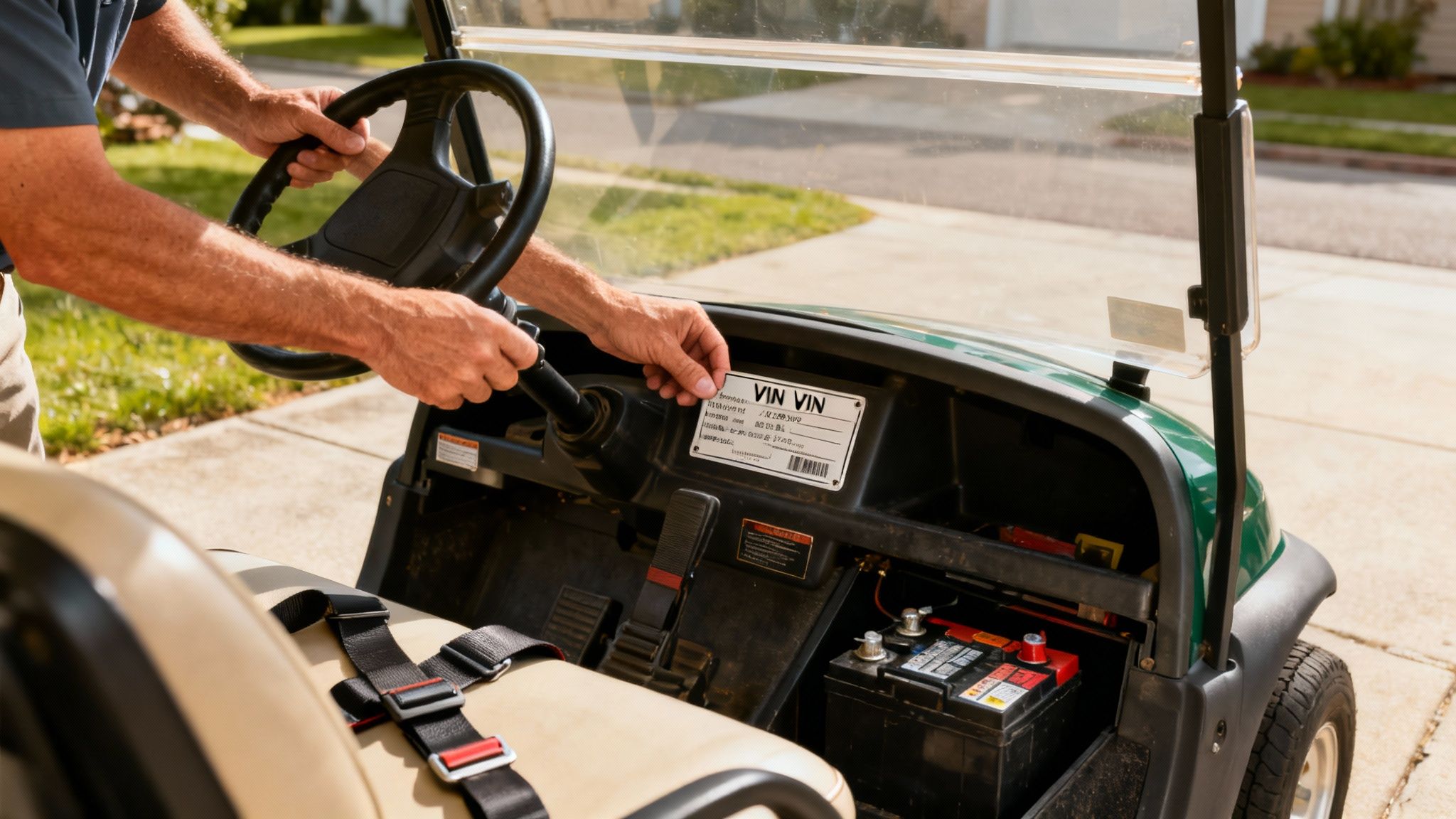
Finally, we get to the official part. Every legally-recognized LSV needs a 17-digit Vehicle Identification Number (VIN). This isn't just a random sticker—it's the vehicle's unique fingerprint in the eyes of the law. For purpose-built LSVs, the manufacturer puts this on the chassis. For conversions, the state will assign one after a successful inspection.
That VIN is what allows the DMV to issue a title, register the vehicle, and let you get insurance. Simply put, a cart without a legitimate VIN cannot be legally driven on public roads. It's the final stamp of approval that certifies your vehicle has met every requirement to be a true street legal golf cart. Always check for a valid VIN before you even think about buying.
To bring it all together, here’s a quick-reference table outlining the key components.
Required Safety Features for Street Legal Golf Carts
This table summarizes the essential safety equipment mandated by federal and state laws for a golf cart to be classified as a street-legal Low-Speed Vehicle (LSV).
| Required Component | Primary Function | Common Standard |
|---|---|---|
| Headlights & Taillights | Ensures visibility to others in low-light conditions. | DOT-approved |
| Turn Signals & Brake Lights | Communicates intent to turn or slow down. | DOT-approved |
| Reflectors | Provides passive visibility from all angles. | Red on rear, amber on sides |
| Horn | Alerts pedestrians and other drivers of presence. | Audible from at least 200 feet |
| Windshield | Protects occupants from debris and weather. | AS1 or AS5 safety glass |
| Rearview & Side Mirrors | Provides a clear view of surrounding traffic. | Required on driver and passenger sides |
| Seat Belts | Secures occupants in case of sudden stop or collision. | Type 1 or Type 2 belts per seating position |
| 17-Digit VIN | Unique identifier for registration, title, and insurance. | Permanently affixed to the chassis |
| Top Speed Limiter | Prevents the vehicle from exceeding 25 MPH. | Governed electronically or mechanically |
Meeting every one of these standards is what transforms a simple cart into a vehicle that’s truly ready for the road.
Choosing Between a Factory LSV and a DIY Conversion
So, you’re ready for a street-legal golf cart. You’ve hit your first major fork in the road: do you buy a vehicle that’s already certified as a Low-Speed Vehicle (LSV) right from the factory, or do you roll up your sleeves and convert a standard golf cart yourself? This isn't just a small choice—it’s a classic battle of guaranteed compliance versus potential savings, of turnkey convenience versus hands-on effort.
Making the right call means taking an honest look at what each path entails. A factory-built LSV is the plug-and-play option, designed for peace of mind. On the flip side, a DIY conversion can be a rewarding project that’s easier on the wallet, but it comes with its own set of challenges you need to be ready for.
The Factory-Built Advantage: Peace of Mind Included
Let's be clear: opting for a factory-built street-legal golf cart is, by far, the path of least resistance. These vehicles aren't just modified golf carts; they're engineered from the ground up to meet all Federal Motor Vehicle Safety Standards (FMVSS). There’s no guessing if you got it right.
Every critical safety feature, from the AS5-rated windshield to the seat belts and turn signals, is professionally installed and seamlessly integrated. Even better, the manufacturer has already handled all the bureaucratic heavy lifting for you.
The biggest win? A factory-built LSV arrives with a pre-assigned 17-digit VIN. This little number is a golden ticket, simplifying the entire process of titling, registration, and insurance. What could be a bureaucratic nightmare becomes a straightforward trip to the DMV.
This route also gives you the invaluable protection of a manufacturer's warranty. If a critical component fails, you have a direct line for repairs or replacement. That kind of security is something a DIY project just can't offer, and for many people, this ready-to-go solution is well worth the higher price tag.
The DIY Conversion Route: Cost vs. Complexity
So, why would anyone choose the DIY route? The main driver is almost always saving money. If you start with a used golf cart and hunt down the parts yourself, you can often get on the road for a lower upfront cost. This hands-on approach also gives you total freedom to build a one-of-a-kind cart that’s perfectly suited to your taste.
But—and this is a big but—this path is littered with potential roadblocks. The real challenge isn’t just bolting on a few parts; it's navigating the tangled web of state and local regulations to get your creation officially certified. The responsibility for making sure every single component is up to code falls squarely on you.
Before you even pick up a wrench, you need to know what you’re getting into. This decision tree provides a simple visual of the process.
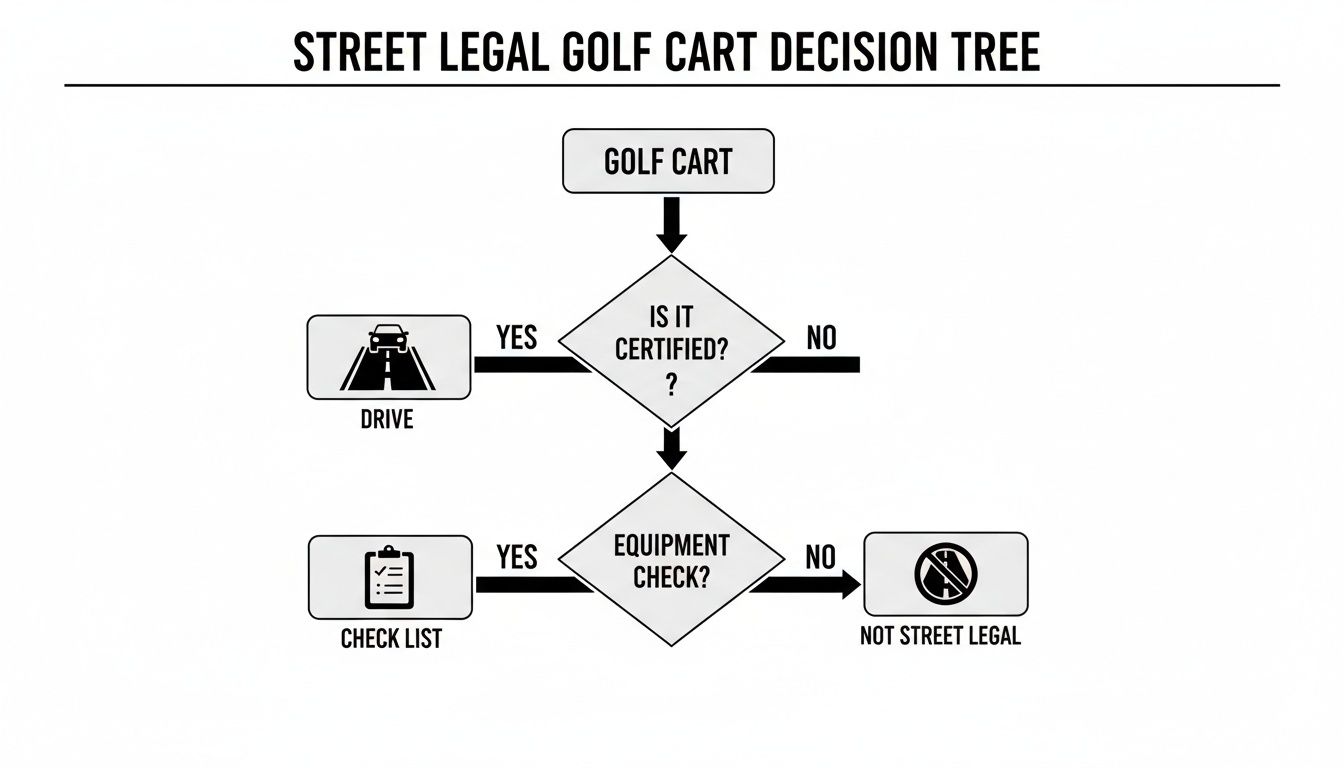
As you can see, the "no" path for a non-certified cart funnels you right into a detailed checklist. This is where the real work for a DIY-er begins.
After you've installed all the required gear, you have to schedule a formal inspection with a state-certified agent, and these inspections are known for being tough. If just one part fails—maybe you used the wrong type of mirror, or your horn isn't quite loud enough—your application gets rejected, and it's back to the drawing board. If you're serious about this route, your first step is understanding everything that comes in a golf cart street legal kit.
Only after passing this rigorous inspection will you be assigned a state-issued VIN. Without that VIN, your custom cart is legally confined to your own property, forever. The whole ordeal can be time-consuming and frustrating, demanding a ton of patience and an obsessive eye for detail.
A Head-to-Head Comparison
To make the decision a bit clearer, let's break down how these two options stack up against each other.
Factory-Built LSV vs. DIY Golf Cart Conversion
| Consideration | Factory-Built LSV | DIY Conversion |
|---|---|---|
| VIN Assignment | Comes with a 17-digit VIN from the manufacturer | Must pass a state inspection to be assigned a VIN |
| Legal Compliance | Guaranteed to meet all federal and state safety standards | Your responsibility to source and install compliant parts |
| Registration Process | Simple and straightforward, like a regular car | Complex and requires passing a rigorous inspection first |
| Upfront Cost | Higher initial investment | Potentially lower, especially if using a pre-owned cart |
| Effort & Time | Minimal effort; drive it home from the dealer | Significant time for research, parts sourcing, and installation |
| Warranty | Includes a manufacturer's warranty for parts and labor | No warranty; you are responsible for all repairs |
| Safety Assurance | Professionally engineered and tested for safety | Relies entirely on the quality of your own work and parts |
| Resale Value | Generally higher and easier to sell | Can be lower and more difficult to sell without clear certification |
Ultimately, choosing a factory-built LSV is the safer, more reliable bet if your priority is getting on the road quickly and without hassle. The DIY path is best suited for experienced hobbyists who enjoy the process and are prepared for the regulatory hurdles.
Making the Final Call
In the end, the choice between buying a factory LSV and building your own comes down to what you value most: cost, convenience, or certainty. A factory-built model is your ticket to a safe, compliant, and stress-free experience, all backed by a solid warranty. A DIY project offers the allure of savings and customization, but it puts the entire weight of compliance and safety on your shoulders.
Think carefully about your budget, your timeline, and your tolerance for dealing with red tape before you decide which road to take.
Smart Buying Tips for Your New Cart
Alright, this is where the fun really starts—shopping for your new ride. But getting it right from the start means you’ll have a cart you love for years, not one that gives you a case of buyer's remorse.
A little planning goes a long way. We're going to walk through the big decisions, from what powers your cart to how many people you can bring along for the ride. Think of this as your pre-flight checklist before you make a commitment.
Powering Your Decision: Battery Choices
The heart and soul of any electric cart is its battery, and you've got two main choices: the old-school standard or modern tech. This decision will impact everything from performance and maintenance to your long-term costs.
-
Lead-Acid Batteries: These are the traditional, budget-friendly option. Their lower upfront cost is tempting, but it comes with trade-offs. They're heavy, need regular upkeep (like checking water levels), and you'll likely replace them every 2-5 years.
-
Lithium-Ion Batteries: This is the premium choice for a reason. Lithium batteries are lightweight, require zero maintenance, and charge up way faster. They also deliver consistent power and last a lot longer—often up to 10 years. That longer lifespan can actually make them the more economical choice over time.
So, how do you choose? If you're planning on long, frequent cruises around the neighborhood, the hassle-free performance of lithium-ion is probably worth the investment. For more casual, occasional use, lead-acid can get the job done.
Assessing Your Real-World Needs
Beyond the battery, it's time to get honest about how you're actually going to use this cart. It's easy to get wowed by all the bells and whistles, but the best cart is the one that fits your life perfectly.
First, think about distance. How far is it to the community pool, the local grocery store, or your friend's place down the road? Figure out your typical daily mileage and pick a cart with a range that easily covers it. You don't want to be sweating it out, wondering if you'll make it home.
Next, do a headcount. Is it just for you and your partner? Or will you be shuttling kids, grandkids, or friends? A two-seater is great for a couple, but a four- or six-seater is a must if you're the social hub of the neighborhood.
The total cost of ownership goes far beyond the initial sticker price. Factoring in future battery replacements, insurance, and potential maintenance gives you a much clearer picture of the long-term financial commitment.
Getting the full financial picture is key. For a deep dive into all the costs involved, check out our guide on how much a golf cart costs.
Test Drives and Inspections
You wouldn’t buy a car without taking it for a spin, right? The same logic applies here. A test drive is the only way to feel how a cart accelerates, how the brakes respond, and whether the steering feels tight or sloppy. Listen for any weird squeaks, rattles, or hums—they could be telling you something.
If you're eyeing a used model, put on your inspector's hat. A thorough once-over is non-negotiable. Look for red flags like rust on the frame, corrosion around the battery terminals, or uneven tire wear, which can signal alignment problems. Exploring options like refurbished golf carts can be a great way to find value, but that inspection is just as critical.
And finally, always ask about the warranty. On a new cart, a solid warranty is a sign the manufacturer has confidence in their product. Make sure you understand exactly what it covers and for how long. It's your peace of mind.
Your Action Plan for Hitting the Road
So, you've done your homework. You know what separates a basic fairway cruiser from a road-ready Low-Speed Vehicle. Now, let’s turn that knowledge into a practical, step-by-step plan to get you from the showroom floor to your first neighborhood cruise.
This simple roadmap is designed to take the guesswork out of the process. Follow these steps in order, and you’ll avoid the common pitfalls and headaches that can pop up, ensuring your journey to owning a street legal golf cart is a smooth one.
Your Five-Step Ownership Roadmap
1. Start With Your Local Laws
Before you even think about colors or models, your very first move should be a call to your local DMV or city hall. This is non-negotiable.
You need to ask about their specific rules for Low-Speed Vehicles (LSVs). What roads can you legally drive on? Are there unique speed limit restrictions in your area? Do they require any special equipment beyond the federal standards? The answers you get here will shape every other decision you make.
2. Figure Out Your Needs and Budget
Get a clear picture of what you'll actually be doing with your cart. Is it for quick trips to the community pool, or will you be covering more ground? Will it just be you and a partner, or are you hauling the whole family?
Thinking through these questions helps you nail down what you need in terms of battery range, seating, and storage. From there, you can set a realistic budget that covers not just the cart itself, but also taxes, registration fees, and insurance.
3. Explore and Compare Your Options
Alright, now for the fun part: shopping. This is where you'll weigh the pros and cons of buying a factory-built LSV versus converting a standard golf cart yourself.
A purpose-built street legal golf cart from a trusted brand like Solana EV comes with guaranteed compliance right out of the box. That means no inspection headaches and a solid warranty, which offers some serious peace of mind.
A test drive is your best friend in this process. It takes the decision off the spec sheet and into the real world, letting you feel how the cart actually handles, brakes, and rides on the road.
4. The All-Important Test Drive
Seriously, never buy a cart without driving it first. When you get behind the wheel, pay close attention to how it accelerates and how responsive the brakes feel. Listen for any weird rattles or noises, and double-check that every piece of safety gear—lights, horn, turn signals—is in perfect working order.
This is also your golden opportunity to grill the dealer. Ask them everything you can think of about routine maintenance, battery longevity, and exactly what the warranty covers.
5. Get the Paperwork Done
Once you've found the perfect cart, the last step is to make it officially yours. First, you'll need to get an insurance policy that meets your state's minimum liability requirements.
With proof of insurance in hand, you can head to the DMV to handle the title transfer and vehicle registration. They'll issue you a license plate, and just like that, you’ll be fully street-legal and ready to hit the road.
Got Questions? We’ve Got Answers.
Even after digging into the details, you probably have a few specific questions floating around. That’s perfectly normal. Let's tackle some of the most common things people ask when they're getting serious about buying a street-legal golf cart.
Do I really need a driver's license?
Yes, you absolutely do. Once a golf cart is street-legal, it's classified as a Low-Speed Vehicle (LSV), and the law views it just like any other car on the road. That means the person behind the wheel must have a valid driver's license.
In most places, a learner's permit won't cut it. This rule is all about safety—it ensures that anyone driving an LSV has passed the same tests and understands the rules of the road.
So I can drive it on any street, right?
Not quite, and this is a big one to remember. Street-legal golf carts are designed for neighborhood travel, not the open road. They are restricted to streets with posted speed limits of 35 miles per hour or less. Some local communities might even limit them to roads marked 25 mph.
Never, ever take an LSV onto a highway, freeway, or any other major road. It's incredibly dangerous and illegal. Always check your local city and state ordinances to know exactly where you're cleared to drive.
How fast do these things actually go?
Federal law is very specific here. To qualify as an LSV, a vehicle must be able to reach a speed of at least 20 mph, but it can't go faster than 25 mph.
This speed window is what allows them to safely mix with regular traffic on slower, local roads. It’s a core part of their legal and safety design.
What’s the damage for insurance?
Good news here—insuring a street-legal golf cart is usually much cheaper than insuring a car. The final cost depends on things like your driving record, where you live, and the coverage you choose, but most people find it very affordable.
On average, you can expect to pay somewhere between $100 and $400 per year for a solid policy. Your best bet is to call a few insurance agents and get quotes, making sure to mention you're insuring a federally-approved LSV.
Ready to find a stylish, compliant, and reliable LSV that’s ready for the road right from the factory? Explore the premium lineup at Solana EV and discover the perfect model for your community, resort, or dealership. Visit us at https://solanaev.com to see our vehicles and learn about our exclusive dealer opportunities.