
A street legal EV is a special type of electric vehicle, more formally known as a Low-Speed Vehicle (LSV), that's specifically designed for zipping around your local area. Unlike a typical electric car built for highways, these are federally regulated to travel between 20-25 mph and are meant for roads with speed limits of 35 mph or less.
Understanding What a Street Legal EV Really Is
When you hear "electric vehicle," your mind probably jumps to a Tesla gliding down the interstate. But the term street legal EV carves out its own incredibly practical niche. It's not about cross-country road trips; it's about mastering your local environment in a smarter, more sustainable way.
Think of it like this: you wouldn't use a massive semi-truck to run to the corner store, right? You'd grab something smaller and more convenient. A highway EV is built for the open road, while a street legal EV is the perfect tool for short trips, getting around your community, and handling all those "last-mile" journeys.
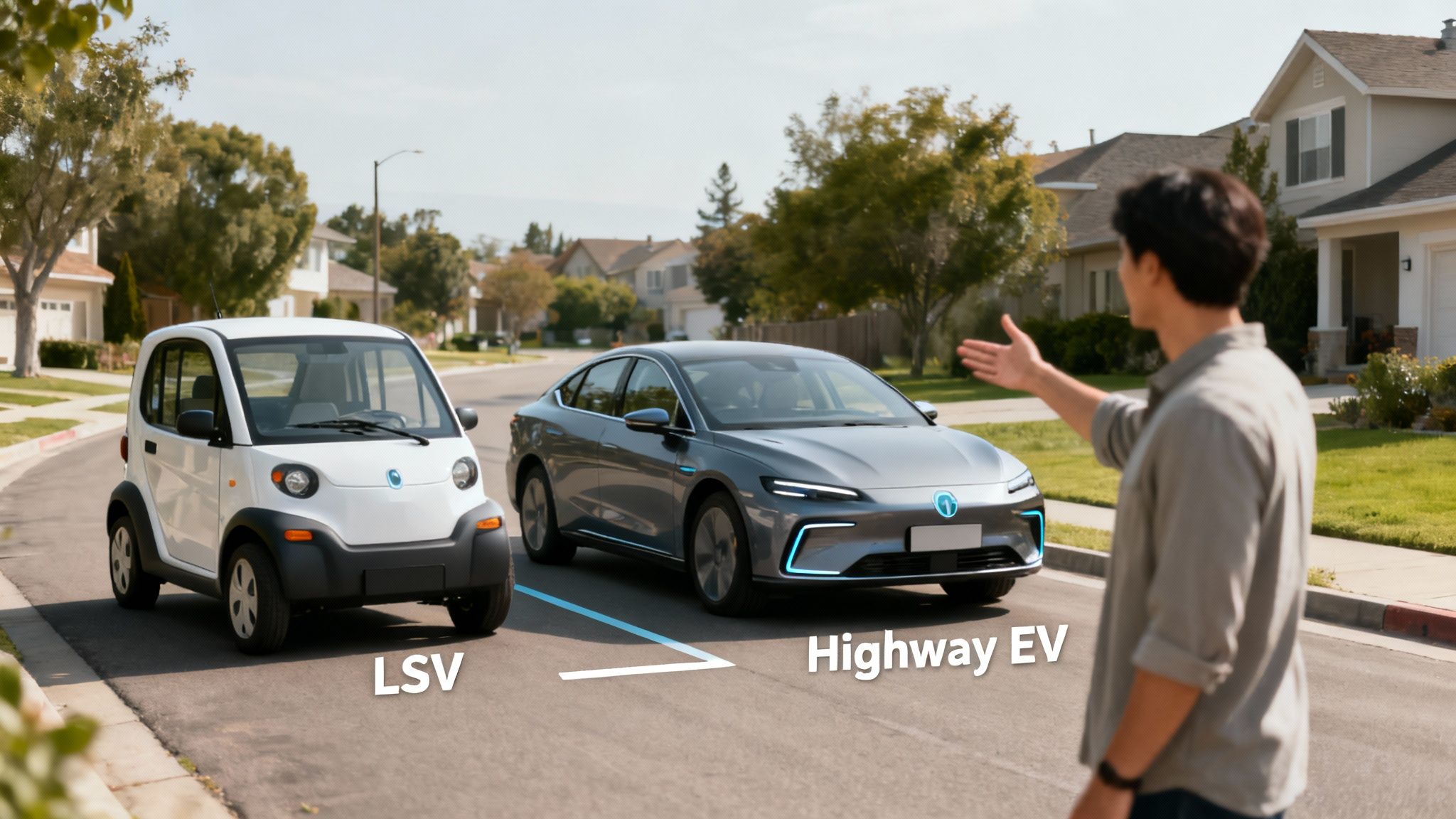
Key Distinctions And Classifications
The most common name you'll see is Low-Speed Vehicle (LSV), sometimes also called a Neighborhood Electric Vehicle (NEV). This isn't just a friendly nickname; it’s an official classification from the National Highway Traffic Safety Administration (NHTSA) under Federal Motor Vehicle Safety Standard (FMVSS) 500. For a closer look at the nitty-gritty details, you can learn more about what a low-speed vehicle is and the specific rules that apply.
To be federally certified and truly "street legal," an LSV has to meet a few key requirements:
- It must have a top speed between 20 and 25 miles per hour.
- It needs a proper 17-digit Vehicle Identification Number (VIN), just like a car.
- It must come equipped with essential safety gear, including headlights, taillights, turn signals, mirrors, and seatbelts.
Why does this federal stamp of approval matter? It’s what separates a legitimate, insurable, and registerable motor vehicle from a standard golf cart, which is only meant for private property like a golf course.
Standard EV vs. Street Legal EV at a Glance
Getting a handle on the operational differences is the first step to figuring out which vehicle is right for you. A standard EV gives you range and power for any road, but a street legal EV offers unbeatable convenience and incredibly low running costs for all your local trips.
This table puts the key differences side-by-side.
| Feature | Standard Highway EV (e.g., Tesla Model 3) | Street Legal EV (LSV/NEV) |
|---|---|---|
| Top Speed | 100+ mph | 20-25 mph |
| Permitted Roads | All public roads, including highways | Roads with speed limits of 35 mph or less |
| Primary Use Case | Commuting, long-distance travel | Local errands, campus transport, resort use |
| VIN and Title | Yes, full vehicle registration | Yes, required for legal road use |
| Required Safety Gear | Full federal safety standards (airbags, etc.) | FMVSS 500 standards (lights, signals, belts) |
This clear separation in design and purpose ensures that each vehicle excels where it's supposed to. A street legal EV isn't just a "lesser" version of a car; it's a specialized tool built for modern, local living.
Understanding the Rules of the Road for Your LSV
So, you know what a street-legal EV is, but what actually gives it the "legal" part of its name? It's not as simple as just slapping a motor on four wheels and calling it a day. There's a specific federal blueprint that manufacturers have to follow, and it’s called the Federal Motor Vehicle Safety Standard (FMVSS) 500.
Think of FMVSS 500 as the official rulebook for Low-Speed Vehicles (LSVs). It's the government's way of making sure every LSV sold in the country meets a baseline for safety and can be properly identified. This standard is what separates a true, road-ready LSV from a modified golf cart, and it's non-negotiable.
Your Vehicle's Must-Have Equipment
Under FMVSS 500, a whole list of safety features aren't just nice-to-haves—they're mandatory. These are the core components that make an LSV compliant right from the factory.
Here’s a practical checklist of what your vehicle absolutely must have to be considered a legitimate LSV:
- Headlamps, Tail Lamps, and Stop Lamps: Just like any car, your LSV needs to see and be seen, day or night.
- Turn Signal Lamps: You have to be able to tell other drivers what you're doing.
- Reflex Reflectors: These are required on the sides, front, and rear to make you more visible.
- Mirrors: You’ll need a rearview mirror and an exterior mirror on the driver's side.
- Parking Brake: A dedicated brake is required to keep the vehicle secure when parked.
- Windshield: This can't be just any piece of glass. It has to be AS-1 or AS-5 safety glazing to resist shattering.
- Seat Belts: Every seat needs a proper Type 1 or Type 2 seat belt.
Beyond the hardware, the single most important identifier is the 17-digit Vehicle Identification Number (VIN). Any legitimate, factory-built street-legal EV will have one, just like a Toyota or a Ford. This number is your key to getting registered, titled, and insured.
The presence of a 17-digit VIN is the clearest sign that you're looking at a true LSV, not just a modified golf cart. Without it, you cannot legally register the vehicle for road use.
The Operational Rules You'll Live By
Owning a street-legal EV also means playing by a different set of rules on the road. These vehicles were designed for a very specific environment, and the laws reflect that. The biggest one? Speed.
A federally compliant LSV must be able to hit a top speed of at least 20 mph, but no more than 25 mph. This speed cap is completely intentional. It keeps the vehicle in its intended environment—local, low-speed roads—and prevents it from becoming a hazard on faster-moving highways.
This brings us to where you can actually drive. Generally, you’ll be restricted to roads with a posted speed limit of 35 mph or less. Now, some states or even local towns might have slightly different rules, so it's always a good idea to check your local ordinances. To dive deeper into these nuances, our detailed guide on street legal golf cart requirements offers more specific insights.
Paperwork: The Final Piece of the Puzzle
The last step in getting your EV on the road involves the kind of paperwork you'd expect for any car, and this is where that VIN becomes absolutely essential.
You'll need three key documents:
- Title: This is the document that proves you own the vehicle. When you buy your EV, you’ll get a Manufacturer's Certificate of Origin (MCO), which you'll take to the DMV to be issued a title in your name.
- Registration: Just like any other car, your LSV has to be registered with your state. This is when you'll get your license plate and officially become road-legal.
- Insurance: You must carry at least the minimum liability insurance your state requires. Driving an LSV on public roads without it is just as illegal as driving an uninsured car.
Nailing down these federal and state rules is what lets you enjoy your street-legal EV safely and without hassle, completely changing the way you handle short trips and get around your community.
Discovering Where Street-Legal EVs Thrive
So, we've covered the rules of the road for a street-legal EV. Now, let's get to the fun part: seeing where these vehicles truly shine. They're not just a novelty; in the right environment, they’re the smartest tool for the job.
A Low-Speed Vehicle (LSV) isn't built for a cross-country road trip. Forget the interstate. Its real power is in mastering the local loop—the places where a full-size car is often just too much hassle. It’s all about convenience, efficiency, and being able to zip around with ease.
Think of it as the perfect vehicle for short, purposeful trips. The question isn't "how far can it go?" but "how smartly can I get around my neighborhood?" From private communities to bustling college campuses, street-legal EVs have found their sweet spot.
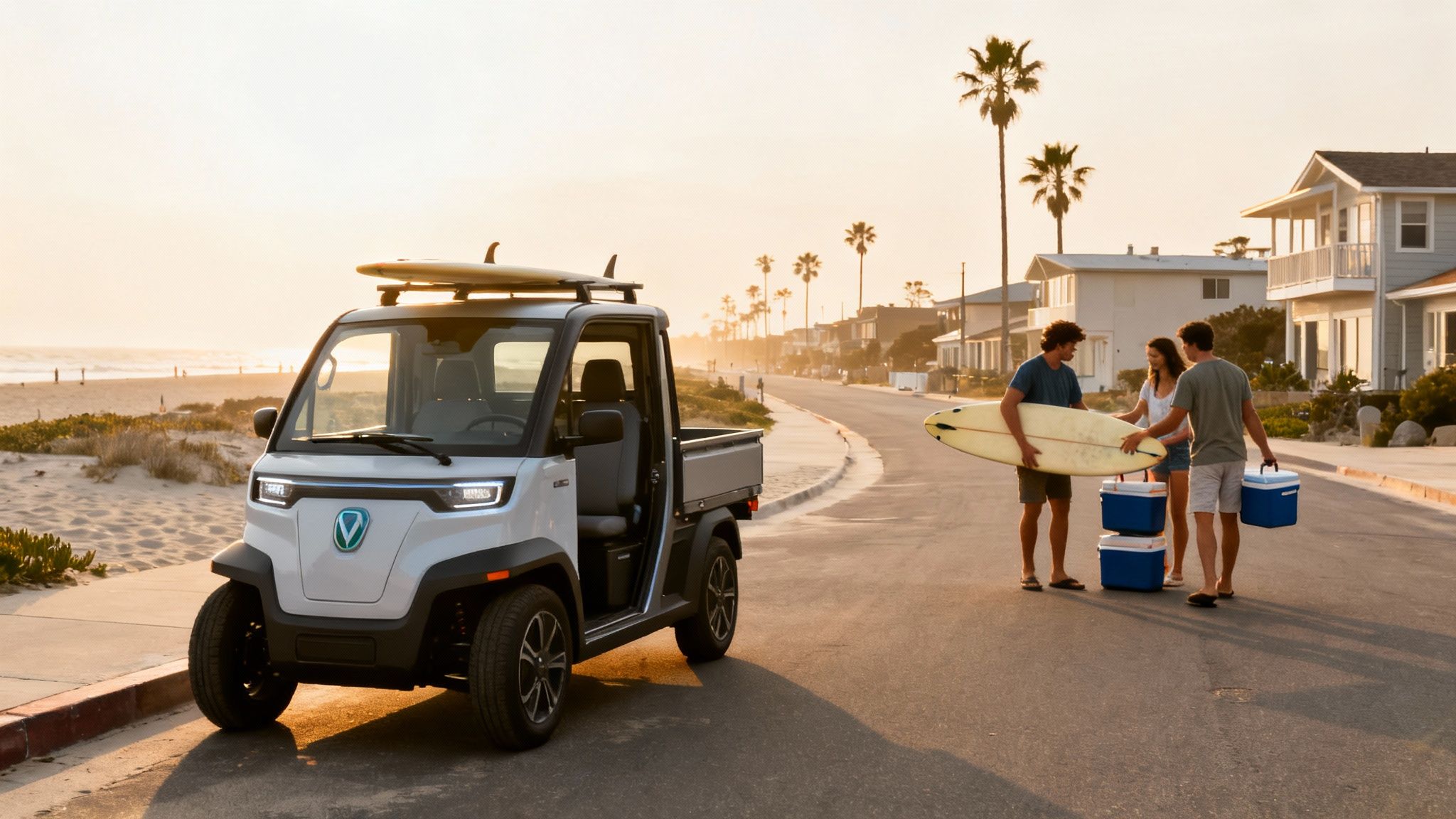
Mastering The Local Loop
The real magic of a street-legal EV happens within a small, familiar radius. This is that "local loop" of daily life where you're just running quick errands or visiting nearby spots. In these situations, a big car is often total overkill. This is where an LSV thrives—where trips are frequent, distances are short, and finding a parking spot feels like winning the lottery.
Here are a few classic examples where an LSV just makes life easier:
- Gated Communities and Retirement Villages: Popping over to the clubhouse, visiting friends down the street, or heading for a tee time becomes incredibly simple. Their quiet ride keeps the neighborhood peaceful, and you can park them just about anywhere.
- Sprawling University Campuses: Imagine facilities staff gliding silently between buildings to handle maintenance requests. An LSV lets them carry tools and supplies without the noise and emissions of a gas-guzzling truck, and they never have to hunt for a parking space.
- Large Resorts and Hospitality Properties: For guests, it's a breezy ride from the lobby to a secluded bungalow. For the grounds crew, it’s a nimble workhorse that helps them cover a lot of ground quickly and efficiently.
The secret weapon here is the rock-bottom operational cost. No gas stations, no oil changes, and barely any maintenance. Those savings really start to pile up over time.
The Ultimate Urban and Coastal Companion
Outside of private communities, the street-legal EV is a game-changer in two specific places: dense city centers and laid-back beach towns. Its design is the perfect antidote to the headaches of driving a regular car in these spots.
In a coastal town, a family can throw their towels, cooler, and boards in an LSV and snag a tight parking spot right by the beach—a spot an SUV could only dream of. The open-air feel is part of the fun, and a little sand is way easier to clean out of a durable EV than a car's plush interior.
It’s a similar story for city dwellers. A quick run to the farmer's market or the post office turns into a fun, simple trip instead of a white-knuckle search for parking. This nimbleness in tight spaces is a huge reason they’re becoming so popular. To get a feel for what makes these vehicles so great for these settings, it’s worth checking out a list of the best low-speed vehicles to see their features up close.
This laser focus on local travel is exactly what makes a street-legal EV such a practical choice for so many people. It's proof that the best vehicle isn't always the one that can do everything—it's the one that perfectly does exactly what you need it to.
Here’s a rewritten version of the section, crafted to sound more human and natural.
Why This Niche Market Is Quietly Booming
To really get why street-legal EVs are such a big deal, you have to look past your own driveway and see the bigger picture. These aren't just glorified golf carts. They're a key part of a massive global shift away from gas engines, and this specific niche is riding a powerful wave.
And this isn’t some slow, gradual change. It's an explosion. The entire electric mobility market is on a tear, jumping from $402.05 billion in 2024 to a projected $501.64 billion in 2025. By 2029? Forecasters see it hitting over $1,152.54 billion. That's a clear signal of where transportation is going. You can dig into the numbers yourself by checking out these electric mobility market trends.
This huge tide lifts all boats, creating the perfect environment for the street-legal EV market. As people get comfortable with electric power in their main car, they naturally start looking for an electric option for all those short, around-town trips, too.
The Forces Driving This Growth
So, what's lighting the fire under this market? It’s not just one thing. Think of it as a perfect storm of better tech, changing attitudes, and smart money all pointing in the same direction.
First and foremost, battery technology has completely changed the game. A decade ago, EV batteries were clunky, expensive, and didn't get you very far. Today, they're lighter, pack more punch, and cost a lot less to make. That progress alone has made street-legal EVs a practical, affordable choice for almost anyone, not just a novelty for the wealthy.
Then there’s the growing environmental consciousness we see everywhere. People genuinely want to reduce their carbon footprint, and swapping a gas-guzzler for a zero-emission EV to run errands is one of the easiest, most direct ways to do it. You’re literally helping clean up the air in your own neighborhood.
Finally, you can't ignore government incentives. The big federal tax credits usually get all the headlines for highway-ready EVs, but many states and even local towns offer their own rebates and tax breaks for Low-Speed Vehicles. These perks can take a serious chunk out of the initial cost, making the switch an easy financial decision.
Owning a street-legal EV is more than just a convenient way to get around. It's a forward-thinking move that lines up perfectly with the biggest trends in transportation today: sustainability, efficiency, and smart, local travel.
A Smart Investment in the Future
When you buy a street-legal EV, you’re not just getting a vehicle; you’re tapping into a smarter, more practical lifestyle. It’s a deliberate step away from the old one-size-fits-all approach to car ownership. Seriously, why burn gas and pay for oil changes on a two-mile trip to the grocery store?
These vehicles are built for how we actually live. A huge number of our daily trips are short and local, and you just don't need a 400-horsepower engine for that. This focus on right-sized, practical transportation is exactly why the street-legal EV market isn't just growing—it's booming. It's a quiet revolution that's changing how we move, one neighborhood at a time.
Your Essential Street Legal EV Buyer's Checklist
So, you're ready to get serious about buying a street-legal EV. That's great! But making the right choice is all about asking the right questions before you open your wallet. This checklist is your playbook—I’ve designed it to walk you through every critical detail, from boring-but-essential federal rules to the battery that actually powers your fun. The goal? To help you buy with total confidence.
Think of it like buying a house. You wouldn't just fall in love with the paint color; you'd get an inspection, check the foundation, and learn the neighborhood rules. We're going to apply that same common-sense approach here so you don’t miss a thing.
This simple flowchart is a great place to start. It helps you answer the very first question on your journey.
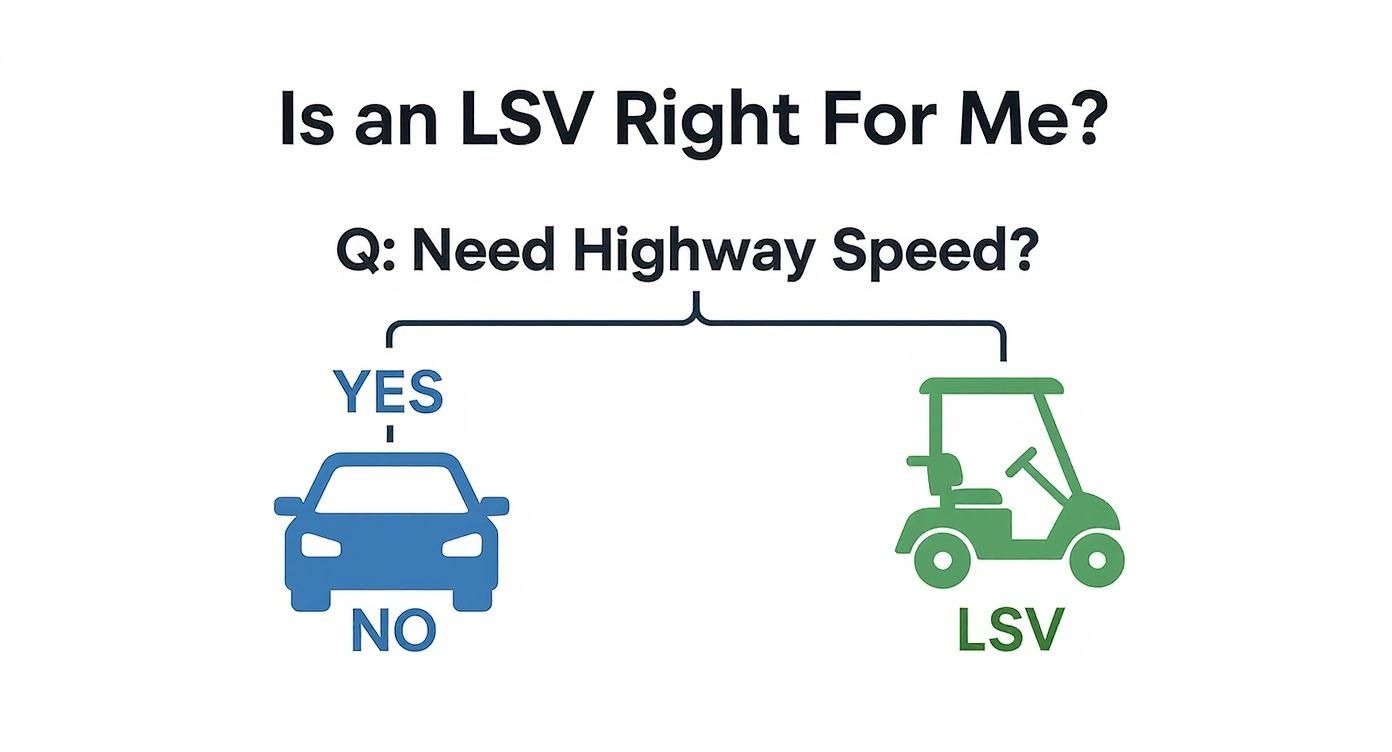
It quickly boils things down: if you need to drive on the highway, your decision is already made for you. If not, an LSV is a fantastic option worth exploring.
Verify Federal and Local Compliance
First things first, let's cover the non-negotiables. A true street-legal EV has to meet specific federal standards to be driven on public roads. This is the absolute bedrock of a smart purchase.
Your number one priority here is FMVSS 500 compliance. This is the federal standard that says the vehicle must have all the necessary safety gear—headlights, turn signals, seatbelts, a shatter-resistant windshield, and so on. Ask the dealer to show you the documentation proving the vehicle was built to meet this standard.
Next, find the 17-digit Vehicle Identification Number (VIN). You should see it on a little placard on the dashboard or stamped on the frame. A legitimate LSV will always have a VIN, which you'll need for registration, title, and insurance. If it doesn't have one, it's not a street-legal vehicle, period.
Crucial Tip: Don't just stop at the state level. Always, always check your local city or county ordinances. Some towns have specific restrictions on where LSVs can go, even if they are 100% legal according to the state.
Assess Your Power and Range Needs
The battery is the heart and soul of your EV. The type you choose directly impacts how it performs, how far it goes, and how much it costs you in the long run. You'll mainly see two options: old-school lead-acid and modern lithium-ion.
Here’s a quick breakdown to help you decide:
- Lead-Acid Batteries: This is the older, more budget-friendly technology. They’re heavy and require a bit of upkeep (like checking water levels), but the lower price tag is tempting. The trade-off is a shorter lifespan and less range.
- Lithium-Ion Batteries: This is the new gold standard, and for good reason. They are way lighter, totally maintenance-free, charge up faster, and give you a longer, more reliable range. While they cost more upfront, their long lifespan of up to 10 years often makes them the cheaper option over time.
Think about how you'll actually use the cart. If you just need to pop over to the community pool a few times a week, lead-acid might be perfectly fine. But for daily errands or longer trips around town, a lithium-ion battery is a much smarter investment for pure reliability and performance.
Evaluate Size, Payload, and Practicality
Beyond the tech stuff, you need to think about the vehicle’s physical size and what it can do. Start with the basics: how many people will you usually have with you? A two-seater is perfect for a couple, but a four- or six-seater model gives you way more flexibility for family outings or work tasks.
Next, look at the payload capacity. That's the total weight the vehicle can safely handle, including passengers and any gear you're hauling. If you plan on loading it up with beach chairs, gardening supplies, or tools, make sure the model you pick can handle the weight without straining the motor. For instance, some utility-focused models like the Solana F are built with a rugged bed specifically for these kinds of jobs.
Finally, consider storage and add-ons. Do you need a cargo bed? A roof rack for paddleboards? Weather enclosures for rainy days? Choosing a brand with a good variety of accessories means you can customize your EV to fit your life perfectly from day one.
Don't Overlook Warranty and Service
Your relationship with the dealer shouldn't end the moment you drive off the lot. A solid warranty and a good service plan are your safety net for long-term peace of mind.
Before you sign any paperwork, make sure you ask these questions:
- What exactly does the manufacturer's warranty cover? Get the details on how long it lasts and which parts are included (powertrain, battery, electronics, etc.).
- Does the dealer offer their own service promise? Some of the best dealers stand behind their sales with their own warranty, which is a huge plus.
- Where do I take it for service? Make sure the dealer has a real service department with technicians who are actually trained to work on these vehicles.
- How easy is it to get parts? A good brand has a reliable supply chain, so you won't be stuck waiting for weeks for a simple repair.
Picking a dealer with a great local reputation for service and support is every bit as important as picking the right vehicle itself. It's the final piece of the puzzle to ensure your street-legal EV is a source of fun, not frustration, for years to come.
Beyond the Purchase: Ownership and Opportunities
Driving your new street legal EV home is really just the beginning. Once the initial thrill wears off, you're left with the day-to-day experience of owning it. The good news? It’s a refreshingly simple reality.
This next chapter is about more than just your own convenience, though. It also unlocks some pretty interesting business possibilities. We'll get into both sides of the coin: the easy maintenance that keeps your EV running smoothly and the entrepreneurial opportunities that come with programs like the Solana EV dealership.
The Simplicity of Street Legal EV Maintenance
If you're used to the constant tinkering and check-ups required for a gas-powered car, prepare for a major sigh of relief. The maintenance routine for a street legal EV is refreshingly minimal because it just doesn't have all the complicated, greasy parts that cause the most trouble.
Say goodbye to oil changes, filter swaps, spark plugs, and surprise exhaust system repairs. Your new to-do list is much shorter, focusing on a few simple checks that keep your ride safe and reliable for years to come.
The heart of your EV is its battery, and taking good care of it is key to a long life—modern lithium-ion batteries can last for up to 10 years with the right habits.
- Charging Habits: Try not to let the battery drain to zero. It's much healthier to plug it in regularly, even after short jaunts around the neighborhood.
- Temperature Control: Extreme heat and cold can zap a battery's performance. Storing your EV in a garage or another sheltered spot makes a real difference.
- Proper Equipment: Having the right charging setup is a game-changer. It's worth looking into professional EV charger installation services to make sure your home or business is properly equipped.
Owning a street legal EV means swapping out complex engine work for simple electrical care. The result is significantly lower maintenance costs and more time spent enjoying the ride.
The rest of the maintenance checklist feels a lot like basic vehicle wellness.
- Tire Pressure: Check it monthly. Keeping tires properly inflated is the easiest way to maximize your range and make sure they wear down evenly.
- Brake Inspection: Get your brakes checked periodically. Since EVs use regenerative braking to slow down, the brake pads themselves get a lot less wear and tear, often lasting much longer than on a gas car.
- General Cleaning: A clean EV is a happy EV. Rinsing the undercarriage and keeping the body clean helps prevent corrosion and protects the electrical components.
This low-key upkeep is one of the biggest perks of owning an EV, saving you a surprising amount of time and money over the long haul.
An Opportunity for Entrepreneurs: The Solana EV Dealer Program
The growing excitement around the street legal EV lifestyle isn't just a win for buyers—it's also creating a fantastic opening for business owners. The Solana EV dealer program was built specifically for entrepreneurs ready to dive into this booming market and bring a high-quality mobility solution to their local communities.
Becoming a dealer is more than just a transaction. It's a genuine partnership with an established brand that gives you the framework and support to succeed. You get access to a full lineup of premium vehicles, from the nimble Solana XA to the tough Solana F, so you can meet the needs of all sorts of customers.
The program is designed to set you up for success with some serious benefits:
- Comprehensive Training: You and your team get expert training on every single model, so you can answer any question and provide top-notch service.
- Dedicated Support: You’re never on your own. A dedicated support system is there to help with everything from sales tactics to technical troubleshooting.
- Marketing Materials: Dealers receive a full suite of professional marketing resources to help build awareness and attract customers in their area.
This partnership offers a clear runway into a high-growth industry, letting you be the one to introduce a stylish, sustainable, and incredibly practical way to get around. It's a chance to build a business that's truly plugged into the future of local transportation.
Got Questions About Street Legal EVs? We've Got Answers.
Even after digging into the details, you probably still have a few questions about making the jump to a street legal EV. That’s completely normal. Here are some quick, no-nonsense answers to the questions we hear all the time.
Can I Just Make My Own Golf Cart Street Legal?
The short answer is almost always no. To be a true Low-Speed Vehicle (LSV), a vehicle has to be built from the very beginning to meet a specific set of federal safety rules known as Federal Motor Vehicle Safety Standard (FMVSS) 500. Standard golf carts just aren't designed with that kind of structural integrity or safety equipment in mind.
The biggest hurdle is that a true LSV comes with a federally issued 17-digit VIN right from the factory. While you might see aftermarket kits for sale, they don't change the fact that the original vehicle wasn't built to these strict standards. Trying to convert one is a risky path that usually ends in a dead-end when you try to get it legally registered and insured.
What Kind of Insurance Do I Need?
Since a street legal EV is a registered motor vehicle, you'll need a standard auto insurance policy, just like you would for your car. At a minimum, nearly every state requires you to carry liability coverage. This is what covers any damage you might cause to another person or their property if you're in an accident.
You might also need collision and comprehensive coverage, especially if you have a loan on the vehicle. The best move is to talk directly with your insurance agent and let them know you’re insuring an LSV to make sure you have the right policy.
Just a heads up: Driving an LSV on public roads without the proper insurance is illegal. It comes with the same serious penalties as driving any other uninsured car.
How Far Can I Actually Go on a Single Charge?
This is the big one! The range of a street legal EV typically falls somewhere between 20 and 50 miles on a full battery. But that number can swing quite a bit depending on a few key things.
The type of battery makes a huge difference, as does the total weight you're carrying, the hills you’re climbing, and even how you drive. For example, vehicles with modern lithium-ion batteries will pretty much always give you a longer range and charge up faster than the older lead-acid style.
Ready to see how a street legal EV can fit into your life? The team here at Solana EV would love to walk you through our lineup of premium LSVs and answer any other questions you have. Take a look at our models and find your perfect ride today at https://solanaev.com.