
When most people hear the term "motorized cart," they probably picture someone cruising down a fairway. But the real utility of these vehicles goes way beyond the golf course. They've become indispensable tools in countless commercial settings, boosting efficiency and cutting down on back-breaking manual labor.
These aren't just beefed-up golf carts; they're purpose-built vehicles designed to be the backbone of a modern operation.
Moving Beyond the Golf Course
Let's clear the air: the world of utility carts is a universe away from recreational golf carts. These machines are the unsung heroes of productivity, engineered from the ground up to be versatile workhorses. Their entire purpose is to haul gear, move teams, and make daily tasks easier across sprawling campuses, busy industrial sites, and massive commercial properties.
Think of them less like a golf cart and more like a compact, specialized truck. A delivery van is built for city logistics, and a dump truck is for construction sites. In the same way, a utility cart is engineered for the specific challenges of a particular environment, focusing on practical things like payload capacity, durability, and operational range.
To give you a clearer picture, let's break down the main categories you'll encounter.
Key Utility Cart Categories at a Glance
This table offers a quick summary of the primary types of motorized utility carts and their most common applications, providing a clear overview.
| Cart Type | Primary Power Source | Common Payload Range | Ideal Use Case |
|---|---|---|---|
| Burden Carriers | Electric | 1,000 – 4,000 lbs | Warehouses, manufacturing plants, moving heavy materials on flat surfaces. |
| Personnel Carriers | Electric or Gas | 500 – 1,200 lbs | Transporting teams across large campuses, resorts, or airports. |
| Street-Legal Carts | Electric | 500 – 1,000 lbs | Navigating public roads in planned communities, college towns, and resorts. |
| Off-Road/4×4 Carts | Gas or Electric | 800 – 1,500 lbs | Agriculture, hunting, construction sites, and challenging, unpaved terrain. |
Each type is a tool designed for a specific job. Choosing the right one starts with understanding your powertrain options.
Gas vs. Electric: A Strategic Choice
Deciding between a gas or an electric model isn't just about how you fill it up; it's a strategic decision that impacts everything from your budget to your daily workflow.
-
Electric Models: These are the quiet champions of the industry. Praised for their near-silent operation and incredibly low maintenance, electric carts are perfect for indoor use or in places where noise and fumes are a real problem, like resorts, hospitals, or university campuses. The running costs are almost always lower, thanks to cheaper "fuel" (electricity) and far fewer moving engine parts to worry about. If you're looking for an efficient workhorse, understanding what an electric utility vehicle can offer is a great starting point.
-
Gas Models: For pure, raw power and extended range, gas often takes the lead. These carts are great for heavy-duty towing and tackling demanding, hilly terrain. You also get the convenience of a quick refuel instead of a recharge cycle. The trade-off? They require more maintenance (think oil changes and engine checks) and produce noise and exhaust fumes.
The decision between gas and electric directly influences your fleet's environmental footprint, daily running costs, and maintenance schedule. It's the first major step in tailoring a solution to your specific logistical needs.
Ultimately, seeing these carts as essential equipment is key. They solve real-world problems by swapping out slow, inefficient manual labor for reliable, on-demand transport. That shift is fundamental to boosting productivity in any large-scale operation.
Decoding a Utility Cart's Core Components
When you're looking to invest in a motorized cart, it’s easy to get distracted by the shiny paint job. But to make a smart choice, you have to look under the hood. The real story of a cart's performance, reliability, and suitability for your job lies in its core components. Understanding what makes these vehicles tick is the difference between getting a dependable workhorse and a constant headache.
This is more important than ever. The global market for motorized carts is projected to hit USD 1.5 billion by 2025 and is expected to keep growing at a steady clip of around 7% annually through 2033. That growth is being driven by real-world needs in warehouses, on factory floors, and in healthcare facilities. It's a clear sign that understanding the tech behind these vehicles is crucial.
This diagram helps visualize how a utility cart’s fundamental design supports its main functions.
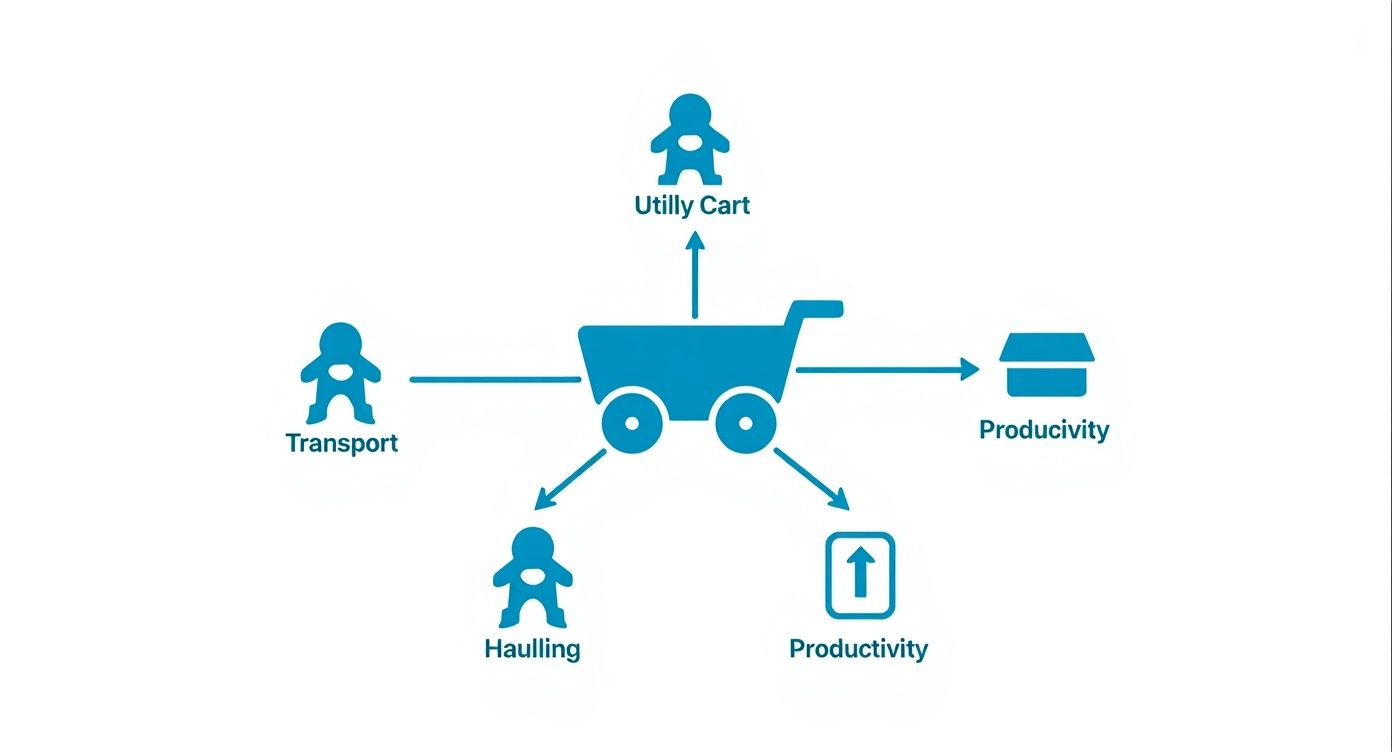
As you can see, everything branches out from its core purpose: transport, hauling, and productivity. Each of these jobs demands something different from the components working inside.
The Power Behind the Performance
At the heart of any electric utility cart is its motor, and trust me, they are not all created equal. The choice between an Alternating Current (AC) and a Direct Current (DC) motor has a huge impact on how the cart handles day-to-day work.
-
DC Motors: These are the old-school standard. They have a simpler design and a lower upfront cost, which is appealing. They give you solid torque right from a dead stop, but they tend to be less efficient at higher speeds and usually need more maintenance, especially with their brushes.
-
AC Motors: This is the modern go-to. AC motors are way more efficient, especially when accelerating or tackling hills. They run cooler, are virtually maintenance-free, and generally deliver a much smoother ride and better overall performance.
It's a lot like choosing between a standard car engine and a high-performance one. Sure, both will get you there, but the AC motor provides more punch with greater efficiency. To really get a feel for the engineering, you can learn more about what sets apart high-performance golf cart motors in our detailed guide.
The Backbone: Payload Capacity
Think of payload capacity as the cart’s structural backbone. It’s the absolute maximum weight—including your driver, passengers, cargo, and any accessories—that the cart can carry safely. Pushing past this limit isn't just bad for performance; it's a serious safety hazard.
Overloading a cart can lead to some nasty problems:
- Brakes that don't stop you in time.
- Poor, sloppy handling and steering.
- Serious strain on the motor and drivetrain.
- Permanent damage to the frame and suspension.
Always match the cart’s payload capacity to the heaviest jobs you have in mind. A landscaping crew hauling bags of soil and tools needs a far more robust rating than a cart just used for security patrols on a flat campus.
A cart’s payload rating is its promise of durability and safety. Ignoring it is like asking a sedan to do a dump truck's job—something is bound to break.
The Fuel Tank: Lithium vs. Lead-Acid Batteries
For an electric cart, the battery is the fuel tank. It dictates how far you can go, how long it takes to "refuel," and what your long-term costs will look like. The battle is really between two technologies: traditional Lead-Acid and modern Lithium-ion.
Think of it this way: lead-acid batteries are like the standard gas tank. They’re the classic, cheaper option upfront, but they're incredibly heavy, need regular maintenance (like topping off water levels), and have a shorter lifespan of around 3-5 years.
Lithium-ion batteries, on the other hand, are the high-performance fuel cell. They are significantly lighter, charge in a fraction of the time, and are completely maintenance-free. While they cost more initially, their 8-10 year lifespan often means a lower total cost of ownership in the long run.
Transforming Your Cart with Accessories
Finally, accessories are what turn a basic vehicle into a specialized tool for the job. The right add-ons can tailor the motorized carts utility perfectly to your daily operations.
Some of the most practical accessories include:
- Cargo Beds: Available in steel, aluminum, or durable plastic for hauling everything from supplies to yard waste.
- Tool Racks: Keep shovels, rakes, and other essential equipment secure and organized.
- Weather Enclosures: A must-have to protect operators from rain, wind, and cold, making the cart useful all year long.
- Hitches: Give your cart the ability to pull small trailers or other wheeled equipment.
These four elements—the motor, payload, battery, and accessories—all work in concert to define what a utility cart is truly capable of. Getting a handle on them is how you pick a vehicle that will genuinely move your operation forward.
Where Utility Carts Really Shine: A Look at Real-World Use
Knowing the specs of a utility cart is one thing, but seeing how they solve real problems is where their value truly clicks. These aren't just vehicles with a list of features; they're the workhorses that tackle logistical headaches everywhere from luxury resorts to sprawling university campuses. Their real magic happens when they blend seamlessly into the day-to-day rhythm of a business or institution.
Think about it: from the perfectly manicured grounds of a golf course to the rugged backroads of a farm, motorized utility carts replace hours of walking and manual hauling. They bring a quiet efficiency that lets your team focus on what really matters. Let's dive into a few places where these vehicles are absolutely indispensable.
Hospitality and Resort Operations
Picture a sprawling, high-end resort. The entire brand is built on tranquility and impeccable service. The last thing you want is a loud, gas-guzzling engine disrupting the peace. At the same time, staff can't be expected to cover acres of ground on foot. This is the perfect scenario for electric utility carts.
A fleet of whisper-quiet personnel carriers can shuttle guests from the main lodge to their secluded bungalows, enhancing the luxury experience. Behind the scenes, housekeeping crews use carts with enclosed cargo beds to move linens and cleaning supplies without being noticed. Meanwhile, the groundskeeping team uses carts with custom tool racks and dump beds to keep the property pristine, getting the job done in half the time without disturbing anyone.
The numbers back this up. The global electric golf cart market—a huge slice of the utility vehicle pie—was valued at USD 1.7 billion in 2024. It's projected to grow at a blistering 8.7% CAGR through 2034, largely because of how essential these vehicles have become for resorts and large properties.
In a resort setting, a utility cart is more than just transportation. It’s a crucial part of the guest experience. It helps deliver prompt service, maintains a peaceful atmosphere, and keeps the property looking its best—all things that lead directly to glowing reviews.
Campus and Institutional Efficiency
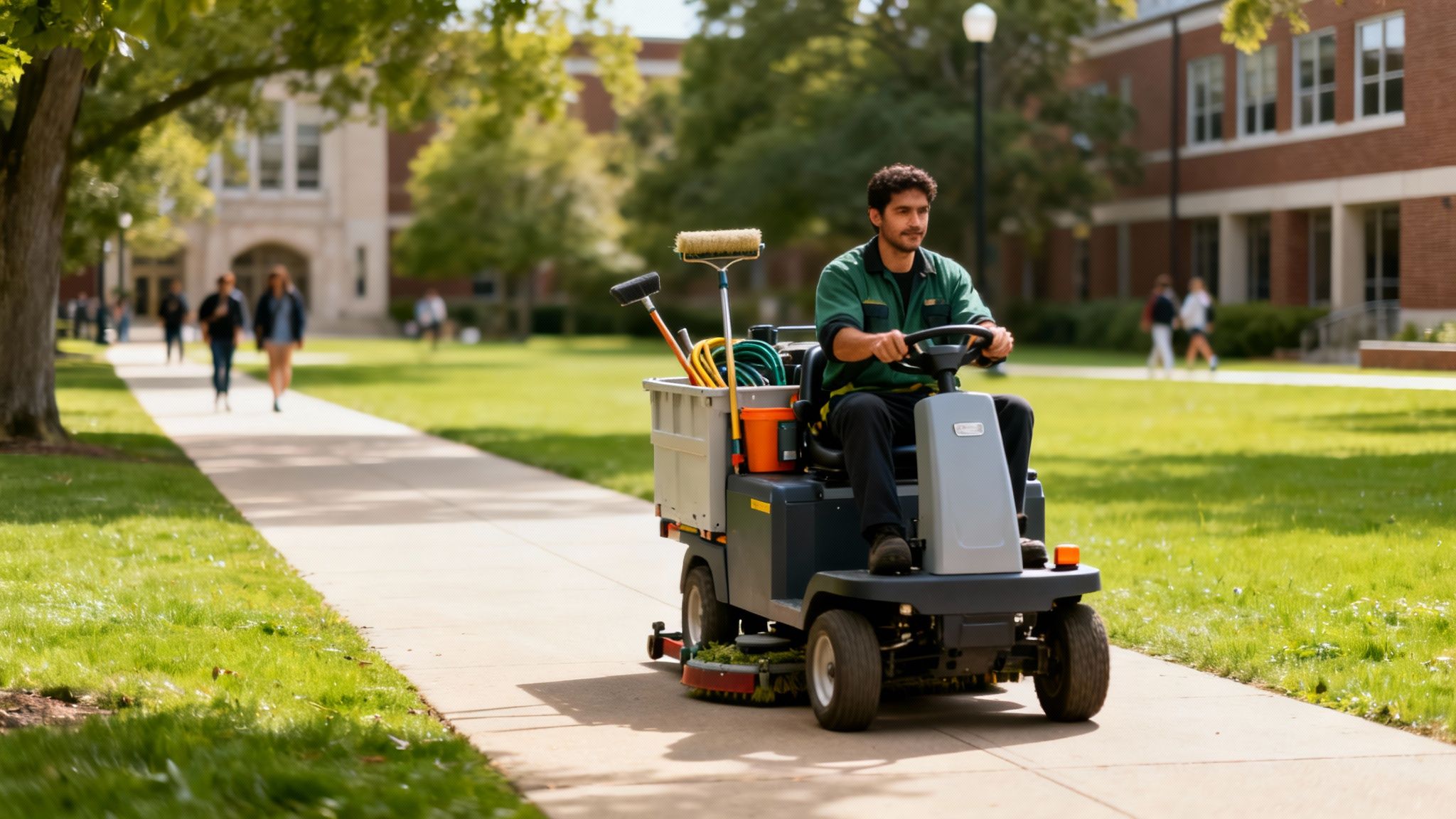
Think of a large university, a corporate park, or a hospital campus. They operate like small cities, with complex needs ranging from security patrols and mail delivery to constant maintenance requests across a huge area. Utility carts are the connective tissue that makes it all work smoothly.
Imagine a technician in the university's maintenance department gets a call. Instead of firing up a big, noisy truck to fix a leaky sprinkler in a pedestrian-only quad, they can jump in a compact electric work cart. They can navigate narrow pathways, pull right up to the job site, and have all their tools ready to go. Likewise, campus security can cover more ground, respond to calls faster, and maintain a friendly, visible presence.
- Maintenance Crews: Get to work orders quicker with all their tools and parts in tow.
- Security Patrols: Patrol more territory quietly and effectively, boosting visibility.
- Mail and Package Delivery: Smooth out the internal logistics of getting items between buildings.
- Event Support: Easily move everything from sound equipment to chairs for campus events.
This is exactly where specialized electric work carts prove their worth, boosting efficiency across the board. They cut response times, slash fuel costs, and minimize disruptions in busy environments.
Rugged Industrial and Agricultural Use
Don't think for a second that these carts are only for paved paths. Out in tougher settings like construction sites, warehouses, and farms, they show off their true grit. On a farm, a heavy-duty utility cart with a reinforced bed can haul feed, fencing supplies, and tools across muddy fields and bumpy trails without breaking a sweat.
Inside a cavernous warehouse, electric burden carriers are the unsung heroes, moving heavy pallets and inventory from the loading dock to the right aisle—all with zero emissions, making them safe for indoor use. On a construction site, they're perfect for zipping personnel, small equipment, and materials through tight spots where a full-sized truck could never go. This kind of versatility makes them an essential tool for getting real work done in demanding environments.
Your Essential Motorized Cart Buying Checklist
https://www.youtube.com/embed/uLgB6p0dN98
Picking the right motorized utility cart isn't just another purchase—it's an investment in how smoothly your entire operation runs. With a sea of models and specs to sift through, it's easy to get bogged down. Think of this checklist as your field guide, helping you cut through the noise, ask the right questions, and find a vehicle that’s a perfect match for your work.
Our goal is to get you from a place of guesswork to a confident, informed decision. By carefully weighing what you need against what a cart can do, you'll end up with a genuine workhorse, not just another piece of equipment. Let's walk through the must-ask questions before you buy.
What Is the Primary Task and Required Payload?
First things first: what’s the cart's main job? Will it be hauling hefty materials across a job site, shuttling a maintenance crew and their tools, or simply making security rounds on a large property? The answer points directly to your ideal payload capacity—the total weight of people and cargo the cart can safely handle.
A classic mistake is to underestimate your load. Don't just think about the average day; plan for the heaviest one. Tally up the weight of your crew, their tools, and any supplies they might carry, then add a 15-20% buffer. This simple step prevents you from constantly redlining the vehicle, which saves the motor, suspension, and brakes from early retirement.
For example, a light-duty patrol cart might only need an 800 lb capacity, but a vehicle destined for warehouse logistics could easily require 2,500 lbs or more.
What Kind of Terrain Will It Cover Daily?
The ground your cart will cover is just as critical as the load it carries. Is it destined for a life on smooth, paved campus pathways, or will it be rumbling over gravel roads, grassy hills, and uneven dirt? The terrain is what really decides the hardware you need.
- Suspension: On flat, predictable surfaces, a standard suspension will do the job. But for anything rougher, you’ll want a heavy-duty setup, ideally with independent front suspension to soak up the bumps and keep the ride stable and safe.
- Tires: Pavement-friendly tires are designed for efficiency on hard surfaces. If your cart is going to see dirt, mud, or wet grass, you absolutely need all-terrain or off-road tires with deeper, more aggressive treads for traction.
- Ground Clearance: More space between the cart's belly and the ground means less risk of getting hung up or damaged by rocks, curbs, and other obstacles.
Putting a cart built for pavement onto a rugged construction site is just asking for trouble. Be honest about the toughest conditions it will face, not just the easiest.
Your cart's terrain capability is its foundation for reliability. Matching the suspension and tires to your environment prevents costly repairs and ensures consistent, safe performance no matter the conditions.
What Are Your Range Needs and Charging Options?
When it comes to electric carts, "range anxiety" isn't just for car owners—it’s a real headache for operations managers, too. You have to know how far a cart can go on one charge and whether that fits into your daily workflow. Start by figuring out the total distance your vehicles need to cover in a typical shift.
Dive into the battery specs. A standard lead-acid battery pack might give you a 20-30 mile range, which is perfectly fine for many jobs. However, a modern Lithium-ion battery can easily double that to 50-60+ miles, charges a whole lot faster, and lasts for many more years.
Next, think about charging logistics. Do you have a central depot where the fleet can charge overnight? Or do you need the flexibility of "opportunity charging" during a lunch break? The battery and charger combination dictates how quickly a cart can get back in the game. A cart that’s always tethered to a wall isn't doing you any good.
To make this a bit clearer, here’s a table that breaks down how your needs might influence your choice of features.
Feature Comparison for Different Utility Needs
Choosing the right specs is a balancing act. A cart for patrolling a quiet campus has vastly different needs than one used for heavy-duty industrial work. This table will help you visualize how to match key features to your specific application.
| Specification | Light-Duty (e.g., Campus Patrol) | Medium-Duty (e.g., Groundskeeping) | Heavy-Duty (e.g., Warehouse Logistics) |
|---|---|---|---|
| Payload Capacity | 800 – 1,200 lbs | 1,200 – 1,800 lbs | 1,800 – 2,500+ lbs |
| Powertrain | AC Drive, standard power | AC Drive, high-torque | AC Drive, maximum torque for towing |
| Suspension | Standard leaf spring | Heavy-duty leaf spring, independent front | Reinforced, heavy-duty independent |
| Tires | Pavement / Turf | All-Terrain | Industrial / Puncture-Resistant |
| Ground Clearance | Standard | Moderate to High | High |
| Battery Type | Lead-Acid or Standard Lithium | Extended-Range Lithium | High-Capacity Lithium |
| Range | 20-30 miles | 30-50 miles | 40-60+ miles |
As you can see, there's no "one-size-fits-all" solution. The key is to be realistic about your daily demands to ensure you invest in a vehicle that’s built for the job you need it to do.
Where Can You Drive It? A Guide to Street-Legal and On-Site Rules
So, you've got a utility cart. Can you just hop in and drive it down the street? Not so fast. The rules of the road—and even the rules on your own property—can be a bit of a maze. Figuring out this legal landscape is the key to making sure your cart is a helpful tool, not a legal headache waiting to happen.
The biggest fork in the road is the difference between a standard utility cart and a true, street-legal Low-Speed Vehicle (LSV). Think of it this way: a standard cart is built for a controlled environment, like a resort or a warehouse floor. An LSV, however, is a different beast altogether. It's built and certified from the factory to meet specific safety standards so it can legally share the road with other cars.
What Makes a Cart a Street-Legal LSV?
For a cart to earn its LSV stripes, it needs to meet a strict checklist from the National Highway Traffic Safety Administration (NHTSA). These aren't just nice-to-have features; they're federally mandated safety equipment required for driving on public roads, typically those with a speed limit of 35 mph or less.
A factory-certified LSV will always come equipped with:
- Lights: Headlights, taillights, and turn signals are essential for being seen and letting other drivers know what you’re doing.
- Mirrors: You’ll need both rearview and side-view mirrors to keep an eye on traffic around you.
- Seatbelts: Every seat needs a seatbelt. No exceptions.
- VIN: Just like a car, every LSV has a unique Vehicle Identification Number for registration and titling.
- Speed Limits: An LSV is engineered to travel between 20 and 25 mph—no faster, no slower.
Here’s the critical takeaway: you can’t just bolt a light kit and some mirrors onto a standard golf cart and call it an LSV. It must be manufactured and certified as a Low-Speed Vehicle from the get-go to be legally registered and insured for road use.
Always Check Your Local Laws
Here's where it gets tricky. The rules for LSVs can change dramatically from state to state, and even from town to town. What's perfectly legal in one county might get you a ticket in the next.
Before you do anything else, your first stop should be your local Department of Motor Vehicles (DMV). Their website is your single best source for the official rules on registering, titling, and insuring an LSV in your area. A few minutes of research here can save you a world of trouble later on.
Rules of the Road for Your Own Property
Even if your carts never leave your property, you still need a game plan. Operating on a corporate campus, farm, or resort without clear guidelines is a recipe for accidents, confusion, and damaged equipment.
To keep things running smoothly and safely, consider putting these simple rules in place:
- Set On-Site Speed Limits: Post clear speed limits, especially in busy areas. A good rule of thumb is 5-10 mph where people are walking.
- Create Designated Paths: If you can, mark out specific lanes for cart traffic to keep them separated from pedestrians.
- Train Your Drivers: Make sure anyone who gets behind the wheel knows how to operate the cart safely and understands your site-specific rules.
- Establish Parking Zones: Don’t let carts become obstacles. Set up designated parking spots that keep them out of walkways and away from emergency exits.
A little bit of structure goes a long way. By creating a clear operating plan, you can ensure your carts are used safely and effectively, whether you're on a private path or a public street.
Calculating Your ROI and Building a Fleet Strategy
Buying your first motorized cart is a simple purchase. But scaling up to a fleet? That's a different ballgame. It's a strategic investment, and for any operations manager or business owner, the focus has to shift from the sticker price to the long-term value and efficiency gains these workhorses bring to your entire operation.
This isn't just a niche trend. The market for motorized carts is exploding, projected to jump from USD 1.5 billion in 2024 to a whopping USD 2.8 billion by 2033. Why? Because industries are getting smarter about logistics, and these vehicles are becoming the backbone of operational efficiency.
Looking Beyond the Sticker Price
The true cost of a utility cart has little to do with what you pay on day one. You need to think in terms of Total Cost of Ownership (TCO), which gives you the complete financial picture over the vehicle's entire life.
To figure out your TCO, you'll want to factor in a few key things:
- Acquisition Cost: This is the obvious one—the initial price tag, plus any accessories you need.
- Energy Costs: For electric carts, it's your electricity bill. For gas models, it's fuel. Spoiler alert: electric is almost always significantly cheaper to run.
- Maintenance Expenses: Here's where electric really shines. With far fewer moving parts, you can say goodbye to oil changes and engine tune-ups, which means a much smaller maintenance budget.
- Battery Replacement: This is a future expense for electric models, but it's a big one. A lead-acid battery might last 3-5 years, while a modern lithium-ion battery can go for 8-10 years or even more. That difference dramatically impacts your long-term TCO.
When you're ready to invest, exploring the best equipment financing companies can help you manage that initial acquisition cost. Financing lets you spread the expense over time, often making it possible to get higher-quality, lower-TCO models from the start.
Measuring Your Return on Investment
Return on Investment (ROI) is where the rubber meets the road. It’s the tangible proof that your investment is paying off by boosting productivity and slashing costs. Think of it as putting a dollar value on all the time and labor you're saving.
It can be as simple as this: a maintenance worker who used to spend 30 minutes a day walking between jobs can now get there in five. That reclaimed 25 minutes, every single day, is a direct productivity win.
The core of ROI calculation is simple: How much more work gets done now that your team isn't wasting time and energy on manual transport? That reclaimed time directly translates to labor cost savings and increased output.
To really measure your ROI, track a few key metrics before and after you deploy the carts:
- Time Saved: Tally up the total hours saved each week on travel and hauling materials.
- Labor Cost Reduction: Multiply those saved hours by your team's hourly wage. That's your direct cost savings right there.
- Increased Task Completion: Are your crews knocking out more work orders per shift? Track the numbers to prove it.
Smart Strategies for Fleet Deployment
Just buying a fleet of carts isn't enough; you have to manage them effectively to maximize that investment. A haphazard approach leads to dead batteries and downtime. A strategic one ensures your carts are always ready to roll.
1. Create a "Home Base"
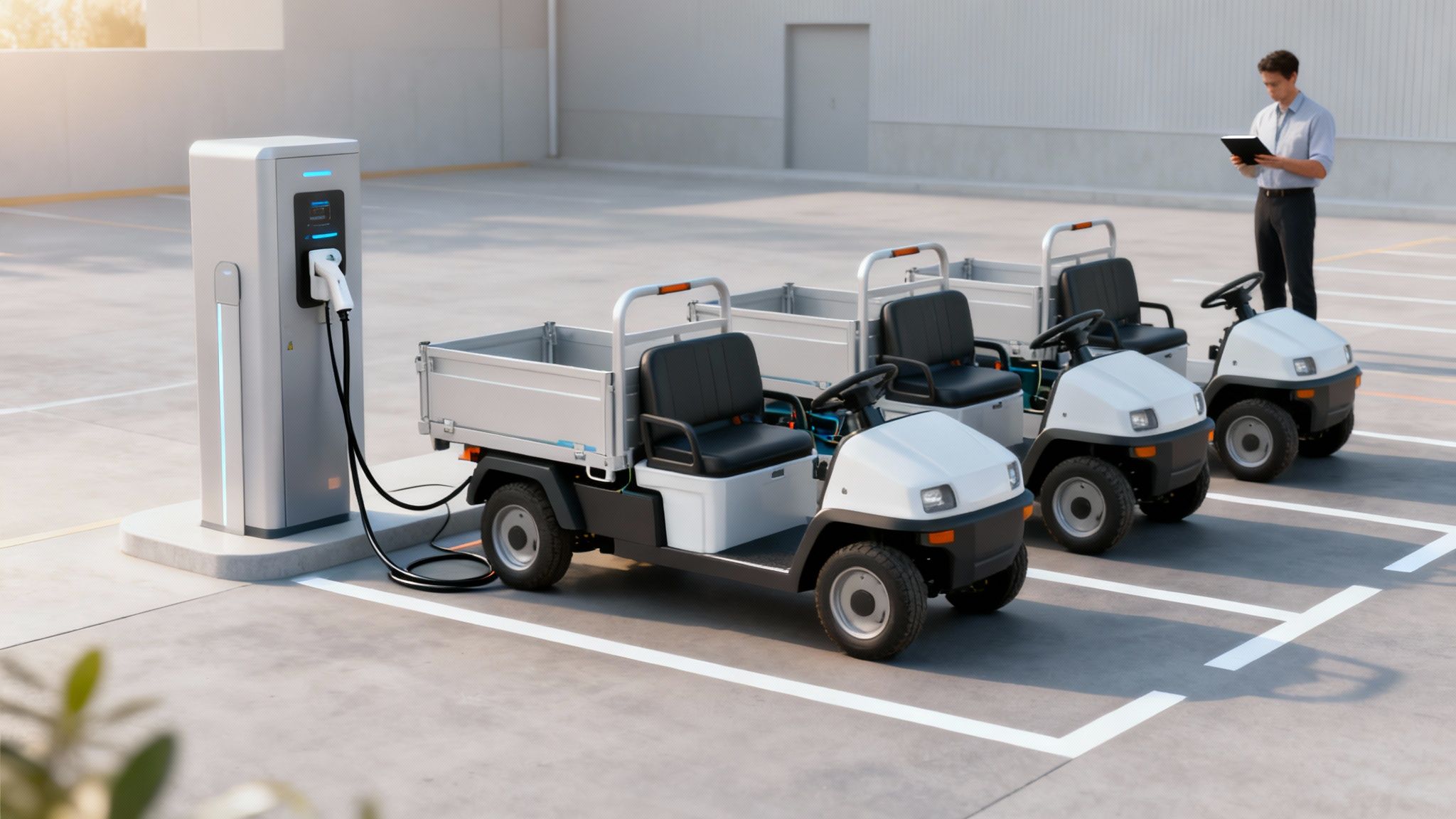
Designate a centralized spot for charging and parking. This simple step prevents carts from being left scattered and dead across your property. A central station makes overnight charging a breeze and ensures every vehicle is at 100% at the start of the day.
2. Get Ahead of Maintenance
Don't wait for something to break. Set up a proactive maintenance schedule for routine checks on tires, brakes, and batteries. This is the best way to minimize surprise downtime and seriously extend the life of your vehicles.
3. Train Your Team and Foster Ownership
Proper training is non-negotiable—it ensures your operators use the carts safely and correctly. Taking it a step further by assigning specific carts to certain teams or individuals often creates a sense of ownership. People tend to take better care of "their" vehicle and are quicker to report any issues, turning your fleet into a reliable asset that drives real results.
Common Questions About Utility Carts
Even after digging into the details, a few practical questions always come up when you're close to making a decision. Let's tackle some of the most common ones to clear up any lingering doubts.
How Long Will an Electric Utility Cart Actually Last?
This is a great question, and the answer really comes down to three things: the quality of the build, how hard you use it, and—most importantly—how you take care of it. A well-built electric cart that gets consistent, proper maintenance can easily be a workhorse for 10 to 15 years.
The battery is the heart of the machine and has the biggest impact on its longevity. If you're looking at a model with older lead-acid batteries, plan on replacing them every 3-5 years. The game-changer has been modern Lithium-ion batteries, which often last 8-10 years or even more, which makes a huge difference in the total cost of ownership. Beyond the battery, regular checks on the motor, frame, and brakes are what will get you that decade-plus of reliable service.
A cart’s lifespan isn’t a fixed date on a calendar; it’s a direct result of care and maintenance. Looking after the battery and powertrain is the single best way to ensure your cart serves you well for years to come.
Are Electric Carts Really Less Maintenance Than Gas Ones?
Absolutely. It's not even close. Electric utility carts are the clear winners when it comes to low maintenance, especially when you compare them to gas-powered buggies. The difference is night and day. With electric, you can forget about oil changes, spark plugs, fuel filters, and all the finicky engine parts that need constant attention. That simplicity saves you a ton of money on running costs and keeps your carts working instead of sitting in the shop.
For an electric cart, the main maintenance tasks are simple and preventative. You’re mostly just keeping an eye on things:
- Battery Care: Check the connections and make sure you're following good charging habits.
- Tires: A quick look at the pressure and tread wear is usually all it takes.
- Brakes: Periodically test them and check the pads for wear.
- Wiring: Just make sure all the connections are tight and clean.
This light maintenance load is honestly one of the strongest financial reasons to go electric with your fleet.
Can I Just Buy a Basic Cart and Make It Street Legal Later?
While that might sound like a clever way to save some money, trying to convert a standard, off-road utility cart into a street-legal LSV (Low-Speed Vehicle) is almost never a good idea. It’s a far more complex and expensive headache than you might think.
A vehicle that comes street-legal from the factory has been designed, built, and tested to meet strict federal safety standards. It includes things like DOT-approved lights, turn signals, mirrors, seatbelts, and a proper Vehicle Identification Number (VIN) so you can register it. Slapping a few aftermarket parts on a standard cart just doesn't cut it and won't get you past a legal inspection. For your own safety, and to stay on the right side of the law, always buy a vehicle that was certified as street-legal right from the manufacturer.
Ready to see what a premium, low-maintenance utility vehicle looks like? The Solana EV lineup is built from the ground up to be street-legal, reliable, and stylish—perfect for everything from managing a resort to keeping a campus running smoothly. Check out our models and find the right fit for your operation at https://solanaev.com.