
Upgrading your golf cart's motor is, without a doubt, the single biggest leap in performance you can make. It’s the difference between a gentle putt and a 300-yard drive. We're talking about transforming your cart from a basic utility hauler into a genuinely fun and capable machine.
Unleash Your Golf Cart’s True Potential
If you've ever felt that sinking feeling as your cart slows to a crawl on a steep hill or watched other carts zip by, a motor upgrade is what you're looking for. The best analogy is swapping the four-cylinder engine in a family sedan for a V8. The change in power, acceleration, and pure fun is something you feel instantly.
Stock motors are built for one thing: cruising around a flat golf course at a predictable, leisurely pace. They were never meant for the hills in your neighborhood, hauling gear, or keeping up with traffic.
This guide will break down everything you need to know to make this happen, starting with the tech that actually makes your cart go.
From Golf Path Cruiser to Neighborhood Powerhouse
A high-performance motor completely changes the personality of your cart. Forget that slow, gradual wind-up. Instead, you get a satisfying surge of power the second your foot touches the pedal. Hills that used to be a challenge are now just part of the ride.
This isn't just about raw speed, either. It’s about making your cart more useful and enjoyable every single day.
Here’s what you really gain with an upgrade:
- Serious Speed Boost: Ditch the standard 15 mph limit and cruise comfortably at 25 mph or more. Your cart suddenly becomes a legitimate neighborhood vehicle.
- Hill-Shredding Torque: A powerful motor delivers the raw grunt needed to climb steep inclines without losing steam, even when loaded with people or equipment.
- Snappy Acceleration: Get a much quicker jump off the line. It's a huge plus in any situation with frequent stops and starts.
- Real Towing Power: The extra muscle means you can pull heavier trailers and carts, turning your golf cart into a proper workhorse.
Think of the motor and controller as the heart and brain of your golf cart. A stock setup is designed for efficiency and predictability. An upgraded system is built for power, torque, and a far more exciting driving experience.
Your Roadmap to a Better Ride
Before you can enjoy the rush, it's crucial to understand that a great upgrade is about creating a balanced system, not just jamming in the biggest motor you can find. This guide will walk you through the key decisions, starting with the two main motor technologies—AC and DC—and covering the other parts you'll need to make sure your new setup is both fast and reliable.
By the time you're done here, you'll have the confidence to pick the right high-performance golf cart motor and the components to support it. You'll know exactly how to build a system that matches what you want to do, whether that's conquering hilly terrain, cruising your community, or just having a more responsive and fun cart to drive.
Choosing Your Powertrain: AC vs. DC Motors
When you decide to juice up your golf cart, you’ll quickly run into a major fork in the road: do you go with an AC (Alternating Current) or a DC (Direct Current) motor? This isn't really about which one is "better" overall, but which one is the right tool for the job you have in mind. Think of it like choosing between a classic muscle car and a modern sports car—both are seriously quick, but they get you there in completely different ways.
For the longest time, DC motors were the undisputed king of the golf cart world. They’re the old-school workhorses, known for delivering a satisfying, neck-snapping jolt of torque right off the line. Their simpler design makes them a more affordable and straightforward upgrade, especially if you’re mostly cruising on flat ground.
But these days, high performance golf cart motors are almost always AC. AC motors are the sophisticated new kids on the block, bringing better efficiency, smoother power, and less maintenance thanks to their brushless design. They are masters at turning battery power into forward motion, which usually means more range and better all-around performance, especially when the going gets tough.
The Classic Powerhouse: DC Motors
A DC motor pulls power straight from your battery pack. It uses a set of carbon brushes to pass electricity to the spinning part of the motor, creating the magnetic field that makes it go. It's this direct, raw connection that gives you that signature, off-the-line grunt.
For a lot of cart owners who stick to neighborhood streets or community paths, a good DC motor has more than enough punch to put a smile on your face.
They're a fantastic choice if you're looking for:
- Instant Torque: That punchy, immediate acceleration the second your foot touches the pedal.
- Good Value: DC motor and controller kits are generally easier on the wallet.
- Proven Simplicity: The design has been the reliable standard for decades, and it just works.
Of course, that simple, powerful approach has its trade-offs. Those carbon brushes are wear items, meaning they’ll eventually need to be replaced. DC motors also tend to be less efficient; they can generate more heat and chew through your battery faster than an AC motor, particularly when you’re pushing them hard.
The Modern Performer: AC Motors
AC motors work a bit differently. Your controller takes the DC power from the batteries, cleverly converts it into AC power, and then feeds it to the motor. This extra step gives the system incredibly precise control over speed and torque, resulting in a ride that feels noticeably smoother and more responsive. Best of all? No brushes, which means fewer maintenance headaches and a much longer lifespan.
The real magic of an AC system is its smart efficiency. It actively manages power to give you better performance, especially on hills, while also enabling cool features like regenerative braking that actually puts a little juice back into your batteries.
This blend of power and efficiency makes AC the clear winner for any demanding setup. If you've got a lifted cart, big oversized tires, or live anywhere with hills, an AC system will hold its speed and power up an incline in a way a DC motor just can't match.
The incredible demand for these powerful, efficient systems is a huge part of what’s driving the golf cart market. As more people use carts for getting around their communities, the industry has exploded. In fact, projections show the global golf cart market hitting USD 3.68 billion by 2035, driven by the shift toward low-emission vehicles. You can check out more about the golf cart industry's growth on futuremarketinsights.com.
This infographic gives you a good visual on where to start when thinking about an upgrade.
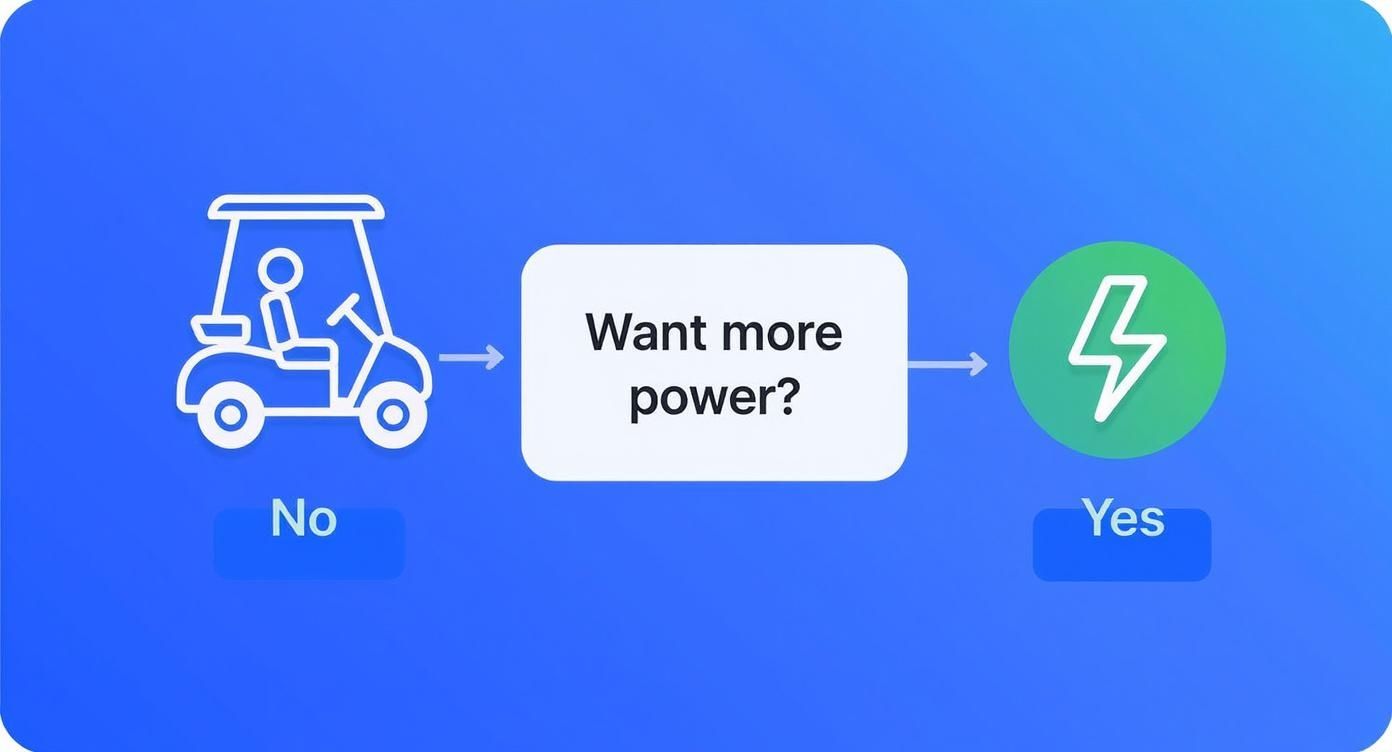
As you can see, it all starts with wanting more power. From there, you can follow the path to figure out which technology is the right fit for your cart and your driving style.
To make things even clearer, let's break down the key differences between these two motor types side-by-side.
AC vs DC High Performance Golf Cart Motors At a Glance
| Feature | AC (Alternating Current) Motors | DC (Direct Current) Motors |
|---|---|---|
| Performance | Smoother, more efficient power delivery. Excellent on hills and under load. | Strong, instant "off-the-line" torque. Best for flat terrain. |
| Efficiency | Higher efficiency means longer range and less battery strain. | Lower efficiency, generates more heat, and uses more battery power. |
| Maintenance | Brushless design means virtually no motor maintenance. | Brushes are a wear item and will require periodic replacement. |
| Cost | Higher initial cost for the motor and controller system. | More budget-friendly and a lower-cost entry into performance. |
| Key Feature | Regenerative braking capabilities (recharges battery on deceleration). | Simpler, proven technology that delivers raw, immediate power. |
| Best For | Lifted carts, hilly terrain, heavy loads, and maximum performance/range. | Neighborhood cruising, flat ground, and budget-conscious upgrades. |
Ultimately, whether you stick with the classic punch of a DC motor or go for the modern sophistication of an AC system, you're on the right track to building a cart that's a whole lot more fun to drive.
What Motor Specs Actually Mean For Your Ride
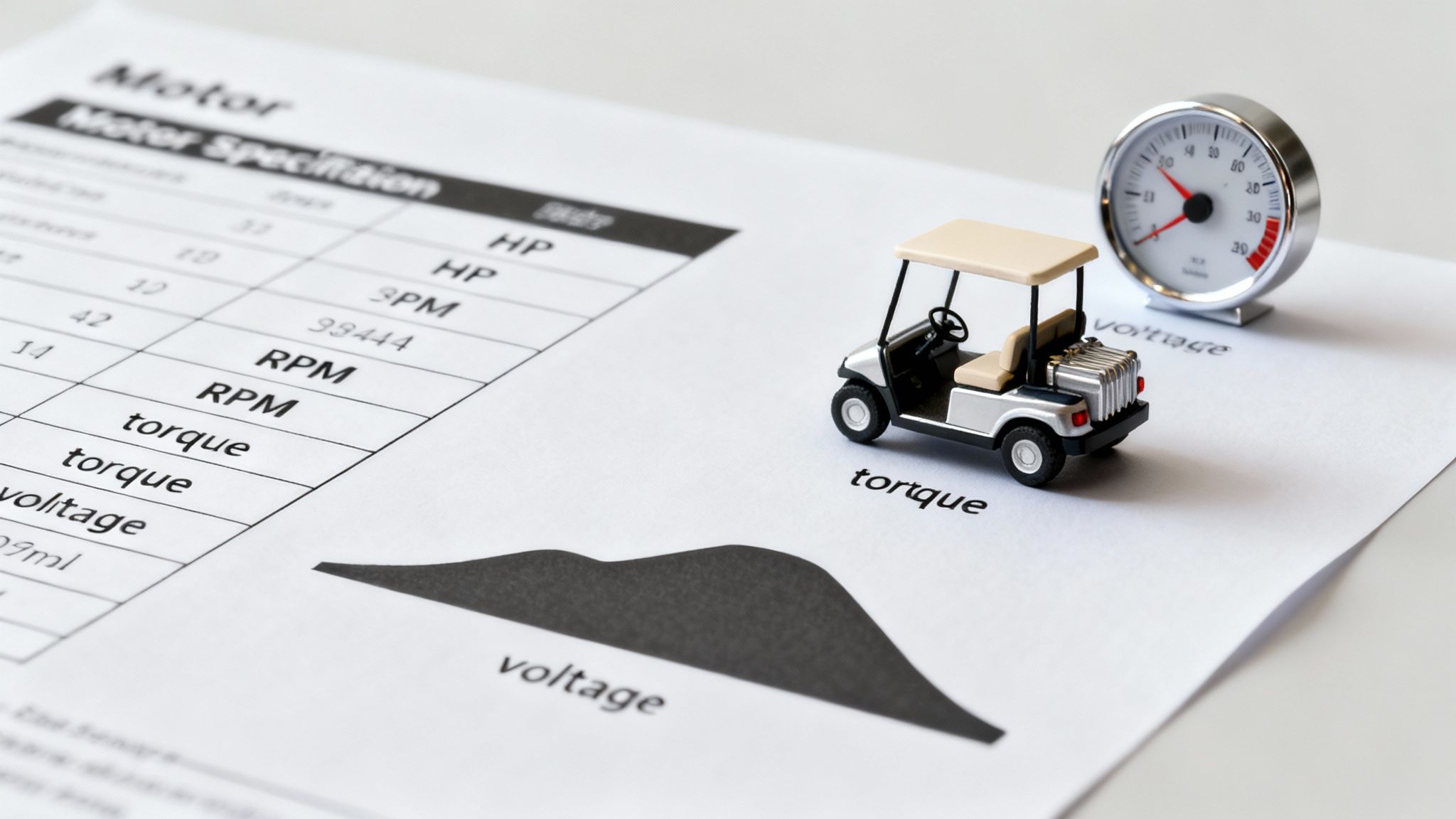
Staring at the spec sheet for a high performance golf cart motor can feel like you're trying to decode a foreign language. You see a jumble of terms like horsepower, torque, and RPM, but what do they actually mean for how your cart will handle? Let's break down the tech talk and connect it to the real-world performance you’ll feel behind the wheel.
Think of these numbers as the DNA of your cart's personality. They don't just describe what the motor is; they predict how it will behave on hills, off the line, and when you're gunning it down a long straightaway. Getting a handle on these specs is the secret to picking a motor that delivers the exact experience you're after.
Torque: The Secret to Climbing Hills and Quick Launches
If you care about raw, instant power, torque is the number you need to watch. It's the rotational force the motor generates—its pure, unadulterated muscle. Think of a powerlifter heaving a heavy barbell off the floor; that initial, brute-force lift is torque in action.
For a golf cart, high torque gives you two things you'll notice immediately:
- That "Throw You Back in Your Seat" Feeling: It's the satisfying jolt you get the moment you hit the pedal. More torque delivers a quicker, more aggressive launch from a dead stop.
- Unstoppable Hill-Climbing Power: This is where torque really flexes its muscles. It's what allows your cart to claw its way up steep grades without slowing down, even when loaded with passengers and gear.
If your daily drive includes plenty of hills or you just love that snappy, responsive feel, then a high-torque motor is non-negotiable. It’s the heart of a truly capable machine.
RPM: Your Ticket to a Higher Top Speed
If torque is the powerlifter, then RPM (Revolutions Per Minute) is the sprinter. This spec simply tells you how fast the motor's shaft can spin. That rotational speed is what ultimately sets your cart's top-end velocity.
A higher RPM rating translates directly to a higher top speed. Simple as that. A motor that can hit 6,000 RPM will push your cart faster than one that tops out at 4,000 RPM, all other things being equal. This is the key spec if your main goal is cruising down neighborhood streets without holding up traffic. For more tips, our guide on improving your golf cart speed covers other upgrades that complement a new motor.
The Classic Trade-Off: It's crucial to know that torque and RPM often have an inverse relationship. A motor built for monstrous, stump-pulling torque might have a lower top-end speed. Likewise, a high-RPM motor built for pure velocity might feel a little sluggish off the line. The magic of a great high-performance motor is finding that perfect balance between the two.
Horsepower and Voltage: The Big Picture
So, where does horsepower (HP) fit in? Think of it as the overall measure of a motor's ability to get work done. It’s actually a product of both torque and RPM, calculated with the formula Horsepower = (Torque x RPM) / 5252. A motor with high horsepower can pull hard and hold its speed.
Voltage, on the other hand, is the electrical "pressure" that drives the whole system. Imagine it like the water pressure in a fire hose. A higher voltage system (like 72V vs. 48V) shoves more electricity into the motor, allowing it to produce way more power. A voltage upgrade is one of the most dramatic ways to boost both torque and speed, but it’s a full-system change—your motor, controller, and batteries all have to be up to the task.
Why Your Battery Choice Is Crucial for Performance
https://www.youtube.com/embed/LRaltNPGBM0
Installing a high-performance golf cart motor without upgrading your batteries is like dropping a V8 engine into a car but keeping its tiny, clogged fuel line. The engine has all the potential in the world, but it's being starved of the fuel it needs to actually perform. It’s the exact same story with your golf cart—the motor is only ever as good as the power source feeding it.
Think of your battery pack as the heart of your cart's entire electrical system. It's what determines how much power is on tap, how steadily that power is delivered, and how long you can go before you have to plug it in again. A standard, aging set of lead-acid batteries just can't supply the high, sustained current that a powerful AC motor craves. This mismatch leads to underwhelming performance and can even risk damaging your new components.
This is a recipe for frustration. You'll hit a hill and immediately feel the "voltage sag" as your speed plummets, and your overall range will shrink dramatically. To truly unlock the speed and torque you paid for with your new motor, the battery system absolutely must be up to the task.
The Game-Changing Shift to Lithium-Ion
For years, heavy, sloshing lead-acid batteries were the only real option. But today, the single most impactful supporting upgrade you can make is switching to a modern lithium-ion battery pack. This isn't just a small step up; it’s a complete transformation that directly amplifies what your motor can do.
There's a reason lithium is becoming the new standard. These batteries last longer, charge faster, and are incredibly light compared to their old-school counterparts. In fact, by 2024, lithium-ion was on track to capture over 48% of the global golf cart market share, a trend that goes hand-in-hand with the demand for high-performance motors.
The benefits translate directly into a better, more exciting ride:
- Consistent Voltage: Lithium packs hold a higher, steadier voltage, even when you're accelerating hard or climbing a steep incline. This gives your motor the consistent power it needs to perform at its peak, getting rid of that frustrating power loss.
- Massive Weight Reduction: A single lithium battery can be up to 300 lbs lighter than a set of lead-acid batteries. That's like kicking a couple of passengers out of the cart, which drastically improves your power-to-weight ratio for quicker acceleration and nimbler handling.
- Higher Current Delivery: Performance motors are thirsty for amps. Lithium batteries are built to deliver huge currents on demand, feeding your motor the raw energy it needs for that instant, neck-snapping torque.
A high-performance motor and a lithium battery pack have a symbiotic relationship. The motor brings the muscle, and the lithium battery provides the high-octane fuel needed to unleash it.
Evaluating Your Power Needs
When you're choosing a battery system, a few key specs will tell you if it's the right match for your motor. Mismatching your components is one of the most common—and costly—mistakes people make. When you're looking at different battery types, it helps to understand the real-world differences, and you can find great guides explaining the advantages of Lithium Iron Phosphate (LiFePO4) batteries over traditional lead-acid options.
You also can't forget about the Battery Management System (BMS). The BMS is the brain of your lithium pack, protecting the cells from over-charging, over-discharging, and overheating. A quality BMS is non-negotiable for both safety and longevity. For a deeper look, check out our guide on what to look for in a golf cart lithium battery.
Ultimately, building a cart that delivers reliable, thrilling performance is all about creating a balanced system where the battery, controller, and motor all work together in perfect harmony.
Building a Complete High Performance System
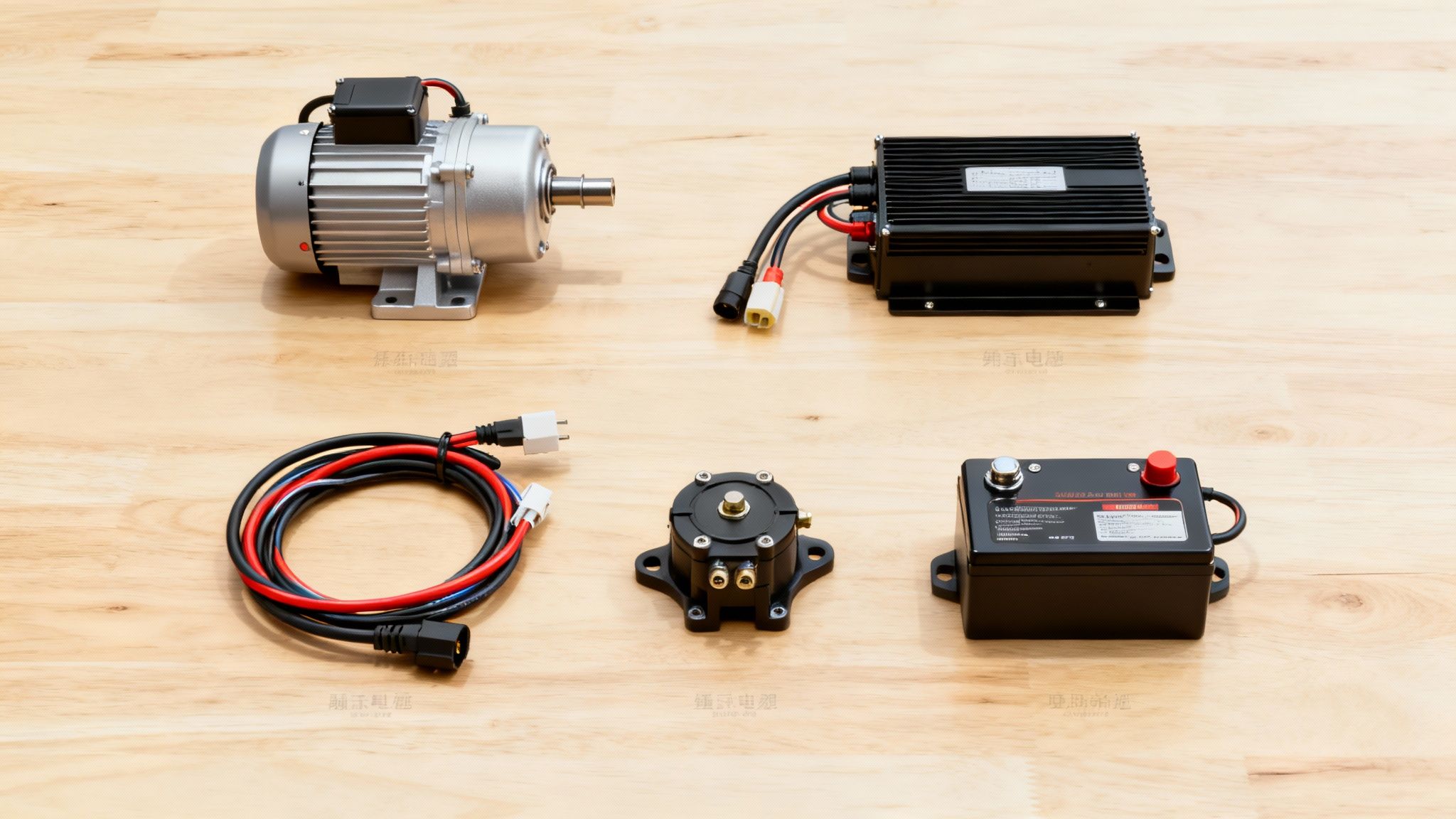
Dropping a powerful new motor into your golf cart is a great start, but it's only one piece of the puzzle. To really get that thrilling, reliable performance you're dreaming of, you have to think about the entire system. Just swapping the motor is like asking a world-class sprinter to run a marathon in flip-flops—all that potential is there, but the supporting gear is going to fail spectacularly.
A high performance golf cart motor is a hungry beast; it draws a lot more electrical current than the stock motor ever did. The factory parts in your cart were designed for gentle cruises around the golf course, not for handling the massive power demands of a performance build. Pushing those stock components too hard is a surefire way to get poor performance, overheating, and even damage your expensive new motor.
The trick is to create a balanced electrical system where every single part is up to the task and works together seamlessly.
The Brains of the Operation: The Controller
Think of the motor controller as the command center, managing the flow of power from the batteries to your new motor. A stock controller is basically a small-town traffic cop, built to handle a slow, predictable stream of cars. Your new performance motor, on the other hand, is an eight-lane superhighway.
A high-performance motor needs a controller with a much beefier amperage rating, typically in the 400-600 amp range. This upgrade is what allows the controller to safely and efficiently handle the huge electrical load. Without it, your motor will be starved for power, leading to disappointingly sluggish acceleration and never reaching its true potential.
Essential Supporting Electrical Upgrades
Beyond the controller, a few other electrical upgrades are absolutely non-negotiable. These components ensure that the immense power you’ve unlocked can get from the batteries to the motor without creating a dangerous bottleneck or a meltdown.
- Heavy-Gauge Battery Cables: Stock cables are simply too thin for this kind of current. Upgrading to thicker 2-gauge or 4-gauge cables is critical. It lowers electrical resistance, which means less heat buildup and more power actually reaching your motor.
- High-Amperage Solenoid: The solenoid is the heavy-duty switch that kicks in when you hit the accelerator. You’ll need a heavy-duty solenoid that can handle the higher amperage of your new system without burning out under the pressure.
A strong performance system is only as good as its weakest link. Upgrading the motor, controller, cables, and solenoid together ensures that your entire powertrain is built to handle the new level of power safely and reliably.
Upgrading for Safety and Handling
Once your powertrain is ready to rip, you have to think about how your cart is going to handle all that extra speed and torque. A cart that can suddenly hit 25-30 mph needs a suspension and brake system that can keep up. Trust me, the factory brakes and suspension were never meant for those speeds.
For a complete rundown on building a faster and safer cart, check out our guide on making an electric golf cart faster. It dives deep into these crucial upgrades. Swapping to hydraulic disc brakes and adding a lift kit with heavy-duty shocks will give you the stopping power and stability you need to actually enjoy your cart's new performance with confidence.
Alright, you've got the technical basics down. Now, let's connect that knowledge to the real world and talk about the brands actually building these impressive motors.
When you start shopping, it can feel like a crowded market, but a handful of names consistently rise to the top. These are the brands the serious enthusiasts and professional cart builders turn to time and again for proven quality and reliable power.
It's a great time to be in the market, too. The demand for personal electric vehicles is booming. The North American golf cart market alone is projected to jump from USD 0.72 billion in 2025 to a massive USD 1.13 billion by 2033. If you want to dive deeper, you can explore the data behind the growing golf cart market on marketdataforecast.com. All that growth is pushing companies to innovate, which means better, more powerful motor options for us.
Leaders in AC Motor Technology
When you're after modern, smooth, and efficient power, a few brands are leading the charge with their AC motor systems. The best ones offer complete kits—pairing a beast of a motor with a perfectly matched high-amperage controller. This takes all the guesswork out of the equation.
-
Navitas Vehicle Systems: These guys are a giant in the AC conversion scene. Navitas is famous for its "plug-and-play" kits that deliver insane torque and speed. The best part? You can fine-tune the whole system right from a smartphone app, making it incredibly user-friendly.
-
Alltrax: While many know them for their legendary DC controllers, Alltrax has become a serious player in the AC world. Their systems are built tough and are loved by builders who want precise control to dial in their cart's performance just right.
A quick pro-tip: Going with a brand that offers a complete, matched system is almost always the smartest play. It guarantees your motor and controller were born to work together, giving you the best possible performance and reliability.
Trusted Names for DC Motor Power
What if you're looking for that raw, get-up-and-go torque for a heavy-duty build? Or maybe you're after a more budget-friendly power boost. This is where DC motors shine, and a few brands are the undisputed kings. These are the workhorses, perfect for lifted carts running big, chunky tires or for utility vehicles that need serious pulling power.
One of the most respected names you'll hear is D&D Motor Systems. They've earned a rock-solid reputation for building high-torque and high-speed DC motors that just don't quit. They smartly categorize their motors by a specific job—one might be wound for climbing ridiculously steep hills, while another is built to hit street-legal speeds on flat ground.
Knowing who the trusted players are gives you a solid starting point. It helps you cut through the noise and ensures your money goes toward a motor that actually delivers on its promises.
Still Have a Few Questions?
Even after getting a handle on the tech, it's totally normal to have a few last-minute questions pop up before you dive into a motor upgrade. Let's tackle some of the most common ones that come up when people are getting ready to pull the trigger.
Think of this as your final gut-check. We’ll get into the practical stuff—the real-world cost, the installation process, and the legal side of things—to make sure you're ready to move forward.
What's the Real-World Cost for a Full Motor Upgrade?
This is a big one, and the answer is that the motor is just part of the equation. For the heart of the system—a quality AC motor and controller kit from a top-tier brand like Navitas or Alltrax—you're looking at a cost between $1,200 and $2,500. This gets you the core components for that serious performance jump.
But to do it right, you need to budget for the supporting cast. A complete, reliable system almost always requires:
- Heavy-Duty Solenoid: A non-negotiable part for both safety and performance. Expect to spend $50 to $150.
- Upgraded Battery Cables: You need thicker 2-gauge or 4-gauge cables to handle the extra power. A full set usually costs $100 to $200.
- Lithium Battery Pack: This is the biggest variable in the budget. A good lithium pack can run anywhere from $1,500 to over $4,000, depending on the voltage and capacity you choose.
So, when you add it all up, a full-blown, high-performance conversion typically lands somewhere in the $3,000 to $6,000 range. It’s a serious investment, but it also completely redefines what your cart can do.
Can I Actually Install a New Motor Myself?
If you're comfortable around a toolbox and have a decent grasp of electrical systems, then absolutely. A motor and controller swap is a very doable DIY project. Most kits from the big names come with solid instructions, and the connections are often designed to be "plug-and-play." Just make sure you have a good set of tools and block out a weekend so you're not rushing through it.
That said, if working with high-voltage DC systems makes you nervous, there's no shame in calling a pro. A simple mistake can damage expensive components—or worse. Professional installation is always the safest route to ensure everything is hooked up correctly and safely.
Does a Motor Upgrade Automatically Make My Cart Street Legal?
Nope, not on its own. A high-performance motor can get your cart up to the speeds required for a Low-Speed Vehicle (LSV) classification, which usually tops out at 25 mph. But speed is only one piece of the puzzle.
To be truly street legal, your cart must be equipped with a whole suite of safety gear. Local laws vary, but they generally require:
- Headlights, taillights, and turn signals
- A horn
- Rearview mirrors
- A windshield
- Seatbelts
- A registered Vehicle Identification Number (VIN)
Before you do anything, check your local and state regulations. Getting a faster motor is just the first step on the road to making your golf cart legally road-ready.
Ready to build a vehicle that perfectly matches your performance goals? At Solana EV, we specialize in premium, street-legal electric vehicles engineered for power, style, and reliability. Explore our lineup and discover the future of personal transportation at https://solanaev.com.
Lovely just what I was searching for.