
Navigating the crowded golf cart market can be tough, but a close look at the top contenders makes all the difference. The Solana EV lineup, with its four specialized models—the recreational XA, the workhorse F, the people-moving G, and the streamlined Campus E—offers a great example of purpose-built design. This guide will walk you through what sets each one apart, so you can find the perfect fit.
Choosing Your Solana EV Golf Cart
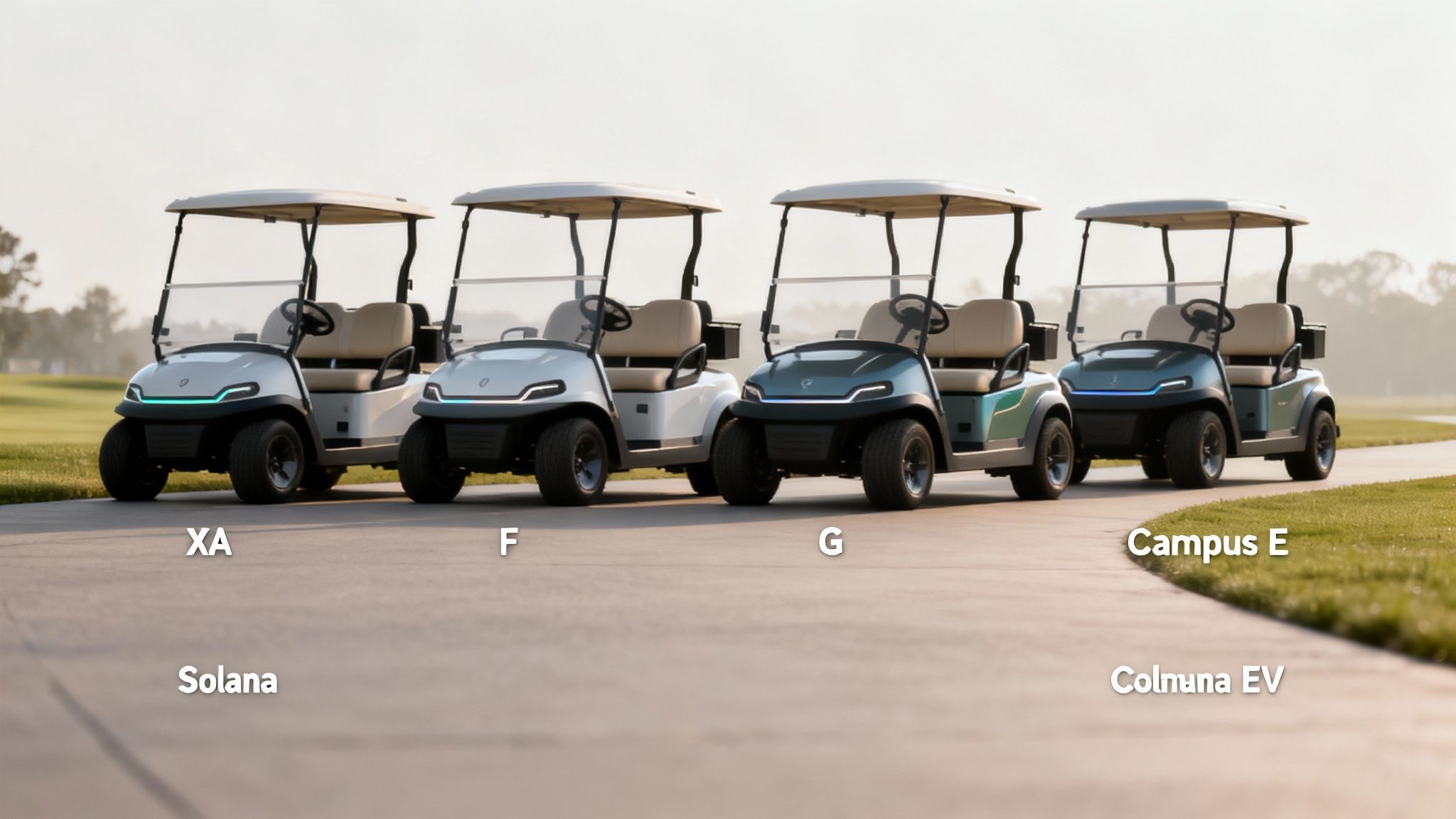
The key to picking the right electric vehicle is understanding what truly differentiates each model. Solana EV has carved out a niche by focusing on specialized carts instead of a one-size-fits-all approach. Every vehicle in their lineup is engineered with a specific person in mind, whether it’s a golfer who values agility or a resort manager who needs a durable fleet.
This strategy makes sense when you see how much the golf cart industry has grown beyond the green. The global market hit roughly USD 1.88 billion in 2023, driven by booming demand from gated communities, commercial properties, and vacation resorts. With projections showing the market could climb to USD 3.29 billion by 2034, it’s clear that versatile, low-speed electric vehicles are here to stay.
Identifying Your Primary Need
Before you get lost in the specs, start with a simple question: what will you actually be doing with this cart? Are you zipping around 18 holes, shuttling guests across a sprawling property, or hauling tools for maintenance jobs? Your answer immediately helps narrow the field.
The core difference isn't just in features but in design philosophy. The XA is built for personal enjoyment and style, while the F series is engineered for pure function and resilience.
To make things easier, we've put together a quick overview of the four main models. This table lays out their intended purpose and standout traits, giving you a handy reference as we dive deeper into performance and features.
Solana EV Models at a Glance
| Model | Primary Use Case | Passenger Capacity | Key Feature |
|---|---|---|---|
| Solana XA | Golf & Recreational | 2-4 Passengers | Sporty handling and premium aesthetics |
| Solana F | Utility & Commercial | 2 Passengers | Heavy-duty cargo bed and robust build |
| Solana G | Group & Guest Transport | 4-6 Passengers | Extended seating and passenger comfort |
| Solana Campus E | Fleet & Campus Mobility | 2 Passengers | Simple, efficient, and budget-friendly |
This snapshot helps set the stage. Whether your priority is performance, utility, capacity, or pure value, Solana EV has a model designed for the job. If you’re just getting started with electric carts, it helps to know the basics; you can read our guide on the advantages of a battery-powered golf cart to get up to speed. Next, we’ll get into the nitty-gritty and compare these models across the most important metrics.
Comparing Drivetrain Performance and Handling
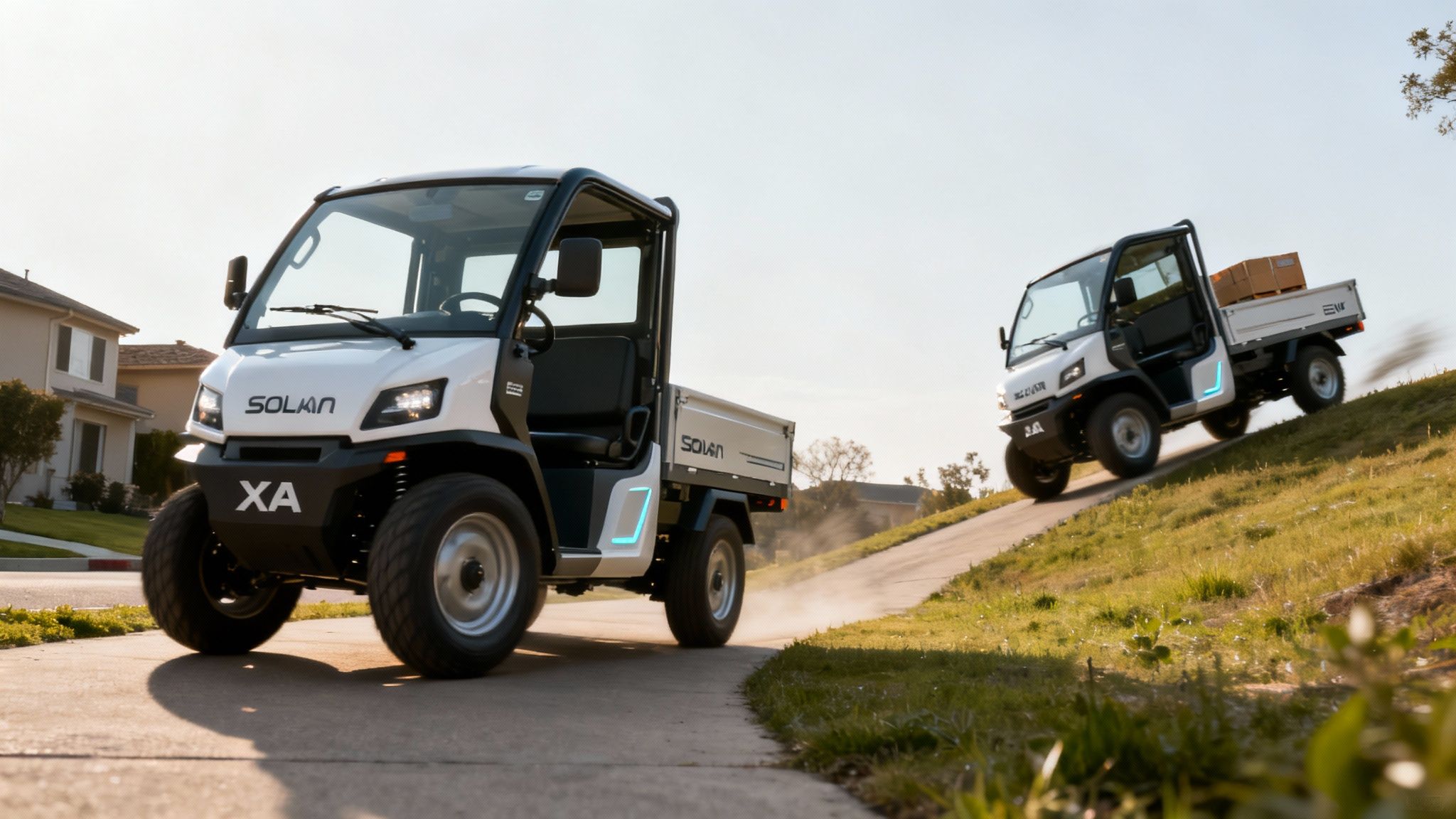
The true personality of a golf cart comes alive the second your foot hits the pedal. It's all in the drivetrain—the motor, controller, and axle working in concert to define everything from off-the-line acceleration to hill-climbing muscle and overall road feel. In the Solana EV lineup, each model's powertrain is specifically engineered for its intended job, which creates four very distinct driving experiences.
This is where the rubber really meets the road in any golf cart review. How a cart feels is just as important as the features on its spec sheet. The industry's massive shift to electric power, now accounting for over 80% of global sales, has made this kind of fine-tuning possible. Drivers prefer their quiet operation and low running costs, especially in noise-sensitive communities and resorts.
Let's dive into how each Solana model handles and what that means for you.
XA Series: Responsive Agility
Think of the Solana XA as the sports car of the bunch. It’s engineered for a lively, engaging ride, thanks to a high-output AC motor that’s been paired with a controller tuned for rapid acceleration. The response is nearly instantaneous. It’s a zippy, fun experience, perfect for navigating tight community roads or winding golf course paths.
The handling is just as nimble. With a lighter frame and responsive steering, the XA feels less like a utility vehicle and more like something you'd take out for a joyride. It's the clear choice for anyone who wants a dynamic driving experience, not just a way to get from A to B.
F Series: Unstoppable Torque
Where the XA is all about quickness, the Solana F is built for pure, unadulterated power. This is the workhorse. It’s outfitted with a high-torque motor designed to pull heavy loads without a second thought. The drivetrain is all about low-end grunt—that raw force you need to get moving from a dead stop with a full bed or to muscle your way up a steep grade.
This focus on torque completely changes the handling. The F series feels planted, solid, and incredibly stable. It won’t win a drag race against the XA, but its relentless power ensures it can haul gear, tools, or supplies over tough terrain without ever breaking a sweat. For a deeper look at what makes these motors tick, check out our guide to high-performance golf cart motors.
Key Differentiator: The XA gives you that thrilling, quick-off-the-line feeling for recreational fun. The F Series, on the other hand, delivers the brute-force torque needed for tough utility jobs. It's a classic choice between speed and strength.
G Series: Smooth and Stable
The Solana G series strikes a brilliant balance, blending the nimble feel of the XA with the stability needed for a larger vehicle. It’s designed to carry more people, so the powertrain is calibrated for absolute smoothness. Acceleration is gentle and controlled, which means no jerky starts or stops for your passengers.
This smooth power delivery is matched by a suspension system tuned for comfort. The G model handles predictably and feels secure on the road, giving you confidence even with every seat filled. It’s the go-to for shuttling guests at a hotel or moving your family around the neighborhood—situations where a gentle ride is the top priority.
Campus E: Optimized Efficiency
The Campus E is in a class of its own. Its drivetrain was engineered with a single mission: to be as efficient as possible in a stop-and-go environment. The motor is optimized for low-speed travel with frequent starts and stops, which is exactly the kind of duty cycle you see on a corporate campus or at a large facility.
The handling is straightforward and direct. It isn’t built for speed or heavy loads, but for easy, predictable maneuverability in crowded or tight spaces. This laser focus on efficiency means it sips power, making it a highly cost-effective choice for fleet managers who just need dependable, no-frills transport.
To put it all in perspective, here’s how they stack up side-by-side.
Performance and Handling Showdown
| Model | Acceleration Profile | Handling Feel | Best Use Case |
|---|---|---|---|
| XA Series | Quick and responsive | Nimble and sporty | Recreational driving, golf courses |
| F Series | Strong and consistent | Solid and powerful | Hauling heavy loads, utility work |
| G Series | Smooth and gradual | Stable and comfortable | Transporting multiple passengers |
| Campus E | Efficient and steady | Simple and maneuverable | Fleet use, stop-and-go routes |
Ultimately, the right drivetrain comes down to what your daily life demands. The Solana EV lineup ensures there’s a performance profile tailored for every scenario, from the spirited ride of the XA to the work-ready reliability of the Campus E.
Battery Technology and Real-World Range
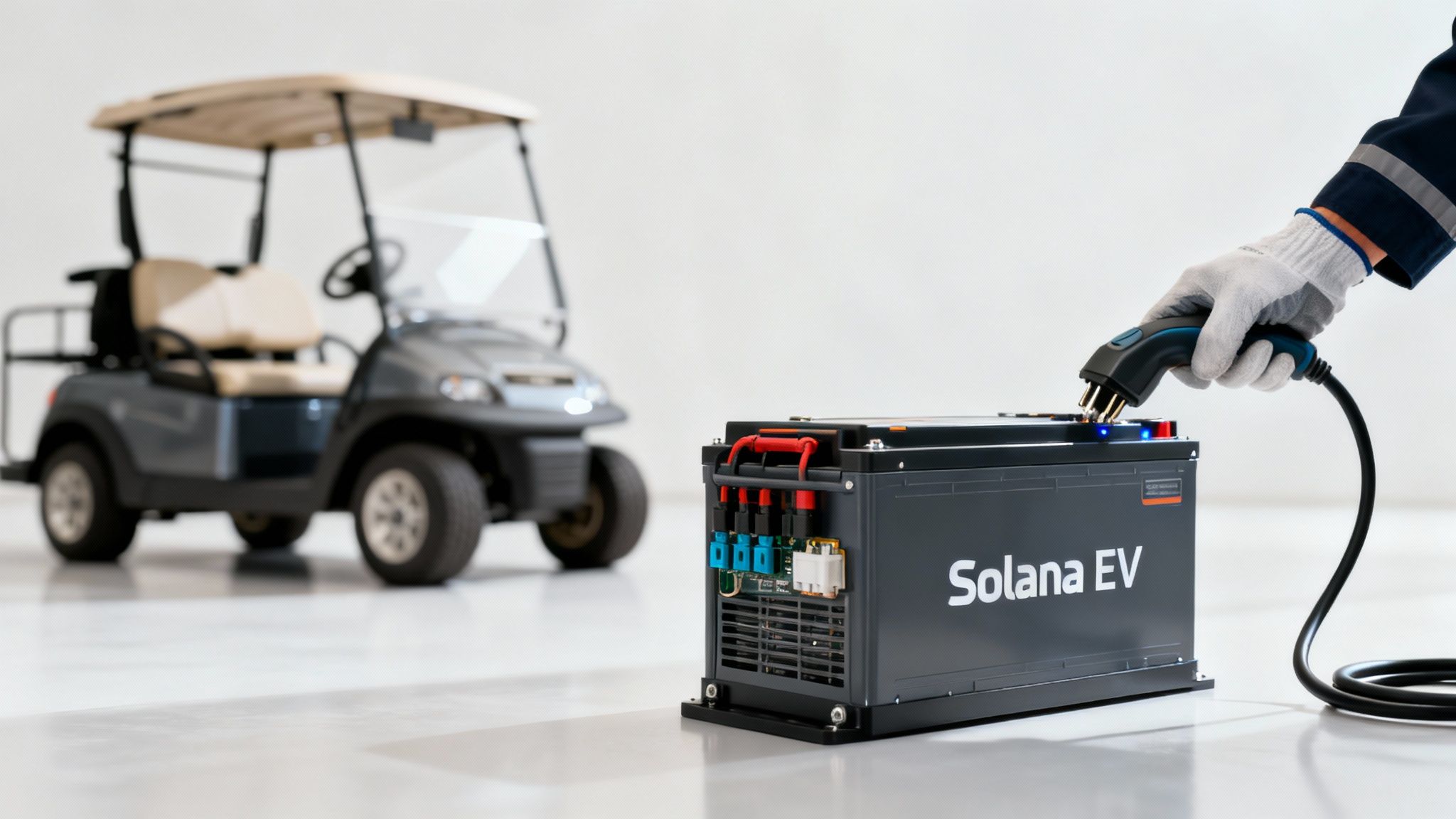
Let's be honest, a golf cart is only as good as its battery. The power source is the heart of the machine, dictating how far you can roam, how long you're sidelined waiting for a charge, and what your total cost of ownership looks like down the road. Solana EV gives you a choice between old-school lead-acid and modern lithium-ion batteries, and the right pick really boils down to how you plan to use your cart.
This isn't just about the numbers on a spec sheet. Real-world range is a moving target, influenced by everything from hilly terrain and passenger weight to how heavy your foot is on the pedal. We’ll break down the practical differences to help you make a smart decision.
Lithium-Ion: The Premium Choice
Solana EV's lithium-ion option, offered on the XA, F, and G models, is the top-tier power setup. These batteries are a big step up, delivering consistent, strong power from a 100% charge all the way down to empty. You won't feel that familiar, frustrating sag in performance as the battery meter drops—a common gripe with older tech.
What really matters in the long run is their lifespan. A lithium battery will often last 8-10 years, a huge jump from the 3-5 year life you'd expect from lead-acid. They’re also completely hands-off, meaning no more topping off water levels or cleaning corroded terminals.
But for many, the real selling point is the charging speed. You can get a full charge in just a few hours. That's a game-changer if you’re running a busy golf course or a commercial fleet where every minute the cart is parked is a minute it's not working for you.
Lead-Acid: The Reliable Standard
Of course, the classic flooded lead-acid battery is still around for a good reason: it has a much lower upfront cost. It's a proven, workhorse technology that gets the job done for plenty of owners. Solana EV offers a high-quality lead-acid system, particularly for the budget-focused Campus E, where keeping the initial fleet investment low is key.
That lower price tag comes with some trade-offs, though. Lead-acid batteries are significantly heavier, which can have a minor effect on handling and overall efficiency. They also demand regular check-ups, like refilling distilled water, to keep them healthy.
Charging is also a waiting game, usually needing a full overnight session to get back to 100%. This is perfectly fine for a family who just takes the cart out for evening cruises, but it can be a real headache in more demanding situations.
Key Insight: The choice isn't just about range; it's about use patterns. If your cart is in constant motion all day, the fast-charging capability of lithium-ion is practically a necessity. For casual, infrequent use, the cost savings of lead-acid can be a much smarter play.
Real-World Range Scenarios
Factory estimates are a decent starting point, but your mileage will absolutely vary. Let’s see how the Solana models stack up in a few real-life situations.
- The Golfer (Solana XA): Someone playing 18 or even 36 holes on a hilly course will see a huge benefit from lithium-ion. The power stays strong, so the cart pulls up that final hill just as hard as it did the first. The range easily covers a full day of play without a hint of battery anxiety.
- The Fleet Manager (Solana Campus E): For a fleet of Campus E carts, lead-acid makes a lot of financial sense at the outset. Since these carts usually return to a central charging depot overnight, the slower charge time isn't a problem. It’s a cost-effective way to handle predictable routes.
- The Resort Operator (Solana G): Hauling guests around a property from sunrise to sunset puts a serious strain on batteries. A lithium-powered G series means the cart is always ready to go. You can even do quick "opportunity charges" during short breaks to keep it running all day long.
Getting a handle on these power systems is key. If you want to dig even deeper, our complete guide to golf cart lithium batteries has more of the nitty-gritty details. When it comes to the charging setup for your Solana EV golf cart, you may want to look into different options, including specific products like Givenergy EV chargers.
Evaluating Design and Onboard Features
Raw power and battery life are just numbers on a spec sheet. What really shapes your day-to-day experience with a golf cart is its design—the comfort of the seats, the smart placement of a storage cubby, or the simple convenience of a well-lit dashboard. This is where the Solana EV models truly show their distinct personalities.
We're going to break down the practical differences you'll feel, from the sporty, almost automotive feel of the XA to the purely functional build of the Campus E. Let's look at everything from seating and dashboard layouts to the little details that make each model click for its intended driver.
Solana XA: Sleek Recreational Styling
The Solana XA is built to turn heads, plain and simple. Its aesthetic is aggressive and modern, with sleek body lines and custom color options that feel more like a luxury car than a typical cart. Add the optional premium wheels, and it really stands out.
But the design isn't just for show. The contoured seats are made from tough, marine-grade vinyl, offering real comfort that holds up against sun and rain. The driver-centric dashboard is another highlight, featuring an intuitive digital display for your speed and battery life. Little things like the integrated cup holders, a locking glove box, and a small front trunk for personal items show a real focus on personal enjoyment and style.
Solana F: Rugged and Purpose-Built
In stark contrast, the Solana F is all business. Its design is brutally functional, built around a heavy-duty frame and a massive flatbed cargo area. You won't find any swooping lines here; every angle is about maximizing durability and utility for tough jobs.
That no-nonsense philosophy carries into the cabin. The bench seat is wide and practical, upholstered in a tough, easy-to-clean material. The dashboard is minimalist, with simple, beefy controls you can operate even with work gloves on. Storage is geared entirely toward tools and equipment, valuing pure accessibility over looks.
Key Design Difference: The XA is a statement piece, blending comfort and high-end finishes for a premium recreational ride. The F is an unapologetic tool, where every design choice serves the core function of hauling and durability.
Solana G: Passenger-Focused Comfort
The Solana G was engineered from the ground up with one goal: moving people comfortably and safely. You'll immediately notice its longer wheelbase and extended roof, but the real story is in the passenger experience. Some configurations even offer forward-facing rear seats, which creates a much more social and conversational ride than the old rear-facing benches.
Every detail is geared towards group travel. Multiple grab handles, generous legroom, and extra cup holders come standard. The interior is designed to feel open and spacious, so no one feels cramped, even with a full load. Optional features like premium sound systems and enhanced lighting can turn the G into the perfect shuttle for resorts or large families.
Solana Campus E: Minimalist Efficiency
The Campus E is the definition of a "less is more" design. Its build is simple, clean, and incredibly efficient, stripped of any non-essential features to keep costs down and reliability up. The compact frame is perfect for zipping through tight spaces, whether it's a warehouse aisle or a crowded campus pathway.
The interior is as straightforward as it gets: a simple bench seat, a basic steering wheel, and a minimal display. There are no luxury frills, but the build quality is solid right where it counts. The Campus E’s design puts function squarely over form, delivering a dependable, low-maintenance workhorse for fleet operations where uptime and cost are the only things that matter.
Feature and Amenity Comparison Across Models
To really see how these differences play out, it helps to put them side-by-side. The table below breaks down the key features you'll find—or won't find—on each model.
| Feature | Solana XA | Solana F | Solana G | Solana Campus E |
|---|---|---|---|---|
| Seating Material | Premium Marine-Grade Vinyl | Heavy-Duty, Easy-Clean Vinyl | High-Comfort Padded Vinyl | Standard Utilitarian Vinyl |
| Dashboard Layout | Digital Display, Locking Glovebox | Minimalist, Analog Gauges | Digital Display, Extra Cup Holders | Basic, Functional Controls |
| Standard Lighting | LED Headlights & Taillights | Basic Halogen Headlights | Full LED Lighting Package | Simple Headlight/Taillight Setup |
| Storage Solutions | Front Trunk, Glovebox | Open Cargo Bed, Tool Racks | Under-Seat Compartments | Small Front Basket (Optional) |
| Optional Upgrades | Premium Sound, Custom Wheels | Bed Liners, Brush Guards | Enclosures, Entertainment Systems | Basic Weather Protection |
As you can see, the choice really comes down to your primary use. The XA and G are loaded with creature comforts for recreation and transport, while the F and Campus E are stripped down for pure, unadulterated work.
Which Solana EV Is Right for You?
Specs and features on a page are one thing, but matching a vehicle to your actual day-to-day life is what really matters. We’ve already looked at the performance, batteries, and design of Solana’s lineup, so now it’s time to put it all into context. A cart that’s perfect for the back nine might feel completely wrong for a maintenance crew, and a utility workhorse won’t have the comforts you want for a family cruise.
This section is all about connecting the dots from features to function. I’ll lay out some common user profiles to help you see exactly where each Solana EV model fits in the real world. Think of it as a guide to making a confident, straightforward decision.
To get the ball rolling, check out this decision tree. It’s a great visual shortcut to narrow down your options based on your main priority: recreation, utility work, or moving people.
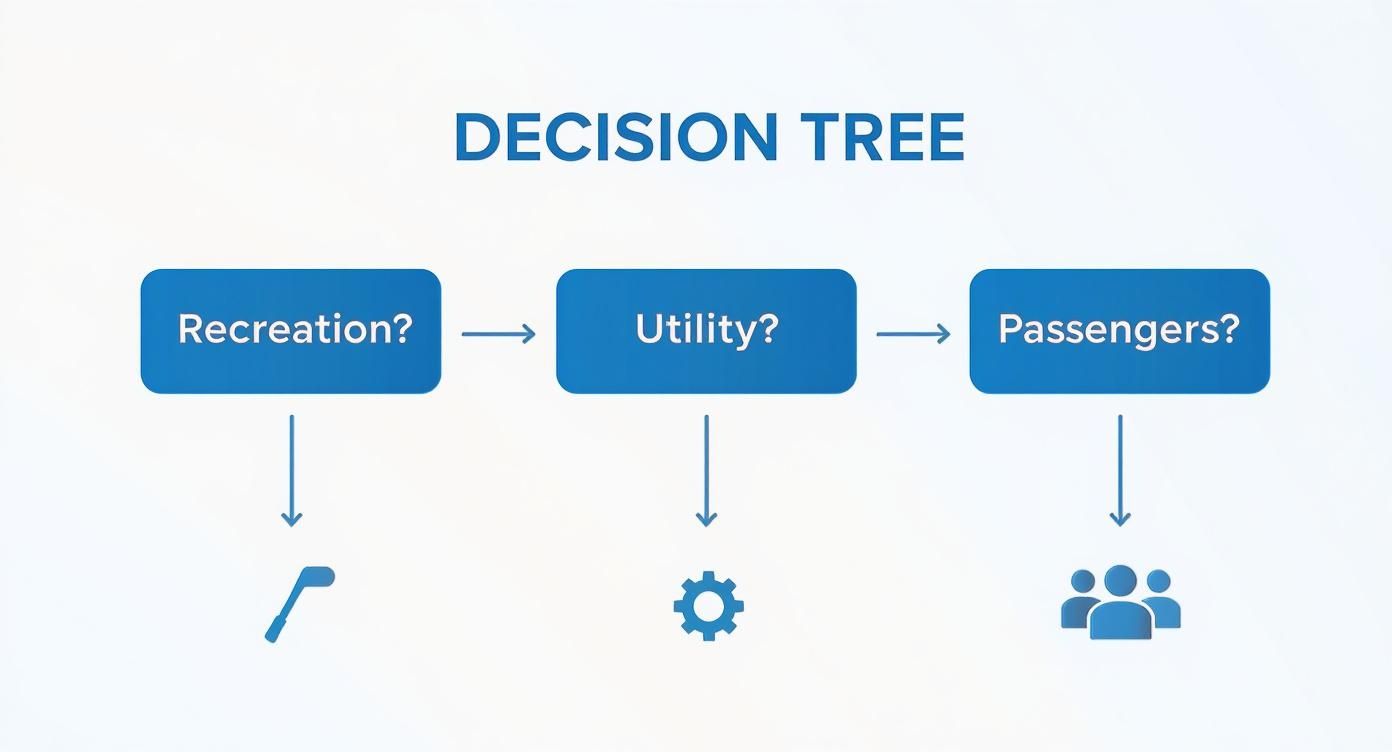
This chart helps you make that first big cut. Once you know your primary use case, diving into the smaller details becomes much easier.
The Daily Golfer and Community Resident
If your days are spent on the golf course or cruising around a gated community, the Solana XA is, without a doubt, the model for you. It strikes that ideal balance of style, comfort, and nimble performance that makes it a pleasure to drive. Navigating winding cart paths feels effortless thanks to its responsive acceleration and sporty handling.
Everything from the premium seating to the driver-centric dashboard is designed for personal enjoyment. If you're looking for a vehicle that feels more like a personal luxury cruiser than a simple utility cart for your daily rounds or trips to the clubhouse, the XA nails that experience.
The Commercial Fleet Manager
For property managers, resort operators, and anyone overseeing a large facility, the priorities shift dramatically. It's all about durability, low running costs, and pure efficiency. Here, the Solana F and Campus E models offer two very different, but equally compelling, solutions.
The Solana F is the workhorse. It’s built for maintenance crews and groundskeepers who need to haul tools, supplies, and equipment over rough ground. Its high-torque motor and tough cargo bed are designed to handle real work without complaint. This is a no-frills, durable machine that can take the daily grind of a commercial job site.
On the other hand, the Solana Campus E is purpose-built for moving staff across large, paved environments like corporate campuses or airport service roads. Its entire design is focused on efficiency and a low total cost of ownership. The simple controls and reliable drivetrain make it the perfect fleet vehicle when minimizing downtime and maintenance is the name of the game.
Situational Recommendation: If your crew is doing physical labor and hauling heavy loads, the raw power of the F series is a must-have. But if you just need simple, low-speed transport over predictable routes, the Campus E is the more cost-effective choice.
The Hospitality and Group Transport Specialist
When your main job is moving people, capacity and comfort are king. This is exactly where the Solana G series comes in. It was designed from the ground up to shuttle guests at resorts, move families around a community, or provide transport at large events.
Every feature is passenger-focused, from the extended seating and smooth acceleration to the stable ride that ensures a pleasant trip for everyone. With options for forward-facing rear seats, the G creates a more social and comfortable vibe than a lot of traditional multi-passenger carts. This focus makes it the clear winner for any application centered on group mobility.
This part of the market is growing fast. While North America has always been the industry leader—the U.S. electric cart market was valued at over USD 529 million in 2024—the Asia-Pacific region is catching up quickly, thanks to a boom in hospitality and tourism. This global trend highlights the growing need for specialized people-movers like the Solana G. You can find more market insights from the experts at Grand View Research.
Cost, Value, and Our Final Take
So, which cart is the right one? In any real-world golf cart review, the answer isn't just about bells and whistles—it’s about what you get for your money over the long haul. The sticker price is just the starting line. You have to think about maintenance, how long the battery will last, and what kind of support you'll get down the road.
Instead of just crowning one model the "best," let's look at which Solana EV cart gives you the most bang for your buck based on what you actually need.
The upfront cost can swing pretty widely across Solana's lineup. The Campus E, with its no-frills design and standard lead-acid battery, is the most wallet-friendly option. It's a smart choice for fleet managers who need to buy in bulk and keep initial spending low. On the other end, you have the XA and G series, which climb higher in price, especially once you add premium lithium-ion batteries and other custom touches.
Looking Beyond the Sticker Price
The real value of a cart shows up over years of use, not on the sales floor. A lithium-ion battery might cost more today, but it can easily last 8-10 years with zero maintenance. Compare that to a lead-acid battery, which you'll likely replace every 3-5 years. That extra upfront cost for lithium often pays for itself by saving you from buying a replacement battery or two.
And don't forget about the warranty and dealer support. It’s the kind of thing you don't think about until you need it. Solana EV's dealer network is a huge plus, giving you a safety net of expert service and parts. That support is a hidden value that keeps your cart running and protects your investment, whether you're a private owner or running a whole fleet.
The Bottom Line: There's no single "best" cart here—it all comes down to your priorities.
- Solana XA: The clear choice for performance and style if you're a recreational user looking for a thrill.
- F Series: Pure, unmatched utility. If you have tough jobs to do, this is your workhorse.
- G Series: Wins hands-down for moving people comfortably and in style.
- Campus E: Delivers unbeatable upfront value, making it perfect for efficient fleet operations.
Ultimately, this golf carts review shows that Solana EV has really thought through its lineup, building a specific vehicle for almost any job you can throw at it. The key is to match your main goal—whether it's speed, hauling, transport, or budget—to the right model. If you think about your long-term needs instead of just the initial price tag, you’ll end up with a cart that's a genuinely smart investment.
Got Questions? We’ve Got Answers.
Even after comparing specs and features, you might still have a few questions floating around. Let's tackle some of the most common things people ask about Solana EV carts to help you lock in your decision.
How Long Will a Solana EV Battery Actually Last?
This really comes down to which battery type you go with. If you opt for a traditional lead-acid battery and take good care of it, you can expect a solid 3-5 years of service.
On the other hand, the newer lithium-ion batteries are built for the long haul. They typically last 8-10 years—sometimes even longer. While they cost more upfront, they deliver better long-term value and save you a lot of hassle.
Expert Insight: Don't just look at the initial price tag. The extended lifespan and zero-maintenance design of a lithium-ion battery often make it the smarter, more cost-effective choice over the life of your cart.
Can I Drive a Solana Golf Cart on the Street?
Absolutely. Many Solana models, particularly in the XA and G series, are designed with street driving in mind. You can get them with a Low-Speed Vehicle (LSV) package, which adds all the necessary safety gear like headlights, turn signals, mirrors, a horn, and a proper windshield.
Just remember, "street legal" depends entirely on your local and state laws. Before you hit the pavement, you'll need to check with your local DMV to make sure you're following all the rules for public roads.
Is Maintaining an Electric Cart Easier Than a Gas One?
Night and day. Electric carts like Solana's are incredibly low-maintenance because they have so few moving parts compared to a gas engine. Think about it:
- You'll never have to do an oil change.
- There are no spark plugs or fuel filters to replace.
- They run silently and produce zero emissions.
Your main tasks are just keeping an eye on tire pressure, making sure electrical connections are tight, and (if you have lead-acid batteries) topping off the water levels. It all adds up to lower ownership costs and more time enjoying the ride.
Ready to see which Solana EV is right for you? Dive into the full lineup of premium, high-performance carts and feel the difference that quality engineering makes. Find your perfect ride today at https://solanaev.com.