
Want to take your golf cart beyond the fairway and onto public roads? You’ll need more than just fresh batteries and a friendly horn. Turning your cart into a street-legal vehicle means checking off a specific equipment list, capping its top speed, and navigating registration steps. Let’s walk through this together.
Golf Cart Street Legal Roadmap
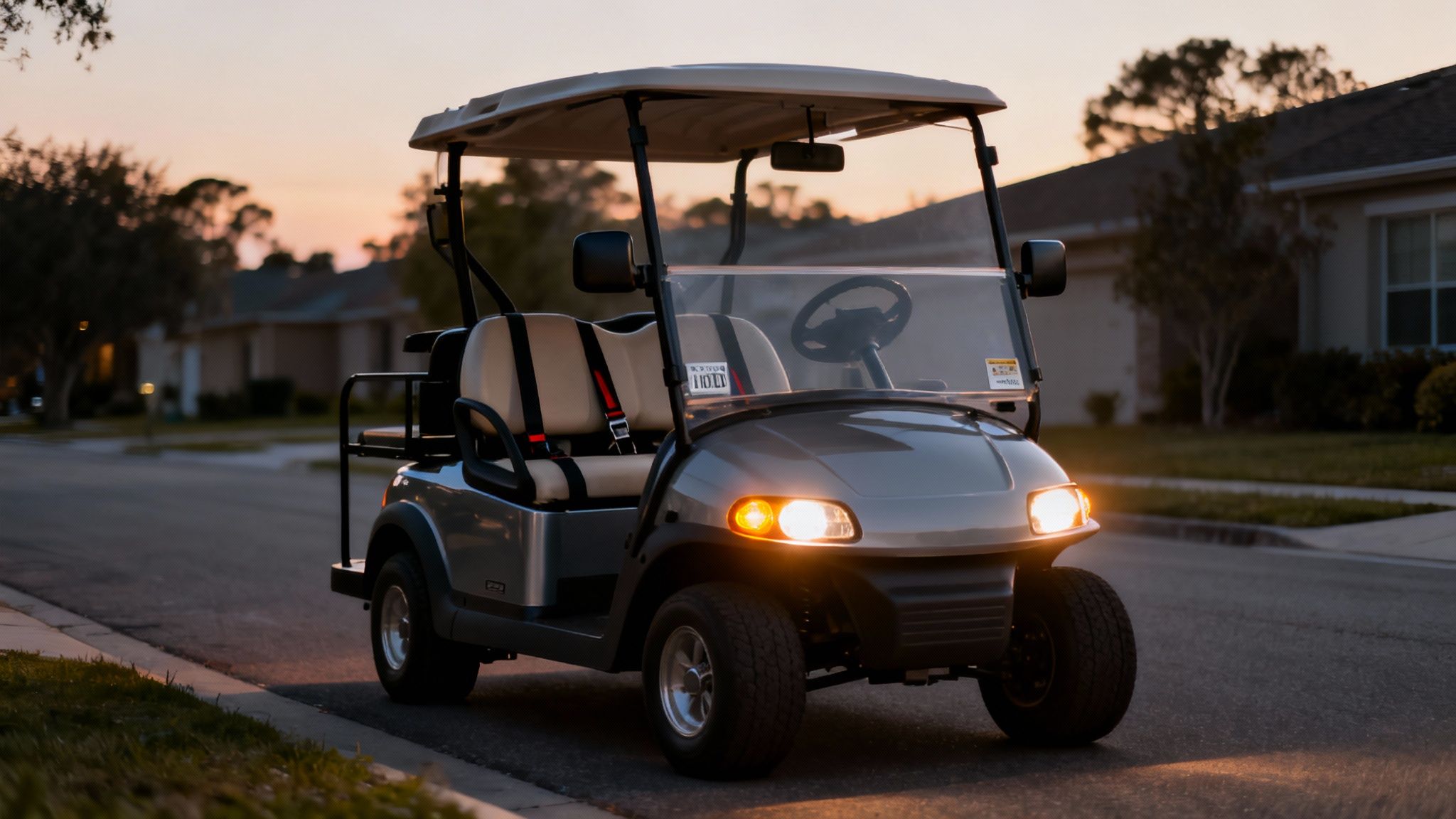
First things first, think of your golf cart as a mini-car. It needs the basics:
- Headlights, taillights, and turn signals to communicate with other drivers
- Side mirrors for a clear view behind you
- Seat belts so everyone stays secure if you hit a bump
- A speed governor to limit top speed to 20–25 mph
Once your cart has the right gear, you’ll move on to inspection. A certified technician will install or verify a Vehicle Identification Number (VIN), then sign off on its safety. After that, you register and insure it just like any low-speed vehicle (LSV).
Different states set their own top speeds for street-legal golf carts. Here’s a quick reference:
State Speed Limits for Street Legal Golf Carts
| State | Max Speed Limit (mph) | Notes |
|---|---|---|
| Florida | 20 | Urban roads and beach paths |
| California | 25 | City streets under 35 mph zones |
| Texas | 20 | Neighborhoods and gated communities only |
| New York | 25 | May require municipal approval |
| Illinois | 20 | Restricted to LSV lanes |
Keep in mind local rules can shift. Always confirm with your DMV before upgrading.
Quick Registration Guide
- Gather your inspection report showing all required equipment works
- Complete a title and registration application at your DMV office
- Buy an LSV insurance policy that meets your state’s minimum coverage
Inspection Pre Checklist
- Verify every light and turn signal illuminates correctly
- Adjust mirrors so you’ve got full rear visibility
- Tug on each seat belt to ensure it locks under tension
Tip Regarding Mirrors: Properly placed side mirrors cut blind spots and speed up inspection clearance.
Don’t forget to keep proof of insurance and registration onboard at all times. With these steps ticked off, you’ll be ready to cruise legally and confidently wherever the road leads.
Understanding Key Concepts For Street Legal Golf Carts
Think of a street-legal golf cart as your quiet neighborhood shuttle—small, nimble, and perfect for quick hops. In this setup, weight, speed, and safety gear must all align with federal Low-Speed Vehicle (LSV) rules.
- Weight Limits influence stability and crash response.
- Speed Governors cap top speed between 20 and 25 mph.
- Safety Gear means headlights, mirrors, turn signals and seat belts.
Electric drivetrains don’t just propel you forward. They deliver instant torque for uphill starts and use regenerative braking to keep speed in check—reducing wear on your brake pads.
Below is a quick glance at these core elements:
undefined
undefined
| undefined | undefined |
|---|---|
| undefined | undefined |
| undefined | undefined |
Use this snapshot as a starting block for your compliance checklist.
How Speed And Safety Work Together
Regulators zero in on two things: your cart’s top speed and its stopping distance. Imagine tuning your brakes like you would on a high-performance bicycle—every millimeter of pad engagement counts.
“An LSV must stop within about 20 feet from 20 mph to ensure safe urban use.”
Clear signaling, reliable brakes and responsive handling make the difference between a casual ride and a road-ready mini-commuter.
Market Growth And Real-World Demand
The global golf-cart sector was valued at USD 1.5–2.6 billion in the mid-20200s, with forecasts pointing to two- to three-fold growth by the early 2030s. Emergen Research lays out the full analysis.
Key drivers include:
- Eco-focused resorts seeking whisper-quiet fleets
- Gated communities streamlining resident transport
- City pilot programs testing low-emission zones
Why Solana EV LSVs Matter
Solana EV models arrive ready for the road. They come with factory-installed speed governors, DOT-approved lights and secure seat belts—everything federal law demands.
Learn more about LSV criteria in our article
By baking compliance into the design, Solana EV turns your cart into a plug-and-play urban commuter.
Next Steps For Your Golf Cart
Start local: double-check your municipality’s LSV speed zones and required accessories. Then:
- Source approved headlights, mirrors and seat belts
- Plan upgrades and set aside a budget
- Schedule an official inspection and VIN assignment
Follow those steps and you’ll be cruising legally in no time—enjoy short-trip commuting with confidence and style.
Required Equipment And Classifications For Street Legal Golf Carts
Turning a golf cart into a street-legal LSV is a bit like piecing together a jigsaw puzzle—each component locks into place to create a safe, roadworthy vehicle. Federal rules set the stage, but your attention to detail seals the deal.
In practice, that minor mirror upgrade can cut your inspection time in half. It’s proof that no part is too small to matter when safety and compliance are on the line.
- Headlights and Taillights: Light the way forward and signal stops or turns to everyone on the road.
- Turn Signals: Clear amber indicators that show other drivers where you’re headed.
- Side Mirrors: Expand your view, shrinking blind spots so nothing sneaks up behind you.
Securing an official LSV rating means adding DOT-approved seat belts, a speed governor, and a few other essentials. While electrified drivetrains add a bit more to the upfront bill, their lower running costs quickly offset that investment. For more insights, check out this detailed research on street-legal carts.
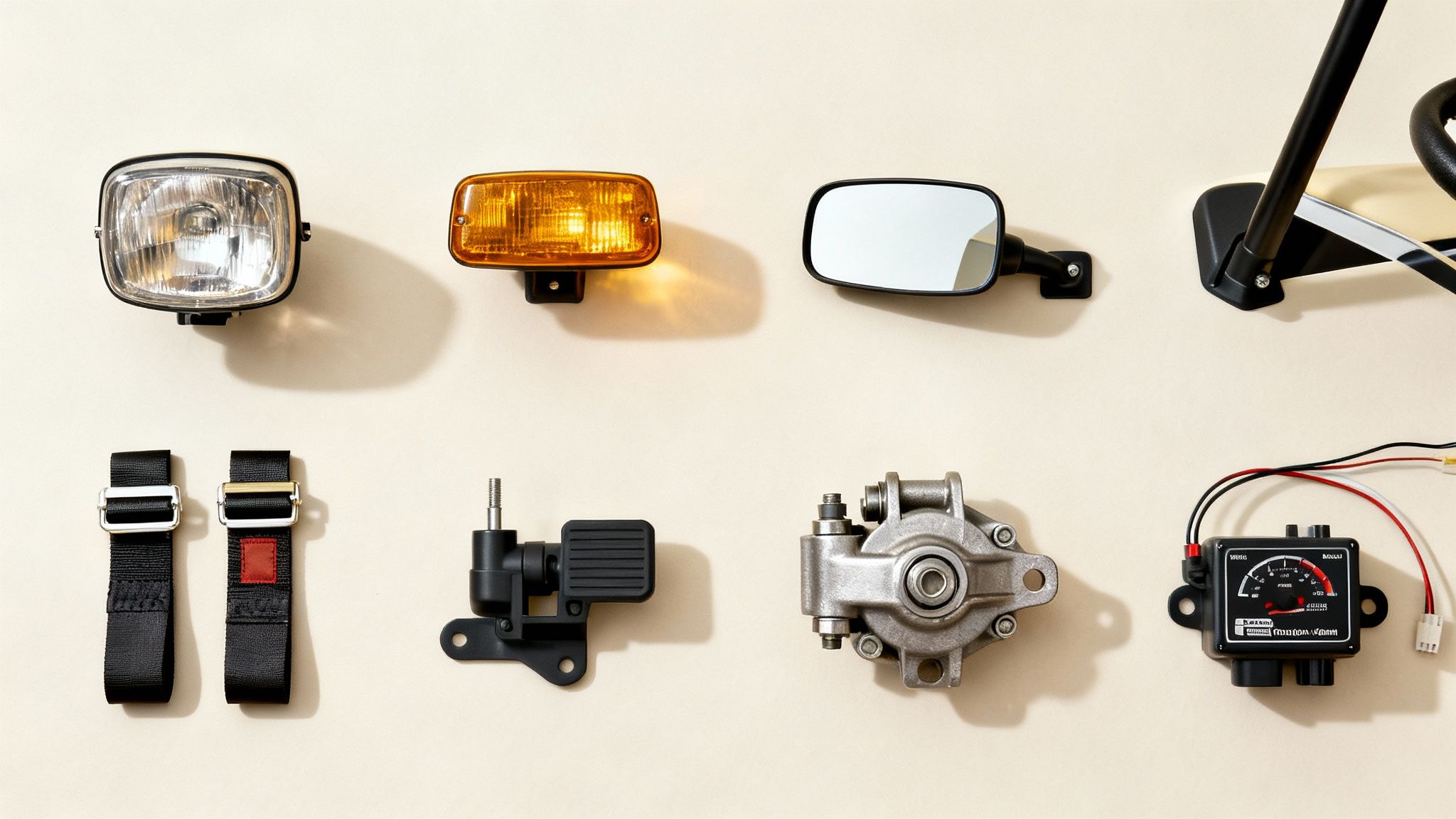
This illustration shows the required LSV identification labels and a 25 mph speed governor limit. Clear, visible labeling speeds up a smooth inspector sign-off.
Equipment Classification And Purpose
Below is a breakdown of each essential component, why it’s needed, and how it ties into federal LSV standards:
LSV Equipment Requirements
| Equipment | Requirement Description | Purpose |
|---|---|---|
| Seat Belts | Three-point belts at every seating position | Keep passengers secure during sudden stop |
| Headlights | DOT-approved low and high beam assemblies | Maintain visibility in low-light settings |
| Turn Signals | Front and rear amber signals with easy-access controls | Announce intended turns |
| Speed Governor | Governor capping top speed at 20–25 mph | Prevent the cart from exceeding safe pace |
| Side Mirrors | Minimum one per side with optional 3× magnification feature | Broaden the rear view around the vehicle |
Every item in this list forms part of the safety net that turns your cart into a legally recognized LSV.
Step By Step Compliance Checklist
- Verify the VIN plate is mounted correctly and logged.
- Install DOT-approved headlights, taillights, turn signals and side mirrors.
- Fit three-point seat belts for all seats.
- Adjust or install the speed governor to max out at 25 mph.
- Book an inspection with a certified LSV technician, then handle registration and insurance.
Sorting out each part on its own can feel like digging through a bin of jigsaw pieces. That’s where a ready-to-go solution shines. Discover our pre-packaged street-legal cart kit for DOT-approved parts bundled in one box.
Why Battery Electric Models Excel
Battery-electric carts often arrive with most requirements built in. The motor controls and wiring can integrate a speed governor at the factory, cutting out retrofit headaches.
Take Solana EV’s lineup, for example—these carts roll off the lot bristling with all the federally required gear. You simply plug in, register, and hit the road.
Braking Systems And Safety
Think of an LSV’s braking system like the multiple pads on a commuter train: if one element falters, the others share the load to bring you to a smooth stop. That redundancy is key on public streets.
Solana EV models add regenerative braking to help prolong pad life and keep stopping distances consistent. It’s a safety boost that also drives down long-term maintenance.
Key Takeaways For Equipment
- Always confirm the presence of a visible VIN plate before scheduling inspection.
- Choose DOT-approved light and brake assemblies to avoid hold-ups.
- Proper mirror placement can be the difference between pass and fail.
- Factory-set speed governors lock in the required 25 mph limit reliably.
- Electric LSVs often bundle seat belts, labels and speed governors for a turnkey solution.
By following these guidelines—or opting for Solana EV’s preconfigured models—you’ll save time, reduce hassle, and enjoy a street-legal ride in record time.
State Rules And Common Variations For Street Legal Carts
Every state writes its own playbook for letting golf carts share the road. Think of it like customizing an outfit—what fits in Florida won’t necessarily work in California. Once you map out local rules, the compliance journey becomes far more predictable.
Major State Variations
Florida and California offer a clear snapshot of how different rules shape your next steps. In Florida, you must hold a valid driver’s license, show proof of insurance, and pass a county DMV inspection. California, on the other hand, insists on a one-mile test to hit 25 mph and a checklist covering lights, mirrors, and more.
- Florida allows carts on roads up to 20 mph; inspections happen at county offices.
- California sets a 25 mph max and requires a one-mile speed trial before registration.
- Texas limits street use to gated areas and demands local ordinance approval.
- New York often needs municipal sign-off and issues unique LSV decals.
Outside those big four, you’ll see the usual suspects—registration fees, insurance minimums and VIN plates—vary by county and state.
Expert Insight: Understanding local LSV rules early can shave weeks off the compliance timeline.
Common Registration And Insurance Variations
Fees and liability requirements can swing wildly from one jurisdiction to the next. Some counties charge as little as $20, while others push past $100. Coverage minimums often start at $10,000 per incident and can climb to $50,000.
| State | Registration Fee | Insurance Min |
|---|---|---|
| Florida | $25 | $10,000 |
| California | $50 | $15,000 |
| Texas | $20 | $10,000 |
| New York | $100 | $25,000 |
Interpreting State Patterns
Here is a federal overview that informs many state sustainability and transportation policies.
This insight shows that states prioritizing green targets often adopt more lenient LSV rules. Stack speed limits, inspection steps and permit demands side by side, and patterns emerge clearly.
For example, a 25 mph cap locks carts onto certain roads, directly impacting route planning. Insurance and fee trends usually reflect regional budgets and infrastructure goals. Rural counties tend to charge less but grant access to fewer approved driving zones.
North America, led by the U.S., accounts for roughly half of global street-legal golf-cart revenues. States allowing LSVs on roads up to 35 mph have an outsized influence on manufacturers and fleet operators. Learn more about these market findings on Fortune Business Insights.
Check out our guide on golf cart registration for detailed state-by-state steps and document requirements at Solana EV. Interpreting your state’s specific rules with these patterns in mind simplifies the path to making your cart street legal.
Regional Case Study Examples
A coastal Florida resort retrofitted its fleet with DOT-approved headlights and seat belts. Their inspection time dropped 30%, letting guests cruise across beachside roads almost immediately.
In California, a seaside community piloted an LSV ordinance near local parks. By fitting carts with a 25 mph governor, the DMV waived certain fees for electric models and cut approval time in half.
A gated Texas ranch negotiated a local permit that matched its 20 mph zone. That collaboration shaved weeks off the rollout and won community buy-in for guided tours.
Tips For Navigating Local Laws
- Visit your state DMV website for official street-legal cart guidelines and fee schedules.
- Call local law enforcement to confirm approved roads, hours and any special permits.
- Keep thorough records—inspection reports, receipts and correspondence—to speed up reviews.
- Join neighborhood forums or industry groups where members share recent rule changes.
- Consider a pre-inspection by a certified technician to catch issues before your DMV visit.
Next Steps To Apply Local Rules
- Review your local statutes and highlight mandatory equipment.
- Source DOT-approved lights, mirrors, seat belts and speed governors.
- Book a compliance inspection with a state-certified LSV technician.
- Submit your inspection report and fees to the DMV without delay.
- Secure liability insurance and attach proof to your registration paperwork.
Summary And Next Considerations
State rules for street-legal golf carts vary wildly but follow similar themes. By tracking speed limits, inspections and fees, you can map out your compliance roadmap. Next, tackle equipment upgrades and lock in your cart’s VIN for registration.
Below Is An Undefined Table To Illustrate The Concept
undefined
| undefined | undefined | undefined |
|---|---|---|
| undefined | undefined | undefined |
| undefined | undefined | undefined |
This concludes the undefined table section.
Leveraging Solana EV Solutions
Solana EV models arrive with DOT-compliant lights, mirrors, seat belts and speed governors already in place. That package cuts upgrade time dramatically and meets most state LSV statutes out of the box. Dealers, resorts and communities also get bundled registration support and factory-assigned VINs to streamline compliance. Learn how Solana EV accelerates compliance in our detailed guide on golf cart registration. Start planning your compliant journey today.
Step By Step Compliance Guide
Turning your golf cart into a street-legal Low-Speed Vehicle (LSV) can feel daunting, but breaking it into four clear stages keeps you on track. Each phase builds on the last, so you won’t face surprises at inspection or the DMV.
- Preparation Phase: Gather parts and tools in advance to avoid hold-ups.
- Installation Phase: Fit wiring upgrades, lights, mirrors, belts and a speed governor.
- Inspection Phase: Schedule VIN assignment and a safety check with a certified inspector.
- Registration Phase: File paperwork, show proof of insurance and secure your plates.
Before diving in, here’s a quick overview:
undefined
This table offers a snapshot of each compliance stage and its main tasks.
| Phase | Key Actions |
|---|---|
| Preparation Phase | Create a parts checklist, verify local laws, stock up on tools. |
| Installation Phase | Mount lights, route wiring, align mirrors, install belts and governor. |
| Inspection Phase | Assign VIN, run a safety check, present documentation. |
| Registration Phase | Submit forms, pay fees, purchase insurance, get plates. |
Use this chart as your roadmap. Keep it handy when you move from one stage to the next.
Preparation Phase
Before you touch any wiring, make a detailed list of everything you’ll need. That list should include:
- DOT-approved headlight kit with low and high beams
- Turn signal assemblies plus a compatible wiring harness
- Rearview and side mirrors for a full field of vision
- Three-point seat belts to secure passengers under federal LSV rules
- Speed governor preset to cap at 25 mph (or your state limit)
- VIN plate kit if your model doesn’t already have a factory number
A quick glance at state-specific requirements can save you from last-minute scrambles at inspection.
Installation Phase
Unplug the battery and lay out your tools. Then follow these steps in order:
- Route the new wiring harness under the chassis and secure it with zip ties.
- Mount headlights, taillights and turn signals using factory or approved brackets.
- Adjust mirrors at eye level while seated; check for blind spots.
- Bolt in the three-point seat belts, using existing holes or carefully drilling.
- Install or tweak the speed governor so it won’t exceed 20–25 mph.
Pro tip: Label each wire connection and double-check torque specs on mounts to avoid inspection delays.
Inspection And Documentation
With the upgrades in place, it’s time for a professional sign-off. Do the following:
- Book an appointment with a state-certified LSV inspector.
- Present your equipment checklist and photos of each installed component.
- Provide your VIN application or existing VIN paperwork.
- Demonstrate turn signals, lights, brakes and mirrors in working order.
Keep every receipt and report in a single binder. Inspectors often flag missing paperwork as the top cause of hold-ups.
Registration And Insurance
Once you pass inspection, you’re almost there. This final stage includes:
- Submitting your inspection report and completed registration form to the DMV
- Paying registration fees (typically $20 to $100+, depending on state)
- Purchasing LSV liability insurance that meets your state minimums
- Receiving your license plate and official LSV permit decal
Store your registration and insurance copy in a sealed envelope under the seat for quick reference.
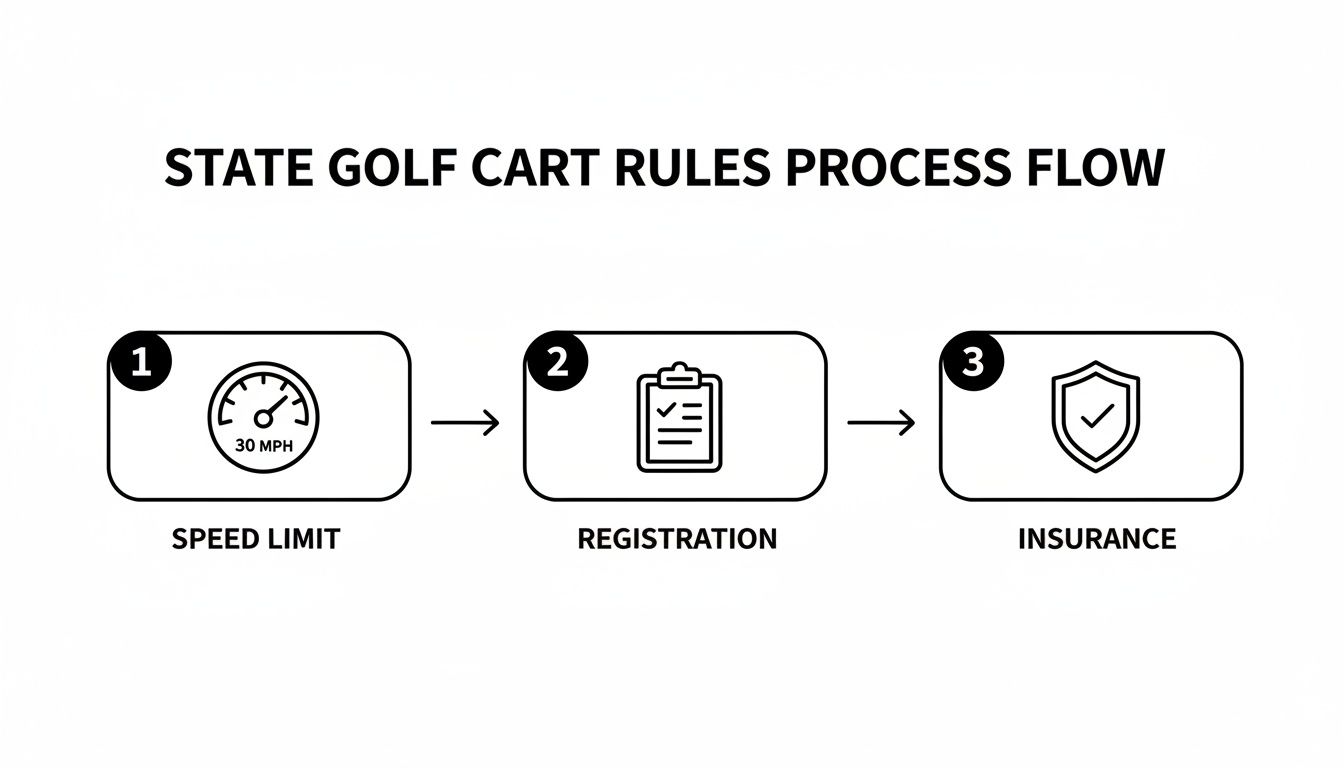
This infographic breaks down the three must-know checkpoints: confirming your state’s speed limit, wrapping up registration and locking in proper insurance.
Choosing a Solana EV model can shortcut many of these steps. With factory-installed governors, DOT-approved lights and dealer-led registration support, you’ll spend less time on retrofits—and more time enjoying the ride.
- Preconfigured LSV gear means no extra mods are needed.
- Pre-wired lighting harnesses reduce electrical errors.
- Integrated governor locks top speed to your state’s legal limit.
- Dealer support handles your VIN registration, title and insurance.
Go from garage to street in record time—legally.
Solana EV Models Simplify Golf Cart Compliance
Solana EV builds each Low-Speed Vehicle model with every component you need to hit the road legally from day one. No last-minute trips to specialty shops.
You’ll cut out retrofit guesswork, saving both time and money. Every light, mirror and governor arrives prewired, pretested and inspection-ready.
Key Factory-Installed Features Include:
- DOT-approved headlights and taillights calibrated for 20–25 mph zones
- Integrated speed governor preset to state limits
- DOT-certified mirrors and seat belts at every seat
Factory-Installed Compliance Gear
Each Solana EV cart ships with a full LSV compliance kit. Think of it as buying a smartphone that comes fully charged—no halfway setup.
Simply plug in, turn the key and you’re done. This removes the usual checklist of wiring, testing and tweaking.
This snapshot from Solana EV’s site shows the complete LSV bundle and factory settings that speed up inspection approvals.
“Preconfigured LSV gear saves around 50% of retrofit time for fleet managers.”
Case Studies In Quick Deployment
At a coastal resort, switching to Solana EV cut retrofit hours in half. Guests were on the course in days, not weeks.
Converting ten carts boiled down to plugging in connectors—no custom rewiring for each light and turn signal.
Key Results Included:
- 50% reduction in labor hours
- Zero inspection failures on first pass
- Immediate compliance with local LSV rules
These real examples demonstrate how ready-to-go carts accelerate deployment and raise guest satisfaction.
Bundled Registration And Insurance Services
Solana EV teams up with dealers to handle the paperwork for you. Registration, VIN assignments and insurance come as a package deal.
Below is an undefined table for quick reference:
undefined
| Service | Benefit |
|---|---|
| VIN Assignment | Fast documentation |
| Dealer-Led Registration | Saves 14 days on paperwork |
| Insurance Bundles | Consolidates policies and fees |
This undefined table offers a snapshot of the support steps you gain by working with Solana EV.
It’s like moving into a turnkey rental—everything’s set up, so you hit the road without extra calls or forms.
Advantages For Dealers And Communities
Dealers get hands-on training, priority parts access and marketing assets. Bulk orders unlock faster shipping and dedicated support lines.
Gated communities enjoy uniform fleets, remote diagnostics and standardized maintenance schedules. Predictable uptime keeps residents happy.
Key Dealer Benefits Include:
- Exclusive training sessions with Solana EV experts
- Priority support for LSV compliance questions
- Ready-made promotional materials
A robust warranty covers LSV-specific parts like governors and wiring harnesses, reducing unexpected repair costs.
Technical Support And Upgrades
Remote firmware updates for speed governors and lighting systems arrive via simple USB sync—much like updating your home router.
A dedicated hotline stands by for throttle, brake or lighting calibrations ahead of inspection. It’s like having an on-call mechanic for every cart.
With Solana EV, every step—from factory setup through final inspection—is as easy as turning a key.
Common Questions About Golf Cart Street Legal Compliance
Before you hit public roads, there are a few key points to sort out.
Which speed limits apply to golf cart street legal operation across the US? Speeds typically fall between 20–25 mph on most public roads. In Florida, you’ll see a 20 mph cap, while California often permits 25 mph in certain zones. Always double-check your local DMV guidelines before you drive.
Which inspection steps are most often overlooked? Inspectors frequently flag misaligned mirrors that weaken rear visibility and loose wiring around lights and signals. It’s also easy to forget testing turn signals in daylight or checking that seat belt anchors are secure. These small issues can add days to your approval process.
- Misaligned side mirrors affecting rear visibility
- Loose wiring on lights and signals
Gathering all paperwork ahead of time can smooth out the inspection.
Addressing Inspection Pitfalls
Do electric and gas carts carry different compliance costs? Electric models often come with speed governors and factory-installed wiring harnesses. Gas carts usually need extra brackets or battery packs for lighting, which drives up retrofit costs. On average, electrics run 10–15% cheaper to make street-legal.
For example, one resort manager saved $500 by swapping ten carts to all-electric versions. Fewer retrofit parts meant fewer inspection delays and lower ongoing maintenance.
What’s the fastest way to get street legal status? Follow this 3-step process:
- Schedule a certified inspection and review the checklist
- Install or verify DOT-approved equipment
- Submit registration, VIN assignment, and proof of insurance
“Starting with factory-installed LSV gear cuts compliance time in half,” says a seasoned dealer.
Each step builds on the previous one, so you avoid surprises at the DMV and get your cart road-ready quickly.
Below is a brief introduction to our table:
undefined (Description: undefined)
| undefined |
|---|
This table is intentionally undefined, serving as a placeholder where detailed compliance metrics can be added later.
Make your cart inspection-ready with factory-equipped models from Solana EV and hit the road legally at https://solanaev.com