
A golf cart light isn't just a fancy add-on; it’s a fundamental upgrade for safety, legal compliance, and getting the most out of your vehicle. Modern LED kits can take your cart from a simple daytime runabout to a versatile machine you can rely on, even after dark.
Why Your Golf Cart Light Is More Than Just an Accessory
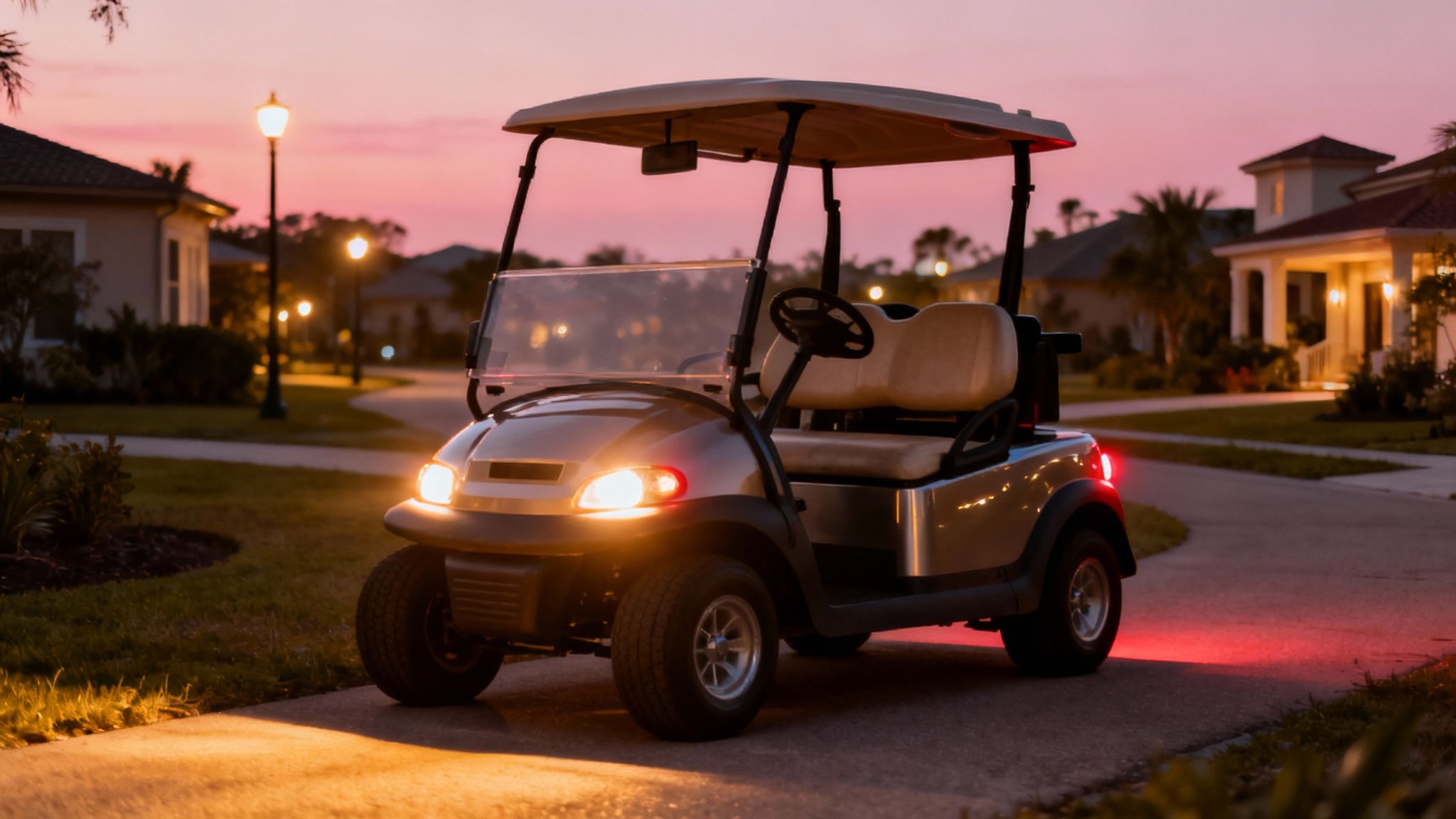
Think about it: without lights, your golf cart’s usefulness is dictated by the sun. Once dusk hits, it's parked for the night. Installing a quality light system is like flipping a switch on your cart’s potential, instantly extending its working hours and making it ready for just about anything, anytime.
But this upgrade is about more than just seeing where you’re going—it’s about being seen. Whether you're driving through a residential community, a sprawling resort, or a busy commercial campus, visibility is everything. A well-lit cart is predictable, and that predictability drastically cuts down the risk of an accident with pedestrians or other vehicles.
Expanding Functionality and Ensuring Safety
The right lighting package does a lot more than just light up the path ahead. It’s an essential layer of both function and safety that modern cart owners can't afford to ignore.
Here’s a quick look at what a good lighting system brings to the table:
- Nighttime Navigation: Suddenly, you can safely get around your property, resort, or worksite long after the sun has set.
- Enhanced Safety: Bright headlights, clear taillights, and functional turn signals communicate your intentions to everyone sharing the road. No more guessing games.
- Legal Compliance: If you plan on driving on public roads, the right lights aren't optional. They're required to meet local street-legal or Low-Speed Vehicle (LSV) regulations.
- Improved Aesthetics: Let's be honest, custom lighting like underglow kits just looks cool. It’s an easy way to give your vehicle a personal touch and a more premium feel.
Upgrading your cart's lighting is one of the smartest investments you can make. It pays you back immediately in safety, usability, and compliance, making your vehicle a far more valuable and secure asset.
What You Will Learn in This Guide
I'm going to walk you through everything you need to know to choose, install, and maintain the perfect lighting system for your cart. We'll dive into the different types of lights out there, from basic headlights to powerful LED light bars. We'll also clear up the often-confusing street-legal requirements so you know exactly what you need.
By the time you're done reading, you'll have the know-how to pick the ideal golf cart light setup for your specific situation, whether you’re outfitting an entire fleet or just upgrading your personal ride. Let's get started.
Understanding the Different Types of Golf Cart Lights
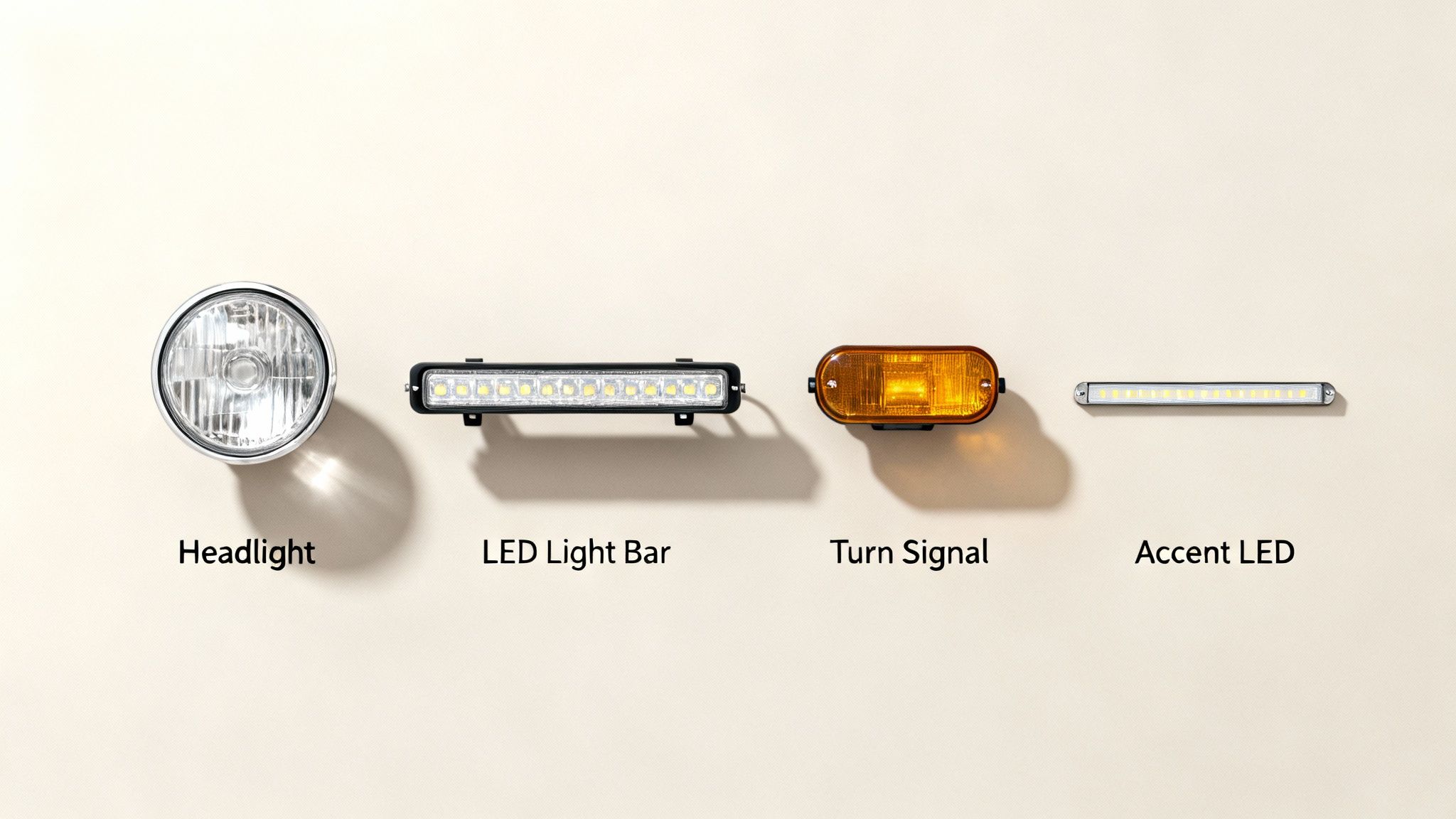
Choosing the right golf cart light system is a bit like packing for a trip—what you bring depends entirely on where you're going. A simple set of headlights might be fine for quick jaunts around your own property, but if you plan on hitting public roads or rugged trails, you'll need a much more complete setup. Getting a handle on each type of light and what it's designed to do is the first step toward building a cart that's safe, functional, and street-legal.
Think about the leap from a basic halogen bulb to a modern LED kit. It's like comparing a weak, flickering flashlight to a stadium floodlight. One barely gets the job done, while the other gives you incredible brightness, efficiency, and durability. Let's break down the main categories so you can figure out exactly what your cart needs.
Foundational Lighting: Headlights and Taillights
Every lighting system starts with the basics: headlights and taillights. These are the absolute non-negotiables for safety and visibility, and they form the foundation of any good setup.
Headlights are your eyes in the dark, lighting up the path so you can spot potholes, turns, and people. Just as importantly, they announce your presence to oncoming traffic, which is critical for avoiding a head-on collision after the sun goes down.
Taillights handle the other side of that equation. Their red glow makes sure anyone coming up from behind can see you clearly. This is especially vital when you're slowing down or driving in areas where cars and carts mix, as it gives other drivers plenty of time to react.
Safety and Communication: Turn Signals and Brake Lights
Once you've covered basic visibility, the next level of lighting is all about communication. Turn signals and brake lights are how you tell other drivers what you're about to do, and they're required for any cart that will be driven near public roads.
- Turn Signals: Those amber flashing lights on the corners of your cart are the universal language for "I'm turning." They take the guesswork out of your movements, making you a predictable and safe presence on the road.
- Brake Lights: These bright red lights pop on the second you touch the brake pedal, giving an instant warning that you're slowing down. This one feature is a huge factor in preventing rear-end collisions, particularly in busy communities or resorts.
Equipping your cart with a complete golf cart light package—turn signals and brake lights included—is what elevates it from a simple recreational vehicle into a responsible part of the local traffic flow.
Enhanced Visibility: The LED Light Bar
For anyone who ventures off the pavement or needs serious illumination, the LED light bar is a total game-changer. These are usually mounted on the roof or front bumper, and they throw a wide, brilliant beam of light that standard headlights can't even touch.
Think of an LED light bar as your high-beam powerhouse. It’s perfect for navigating unlit trails, sprawling properties, or work sites where you need to see absolutely everything. Their rugged build and powerful output make them an essential tool for off-roaders and commercial users.
Personalization and Style: Accent and Underglow Lights
Finally, we get to the fun stuff: accent and underglow lighting. This is all about giving your cart a custom look and a bit of personality. These LED strips can be installed under the body, in the wheel wells, or along the roof to create a cool, ambient glow.
While they're mostly for looks, they do add a real safety benefit by making your cart much more visible from the side at night. With a whole spectrum of colors available—even kits that change colors on command—underglow is the perfect way to make your Solana EV or other premium cart stand out. This type of golf cart light is where style meets a subtle boost in safety.
Here's a quick rundown to help you compare these options at a glance.
Quick Comparison of Golf Cart Light Types
| Light Type | Primary Function | Brightness Level (Lumens) | Energy Efficiency | Best For |
|---|---|---|---|---|
| Headlights | Forward illumination | 800 – 1,500 | Good to High | All-purpose night driving |
| Taillights | Rear visibility | 100 – 300 | High | All-purpose night driving |
| Turn Signals | Indicating direction | 200 – 500 | High | Street and community driving |
| LED Light Bar | Maximum forward illumination | 3,000 – 20,000+ | Moderate | Off-road, rural, and work use |
| Underglow/Accent | Style & side visibility | Varies | Very High | Customization and extra visibility |
As you can see, each light serves a distinct purpose, from essential safety to powerful utility and pure style. The best setup for your cart will always be the one that matches how and where you drive.
Navigating Street-Legal Light Requirements
Want to take your golf cart from the back nine to the main drag? It's not as simple as just turning the key and heading out. To legally drive on public roads, your cart needs to be converted into a street-legal Low-Speed Vehicle (LSV), and that all starts with the right lights.
Think of it as getting a driver's license for your cart. Your golf cart light system is the single most important part of this transformation. The specific rules can get a little tricky, as they often change from state to state, and sometimes even by county or city. But the core idea is always the same: making your cart a safe, predictable, and visible part of traffic.
The Essential Lighting Checklist for LSV Compliance
While you should always check your local regulations, there's a standard set of lights you'll almost certainly need to be considered street-legal. The best way to think about it is as a complete communication system for your cart. Every light has a job to do.
Here’s a quick rundown of the must-haves:
- Headlights with High and Low Beams: Your headlights need to do more than just light up your path. A low-beam setting is crucial for not blinding oncoming drivers, while a high-beam option is necessary for those darker, unlit roads.
- Functional Taillights: These simple red lights are non-negotiable. They ensure you’re visible from behind, which is a basic requirement for any vehicle on the road.
- Operational Brake Lights: When you hit the brakes, the driver behind you needs a clear, bright red warning that you’re slowing down or stopping.
- Amber Turn Signals: You have to signal your intentions. Flashing amber lights on both the front and rear of your cart are required to show other drivers when you plan to turn or change lanes.
- Reflectors: Don't forget these! Reflectors on the sides and back add an extra layer of visibility, making your cart noticeable even when it's parked and the lights are off.
A street-legal light kit isn't just another accessory; it's the passport that lets your golf cart safely and legally share the road. As the owner, it's on you to make sure every single component is working perfectly.
Why Every Light Matters
More and more people are using golf carts for way more than just golf. From sprawling resorts and planned communities to large commercial properties, the demand for road-ready carts is booming. The global golf cart market was valued at USD 2.45 billion in 2025 and is expected to hit USD 3.96 billion by 2033. That growth highlights just how critical a compliant and reliable golf cart light system really is.
This principle of safety through proper equipment isn't unique to golf carts. For example, similar rules and thinking determine whether electric bikes are street legal. It all comes down to clear communication on the road.
If you want to get into the nitty-gritty of making your cart compliant, you can check out our guide on street-legal requirements. It’s the perfect resource to ensure your Solana EV is ready for any road, any time.
How to Choose the Perfect Golf Cart Light Kit
Picking the right golf cart light kit can feel like trying to decipher a secret code of lumens, watts, and IP ratings. But honestly? You only need to get a handle on a few key ideas to make a great choice. I'm going to translate the tech talk into real-world advice to help you find a setup that fits your cart and your needs perfectly.
As you start looking, it's worth knowing the difference between OEM vs aftermarket parts to make a solid call on quality and compatibility. Whether you stick with the original manufacturer's gear or go with a third-party brand, focusing on the right performance specs is what really counts.
Decoding Brightness: Lumens vs. Watts
For years, we were all taught to judge a lightbulb by its wattage. But when you're dealing with modern LEDs, watts just tell you how much power the light is sipping from your battery. The real measure of brightness is lumens.
Here’s a simple way to think about it: watts are the "fuel," while lumens are the actual "light" you get. A well-designed LED can pump out a staggering amount of lumens while using barely any watts.
When you’re comparing light kits, always look at the lumen count first. More lumens means brighter, more effective light, which is exactly what you need for spotting hazards on dark paths.
This is a huge deal for an electric vehicle like a Solana EV, where every bit of battery power matters. Grabbing a high-lumen, low-watt LED kit gives you maximum visibility without cutting your driving range short.
Choosing Your Beam Pattern: Spot vs. Flood
Next up is the beam pattern. This simply describes how the light is shaped as it leaves the housing. Your two main options are spot beams and flood beams, and they're designed for completely different jobs.
Imagine you're out on a pitch-black trail. A spot beam acts like a searchlight, throwing a tight, focused beam of light way down the path. It’s perfect for seeing what’s coming up far ahead.
A flood beam, on the other hand, is more like a lantern. It spreads a wide, even wash of light over a large area right in front of you. This is fantastic for navigating tight turns, seeing the edges of the trail, or just getting a good look at your immediate surroundings. Many modern LED bars offer a "combo" pattern that gives you both in one unit.
Power Consumption and Battery Health
Managing power is the name of the game with any electric vehicle. Every accessory you add, especially your golf cart light system, pulls from the same battery that gets you home. This is exactly why efficient LEDs have completely taken over the market.
Old-school halogen bulbs are notorious power hogs. They get hot, burn out, and put a serious drain on your battery. In stark contrast, modern LEDs are incredibly efficient, delivering brilliant light while consuming up to 80% less energy.
This efficiency is a major reason the golf cart market is booming, hitting a value of USD 1.01 billion in North America in 2023. Smart tech upgrades, like efficient lights, can reduce overall battery drain by up to 20% in modern EVs. That's a huge win for anyone wanting to maximize their range.
This decision tree helps visualize how your lighting needs change depending on where you plan to drive.
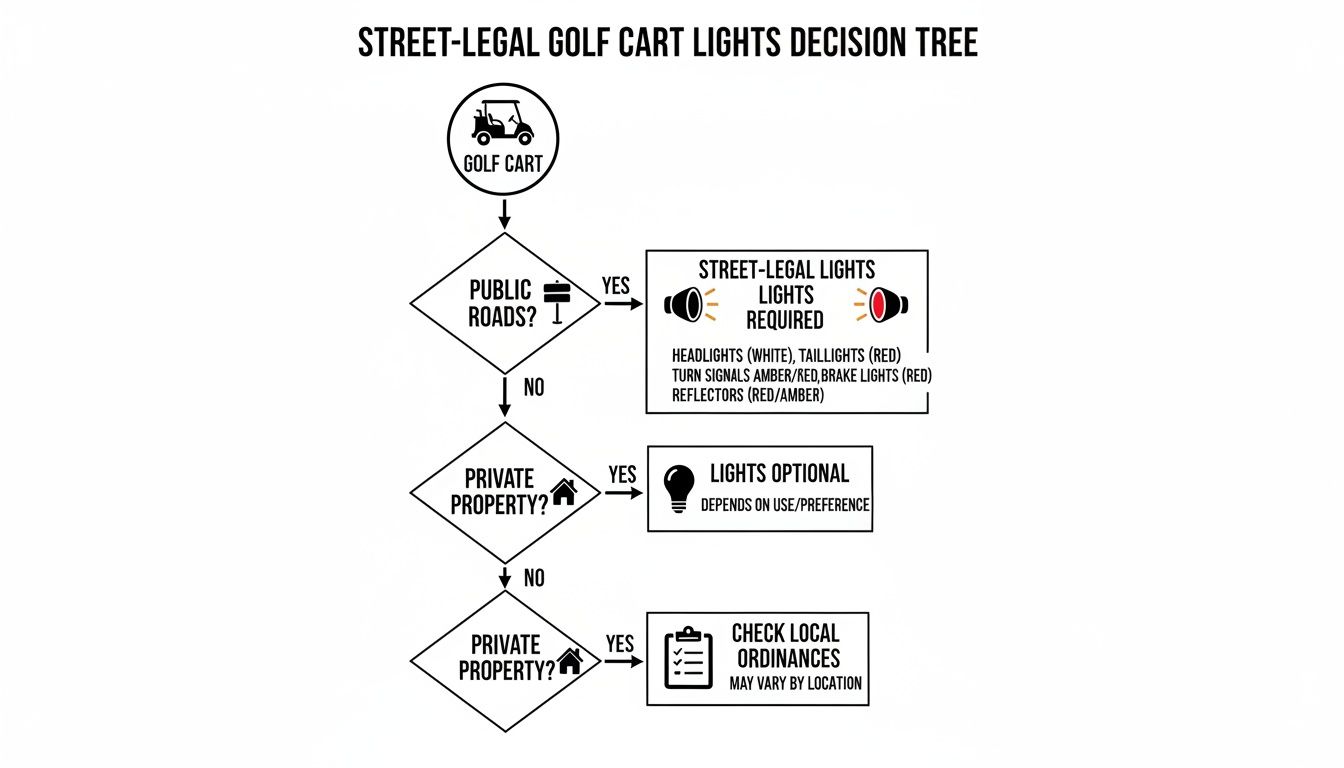
As the flowchart shows, the moment you decide to drive on public roads, a full-blown lighting package with turn signals and brake lights becomes non-negotiable. If you're looking for an all-in-one solution, our guide at https://solanaev.com/golf-cart-street-legal-kit/ walks you through everything you'll need.
Durability and Weatherproofing: Understanding IP Ratings
Your golf cart is going to see it all: rain, mud, dust, and plenty of bumpy rides. Your lights need to be built to take a beating. That’s where IP ratings come into play. An IP (Ingress Protection) rating is just a simple, two-digit code that tells you how well a piece of electronics is sealed against the elements.
Let's break it down:
- First Digit (Solids): This number (0-6) rates how well the light is protected from things like dust and dirt. A 6 is the top score, meaning it’s completely dust-tight.
- Second Digit (Liquids): This number (0-8) rates its protection against water. For a golf cart, you want a rating of at least a 7, which means it can be dunked in water for a short time without failing.
So, when you see a light with an IP67 rating, you know you're getting a tough piece of gear. It's completely sealed from dust and can survive a downpour or a deep puddle, giving you peace of mind that it'll work when you need it most.
A Practical Guide to Installation and Wiring
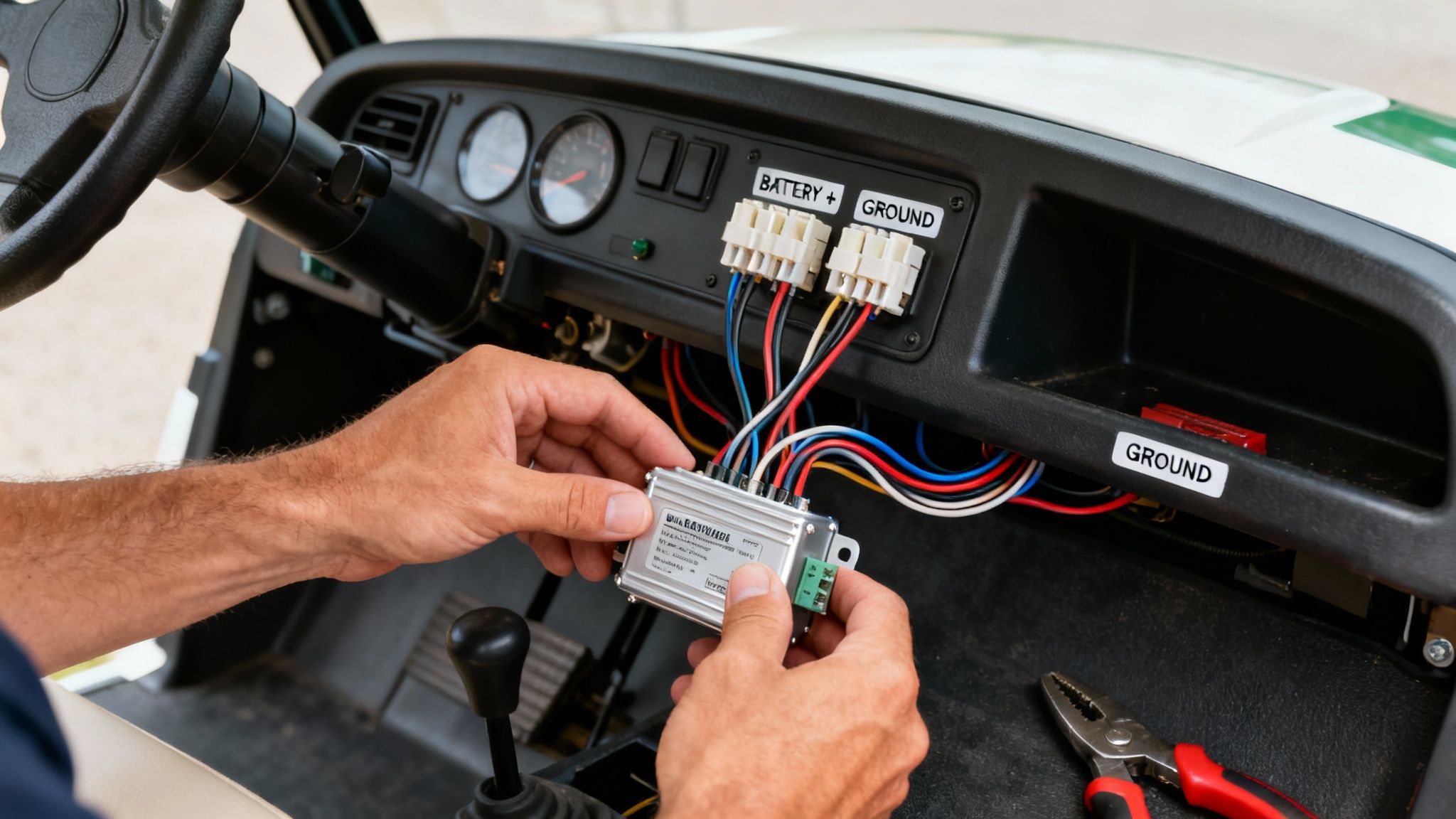
Diving into a golf cart light installation might seem a bit daunting, especially if you're not an expert electrician. But the core concepts are actually pretty straightforward. Think of this as your high-level overview, giving you enough knowledge to either handle a simple upgrade yourself or have an intelligent conversation with the pro installing a full street-legal kit on your cart.
The backbone of any good light kit is the wiring harness. This is essentially a pre-made bundle of wires that acts like the central nervous system for your lights. It connects the power source to your dashboard switch and then out to each individual light, making sure everything talks to each other correctly. It’s designed to be a plug-and-play system that removes most of the electrical guesswork.
Another absolutely critical piece of the puzzle is the voltage reducer. Your cart's battery pack is a powerhouse, running at 36V or 48V. That's way too much juice for standard 12V accessories like lights, horns, or a stereo. The voltage reducer safely "steps down" that high voltage to a usable 12V, preventing you from frying your new gear. It's the essential middleman between your batteries and your accessories.
Safety First: Messing with electrical systems can be dangerous. Before you touch a single wire, always disconnect the main battery pack on your cart. If you hit a snag or feel unsure about any step, just stop and call a professional. It’s not worth the risk.
Key Installation Steps Overview
While every kit is a little different, the installation process usually follows the same logical sequence. You'll start with the physical mounting and finish with the final electrical hookups. If you're curious about the component that manages all of your cart's power, you can learn more about the golf cart controller in our other guide.
Here's a simplified look at how a typical installation unfolds:
-
Mounting the Lights: This is where you physically attach the headlights, taillights, and turn signals to the cart. For a clean, factory look, this often means carefully cutting into the cart's body panels to create a flush fit.
-
Running the Wiring Harness: Next, you'll snake the main wiring harness along the cart's frame. The goal is to neatly connect the front and rear lights while bringing a central line up to the dashboard for the control switch.
-
Connecting the Voltage Reducer: This is a vital step. The reducer gets wired directly to your main battery pack. From there, it provides the clean 12V power that the entire light system will feed on.
-
Final Connections and Testing: With everything in place, you’ll connect the harness to the reducer, the lights, and the switch. After a final check to ensure all connections are tight, you'll reconnect the main battery and test every function—headlights, high beams, taillights, brake lights, and signals—to make sure it all works perfectly.
Even though a DIY install is tempting for basic kits, the precision and safety required for a street-legal Solana EV build make professional installation the smarter path. It's the best way to guarantee every connection is safe, secure, and ready for whatever the road throws at you.
Keeping Your Lights Bright and Trouble-Free
Alright, you've got your new golf cart light system installed and it looks fantastic. Now, the key is to keep it that way. A little bit of routine care will ensure those lights shine just as bright years from now as they do today.
Think of it as a quick pre-drive check. These simple steps don't take much time, but they go a long way in protecting your investment and preventing a minor annoyance from turning into a real headache down the road.
A Simple Maintenance Checklist
You don't need to be a mechanic to keep your lights in top shape. Just work these three quick checks into your regular cart cleaning routine, and you'll guarantee brilliant, reliable light every time you head out.
- Clean the Lenses Regularly: It sounds simple, but you'd be surprised how much dirt, mud, and dust can dim your output. A quick wipe with a soft microfiber cloth and a gentle cleaner is all it takes to clear away buildup and let the light shine through.
- Check for Secure Connections: The constant bumps and vibrations of a ride can work connections loose over time. Just give the wiring a quick visual inspection every now and then. Make sure everything is snug and free of corrosion, paying special attention to where the wires meet the light and the voltage reducer.
- Inspect for Moisture: Good lights are sealed tight, but it never hurts to be cautious. After a heavy downpour or a good washing, take a peek inside the housings for any condensation. Catching a bad seal early can save the entire light.
A clean lens on an LED headlight can improve light projection by as much as 25%. That’s a huge difference in visibility and safety for just 30 seconds of your time. It’s one of the easiest and most effective things you can do.
Common Problems and Quick Solutions
Even with the best lights, you might hit a snag eventually. The good news is that most common problems are pretty straightforward to diagnose and fix if you know what to look for. Here’s how to tackle the most frequent issues.
Problem: One Light Is Dim or Flickering
When just one light starts acting up, the problem is almost always isolated to that specific unit. Don't immediately assume the light is bad; start with the easy stuff.
More often than not, a loose ground wire is the culprit. A single flickering or dim golf cart light is screaming "check my ground!" Make sure its ground wire is securely fastened to the cart's frame. If the ground is solid, wiggle the plug connecting directly to the light itself—it might have just vibrated loose.
Problem: Lights Won't Turn On
If the whole system is dark, the issue is almost certainly with a component that powers everything. Start your search at the fuse panel. A blown fuse is the best-case scenario—it's a cheap and easy fix.
If the fuse looks good, your next stop is the dashboard switch. If that seems fine, it’s time to grab a multimeter and check your voltage reducer. If it isn't putting out a steady 12V, none of your accessories will get the power they need to run.
Answering Your Top Questions About Golf Cart Lights
Once you start looking into lighting upgrades, a few common questions always pop up. Let's get them answered so you can feel confident about your next steps.
Can I Just Add a Light Kit to Make My Cart Street-Legal?
That’s a big part of it, but unfortunately, it's not the only piece of the puzzle. To get your cart officially classified as a Low-Speed Vehicle (LSV), you need more than just lights. Think of it as a complete safety package.
Most local laws require you to have:
- A horn for warnings.
- A DOT-approved windshield.
- Seatbelts for every passenger.
- Side and rearview mirrors.
- The ability to hold a speed between 20-25 mph.
Rules can change from state to state, and even town to town, so it's critical to check with your local DMV. Your best bet is usually an all-in-one street-legal kit that bundles everything you need to be fully compliant.
What's a Voltage Reducer, and Do I Really Need One?
Yes, and this one is non-negotiable. A voltage reducer is absolutely essential for almost any accessory you add to your cart. Your main battery pack puts out a powerful 36V or 48V, but your lights and other add-ons are built to run on a standard 12V car-style system.
Think of it like a translator for your cart's electrical system. It takes that high voltage from your batteries and safely "steps it down" to a stable 12V supply. If you hook a 12V light directly to a 48V source, you'll fry it instantly. The reducer is the crucial component that protects your investment.
A voltage reducer is the unsung hero of your electrical system. It ensures all your 12V accessories receive the correct, stable power they need to function correctly and last for years.
Are LED Lights Actually Worth the Extra Money Over Halogen?
Without a doubt. Especially for an electric cart where every bit of battery life counts. Halogen bulbs might be cheaper to buy, but LEDs win in every other category that matters.
First off, LEDs are ridiculously energy-efficient. They sip power from your battery instead of guzzling it, which means more driving range for you. They’re also far brighter, casting a clean, crisp light that makes a huge difference for nighttime visibility and safety.
And the best part? LEDs have an incredibly long lifespan, often rated for over 20,000 hours. You’ll probably sell the cart before you ever have to replace the lights. The higher initial cost pays for itself time and time again in performance, efficiency, and durability.
How Do I Take Care of My New LED Lights?
Great news here—high-quality LEDs are pretty much set-it-and-forget-it. A little basic care is all they need to stay looking and working like new.
Every once in a while, wipe the lenses down with a soft microfiber cloth and a mild cleaner to keep them clear and bright. It’s also a good idea to check that the mounting bolts are still snug, especially if you drive on rough paths.
Finally, give the wiring a quick look-over. Just make sure the connections are tight, dry, and not showing any signs of corrosion. A good golf cart light system is built to handle the elements, but these simple checks will ensure it performs flawlessly for years.
Ready to transform your ride with superior visibility and style? The team at Solana EV can help you find the perfect, fully integrated lighting solution for your vehicle. Explore our premium street-legal carts and accessories today at https://solanaev.com.