
You're standing beside a cart that would make neighborhood trips easier, and the salesperson has already found a monthly payment that sounds comfortable. Before you agree, ask what you're financing, who will lend against it, and how much you'll still owe when you're ready to sell. A manageable payment isn't enough if the contract lasts longer than you want to own the cart.
Table of Contents
- What Nearby Golf Cart Financing Really Costs
- How Lenders Classify a Street-Legal Golf Cart
- Comparing Credit Unions Banks and Dealer Offers
- Applying Through a Dealer Near You
- Tips for Judging Term Risk and Total Cost
- Get Written Quotes from a Solana EV Dealer
What Nearby Golf Cart Financing Really Costs
The payment written on a dealer's worksheet is an answer to a narrow question: how much would you pay each month under that particular offer? It doesn't tell you whether the price is competitive, whether the fees are reasonable, or whether the repayment period fits your plans. Don't negotiate the payment before you understand the purchase.
A household buying for a gated community might care mainly about staying within its monthly budget. A resort manager might focus on preserving operating cash. Both should insist on seeing the full borrowing cost before deciding that a nearby lender has offered a good deal.
Use car rates as context, not a promise
The Federal Reserve's May 2025 consumer-credit release reported commercial-bank new-car loan rates of approximately 8.04% for 60 months and 8.16% for 72 months, but these are not golf-cart-specific rates (Federal Reserve consumer-credit release). Don't walk into a showroom expecting a specialty-vehicle lender to match an automobile benchmark.
At an otherwise comparable positive interest rate, extending repayment lowers the scheduled payment because you spread principal across more months. You also keep paying interest longer. That's why a dealer can make an expensive purchase look more comfortable without reducing its price.
Practical rule: Ask what changed when the payment dropped. If the answer is only the term, you haven't negotiated a cheaper cart.
Request a complete price for borrowing
When you search for golf cart financing near me, collect written quotes from local banks, credit unions, specialty lenders, and the selling dealer. Require the same basic information from each:
- APR and repayment term. Get the annual percentage rate and the complete payment schedule, not just a quoted interest rate.
- Amount financed and down payment. Identify how much you're borrowing and how much cash or trade equity you're contributing.
- Origination and documentation fees. Ask which charges you pay upfront and which enter the loan.
- Total interest and total repayment. Make the lender show what the contract costs if you follow its scheduled payments.
Before visiting lenders, use Toya AI's auto loan estimator guide as a resource for organizing payment inputs. Use an estimator to test assumptions, not to replace a written lender disclosure.
Approval and pricing can differ depending on whether the cart is new or used, titled, street legal, pledged as collateral, or purchased for business use. Don't assume the advertisement applies to your exact unit. Rank comparable offers by total repayment cost, then decide whether the payment fits your budget.
How Lenders Classify a Street-Legal Golf Cart
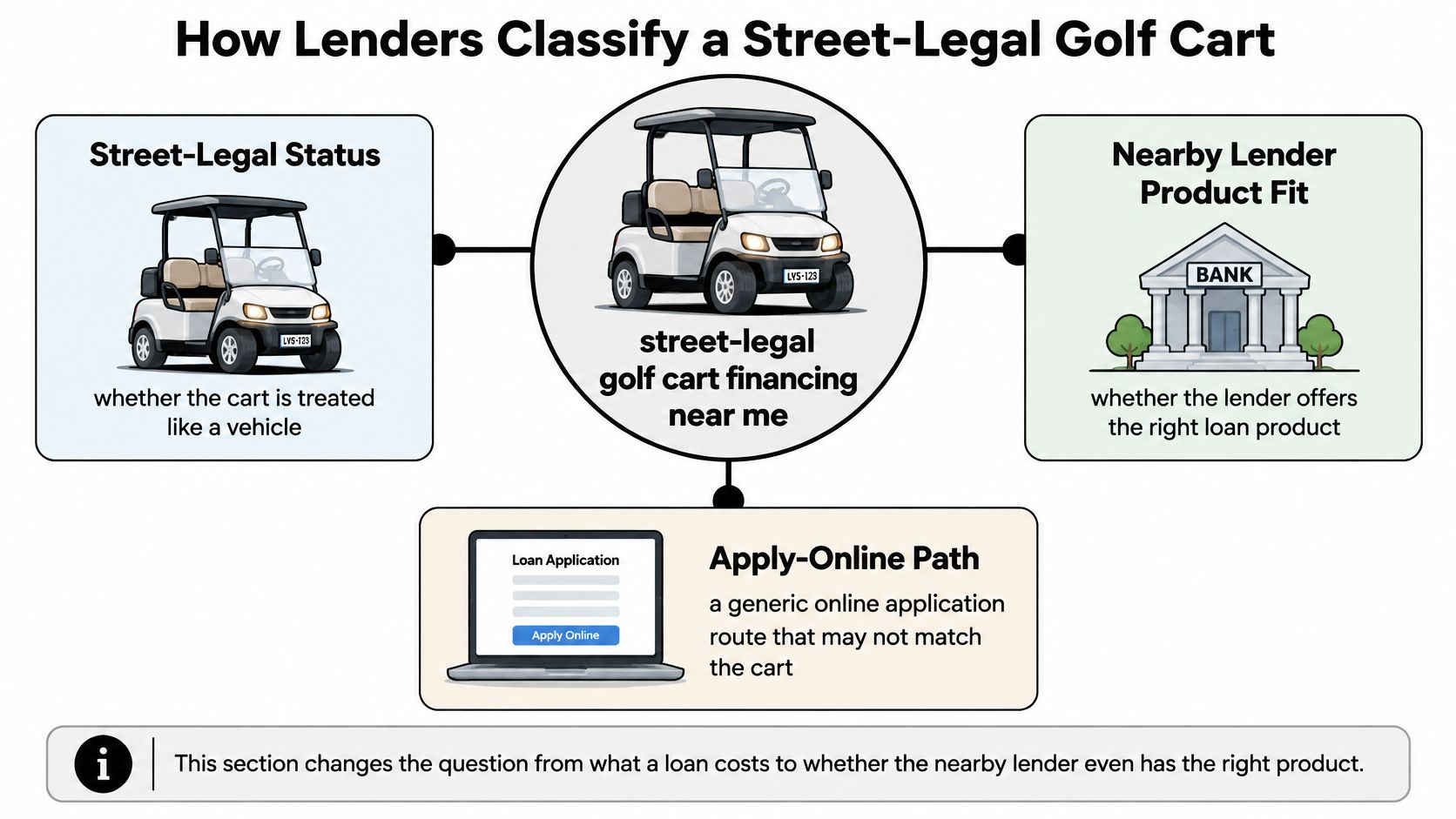
The nearest bank isn't necessarily the right lender. Before submitting an application, ask what its lending department calls the vehicle you intend to buy.
A lender might classify it as a golf cart, low-speed vehicle, recreational vehicle, powersports unit, or specialty equipment. That distinction can affect which application you need, what documents the lender requests, and whether it will accept the vehicle as collateral. A generic online application doesn't establish product eligibility.
The classification map below highlights the questions to settle before applying.
Confirm the title and collateral requirements
Start with the actual vehicle documents, not the dealer's description of it as neighborhood-ready. Review the low-speed vehicle requirements and ask the seller to identify the documentation available for the specific unit.
Then ask the lender direct questions:
- Vehicle eligibility. Does your loan program finance titled, street-legal low-speed vehicles?
- Collateral identification. Will you secure the loan against this vehicle identification number, or VIN?
- Documentation. Do you require a title, registration information, or particular insurance coverage before funding?
- Exit options. Does the contract permit early payoff and refinancing, and under what conditions?
Don't accept a general statement that the lender finances electric vehicles. Ask for confirmation that it finances this vehicle under this loan program.
Match the contract to the actual use
A homeowner needs a consumer purchase contract suited to personal use. A resort or campus operator should disclose commercial use before anyone submits a household application. Ask whether the lender permits that use and whether it considers business income when evaluating repayment.
A dealership buying inventory has a different need again. Dealer floor-plan financing funds inventory, not a household's cart purchase. An operator purchasing vehicles for daily service should ask about business asset financing rather than assuming an inventory facility or consumer contract is appropriate.
For broader context, Experian reported an average new-vehicle loan amount of $42,332 and an average payment of $748 in Q3 2025, figures that describe conventional vehicle financing rather than cart offers (Experian vehicle-financing release). Don't let automobile advertising substitute for an eligibility check on a specialty vehicle.
Treat refinancing as a possible future comparison, not a rescue plan for an uncomfortable contract. Confirm whether another lender would accept the asset, but buy on terms you can carry without assuming a later approval.
Comparing Credit Unions Banks and Dealer Offers
Once a lender confirms eligibility, request competing quotes using the same vehicle, purchase price, down payment, and intended use. For a documented street-legal cart, start with a local credit union's LSV product, a dealer-arranged powersports lender, and an unsecured-loan provider. Ask your bank whether it offers an eligible secured product before treating its personal loan as your only outside option.
Compare the structure before the headline rate
Each lender should identify whether it takes a lien against the VIN, finances permanently installed equipment, and includes taxes, registration, title charges, dealer fees, or warranties in principal. Those answers determine whether you're comparing equivalent loan amounts.
| Financing route | What to establish in writing | What not to assume |
|---|---|---|
| Credit union | LSV eligibility, cash contribution, collateral rules, eligible equipment | Every credit union finances carts |
| Local bank | Secured or unsecured structure and permitted use | Your existing account guarantees competitive pricing |
| Dealer-arranged specialty lender | Exact lender, itemized principal, promotional conditions | Convenience means the lowest total cost |
| Unsecured-loan provider | Net proceeds, fees, repayment schedule | Avoiding vehicle collateral makes borrowing cheaper |
For a credit-union search, PenFed accounts and rates in 2026 from Fintrack can serve as background reading. Confirm current product eligibility and terms directly with the institution before relying on any published comparison.
A published credit-union example finances up to 95% of an eligible LSV's purchase price, requires at least 5% cash or trade equity, permits terms up to 60 months, and excludes non-permanently attached options and negative trade equity; its illustrated $20,000 loan at 8.90% APR over 42 months has an approximate $554.81 payment (Eglin Federal Credit Union golf-cart financing). Those are that lender's published parameters, not universal cart-loan rules.
Use credit benchmarks without confusing them with offers
The following published vehicle APR benchmarks are references, not golf-cart quotes; the accompanying consumer-finance discussion reports Q1 2025 averages of 6.73% for new vehicles and 11.87% for used vehicles, and describes Consumer Reports findings that similarly high-credit borrowers received offers from 0% to above 25% APR (vehicle APR and credit-tier comparison).
Published Vehicle APR Benchmarks by Credit Tier
| Credit tier | New-vehicle APR | Used-vehicle APR |
|---|---|---|
| Super-prime | 4.41% | 6.29% |
| Prime | 6.15% | 8.81% |
| Near-prime | 9.71% | 13.93% |
| Subprime | 13.52% | 19.10% |
Your credit profile matters, but it doesn't eliminate the need to shop. Ask participating dealers about available retail promotions and whether accepting one changes the purchase price or removes a cash discount.
Compare the complete deal, not a promotional rate attached to a different selling price.
Collect offers within a short shopping window and record their expiration dates. Rank each by fully amortized payment, total interest, fees, and required upfront cash. A lower APR isn't enough when the lender finances a larger balance or requires a substantially different purchase arrangement.
Applying Through a Dealer Near You
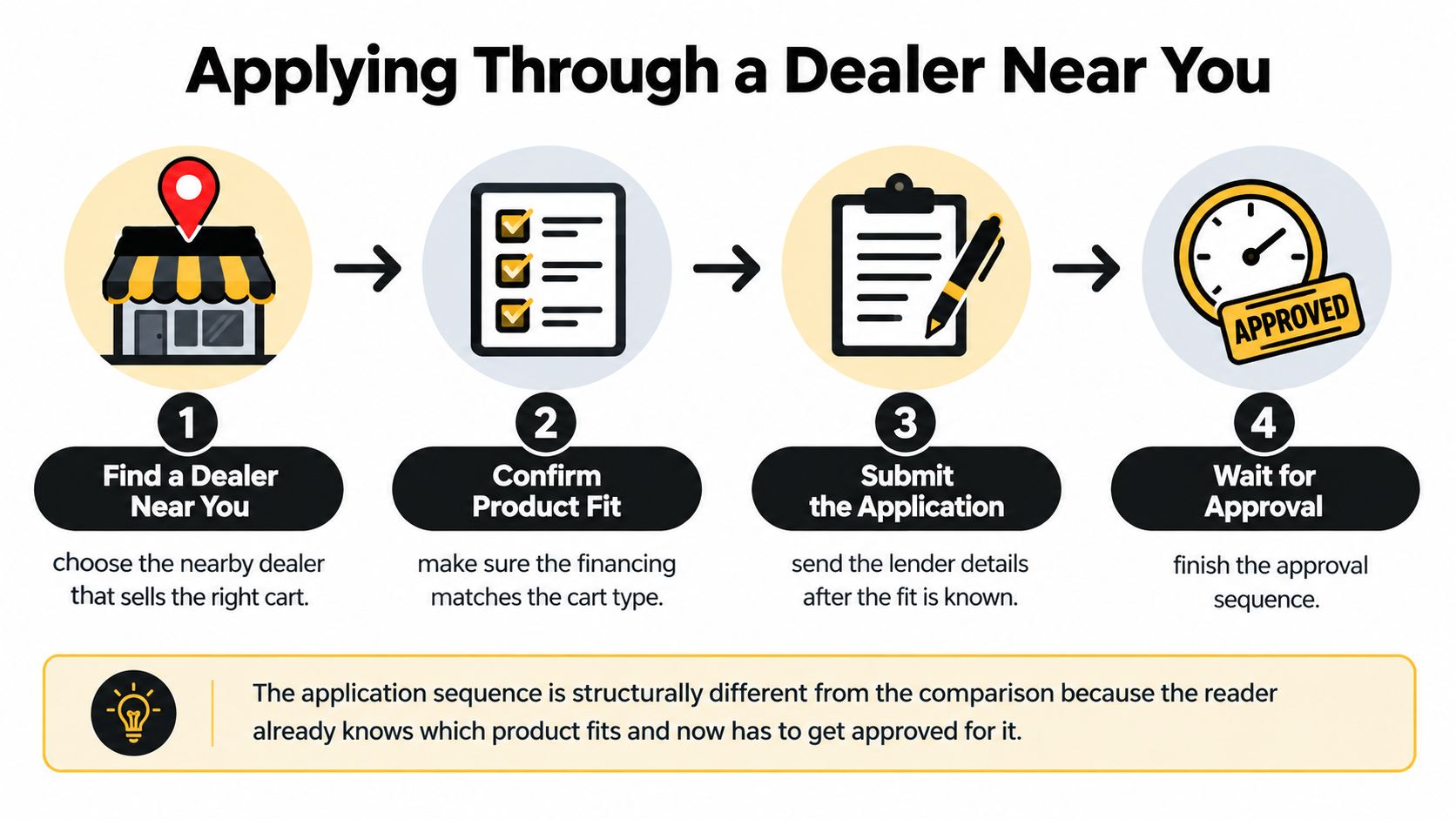
Arrive with the product fit established and your outside quote available. Use the local golf-car dealer directory to arrange a visit, then tell the dealer whether you need a neighborhood passenger vehicle, a street-legal LSV, or a work-oriented unit.
Don't submit an application while the vehicle description is still vague. Confirm whether the unit is new or used, how it will be titled, and whether its identification matches the paperwork.
Use the application flow below to keep the visit in order.
Settle the purchase before submitting the file
Request an itemized out-the-door buyer's order. It should identify the vehicle and separately show accessories, delivery, taxes, registration, service plans, and customization.
Decide which optional items you want before the dealer sends the financing request. Don't let an approval amount become permission to add equipment you hadn't planned to buy.
Calculate your debt-to-income ratio using the proposed payment: add that payment to your existing monthly debt obligations, then compare the result with your gross monthly income. Ask the lender which obligations and income documentation it uses. Keep your own affordability check separate from its approval decision.
If collections are part of your credit history, review Superior Credit Repair collection rebuilding steps before applying. Bring accurate records for any account information that needs clarification, and don't assume a dealer can resolve a credit-report discrepancy during the sale.
Resolve mismatches before signing
Have the dealer arrange its retail offer alongside your outside lender's quote. Before authorizing submission, ask which lenders will receive the application and what supporting documents they require.
Request written answers covering:
- Contract restrictions. Prepayment penalties, refinancing permissions, and permitted personal or commercial use.
- Vehicle limits. Age restrictions, street-legal requirements, and acceptable title documentation.
- Funding requirements. Insurance, documentation fees, and any conditions that remain outstanding.
A missing VIN, an untitled unit, or commercial use prohibited by a consumer contract isn't a minor clerical detail. Stop and correct the mismatch rather than letting someone force the purchase into a recreational-equipment application that doesn't fit.
For an additional visual resource during your dealer research, the video is embedded below.
Leave with a complete application file and comparable written offers. A verbal payment estimate, even from a helpful salesperson, isn't the document you should use to make the purchase decision.
Tips for Judging Term Risk and Total Cost
Choose a repayment period you can defend without pointing only to the payment. If the purchase works only after stretching the loan, reconsider the vehicle price, optional equipment, or timing.
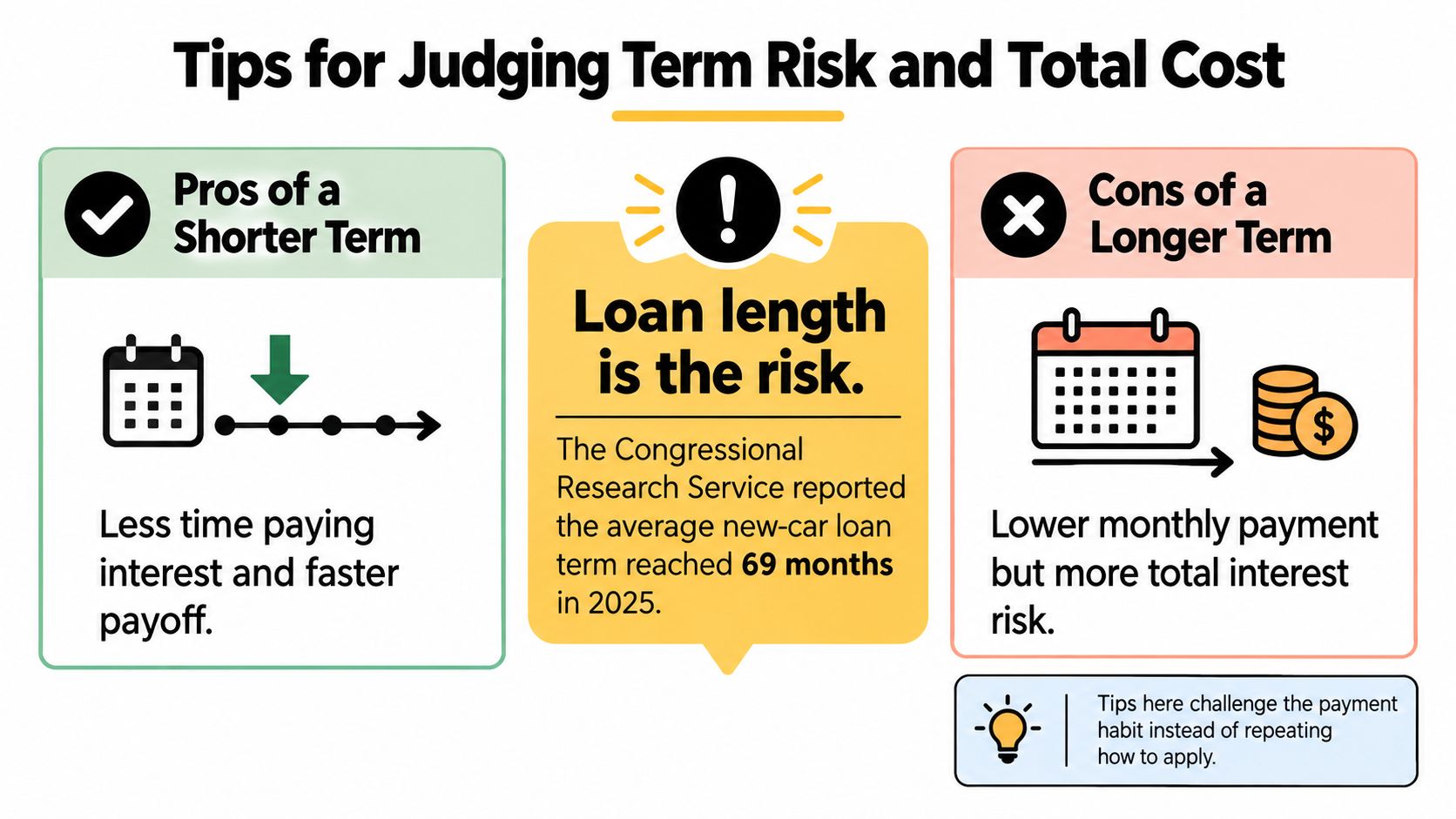
The Congressional Research Service reported an average new-car loan term of 69 months in 2025; commercial-bank rates for a 48-month new-auto loan moved from 4.6% in November 2021 to 8.5% in November 2023, then 7.5% in November 2025, while monthly vehicle payments rose nearly 30% between 2020 and 2023 (Congressional Research Service vehicle-finance overview). These automobile figures provide context, not evidence that a long cart loan is sensible.
The comparison below highlights why repayment length deserves its own decision.
Test the loan against your ownership horizon
Ask the lender to show a shorter-term alternative at the quoted purchase price and down payment. Compare the remaining balance at your planned sale date, not merely the final payoff date.
Put the battery warranty, vehicle warranty, and expected ownership period beside that schedule. Don't invent a battery replacement date or assume warranty coverage lasts as long as the loan. Read the actual coverage, exclusions, and any usage conditions.
Exit test: Could you sell the cart when you intend to without bringing cash to clear the loan?
Resale value isn't guaranteed. Ask the dealer how it evaluates trade-ins and use conservative expectations rather than the strongest asking price you can find online.
Budget for the buyer you actually are
Use a total cost of ownership framework to account for expenses outside the loan. Obtain estimates tied to your vehicle and location rather than borrowing a generic ownership budget.
- Homeowner. Include charging arrangements, storage, insurance, maintenance, and any registration obligation. Judge the purchase against realistic use.
- Gated-community resident. Confirm community access rules and whether your intended routes require different vehicle documentation. Don't finance equipment that won't solve your transportation need.
- Resort operator. Budget for servicing and periods when the vehicle is unavailable. Match the ownership plan to guest transportation or property work.
- Business user. Include commercial coverage and maintenance needs associated with the intended workload, then compare repayment with available operating cash.
A smaller vehicle doesn't automatically produce a cheap ownership plan. Financed accessories and plans still have to be repaid, and repair expenses don't pause the loan.
My recommendation is straightforward: choose the shortest term that remains comfortable after ownership costs and a cash cushion. If that payment doesn't work, reduce the purchase rather than relying on optimistic resale value or a trouble-free battery.
Get Written Quotes from a Solana EV Dealer
Book a dealer appointment with a specific request: a written retail-financing offer for an identified vehicle, matched to your intended use. Bring the itemized purchase proposal and your outside financing quote so the discussion starts with a real alternative, not an open-ended monthly budget.
Ask the dealer to confirm the exact unit before discussing financing availability. The inventory conversation and the lending conversation are related, but they aren't interchangeable. A feature you like doesn't improve a contract's repayment terms.
Make the request fit your purchase
For a household or gated-community resident, ask for the consumer contract appropriate to the vehicle's documented classification. Tell the dealer where you expect to use it and what passenger or cargo needs it must meet.
A resort or campus buyer should identify commercial use at the outset. Describe who will operate the cart, what work it will perform, and which business will purchase it. Don't accept household paperwork just because it's easier to submit.
A prospective dealership should ask separately about inventory floor planning. Keep that conversation apart from the retail terms offered to end customers.
Ask the dealer to put its response in a form you can take away:
- Vehicle match. Identify the unit, included equipment, and any requested changes.
- Offer conditions. State credit-approval requirements, promotion eligibility, expiration dates, and discount trade-offs.
- Decision-ready figures. Provide a complete repayment disclosure using the agreed purchase configuration.
Decide from documents, not urgency
Compare the dealer's final proposal with the competing offers you collected. If a figure has changed, ask for a revised written version and an explanation before signing.
Don't let the availability of a particular cart rush you past an unresolved title question or an unexplained charge. You're allowed to like the vehicle and reject its financing.
A dealer earns your signature by making the purchase clear, not by making the payment sound small.
Aim to finish the comparison during the same shopping period, while the quotes remain valid. If an offer expires or the vehicle changes, refresh the numbers instead of assuming the old approval still applies.
The right nearby dealer should help you identify the vehicle, document its eligibility, and explain the contract. Your job is to choose a purchase you can comfortably keep, maintain, and eventually sell.
Solana EV offers electric golf carts and access to dealer-arranged retail financing for buyers comparing local purchase options. Visit Solana EV to browse vehicles or locate a nearby dealer, then request a written offer matched to your vehicle and personal or business use. Bring an outside quote and choose the contract by its total cost, not its smallest monthly payment.