
You might think the golf cart was born out of a desire for luxury or convenience on the course, but you'd be wrong. Its evolution wasn't driven by making the game easier for everyone; it started with a simple, human need to help a few people keep playing the game they loved. These vehicles, now everywhere, began as a practical solution to a personal struggle, and that humble origin story ended up changing golf forever.
From Necessity to Novelty: The Birth of the Golf Cart
Before golf carts became a fixture at every club and gated community, the golf course was strictly walking territory. The very idea of a motorized caddy was pure science fiction for most. But the real origin story is a fantastic reminder that some of the best inventions come from a person trying to solve their own problem. This was a story of adaptation, not indulgence.
Our journey starts back in the early 1930s. At the time, playing golf meant walking the course—no exceptions. For most people, that was just part of the game. But for players with health issues or mobility challenges, it was a genuine barrier that could force them to give up the sport entirely. And it was that very obstacle that provided the spark for what would become the modern golf cart.
The Rickshaw on the Green
Believe it or not, the first real ancestor of the golf cart didn't have a gas engine or a battery pack. It was powered by people. The concept first took shape thanks to Lyman Beecher, a Florida man who refused to let his arthritis sideline his golf game. His first design, built in 1932, was basically a two-wheeled rickshaw with a seat, pulled along the fairways by a couple of caddies. It was a simple, yet brilliant, solution. You can actually read more about this pioneering effort and see how it set the stage for everything that followed.
While it worked, Beecher's human-powered cart was obviously not the most efficient system. It was entirely dependent on the caddies' strength. But it proved a crucial point: personal transport on the golf course was not only possible but essential for some players. This rickshaw was the proof-of-concept that inspired the next logical step—adding a motor.
The Dawn of Electric Power
It didn't take long for Beecher to move beyond the rickshaw idea. He soon tinkered his way to a clunky, three-wheeled electric vehicle. Let's be clear, this machine was a far cry from the sleek carts we zip around in today. It was slow, incredibly heavy, and probably broke down all the time. The whole thing was powered by standard car batteries that gave it a very limited range and not much oomph.
These first-generation carts were mostly one-off creations, cobbled together in garages by determined inventors. They weren't being mass-produced; they were seen as oddities, not serious vehicles. The technology was just getting started, and the challenges were huge:
- Battery Limitations: Early lead-acid batteries were notoriously inefficient. They could barely hold enough charge to get a player through a full 18 holes.
- Rudimentary Motors: The electric motors were weak and anemic, struggling with the slightest hill or patch of rough terrain.
- Bare-Bones Design: Comfort wasn't a consideration. With zero suspension and primitive steering, the ride was rough and unforgiving.
The first golf carts weren't a symbol of status. They were a symbol of perseverance—a refusal to let physical limitations keep someone from a sport they loved. A personal struggle was on its way to becoming a worldwide convenience.
Despite all these problems, the idea was planted. The move from a caddy-pulled rickshaw to a self-propelled (if flawed) electric cart was a massive leap forward. It established the fundamental concept that would guide the golf cart's evolution for decades, paving the way for other inventors and companies to jump in and start perfecting the design.
The Gas-Powered Revolution and Rise of Major Brands
Those early electric carts were a neat idea, but let's be honest—they weren't quite ready for prime time. Their weak motors and batteries that died halfway through a round made them more of a curiosity than a practical tool. For the golf cart to really take off, it needed a different kind of power, something with the muscle and stamina to handle hilly courses all day long. The answer, of course, was the good old internal combustion engine.
This move from electric to gas in the mid-20th century was a huge leap forward. The first official gas-powered golf cart rolled out in 1954, and it was an absolute game-changer. Suddenly, golfers had all the range and power they needed, making carts a must-have for larger courses where walking just wasn't practical.
The infographic below shows just how far things had come, from early human-powered concepts to the first simple motorized buggies.
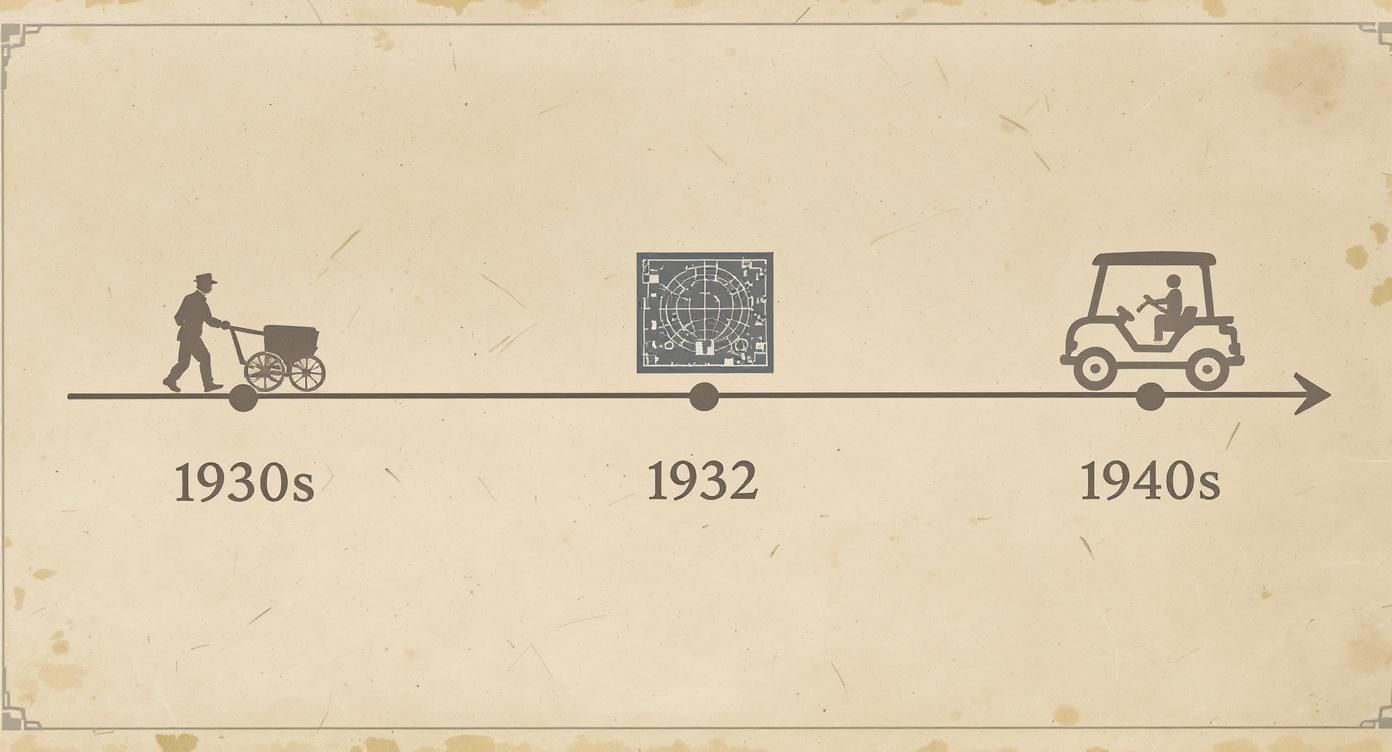
You can really see the slow-but-steady evolution from a basic idea in the 1930s to a clunky-but-functional vehicle by the 1940s, which perfectly set the stage for the gas-powered boom.
The Rise of the Big Three
The arrival of the gas engine didn't just solve a power problem; it kickstarted an entire industry. What was once a niche hobby for garage tinkerers became a legitimate business. This is when the brands we all know today started to make their mark.
E-Z-GO jumped into the scene early, starting out in a small machine shop back in 1954. Their success helped create a standard for what a golf cart should be. Cushman, already a big name in utility scooters, saw an opportunity and brought their reputation for rugged, no-nonsense vehicles to the golf course.
But the competition really fired up when Club Car, founded in 1958, entered the ring with a focus on top-notch engineering and durability. Yamaha wasn't far behind, bringing its deep expertise in engine manufacturing to create some of the most dependable gas carts on the market.
This table highlights some of the key turning points during this foundational period.
Key Milestones in Mid-Century Golf Cart Development
| Year | Milestone | Significance |
|---|---|---|
| 1954 | First commercial gas-powered golf cart | Provided the range and power needed for widespread adoption on courses. |
| 1954 | E-Z-GO is founded | Helped standardize cart design and manufacturing, making them more accessible. |
| 1958 | Club Car is founded | Introduced a new level of engineering quality and durability to the market. |
| 1960s | Cushman enters the golf cart market | Brought a focus on rugged, utility-focused designs popular with course maintenance. |
| 1970s | Yamaha begins producing golf carts | Leveraged decades of engine expertise to create highly reliable and efficient vehicles. |
This intense competition was fantastic for golfers and course owners. Brands were constantly trying to one-up each other, which led to a flood of improvements:
- Engine Efficiency: Carts got quieter, used less fuel, and produced fewer emissions.
- Suspension Systems: The ride quality got way better, making a trip around the course a lot more comfortable.
- Durability and Reliability: To stand out, manufacturers had to build tougher frames and more reliable parts.
- Aesthetic Design: Carts finally started to look like they were designed for the golf course, not just like a scooter with extra wheels.
Pushing the Boundaries of Performance
With reliable engines and a competitive market, manufacturers started thinking bigger. The golf cart was no longer just a two-person shuttle; it was becoming a much more versatile vehicle.
One of the biggest improvements was the move to four-wheel designs. The original three-wheelers were a bit wobbly, but adding that fourth wheel made carts drastically more stable, safe, and smooth to drive. It seems like a small change now, but it was a fundamental shift that made carts appealing to a much wider audience.
As the industry grew, so did the arguments over which brand was best. That's a debate that continues to this day—you can see a modern take on it in our detailed comparison of E-Z-GO vs. Club Car. Ultimately, this era of gas-powered innovation built the foundation for everything that came next, from souped-up custom carts to street-legal electric vehicles.
Customization and Life Beyond the Golf Course
The gas-powered boom put a golf cart on just about every fairway, but its story was far from finished. The next chapter in the golf cart evolution wasn't written by engineers or manufacturers. It was written by the owners themselves. Starting in the 1970s and 80s, a cultural shift began brewing that would turn this humble utility vehicle into a canvas for personal expression.
It started small. In sprawling retirement communities and private resorts, owners realized their carts were more than just a way to get to the next hole—they were becoming their main ride for getting around town. And just like with a car, people wanted their vehicle to show off a bit of their personality.
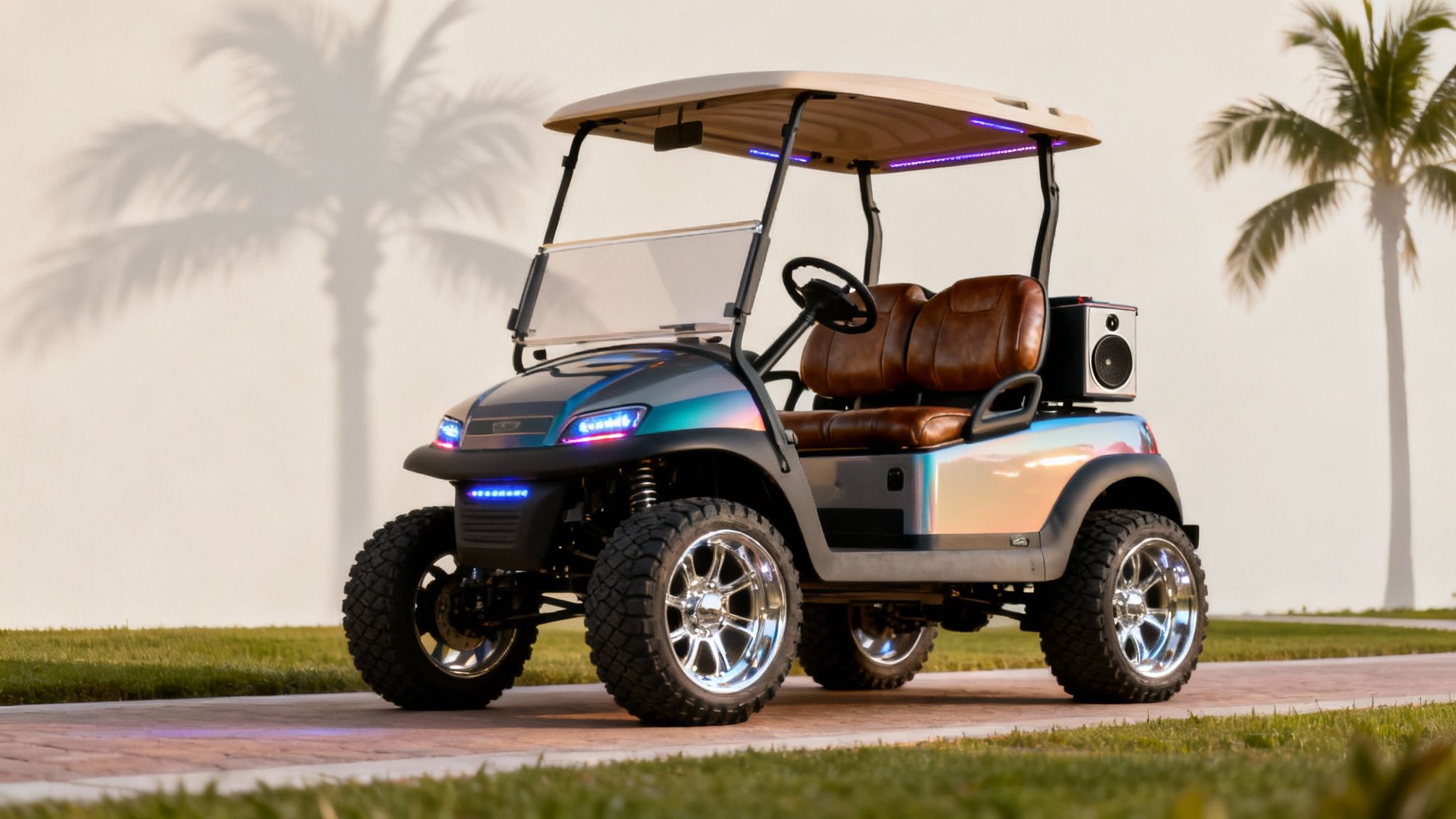
This budding desire for a personal touch kicked off a whole new industry. Simple color swaps gave way to elaborate, automotive-grade paint jobs. Flimsy vinyl benches were swapped out for plush, upholstered seats that offered real comfort and style. The era of the bare-bones golf cart was officially over.
From Utility to Individuality
The customization craze didn't stop with looks; it quickly moved into functional and fun upgrades. People started adding features that made their carts more practical and enjoyable for everyday life, not just for a round of golf.
This wave of creativity brought all sorts of cool additions:
- Upgraded Sound Systems: Stereos and speakers became a must-have, letting owners cruise with their favorite tunes.
- Custom Wheels and Tires: Shiny chrome rims, slick alloy wheels, and beefy all-terrain tires didn't just look good—they improved how the cart handled on different surfaces.
- Lift Kits: Jacking up the suspension gave carts a tougher, truck-like look and made them better at tackling rough ground.
- Enhanced Lighting: LED light bars, underbody glow kits, and custom headlights made the carts pop visually while also making them safer and more visible.
The trend was clear: the golf cart was shedding its purely functional image. As its popularity grew in new environments, so did the desire for owners to make it their own, from eye-catching paint to booming sound systems.
The golf cart was no longer just a piece of sports equipment. It was becoming a personal vehicle, a statement of style, and a symbol of a relaxed, community-first lifestyle.
This movement forced manufacturers to pay attention. They realized people wanted more than the standard two-seater and began offering more options right off the assembly line. For a look at how far things have come, check out our guide on modern golf cart customization ideas.
Breaking Free from the Fairway
As owners tricked out their carts, the vehicle's role in daily life expanded in a big way. The very things that made them great for golf—quiet, slow, and easy to drive—also made them perfect for other controlled environments.
Gated communities, especially in sunny states like Florida and Arizona, became the epicenter of golf cart culture. Residents used them for everything: visiting neighbors, popping over to the community pool, or just going for a leisurely evening drive. The cart perfectly filled the gap between walking and firing up a full-sized car.
This created a feedback loop. The more people used carts for neighborhood travel, the more manufacturers saw a golden opportunity. They started designing models specifically for this purpose, leading to a much more diverse lineup of vehicles.
The market exploded with specialized carts:
- Multi-Passenger Shuttles: You started seeing four, six, and even eight-seaters shuttling people around resorts, airports, and big event venues.
- Utility and Cargo Carts: Businesses and maintenance crews fell in love with carts equipped with flatbeds or cargo boxes for hauling tools and supplies across sprawling campuses.
- Off-Road and Hunting Models: Rugged versions with lifted suspensions, aggressive tires, and camouflage paint jobs hit the market, built to handle trails and backcountry terrain.
This diversification was all the proof anyone needed. The golf cart had successfully broken out of its niche, evolving into a versatile personal transport solution. It was now perfectly positioned for its next big leap: becoming a street-legal vehicle.
The Modern Era of Electric and Street-Legal Carts
History has a funny way of repeating itself. Just as gas engines pushed aside the first electric carts a century ago, a new generation of electric power has come roaring back to completely reshape the industry. But this isn't the same old story. Today's electric carts are a different breed entirely—quiet, clean, and often outperforming their gas-powered cousins.
This comeback is all thanks to incredible leaps in battery and motor technology. The clunky, short-lived lead-acid batteries of the past are quickly being replaced by high-performance lithium-ion batteries. It’s like trading in a brick-sized 1990s cell phone for today's smartphone. Lithium batteries are lighter, charge in a fraction of the time, and provide consistent, fade-free power right down to the last drop of charge.
But the upgrades don't stop with the battery. Modern carts are now driven by sophisticated AC (alternating current) motors, which deliver far better efficiency, zippier acceleration, and serious hill-climbing torque compared to older DC motors. Many also feature regenerative braking, a smart system that recaptures energy when you slow down and sends it back to the battery, squeezing out a little extra range.
From Golf Path to Public Road
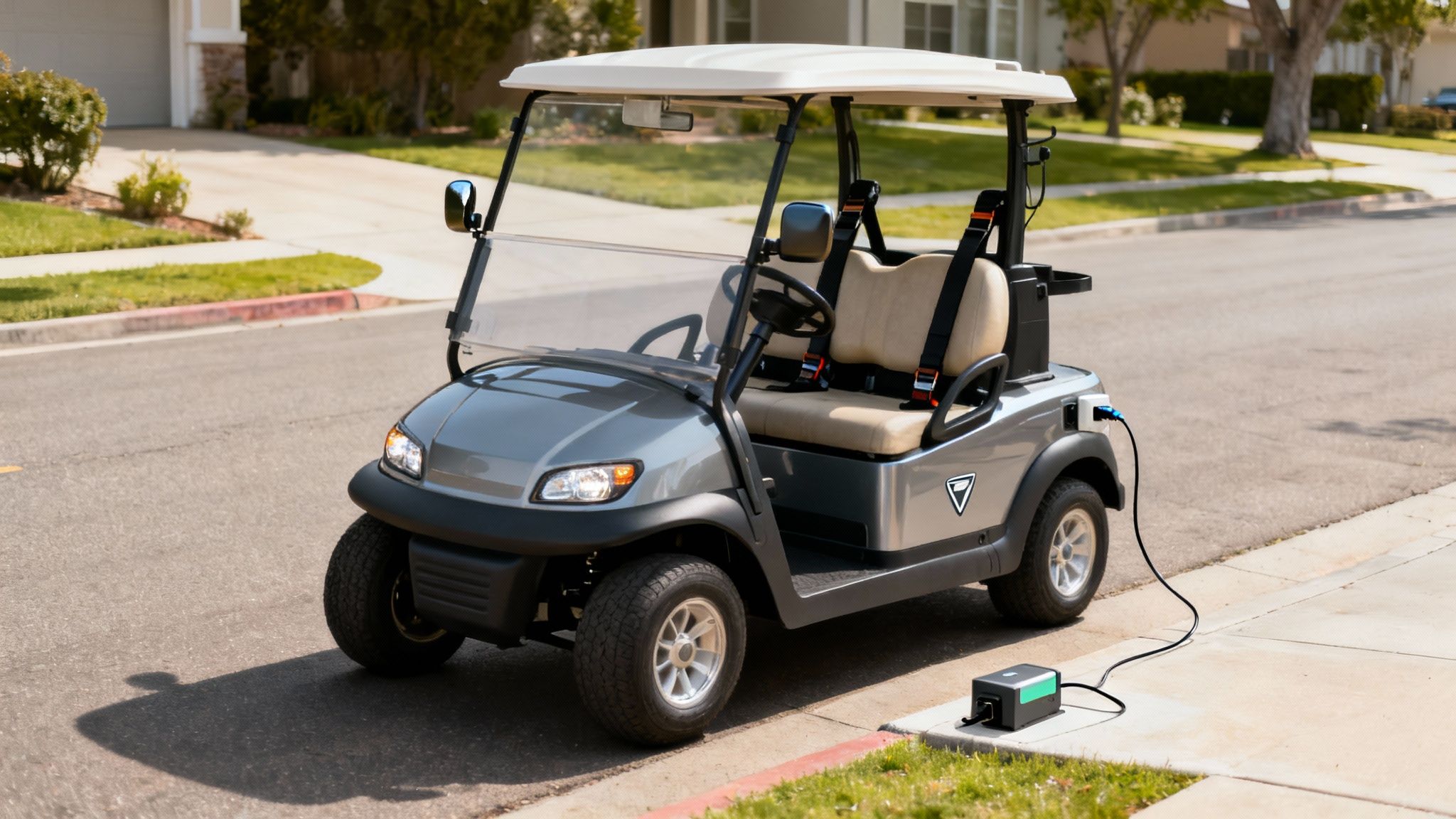
This wave of innovation didn't just improve the carts on the course; it created a whole new category of vehicle: the Low-Speed Vehicle (LSV). You probably know them better as street-legal golf carts. The LSV emerged to meet a growing demand for easy, green transportation in master-planned communities, beach towns, and sprawling corporate campuses.
Of course, you can't just take a standard golf cart and drive it downtown. To become a road-worthy LSV, a cart has to meet specific federal safety standards. This is where the line between a recreational vehicle and a true transportation solution is drawn.
An LSV must be equipped with essential safety gear, including:
- Headlights, Taillights, and Brake Lights for being seen.
- Turn Signals to let other drivers know your next move.
- Seatbelts for every passenger.
- Rearview and Side-View Mirrors for situational awareness.
- A Shatter-Resistant Windshield for protection.
- A Vehicle Identification Number (VIN), just like any other car.
These upgrades transform the humble cart into a legitimate vehicle for local trips. If you want to dive deeper into the specific requirements, our guide on what makes golf carts street-legal breaks it all down.
The Bigger Picture of Micro-Mobility
The explosion in popularity of street-legal carts is part of a much larger trend. As our towns and suburbs grow denser, people are searching for better ways to handle short trips—running to the store, dropping kids at the pool, or visiting a neighbor—without firing up a full-sized car.
Modern electric carts have become the perfect "in-between" vehicle. They bridge the gap between walking and driving, offering a practical, enjoyable, and sustainable way to navigate local environments.
This shift also goes hand-in-hand with a growing desire for greener living. The energy efficiency of electric versus gas-powered vehicles is a major selling point. With zero tailpipe emissions, electric LSVs dramatically reduce both air pollution and noise in our communities, making them a much cleaner choice for getting around town.
Ultimately, the modern golf cart has finally come into its own. No longer just for the back nine, it has matured into a sophisticated, safe, and genuinely useful form of personal transportation that fits perfectly with the way we live today.
The Future of Personal Mobility and Smart Carts
The golf cart evolution has taken us from rickety course shuttles to polished, street-legal machines. But the story doesn't end there. We’re now watching the humble cart step into the world of smart technology, positioning itself as a serious contender in the future of personal transport.
We are on the cusp of a new era where golf carts are becoming more connected, aware, and even autonomous. This isn’t about adding a few flashy gadgets. It's a total rethink of what these vehicles can be and how they fit into our lives. The cart of tomorrow is less a simple vehicle and more a mobile technology platform.
Integrating Intelligence and Connectivity
The biggest leap forward is coming from integrated smart features. For managers overseeing fleets at resorts or sprawling corporate campuses, this technology is a breath of fresh air. Carts are now being built with advanced telematics and GPS tracking systems, giving managers a real-time, bird's-eye view of vehicle locations, battery levels, and usage patterns right from a central dashboard.
This level of connectivity opens the door to some powerful fleet management tools:
- Geofencing: Managers can draw virtual boundaries to keep carts within specific zones. If a cart wanders off, it can be automatically slowed or even stopped.
- Remote Diagnostics: Technicians can keep an eye on a vehicle's health and get alerts for maintenance issues before they turn into costly breakdowns.
- Usage Analytics: By seeing which carts get used most, managers can optimize how they distribute the fleet and schedule charging for peak efficiency.
Suddenly, a golf cart is no longer just a passive piece of equipment—it's an active, manageable part of a larger operational network.
Advanced Safety and the Path to Autonomy
Safety is getting a huge tech boost as well. Taking a page from the automotive world, manufacturers are starting to build Advanced Driver-Assistance Systems (ADAS) into their high-end models. Picture a cart with collision-avoidance sensors that automatically hit the brakes if something gets in the way, or ultrasonic sensors that make parking a breeze.
This is the technology that lays the groundwork for a truly autonomous future. While fully self-driving cars on public roads are still a massive undertaking, autonomous carts in controlled environments like a resort or a gated community are a much closer reality.
The next frontier isn't just a smarter cart; it's a cart that can think for itself. In contained spaces like resorts, airports, and master-planned communities, autonomous shuttles are set to redefine convenience and efficiency.
These self-driving shuttles could be hailed with a smartphone app, whisking guests from their rooms to the pool or navigating a complex campus without anyone behind the wheel. This isn't science fiction anymore—pilot programs are already proving this technology works for short, predictable trips.
Sustainability and the Micro-Mobility Revolution
Beyond the smarts, the push for sustainability keeps fueling new ideas. Hyper-efficient powertrains and lighter materials are squeezing more range out of every battery charge. Even better, solar-powered charging is moving from a novelty to a standard option. Solar panels on the roof can trickle-charge the battery all day, making the cart less dependent on the power grid and extending its runtime, especially in sunny climates.
This blend of tech and eco-friendly design cements the golf cart's place in the larger micro-mobility movement. As they become smarter, their role in the future of personal mobility solutions becomes clearer.
They're not just for fun anymore. The modern smart cart is a practical, efficient, and increasingly intelligent answer for that tricky "last mile"—the distance that's too far to walk but too short for a car. The golf cart evolution is picking up speed, turning a simple vehicle into a key piece of the communities of tomorrow.
Answering Your Questions About the Golf Cart's Journey
We’ve traveled from rickety, caddie-pulled contraptions of the 1930s all the way to the sophisticated, street-legal carts zipping around today. To tie it all together, let’s tackle some of the most common questions people have about these surprisingly complex vehicles. This will help cement the key moments and breakthroughs we've covered.
What Was the Very First Golf Cart?
The first golf cart wasn’t a product of a big company but the clever invention of a man who simply refused to give up the game he loved. Back in 1932, a gentleman in Florida named Lyman Beecher was dealing with arthritis that made walking 18 holes impossible. His first solution was beautifully simple: a rickshaw-style cart pulled by his caddies.
Of course, human power has its limits. Beecher soon tinkered his way to a motorized, three-wheeled buggy powered by car batteries. It was clunky, slow, and probably broke down more than it ran, but it was a true game-changer. This was the first real golf cart, born not from a desire for luxury, but from one man's determination.
The very first golf carts weren't about convenience for the masses. They were a testament to one person's refusal to let physical limitations get in the way of their passion, accidentally kicking off an entire industry.
This humble beginning proved that mechanical on-course transport was a viable idea, planting the seed for everything that came after.
Are Gas or Electric Golf Carts Better?
Ah, the classic debate. The truth is, there's no single right answer—it really boils down to what you need the cart to do. It’s like asking whether a pickup truck is better than a sedan. One is built for work, the other for smooth cruising.
Gas carts have long been the go-to for heavy-duty jobs. They're the workhorses of the golf cart world, bringing more raw power and torque to the table. This makes them the obvious choice for:
- Tackling Hills: That engine provides the grunt needed to climb steep grades without losing steam.
- Hauling and Towing: If you're moving equipment or pulling a small trailer, gas is your friend.
- Long-Haul Range: You can go much farther on a tank of gas than a single charge, and refueling takes minutes, not hours.
But don't count electric out. Modern electric carts, especially the ones running on lithium batteries, have seriously closed the performance gap and bring their own set of killer advantages. An electric cart is probably your best bet for:
- Neighborhood Life: They're whisper-quiet, which is a huge plus in residential communities with noise rules.
- Hassle-Free Maintenance: Forget oil changes, spark plugs, and belts. Electric carts are far simpler and cheaper to keep running.
- A Greener Ride: With zero emissions, they offer a clean, environmentally friendly way to get around.
So, if you need a rugged work vehicle, lean toward gas. If you’re looking for a smooth, quiet ride for your community, electric is the clear winner.
What Makes a Golf Cart Street Legal?
You can’t just take a standard course cart and drive it down a public road. For that, it needs to be classified as a Low-Speed Vehicle (LSV), which means it has to meet a specific checklist of federal safety standards designed to protect you and everyone else on the road.
To earn that LSV title, a golf cart must be upgraded with essential safety gear, including:
- Headlights, taillights, and brake lights
- Front and rear turn signals
- Seatbelts for every passenger
- A proper windshield (usually shatter-resistant)
- A registered Vehicle Identification Number (VIN)
- Rearview and side-view mirrors
On top of the equipment, an LSV has to be able to hit a top speed between 20 and 25 mph. You’ll generally be limited to roads with a posted speed limit of 35 mph or less, which makes them perfect for local trips.
Who Are the Biggest Names in Golf Cart Manufacturing?
While plenty of brands have come and gone, the industry has really been shaped by three dominant players for decades. These "Big Three" have set the bar for quality and innovation, and their rivalry has pushed the entire market forward.
- Club Car: If you're looking for something built like a tank, you're looking for a Club Car. They’re famous for their rustproof aluminum frames, making them a favorite in coastal towns where salt air eats other carts for breakfast.
- E-Z-GO: As one of the original pioneers, E-Z-GO has always been a leader in electric vehicle tech. They’ve consistently pushed the envelope on what an electric drivetrain can do, focusing on efficiency and power.
- Yamaha: Drawing from its deep well of engine expertise, Yamaha makes some of the smoothest and quietest gas carts you can buy. Their electric models are no slouch either, known for their rock-solid reliability.
These three giants are the architects of the modern golf cart evolution, constantly one-upping each other to build better, safer, and more capable vehicles for all of us.
Ready to experience the peak of golf cart evolution? Solana EV offers a premium lineup of street-legal electric vehicles that blend sophisticated design with powerful, eco-friendly performance. Discover the perfect ride for your community, resort, or adventure by exploring our models.