
For decades, the familiar hum of a golf cart was powered by heavy, messy, and high-maintenance lead-acid batteries. That era is officially coming to a close. The move to golf cart batteries lithium technology is more than just an upgrade—it's a complete reimagining of what these vehicles can do, delivering longer range, faster charging, and zero maintenance for owners and fleet managers.
The Power Shift to Lithium Golf Cart Batteries
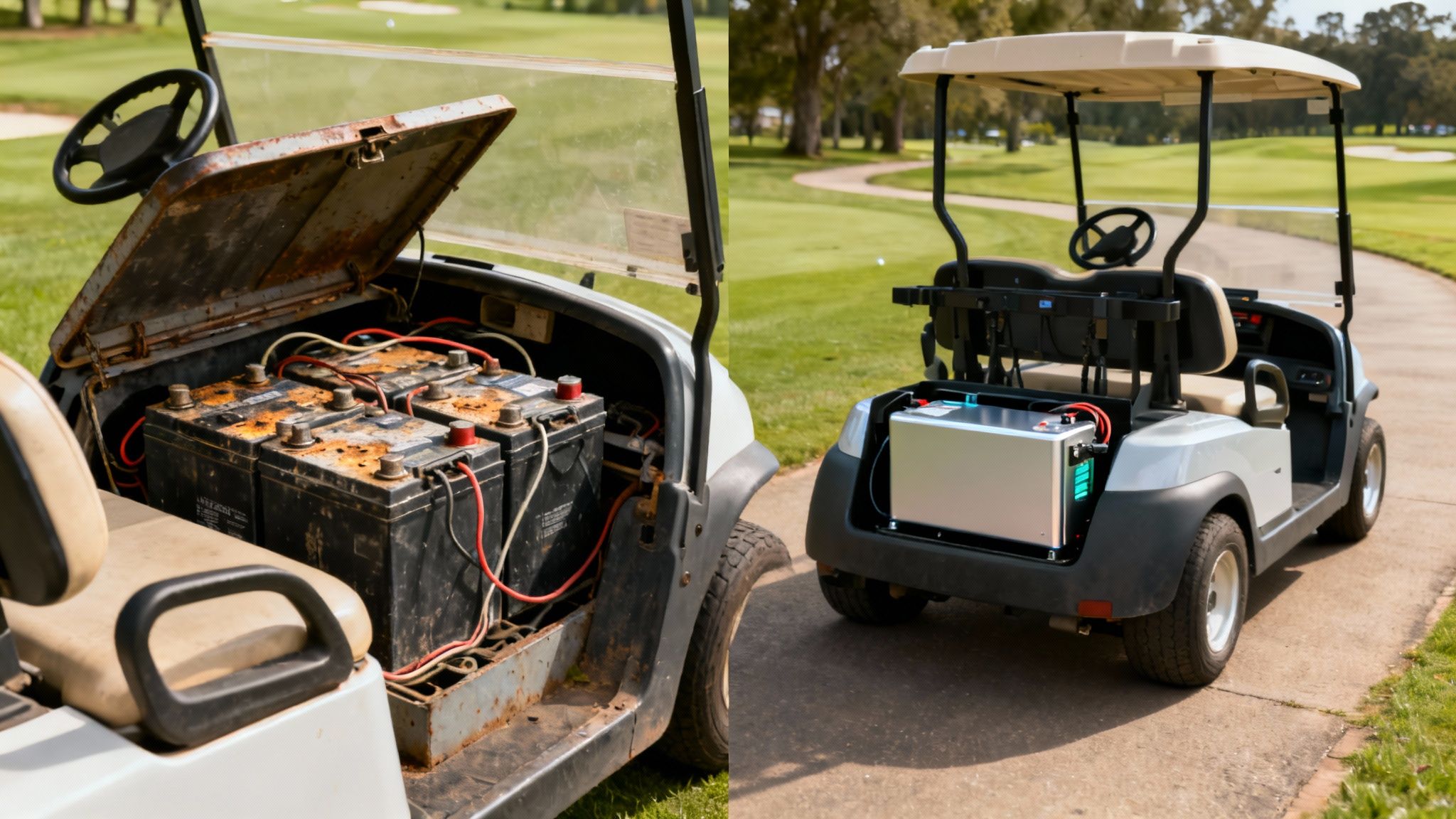
If you've ever owned a traditional golf cart, you know the drill: constantly checking water levels, scrubbing away terminal corrosion, and putting up with that frustrating power sag on hills. Those days are numbered. Lithium-ion technology is changing the game for every electric vehicle, from the family low-speed vehicle (LSV) to the largest resort fleets.
This isn't just a minor improvement; it's a whole new level of performance. Think of the old lead-acid setup as a heavy, leaky bucket—a pain to carry and losing power with every step. In contrast, a lithium battery is like a modern, sealed power pack. It’s dramatically lighter, charges in a fraction of the time, and provides strong, consistent power right until it’s empty.
Why Everyone Is Making the Switch
This industry-wide shift isn't just hype; the numbers tell the story. A decade ago, lithium was a niche player. In 2012, lithium batteries made up less than 5% of the golf cart battery market. Fast forward to 2023, and that share has exploded to over 40% worldwide.
Market projections show this trend accelerating, with some analysts predicting lithium will capture up to 70% of the market by 2025. This rapid change is fueled by huge leaps in battery tech and a clear demand from people who just want a better, more reliable vehicle. You can explore more about the history of this shift and its market impact to see the full picture.
For a resort manager, this means less vehicle downtime and reduced labor costs. For a homeowner, it means more time enjoying their LSV and less time tinkering in the garage. The benefits are real and immediate.
To help you get up to speed, this guide will break down everything you need to know about this powerful technology. We’ll cover the core advantages, explain the specs in plain English, and give you practical tips on choosing, installing, and caring for your new power source. Ultimately, making the switch is an investment in a better ownership experience—one where performance and convenience come standard.
Let's start with a quick look at how these two technologies stack up head-to-head.
Lithium vs. Lead-Acid At a Glance
The table below gives you a clear, side-by-side comparison of the most important differences you'll experience when upgrading.
| Feature | Lithium Battery | Lead-Acid Battery |
|---|---|---|
| Weight | 70-80% Lighter (approx. 75-125 lbs) | Very Heavy (approx. 300-400 lbs) |
| Lifespan (Cycle Life) | 3,000 – 5,000 cycles (8-10+ years) | 500 – 1,000 cycles (3-5 years) |
| Charging Time | 2 – 4 hours | 8 – 12 hours |
| Maintenance | None | Regular watering and cleaning required |
| Performance | Consistent power, no voltage sag | Loses power and speed as it discharges |
| Efficiency | ~95% (less wasted energy) | ~80-85% (more energy lost as heat) |
| Upfront Cost | Higher | Lower |
| Long-Term Value | Excellent ROI | Frequent replacement costs |
As you can see, while lead-acid batteries have a lower initial price tag, lithium wins in every other category, from daily performance and convenience to long-term value and lifespan.
So, What's the Big Deal with a Lithium Upgrade?
Thinking about swapping your old batteries for golf cart batteries lithium? It's more than just a simple part replacement. This is a fundamental shift in how you'll experience your cart—moving from a cycle of constant maintenance to one of just getting in and going. The benefits aren't just small tweaks; they completely change the game.
Let's break it down with an analogy. Your old lead-acid batteries are like a heavy, leaky wooden bucket. You lug it around, it loses water even when you're not using it, and it seems to hold a little less every time you fill it up. You're always patching it and topping it off just to keep it working.
A lithium battery? That's your modern, high-tech fuel cell. It’s incredibly light, totally sealed, and delivers full power from the moment you hit the pedal until it's nearly empty. It recharges in a flash and holds onto that power, giving you a reliable and predictable ride every single time.
A Battery That Can Last a Decade
The single biggest win from a financial standpoint is the sheer longevity of lithium. If you're meticulous, a good set of lead-acid batteries might get you three to five years. A quality lithium pack, on the other hand, is built to handle 3,000 to 5,000 charge cycles. For most people, that easily translates to over a decade of use.
Think about that for a second. In the time you'd own one lithium battery, you might have to buy, install, and get rid of lead-acid batteries two, three, or even four separate times. When you add it all up, the long-term savings often make the upfront cost of lithium a no-brainer.
Say Goodbye to Maintenance Headaches
One of the best things about going lithium is what you don't have to do anymore. The endless weekend ritual of battery maintenance? Gone.
With a lithium upgrade, you can officially forget about:
- Checking water levels and carefully topping them off with distilled water.
- Scrubbing that fuzzy green corrosion off the terminals and cables.
- Worrying about acid spills eating away at your garage floor or the cart's frame.
- Running special "equalization charges" just to keep the cells balanced.
This "set it and forget it" approach is a game-changer, especially for resort managers who have to look after a whole fleet. It frees up an incredible amount of staff time and cuts out the cost of maintenance supplies, letting the team focus on what really matters.
For a personal owner, it’s simple: more time driving, less time tinkering. It's pure, hassle-free enjoyment.
Feel the Consistent, Unwavering Power
Ever notice how a lead-acid cart feels zippy at first, but then slowly gets sluggish as the battery drains? That frustrating power drop, known as voltage sag, is a classic sign of old-school battery tech. Climbing a hill can feel like a struggle when you're down to your last few bars of charge.
Lithium batteries completely eliminate this problem. They deliver a consistent voltage output, meaning your cart has the same pep and power whether the battery is at 90% or 20%. You get that same quick acceleration and hill-climbing muscle from the start of your trip to the very end. It just makes for a much better, more predictable drive.
Lightning-Fast Charging and a Lighter Ride
Two other perks really improve the day-to-day experience. First, lithium batteries charge up incredibly fast. A lead-acid system can take 8 to 12 hours to get a full charge. A lithium battery? You're often looking at just 2 to 4 hours. For a rental fleet or a busy community, that means less downtime and more time on the move.
Second, the weight difference is just staggering. A set of six lead-acid batteries can easily top 300 to 400 pounds. A comparable lithium pack is often around 75 pounds. That's a weight reduction of over 70%. This diet makes your cart more efficient, helps it accelerate faster, improves handling, and even reduces the long-term wear and tear on your tires and suspension.
Understanding Your Lithium Battery's Technology
Getting into the technical specs of lithium golf cart batteries can seem a little intimidating at first. But you don't need an engineering degree to make a smart choice—you just need to know what a few key terms mean for your cart's real-world performance. Think of it less like a technical manual and more like a car's window sticker; these numbers tell you everything about its power, range, and how long it’ll last.
Let's break down the two most important numbers you'll see: Voltage (V) and Amp Hours (Ah). They work together to define what your battery can actually do.
The Power and The Fuel Tank
The easiest way to think about it is with a car analogy. Voltage (V) is the raw power your cart's motor has on tap. A higher voltage, like a 48V system, gives you that punchy acceleration and the muscle to climb hills without slowing to a crawl. It’s basically the "horsepower" of your battery.
Now, if voltage is the engine's power, Amp Hours (Ah) is the size of your fuel tank. A higher Ah number, say 105Ah, simply means your battery stores more energy. This translates directly to how far you can drive on a single charge. Getting the right combination of voltage and amp-hours means your cart will have both the get-up-and-go and the staying power you need.
The infographic below shows how this better technology translates into a superior experience on the ground.
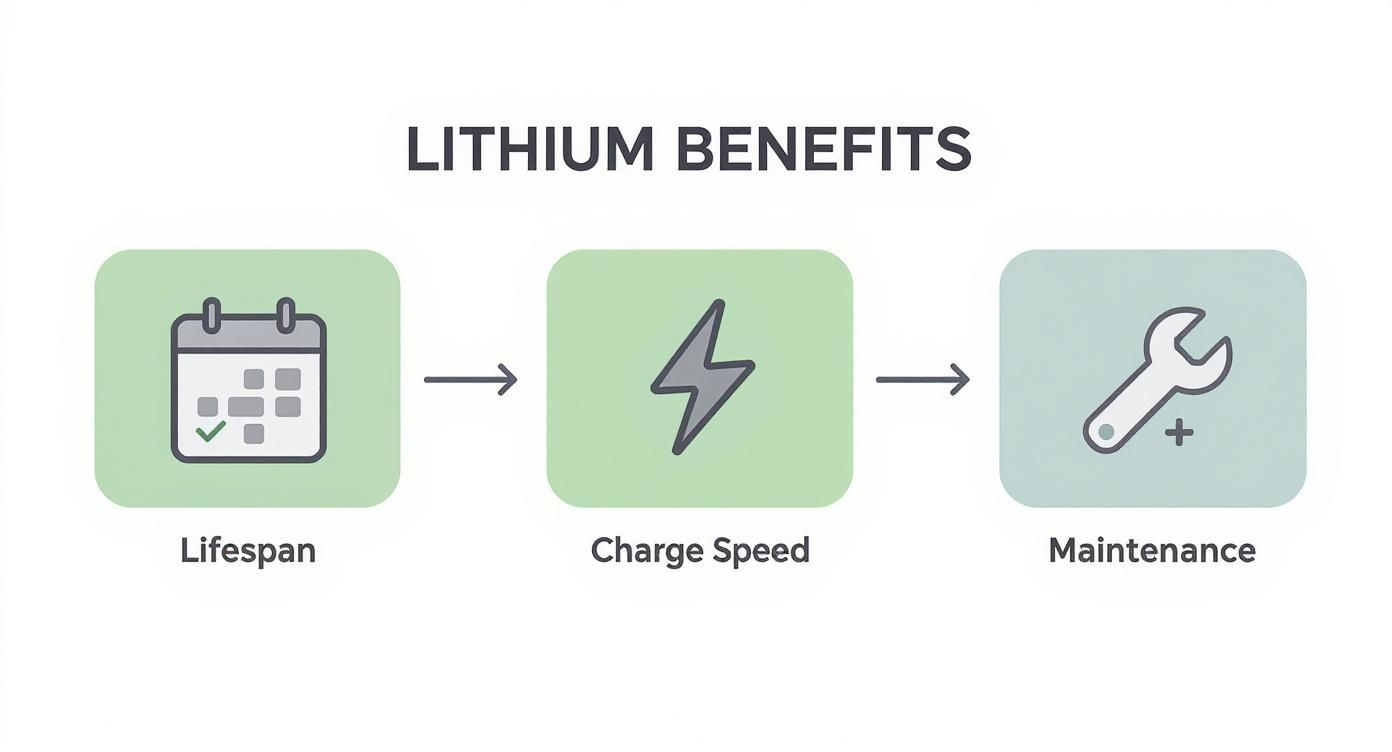
As you can see, it’s not just about numbers; it’s about a battery that lasts a decade, charges in a few hours, and asks for almost nothing in return.
The Brains of the Operation: The BMS
While power and range are key, the real secret sauce inside every modern lithium battery is the Battery Management System (BMS). This is the battery's onboard computer, a sophisticated electronic brain that constantly monitors and protects your investment. Frankly, it's the single biggest reason why lithium technology is so incredibly safe and dependable.
Think of the BMS as a dedicated bodyguard for the battery cells, performing a few critical jobs 24/7:
- Overcharge Protection: It cuts off power when the battery is full, so you can't damage it by leaving it plugged in.
- Over-Discharge Protection: It stops the battery from running down too far, which is crucial for its long-term health.
- Temperature Control: It keeps an eye on the heat, shutting things down to prevent overheating or damage from charging in freezing weather.
- Cell Balancing: It makes sure all the individual cells inside the battery pack are working together in harmony, which maximizes both performance and lifespan.
The BMS is the unsung hero of lithium technology. It’s the intelligent system that allows you to simply plug in your cart and trust that the battery is taking care of itself safely and efficiently.
To get a more in-depth look at how this critical component works, you can learn more about the importance of a Battery Management System in our detailed guide.
Translating Cycle Life Into Real Years
The last spec you’ll run into is "cycle life," often rated at 3,000 or 5,000 cycles. A cycle is just one full charge and discharge. This number might seem abstract, but it's the most direct measure of how many years of service you can expect.
Let's put a 5,000-cycle rating into perspective. If you use your golf cart three times a week, that’s about 156 cycles a year. At that pace, your battery could theoretically last for over 30 years.
Even if you’re a heavy user who charges the cart daily (365 cycles a year), that same battery gives you a rock-solid lifespan of well over 13 years. This is exactly why a lithium battery is a long-term investment, not just another replacement part.
How to Choose the Right Lithium Battery
Upgrading to lithium shouldn't be a shot in the dark. It’s all about matching the right battery to your golf cart and how you use it every day. Get this right, and you'll have an investment that pays you back in performance and reliability for years to come.
The very first thing to nail down is your cart's voltage. Most golf carts you see on the course today—Club Car, E-Z-GO, Yamaha—run on a 48V system. But don't assume! Older carts might be 36V, and some custom high-performance models push it to 72V. This is the one spec you can't get wrong; the battery voltage must match your cart's system perfectly.
With voltage sorted, the next big decision is Amp Hours (Ah). This is where you really need to think about your lifestyle and daily routine.
Sizing Your Battery for Range and Terrain
Think of Amp Hours (Ah) as the size of your gas tank. The bigger the number, the more energy you have on board and the farther you can drive on a single charge. You want to pick a capacity that gets you through your day with power to spare, so you're never worried about making it back home.
How do you figure out what you need? It really boils down to how far you drive and what kind of ground you're covering.
To help you find the right fit, we've put together a simple table based on common usage patterns. Think about your typical day and find the recommendation that best matches your needs.
| Daily Mileage | Primary Terrain | Recommended Ah Range |
|---|---|---|
| 10-15 miles | Mostly Flat (e.g., standard golf course) | 60Ah – 75Ah |
| 15-25 miles | Mixed, Rolling Hills (e.g., large community) | 90Ah – 105Ah |
| 25+ miles | Steep Hills, Heavy Loads (e.g., resort fleets) | 120Ah or more |
Choosing the right Ah capacity is about giving yourself a comfortable buffer. This way, you avoid "range anxiety" and know your cart has the juice to handle even your longest, toughest days.
Your terrain matters just as much as your mileage. Climbing hills demands significantly more energy from the battery, so if your daily route includes steep inclines, always opt for a higher Ah capacity than you think you might need.
For a more detailed look at the top contenders on the market, be sure to check out our complete guide on the best lithium battery for golf cart models available.
Ensuring a Perfect Physical Fit
Once you've got the electrical specs figured out, there's one last practical step: making sure the battery actually fits in your cart. Lithium batteries are a lot smaller and lighter than the bulky lead-acid batteries they replace, but their exact dimensions can vary from one brand to another.
Many golf cart batteries lithium are sold as "drop-in" replacements. This is ideal, as it means they're designed to fit perfectly into the space your old batteries occupied with no modifications needed. Other batteries might come with a kit that includes brackets or spacers to secure the smaller lithium unit inside the larger battery tray.
Before you click "buy," grab a tape measure. Get the length, width, and height of your cart's battery bay and check those numbers against the specs of the battery you're eyeing. This simple check will save you the headache of getting a battery that just won't fit. Seeing how others evaluate similar big-ticket items, like in these reviews of Australia's best solar battery systems, can also offer a useful framework for comparing technical specifications and real-world performance.
Thinking Long-Term: Cost and Return on Investment
Let's be honest, the initial price tag on a lithium golf cart battery can give you a moment of pause. It’s definitely higher than a set of traditional lead-acid batteries, and that's a fact. But focusing only on that upfront number is a bit like judging a car by the cost of its first tank of gas—it completely misses the bigger picture.
To really see what you’re getting, we need to look at the Total Cost of Ownership, or TCO. When you zoom out and consider the entire lifespan of the battery, a different story emerges. That lithium battery isn't just a part; it’s a long-term financial upgrade that almost always ends up being the smarter, more affordable choice.
The Replacement Cycle Trap
The biggest hidden cost of lead-acid batteries? You have to keep buying them. A decent, well-maintained set might get you three to five years if you're lucky. In sharp contrast, a quality lithium pack is built to last a decade or more.
Think about that for a second. You could find yourself buying and installing new lead-acid batteries three, or even four times, in the same period you'd own a single lithium battery. Each one of those replacements piles on costs—not just for the batteries, but for the labor to install them and the downtime for your cart.
Calculating the Hidden Savings
Beyond just buying fewer batteries, the savings keep rolling in from two other areas where lead-acid just can't compete.
- Zero Maintenance Costs: You can officially say goodbye to buying distilled water, cleaning terminals, and messing with anti-corrosion sprays. More importantly, think of the time saved. For a fleet manager, that's hours of labor that can be spent on tasks that actually make money, not just keep batteries alive.
- Lower Electricity Bills: This one is simple math. Lithium batteries are incredibly efficient, at around 95%. This means nearly every bit of electricity you pay for goes straight into the battery. Lead-acid batteries, on the other hand, are only about 80-85% efficient, losing the rest as heat. That efficiency gap translates directly to lower charging costs every single month.
When you add up the repeated purchases, the constant need for maintenance supplies, and the wasted electricity, the "cheaper" lead-acid option quickly reveals itself as a long-term financial drain. The ROI on a lithium battery often covers the initial price difference in just a few years.
To get a clearer picture of these expenses, explore our detailed breakdown of golf cart battery replacement cost considerations.
The Price of Technology is Dropping
There's another powerful trend working in your favor: the cost of lithium technology itself is falling. As manufacturing gets better and more widespread, the price per kilowatt-hour (kWh) has plummeted. Projections show the cost per kWh falling to an estimated $300 by 2025—a massive 60% reduction from what it was back in 2012.
This trend makes lithium more accessible than ever and just keeps sweetening the ROI. In the end, it all comes down to simple math. Lead-acid gets you in the door for less, but a lithium golf cart battery delivers a far superior return through sheer longevity, efficiency, and zero-maintenance convenience. It’s an investment that truly pays for itself year after year.
Installation and Safety Best Practices
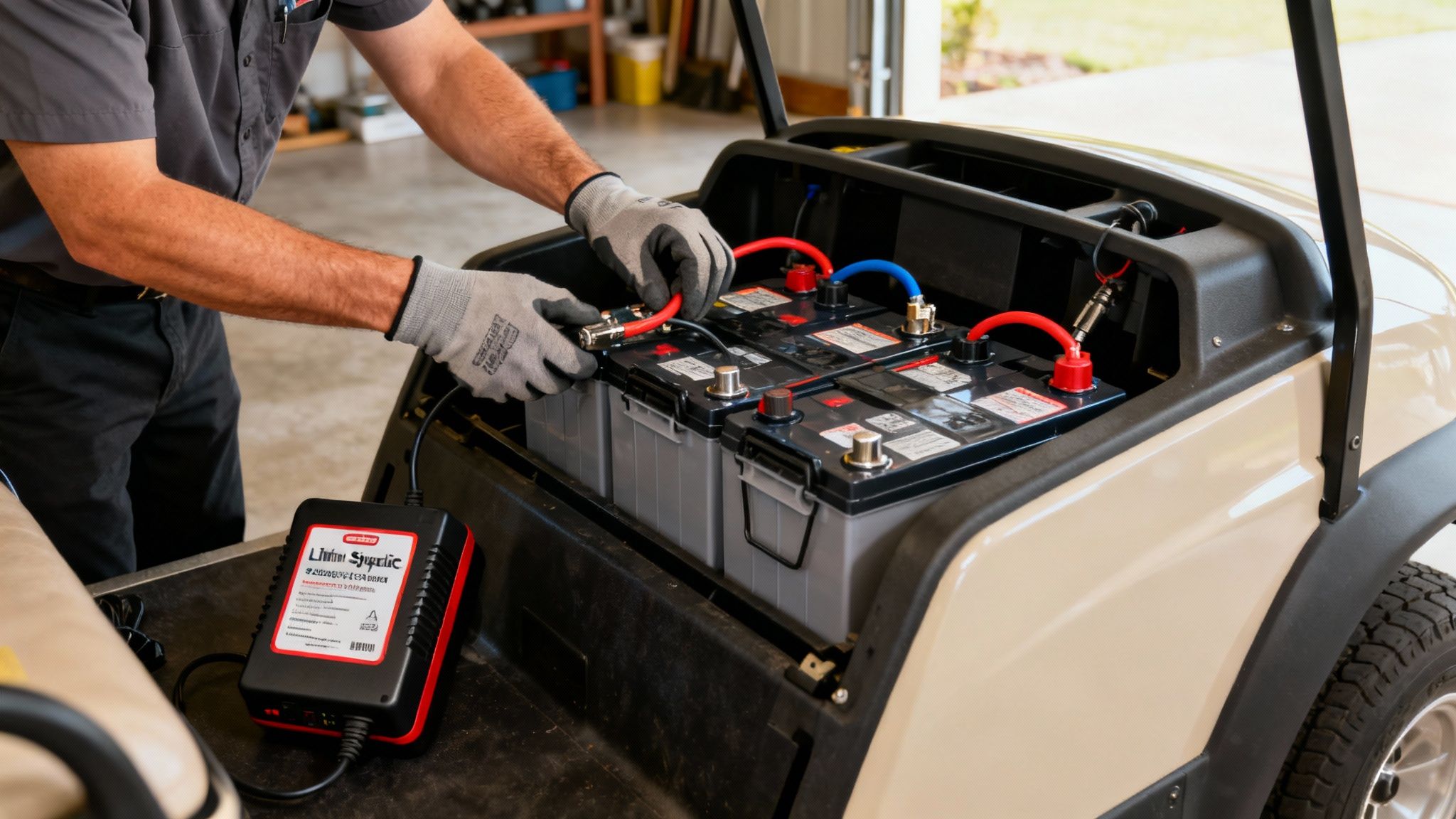
Getting your new golf cart batteries lithium upgrade installed correctly isn't just about unlocking better performance—it’s about doing it safely. Whether you’re a hands-on owner tackling the job yourself or bringing in a pro, following the proper steps is key to protecting your cart, your battery, and yourself.
The good news is that the upgrade process is fairly straightforward. The biggest physical advantage is how light lithium packs are; you won’t be wrestling with those back-breaking lead-acid batteries. That said, the electrical connections demand precision to ensure your power system is secure and reliable for the long haul.
The Essential Safety Checklist
First things first: safety. Anytime you're working with an electrical system, there are risks, but a methodical approach keeps them in check. Disconnect everything properly, take your time, and always double-check your connections.
Here are the non-negotiable first steps for any installation:
- Engage the Tow/Maintenance Switch: This should always be your first move. It disables the motor controller so the cart can’t lurch forward unexpectedly.
- Disconnect the Old System: The golden rule is negative first, positive second. Always remove the main negative terminal, then the main positive. After that, you can undo the jumper cables between the old batteries.
- Remove Old Batteries Carefully: Throw on some gloves. Old lead-acid batteries can leak corrosive acid. Lift them out carefully and prepare them for proper recycling.
With the old batteries gone, it's the perfect time to give the battery tray a good cleaning and inspect the main power cables for any cracks or corrosion.
Securing Your New Lithium Battery
Now for the easy part. Place your new lithium battery into the clean tray. Most are designed as "drop-in" replacements, but you absolutely must secure it. Use the mounting brackets or straps that came with it to stop it from sliding around while you drive.
Once it's locked down, connect the main positive cable first, then the main negative. Get them good and tight. A loose connection can cause arcing, which creates heat and can lead to serious damage.
Crucial Safety Point: Never, ever plug your old lead-acid charger into a new lithium battery. They use completely different charging profiles. Using the wrong one is a major fire risk and will absolutely destroy your new battery.
Making the switch means you need the right gear. Investing a few minutes in selecting the right lithium battery charger is essential for the health and safety of your entire system.
Your final layer of protection is the battery’s built-in Battery Management System (BMS). Think of it as the battery's brain, constantly working to prevent overcharging, over-discharging, and overheating. This smart system is your safety net, giving you peace of mind that your investment is protected from the most common electrical problems. Follow these steps, and your upgrade will be smooth, safe, and successful.
Common Questions About Lithium Golf Cart Batteries
It's smart to have a few questions before making the switch to lithium. This technology is a big leap forward from the old lead-acid batteries most of us are used to, so getting clear answers is the best way to feel confident about your decision. Let's tackle the most common questions we hear from folks looking to upgrade.
Can I Upgrade Any Golf Cart to a Lithium Battery?
Almost certainly, yes. The vast majority of 36V, 48V, and even 72V carts from the big names—Club Car, E-Z-GO, Yamaha—are perfect candidates for a lithium battery conversion.
Many manufacturers have made this incredibly easy by designing "drop-in" replacements. These are built to the exact dimensions of your old batteries, so they slide right into the existing tray. For carts that need a bit of adjustment, simple conversion kits with brackets and cables are readily available to make the fit secure and professional.
How Do Lithium Batteries Perform in Hot or Cold Weather?
This is where lithium really shines. High-quality lithium iron phosphate (LiFePO4) batteries are engineered to handle a wide range of temperatures, far better than their lead-acid counterparts.
The secret sauce is the integrated Battery Management System (BMS). Think of it as a tiny computer protecting your investment. It will automatically prevent charging in freezing conditions (below 32°F or 0°C) to avoid cell damage. In scorching heat, it intelligently manages power to prevent overheating, giving you reliable performance no matter the season.
What Is the Correct Way to Store My Cart for the Off-Season?
Storing a lithium-powered cart is refreshingly simple. Gone are the days of needing a trickle charger and constantly worrying about your batteries. Lithium batteries have an incredibly low self-discharge rate, typically losing only 1-3% of their charge per month.
To prep for storage, just get the battery to about 50-70% charge. After that, flip the tow/run switch to "Tow" or just disconnect the main power cable. Park the cart in a cool, dry spot, and you're all set until next season.
How Do I Dispose of an Old Lithium Battery?
Proper disposal is key. Lithium batteries should never be thrown into the regular trash because they contain valuable materials that can be recycled.
When your battery finally reaches the end of its very long life, the best thing to do is take it to a certified e-waste or hazardous waste recycling facility. Many battery dealers and retailers also have take-back programs. This ensures the components are handled safely and get a second life, which is a win for everyone and the environment.
Ready to transform your ride with superior power, range, and zero maintenance? Explore the full range of high-performance electric vehicles and battery solutions at Solana EV. Find your perfect upgrade today!