
Over 30,000 golf carts are stolen every year in the U.S., and recovery without the right stack is weak enough that owners shouldn't treat a siren as a security plan. The key decision isn't whether to buy an alarm, it's whether you want a deterrent, a tracking layer, or an actual recovery system. Most carts need all three.
Table of Contents
- Why Golf Cart Theft Demands a Real Security Strategy
- Types of Golf Cart Alarm Systems and Key Features
- Compatibility and Installation for Solana EV Vehicles
- The Layered Security Approach That Works
- Selection Criteria and Cost Considerations
- Anti-Theft Best Practices for Resorts and Communities
- Next Steps for Dealers and Buyers
Why Golf Cart Theft Demands a Real Security Strategy
The theft problem is large enough to demand serious attention. One industry report citing law-enforcement statistics says about 30,000 golf carts are reported stolen yearly in the United States, and another source says carts with GPS tracking and alarm systems can achieve recovery rates of over 80%, compared with less than 20% for unprotected vehicles. A separate source also reports over 1,500 stolen golf carts in 2020 in the U.S., which shows this is a recurring operational loss, not a one-off annoyance. Golf Business Monitor's summary of the theft issue
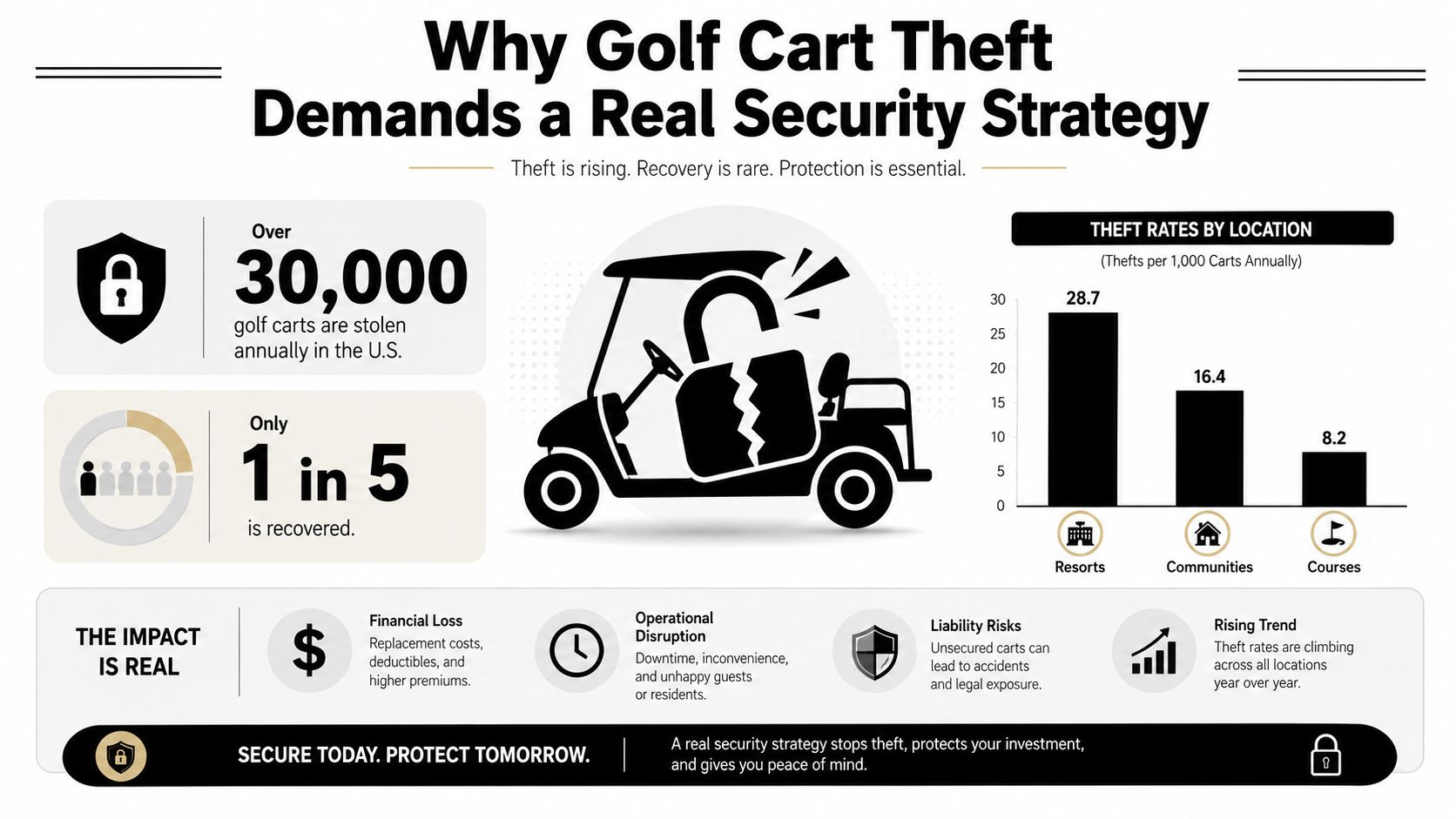
A golf cart alarm system should be treated as one layer in a broader anti-theft stack. It is not just a loud box bolted to a cart. It combines acoustic alerting, motion or vibration detection, and, in stronger setups, tracking and zone control that help staff respond before a cart leaves the property.
Theft is a property management problem, not a toy problem
Resorts, gated communities, golf courses, and dealers all lose money in different ways when carts go missing. Guests get frustrated, staff spend time chasing reports, and managers inherit avoidable downtime. Theft also changes behavior, because once a site becomes easy to target, the problem tends to repeat.
Practical rule: if the cart can be rolled, lifted, or driven away without triggering a response that someone will see, your security is weak.
That is why alarm systems matter as part of the wider vehicle anti-theft market. The global vehicle anti-theft system market was valued at USD 13.6 billion in 2024, and alarm systems accounted for 14.7% of that market, or about USD 2.00 billion. Strategic Market Research That scale matters because it shows alarm-based protection is mature, familiar, and widely understood, not some niche add-on for hobby carts.
North America already had a substantial security baseline too. In 2019, there were 31.7 million active monitored alarm systems in the U.S. and Canada, representing a 21.0% penetration rate across roughly 150 million households and businesses. Strategic Market Research In plain English, people already trust alarm logic for property protection. Golf carts are just catching up. Use that same mindset when you choose accessories from Solana EV golf cart accessories, and compare wired and wireless alarms before you buy.
Types of Golf Cart Alarm Systems and Key Features
A golf cart alarm system only works if you know what job it is supposed to do. Some units are built to make noise fast. Others are built to catch movement, lifting, or tampering. A few are really recovery tools with a siren attached.
Acoustic alerts, sensors, and immobilization do different jobs
A 110 dB siren is for immediate attention. Add a vibration sensor, and the system can react before someone fully rolls or loads the cart. One wireless unit also uses a remote control with a maximum range of 66 feet, runs on a lithium-polymer battery, and uses magnetic, no-wiring installation. That setup works well when you want fast deployment without opening the cart's electrical system. Guardian Secure golf cart alarm specs
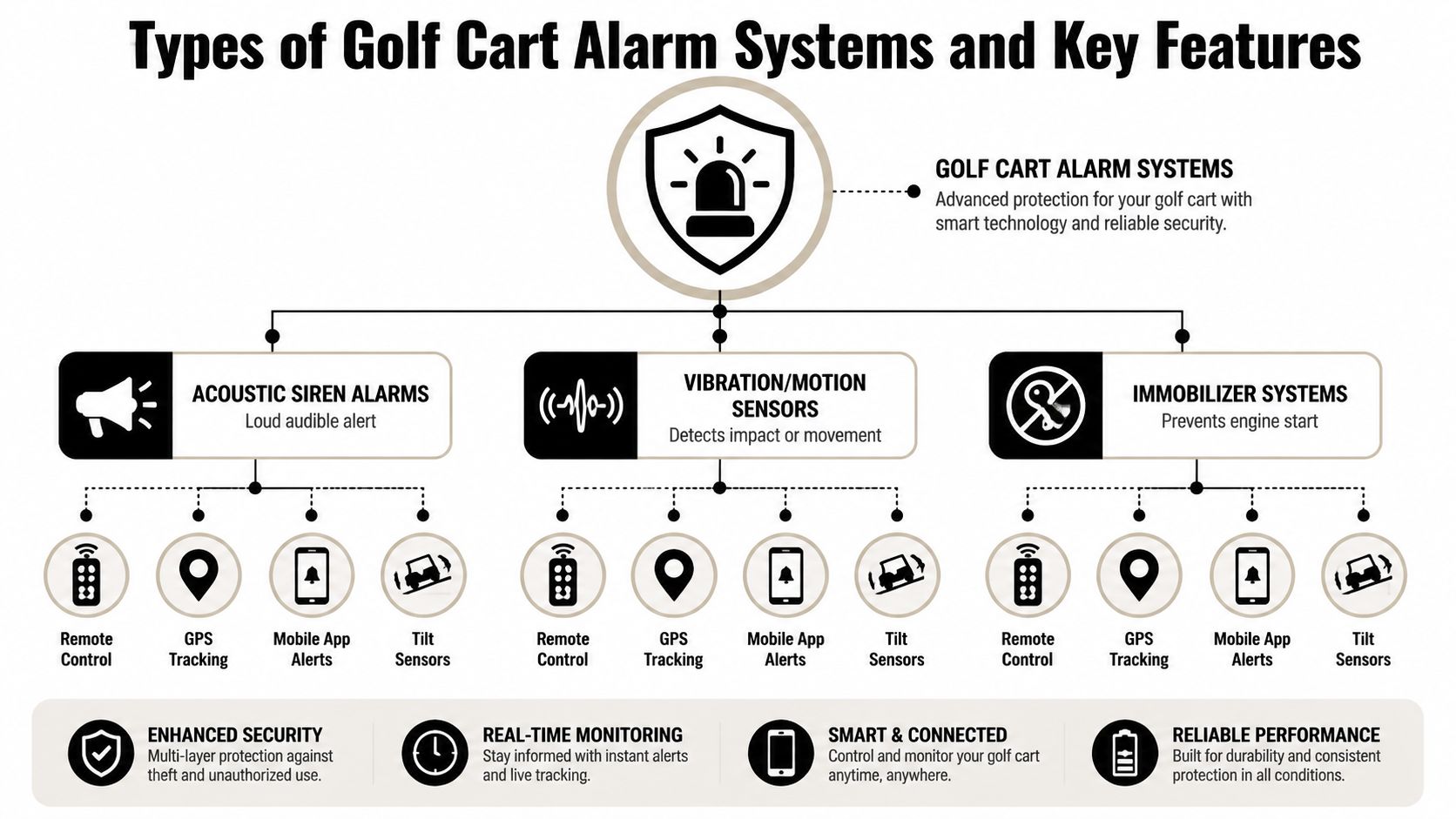
Hardwired systems serve a different purpose. They can be neater in a managed fleet and easier to standardize across carts, but they take longer to install and usually need a technician. Wireless systems are faster to roll out, yet they demand battery discipline and tighter maintenance oversight. If you want a clear comparison of installation trade-offs in the broader alarm market, compare wired and wireless alarms from Wisenet Security Ltd., then apply the same logic to carts.
Features worth paying for
- GPS tracking: this is the recovery layer, not the scare layer. Hidden trackers give you a chance after the cart has already left the property.
- Geofencing: this is boundary control. It defines where the cart should and should not be, which matters on large properties and across mixed-use sites.
- Motion and tilt sensing: these detect movement, lifting, or tampering before the cart is casually driven off.
- Mobile alerts: these matter only if someone on your team is assigned to respond.
The practical split is simple. A single owner can get by with a wireless siren and motion sensor if the cart stays in a controlled area. Fleets need layered features, because one weak control point should not expose the entire inventory. If you are building out the cart as a whole, start with Solana EV golf cart accessories, because security only makes sense when it fits the rest of the setup.
Compatibility and Installation for Solana EV Vehicles
Modern electric carts deserve a cleaner installation standard than old-school bolt-on gadgets. With premium EV platforms, the issue isn't whether an alarm can be mounted, it's whether the installation respects the cart's electrical architecture, finish, and serviceability. If a system creates nuisance wiring, ugly add-ons, or warranty questions, it's the wrong choice.
Wireless usually wins for speed and low disruption
A magnetic, no-wiring installation is the safest default when you're protecting a newer cart and don't want to touch the low-voltage system. That matters on premium builds with aluminum chassis construction and integrated electronics, because installers shouldn't be cutting into a system just to add a siren. Wireless units also reduce downtime, which matters more in fleets than most buyers admit.
That said, wireless doesn't mean hands-off. Battery-powered alarms need a charging or replacement routine, and the alarm has to be mounted where vibration is detected without making removal easy. The source example with IP65 waterproofing, a 35-pound magnet mount, and a full charge in about 3 hours shows the kind of physical and maintenance design that matters in real use. The same source also notes battery life can run from 3 to 6 months depending on use. YouTube product demonstration
Integration needs to stay out of the way of the cart's systems
For dealerships and fleet technicians, the rule is simple. Don't let an alarm interfere with infotainment, charging behavior, or normal service access. On carts with advanced dashboards and connected features, the alarm should behave like a separate security layer, not an extra electrical headache. Solana EV dashboard is a good reminder that buyers now expect a refined user experience, not a hacked-together add-on.
A good installation leaves no obvious excuse for callbacks.
If you're working on a premium EV platform, choose the alarm path that avoids unnecessary modifications first. Use hardwired solutions only when you want a deeper fleet-wide standard and you've already documented the service process. For most resort and dealer deployments, the best outcome is clean mounting, easy service access, and no conflict with the cart's existing electronics.
The Layered Security Approach That Works
A siren alone is easy to overrate. It makes noise, but noise does not equal recovery. The stronger approach is layered, because each layer blocks a different stage of the theft chain.
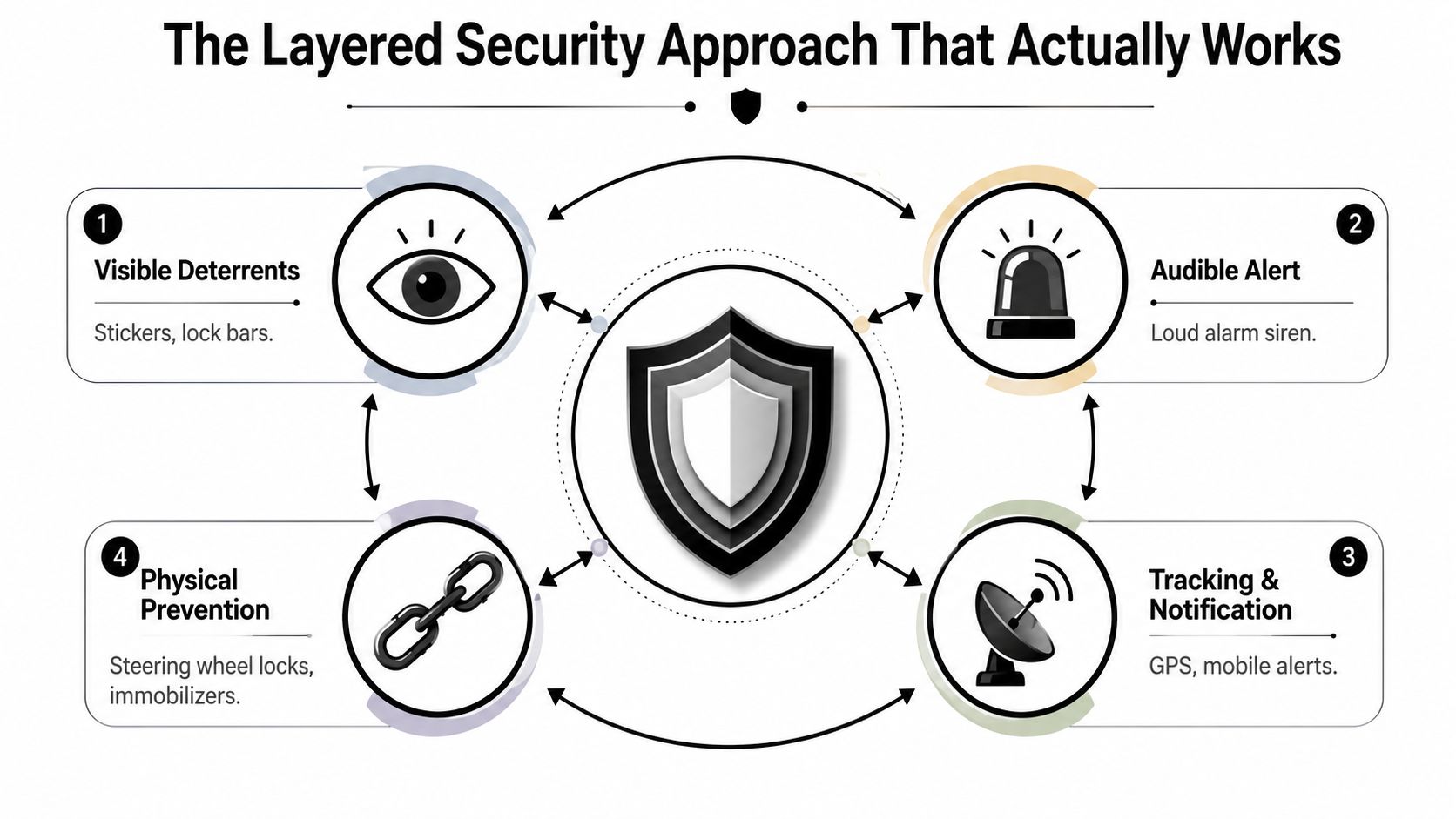
Start with visibility, then add response, then recovery
A thief scanning a parking area usually looks for the easiest target first. Visible deterrents, such as lock bars or obvious security markings, push the cart out of that category. The audible alert adds pressure because it turns a quiet theft into a public event. Tracking and notification matter after that, because they improve the odds that someone can act on the cart's location instead of just hearing it leave.
A hidden GPS tracker matters most if the cart leaves your property. A simple alarm stops helping at that point. The strongest setup uses visible deterrence, an alarm with motion or tilt sensing, and a hidden GPS tracker, because each layer covers a different failure point. Cunningham Golf Car's theft-prevention guidance makes that point clearly.
False-trigger tuning matters more than most buyers think
The weak spot in many installations is not the hardware, it is the settings. Crowded parking, moving carts near storage areas, and property boundaries can all create nuisance alarms if sensitivity is set badly. That is why cart security needs tuning, not just installation.
Geofencing helps because it lets managers define where carts should operate and where alerts should kick in. Golf-course geofencing vendors emphasize perimeter rules and GPS monitoring, which is the direction the market is taking. Tagmarshal's geofencing guidance is a useful reference for that logic. Use it to design alert zones that reduce blind spots without turning every bump into an incident.
Solana EV GPS tracking fits naturally into that stack when the goal is recovery, not just deterrence. If staff cannot tell the difference between a real theft event and expected cart movement, the system is too noisy to trust.
Selection Criteria and Cost Considerations
A golf cart alarm system is only worth buying if it fits the way the carts are used. Buyers who manage a quiet private driveway can keep it simple. Resort managers, dealers, and community operators need gear that keeps working through weather, washdowns, service cycles, and staff turnover. If the cart can disappear off property, the alarm is only one layer in the stack, and golf course security in Sacramento shows why operators should plan for the whole recovery chain, not just the siren.
Judge the system on operational traits, not marketing language
Ignore the glossy copy and look at the parts that affect daily use. Siren output, sensor type, mounting strength, weather resistance, power draw, and maintenance cycle tell you far more than a polished product page. A loud alarm that quits after a few months is a poor purchase. A quieter unit that stays online and gets serviced on schedule does more real work.
One cited system reports an IP65 waterproof design, a 35-pound magnet mount, and battery life of 3 to 6 months depending on use. Another source says a similar product can last 6 to 9 months between charges and uses an aluminum housing for damage resistance. That is the kind of detail that separates a field-ready device from something built to look good in a demo. The YouTube product demonstration is useful for checking how those claims translate into actual mounting, fit, and day-to-day handling.
Compare systems by use case
| System Type | Key Features | Best For | Maintenance Level |
|---|---|---|---|
| Basic wireless siren | Audible alert, vibration sensor, magnetic mount | Single carts, light-use properties | Low to moderate |
| Wireless alarm plus GPS | Siren, motion detection, tracking, mobile alerts | Resorts, communities, fleets | Moderate |
| Hardwired fleet setup | Deeper integration, consistent deployment, centralized control | Large managed fleets | Moderate to high |
| Layered security stack | Alarm, GPS, geofencing, physical lock, immobilizer | High-theft environments | Highest, but strongest outcome |
The table is blunt because the buying decision should be blunt. More valuable carts create more theft exposure, and that means the cheapest alarm is usually the weakest choice. A single-feature product can deter casual misuse, but it does not cover the full risk. If theft recovery matters, the stack matters more than the siren alone.
Maintenance is part of the purchase price
Battery-powered alarms are not install-it-once devices. Someone has to charge them, inspect the mount, and confirm the unit has not been ignored for months. On a property with many carts spread across different parking areas, that labor shows up whether it is tracked on paper or not.
That is also why managers should think about the alarm together with GPS tracking, geofencing, and immobilizer options. The alarm tells you something is wrong. GPS helps you find the cart. Geofencing defines where the cart should and should not move. An immobilizer stops easy getaways. A buyer choosing only one layer is asking the system to do a job it cannot finish.
Buying rule: if the vendor cannot explain the maintenance cycle in plain language, the system is not built for a fleet.
Anti-Theft Best Practices for Resorts and Communities
Security fails when carts are treated as casual assets instead of tracked property. Resorts, gated communities, and golf courses need procedures that support the hardware. Otherwise, even good alarm systems get bypassed by weak habits.
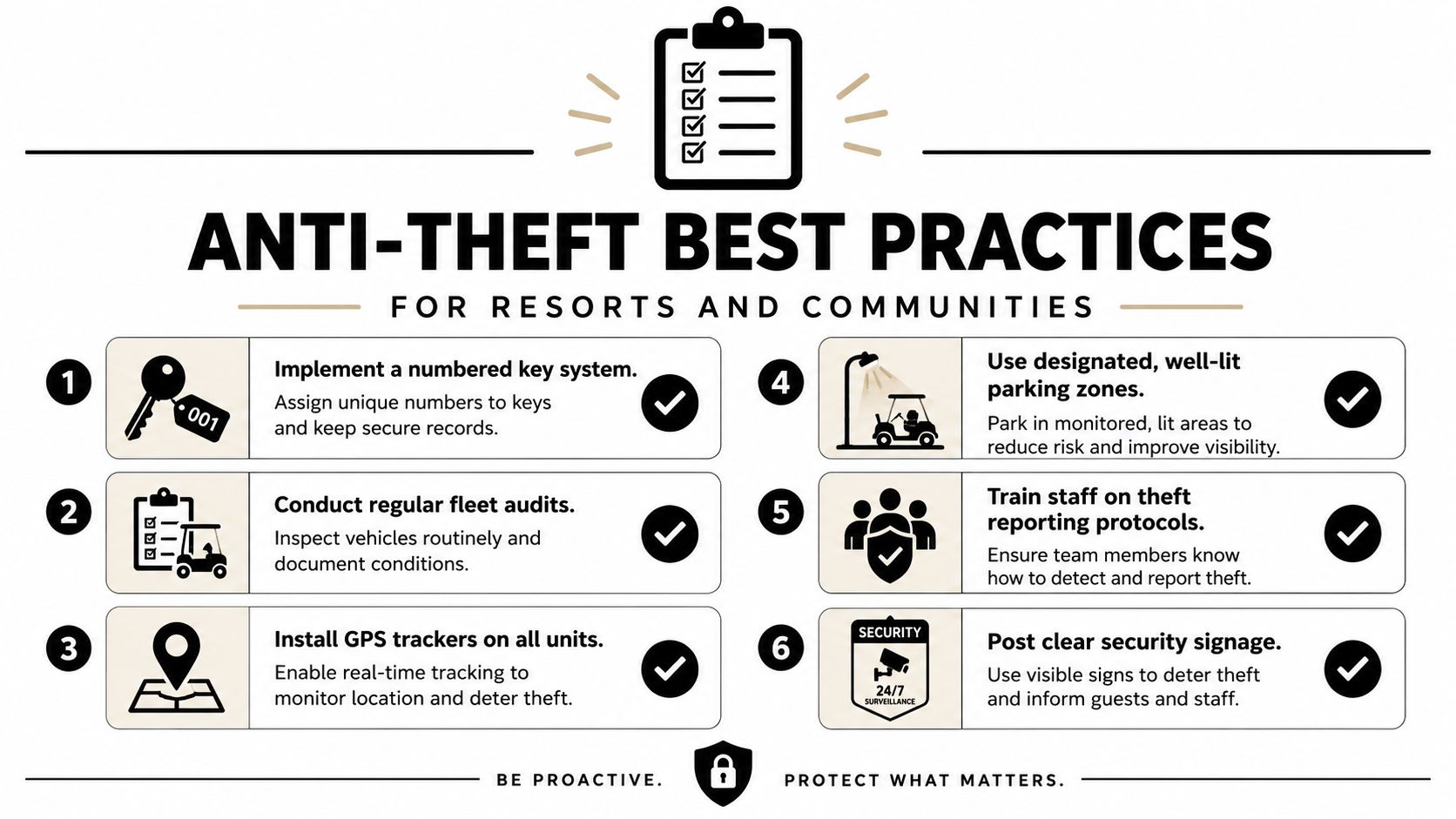
Make the process boring and repeatable
Start with a numbered key system so staff can track who has access. Then run regular fleet audits so missing carts aren't discovered late. Put carts in designated, well-lit parking zones, because darkness and clutter help thieves.
The rest is about discipline, not hardware glamour.
- Install GPS trackers on all units. Recovery is easier when the cart can be found fast.
- Train staff on theft reporting protocols. People should know who to call and what to document.
- Post clear security signage. Visible rules change behavior and support deterrence.
Use geofencing as a policy tool, not a novelty
Geofencing works best when it matches real property boundaries and normal cart movement. If your boundary rules are too loose, the alert becomes meaningless. If they're too strict, staff will ignore it. The goal is to tune the system so response teams can trust the alert without chasing false events.
A practical outside reference for property-level security thinking is golf course security in Sacramento from Stormhammer Security, Inc., because the site-security mindset is the same even when the asset changes. Controlled access, visible deterrence, and response planning all matter more than flashy hardware.
The best operations also assign response ownership. If an alarm triggers and nobody knows whether to call security, the desk, or management, the system is functionally weak. Decide that before you deploy anything.
Next Steps for Dealers and Buyers
A dealer shouldn't sell security like an accessory. It's a retention and trust issue. A resort manager shouldn't treat alarm selection as a one-time purchase either, because the value comes from how the system fits into daily operations.
Ask the right questions before you buy
Before you approve any system, ask four things. Does it deter casual theft? Does it trigger fast enough to matter? Can you recover a cart if it leaves the property? Can your staff maintain it without creating extra work?
Those questions separate useful systems from impressive-looking ones. If a vendor only talks about loudness, they're selling a siren. If they can explain alerting, GPS, geofencing, and maintenance together, they're selling security.
Dealers should package security as part of the vehicle sale
That's where the opportunity is. Dealers can present alarm systems as a value-add that protects the buyer's investment and creates recurring service relationships. Fleets benefit from the same structure, because standardized installation and maintenance are easier to support than one-off purchases.
A premium vehicle line also gives dealers a cleaner platform for this conversation. Solana EV, for example, is built around modern electric cart expectations, and buyers in that segment already expect connected features and polished fit-and-finish. That makes security integration part of the overall ownership experience, not an afterthought.
The carts that disappear are usually the ones nobody planned to protect properly.
Treat the next purchase as a system decision, not a parts decision. Build a layered plan, insist on clear maintenance terms, and choose hardware that supports recovery as well as deterrence. If you're ready to protect a fleet, a resort, or a private cart with a cleaner long-term approach, visit Solana EV and evaluate vehicles and support with security in mind.