
So, you're looking for an electric golf cart for sale. You've come to the right place. These aren't just for hitting the links anymore; they've become the go-to ride for everything from zipping around the neighborhood to managing large properties. They're quiet, efficient, and surprisingly versatile.
This guide is built to help you navigate all the choices out there and land on the perfect cart for your needs and budget.
Your Guide to Buying an Electric Golf Cart
Think of us as your personal guide through the entire process. We're going to break down everything you need to know, from the basic models to the high-tech, street-legal machines that are changing how people get around in their communities.
Choosing the right cart is a lot like buying a car. It's all about matching the vehicle to your life. The cart that’s perfect for a retiree in a quiet, gated community is going to be completely different from one needed to haul equipment around a sprawling resort.
More Than Just a Golf Accessory
Let's get one thing straight: the modern electric golf cart has grown up. It has evolved from a simple course caddy into a primary mode of transportation for millions. Because of this, the market is filled with an incredible variety of models, each built for a specific purpose.
The secret to a smart purchase is figuring out your needs before you start shopping. Ask yourself this one simple question: "What will I be using this cart for 90% of the time?" Your answer is the key that unlocks all the other decisions.
We’ll walk you through everything, from decoding different models and battery types to understanding what makes a cart "street-legal" and how to find the best financing. Here's a quick look at what we'll cover:
- Your Use-Case: Are you a golfer, a neighborhood cruiser, or do you need a workhorse for utility tasks? We'll help you pinpoint your primary need.
- Street-Legal Rules: We'll clear up the confusion between a standard golf cart and a Low-Speed Vehicle (LSV) that's legal to drive on public roads.
- Power and Performance: It's a classic showdown: old-school lead-acid vs. modern lithium-ion batteries. We'll compare them so you can decide what's best for your range and maintenance needs.
- Budgeting and Costs: We'll go beyond the sticker price to look at financing, insurance, and the real total cost of owning a cart.
This is your roadmap to buying with confidence. Our goal is to make sure the electric golf cart for sale you end up with is one you'll love for years—a reliable, quiet, and fun ride that fits your life perfectly.
How to Choose the Right Electric Golf Cart for Your Lifestyle
Before you even start looking at models or colors, the first and most important question to ask yourself is: "What am I really going to use this for?" It's a simple question, but the answer will guide every other decision you make.
Think of it this way: you wouldn't buy a sports car to haul lumber. The same logic applies here. Being honest about your primary use case is the key to finding the perfect electric cart. It stops you from paying for flashy features you'll never use or, even worse, ending up with a cart that can't keep up with your needs.
Let's walk through the most common ways people use their carts to help you figure out where you fit in.
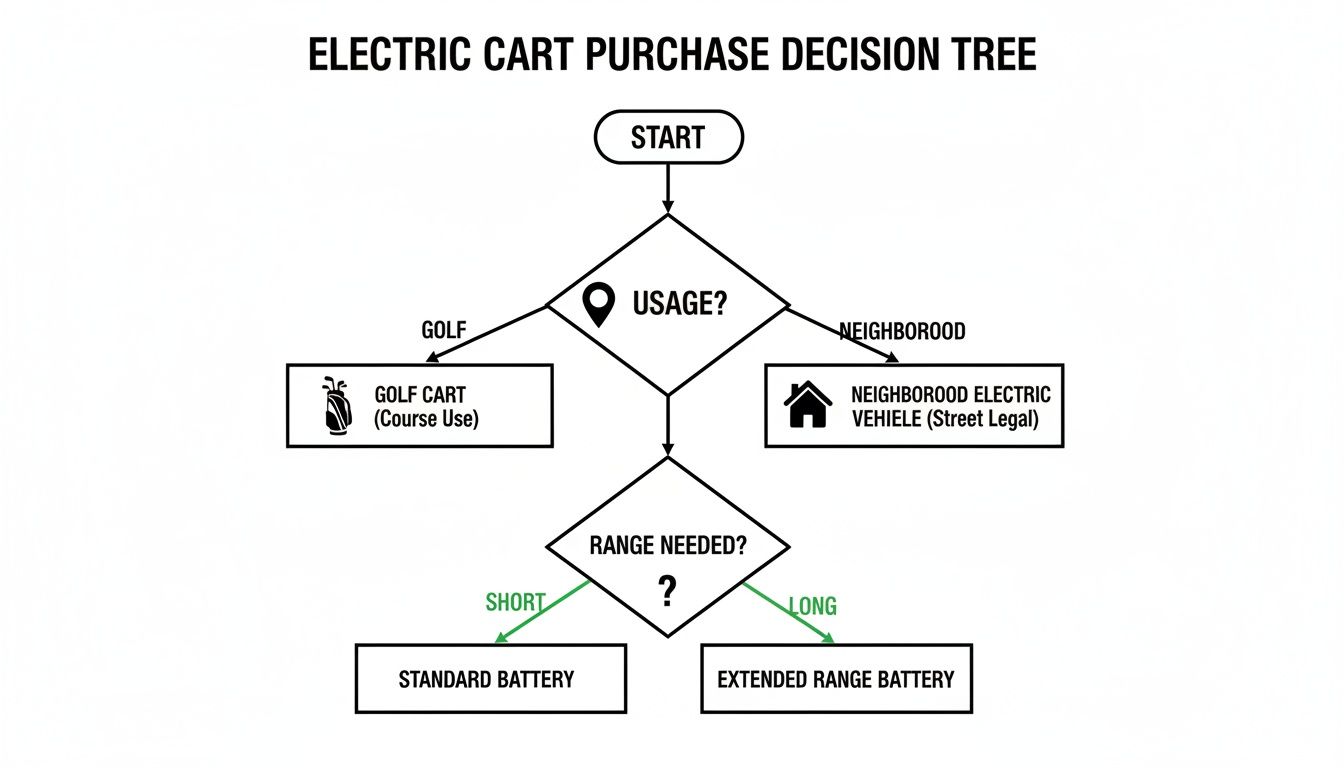
As you can see, the path splits right away. Is your cart destined for the golf course or for cruising around town? The answer changes everything.
For the Avid Golfer
If your cart’s main job is getting you through 18 holes, your needs are very specific. Performance on the course is everything. The last thing you want is a cart that tears up the fairway or dies on the back nine.
Your focus should be on features built for the game. Look for turf-safe tires that give you grip without damaging the grass. You’ll also appreciate practical add-ons like club and ball washers, built-in coolers, and sand bottle holders that make your round smoother and more enjoyable.
Key features for golfers include:
- Turf-Friendly Tires to keep the course pristine.
- Ample Storage for bags, coolers, and gear.
- Sufficient Range to easily handle 18-36 holes on a single charge.
- Quiet Operation so you don't disturb other players' focus.
For the Neighborhood Explorer
This is where the electric cart world has really exploded. If you see yourself using a cart for quick trips around the community—visiting friends, heading to the pool, or making a quick grocery run—your priorities are completely different.
Here, comfort and safety take center stage. You’ll want a smooth ride, comfortable seats, and all the features that make you feel secure on paved roads. This is the natural habitat of street-legal models, often called Low-Speed Vehicles (LSVs). These carts come from the factory with everything needed for road use.
A cart for neighborhood cruising is less about sport and more about practical, fun transportation. It's like a second family car for short hops, where safety, comfort, and following local rules are the top priorities.
This explosion in personal and residential use is what's fueling the industry's growth. The global electric golf cart market hit a valuation of USD 1.7 billion in 2024, with North America accounting for a massive 56% of that. While golf courses still made up 45% of the market in 2024, personal community use is closing the gap fast. You can find out more about the explosive growth in the electric mobility market and see just how big this trend has become.
For the Commercial Operator or Utility User
Need a tough vehicle to manage a large property, resort, or business campus? Then you're in the market for a workhorse. Forget the bells and whistles; your focus is on durability, hauling capacity, and pure versatility.
Utility-focused electric carts are built from the ground up to handle tough jobs, quietly and efficiently. These models often come with heavy-duty suspension, bigger cargo beds, and a more rugged frame. They can be configured for all sorts of tasks, from landscaping and maintenance to shuttling guests around a hotel.
Look for these utility-focused features:
- High Payload Capacity for moving tools, supplies, or heavy equipment.
- Durable Construction, including a reinforced frame and all-terrain tires.
- Customizable Configurations like flatbeds, cargo boxes, or extra seating.
- Powerful Motors that can handle heavy loads and rough terrain without breaking a sweat.
Once you’ve identified which of these profiles sounds most like you, your search for an electric golf cart for sale gets a whole lot easier. You can tune out the noise and focus on the models and features that will actually make a difference in your daily life.
To make it even clearer, here’s a quick breakdown of how these use cases translate into the right cart for you.
Which Electric Golf Cart is Right for You?
| Use Case | Recommended Model Type | Key Features to Look For | Typical Price Range |
|---|---|---|---|
| Golf Course Regular | Traditional Golf Cart | Turf-safe tires, bag holders, cooler, long-range battery, quiet motor | $8,000 – $12,000 |
| Neighborhood Cruising | Street-Legal / LSV | Headlights, taillights, turn signals, seatbelts, VIN, mirrors, smooth suspension | $10,000 – $18,000 |
| Property Management | Utility Cart (UTV-style) | Cargo bed, high payload capacity, durable frame, all-terrain tires, powerful motor | $12,000 – $20,000+ |
| Family & Community | 4-Seater or 6-Seater | Rear-facing seats, grab bars, seatbelts, extended roof, comfortable seating | $11,000 – $19,000 |
This table should give you a solid starting point. By matching your primary need to a model type, you ensure your investment is a perfect fit from day one.
So, You Want to Drive It on the Street? Navigating Legal & LSV Requirements
Thinking of taking your golf cart beyond the back nine and into the neighborhood? That’s where things get a bit more complex. A standard golf cart is built for private property, but the moment your wheels hit a public road, a whole new set of rules kicks in. This is where you'll start hearing the term Low-Speed Vehicle (LSV).
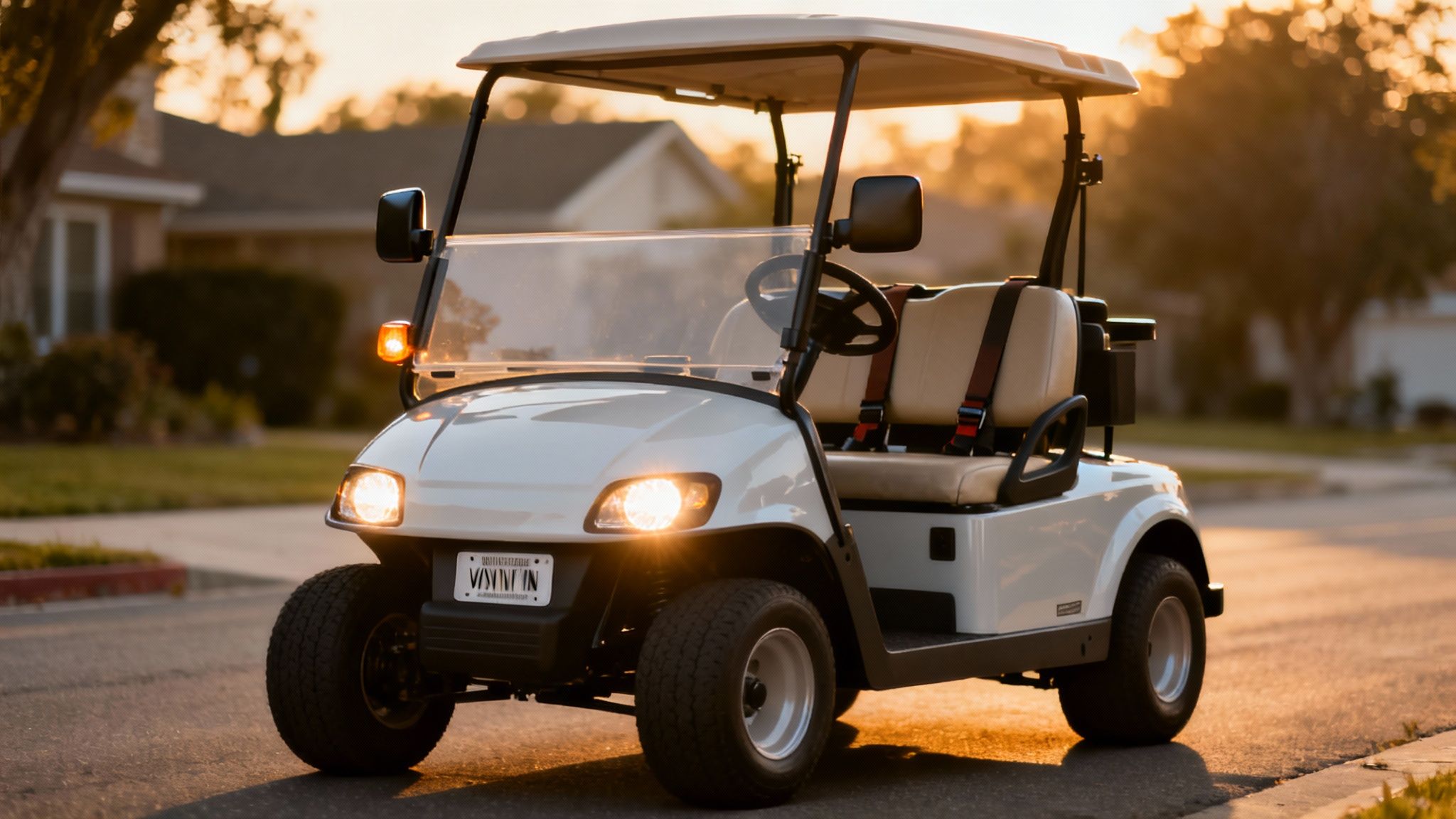
Here's a simple way to think about it: a regular golf cart is like a bicycle—great for designated paths and your own land. An LSV, however, is treated more like a scooter or a small car. It's been officially certified to safely share the road with other traffic. Getting this distinction right is the first step to enjoying your ride without any legal headaches.
What Makes a Golf Cart a Street-Legal LSV?
For an electric cart to legally be called an LSV, it needs to meet a very specific checklist of federal safety standards. It’s not as simple as just bolting on a headlight and calling it a day. The vehicle has to be built from the ground up—or properly converted—to meet these strict rules. This certification is what makes it safe and legal to drive on public roads, typically those with a speed limit of 35 mph or less.
This whole process turns a simple recreational vehicle into a registered one. A key performance requirement is that it must be able to reach a speed of at least 20 mph, but it can't go faster than 25 mph.
The single biggest giveaway of a true LSV? It’s the VIN. A federally compliant LSV will have a 17-digit Vehicle Identification Number (VIN), just like your car. This number is absolutely essential for titling, registering, and insuring it.
The Essential LSV Equipment Checklist
To earn that coveted street-legal status, an electric golf cart must come equipped with a number of non-negotiable safety features. These are all designed to make the vehicle visible, predictable, and safe for everyone on the road.
Here’s a quick rundown of what’s required for LSV certification:
- Headlights and Taillights: For being seen, day or night.
- Turn Signals and Brake Lights: To let other drivers know what you’re doing.
- DOT-Approved Windshield: A regular piece of acrylic won't cut it; it needs to be shatter-resistant.
- Mirrors: You’ll need both rearview and side-view mirrors to see what's happening around you.
- Seatbelts: One for every person on board.
- A Horn: To get the attention of pedestrians and other vehicles.
- Reflectors: Placed on all corners of the cart for extra visibility.
- A Valid 17-Digit VIN: The official ID needed for all your paperwork.
Any new for sale electric golf cart that is advertised as an LSV will have all of these features straight from the factory. If you're buying used, double-check this list to make sure you're not inheriting a legal problem. To get into the nitty-gritty, you can explore the complete list of street legal golf cart requirements and make sure you're covered.
Titling, Registration, and Insurance
Got a cart that checks all the LSV boxes? Great! The last few steps are a lot like buying a car. You’ll need to take the Manufacturer's Certificate of Origin (MCO) and your bill of sale down to your local DMV.
They'll help you get the cart officially titled and registered in your name. You'll walk out with a license plate, making your cart 100% road-ready. But remember, with registration comes responsibility. Most states require LSVs to have at least minimum liability insurance, just like any other car on the road. This is crucial protection in case of an accident.
Don't be tempted to skip these steps. Failing to properly title, register, and insure an LSV can result in some pretty hefty fines. If you treat it with the same care as you would a car purchase, every cruise through the neighborhood will be safe, legal, and completely stress-free.
Understanding Batteries, Performance, and Charging
Think of the battery as the heart and soul of your electric golf cart. It’s the single most important component, dictating everything from how far you can go to how fast you get there. When you see a for sale electric golf cart, the battery setup underneath is one of the biggest decisions you'll make. It’s not just about power; it’s about your entire ownership experience.
Essentially, you have two main choices: the old-school, reliable lead-acid batteries or the modern, high-tech lithium-ion batteries. It's a bit like choosing between a classic V8 engine and a modern, efficient turbocharged one. Both will get you down the road, but how they do it—and what they demand from you—is completely different.
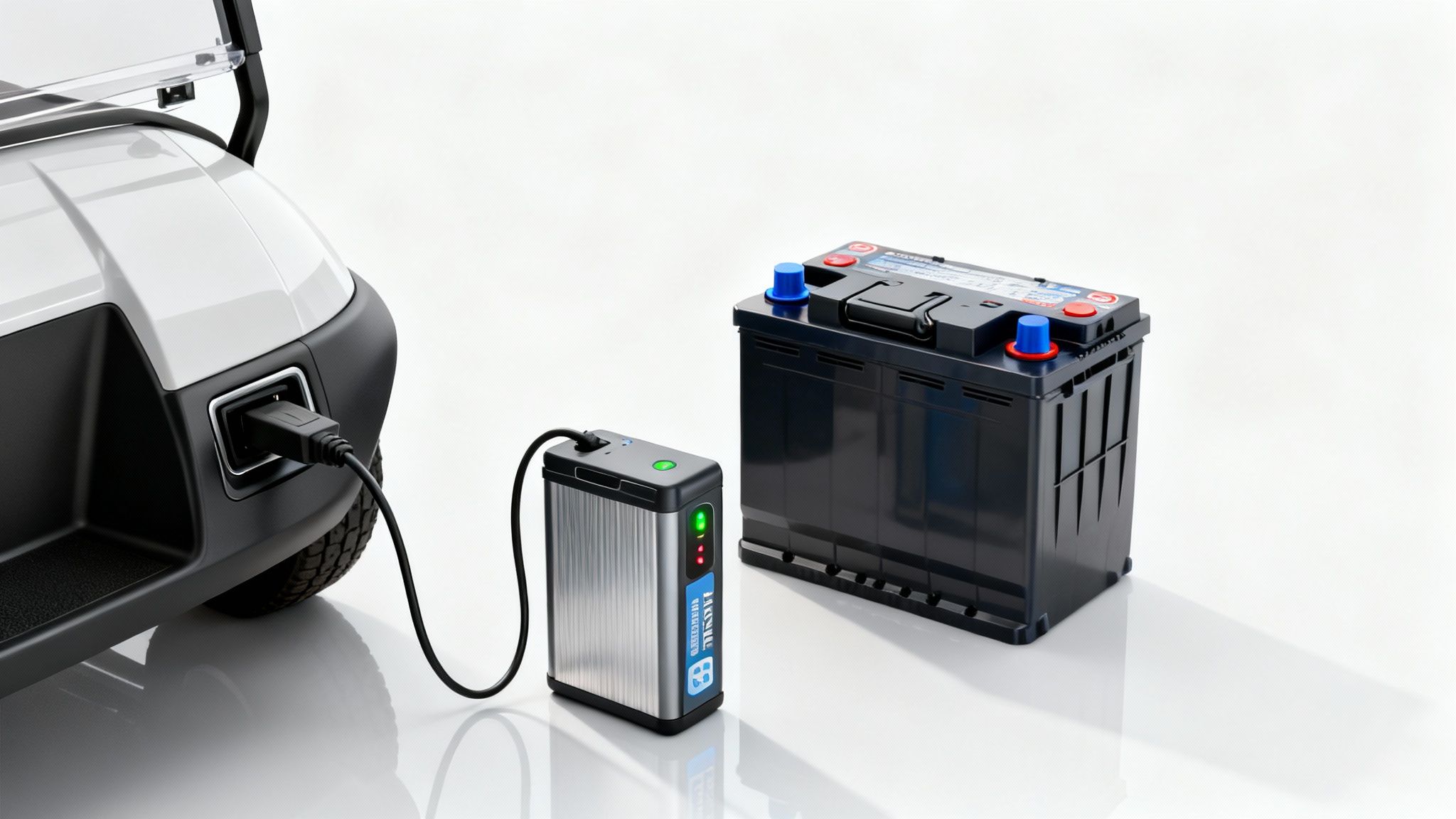
Lead-Acid: The Tried-and-True Workhorse
For decades, lead-acid batteries were the only game in town. They’re the traditional standard, known for being dependable and, more importantly, cheaper upfront. They have a long track record, and there are no surprises.
But that lower initial cost comes with a catch: maintenance. Lead-acid batteries are heavy and need regular attention to perform their best. You'll be popping the seat to check water levels, carefully topping them off with distilled water, and cleaning the terminals to keep corrosion at bay. If you slack on this routine, you’ll significantly shorten their lifespan, which usually tops out around 4-6 years.
Lithium-Ion: The Modern Powerhouse
Lithium-ion is the new gold standard, and for good reason. These batteries are incredibly lightweight, charge up in a fraction of the time, and are completely maintenance-free. It's a true "set it and forget it" system, which is a huge draw for most owners.
Yes, a lithium setup costs more when you buy the cart. But the investment pays off over time. Lithium batteries last much longer, typically 8-10 years or even more, and they deliver consistent, full power right until they're empty. Your cart won't get sluggish as the battery drains. If you want to get into the nitty-gritty, you can explore the specific benefits of a golf cart lithium battery to see why they offer much better long-term value.
A key advantage of lithium is its efficiency. A lithium-powered cart can often be fully charged in just 2-4 hours, whereas a lead-acid cart might need 8-10 hours for a complete charge cycle. That's more time driving and less time waiting.
Comparing Your Power Options
Let's put them side-by-side to make the decision crystal clear.
| Feature | Lead-Acid Batteries | Lithium-Ion Batteries |
|---|---|---|
| Upfront Cost | Lower | Higher |
| Lifespan | 4-6 Years | 8-10+ Years |
| Maintenance | Requires regular watering and cleaning | Virtually maintenance-free |
| Charge Time | 8-10 Hours | 2-4 Hours |
| Weight | Heavy (can be over 300 lbs) | Lightweight (often under 100 lbs) |
| Performance | Power fades as the battery drains | Consistent power output until fully discharged |
| Total Value | Lower initial investment | Better long-term value and lower ownership cost |
Beyond the Battery: Conquering Range Anxiety
A big question I always get from first-time buyers is, "How far will it actually go?" It’s a valid concern—nobody wants to get stranded. Most new carts offer a solid range of 15-25 miles on a full charge, which is plenty for zipping around the neighborhood or playing a couple of rounds of golf.
But that number isn't set in stone. Your real-world mileage depends on a few key things:
- Terrain: Hills are a battery killer. Cruising on flat ground is easy, but climbing steep inclines takes a lot more juice.
- Load: The more weight you're hauling—whether it's people or gear—the harder that motor has to work.
- Tire Pressure: This one’s a silent range-killer. Underinflated tires can reduce your range by up to 10% due to increased rolling resistance.
- Driving Style: A heavy foot on the accelerator will drain your battery much faster than smooth, steady driving.
The market for electric carts is booming, and advancements in battery tech are a huge reason why. The industry was valued at USD 1.55 billion in 2024 and is projected to hit USD 2.58 billion by 2033. This explosion in popularity, driven by the shift to lithium-ion, is making these powerful, low-maintenance options more accessible than ever. By understanding what affects your cart's performance, you can pick the right battery for your needs and cruise with confidence.
5. Pricing, Financing, and Finding the Best Deals
Alright, let’s talk money. Figuring out the financial side of your purchase is every bit as important as picking the perfect model with all the right features. When you start searching for a for sale electric golf cart, you'll notice prices are all over the map. The key to making a smart investment is understanding what’s behind those numbers.
The market for electric carts is absolutely booming, valued at around USD 1.13 billion in 2024 for electric models alone. And it's only growing. This is great news for you because it means more choices—from brand-new carts with great incentives to well-maintained used models that hold their value incredibly well. You can discover more insights about the booming electric golf cart market and see for yourself why they’ve become such a resale hotspot.
Setting a Realistic Budget
So, what should you expect to pay? The final price tag on an electric golf cart swings wildly based on a few key things. A brand-new, street-legal LSV decked out with all the premium upgrades is going to be on the higher end, naturally. On the other hand, a basic, pre-owned cart for the neighborhood will be far more budget-friendly.
Here’s a quick rundown of what moves the price needle:
- New vs. Used: A new cart gets you the latest tech and a full warranty, but a used one is your ticket to a lower upfront cost.
- Battery Type: Carts running on modern lithium-ion batteries usually cost more initially than their lead-acid counterparts.
- Street-Legal Features: A factory-built LSV with all the required safety gear costs more than a standard cart designed just for the golf course.
- Brand and Customizations: High-end brands and fun add-ons like custom-stitched seats, a bumping sound system, or slick aftermarket wheels all add to the bottom line.
For a much deeper dive into the numbers, check out our complete guide on the cost of an electric golf cart.
Exploring Your Financing Options
Once you've got a budget in mind, it's time to figure out how to pay for your new ride. You don't have to pay all at once in cash. Just like buying a car, financing is a very common option, and most dealerships—including your local authorized Solana EV dealer—offer plans to make the purchase much more manageable.
When you finance, you're taking out a loan. The two big terms to wrap your head around are the interest rate (what it costs to borrow the money) and the loan term (how long you have to pay it back). The goal is simple: get the lowest interest rate and the shortest term possible to save the most money.
Think of financing like this: A longer loan term will get you a lower monthly payment, which seems great at first. But you'll end up paying way more in total interest over the life of the loan. It's always best to aim for the shortest term you can comfortably afford.
Strategies for Securing the Best Deal
Getting a great price isn't about getting lucky—it's about smart timing and being a confident buyer. Don't ever hesitate to ask questions, explore all your options, and make sure you're walking away with the best value for your hard-earned money.
Here are a few proven strategies to try:
- Shop in the Off-Season: Demand for golf carts usually takes a dip in the fall and winter. Dealers are often more motivated to negotiate to clear out inventory during these slower months.
- Ask About Demo Models: Dealerships sometimes sell their floor models or demo carts at a discount. These are practically brand new, just with a few hours of light use. It's a fantastic way to save.
- Negotiate Politely: That sticker price is almost never the final price. Do your homework, make a reasonable offer based on your research, and be ready to have a friendly conversation.
- Consider the Total Cost: Remember to look beyond the purchase price. Factor in future expenses like insurance, eventual battery replacement, and regular maintenance to understand the true long-term cost of owning the cart.
Warranty, Maintenance, and Making It Your Own
Driving your new electric golf cart home isn't the end of the journey—it's just the beginning. To really love your cart for years to come, you need to think about what happens after the sale. It really boils down to three things: a solid warranty, simple upkeep, and the freedom to add your own personal touch.
A good warranty is your peace of mind, plain and simple. It’s the manufacturer's promise to stand behind their product. When you're looking at a for sale electric golf cart, don't just ask if it has a warranty; ask what it specifically covers. The best brands don't lump everything together.
Look for a warranty that breaks things down:
- The Frame: This is the backbone of your cart. A long warranty on the frame, often several years, is a huge sign of quality manufacturing.
- The Powertrain: This is the heart of your machine—the motor and the controller. You want strong coverage here.
- The Battery: For modern lithium-ion carts, a multi-year battery warranty isn't just a bonus, it's the standard. Don't settle for less.
Keeping Your Cart in Top Shape
Let's be honest, one of the best things about going electric is saying goodbye to the greasy mess of gas engines. No more oil changes, spark plugs, or fuel filters. But "low maintenance" doesn't mean "no maintenance." A little bit of attention goes a long way in keeping your cart running smoothly and safely for the long haul.
Think of it like a good bicycle. You don't need to be a professional mechanic to keep it in great shape. You just check the tire pressure, make sure the brakes work, and keep the chain clean. It's the same idea here.
A simple checklist is all you need. Once a month, check the tire pressure. Before you head out, give the brakes a quick test. If you have lead-acid batteries, make sure the terminals are clean. That's most of the work right there.
Customizing Your Ride with Upgrades and Accessories
Now for the fun part: making the cart truly yours. This is where you can take a standard model and turn it into something that fits your lifestyle and shows off your personality. The options are practically endless, from boosting performance to just looking sharp.
For instance, if you want to give your cart's finish incredible protection and a deep, glossy shine, advanced options like graphene coatings are a fantastic way to go beyond a simple wax job.
Some of the most popular upgrades people ask for include:
- Premium Seating: Ditch the standard bench for contoured, marine-grade vinyl seats. They look amazing and are way more comfortable.
- Custom Wheels and Tires: Nothing changes the look of a cart faster than a new set of alloy wheels and some quality tires. It can also improve the ride.
- Sound Systems: Who doesn't want their favorite playlist along for the ride? Integrated Bluetooth speakers are a must-have for many owners.
- All-Weather Enclosures: A good enclosure turns your cart into a year-round vehicle, keeping you dry in the rain and warm when it's windy.
Your Top Electric Golf Cart Questions, Answered
Alright, you've done the research, but a few nagging questions might still be bouncing around in your head. It's completely normal. Making a smart purchase means getting all the facts straight before you pull the trigger.
Let's clear up some of the most common questions we hear from buyers. Think of this as the final check-in to make sure you're feeling 100% confident about your new ride.
How Long Do Electric Golf Cart Batteries Really Last?
This is probably the most important question, and the answer comes down to one thing: the type of battery you choose. You're essentially deciding between a lower upfront cost and long-term, hassle-free value.
- Lead-Acid Batteries: These are the old-school standard. With proper care—meaning you're diligent about checking water levels and keeping the terminals clean—you can expect them to last a solid 4-6 years.
- Lithium-Ion Batteries: The modern powerhouse. Yes, they cost more initially, but they can easily last 8-10 years or more. Plus, they require zero maintenance, which is a huge bonus for most owners.
What's the Real-World Range on a Full Charge?
On a good day, on flat ground, most standard electric golf carts will get you 15-25 miles on a full battery. That's plenty for a couple of rounds of golf or making all your runs around the community for a day or two.
But "real-world" is the key phrase here. Your actual range will change based on how you drive. Tackling steep hills, carrying a full load of passengers and gear, or even just having underinflated tires will reduce how far you can go.
A new cart will almost always have a lower initial purchase price than a used one. However, the true value depends on long-term costs. A used cart might need a costly battery replacement sooner, while a new one comes with a full warranty and the latest technology.
Do I Actually Need Insurance for a Street-Legal Cart?
Yes, and this one is not up for debate. If your cart is classified and registered as a street-legal Low-Speed Vehicle (LSV), the law requires you to insure it. You'll need, at a minimum, the same basic liability coverage you'd carry for your car. It’s a crucial step to legally hitting the road.
Ready to find the perfect electric vehicle that fits your lifestyle? Explore the premium, street-legal lineup at Solana EV and discover the future of personal transportation. Visit us at https://solanaev.com to see our models and find a dealer near you.