
When you're trying to figure out the real cost difference between an electric and a gas car, the sticker price is only the beginning of the story. While gas-powered cars often look cheaper on the lot, EVs almost always pull ahead in the long run. The secret is in the day-to-day savings on fuel and maintenance, which can make them a much smarter financial move over the life of the vehicle.
The True Cost of Ownership EV vs Gas

The price you see at the dealership is just the first chapter. To truly understand what you'll spend, you need to look at the Total Cost of Ownership (TCO). This is the only real way to compare apples to apples and see which vehicle is actually more affordable for your situation.
TCO isn't just a buzzword; it’s a comprehensive look at every dollar you'll spend from the day you drive off the lot until the day you sell. It bundles all the crucial financial pieces into one clear picture.
- Upfront Purchase Price: This is your starting point—the actual cost to buy the car, including any dealer fees.
- Government Incentives: Don't forget these. Federal tax credits and state rebates can slash an EV's effective price right away.
- Fuel/Energy Costs: This is the big one. It's the ongoing battle between filling up at the pump versus plugging in at home.
- Maintenance and Repairs: Think of all the routine costs like oil changes and tune-ups (for gas cars) plus any unexpected fixes down the road.
- Insurance Premiums: These can vary based on the vehicle’s value and repair costs, so it's a factor worth considering.
When you lay all these costs out side-by-side, the real winner becomes much clearer. It shifts the decision from a simple price tag comparison to a truly informed, long-term financial choice.
Factoring in Long-Term Savings
It’s true that you might pay an extra $3,000 to $8,000 for an EV upfront compared to a similar gas model, but that gap is closing every year. More importantly, you start saving money the moment you start driving. On average, EV owners in the U.S. save around $790 a year on fuel alone—that's a 58% cut compared to what they’d spend on gasoline.
Tack on another $600 to $900 per year in maintenance savings (goodbye, oil changes!), and the financial argument for EVs gets pretty compelling. You can explore the complete cost breakdown of electric versus gas cars to see just how quickly these savings add up.
The real "cost" of a vehicle isn't what you pay to acquire it; it's what you pay to keep it running. For many drivers, the lower operational expenses of an EV create a powerful financial advantage that quickly overcomes a higher initial investment.
Let's break down what those annual operating costs look like in a simple table.
Annual Operating Cost At A Glance EV vs Gas
This table summarizes the key annual running cost differences between a typical EV and a comparable gas vehicle, providing a quick reference for the major savings areas discussed in the article.
| Cost Category | Average Gas Vehicle (Annual) | Average Electric Vehicle (Annual) | Estimated Annual Savings |
|---|---|---|---|
| Fuel Costs | $1,370 | $580 | $790 |
| Maintenance Costs | $1,200 | $450 | $750 |
| Total Operating Costs | $2,570 | $1,030 | $1,540 |
As you can see, the numbers speak for themselves. The ongoing savings from driving an EV can easily offset a higher initial purchase price in just a few years.
Deconstructing the Upfront Purchase Price
When you're weighing the cost of an electric vehicle against a gas car, the first number most people look at is the sticker price. For a long time, gas vehicles had a clear edge here. But that's quickly becoming an old way of thinking. The truth is, that upfront cost gap is shrinking fast—and in some cases, it's gone completely.
Once you look past the Manufacturer's Suggested Retail Price (MSRP), the real cost to get into an EV starts to look a lot more appealing. This isn't just one thing, but a combination of more competitive manufacturer pricing, a flood of new models hitting the market, and some very compelling government incentives designed to get more people driving electric.
The Myth of the Expensive EV
For years, the story was simple: if you wanted to go electric, you had to pay a premium. That was largely true, mainly because of how expensive it was to produce the batteries. The battery is the heart of an EV, dictating much of its cost and performance, so it's worth understanding the key considerations in electric vehicle battery technology to see how far things have come.
Today, that old story is being completely rewritten. We're now seeing hard data that shows in several popular market segments, the cost of buying an EV has either reached parity with gas cars or even dipped below them.
According to S&P Global, EV purchase prices and even monthly payments are now matching or beating comparable gas cars in major U.S. markets. In segments like compact luxury cars and utility vehicles, for example, EV monthly payments were consistently lower than their gas-powered rivals through the early part of the year.
This massive shift is being driven by a few key factors: manufacturers are building EVs at a much larger scale, subsidies are bringing prices down, and the competition in the market is fierce. In fact, seven of the top ten high-volume EV models saw their average monthly payments drop between January and April, often by double-digit percentages. It's a clear sign that the old "EVs are too expensive" argument just doesn't hold up anymore.
The Power of Incentives and Rebates
This is where the math gets really interesting. Government incentives are easily the biggest factor in lowering the upfront cost of an EV. These programs are specifically designed to make electric vehicles more affordable, and they can take a huge bite out of what you actually pay.
The federal tax credit gets most of the attention, and for good reason—it can knock a significant amount off your tax bill. But that's just the start. Many states, local governments, and even utility companies have their own separate rebates, credits, and other perks.
These aren't just small discounts; they can completely change the financial picture:
- Federal Tax Credits: These can slash the effective purchase price by thousands, directly lowering your initial investment.
- State Rebates: Many states offer point-of-sale rebates that come right off the price at the dealership, so you pay less from the get-go.
- Local and Utility Programs: You might find extra rebates, lower vehicle registration fees, or special deals for installing a home charger.
Learning how to stack these incentives is the key to getting the absolute best price. We've put together a comprehensive guide on electric vehicle tax credits that walks you through how it all works. When you take full advantage of these programs, you might find that a premium EV model actually costs you less than a mid-range gas car.
Comparing Real-World Sticker Prices
Let's look at how this plays out with a real-world example. A base-model, gas-powered compact SUV might have a lower MSRP on paper, but a comparable EV often ends up being the cheaper option once all the incentives are factored in.
Say a gas SUV has an MSRP of $30,000. A similar electric SUV might be listed at $42,000. At first glance, the gas car looks like the obvious choice.
But then the incentives kick in. After applying a $7,500 federal tax credit and maybe a $2,500 state rebate, the EV's effective price plummets to $32,000.
All of a sudden, that intimidating $12,000 price difference has shrunk to just $2,000. And when you remember that you'll be saving money on fuel and maintenance from day one, that small gap is often closed within the first year of ownership. From that point on, the EV isn't just the greener choice—it's the smarter financial one, too.
Calculating Your Cost Per Mile
The sticker price is just the beginning of the story. When we dig into the electric vehicle vs gas cost debate, the real game-changer is what you pay to keep it moving. This is where electric vehicles pull ahead, offering a clear and consistent financial advantage over their gas-guzzling cousins.
Think about it: gas prices are a rollercoaster, swinging wildly with global events and seasonal whims. Electricity rates? Far more stable and predictable. This stability alone makes budgeting easier, shifting a major variable expense into a manageable fixed cost. Fleet managers have long known this, using advanced strategies for slashing fuel costs to rein in expenses.
For the everyday driver, though, the biggest win is the simplicity of plugging in at home. You gain direct control over your "fueling" costs—a powerful financial tool that traditional combustion engines just can't match.
Breaking Down Electricity vs Gasoline Costs
Let's get right to the numbers. Powering an EV is consistently, undeniably cheaper than filling a gas tank. On average, driving a gas car 100 miles will set you back somewhere between $12 and $15. That same distance in an EV charged at home? A much more palatable $3 to $5.
Those savings add up fast. A state-by-state analysis shows that EV drivers save an average of 7.4 cents per mile on fuel. For someone driving 1,200 miles a month, that's roughly $90 back in your pocket every month, or over $1,100 a year.
The benefits can be even greater depending on where you live. In a state like Washington, with high gas prices and cheap electricity, drivers can save up to 13.1 cents per mile. Even in places with cheaper gas and pricier electricity, like Massachusetts, EV owners still come out ahead by an average of 4.7 cents per mile.
The takeaway is clear: no matter where you live in the U.S., electricity is a more affordable vehicle fuel than gasoline. These operational savings are the bedrock of an EV's superior total cost of ownership.
Of course, the key to unlocking these savings is understanding how you charge. Your charging habits directly influence your cost per mile.
Home Charging vs Public Charging Stations
The absolute best way to save is by charging at home. This is where you get access to the lowest residential electricity rates, making it the go-to "refueling" method for most EV owners.
- Level 1 & 2 Home Charging: This is your most cost-effective option, hands down. By charging overnight, you can often tap into off-peak electricity rates from your utility provider, which can slash your charging costs by another 30% or more.
- Public DC Fast Charging: While incredibly handy for long trips, public fast chargers come at a premium. A full charge might run you $20 to $40. That’s still usually cheaper than a tank of gas, but it's a lot more expensive than plugging in at your own house.
Don’t forget that your vehicle's efficiency plays a huge role, too. Just like gas cars have MPG ratings, every EV has its own efficiency metric. You can dive deeper into how to optimize your EV charging efficiency in our detailed guide to get the most range out of every dollar.
By making home charging your default and understanding your vehicle's energy use, you can lock in significant long-term savings that tilt the electric vehicle vs gas cost comparison heavily in favor of electric.
Comparing Long Term Maintenance and Repairs
When you look past the fuel savings, the real game-changer in the electric vs. gas vehicle debate is long-term maintenance. An EV's mechanical simplicity is its secret weapon, leading directly to fewer trips to the shop and a much smaller annual repair budget. It’s a simple equation: EVs just don't have the dozens of failure-prone components that are standard in every gasoline car.
Think about a traditional internal combustion engine (ICE). It's a complex machine with hundreds of moving parts that need constant lubrication, cooling, filtering, and eventual replacement. In stark contrast, an electric motor is incredibly straightforward, often having just one major moving part. This fundamental difference is the reason EVs are so reliable and cheap to keep on the road.
The End of Routine Maintenance
If you've ever owned a gas car, you know the drill. That familiar, and often costly, routine of oil changes, spark plug swaps, and new filters adds up fast over the life of a vehicle. With an EV, that entire schedule is thrown out the window.
Imagine owning a vehicle that never needs:
- An oil change: The motor in an EV doesn't use oil, saving you hundreds of dollars and several hours at the service center every single year.
- Spark plugs or a timing belt: These are critical ICE parts that wear out and can be a real headache to replace. They simply don't exist in an EV.
- A complex exhaust system: You'll never get hit with a repair bill for a failing catalytic converter or a rusty muffler, which can easily cost $1,000 or more.
Because of this streamlined design, EV owners spend, on average, about 50% less on maintenance than people driving gas-powered cars. Over ten years, that can easily put thousands of dollars back in your pocket.
The core of an EV's low maintenance cost is its powertrain. By removing the engine, transmission, and exhaust, you eliminate the most common and expensive sources of mechanical failure found in gasoline vehicles.
This isn't just about the money, either. It’s about getting back your time and avoiding the hassle of constant service appointments. A typical EV service schedule is refreshingly simple. For a closer look at what to expect, check out our in-depth guide to electric vehicle maintenance costs.
To really see the difference, let’s map out what a typical five-year service plan looks like for both types of vehicles.
Typical 5-Year Maintenance Schedule EV vs Gas
| Maintenance Task | Gas Vehicle Frequency & Est. Cost | Electric Vehicle Frequency & Est. Cost |
|---|---|---|
| Oil Change | Every 5k-10k miles ($400-$800) | Not Required ($0) |
| Engine Air Filter | Every 15k-30k miles ($100-$150) | Not Required ($0) |
| Spark Plugs | Once at 60k-100k miles ($200-$400) | Not Required ($0) |
| Coolant Flush | Every 30k-50k miles ($150-$250) | Every 100k+ miles ($100-$150) |
| Brake Fluid | Every 2-3 years ($100-$150) | Every 2-3 years ($100-$150) |
| Brake Pads/Rotors | Every 30k-60k miles ($500-$800) | Every 80k-120k miles ($300-$500) |
| Tire Rotation | Every 5k-7.5k miles ($100-$150) | Every 5k-7.5k miles ($100-$150) |
As the table shows, the list of required tasks for an EV is dramatically shorter, highlighting where those long-term savings really come from.
Understanding EV Battery Health and Longevity
Of course, the elephant in the room for any potential EV owner is the battery. It's true that the battery pack is the single most expensive component, but fears of sudden, bank-breaking replacements are largely a thing of the past.
Modern EV batteries are built to last and are engineered to endure for the entire life of the vehicle—often 15 years or more. Plus, federal regulations require all EV manufacturers to provide a battery warranty for at least 8 years or 100,000 miles, which offers a serious safety net.
While a full battery replacement isn't cheap—it can range from $5,000 to $15,000—it’s an incredibly rare event, especially with newer models. It's far more likely that if an issue does pop up, a technician can simply replace a few failed modules inside the battery pack for a fraction of the cost.
EVs have another trick up their sleeve, too: regenerative braking. This system uses the electric motor to slow the car, turning kinetic energy back into electricity to top off the battery. The big bonus here is that it drastically reduces wear on the traditional brakes. This means your brake pads and rotors can easily last two to three times longer than they would on a gas car, another major contributor to an EV's lower long-term repair costs.
Analyzing Real-World Cost Scenarios
General data is a great starting point, but the true financial picture of the electric vehicle vs gas cost debate only comes into focus when you apply it to real life. The numbers can shift dramatically depending on how, where, and how often you drive. A vehicle that's a clear financial win for one person might be a less-than-ideal choice for another.
To really illustrate this, let's walk through three distinct driver profiles. By looking at these specific use cases, we can calculate a realistic Return on Investment (ROI) and see how the total cost of ownership actually plays out. This kind of contextual analysis is key to figuring out which vehicle type truly aligns with your driving habits and budget.
Scenario 1: The Daily Commuter
Meet Alex, a suburban professional with a predictable 40-mile round-trip commute. Alex drives about 12,000 miles per year, almost all of it for work, with very little driving on the weekends. This kind of predictable routine is the perfect setup for maximizing EV savings.
- Charging Habits: Alex can plug in their Solana EV at home every night, taking full advantage of low, stable residential electricity rates. They almost never have a reason to use more expensive public fast chargers.
- Fuel Savings: Driving a gas sedan that gets 30 MPG with gas at $3.50/gallon, Alex would spend about $1,400 a year on fuel. In an EV, charging at home for $0.17/kWh, that same mileage costs just $580, saving a cool $820 annually.
- Maintenance: Alex gets to skip about two oil changes and a set of air filters each year, saving another $200 in routine upkeep.
For Alex, the steady mileage and easy access to cheap home charging give the EV a clear financial edge. The slightly higher sticker price gets wiped out pretty quickly by over $1,000 in annual savings, leading to a positive ROI in just a few years.
For drivers with consistent daily routines and reliable home charging, an EV isn't just an environmental choice—it's a powerful budgeting tool that turns a volatile expense like gasoline into a predictable, low-cost utility bill.
So much of these savings come from simply eliminating the most frequent and annoying maintenance tasks that come with gas engines.
This infographic breaks down the key differences in upkeep between gas and electric vehicles.
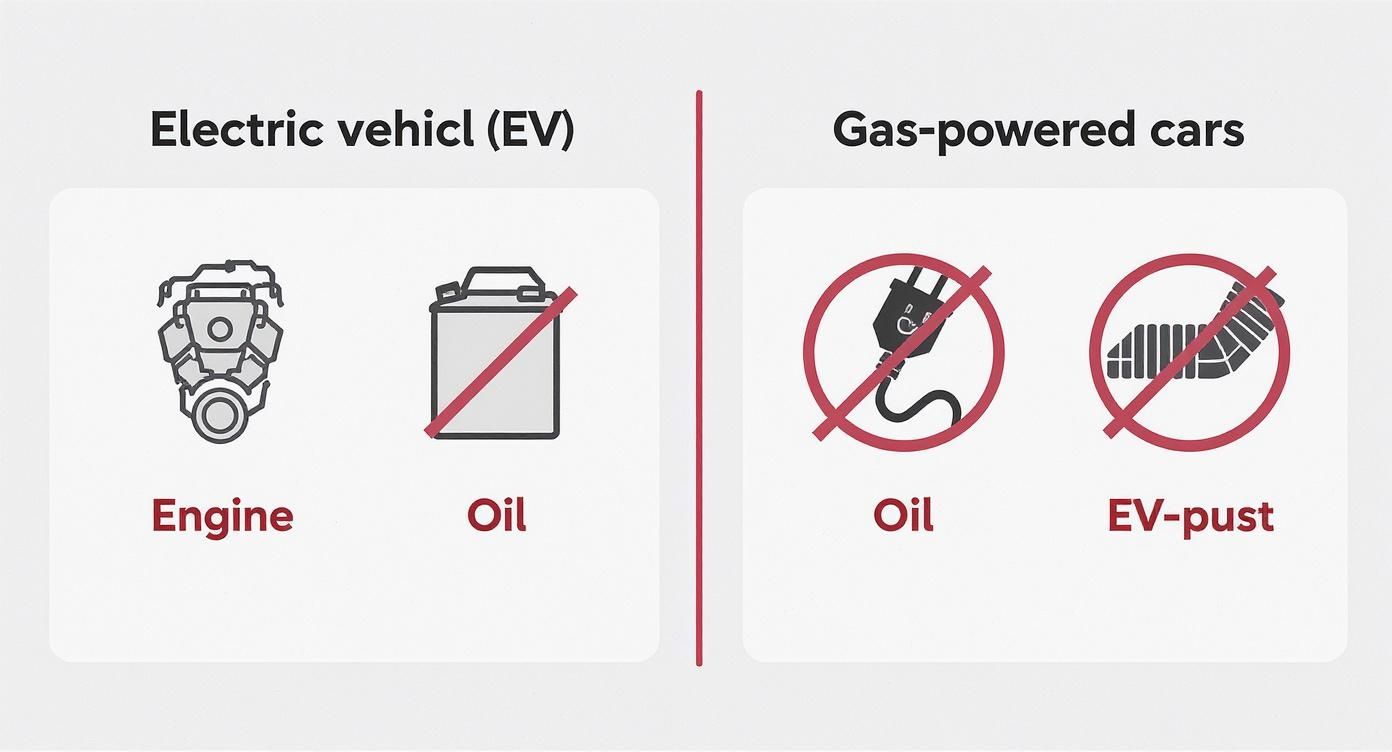
As you can see, the lack of an internal combustion engine means an EV owner never has to think about oil changes, spark plugs, or exhaust system repairs—some of the most common headaches for gas car drivers.
Scenario 2: The High-Mileage Commercial Driver
Now, let's picture a small resort that uses a fleet of utility vehicles to shuttle guests and haul equipment. Their vehicles, like the Solana G, are constantly on the move, racking up 25,000 miles per year and operating nearly every single day. This kind of high-mileage scenario dramatically speeds up the ROI for going electric.
- Fuel Savings: At this mileage, a gas vehicle averaging 25 MPG would burn through 1,000 gallons of gas. At $3.50/gallon, that’s a $3,500 fuel bill. An equivalent EV, charged on-site, would cost around $1,200 in electricity—saving $2,300 per vehicle, per year.
- Maintenance Reductions: High mileage means constant upkeep. The gas vehicle would need at least five oil changes, new spark plugs, and probably brake work. The EV, with its regenerative braking and far simpler powertrain, dodges most of this, saving an estimated $700 annually.
- Operational Uptime: Less time in the shop means more time in service. For any business, this increased uptime is a critical financial benefit that often gets overlooked.
For a business, the combined savings of over $3,000 per vehicle each year make switching to electric a no-brainer. The ROI is often hit in under three years, turning the fleet into a strategic investment that directly boosts the bottom line.
Scenario 3: The Family Vehicle
Finally, let's look at a family that uses their vehicle for a mix of everything: local errands, school runs, and a few long-distance road trips each year, totaling about 15,000 miles annually.
- Mixed Charging Costs: For day-to-day driving, they rely on cheap home charging. But on their three annual road trips, they use public DC fast chargers, which cost more. This blend nudges their average cost-per-mile up slightly compared to the daily commuter.
- Calculating Blended ROI: While their annual fuel savings might be a bit less than a high-mileage driver—maybe around $900—the maintenance savings of $400-$500 per year are still substantial. The total annual savings still easily top $1,300.
Even for families with more varied driving patterns, the financial case for an EV holds up. The huge savings from all those local, electrically-powered miles more than make up for the occasional higher cost of fast charging on vacation. Plus, the quiet, smooth ride and convenience are lifestyle perks that make an EV an incredibly practical and attractive choice for modern family life.
Making the Right Choice for Your Wallet
When you're weighing the cost of an electric vehicle against a gas car, the national averages only tell part of the story. The numbers almost always show that EVs save you a ton of money in the long run, but your personal situation dictates how quickly you'll actually see those savings.
It all boils down to finding your unique financial tipping point. This is that moment when the lower running costs of an EV finally overtake its higher initial price tag, and the car starts putting money back in your pocket. For some people, that happens in the first year. For others, it takes a bit longer.
Finding Your Financial Tipping Point
The biggest factor by far? Your annual mileage. The more you're on the road, the faster you’ll make back that initial investment through what you save on fuel and maintenance.
Think about it: a high-mileage driver knocking out 20,000 miles a year can easily save over $1,500 annually just on gas. That slashes the time it takes to break even compared to someone who only drives 5,000 miles a year.
Where you charge also plays a huge role. Being able to plug in at home overnight is the secret sauce to maximizing your savings, since you’re using cheap residential electricity. If you're constantly relying on pricey public DC fast chargers, the financial edge of an EV shrinks, though it doesn't disappear entirely.
The decision to go electric is less about a single sticker price and more about a collection of personal variables. Your daily commute, local electricity rates, and available incentives all combine to create a unique cost-of-ownership profile.
To really nail this down for yourself, run through the questions below. Your answers will give you a solid framework for making a smart financial choice that fits your life perfectly.
Your Final Decision Checklist
- How many miles do you drive annually? The more you drive, the faster your EV pays for itself. Simple as that.
- Can you install a charger at home? This is the single biggest key to unlocking cheap "fuel" and major long-term savings.
- What are your local electricity rates? It's worth a call to your utility company. Ask about off-peak plans that make overnight charging even cheaper.
- What state and local incentives are available? Don't stop at the federal tax credit. Local rebates can knock thousands more off the upfront cost.
- How long do you plan to own the vehicle? The longer you keep an EV, the more those maintenance and fuel savings stack up, making it a clear winner over time.
Frequently Asked Questions
When you start digging into the real numbers behind owning an EV versus a gas car, a few key questions always come up. Let's tackle them head-on with some straight answers.
How Long Do EV Batteries Actually Last?
This is probably the biggest question people have. The simple answer is that most modern EV batteries are built to outlast the car itself, easily lasting 15 to 20 years. In fact, U.S. law requires every manufacturer to warranty the battery for at least 8 years or 100,000 miles, which gives you a great safety net.
We've moved past the days of worrying about a full, catastrophic battery failure. Technology has improved so much that it's now standard practice for technicians to swap out just a single faulty module within the battery pack instead of the whole thing. This makes any potential repair far more manageable and less expensive.
What Is the True Cost of Installing a Home Charger?
Getting a Level 2 charger installed at home typically runs anywhere from $500 to over $2,000. The final bill really comes down to a few things: the charger model you choose, your local electrician's rates, and how much work is involved—like if they need to run a new line a long way from your electrical panel.
Don't forget to look for incentives! Many states and even local utility companies offer some pretty generous rebates or tax credits for installing a home charger. These can take a big bite out of that initial cost.
How Does Resale Value Compare Between EVs and Gas Cars?
It's true that early on, EVs didn't hold their value as well as gas cars. This was mostly because the battery tech was changing so fast and buyers were still a bit hesitant. That script has completely flipped.
As EV technology has stabilized and the demand for used electric cars has exploded, their resale values have become incredibly competitive. For many popular models, you'll find they hold their value just as well as—and sometimes even better than—a similar gas-powered car. This shift makes them a much more solid long-term investment than they used to be.
Ready to see how the numbers add up for your lifestyle or business? Explore the Solana EV lineup and discover a smarter, more efficient way to drive. Visit us at https://solanaev.com to find the perfect model for you.