
Not too long ago, finding an "electric golf cart sale" was something that only really mattered to, well, golfers. But that's all changed. Now, these sales are attracting everyone from homeowners in planned communities to property managers and small business owners.
The reason is simple: people are looking for quiet, clean, and easy ways to get around their local area. Today’s carts aren't just for the back nine; they're stylish, surprisingly capable, and incredibly useful. Finding a great deal on one means getting a versatile little vehicle that can make community life a whole lot easier.
Why Everyone Is Shopping for an Electric Golf Cart
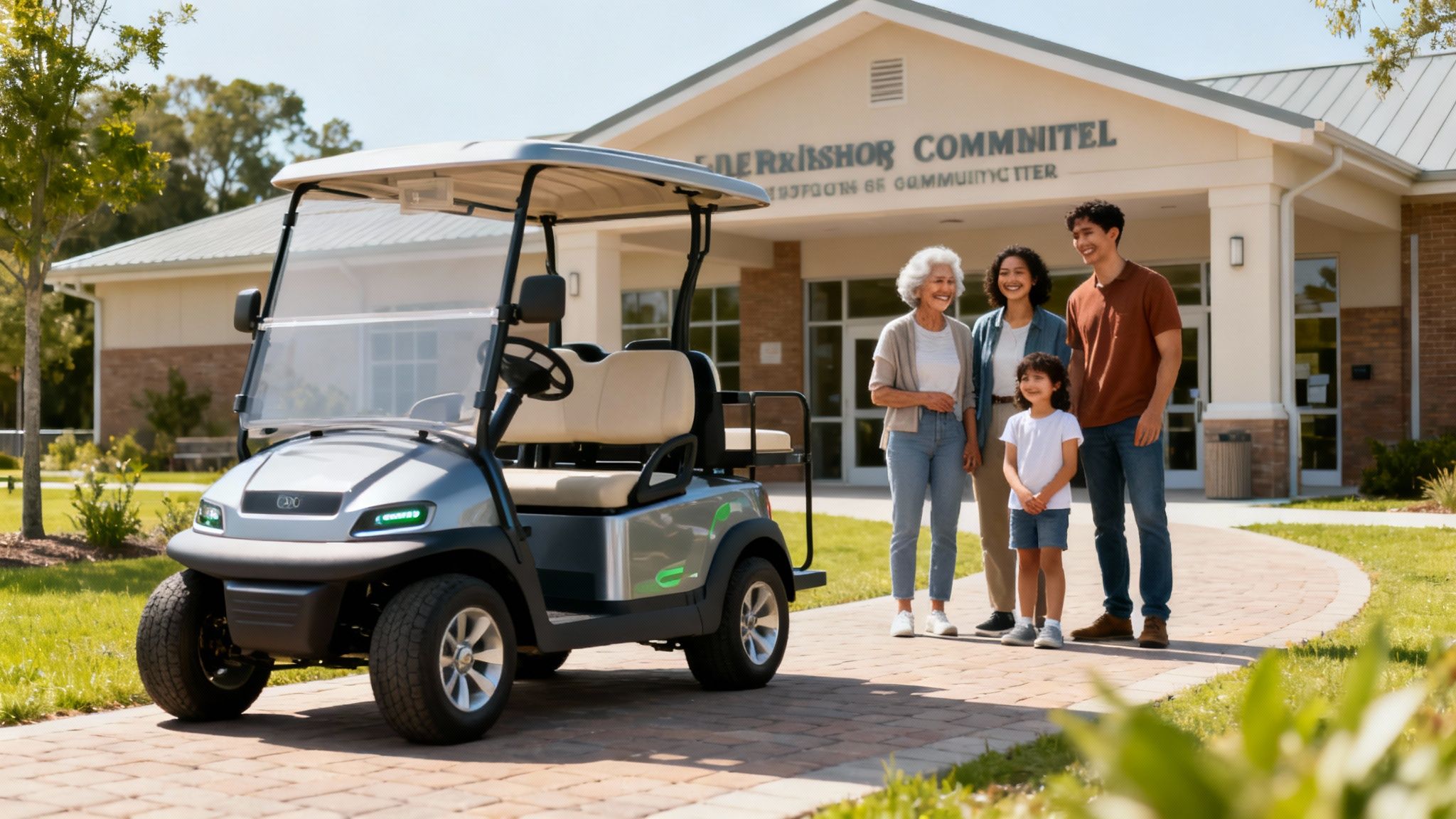
The electric golf cart has officially escaped the golf course. What was once a specialized vehicle is now a common sight cruising through master-planned neighborhoods, across huge corporate campuses, and even down quiet local roads. It’s a real shift in how we think about getting around for those short trips where a car feels like overkill.
And this boom isn't just a fluke. A few key trends are behind this surge in popularity, turning every electric golf cart sale into a big deal for a much wider audience. At its core, it's all about a collective move toward transportation that's both greener and more convenient.
The Rise of Eco-Friendly Local Travel
Let's face it, we're all a bit more conscious of our environmental impact these days. Electric golf carts offer a perfect zero-emission solution for those quick trips—zipping over to the community pool, visiting a neighbor, or running a small errand. They’re whisper-quiet, produce no smelly fumes, and are way cheaper to run and maintain than your average car.
This push for cleaner local travel is showing up in the numbers, too. The global market for electric golf carts was valued at USD 1.55 billion and is expected to climb to USD 2.58 billion by 2033. That steady growth makes one thing clear: people want quiet, emission-free vehicles for their communities and recreational time. You can actually explore more data on this market shift and what’s driving it.
Technology and Versatility Drive Demand
Today’s electric carts are a world away from the clunky, slow models you might remember. The biggest leap forward has been in battery technology, especially with the move to lithium-ion. These modern power sources have completely changed the game.
- Longer Range: Carts can travel much farther on a single charge, making them practical for a whole day's worth of running around.
- Faster Charging Times: Lithium batteries juice up way faster than old-school lead-acid ones, so there's less waiting around.
- Reduced Maintenance: Say goodbye to checking water levels. Lithium options are pretty much set-it-and-forget-it.
The modern electric cart is less like a simple golf accessory and more like a compact, personal utility vehicle. It’s built for lifestyle integration, not just for a round of 18 holes.
This better tech has blown the doors open on what these vehicles can do. They're not just for people anymore; they’ve become workhorses for maintenance crews, security patrols, and resort staff. Finding the right electric golf cart sale is your ticket into this new era of versatility, helping you find a vehicle that slots perfectly into your day-to-day life.
How to Spot a Genuinely Good Deal
Navigating an electric golf cart sale can feel a bit like a treasure hunt. You see a flashy price tag and think you’ve struck gold, but a truly great deal is more than just a low number. The real trick is learning to tell the difference between a genuine value and a clever marketing ploy to offload old or troubled carts.
Think of it like buying a car, just on a smaller scale. You wouldn't walk onto a car lot without doing your homework first, right? The same logic applies here. Your first job is to figure out what a new cart should cost to set a solid baseline.
Start with the MSRP
Before a "sale" price can even tempt you, you need to know the Manufacturer's Suggested Retail Price (MSRP). This is the price the brand, like Solana EV, sets for a brand new, base-model cart. It's your anchor, the number that tells you how deep a discount you’re actually getting.
Finding the MSRP is usually pretty easy. Just hop on the manufacturer's official website or give a couple of authorized dealers a quick call. Once you have that figure, you can properly judge any sale you come across. A price that’s 15-20% below MSRP is often a good sign you're looking at a legitimate end-of-season or promotional sale.
A "sale" price that's really just the MSRP in disguise isn't a deal at all—it's just marketing. Always check the original MSRP to see how much you're truly saving.
Timing Your Purchase with Seasonal Sales
The golf cart world has its own seasons, and if you time your purchase right, you can save a bundle. Dealers are always looking to clear out last year's models to make space for the new ones, creating predictable sale cycles you can use to your advantage.
- End-of-Season Sales (Fall/Winter): This is prime time. As the weather cools and the peak season winds down, dealers are much more motivated to move their remaining inventory.
- Holiday Promotions: Keep an eye out around big holidays like Memorial Day, the Fourth of July, and Labor Day. Dealers often roll out special offers to attract buyers.
- New Model Releases: When a manufacturer unveils a new model, dealers often discount the outgoing version to free up showroom floor space.
Watch for bundled packages, too. A dealer might throw in accessories like a custom canopy, premium seats, or an upgraded sound system. To see if it's a good deal, price out each accessory on its own. If the cost of buying them all separately is way more than the package price, you’ve found yourself a winner.
Inspecting Used and Demo Carts on Sale
When you're looking at a used, refurbished, or demo model on sale, your focus needs to shift from the price tag to a hands-on inspection. A low price is great, but not if it comes with a bunch of hidden problems. Make a checklist and be methodical. For a complete rundown, our guide on buying a used golf cart is an absolute must-read.
Here are the non-negotiables to check:
- Battery Health: This is everything. Ask how old the batteries are. For traditional lead-acid batteries, a set that's over 3-4 years old is probably on its last legs, and a replacement can cost thousands. Lithium batteries last much longer, but you still want to confirm their age and condition.
- Frame and Chassis: Get down and look underneath the cart. You're searching for rust, cracks, or any signs of weld damage. A busted frame is a huge red flag and often costs more to fix than the cart is worth.
- Controller and Electronics: Test everything. Take it for a spin and feel for how it accelerates. If it’s jerky or hesitant, that could mean trouble with the motor controller—another pricey repair.
By doing your homework on new models and giving used ones a thorough once-over, you can confidently spot a real electric golf cart sale and drive away with a cart that will serve you well for years.
Matching the Right Cart to Your Lifestyle
Finding a great electric golf cart sale feels like a win, but the real victory is choosing the right cart for your life. It’s a lot like buying shoes—those heavy-duty hiking boots are a steal, but they won’t do you much good if you’re training for a marathon. You have to match the cart’s features to your day-to-day, making sure it’s not just a purchase, but a perfect fit.
The trick is to look past the shiny paint and focus on the specs that actually matter. Ask yourself: what’s the main job for this cart? Will you be hauling mulch around your property, cruising the neighborhood with your family, or zipping between buildings on a campus? Your answer is the compass that will point you to the right model.
Utility Versus Community Cruising
The first big split in the golf cart world is between rugged utility models and sleek community cruisers. A utility cart, like the Solana F, is basically a mini-truck. It’s built with a heavy-duty frame, has a cargo bed for tools and supplies, and its motor is tuned for torque, not top speed. It’s the perfect workhorse for property managers, farmhands, or anyone with a job to do.
On the flip side, a neighborhood vehicle like the Solana XA is all about comfort and style. The focus here is on a smooth ride, cushy seats for passengers, and features that make short trips easy and fun. While it can handle a bag of groceries, its real purpose is getting you and your family to the pool, a friend's house, or the local park.
This distinction is more important than ever. The industry is booming precisely because carts are no longer just for golfing. In fact, electric models now make up over 63% of the golf cart market, which is on track to blow past $3.6 billion by 2034. This growth is all about manufacturers adding features like GPS and Bluetooth to appeal to a wider audience. If you're interested in the details, you can read the full analysis of the growing golf cart market and see where things are headed.
Decoding the Spec Sheet
Once you know whether you need a workhorse or a cruiser, it's time to get into the nitty-gritty. The three most important numbers on any spec sheet are the battery type, real-world range, and motor power. These three things will define your daily experience with the cart.
-
Battery Technology (Lead-Acid vs. Lithium-Ion): This is probably the biggest decision you'll make. Lead-acid batteries are the old-school, cheaper option, but they need regular maintenance (like checking water levels) and only last about 3-5 years. Lithium-ion batteries cost more upfront but are a game-changer: they're maintenance-free, charge way faster, weigh less, and can last 8+ years.
-
Real-World Range: Don't get fixated on the manufacturer's best-case-scenario range. Think about how you'll actually drive. Hills, heavy loads, and a lead foot will all drain the battery faster. A good rule of thumb is to pick a cart with more range than you think you’ll need on your busiest day. That way, you’ll never have to sweat it.
-
Motor Power and Speed: The motor dictates how peppy the cart feels and how well it tackles hills. If you live in a hilly area, a more powerful AC motor isn't just nice to have—it's a necessity. Top speed is another key factor, especially if you want a street-legal Low-Speed Vehicle (LSV), which legally has to hit speeds between 20-25 mph.
This flowchart breaks down the simple questions to ask yourself when you spot a potential deal at an electric golf cart sale.

As you can see, a true bargain isn't just about the sticker price. It’s about when you're buying and what extras are thrown in to sweeten the pot.
To help you visualize how these specs translate to real-world use, here’s a quick comparison of different cart types.
Electric Golf Cart Model Comparison for Different Needs
This table breaks down how different models are designed for specific jobs, from light-duty cruising to heavy-duty work.
| Model Type (Example) | Primary Use-Case | Battery Type | Typical Range | Top Speed | Key Features |
|---|---|---|---|---|---|
| Community Cruiser (Solana XA) | Neighborhood travel, family transport | Lithium-Ion | 30-40 miles | 25 mph | Comfortable seating, premium sound, smooth suspension |
| Heavy-Duty Utility (Solana F) | Property maintenance, hauling | Lead-Acid or Lithium | 20-30 miles | 15-19 mph | Steel cargo bed, high-torque motor, all-terrain tires |
| Crossover/Multi-Use (Solana G) | Golf course, community, light utility | Lithium-Ion | 25-35 miles | 25 mph | Rear flip seat, golf bag holder, street-legal options |
| Campus/Fleet (Campus E) | Large properties, resorts, campuses | Lead-Acid (Cost) | 20-25 miles | 15 mph | Basic transport, durable build, multi-passenger options |
Looking at the options side-by-side makes it clear that there's a specialized cart for nearly every scenario.
Your lifestyle is the ultimate blueprint for the perfect golf cart. A cart that excels at one task may be completely wrong for another, making an honest self-assessment the most valuable part of your shopping process.
Taking the time to choose the right model from an electric golf cart sale ensures you end up with a vehicle that doesn’t just meet your expectations, but quickly becomes an essential part of your daily routine.
Navigating Financing and Trade-In Options
So you've found the perfect ride at an electric golf cart sale, but the price tag feels a bit steep. Don't walk away just yet. That sticker price isn't a wall; it's a number that can be made much more manageable with the right financing. Think of it as a tool to break down a big purchase into smaller, bite-sized monthly payments, putting even the top-tier models well within reach.
The first step is figuring out how you want to pay for it. Most people go one of two ways: financing directly through the dealership or getting a personal loan from their own bank or credit union. Each path has its own perks and quirks.
Dealer Financing Versus Personal Loans
Going through the dealer is definitely the path of least resistance. You find the cart, you love it, and the sales team handles all the loan applications right there. It’s quick and easy. Plus, dealers often have special relationships with lenders, which can unlock promotional deals you won't find anywhere else—like 0% APR for an introductory period. That's a hard offer to pass up, though their standard rates might be a touch higher than what your bank could offer.
On the flip side, securing a personal loan ahead of time puts you in a powerful position. When you walk into the dealership with a pre-approval from your bank, you’re essentially a cash buyer. You know your budget down to the dollar, which gives you serious leverage when negotiating the final price of the cart. If you're leaning this way, a good car loan calculator is your best friend for running the numbers and seeing what your monthly payments might look like.
No matter where you get the loan, the fundamentals are the same: the interest rate (what it costs to borrow), the term (how long you pay), and your down payment (the cash you put down). The bigger your down payment and the shorter the term, the less you'll pay in interest over the life of the loan.
Maximizing Your Trade-In Value
Got an old cart collecting dust? It’s not just taking up space—it’s a major bargaining chip. Trading it in directly reduces the amount you need to finance, which means a smaller monthly payment and less interest paid over time. But you can't just roll it onto the lot covered in cobwebs and expect a great offer.
A little prep work can add hundreds, sometimes even thousands, to your trade-in value. Treat it like you're selling it yourself.
- Make It Shine: First impressions matter. Give it a deep clean from top to bottom—wash the body, scrub the seats, wipe down the dash, and even clean the battery terminals. A sparkling cart looks like a well-cared-for cart.
- Fix the Small Stuff: That burnt-out headlight or torn seat cover might seem minor, but they scream "neglect." Taking care of these small, inexpensive repairs instantly boosts the cart's perceived condition and value.
- Show Your Work: Pull together all your service and maintenance records. A documented history of battery care, tune-ups, and professional servicing is proof that you’ve taken good care of it, giving the dealer confidence to offer you a better price.
By thinking through the money side of things with a clear plan, you can make almost any electric golf cart sale fit your budget. Whether it's finding the right loan or sprucing up your trade-in, getting behind the wheel of your dream cart is more achievable than you think.
Taking Your Golf Cart From the Course to the Curb
Ever thought about taking your golf cart off the green and onto the main drag? You're not alone. More and more owners are realizing their carts can be so much more than just fairway transportation, turning them into road-ready vehicles for neighborhood trips. But it's not as simple as just driving it off the course; you have to upgrade it to meet federal and state standards for a Low-Speed Vehicle, or LSV.
Think of it as getting your cart its own driver's license. A standard golf cart is built for the gentle terrain of a golf course. An LSV, on the other hand, is officially cleared for takeoff on public roads with speed limits of 35 mph or less. Making that leap unlocks a whole new world of freedom and convenience.

What It Takes to Be LSV Compliant
To get that coveted street-legal status, a golf cart needs a specific set of safety gear. These aren't optional add-ons; they're the mandatory parts required to get a Vehicle Identification Number (VIN) and register your cart. Without them, you're stuck on private property.
Here’s the essential checklist for an LSV upgrade:
- Headlights, Taillights, and Brake Lights so you're visible day and night.
- Turn Signals and Reflectors to let other drivers know what you're doing.
- A Horn for alerting pedestrians and other vehicles.
- A DOT-Approved Windshield that won’t shatter.
- Rearview and Side Mirrors to see what’s happening around you.
- Seatbelts at every single seat.
A good golf cart street legal kit will usually bundle all these parts together, which makes the whole conversion process a lot smoother. Once everything is installed, you can get the vehicle inspected, registered, and insured, just like you would with a car.
Upgrading to an LSV is about more than just bolting on new parts. It's about meeting a legal safety standard so your cart can responsibly share the road with everyone else.
Popular Upgrades Beyond the Basics
Once you’ve checked all the legal boxes, the real fun starts. This is where you can customize your cart to fit your style and needs, turning it from a standard vehicle into something that’s uniquely yours.
Some of the most popular upgrades—both for looks and performance—include:
- Lift Kits and All-Terrain Tires for better ground clearance and a tougher stance.
- Custom Wheels and Rims for a personalized touch that really pops.
- Upgraded Sound Systems with Bluetooth, because every cruise needs a soundtrack.
- All-Weather Enclosures to keep you dry and comfortable when the weather turns.
These personal touches are part of a bigger picture. The market for golf carts and Neighborhood Electric Vehicles (NEVs) is booming—valued at USD 5.02 billion and expected to climb to USD 6.48 billion by 2032. As people look for more sustainable, local transportation, features like digital dashboards and regenerative braking are becoming the norm, not the exception. So, when you spot an electric golf cart sale, remember to look past the base model and imagine the possibilities.
The True Cost of Owning an Electric Golf Cart
The sticker price you see during an electric golf cart sale is just the first chapter of the story, not the whole book. It’s tempting to focus solely on that number, but the real financial win with an electric cart unfolds over years of ownership. Getting a handle on these long-term costs gives you the full picture and helps you budget like a pro.
Think of it this way: the sale price is like the down payment. The true cost of ownership is everything else—charging, upkeep, insurance, and eventually, new parts. This is exactly where electric carts leave their gas-powered counterparts in the dust.
Looking Beyond the Upfront Price
Your biggest ongoing expense, by far, will be tied to the battery. This one component is the heart of your cart, dictating not just its performance but also its long-term running costs. The choice you make between old-school lead-acid and modern lithium-ion batteries will have a massive impact on your wallet down the road.
Lead-acid batteries are cheaper at the outset, but they come with strings attached. They need regular TLC, like topping off water levels, and have a much shorter lifespan—you'll be lucky to get 3-5 years out of a set. On the other hand, lithium-ion batteries cost more upfront but are practically maintenance-free and can easily last 8-10 years, sometimes even longer.
"The initial cost of a lithium battery might make you pause, but when you do the math on its lifespan and the fact that you'll never have to service it, it almost always comes out as the smarter financial choice over the life of the cart."
For a much deeper dive into how all these numbers stack up, check out our guide on the cost of an electric golf cart. It breaks down the costs across different models and real-world scenarios.
Budgeting for Upkeep and Insurance
Besides the battery, your routine costs are pretty minimal, but you’ll still want to plan for them. The good news is that these expenses are predictable and way lower than what you’d face with a gas cart that constantly needs oil changes, new filters, and trips to the pump.
Here’s a quick rundown of what to expect:
- Routine Maintenance: This is basic stuff—checking tire pressure, inspecting the brakes, and making sure all the electrical connections are snug. A once-a-year service check-up is a great habit to get into and won't break the bank.
- Insurance Premiums: If you're only driving on your own property, your homeowner's policy might cover you. But if you have a street-legal LSV, you'll need a separate auto insurance policy. The cost for that can vary depending on where you live and your driving history.
- Electricity Costs: Juicing up your cart is incredibly cheap compared to filling up a gas tank. The exact cost depends on your local electricity rates, but for most people, it only adds a few bucks to the monthly utility bill.
Estimated Annual Ownership Costs for an Electric Golf Cart
To give you a clearer idea of what to budget for, this table lays out the potential ongoing expenses. It's a realistic look at the financial picture you can expect after the initial electric golf cart sale.
| Expense Category | Estimated Annual Cost (Lead-Acid Battery) | Estimated Annual Cost (Lithium-Ion Battery) | Notes |
|---|---|---|---|
| Battery Replacement (Pro-rated) | $300 – $500 | $150 – $250 | Based on a 4-year life for lead-acid and a 10-year life for lithium. |
| Routine Maintenance | $100 – $200 | $100 – $200 | Includes tire checks, brake adjustments, and general inspections. |
| Electricity (Charging) | $60 – $120 | $50 – $100 | Lithium batteries are more efficient, leading to slightly lower charging costs. |
| Insurance | $100 – $300 | $100 – $300 | Varies widely based on LSV status and coverage level. |
Once you understand these ongoing costs, you can invest in an electric golf cart with confidence. You'll know you’re not just getting a great deal upfront, but a vehicle that’s going to be reliable and affordable for many years to come.
Got Questions? We've Got Answers
When you're shopping for an electric golf cart, especially during a big sale, the same questions tend to bubble up. Getting solid answers to these common sticking points is what separates a smart buy from a decision you'll regret later.
Let's break down the most frequent questions we hear from buyers, covering everything from used vs. new to the nitty-gritty of battery care and insurance.
New or Used: What's the Smarter Play During a Sale?
This is the big one: Should you grab a brand-new cart or a pre-owned one when prices are low? Honestly, it boils down to your budget and your appetite for risk. A new cart on sale gives you the best of both worlds—a lower price and a full manufacturer's warranty. You get the latest tech and total peace of mind.
On the flip side, a used cart can be an absolute steal, saving you a significant chunk of cash upfront. The catch? You have to play detective. The condition is everything, and your primary focus should be the batteries—they're the single most expensive part to replace down the road. A well-cared-for used cart is a gem, but always factor in the potential cost of a new battery set when you're looking at that sale price.
Battery Maintenance: Lead-Acid vs. Lithium
What's the real difference in upkeep between battery types? It’s all about your time and effort. Old-school lead-acid batteries are needy. They require you to regularly top off water levels and scrub away the corrosive gunk that builds up on the terminals. Plus, you’ll be replacing them every 3-5 years.
Lithium-ion batteries, however, are the "set it and forget it" champion. They require basically zero maintenance, charge up way faster, and are much lighter. Best of all, they can easily last 8-10 years or even longer. While they cost more initially, the convenience and long lifespan make them a much better value over time.
Street-Legal Carts and Insurance
If my cart is street-legal, do I need special insurance? Yes, absolutely. Once you register your cart as a Low-Speed Vehicle (LSV) to drive it on public roads, your homeowner's policy won't cover it. You are legally required to have auto insurance that meets your state's minimum liability coverage, just like a car.
This involves getting it registered at the DMV, putting a license plate on it, and always having proof of insurance with you. It’s a non-negotiable step to stay legal and safe while cruising around your neighborhood.
Ready to find an electric cart that fits your life and your budget perfectly? Take a look at the premium, street-legal models from Solana EV. You can explore the right fit for your community, campus, or property today and see what makes them different.