
At its core, an electric golf cart is a compact, battery-powered vehicle. While it got its start on the golf course, it’s now the go-to ride for zipping around neighborhoods, resorts, and large properties. Think of it as the ultimate short-distance transport solution.
Their popularity has exploded for a few simple reasons: they're incredibly quiet, eco-friendly, and much cheaper to run than their gas-guzzling cousins. This guide will cover everything you need to know to find the right one for you.
Why Everyone Is Talking About Electric Golf Carts
Take a walk through any modern gated community or vacation resort, and you’ll see them everywhere. The once-humble golf cart has officially graduated from the fairway to become the preferred way to get around town. But why the sudden shift, and what’s in it for you?
It’s about more than just convenience. The quiet hum of an electric motor is a game-changer for neighborhood tranquility, completely replacing the loud, disruptive rumble of a gas engine. For anyone living in a close-knit community, that silent operation is a massive quality-of-life upgrade.
The Financial and Environmental Edge
The cost savings are what really seal the deal for many owners. Charging an electric cart typically adds just a few dollars to your monthly power bill—a tiny fraction of what it costs to keep a gas vehicle fueled up. This simple economic advantage is a huge driver behind their widespread adoption. You can dig deeper into the broader benefits of electric vehicles to see how these savings scale up.
On top of that, these carts leave a minimal environmental footprint. With zero tailpipe emissions, they're a fantastic way to keep the air clean, which is a big win for both eco-conscious families and community developers focused on sustainability.
The market numbers tell the same story. Valued at USD 1.55 billion, the electric golf cart market is on track to hit USD 2.58 billion by 2033. That’s not just growth; it's a clear signal that these vehicles are here to stay.
This boom isn't just a trend; it's a smart, practical response to our need for clean, affordable, and efficient ways to get around locally. Data from multiple market growth forecasts confirms this, showing electric models dominating the industry. Getting a handle on these details is the first step to finding a cart that fits your life perfectly.
What Kind of Electric Cart Do You Need?
It sounds simple, but choosing the right electric golf cart is a lot like picking any other vehicle. You wouldn't buy a two-seater sports car to haul lumber, and you wouldn't take a compact sedan off-roading. The same logic applies here. The electric cart market is packed with specialized models, and understanding the main types is the first step to finding one that genuinely fits your life.
Think of this as a quick tour of the showroom. We'll look at the four main categories of electric carts, breaking down what they do best and who they're built for. By the end, you’ll know exactly which direction to go, whether you're planning on cruising around the neighborhood, hitting the trails, or putting it to work.
First, let's look at the "why" behind going electric. The benefits are pretty clear.
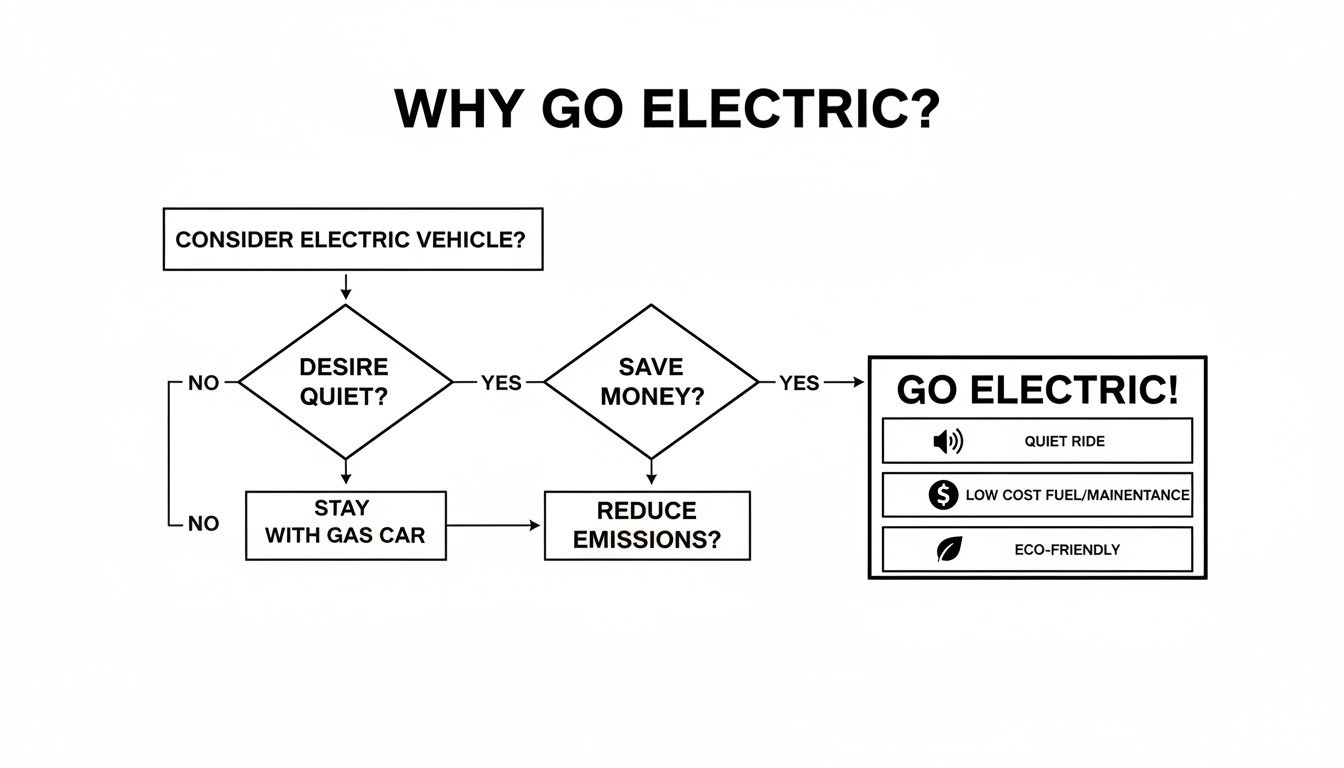
As you can see, a quiet ride, zero emissions, and lower running costs are huge draws. Now, let’s see how those advantages play out across the different types of carts.
Recreational Carts: The Classic Choice for the Course and Community
When you picture a "golf cart," this is probably what comes to mind. These are the classic, no-fuss vehicles you see gliding across manicured fairways and winding through quiet, master-planned communities. Their main purpose is straightforward: move people and their gear smoothly and quietly across predictable, mostly flat terrain.
Most recreational carts top out at around 12-15 mph. They’re built for comfort on short trips and don't come with the heavy-duty safety gear needed for public roads. If your world is contained within a private resort, a sprawling retirement community, or the country club, this is your go-to option.
Street-Legal Carts (LSVs): Your Ticket to Neighborhood Freedom
What if you want to pop over to a neighbor's house, run a quick errand, or head to the community pool without firing up your car? That's where the Street-Legal Cart, officially known as a Low-Speed Vehicle (LSV), comes in. These aren't just beefed-up golf carts; they're a specific class of vehicle that has to meet federal and state safety standards.
To earn that LSV designation, a cart needs to hit speeds between 20 and 25 mph and come from the factory with a full suite of safety features:
- Headlights, taillights, and turn signals
- Brake lights and reflectors
- A proper windshield and rearview mirrors
- Seatbelts for every passenger
This equipment makes them legal for use on public roads with speed limits of 35 mph or less. They perfectly bridge the gap between a recreational toy and a practical daily vehicle, giving you all the convenience without the gas bill.
Here's a pro tip: While you can technically upgrade a standard cart to meet these requirements, it's far easier and safer to buy a model that was built as an LSV from the ground up. Brands like Solana EV design their carts to meet these standards right off the assembly line, so there's no guesswork involved.
Off-Road Carts: Built for the Back 40
When your property is more rugged than refined, you need a cart that can keep up. Off-road electric carts are the 4x4s of the golf cart world, engineered specifically to handle tough, uneven environments. These are built for adventure.
You can spot them by their distinct features:
- Lifted Suspensions: This gives them much higher ground clearance to get over rocks, logs, and ruts without getting hung up.
- Aggressive, All-Terrain Tires: Knobby, deep-tread tires provide serious grip on dirt, mud, and gravel.
- Powerful Motors: They deliver the low-end torque needed to climb steep hills and muscle through tricky spots.
These workhorses are perfect for hunters, farmers, and anyone with a large piece of land to manage. The silent operation of an electric motor is a massive bonus—you can scout for wildlife or check fence lines without the noisy rumble of a gas engine scaring everything away.
Utility Carts: The Quiet Workhorse
Last but not least, we have the utility cart. This one is all about function. Designed as a compact and efficient tool, a utility cart trades passenger seats for pure hauling capability. You'll find them equipped with rugged cargo beds, hydraulic dump beds, or custom racks for tools and equipment.
They are the unsung heroes of resorts, maintenance depots, farms, and event venues. They can haul anything from luggage and landscaping supplies to construction materials, all while offering the quiet, low-maintenance benefits of an electric powertrain. For any job that requires moving stuff, a utility cart is an incredibly practical solution.
To make things even clearer, let's break down the options in a simple chart.
Which Electric Golf Cart Type Is Right for You?
This table offers a straightforward comparison of the main electric golf cart models, highlighting their speed, features, and ideal uses to simplify your choice.
| Cart Type | Typical Max Speed | Key Features | Best For |
|---|---|---|---|
| Recreational | 12-15 mph | Basic comfort features, simple design, open-air feel | Golf courses, private communities, resorts |
| Street-Legal (LSV) | 20-25 mph | Full safety package (lights, seatbelts, windshield) | Neighborhoods, running errands on roads ≤ 35 mph |
| Off-Road | Varies (often 15-25 mph) | Lifted suspension, all-terrain tires, powerful motor | Hunting, farming, large properties, trails |
| Utility | Varies (often 10-20 mph) | Cargo or dump bed, heavy-duty frame, high torque | Maintenance, agriculture, commercial job sites |
Hopefully, this gives you a much better picture of where you might land. By matching your primary needs to one of these categories, you're already well on your way to choosing the perfect electric cart.
The Power Behind Your Ride: Batteries and Motors Explained
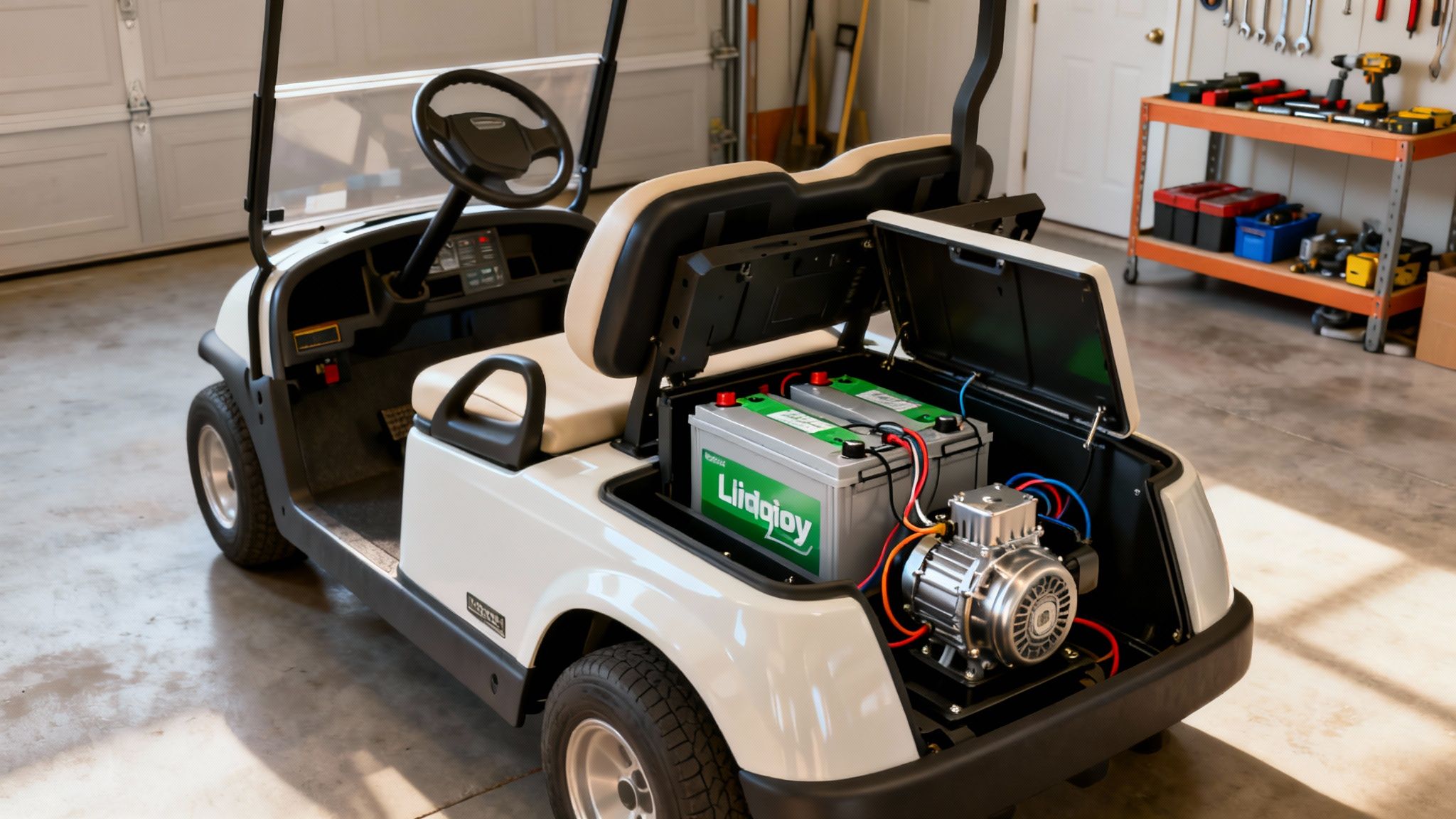
To really understand what an electric golf cart can do, you have to look under the seat. That's where you'll find its heart and soul: the battery and the motor. These two components are the key to its quiet, smooth performance, and they dictate everything from how far you can go to how easily you can climb a steep hill.
Think of it like a gas-powered car. The motor is the engine, and the battery is the fuel tank. One provides the muscle, and the other stores the energy. Getting a handle on how they work together will help you read a spec sheet like a pro and choose a cart that truly fits your needs.
Decoding Your Cart's Battery Specs
Your cart’s battery is its lifeline, and the technology has come a long way. We've moved from clunky, high-maintenance batteries to sleek, modern power packs. You’ll generally run into two main types: the old-school lead-acid and the modern lithium-ion.
Lead-acid batteries were the standard for decades. They’re dependable and cheaper upfront, but they come with trade-offs. They are heavy, need regular upkeep (like topping off water levels), and have a shorter lifespan, usually around 4-6 years.
Lithium-ion batteries are the new gold standard. They're significantly lighter, completely maintenance-free, charge up way faster, and last a whole lot longer—often 8-10 years or more. While they cost more initially, their convenience and longevity make them a worthwhile investment for most owners.
The boom in electric vehicles is directly linked to better batteries. The International Energy Agency noted that demand for automotive lithium-ion batteries jumped by roughly 65% in 2022. That kind of scale helps bring down costs for everyone, making advanced battery tech more accessible for golf cart buyers.
When you’re looking at specs, two numbers matter most:
- Voltage (V): Think of this as the raw power of the system. Higher voltage (48V or 72V) means more torque for climbing hills or hauling heavy loads without bogging down.
- Amp-Hours (Ah): This is your fuel gauge. A higher amp-hour rating means the battery stores more energy, giving you more range before you need to plug in.
From Stored Energy to Forward Motion: The Motor
If the battery is the fuel tank, the motor is the engine. This is the workhorse that takes the battery's electrical energy and turns it into the force that spins the wheels. The motor in an electric golf cart directly affects how quickly it accelerates, its top speed, and its hill-climbing muscle.
You'll find two main motor types in modern carts:
- DC (Direct Current) Motors: The traditional option, known for fantastic low-speed torque. They're great for heavy-duty work and tough terrain but aren't as efficient when you get up to speed.
- AC (Alternating Current) Motors: The more modern and efficient choice. AC motors give you punchier acceleration, higher top speeds, and need less maintenance. They also enable regenerative braking, which sends a little bit of power back to the battery when you slow down, squeezing out a bit more range.
For most people using their cart for neighborhood drives or a round of golf, an AC motor provides a much zippier and more enjoyable ride. You can dive deeper into the technical differences in our guide to high-performance golf cart motors.
Putting It All Together: Performance in the Real World
So, what does all this mean for your daily drive? A high-voltage battery matched with a powerful AC motor will give you that satisfying, instant acceleration and make hills feel like they aren't even there. On the flip side, a lower-voltage system with a basic motor might feel sluggish, especially with a full load of passengers.
It’s also interesting to see how this technology compares to other applications. For instance, exploring the different RV battery types like LiFePO4 vs AGM can give you a broader understanding of the power storage principles at play.
And remember, the advertised range is always just an estimate. How far you actually go on a charge depends on a few real-world variables:
- Terrain: Cruising on flat pavement sips energy. Climbing steep hills or driving on soft ground guzzles it.
- Load: The more weight you're carrying—people, coolers, equipment—the harder the motor works, and the shorter your range.
- Tire Pressure: Just like a car, underinflated tires create drag and force the motor to use more power to move.
- Driving Habits: A lead foot will drain your battery much faster than smooth, steady acceleration.
By understanding these core components, you're not just looking at a price tag anymore. You're seeing the whole picture—the power, the endurance, and the true capability of the machine you're about to buy.
Understanding the Real Cost and Rules of Ownership
The sticker price on an electric golf cart is just the beginning of the story. To get a real sense of your investment, you need to look past the initial purchase and think about the total cost of ownership. This includes everything from the electricity needed to charge it to the local rules you’ll need to follow.
Just as important as the budget is understanding the law. You can't just hop in a cart and drive it anywhere. The rules of the road for these vehicles are specific and change from place to place, so knowing what's allowed before you buy is key to avoiding headaches later on.
Navigating the Rules of the Road
The biggest legal difference you’ll come across is between a standard electric golf cart and a street-legal Low-Speed Vehicle (LSV). Think of it like a bicycle versus a moped—one is designed for private paths, while the other is built and equipped for public roads.
A standard golf cart is usually limited to golf courses, your own property, or designated cart paths in a community. It tops out under 20 mph and doesn't have the safety features required for street use.
An LSV, on the other hand, is an actual vehicle classification under federal law. To earn that title, a cart must:
- Reach a top speed between 20 and 25 mph.
- Come equipped with safety gear like headlights, taillights, turn signals, mirrors, seatbelts, and a proper windshield.
- Have its own unique Vehicle Identification Number (VIN), just like a car.
These upgrades mean it can be legally driven on most public roads where the speed limit is 35 mph or less. But always, always check your local city and state rules, because some communities have their own specific regulations.
Here's the bottom line: if you plan on running errands, visiting a neighbor, or driving on any public street, you need an LSV. Buying a model that’s factory-built to meet these standards, like the ones from Solana EV, is the surest way to be compliant and safe right from the start.
Calculating the Total Cost of Ownership
Once you know which type of cart fits your life, it’s time to look at the long-term costs. The great news? Owning an electric golf cart is incredibly light on the wallet compared to a gas-powered car, but there are still a few things to plan for. Having a clear picture of these expenses helps you budget smartly.
For a deep dive into the numbers, check out our guide on the full cost of an electric golf cart.
These ongoing costs fall into a few simple categories.
Ongoing Running and Maintenance Costs
Keeping your electric cart running smoothly is generally straightforward and affordable. Knowing what to expect means no surprises down the road.
- Electricity: This is your fuel, and it's cheap. Charging your cart will likely only add a few dollars to your monthly utility bill, depending on how much you drive and what your local electricity rates are.
- Battery Replacement: This is the single biggest long-term expense. Modern lithium-ion batteries are built to last, often for 8-10 years, but they will eventually need to be replaced. It's smart to plan for this cost over the life of the cart.
- Routine Maintenance: We're talking about simple things like checking tire pressure, inspecting the brakes, and keeping battery terminals clean. Electric carts have far fewer moving parts than gas models, but a little regular attention goes a long way in keeping it running perfectly.
- Insurance: If you own a street-legal LSV, you’ll most likely need to insure it, just like a car. The rates are usually very affordable, but it's a recurring cost you need to factor in.
By thinking about these real-world running costs and the local rules, you get the full picture of what it means to own an electric golf cart. It puts you in the driver's seat to make a great investment that will bring you years of fun and convenience.
Your Smart Buyer's Checklist for Electric Golf Carts

Alright, you’ve explored the different kinds of electric carts and have a good handle on the tech that makes them go. Now for the fun part: picking the one you’ll take home.
This isn’t just a list of tips; it's your game plan for walking into a dealership with confidence. Think of it as a guide to moving from a casual browser to an educated buyer who knows exactly what they’re looking for and how to get a fair deal.
We'll walk through everything from seating capacity to the critical decision between a shiny new model and a budget-friendly used one.
Define Your Core Needs First
Before you even start looking at pictures online, take a moment to figure out what you actually need. Seriously, skipping this step is the number one reason people end up with a cart that doesn't quite fit their lifestyle. A little thinking now saves a lot of buyer's remorse later.
Start by answering a few basic questions:
- How many seats do you really need? A 2-seater is great for you and a partner. But if you plan on taking the kids to the pool or cruising with another couple, a 4 or 6-seater is non-negotiable.
- Where are you going to drive it? If you're sticking to the smooth, paved roads of a planned community, just about any standard cart will do. But if your property has dirt trails or you plan on venturing off the beaten path, you’ll want to look for something with higher ground clearance and beefier tires.
- What's your realistic budget? Figure out a price range that covers more than just the sticker price. You need to account for taxes, any dealer fees, and the must-have accessories you'll want from day one.
Getting clear on these points will instantly narrow your search, letting you focus only on the carts that are a real possibility.
New vs. Used: Which Is the Smarter Move?
This is one of the biggest forks in the road. Do you go for a brand-new cart with that new-car smell, or do you save some cash with a pre-owned model? Both have their pros and cons, and the right choice really boils down to your budget and how much risk you're willing to take on.
A new cart gives you the latest tech, a full manufacturer's warranty, and that sweet peace of mind that comes from being the first and only owner. You’re getting fresh batteries and brand-new components, which means peak performance right out of the gate. Brands like Solana EV, for example, offer street-legal models straight from the factory, ready to roll.
A used cart can definitely save you a good chunk of money upfront. The catch? You have to do your homework. The single biggest wild card is the battery pack. Older lead-acid batteries might be on their last legs, and replacing them can cost a few thousand dollars.
When you're looking at a used cart, always mentally add the potential cost of a new set of batteries to the price. A great deal on the cart can sour quickly if you're hit with a huge replacement bill in the first year.
The All-Important Test Drive and Inspection
You wouldn't buy a car without taking it for a spin, right? The same logic absolutely applies here. The test drive is your chance to see how the cart actually performs—to feel it for yourself, beyond the spec sheet.
As you're driving, pay attention to these things:
- Acceleration: Does it take off smoothly, or is it jerky and slow to respond?
- Braking: The brakes should feel solid and stop the cart evenly without pulling to one side.
- Steering: Is there a lot of slop or "play" in the steering wheel? It should feel tight and responsive.
- Suspension: Try to find a few bumps. Does the cart handle them well, or does it feel like every little crack in the pavement is rattling your teeth?
- Weird Noises: Listen for any grinding, squeaking, or whining sounds. Those are often signs of a problem.
Once you’re done driving, give it a good look-over. Check the frame for rust, inspect the tires for wear, and pop open the battery compartment. If you see corrosion or leaks—especially with lead-acid batteries—that's a major red flag.
Essential Questions to Ask the Dealer
Whether you're at a big dealership or buying from a private seller, you need to ask the right questions. A good seller will have nothing to hide and will be happy to answer. This is a big purchase, so don't be shy.
Here’s what you need to ask:
- What does the warranty cover? On a new cart, get the details: what’s covered and for how long? For a used one, ask if they offer any kind of short-term or limited warranty.
- How old are the batteries? This is the most important question for any used electric cart. If they don't know, be cautious.
- Do you have the service records? A well-cared-for cart usually comes with a paper trail.
- Are there any hidden fees? Ask for the "out-the-door" price in writing so there are no surprises.
- What about service and parts down the road? It’s a huge plus to know you can get your cart serviced locally.
Follow this checklist, and you'll be armed with the knowledge to make a great decision. You'll drive away in a cart that’s perfect for you, ready for years of enjoyment.
The Bigger Picture: Global Trends in Electric Carts
When you choose an electric golf cart, you’re doing more than just picking a convenient way to get around. You're tapping into a massive global shift in how we think about personal transportation. From sprawling master-planned communities in Florida to eco-conscious resorts in Asia, the demand for quiet, clean personal vehicles is exploding.
This isn’t happening by accident. It's a direct response to a worldwide push for smarter, more sustainable living.
A few key factors are driving this growth. First off, the rise of large-scale residential communities with their own internal road networks has created the perfect environment for these carts to thrive. Residents need an easy, low-cost way to get to the pool, visit neighbors, or pop over to the community clubhouse without firing up a car. An electric cart is the perfect tool for the job.
At the same time, a broader societal shift toward green transportation has given the humble golf cart a serious glow-up. Once seen as something just for the links, it’s now a legitimate form of local, zero-emission transport.
Market Momentum and Long-Term Value
This isn't just a fleeting trend; it's backed by serious market growth, which means your investment holds its value over the long haul. North America and the Asia-Pacific regions are leading the charge, making them the largest and fastest-growing markets for electric carts. This boom is helped along by an ever-improving EV infrastructure that makes charging easier and more accessible than ever.
By getting an electric cart, you're not just buying a fun vehicle. You're joining a global movement toward cleaner, quieter, and more efficient mobility that's reshaping how we live in our communities.
The numbers don't lie. Recent golf cart market analyses show the global market was valued at USD 1.127 billion and is projected to grow at a healthy 6.1% each year through 2034.
North America is a huge piece of that pie, accounting for about 38.6% of the total global revenue. This strong market performance confirms that an electric golf cart isn't just a purchase—it's a smart, future-proof choice.
Got Questions? We've Got Answers
Even after digging into all the details, you probably still have a few questions rolling around in your head. That's completely normal. Let’s tackle some of the most common ones we hear from people just like you, so you can move forward feeling confident about your choice.
How Long Do Electric Golf Cart Batteries Really Last?
This is a big one, and the answer comes down to the battery type you choose. Your classic lead-acid batteries will give you a solid 4-6 years of service, as long as you keep up with their maintenance. Think of it like a classic car—a little TLC goes a long way. You'll need to check the water levels and make sure the terminals are clean.
On the other hand, the newer lithium-ion batteries are pretty much set-it-and-forget-it. They typically last 8-10 years (sometimes even longer) with virtually no maintenance. They cost more upfront, but many people find the hassle-free ownership and longer lifespan well worth the investment.
What’s a Realistic Driving Range on a Full Charge?
For most standard electric golf carts, you can realistically expect to get between 25 and 40 miles from a single charge. But that number isn't set in stone; it's heavily influenced by how and where you drive.
Your actual range can take a hit from things like:
- Tackling steep hills or driving on soft surfaces like grass and gravel.
- Loading up the cart with passengers or heavy gear.
- Driving on underinflated tires (this creates a surprising amount of drag!).
- A lead foot—lots of hard accelerating and stopping will drain the battery faster.
Some carts with upgraded, high-capacity lithium packs can push past 50 miles. It’s smart to treat any advertised range as a "best-case scenario" and then think about your own daily routes.
Pro Tip: Want to squeeze every last bit of juice out of your battery? Drive smoothly and keep your tires properly inflated. These simple habits can add a noticeable amount of mileage to each charge.
Can I Make My Regular Golf Cart Street Legal?
In many cases, yes, but it’s not as simple as flipping a switch. Turning a standard golf cart into a street-legal Low-Speed Vehicle (LSV) means you’ll have to install a whole list of safety features.
You're typically looking at adding headlights, taillights, turn signals, mirrors, a DOT-approved windshield, and seatbelts. The cart also has to be able to hit and hold a speed between 20-25 mph. Once it's decked out, it will need an inspection before it can be titled and registered.
It's super important to check your local and state laws, though, because the rules can vary a lot from one place to the next. Honestly, the smoothest route is often just buying a cart that was built to be an LSV right from the factory.
Is It Expensive to Charge an Electric Golf Cart?
Not even close. When you compare it to the cost of a tank of gas, charging an electric golf cart is a bargain. The exact cost will depend on what you pay for electricity, but for most people, it only adds a couple of bucks to the monthly power bill. This makes it one of the most economical ways to get around your neighborhood or community.
Ready to experience the perfect blend of style, performance, and eco-friendly technology? Explore the full lineup of premium, street-legal electric vehicles from Solana EV and find the model that fits your life. Visit us at https://solanaev.com to learn more.