
It's impossible to ignore Denago these days. In a market long dominated by a few big names, they've stormed onto the scene and quickly carved out a serious reputation. How? By offering what many buyers have been asking for: modern looks, street-legal readiness, and standard lithium batteries, all without a sky-high price tag. This approach puts them squarely in competition with established brands, making them a really compelling choice for folks in gated communities and resorts.
What to Know About Denago Golf Carts
Denago didn't just stumble into the electric vehicle space. They arrived with a clear goal: to package premium features into a cart that's actually affordable. While legacy brands often make you pay extra for modern essentials, Denago builds its carts for the modern user from the get-go. This thinking is exactly why they've gained so much ground so quickly.
When you boil it down, Denago's appeal rests on three core pillars that resonate with both personal and commercial buyers.
- Standard Lithium Batteries: Every single Denago cart rolls out with a lithium battery. That means more range, quicker charging, and a much longer lifespan compared to the old-school lead-acid batteries you still find elsewhere.
- Street-Legal (LSV) Compliance: Most of their lineup is ready for the road. They're built to meet Low-Speed Vehicle (LSV) standards with essentials like headlights, taillights, turn signals, and seatbelts, so you can legally drive them on many public streets.
- Modern Design and Aesthetics: Let's be honest, looks matter. With sleek lines and automotive-style finishes, these carts are designed to turn heads. They appeal to buyers who want a vehicle that performs well and looks great doing it.
A New Contender in a Growing Market
Denago’s timing couldn't be better. They've planted their flag in the fastest-growing part of the global golf cart market, which is on track to hit $3.5 billion by 2033. The market's explosive growth is fueled by the very things Denago focuses on: electric power and street-legal personal use. It’s no surprise that industry reports now list Denago alongside the legacy players as a key manufacturer, which says a lot about how effective their strategy has been. You can explore more details on the golf cart market growth in recent analyses.
Denago isn't just trying to be the cheapest cart on the block. Their strategy is all about capturing the lifestyle-oriented buyer by competing on modern tech, standard features, and slick design.
Here’s a quick look at how Denago's identity stacks up against a more specialized brand like Solana EV, which often aims for the premium or heavy-duty commercial crowd.
| Feature | Denago Value Proposition | Typical Solana EV Focus |
|---|---|---|
| Battery Tech | Standard Lithium Across All Models | Premium, High-Capacity Lithium Packs |
| Market Position | Value-Driven Premium Features | Specialized, High-Performance Builds |
| Primary Target | Gated Communities, Personal Use | Resorts, Commercial Fleets, Off-Road |
| Design Focus | Modern, Automotive-Inspired Style | Purpose-Built for Durability & Use-Case |
Understanding this difference is key. It explains why any good Denago golf cart review will highlight that perfect balance of features and cost. They've created an attractive option for homeowners and property managers who need versatile, eco-friendly transport without breaking the bank.
Denago Carts vs. Solana EV: A Head-to-Head Comparison
When you're shopping for a golf cart, it’s easy to get lost in spec sheets. The real question is: which cart is genuinely right for you? Comparing Denago to the Solana EV lineup isn't about finding a single "best" option; it’s about understanding two completely different design philosophies. Denago has mastered the art of building a fantastic, high-value cart for everyday life, while Solana EV focuses on engineering purpose-built machines for more specialized, demanding work.
This is where a proper Denago golf cart review has to dig deeper. We’re going to break down the real-world differences in their motors, batteries, and overall construction. Think of it less as a competition and more as a guide to matching the right tool to the right job.
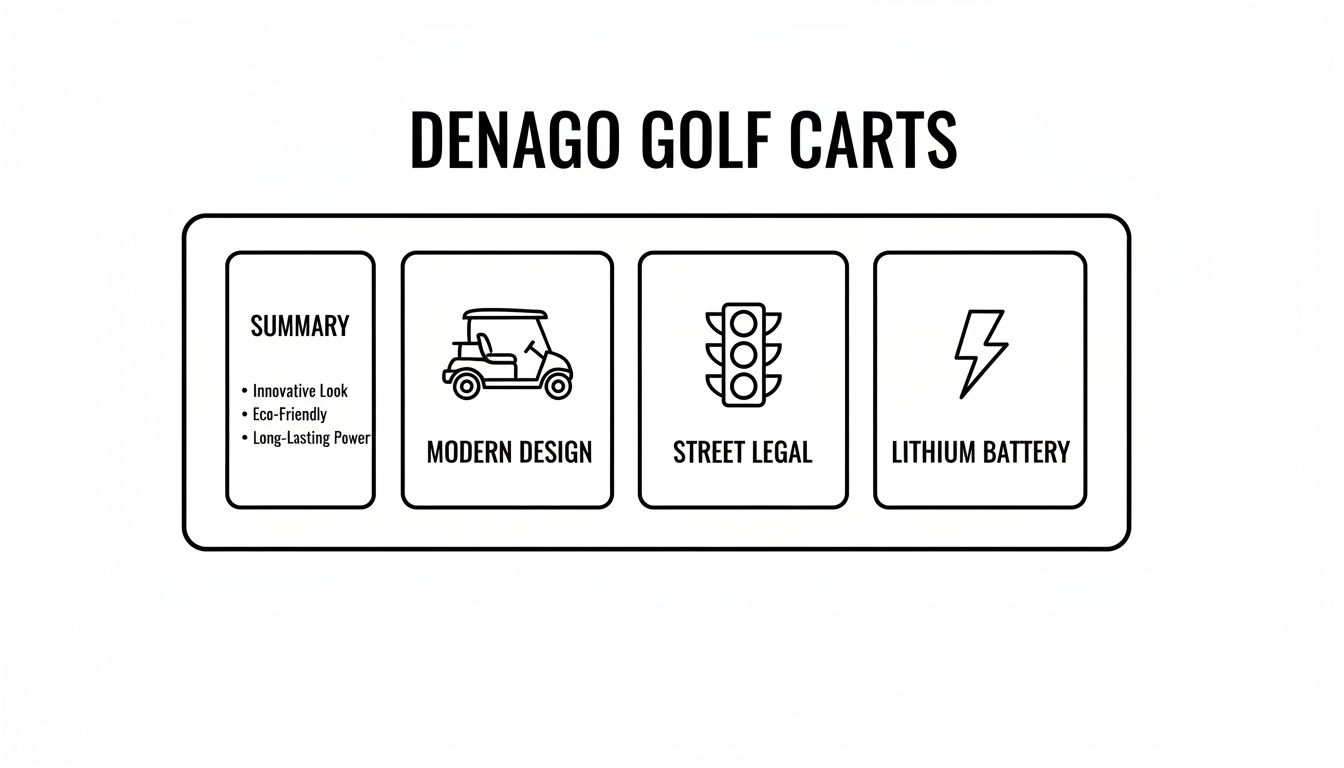
As you can see, Denago's appeal is built on three pillars: fresh, modern looks, standard lithium power, and street-legal readiness right out of the box. This combination makes them an incredibly compelling choice for personal transportation in planned communities where style and convenience matter.
Powertrain and On-Road Performance
The heart of any electric cart is its powertrain—the motor and controller. Denago carts typically run on a dependable AC motor, usually around 5 kW. This setup gives you plenty of juice for cruising neighborhood streets and tackling moderate hills. For the average resident of a gated community making daily trips, the acceleration is smooth, and the operation is whisper-quiet. It's exactly what you need.
Solana EV, however, tends to engineer its powertrains for tougher assignments. Take the Solana XA, for example. It's equipped with a high-torque motor and a controller fine-tuned for sharp, responsive handling across mixed terrain. You feel the difference immediately when you point it up a steep resort path or accelerate with four passengers and gear. The Denago will get the job done just fine, but the Solana XA does it with more authority and feels less strained.
This distinction is mission-critical for commercial buyers. A resort manager can't afford carts that lose steam halfway through the day. They need machines that can handle constant, heavy use without a drop in performance, and that's precisely the problem Solana EV's heavy-duty component philosophy is designed to solve.
Battery Technology and Real-World Range
Both brands have smartly embraced lithium-ion batteries, leaving old-school lead-acid technology behind. For the owner, this means a much longer battery life, quicker charging, and consistent power from full to empty. But how they apply this technology is where they diverge.
Denago makes a powerful statement by including a quality lithium battery pack as standard equipment across its lineup, including the popular Nomad and Rover models. This is a huge win for the buyer, saving them from an expensive, must-have upgrade right off the bat. For a typical owner, this battery delivers more than enough range for a full day of errands and joyrides.
While both brands use lithium, Solana EV’s battery systems are often engineered for higher capacity and endurance. They're designed to meet the rigorous demands of commercial fleets and off-road applications where downtime is not an option.
Models like the Solana G and Campus E are often fitted with premium, high-capacity lithium packs built for the long haul. These aren't just off-the-shelf batteries; they are engineered for maximum energy density and durability under intense, daily use cycles. A property manager overseeing a sprawling corporate campus needs carts that run from sunrise to sunset without a mid-day charge. That's where Solana EV's investment in top-tier battery engineering really shines.
To see how different models stack up, our comprehensive golf carts review offers more detailed performance data and comparisons.
Build Quality and Frame Durability
A cart’s lifespan comes down to its bones—the frame, the welds, and the suspension. Denago carts are built on solid frames designed for comfort and reliability in typical residential settings. They provide a smooth, pleasant ride on paved streets, perfectly matching the environment they were made for.
Get them off the beaten path, though, and the structural differences start to show.
- Solana XA and Solana F: These models are built with durability as a top priority. The Solana F, a true utility player, has a reinforced frame and beefy components ready for light off-road work or hauling supplies. The XA, on the other hand, boasts a specialized suspension that delivers incredible stability and comfort on rough, uneven ground.
- Denago Models: While very well-made, a standard Denago isn’t primarily designed for that kind of abuse. Its suspension is tuned for pavement, and its frame is optimized for passenger comfort, not rugged utility.
This is a make-or-break consideration for many buyers. If your property has gravel paths, unpaved trails, or steep hills, a purpose-built model like the Solana F or XA is a smarter, more durable investment. But for cruising the smooth roads of a planned community, a Denago offers a fantastic blend of comfort and value.
Standard Safety and Street-Legal Features
Both Denago and Solana EV take safety seriously, especially with their street-legal LSV models. To earn that classification, carts need a specific suite of safety equipment, and both brands deliver the essentials. Here's a quick look at how their standard features compare.
Denago vs. Solana EV Feature Matrix
This table breaks down the key specifications and features, showing where each brand focuses its efforts. While Denago provides an excellent, well-rounded package for personal use, Solana EV often adds specialized, heavy-duty components for commercial and off-road scenarios.
| Feature | Denago Model (Typical) | Solana XA | Solana F | Solana G | Solana Campus E |
|---|---|---|---|---|---|
| Motor Type | 5 kW AC Motor | High-Torque AC or DC Motor | Utility-Tuned AC Motor | High-Efficiency AC Motor | Commercial-Duty AC Motor |
| Battery System | Standard Lithium-Ion | High-Capacity Lithium (Optional) | Standard/High-Capacity Lithium | Premium High-Capacity Lithium | Fleet-Grade High-Capacity Lithium |
| Top Speed | Up to 25 MPH (LSV Compliant) | Up to 25 MPH | Up to 25 MPH | Up to 25 MPH | Up to 25 MPH |
| Brakes | 4-Wheel Hydraulic Disc | 4-Wheel Hydraulic Disc w/ Optional Regen | Heavy-Duty 4-Wheel Hydraulic Disc | 4-Wheel Hydraulic Disc | Regenerative & Hydraulic Braking |
| Suspension | Independent Front / Solid Rear Axle | Independent Long-Travel Suspension | Heavy-Duty Leaf Spring / Independent Front | Comfort-Tuned Independent Suspension | Commercial-Grade Independent Suspension |
| Frame | Powder-Coated Steel | Reinforced Off-Road Steel Frame | Reinforced Steel Utility Frame | Automotive-Grade Steel Frame | Heavy-Duty Steel Frame |
| Street-Legal Kit | Standard | Standard | Standard | Standard | Standard |
The key takeaway isn't just what's included, but the robustness of the components. Solana EV models, especially commercial ones like the Campus E, may offer automotive-grade safety glass or more advanced regenerative braking systems that boost both safety and efficiency. Denago, meanwhile, provides a complete, compliant, and perfectly executed package for the personal market, making it a safe and fantastic choice for getting the family around town. The decision comes down to whether you need a great standard safety system or one that's specialized for more demanding work.
Analyzing Real-World Performance and Build Quality
A spec sheet only tells you half the story. The real test is how a golf cart feels cresting a hill or how its frame handles a bumpy path, day in and day out. This is where you separate the good from the great, and when doing any serious Denago golf cart review, you have to look past the numbers to see how they hold up in the wild.
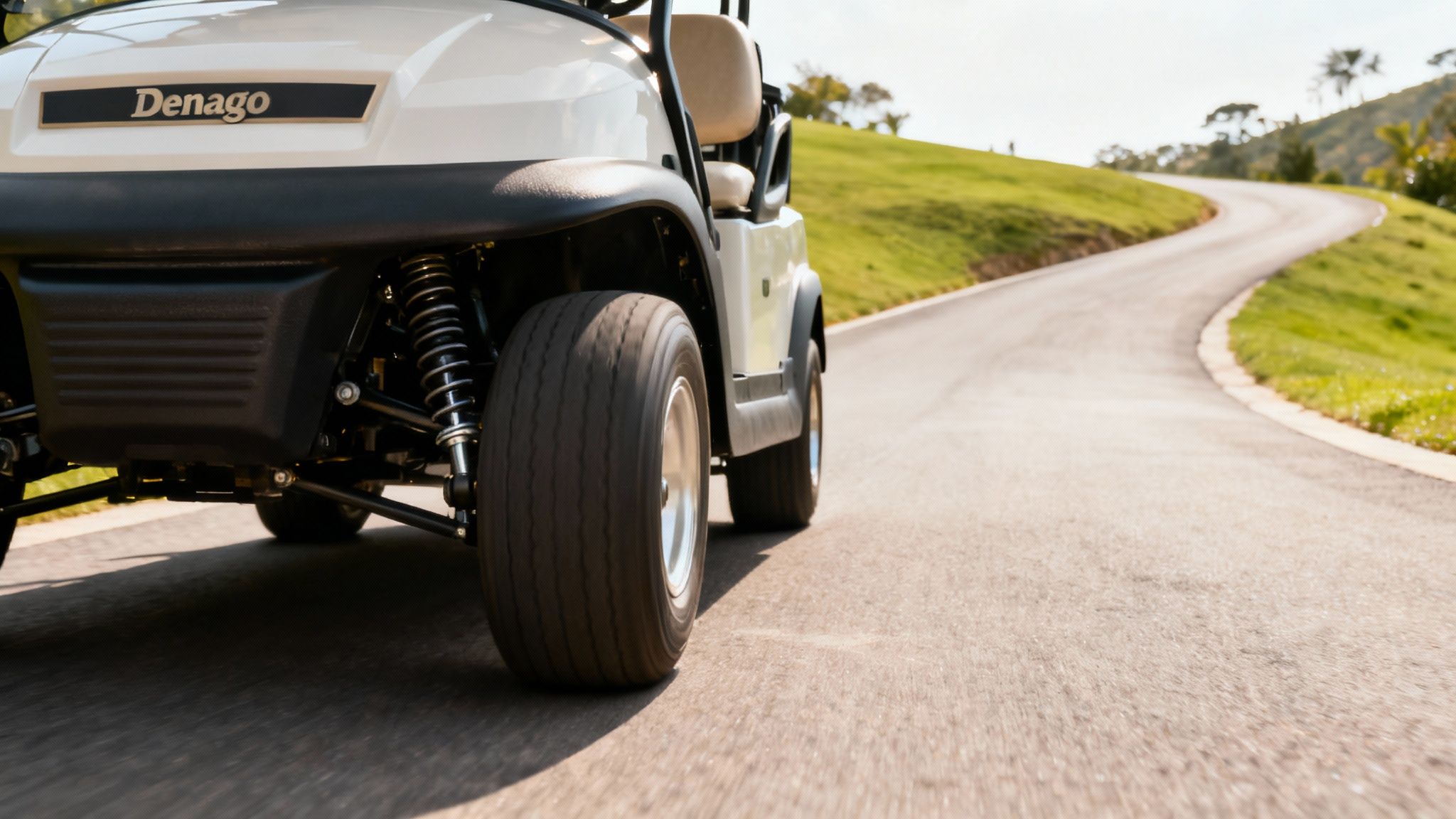
On pavement, Denago carts are a dream. The ride is smooth, and the acceleration is brisk but predictable—perfect for navigating neighborhood traffic with confidence. The handling is light and easy, exactly what you want for the low-speed, stop-and-go driving you do in a planned community.
The Solana EV lineup, however, is clearly engineered for more demanding situations. Take the Solana XA, for example. It has a purpose-built suspension designed from the ground up for mixed terrain. On a winding resort path with uneven ground, the XA feels completely planted, soaking up bumps that would unsettle a lesser cart. This really gets to the heart of their different design philosophies.
Deconstructing Build Quality and Durability
Build quality isn't just about a nice paint job. It's about the integrity of the frame, the quality of the welds, and the toughness of every nut and bolt. Denago uses solid, powder-coated steel frames that provide excellent longevity for their intended use. For their price point, the fit and finish are impressive, giving you a sense of quality that resonates with home and family users.
Solana EV models often take a more heavy-duty approach. Their frames are typically reinforced to handle the grind of commercial work or light off-roading. You'll see stronger welds and more robust suspension components that are built for a longer service life under constant, heavy loads.
The key takeaway isn't that one cart is "built better" than the other. It's that each is built for a specific job. A Denago is perfectly constructed for zipping the family to the pool, while a Solana F is engineered to haul gear across a large property without breaking a sweat.
This is why their manufacturing strategies are so important. Denago’s recent move toward U.S. assembly, highlighted by a new $60 million chassis factory in Texas, is a massive commitment to quality control. This focus on domestic production is a huge plus for commercial buyers who can't afford downtime and need consistent lead times. For more on this trend, you can find in-depth market analysis on GMInsights.com.
The Impact of Manufacturing on Longevity
Denago's big bet on U.S. manufacturing has been a key reason for its rapid growth. This strategy helps them manage quality while tapping into the growing demand for domestically assembled EVs. I've seen discussions on dealer forums noting just how aggressively Denago has entered the retail LSV market, quickly becoming a major player.
This manufacturing choice directly affects your experience as an owner. Tighter quality control means fewer headaches and a more reliable vehicle over its lifespan. While Solana EV relies on production standards refined over many years, Denago’s new facilities represent a very modern way to scale up without sacrificing quality. To see how this plays out in a head-to-head matchup, our complete guide to Denago golf carts reviews provides more detailed comparisons.
Ultimately, the real-world performance for both brands is impressive, but for different reasons.
- Denago: Shines in providing a comfortable, reliable, and smooth ride for personal use in structured settings like neighborhoods and communities.
- Solana EV: Built for higher-stress jobs, offering enhanced durability, better handling on varied terrain, and components designed for commercial-grade longevity.
The right choice comes down to what your daily life looks like. For smooth sailing on asphalt, Denago offers a fantastic experience. But if your daily route involves rougher terrain or heavy loads, the specialized build of a Solana EV model gives you the performance and peace of mind you can count on.
Matching the Right Cart to Your Needs
Choosing the right golf cart isn't about picking the "best" one on paper—it's about finding the vehicle that genuinely fits your world. Whether you're running a five-star resort, cruising through a quiet gated community, or managing a commercial fleet, what you need from a cart changes dramatically. This is where a proper Denago golf cart review has to go beyond a simple spec sheet and get into real-world scenarios.
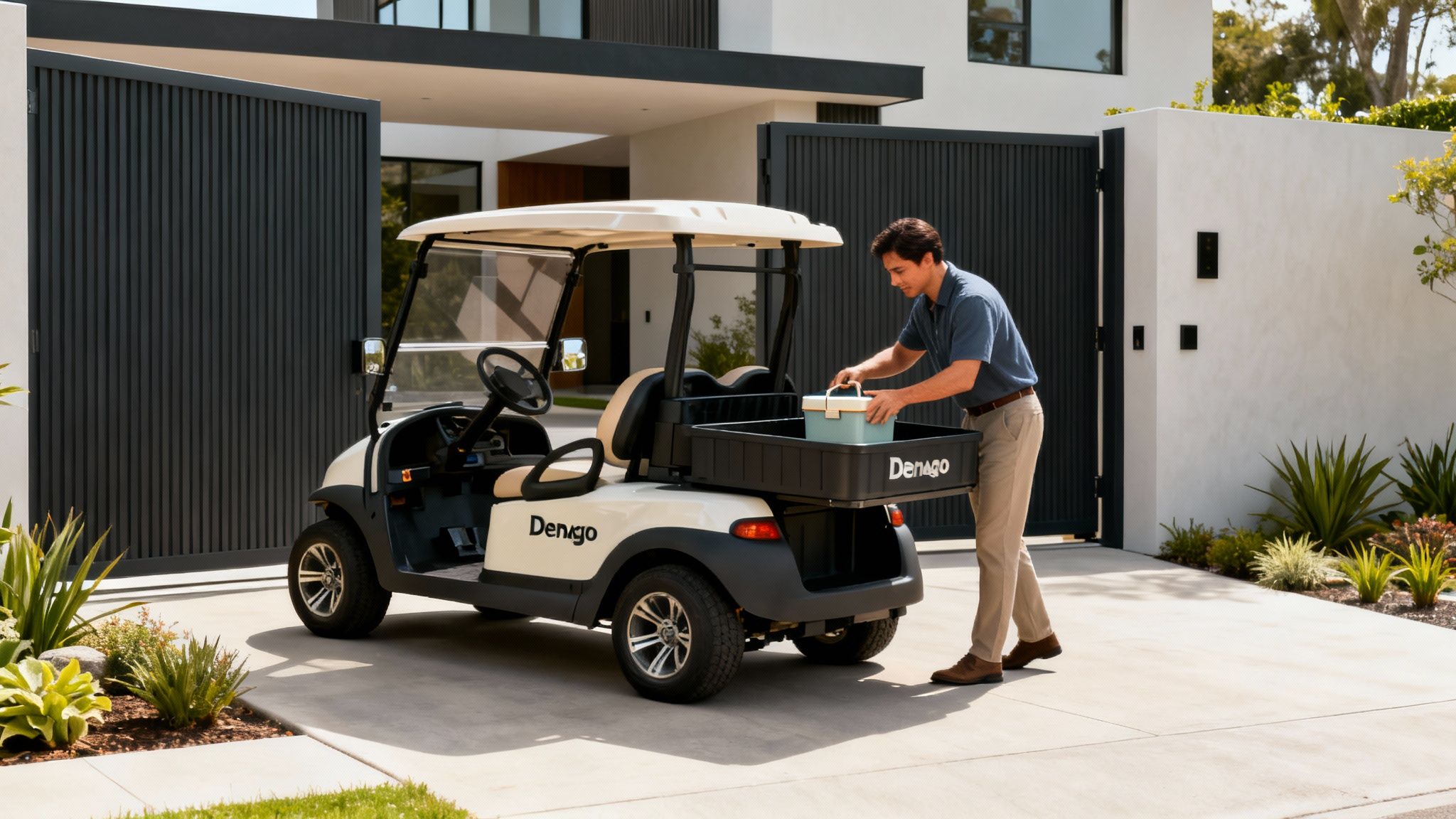
Let's break down which Denago and Solana EV models make the most sense for different people and professions.
For the Gated Community Resident
Life inside a planned community is all about ease and comfort. Your daily trips are usually short jaunts to the pool, tennis court, or a friend's house, almost always on smooth, paved roads. Here, style, reliability, and simplicity are king.
For this kind of use, a Denago Nomad or Rover model is almost always the perfect fit. These carts were practically built for this exact environment. They offer a comfortable ride, have a modern, car-like look, and come standard with all the street-legal features you need for neighborhood driving. Plus, the standard lithium battery has more than enough juice for a full day of errands and fun without a second thought.
A Solana EV model like the Solana G would certainly be a luxurious step up, but for most homeowners who just want a great-looking, practical cart for daily use, a Denago hits that sweet spot of features and value that's tough to argue with.
For the Resort Property Manager
A resort manager’s checklist is completely different. The priority shifts from personal convenience to guest satisfaction, operational uptime, and sheer durability. Carts need to be comfortable, safe, and ready to run all day, every day, across everything from pristine walkways to hilly service roads.
This is where the purpose-built engineering of the Solana EV lineup really shines and shows its advantage.
- Solana G: This is your go-to for upscale guest transportation. It delivers a premium ride quality and refined look that reflects well on the resort's brand.
- Solana XA: For properties with mixed or rugged terrain, the XA is the answer. Its advanced suspension keeps the ride smooth and stable for guests, even when the path is anything but.
- Solana F: Think of this as the workhorse for your maintenance and groundskeeping crews. It’s built with a reinforced frame to haul tools, supplies, and stand up to constant, heavy use.
While a Denago fleet could certainly work for a smaller resort, Solana EV’s models are engineered from the ground up to handle the relentless grind of a commercial hospitality setting. They promise less downtime and a better overall experience for your guests.
For the Commercial Fleet Operator
If you're managing a fleet for a corporate campus or logistics facility, your main goal is simple: maximize productivity. That means you need vehicles that are dead reliable, low-maintenance, and built for a very specific, demanding job.
This is exactly what the Solana Campus E was designed for. It’s a fleet-duty vehicle through and through, featuring a heavy-duty frame, a commercial-grade powertrain, and a high-capacity battery system built for continuous operation. Every part was chosen for longevity to keep maintenance costs down and the carts on the job.
It's worth noting that Denago's focus on multi-passenger, street-legal carts is incredibly smart. Globally, 4-seater and larger models now make up over half of all demand, with North America leading the charge. This boom is fueled by communities and businesses, not just golf courses. Denago’s modern batteries and neighborhood-ready designs place it squarely in the middle of this growing market. You can discover more insights on these market trends at Grand View Research.
At the end of the day, Denago provides fantastic, versatile options that are perfect for personal use. But for the mission-critical tasks faced by commercial and resort operators, Solana EV’s specialized lineup offers the tailored, heavy-duty solutions they truly need.
Looking at Price and Long-Term Value
When you're making a smart investment, the sticker price is just the beginning. To really compare Denago and Solana EV, you have to look at the total cost of ownership (TCO). This bigger picture includes everything from upkeep and battery lifespan to the real-world value of having strong dealer support. It’s the only way to get a true financial picture and see what you're really getting for your money over the long haul.
Denago's pricing is a huge part of its appeal. Models like the Nomad and Rover typically land somewhere in the $8,000 to $12,000 range. What's impressive is that this price often includes features like lithium batteries and street-legal kits—things that are usually pricey add-ons with other manufacturers. This makes a Denago an incredibly attractive option right out of the gate, especially for homeowners and personal users.
But the true cost of any vehicle only shows up after a few years of driving it around. This is where a more specialized brand like Solana EV starts to pull ahead, particularly for businesses or anyone planning to put their cart through its paces day in and day out.
Calculating the Total Cost of Ownership
To figure out the real financial commitment, you need to think about a few key things that go way beyond the initial purchase price. These are the factors that will affect your wallet for years to come.
-
Battery Longevity: Both brands use modern lithium batteries, but there's lithium, and then there's lithium. Solana EV uses premium, high-capacity battery packs specifically engineered to handle more charge cycles under demanding commercial use. This can significantly extend their lifespan, pushing a very expensive battery replacement further down the road.
-
Maintenance and Repairs: A Denago is built well for personal use, no question. But Solana EV models, like the Campus E, are put together with commercial-grade components designed to take a beating. For a business, this can mean fewer breakdowns and less time in the shop, which translates directly into saving money.
-
Warranty and Support: Think of a good warranty as your financial safety net. Solana EV invests heavily in comprehensive dealer training and a dedicated support network. This means their technicians are experts who can diagnose issues quickly and make efficient repairs, which can drastically cut long-term maintenance bills.
For a resort or a large campus, uptime is money. A golf cart that's out of commission isn't just an inconvenience—it's lost revenue. Solana EV's focus on heavy-duty parts and expert dealer support is all about maximizing that uptime, which offers a serious financial advantage over time.
Breaking Down the Value Proposition
Let's lay this all out in a simple comparison. While specific numbers can change, the core value each brand offers is aimed at a different buyer with different financial priorities.
| Financial Factor | Denago Value Proposition | Solana EV Value Proposition |
|---|---|---|
| Upfront Cost | Very competitive, with premium features often included as standard. | A higher initial investment that reflects its specialized, heavy-duty build. |
| Battery TCO | Great lifespan for typical personal use, delaying replacement costs. | Engineered for maximum longevity in commercial fleets to boost ROI. |
| Maintenance | More affordable parts for standard repairs, perfect for residential use. | Fewer major repairs over its lifetime due to commercial-grade quality. |
| Dealer Support | A growing network that provides necessary service and parts. | An expert, factory-trained network that minimizes downtime and repair bills. |
Ultimately, any Denago golf cart review will highlight its immediate and powerful value for the average person. You get a modern cart loaded with features for a fantastic price. If you want to dig deeper into the numbers, understanding the cost of electric golf carts can give you more context.
Solana EV is playing the long game. Its value proposition is tailored for commercial buyers who know that paying more upfront for durability, reliability, and top-tier support often results in a lower total cost over the vehicle's entire service life.
The Final Word: Which Cart Is Right for You?
So, who wins in a head-to-head matchup? The truth is, there’s no single champion here. Denago and Solana EV aren't really fighting for the same trophy; they’re competing in entirely different events. The right choice simply comes down to what you need your cart to do.
Denago has absolutely nailed the market for modern, planned community living. If your daily routine involves zipping over to the clubhouse, taking the kids to the pool, or just cruising around the neighborhood on paved streets, a Denago is a fantastic option. They’ve packed a ton of style, comfort, and premium features—like a standard lithium battery—into a package that delivers serious value. It’s the perfect street-legal cart for family fun and personal use.
Solana EV, on the other hand, builds specialized workhorses for tough, commercial jobs. If you're managing a resort and need a fleet of high-end shuttles like the Solana G or XA to impress guests, their engineering is built for that kind of reliability. Likewise, a commercial operator who can’t afford downtime will see the rugged build of the Solana Campus E as a smart, long-term investment.
The bottom line is this: it all boils down to your primary use case. If you're a homeowner looking for a stylish, dependable, and budget-friendly ride for life in your community, the Denago is a smart, compelling buy.
But if you’re up against rougher terrain or the constant grind of a commercial operation, you need the purpose-built durability that a Solana EV provides. It's an investment in robust performance and the peace of mind that comes with it.
Got Questions? We've Got Answers.
Making a big purchase like a golf cart always brings up a few last-minute questions. Let's tackle some of the most common ones that pop up when you’re comparing Denago with a specialized brand like Solana EV.
Are Denago Carts Street Legal Everywhere?
Not exactly, and this is a crucial point for any brand. Denago builds its carts to meet the federal standards for a Low-Speed Vehicle (LSV). That means they come equipped with the necessary safety gear—lights, turn signals, seatbelts—and are capped at 25 mph.
However, federal compliance is just the first hurdle. Every state, and sometimes even a city or local community, has its own rules for where and how you can drive an LSV on public roads. You absolutely have to check with your local DMV to understand the specific registration, insurance, and road-use laws that apply to you.
What’s the Real Difference in Their Batteries?
Both Denago and Solana EV have moved on from old-school lead-acid batteries, and that’s a good thing. They both use modern lithium-ion technology, which gives you better range, faster charging, and a much longer lifespan.
The key distinction comes down to purpose. Solana EV often engineers its carts with premium, high-capacity lithium packs built for the grind of commercial work or demanding recreational use. Think all-day resort transport or heavy-duty utility tasks. Denago, on the other hand, makes reliable lithium power a standard, high-value feature across its lineup, which is more than enough for typical neighborhood cruising and personal use.
How Does Dealer Support and Warranty Stack Up?
This is where your long-term ownership experience is really defined. Solana EV has built a reputation on its robust dealer program, which emphasizes deep technical training, dedicated support lines, and comprehensive warranties. For a business running a fleet of carts, that focus on minimizing downtime and ensuring reliability is a massive selling point.
Denago is growing its dealer network quickly, but this also means the quality of local support and the specifics of the warranty can vary from one location to the next. The best advice? Talk directly to your local dealers for both brands. Get a feel for their service department and get the warranty details in writing so you know exactly what kind of support you're signing up for.
Ready to see what a purpose-built electric vehicle feels like? Discover the Solana EV lineup and find the perfect model for your resort, community, or commercial needs at https://solanaev.com.