
Trying to decipher golf cart reviews for Germany, Austria, or Switzerland? It's easy to get lost. You can't just compare top speeds or cup holder counts like you might for a cart in Florida. The DACH region has its own set of rules and realities that can make a top-rated cart from elsewhere a terrible choice here.
Why DACH Golf Cart Reviews Are Different
A simple feature-for-feature rundown just doesn't work in the DACH market. The entire buying process is shaped by very specific local factors, so generic advice falls flat.
Think of it like reading a restaurant review. A critic might rave about a chef's creativity, but that's useless information if you have a nut allergy and the review never mentions the ingredients. It’s the same with golf carts. A review that gushes about a cart's high speed is pointless if that very speed makes it illegal for road use in your state or canton.
This guide is about developing ‘review intelligence’—the skill of reading between the lines to see what a review actually means for you, right here.
Key Regional Considerations
Before you even start comparing models, you need to filter every review through the lens of our region’s specific demands. This means looking past the flashy specs and focusing on how the cart will actually perform in your world.
Here are the big factors that set the DACH market apart:
- Strict Regulations: Using a golf cart on public roads is a serious business here. Any review worth its salt must talk about Straßenzulassung (road approval) and whether the vehicle meets local traffic laws.
- Tough, Varied Terrain: Our landscape isn’t all flat, manicured lawns. We have everything from steep alpine roads and historic cobblestone villages to sprawling private estates. A cart’s performance on a perfect golf course says nothing about its ability to climb a Swiss mountain pass.
- Unique Customer Expectations: Buyers here value solid engineering, long-term reliability, and durability above all else. Reviews that obsess over superficial gadgets but ignore build quality or weather resistance just aren't helpful.
A golf cart isn't just a vehicle; it's an investment in mobility. In the DACH region, that means investing in a machine that is legally compliant, tough enough for the environment, and engineered to work flawlessly where you need it most.
This guide will give you a clear roadmap for cutting through the noise. We'll show you how to interpret performance stats, battery life claims, and build quality assessments with a practical, local eye. Once you understand these nuances, you can ignore the generic fluff and focus on what really matters for making a smart purchase.
Navigating The DACH Regulatory Landscape
Reading an American or Asian review for a golf cart you plan to use in Germany, Austria, or Switzerland is a bit like using a boating map to find your way up a mountain. The map might be perfect for its intended purpose, but it’s completely useless—and maybe even dangerous—for yours. This is why the single most important filter when you're digging into DACH golf cart reviews is the intricate web of local regulations.
A vehicle's legal status isn't just another feature; it's the absolute foundation. In the DACH region, the term Straßenzulassung (road approval) is the gatekeeper that decides whether your golf cart is a versatile vehicle or just a very expensive garden decoration. Most reviews from outside Europe won't even mention this, because for their audience, it’s a non-issue. This critical oversight can easily lead an unsuspecting buyer to purchase a vehicle that can never legally leave their own property.
Think of it as the automotive version of a passport. Without the right approvals, your vehicle is grounded, confined to its "home country"—which in this case, is just your driveway.
This summary breaks down the core areas you need to watch when looking at any golf cart for use in the DACH region.
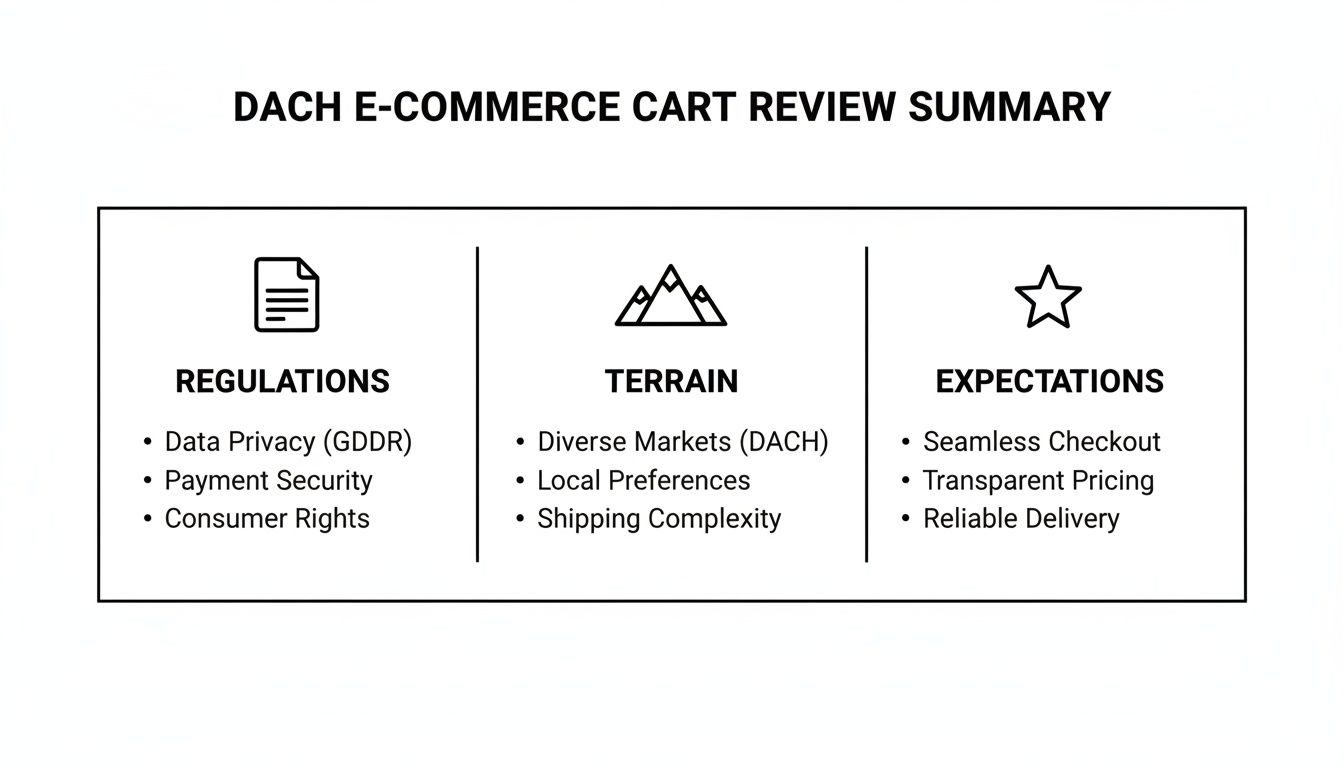
As you can see, the regulations, local terrain, and what you actually expect from the vehicle are the three pillars of a smart buying decision here.
Understanding Straßenzulassung Requirements
Getting Straßenzulassung isn't about ticking a single box. It’s a rigorous process that involves meeting a strict set of technical and safety standards, much like those for a small car. While there are minor differences between Germany, Austria, and Switzerland, the fundamental requirements are consistent and absolutely non-negotiable.
A truly compliant street-legal vehicle must come from the factory with a whole suite of safety features already built-in. Just trying to bolt on a few lights after you buy it won't cut it for legal approval.
Key mandatory features typically include:
- A Proper Lighting System: This means headlights with high and low beams, tail lights, brake lights, and turn signals.
- Mirrors: You'll need both side-view and rearview mirrors to give you a full picture of your surroundings.
- A Horn: A working horn is essential for alerting pedestrians and other drivers.
- A Windshield: This often has to be a certified safety glass windshield, not just a flimsy plastic screen.
- A Vehicle Identification Number (VIN): A legitimate VIN is required for registration and insurance.
If a golf cart is missing these factory-integrated components, you simply won't be able to register it for public roads. This is a crucial detail that generic reviews almost always overlook.
Getting a handle on the legal framework is your first line of defense against making a bad investment. A cart that isn't compliant with local laws is a non-starter, no matter how great its performance or features are.
To make this easier, here's a quick look at how the core requirements compare across the DACH region.
DACH Region Street-Legal Requirements At A Glance
| Requirement | Germany (DE) | Austria (AT) | Switzerland (CH) |
|---|---|---|---|
| Vehicle Class | L6e or L7e | L6e or L7e | Kleinmotorfahrzeug / Leichtmotorfahrzeug |
| Max Speed | Typically 45 km/h for L6e | Typically 45 km/h for L6e | Up to 45 km/h depending on class |
| Lighting | Full system required (headlights, signals, brake) | Full system required | Full system required |
| Mirrors | Side and rearview required | Side and rearview required | Side and rearview required |
| Tires | Road-rated tires mandatory | Road-rated tires mandatory | Road-rated tires mandatory |
| Registration | Yes, with insurance plate (Versicherungskennzeichen) | Yes, requires standard registration | Yes, requires control plate (Kontrollschild) |
This table shows that while the terminology might change, the core safety and registration principles are very similar. Always double-check the specifics for your exact location before making a final decision.
Speed Limits And Vehicle Classifications
Another critical piece of the regulatory puzzle is the vehicle's classification, which is tied directly to its top speed. In Germany, for instance, most street-legal carts fall into the L6e or L7e light electric vehicle categories. These classifications have their own rules, including speed limits that are often capped at 45 km/h.
This is precisely why a review that raves about a cart's "blazing" 70 km/h top speed should be a massive red flag for a DACH buyer. While that speed might be great somewhere else, it could disqualify the vehicle from the more straightforward L-class registration here, bumping it into a much more complicated and expensive category to own and insure.
This isn't just paperwork; it affects everything from insurance costs to the type of driver's license you need. To get into the weeds on this topic, you can check out our detailed guide on street-legal golf cart requirements that breaks down these classifications. The bottom line? Always confirm that the model you're considering was engineered from the ground up to meet the specific speed and class rules in your country. Ignoring this can lead to some serious legal and financial headaches later on.
What To Look For In DACH Golf Cart Reviews
So, you've found a golf cart that meets all the legal requirements for the DACH region. Great. But that's just the first checkpoint. Now the real work begins—sifting through reviews to see how the vehicle actually performs in our unique corner of the world.
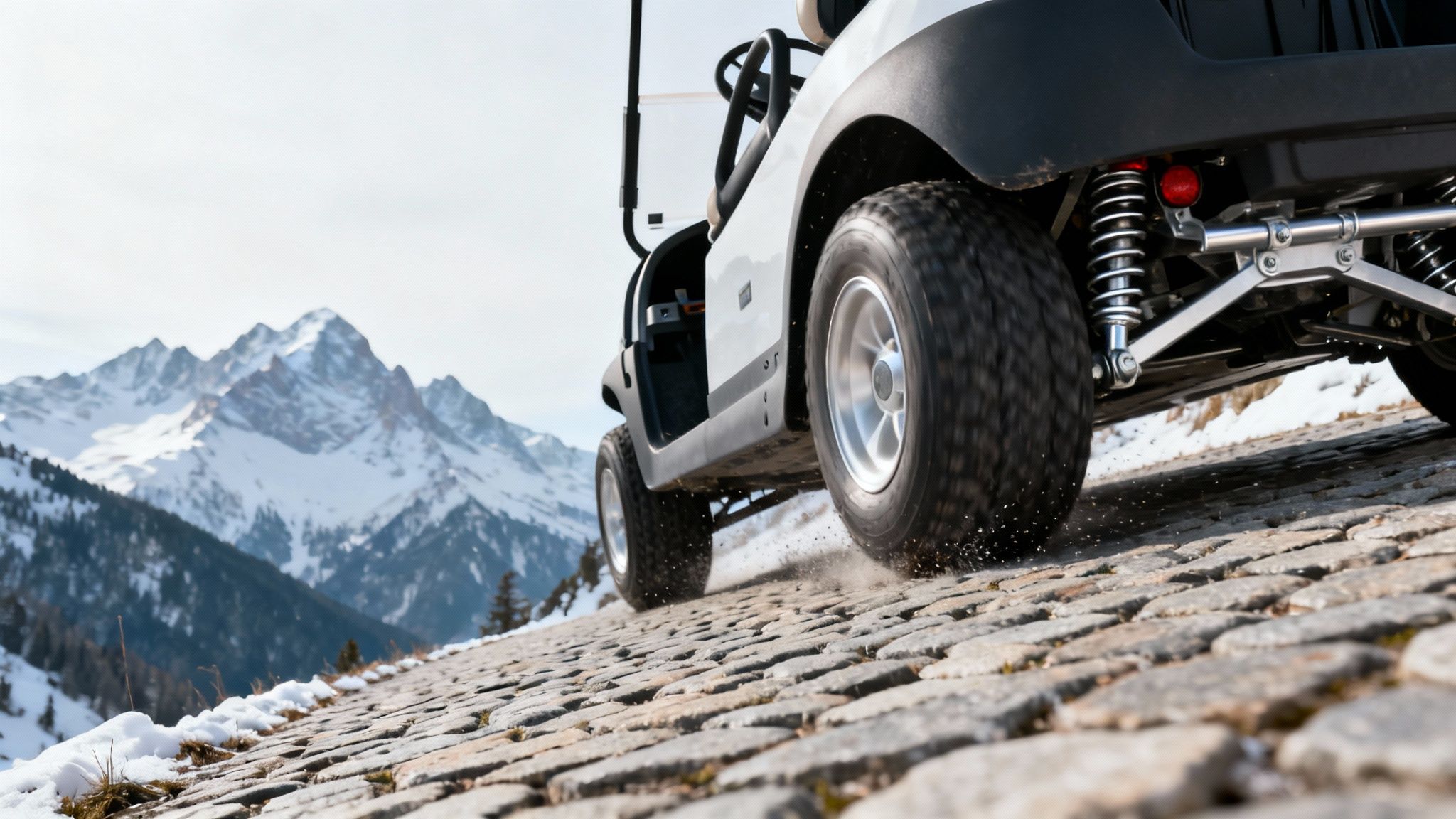
A generic review talking about top speed on a flat, sunny golf course in Florida is almost useless to us. That tells you nothing about how a cart will handle a steep climb to an alpine resort or navigate a cobblestone village square. Reading DACH golf cart reviews is about looking past the manufacturer's spec sheet for clues about real-world capability.
Think of it like buying hiking boots. You wouldn't pick a pair based on how they look on a polished shop floor. You want to know how they grip wet, rocky trails. The same logic applies here. Your focus needs to be on how a golf cart stands up to the terrain and climate it will actually be used in.
Motor Power Is More Than Just Speed
In the DACH market, a powerful motor isn't for showing off—it's a necessity. When a review mentions a big number, like a 7500W electric motor, your first thought shouldn't be "fast." It should be "torque."
Torque is the muscle. It's the rotational force that gets you moving from a standstill and, more importantly, keeps you moving up a steep grade. A cart with high torque can tackle a winding mountain road to a Swiss chalet without a hint of struggle, even when it's loaded with people and gear. A review that raves about a cart’s ability to "climb hills effortlessly" is infinitely more valuable than one fixated on its top speed. This is exactly the kind of power you'll find in options like the DACH Apollo Golf Cart.
Look For Clues About Build Quality
The way a golf cart is built is crucial for its lifespan, especially with the kind of weather we get in Germany, Austria, and Switzerland. Between the snow, road salt, and general dampness, a poorly constructed frame can start to corrode surprisingly quickly.
That's why a review mentioning an aluminum chassis should grab your attention. Aluminum naturally resists rust and corrosion, making it a much smarter choice than steel for any vehicle intended for year-round use in our climate. Keep an eye out for user comments that talk about how the cart looks after a tough winter or how it handles the rattling from cobblestone streets. Those real-world insights are pure gold.
A premium vehicle in the DACH market is defined by its ability to perform flawlessly year after year, not just on the day it's delivered. Look for reviews that speak to long-term durability and resilience against the elements.
Interpreting Battery Performance In The Cold
Battery range is another spec that needs a reality check. The range a manufacturer advertises is almost always based on perfect conditions: flat ground, mild weather, and a light load. But as we all know, cold temperatures can slash a battery's efficiency and cut its range significantly.
When you're reading reviews, zero in on any comments about performance in colder weather. The best carts are equipped with modern battery tech like LiFePO4 (Lithium Iron Phosphate), which are known for being far more stable and reliable across a wider temperature range than old-school lead-acid batteries. The top manufacturers are now making high-capacity systems like 105Ah LiFePO4 batteries the standard, delivering the kind of real-world range you can actually count on. A trustworthy review will give you realistic range estimates based on actual use, not just the number printed on the box.
Matching The Right Solana EV To Your Needs
Now that we’ve covered what to look for in a golf cart review for the DACH market, let's put that knowledge into practice. This isn't about selling you a specific model. Instead, think of this as a practical exercise in connecting a vehicle’s features to the job it needs to do.
We're going to break down the Solana EV lineup and see how its engineering solves the real-world challenges we've discussed. This helps you move past a simple spec sheet and understand the why behind each design choice. You'll start to see how a high-torque motor or a specific suspension setup directly translates into a solution for an owner in Germany, Austria, or Switzerland.
For The Alpine Resort Manager: Solana XA
Picture yourself managing a beautiful resort tucked away in the Austrian Alps. Your daily routine involves navigating steep, winding service roads, dealing with unpredictable weather, and moving guests and gear safely. A standard-issue golf cart would probably give up on day one.
This is precisely the environment the Solana XA was built for. When you're scanning reviews, you’re not looking for generic praise. You're hunting for specific mentions of its high-torque motor and its tough, independent suspension. Those aren't just marketing terms; they're the direct answer to your biggest headaches.
- High-Torque Motor: This is the muscle you need to climb steep grades without bogging down, even with a full load of luggage or supplies.
- Robust Suspension: This keeps the ride smooth and stable on bumpy or unpaved mountain trails, which is crucial for guest comfort and safety.
- Durable Build: The aluminum chassis is a game-changer here. It offers fantastic resistance to the corrosion that road salt and damp alpine air can cause.
For a resort manager, a review that raves about the Solana XA's hill-climbing grunt is worth ten times more than one that talks about its top speed on a flat road.
For The Private Estate Owner: Solana F
Let's shift gears. Imagine you own a sprawling private estate near a historic German village. Your needs are a mix of on-property utility and the freedom to pop into town for errands or a coffee. For you, style, comfort, and street legality are paramount.
The Solana F is designed for exactly this kind of lifestyle, blending a touch of luxury with everyday practicality. When you look at reviews for this model, your priorities will be completely different from the resort manager's.
The perfect vehicle is one that seamlessly integrates into your lifestyle. For an estate owner, this means a cart that feels as comfortable on a public road as it does on a private path, all while reflecting a certain standard of quality.
You’d be looking for feedback on its:
- Street-Legal Compliance: Full Straßenzulassung is the most important feature. The vehicle needs to be ready for registration from the moment it's delivered, complete with all required lights, signals, and safety equipment.
- Luxury Finishes: Things like premium seating, a modern dashboard, and an overall polished look matter a lot to an owner who appreciates quality craftsmanship.
- Quiet Operation: A whisper-quiet electric motor means you can enjoy the peace of your property without the noise and fumes of a gas engine.
In this scenario, a review that praises the Solana F’s smooth ride on cobblestones and its elegant design is a huge green flag.
For Commercial And Campus Environments
Finally, let’s consider the facility manager at a large university campus in Switzerland or a logistics coordinator at an industrial park in Germany. Their world revolves around efficiency, reliability, and safety in a closed, controlled environment.
This is the domain of the Solana G (the utility workhorse) and the Campus E (the people mover). These vehicles are built for pure function, not fashion.
The Solana G, with its versatile cargo bed, is the perfect tool for maintenance crews, delivery teams, and groundskeepers. A review that highlights its impressive payload capacity and rugged construction would be incredibly valuable.
For the Campus E, which is all about moving people across large, flat areas, you'd want to see reviews that mention its excellent battery life, tight turning radius, and low maintenance requirements. These models are a perfect reminder that the "best" cart is always the one that’s perfectly matched to its mission.
How To Find The Right Dealer In The DACH Market
While DACH golf cart reviews online are great for learning about a specific model's performance, they often skip over a crucial piece of the puzzle: the dealer. A premium vehicle isn’t just a one-off purchase. It’s the start of a long-term relationship with the local expert who will keep it running perfectly.
Think of it like buying a classic car—you wouldn't just buy it from anyone. You need a specialist who understands its quirks, knows the local environment, and can offer reliable support for the long haul. In the DACH market, a great dealer is much more than a salesperson; they're your guide.
Beyond The Sale A Partner In Ownership
A top-tier dealership brings value that a simple online checkout can never match. They offer the hands-on experience and local knowledge you need to buy with confidence. So, before you focus solely on price, look for a dealer who delivers more.
Here’s where a good partner truly shines:
- Expertise in Regional Regulations: A dealer worth their salt will be an expert on the specific Straßenzulassung rules for your canton or state. They'll handle the paperwork properly, saving you from a world of legal trouble down the road.
- Availability of Test Drives: Reviews are one thing, but getting behind the wheel is another. A good dealer will insist you take a test drive to feel the cart's handling, power, and comfort on roads you actually use.
- Reliable After-Sales Support: What happens when you need a repair or just routine service? A quality dealership has a proper service department with trained technicians and ready access to genuine parts. This is key to keeping your vehicle in prime condition.
The Importance Of Local Customization
Your needs are unique, and an off-the-shelf model might not be a perfect fit. This is where a great dealer becomes a consultant, helping you customize the vehicle for your specific tasks.
They can help you add the right enclosure for a harsh Alpine winter, install specialized tires for the terrain on your property, or integrate other accessories that make the cart genuinely useful. You just can’t get that level of personalization from a faceless online retailer.
The right dealer transforms a transaction into a partnership. They invest in your satisfaction long after you drive away, providing the peace of mind that comes from knowing expert help is always just a phone call away.
To make sure you're asking the right questions from the get-go, we've put together a quick checklist. Use these questions to gauge a dealer's expertise and commitment to service before you make a decision.
Key Questions To Ask A DACH Golf Cart Dealer
| Category | Question To Ask | Why It Matters |
|---|---|---|
| Regional Expertise | Can you walk me through the entire Straßenzulassung process for my specific area? | This tests their knowledge of local laws. A vague answer is a red flag. |
| Service & Support | Who performs the maintenance, and are your technicians factory-trained? | This confirms they have a dedicated, qualified service team, not just a sales floor. |
| Parts Availability | Do you keep common replacement parts in stock, or do they need to be ordered? | In-stock parts mean faster repairs and less downtime for you. |
| Customization | What are the most common customizations you do for customers in this region? | Their answer will reveal how well they understand the practical needs of local owners. |
| Test Drives | Can I test drive the model on a hill or a similar surface to what I have? | It shows they are confident in their product's performance and want you to be too. |
Having these answers helps ensure the dealer you choose is equipped to support you for the entire life of your vehicle, not just on the day you buy it.
The global market for electric golf carts is growing fast, moving well beyond the golf course into personal and community transport. This shift makes specialized, regional dealers more important than ever. As you weigh your options, remember that a solid local partner is a core part of your investment.
Finding a local expert you can trust is a crucial step. Our guide on how to locate the right golf cart dealership near you offers even more tips for finding a partner who can meet your needs for sales, service, and support.
Bringing It All Together: Making the Right Choice
Alright, you've done the hard work. You've waded through the DACH region's specific rules, learned to read between the lines of customer reviews, and figured out which features actually matter for your daily grind. Now, it's time to put all that knowledge to use and make the final call.
The biggest takeaway here is something experienced owners know well: the best golf cart isn’t just the one with the flashiest brochure. It’s the one that fits seamlessly into your life in Germany, Austria, or Switzerland—legally, environmentally, and practically. A high-tech feature is worthless if it can’t handle a steep, wet cobblestone street on a cold morning.
Your Final Gut-Check List
Before you commit, run through this quick mental checklist. Think of it as your final safeguard to ensure you’re making a smart investment that you won't regret later.
- Is it road-legal out of the box? Double-check that the cart meets all local Straßenzulassung requirements from the get-go, without needing complicated after-market fixes.
- Are the reviews relevant to me? Are you focusing on feedback that mentions things like torque for climbing hills, how the battery holds up in the cold, and whether the frame resists rust from salted winter roads?
- Does it fit my world? Is the motor, chassis, and suspension truly built for the challenges of your specific property or town?
- Is the dealer a real partner? Have you found someone local who knows their stuff, encourages a test drive, and will actually be there to help you with service down the road?
The whole point of this process is to get you to a place where you feel confident and clear-headed. A good decision comes from understanding what you're buying, and that's what this guide is all about.
The electric cart world has exploded in recent years. It's no longer just for the golf course; it's a serious option for personal and business transport. The global market, valued at a whopping USD 1.55 billion, is expected to climb to USD 2.58 billion by 2033. This isn't just a trend; it's a major shift in how people get around.
You can discover insights about the growing demand for electric golf carts and see the data for yourself. This rapid growth means more choices, but it also makes it even more important to be an informed buyer. By following the advice here, you're not just buying a vehicle—you're choosing a reliable asset that will serve you well for years to come.
Frequently Asked Questions
When you start looking into street-legal golf carts for use in Germany, Austria, or Switzerland, a few key questions always come up. Here are some straightforward answers to the things we hear most often, helping you get a clear picture of what ownership really looks like.
Do I Need Special Insurance For A Street-Legal Golf Cart?
Yes, you absolutely do. As soon as your golf cart has Straßenzulassung (road approval) and you plan to drive it on public roads, it's treated like any other vehicle. That means insurance isn't optional—it's mandatory.
In Germany, this is handled with a small insurance license plate, the Versicherungskennzeichen, which shows you have liability coverage. In Austria and Switzerland, the process is a bit more formal, requiring full registration that includes proof of insurance. Your best bet is always to chat with a local insurance agent to make sure you're getting the right policy for your specific region.
What Is The Typical Maintenance Schedule?
One of the best things about going electric is how little maintenance is required compared to a gas-powered cart. You can forget about oil changes, spark plugs, and all the usual engine headaches. Still, a few regular checks are key to keeping your cart safe and running smoothly for years.
Here’s a simple routine to follow:
- Tire Pressure Checks: A quick check once a month keeps the cart handling well and rolling efficiently.
- Brake Inspection: Have a professional look at the brakes at least once a year.
- Battery Terminal Cleaning: Make sure the terminals are clean and the connections are snug for the best performance.
- Suspension and Steering: A yearly once-over will spot any wear from driving on different types of roads or paths.
How Should I Care For The Battery In Winter?
This is a big one, especially with the cold winters we get in the DACH region. Low temperatures can really sap a battery's performance and shorten its life if you're not careful. The good news is that caring for the LiFePO4 batteries in Solana EV models is simple.
If you plan to store your golf cart for the winter, proper battery preparation is the single most important step you can take to protect your investment and ensure it’s ready to go in the spring.
If you're parking the cart for the season, aim to store the battery with a partial charge—somewhere around 50-70% is the sweet spot. Never leave it completely full or totally empty for long periods. If you can, keep the cart in a garage or shed where the temperature stays above freezing. This small step makes a huge difference in preserving the battery's health for the long haul.
Ready to see how performance, style, and DACH-ready compliance come together? The team at Solana EV is here to help you find the perfect electric vehicle. Explore our full lineup today and find a dealer near you!