
If you've found yourself searching for a "DACH golf cart for sale," you're on the right track for something a cut above the rest. It’s a common misconception that DACH is a specific brand. Instead, think of it as a seal of quality—a nod to the high standards of engineering you’d expect from German, Austrian, and Swiss manufacturing. These carts are built for people who value durability, performance, and features that actually make a difference.
Your Essential Guide to Buying a DACH Golf Cart
This guide is your complete roadmap for navigating the world of premium electric vehicles. Whether you're a resort manager needing a bulletproof fleet or a homeowner looking for a stylish, street-legal ride for the neighborhood, we're here to help you make a smart, confident choice. We’ll break down everything that matters, from the nitty-gritty tech specs and legal hoops to finding a dealer who’ll have your back for years to come.
The shift toward high-end electric vehicles isn't just a trend; it's a movement. The U.S. electric golf cart market was valued at an impressive USD 529.4 million in 2024. It’s expected to climb to USD 886.7 million by 2033, growing at a steady 6.2% each year. This boom is driven by people in gated communities and resort managers who are tired of subpar options and are demanding more reliable, high-performance transportation.
What to Expect in This Guide
To make this process as straightforward as possible, we’re going to walk through the most critical factors that should influence your decision. Think of this as your personal checklist for making sure you’ve covered all the bases. Knowing what to look for will empower you to ask the right questions and truly understand the differences between models. If you want to see how specific carts stack up, you can dive into detailed DACH golf cart reviews.
Here's a quick look at what we'll cover:
- Decoding Features: We'll translate the tech-speak around batteries, motors, and payload capacity into plain English.
- Street-Legal Requirements: Find out exactly what equipment you need and what the registration process looks like for driving on public roads.
- Model Comparisons: We'll help you figure out which cart is the perfect match for your needs, whether it's for work, play, or a bit of both.
- Dealer Selection: Get practical, real-world tips for vetting local dealers to ensure you get great service and support.
A well-informed buyer is a confident buyer. Taking the time to understand the key aspects of a premium golf cart ensures your investment aligns perfectly with your expectations for performance, reliability, and long-term value.
To get you started, the table below provides a quick checklist of the most important things to think about. Keep this handy as you begin your search—it will help you stay focused on what truly matters.
Quick Checklist for Your Golf Cart Purchase
This table summarizes the core factors to evaluate when you're in the market for a DACH-style golf cart. It's a great starting point for organizing your thoughts and questions.
| Consideration | Key Questions to Ask | Why It Matters |
|---|---|---|
| Primary Use Case | Will it be for personal, commercial, or off-road use? | Determines the required durability, capacity, and features. |
| Battery & Range | Do I need a lithium-ion battery for longer range and faster charging? | Affects daily usability, maintenance needs, and overall cost of ownership. |
| Street-Legal Status | Does the vehicle need to be registered for on-road driving? | Dictates the safety features, insurance, and titling requirements. |
| Dealer Support | Does the dealer offer a strong warranty and reliable service? | Ensures long-term support, parts availability, and a positive ownership experience. |
With these key points in mind, you’re ready to dig deeper. Let’s explore each of these areas so you can find the perfect golf cart for your needs.
What Really Makes a Premium Electric Golf Cart?
When you first dive into the world of premium golf carts, the spec sheets can be a little intimidating. Let's cut through the noise and focus on the core features that truly separate a high-performance electric vehicle from a basic runabout. Thinking about these components in terms of how you'll actually use the cart will make all the difference.
At the heart of any electric cart is its power source. It's best to think of the battery as the vehicle's fuel tank. Just like a car can run on regular or premium gasoline, electric carts have different battery technologies, each with its own pros and cons.
The Power Plant: Battery and Motor Performance
The biggest choice you'll face is between lithium-ion and traditional lead-acid batteries. Lithium-ion is the modern, high-performance standard. These batteries are lighter, charge much faster, and give you a longer, more consistent range before you need to plug in. Think of it as the premium fuel that keeps your cart running strong all day without a second thought.
Lead-acid batteries are the old-school workhorse. They're often cheaper upfront but come with more baggage—they're heavy, require regular maintenance, and have a shorter overall lifespan. While they get the job done, they just can't match the efficiency and longevity of their modern counterparts. For most people looking for reliability and convenience, lithium-ion is the way to go.
Next up is the motor, which is the "engine" of your cart. You'll generally see two types: Alternating Current (AC) and Direct Current (DC). AC motors are the gold standard in premium carts for a reason—they're more efficient and deliver much better acceleration and hill-climbing power. You can feel the difference in the smooth, responsive ride, especially when you've got a full load of passengers. DC motors, on the other hand, are typically found in older or more budget-friendly models.
This map helps visualize how these critical components—along with buyer needs and overall quality—come together in a well-designed golf cart.
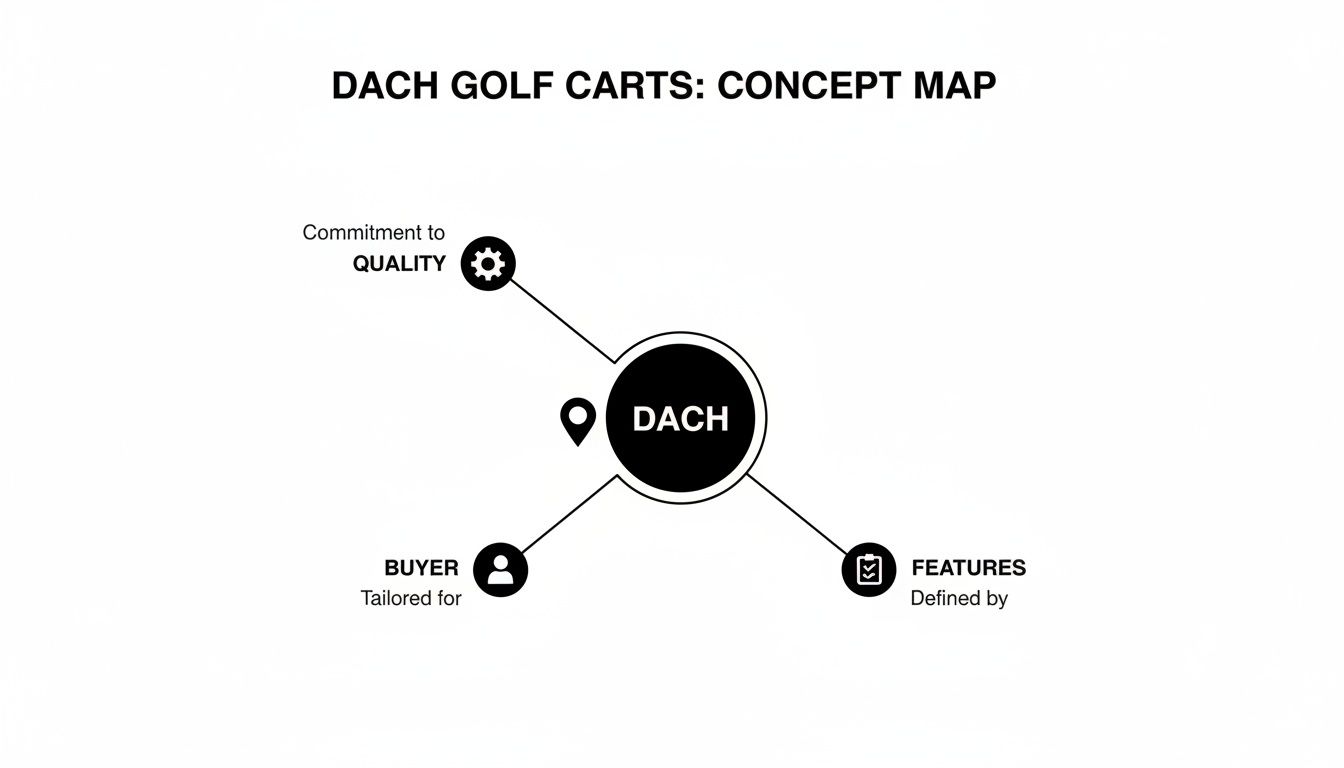
It’s a great reminder that a top-tier cart isn't just about one flashy feature. It’s about the smart combination of quality engineering, user-focused design, and a solid set of features working in harmony.
Understanding Speed and Capacity
As you browse listings for a DACH golf cart for sale, you'll see numbers for top speed and payload capacity. Pay close attention to these. Top speed isn't just for fun; it's a legal necessity if you plan to drive on public roads. To be classified as a street-legal Low-Speed Vehicle (LSV), a cart must be able to hit speeds between 20-25 mph.
Payload capacity is simply the total weight the cart can safely handle, including you, your passengers, and any gear. A standard four-seater might be perfect for a family cruising around the neighborhood. But if you're a property manager hauling guests and luggage, you'll need a model with a much higher payload and more seats.
Think carefully about how you'll use your cart 90% of the time. A vehicle designed for a flat golf course will likely struggle with the constant stop-and-go of street driving or the demands of heavy-duty work. Matching the cart's capabilities to your real-world needs is the single most important step to a smart purchase.
The demand for more powerful and versatile electric carts is exploding. The global market hit USD 1,127.09 million in 2024 and is forecast to climb to USD 2,029.44 million by 2034. A huge driver of this growth is the incredible drop in battery costs—down a whopping 89% since 2010! This trend is making premium, feature-rich carts more affordable than ever. You can dig into more of these market insights from Polaris Market Research.
Key Performance Features to Look For
When you're comparing models, it helps to have a mental checklist. Beyond the battery and motor, a few other elements really define a premium experience.
- Suspension System: A quality suspension is the difference between a smooth glide and a bumpy, jarring ride. Look for independent suspension systems, which handle uneven terrain far better than the basic leaf springs found on older carts.
- Braking System: For a street-legal LSV, hydraulic disc brakes are non-negotiable. They provide vastly superior stopping power and reliability compared to old-school drum brakes, which is a critical safety feature.
- Onboard Charger: A good onboard charger doesn't just replenish the battery; it protects it. These "smart" chargers optimize the charging process to extend your battery's overall lifespan, saving you a lot of money down the road.
- Frame Construction: Pay attention to what's underneath. Frames made from aluminum or galvanized steel are built to last. They resist rust and corrosion, which is especially important if you live in a coastal or humid climate.
By focusing on these practical, real-world features, you can look right past the marketing fluff and find a vehicle that is genuinely well-built and perfectly suited for you.
Making Sure Your Golf Cart Is Ready for the Road
Thinking you can just hop in a golf cart and cruise down your neighborhood street? It's not quite that simple. This is where you run into the critical difference between a standard "golf cart" and a true, street-legal Low-Speed Vehicle (LSV). Getting this right is the single most important step when you're looking at a DACH golf cart for sale.
Think of it this way: a regular golf cart is built for private property—a golf course, a large ranch, or a worksite. An LSV, however, is a whole different beast. It's a specific class of motor vehicle, engineered from the get-go to meet federal safety standards so it can legally share the road with cars.
This isn't just a minor detail; it's a legal requirement. The demand for these road-ready carts is exploding, with the golf cart market in the Americas alone expected to reach USD 1,627.6 million by 2026. Electric models already make up over 55% of that market, thanks in large part to the more than 3,000 gated communities that now allow LSVs on their streets. You can see more data on this trend from Allied Market Research.
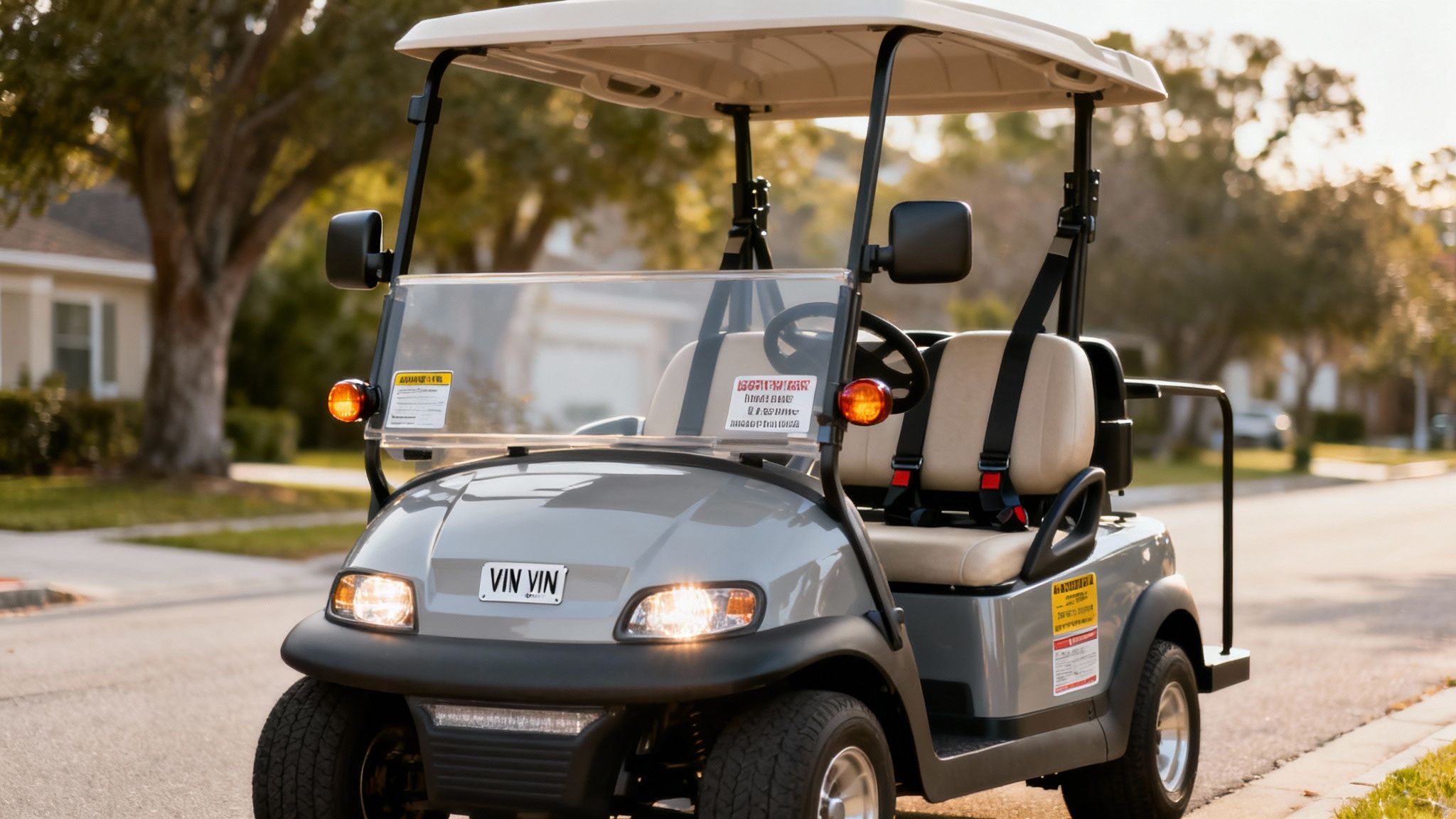
What Makes a Golf Cart a Street-Legal LSV?
To be considered a true LSV, a cart must roll out of the factory with a very specific set of safety gear. These features aren't optional add-ons; they're built-in requirements for operating on most public roads with a speed limit of 35 mph or less. Trying to piece together a compliant cart yourself is a huge headache and often won't pass legal inspection.
Here’s the essential safety checklist your LSV must have from the manufacturer:
- Headlights, Taillights, and Brake Lights: Your cart has to be seen, day or night, just like any other vehicle.
- Turn Signals: Both front and rear signals are a must for letting other drivers know what you're doing.
- Reflectors: All four corners of the vehicle need reflectors to improve visibility from all angles.
- Mirrors: A rearview mirror and side-view mirrors are non-negotiable for situational awareness.
- Seat Belts: Every single seat needs a DOT-approved seat belt.
- Windshield: You'll need a proper, shatter-resistant automotive-grade windshield for protection.
The most crucial piece of the puzzle is the 17-digit Vehicle Identification Number (VIN). If a cart doesn't have a factory-issued VIN, you can't title or register it. No VIN, no license plate—it's that simple.
That VIN is your key to getting a title, registration, and insurance. Without it, you’ve just got a fancy golf course vehicle, not a street-legal machine. You can get into the nitty-gritty by reading our complete guide on street-legal golf cart rules.
From the Dealer's Lot to Your Street: The Registration Process
Once you've confirmed your cart is a federally certified LSV, getting it on the road is a lot like buying a new car. A few key steps will officially turn your new ride into a registered vehicle.
It starts with the Manufacturer's Certificate of Origin (MCO) you get from the dealer. This is basically the vehicle’s birth certificate and is vital for the titling process. You’ll take the MCO to your local DMV or tag agency to apply for an official vehicle title in your name.
Next up is registration. This gets your LSV into the state's system and gets you a license plate. At this point, you'll also have to provide proof of insurance. Most states require LSVs to have, at a minimum, personal injury protection (PIP) and property damage liability (PDL) coverage.
Finally—and don't skip this step—you absolutely must check your local laws. While the federal government sets the baseline for what an LSV is, your state, county, or even your homeowner's association can have their own rules. A quick call to city hall or the local police department can save you from a major headache and a costly ticket.
Choosing the Right Model for Your Needs
How do you sort through all the different golf cart models to find the perfect one? The secret is to stop thinking about a list of features and start thinking about your actual, day-to-day life. The best cart isn't the one with the most bells and whistles; it's the one that fits your world like a glove.
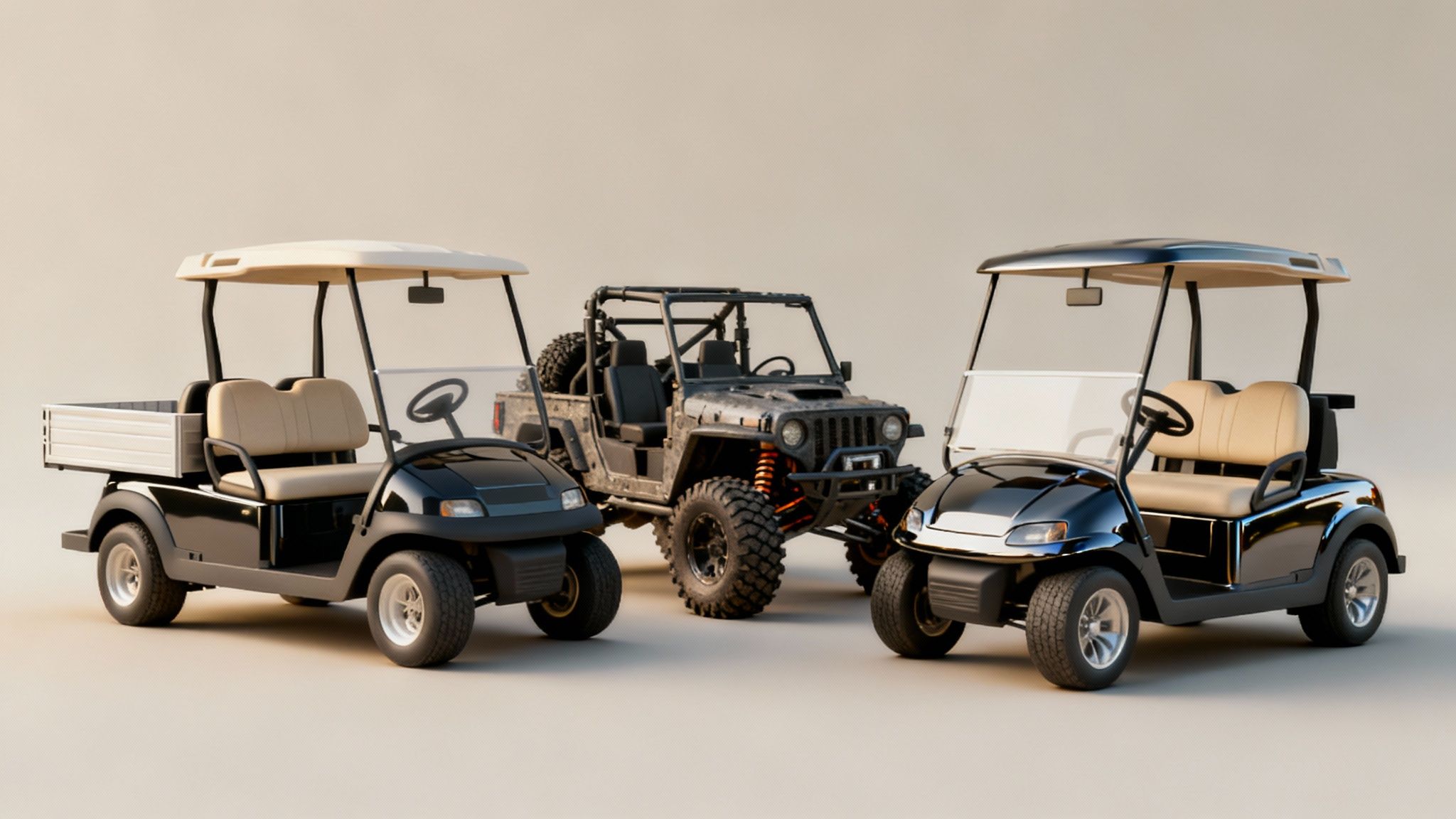
To make this simple, let's connect the dots between the technical specs and how they play out in the real world. We’ll look at a few common scenarios to see how different needs call for completely different types of vehicles. By seeing how others find their ideal cart, you can zero in on the right path for you.
For the Resort Manager, Ron
Meet Ron. He manages a sprawling seaside resort, and his top priority is moving guests and their luggage around efficiently and comfortably. He needs a fleet of vehicles that are not only workhorses but also project the premium image of his resort. Downtime is a killer for his operation, and guest safety is everything.
For Ron, the clear choice is a high-capacity, multi-passenger model. Here's what he's looking for:
- High Payload Capacity: Ron needs carts that can easily handle six or even eight passengers plus luggage without putting a strain on the motor or suspension.
- Durable Construction: His fleet is constantly exposed to salty air. That means aluminum or galvanized steel frames are a must-have to fight off rust and corrosion.
- Efficient Lithium-Ion Batteries: With carts on the move all day, long range and quick charging are critical. Lithium batteries keep his vehicles out serving guests, not stuck at a charging station.
- Enhanced Safety Features: Since the carts navigate areas with plenty of foot traffic, powerful hydraulic disc brakes and a smooth, predictable AC motor aren't just nice to have—they're essential.
Ron couldn't care less about off-road capability or flashy paint jobs. He's focused on durability, efficiency, and capacity. A utility-first, high-capacity vehicle is the backbone of his operation.
For the Off-Road Enthusiast, Olivia
Now, let's look at Olivia. She's an outdoor adventurer with a large, wooded property full of rugged trails. She wants a vehicle to take her deep into the woods, tackle tough terrain, and haul gear for camping or hunting. A standard golf cart would get stuck in the first ten feet.
Olivia’s search for a DACH golf cart for sale is all about raw performance and toughness. Her checklist is the polar opposite of Ron's:
- Lifted Suspension: A major lift kit is non-negotiable. She needs the ground clearance to get over rocks, roots, and ruts without getting hung up.
- All-Terrain Tires: Aggressive, knobby tires are crucial for digging in and finding traction in mud, gravel, and loose dirt.
- Powerful AC Motor: She needs that instant torque to claw her way up steep hills without a second thought.
- Utility Bed and Accessories: A rear utility bed is a must for her gear. She’s also planning to add a winch, a front brush guard, and some serious LED light bars for those early morning or late-night trips.
Your primary environment dictates your needs. A vehicle built for paved resort paths will fail on a rugged trail, and an off-road beast may be overkill for simple neighborhood trips. Matching the model to your terrain is fundamental.
Olivia’s perfect cart is a purpose-built off-road machine. It trades some on-road comfort for maximum capability where the pavement ends.
For Gated Community Greg
Finally, we have Greg. He lives in a beautiful gated community with quiet, tree-lined streets where the speed limit is 25 mph. He's looking for something stylish, comfortable, and street-legal for daily errands—zipping to the clubhouse, grabbing the mail, or heading to a neighbor's barbecue.
Greg’s priorities are a mix of style, comfort, and legal compliance. He wants a vehicle that feels less like a utility cart and more like a personal cruiser.
Here’s what’s on his list:
- Street-Legal LSV Certification: This is his number one requirement. The cart must have a VIN and all the required safety gear like headlights, turn signals, and seatbelts to be driven legally on public roads.
- Premium Comfort Features: Greg is looking for things like contoured seats, a smooth suspension designed for pavement, and maybe even a good sound system.
- Custom Aesthetics: Appearance is important. He's drawn to custom paint colors, premium wheels, and a design that looks sharp and modern.
- Quiet and Efficient Operation: An AC motor paired with a lithium battery gives him that silent, smooth ride he wants for cruising around his peaceful community.
These "personas" are a great way to think about your own needs. Figuring out which one you relate to most will instantly narrow down your choices and put you on the right track. To make it even clearer, let's break it down in a table.
Which Premium Golf Cart Model Is Right for You?
| User Persona | Primary Use Case | Key Features Needed | Example Model Archetype |
|---|---|---|---|
| Resort Manager Ron | Transporting guests and luggage on large, paved properties. | 6-8 seats, high payload, rust-proof frame, lithium battery. | Multi-Passenger Shuttle |
| Off-Road Enthusiast Olivia | Navigating rugged trails, hunting, and property maintenance. | Lift kit, all-terrain tires, powerful AC motor, utility bed. | Lifted Off-Road Utility |
| Gated Community Greg | Neighborhood errands, social visits on public roads (under 25 mph). | Street-legal (LSV), premium seats, custom colors, smooth ride. | Street-Legal Cruiser |
So, are you a Ron, an Olivia, or a Greg? Maybe you're a mix of two. Once you identify your primary use case, you've already done the hardest part of the shopping process. You can now walk into a dealership with confidence, knowing exactly what kind of vehicle will truly fit your life.
Finding a Dealer and Ensuring Long-Term Support
Picking out the perfect golf cart is exciting, but it’s only half the battle. The dealership you buy from becomes your long-term partner, and finding the right one is just as crucial as choosing the right model. A great dealer doesn’t just make a sale; they provide the support, service, and expertise to keep your cart running flawlessly for years.
Think of it like finding a trusted mechanic for a new car. You want someone with a great reputation, specialized knowledge, and a real commitment to keeping you on the road. The same thinking applies when you're looking for a "DACH golf cart for sale." Your dealer is your go-to expert for everything from routine tune-ups to troubleshooting tricky issues.
This relationship is all about trust. A solid dealership invests in training their technicians to handle modern electric vehicles, especially those with advanced lithium-ion systems and AC motors. This means they can diagnose problems correctly the first time and have the right parts ready to go, which gets you back out there faster and protects your investment.
How to Evaluate a Local Dealer
Before you shake hands on a deal, it pays to do a little recon. Popping into a showroom gives you a feel for their operation, but you need to ask smart questions to understand the kind of support you’ll actually get. Don't be afraid to dig into the details of their service policies and warranty.
Here’s a practical checklist to help you size them up:
- Technician Know-How: Ask them straight up about their experience with modern electric LSVs. Are their techs certified to work on high-voltage lithium battery systems?
- Parts on Hand: What's their inventory of common replacement parts look like? A dealer who stocks the essentials can fix your cart in days, not leave you waiting for weeks on a shipment.
- Warranty Clarity: Ask for the warranty details in writing. What does it cover, and for how long? Make sure you understand exactly how to file a claim if you ever need to.
- Service Department Buzz: Check online reviews, but focus on what people say about the service center. A dealer with glowing sales reviews but a terrible service reputation is a huge red flag.
A dealer's commitment to after-sale support says everything about their business. When they prioritize service and parts availability, they're investing in a long-term relationship with you, not just a quick sale.
Taking this extra time upfront helps you avoid major headaches down the road. You aren't just buying a product; you're buying into a support system that should last the entire life of your vehicle.
Questions You Must Ask About Service
When you're at the dealership, a few direct questions can tell you a lot. The quality of their answers will show you just how transparent and knowledgeable they really are.
Here are a few essential questions to run by the service manager:
- What’s your typical turnaround time for standard maintenance? This gives you a good feel for how efficiently their shop operates.
- Do you offer mobile service or a pickup/delivery option? This is a massive convenience, especially if you have a packed schedule or don't own a trailer.
- Can I see your service agreement in writing? Always read the fine print. Go over the terms and conditions before you sign anything.
- How do you handle warranty claims for major parts like the battery or motor? Knowing the process beforehand prevents any unwelcome surprises later on.
Finding a quality local partner is a key part of the buying process. For more tips on what to look for, check out our detailed guide on finding a trusted golf cart dealership near you. By arming yourself with the right questions and a clear set of expectations, you can confidently choose a dealer who will provide excellent support for years to come.
Got Questions About Premium Golf Carts? We’ve Got Answers.
When you start digging into the world of high-end electric carts, a few questions always seem to pop up. It's totally normal. Getting straight answers is the key to feeling good about your decision, so let's clear up some of the most common uncertainties people have when looking at a DACH-style cart.
Think of this as the final piece of the puzzle. We want to address any lingering doubts so you can move forward, fully informed and confident you're picking the right ride.
How Long Does a Lithium-Ion Golf Cart Battery Really Last?
A top-notch lithium-ion battery—the kind you'll find in almost any premium cart these days—is built to go the distance. You can realistically expect it to last for 8 to 10 years. That breaks down to about 2,000 to 3,000 full charge cycles.
This is a huge leap forward from the old-school lead-acid batteries that needed replacing every 3-5 years. The longevity of lithium means you're not shelling out for expensive battery swaps down the road, which dramatically lowers your total cost of ownership. Plus, with a little care—like avoiding running it completely dead and keeping it out of extreme temperatures—you can extend its life even further.
Are Electric Golf Carts a Pain to Maintain?
Not at all. In fact, electric carts are way cheaper and easier to maintain than gas-powered ones. Why? Because they have so many fewer moving parts in the drivetrain. You can say goodbye to oil changes, new spark plugs, and clogged fuel filters for good.
Routine maintenance for an electric cart is simple stuff: checking the tire pressure, giving the brakes a once-over, and making sure the battery terminals are clean. Over the life of the cart, you could see annual upkeep costs that are up to 70% lower than a similar gas model. That's a huge win, especially if you're managing a whole fleet.
The beauty of an electric powertrain isn't just about being green. It’s a smarter design that saves owners a ton of time and money on upkeep year after year.
Can I Just Upgrade My Regular Golf Cart to Be Street-Legal?
That sounds like a good idea on the surface, but trying to turn a standard golf cart into a street-legal vehicle is a tough, and often surprisingly expensive, road to go down. For a cart to be officially classified as a Low-Speed Vehicle (LSV), it has to be built that way from the very beginning, with all the necessary safety gear installed at the factory.
The most important part? It needs a manufacturer-issued 17-digit VIN. You can't just add one later. Bolting on some lights and seatbelts to a basic cart probably won’t satisfy the strict federal and local laws. It's almost always smarter, safer, and cheaper in the long run to buy a cart that's already certified as a street-legal LSV straight from the manufacturer. That way, you know it's fully compliant and registration will be a breeze.
Ready to see what a new standard in electric mobility looks like? At Solana EV, we engineer premium, street-legal vehicles that blend style, performance, and durability for any environment. Discover the perfect model for your lifestyle today at Solana EV.