
Figuring out the cost of an electric golf cart can be a bit like trying to hit a moving target, but let's clear things up. The initial price you'll see on the tag usually lands somewhere between $5,000 for a simple used model and can easily climb past $20,000 for a brand-new, souped-up ride.
Of course, that sticker price is just the tip of the iceberg when it comes to understanding your total investment.
Decoding the Price Tag: What You Can Expect to Pay
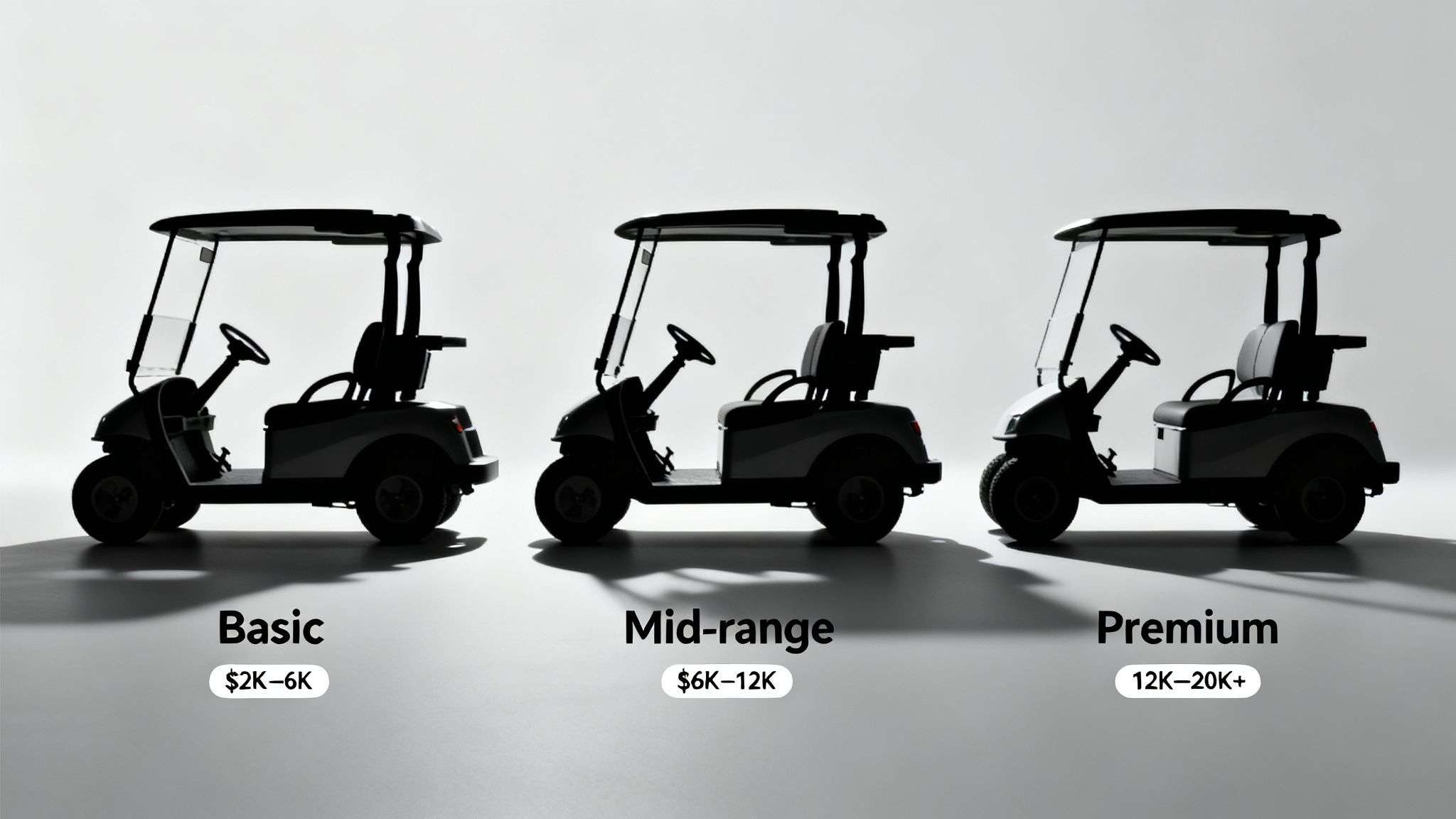
The purchase price is what grabs your attention first, but so many things influence that final number. Think of it like buying a car—a no-frills sedan costs a lot less than a luxury SUV decked out with every premium feature. The same logic applies to golf carts, and knowing the key differences is what helps you make a solid financial decision.
It’s a similar dynamic in other industries, too. When you’re trying to figure out how much a wedding photographer costs, the final quote depends on their experience, the quality of their gear, and what's included in the package. It's all about the value you're getting for your money.
A Quick Price Snapshot
To give you a clearer picture, let's break down the typical cost of an electric golf cart based on its condition and level of features. Think of this table as a starting point to help you set a realistic budget.
Estimated Electric Golf Cart Price Ranges
Here’s a quick overview of what you can expect to pay for new and used electric carts, from basic models to premium builds.
| Cart Category | New Price Range (USD) | Used Price Range (USD) | Key Features |
|---|---|---|---|
| Basic | $7,000 – $9,000 | $4,000 – $6,000 | Standard seating, basic roof, lead-acid batteries. |
| Mid-Range | $9,000 – $14,000 | $6,000 – $9,000 | Upgraded seats, lights, lithium battery option. |
| Premium | $14,000 – $20,000+ | $9,000 – $15,000+ | Lift kits, premium audio, custom wheels, lithium battery. |
As you can see, the ranges are pretty wide. But remember, this upfront cost is only one piece of a much larger financial puzzle.
The most important concept to wrap your head around is the total cost of ownership. This goes beyond the purchase price and includes every single expense you'll run into over the life of the cart.
The real key to smart buying isn't just focusing on the sticker price; it's about projecting the long-term expenses to understand the vehicle's true lifetime cost.
In the next sections, we'll dig into all of those other factors—like maintenance, battery replacement, and customizations. By looking at the complete financial picture, you'll be able to decide if a cheaper upfront option or a pricier, more efficient model is the better long-term value for you.
Decoding the Upfront Purchase Price
When you first start shopping for a golf cart, the price tags can be a bit of a shock. You'll see one cart listed for $7,000 and another, which looks pretty similar, going for $15,000. So, what gives?
It really all comes down to the details. Think of it like buying a car—a base model will get you around just fine, but every bell and whistle you add, from custom seats to a better sound system, bumps up that final price. Getting a handle on these key factors is the first step to figuring out where your budget and your wish list meet in the middle.
Let's break down the three biggest things that determine what you'll pay right out of the gate.
New Versus Used: A Major Cost Factor
The first big decision you'll face is whether to buy a brand-new cart or a pre-owned one. There's no right or wrong answer, but it dramatically impacts the price.
A new cart is a fantastic option if you want the latest tech, a full factory warranty, and that untouched, straight-from-the-dealership feel. Of course, you pay a premium for that peace of mind. Expect to see new electric models starting in the $7,000 to $12,000 range for a nicely equipped cart.
On the flip side, the used market is where you can find some incredible deals. A well-maintained, pre-owned cart can save you thousands, often letting you get a higher-end model with more features than you could afford new. This path just requires a little more homework to make sure you're getting a reliable ride. If you're leaning this way, our guide to buying a used golf cart is a great resource to help you spot a gem and avoid a lemon.
Brand Reputation and Build Quality
Just like with cars, brand names mean something in the golf cart world. You have the heavy hitters—Club Car, E-Z-GO, and Yamaha—that have spent decades building a reputation for solid, reliable carts. You pay a bit more for that name, but what you're really buying is proven durability and the confidence that parts and service will be easy to find down the road.
Then you have newer or less common brands that might pack in more features for a lower price to carve out a spot in the market. You can find some amazing value there, but it pays to do your research on their long-term performance and what customer support looks like. The brand you choose isn't just about the initial price; it’s about what your ownership experience will be like for years to come.
A well-known brand might cost more upfront, but its proven reliability and strong resale value can make it a smarter financial choice over the vehicle's entire lifespan.
The Power Source: Battery Technology
This is a huge one. The type of battery in your cart doesn't just influence the sticker price; it fundamentally changes how you use and maintain your vehicle.
-
Lead-Acid Batteries: This is the old-school, traditional choice. Carts with lead-acid batteries are cheaper to buy, but they come with a trade-off. They need regular maintenance (like topping off the water levels) and you can expect them to last about 3-5 years before needing a replacement.
-
Lithium-Ion Batteries: This is the modern, premium technology. A cart with a lithium battery will cost more initially—often $1,500 to $2,500 more—but the benefits are massive. They are completely maintenance-free, charge much faster, and can last for 10 years or more.
The market is clearly showing its preference, with electric carts now making up about 52% of all sales. People are doing the math and realizing that a higher initial investment can lead to lower costs for fuel and maintenance over time. This battery decision is so important, we’ll be diving much deeper into the pros and cons a little later on.
Looking Beyond the Sticker Price: The True Cost of Ownership
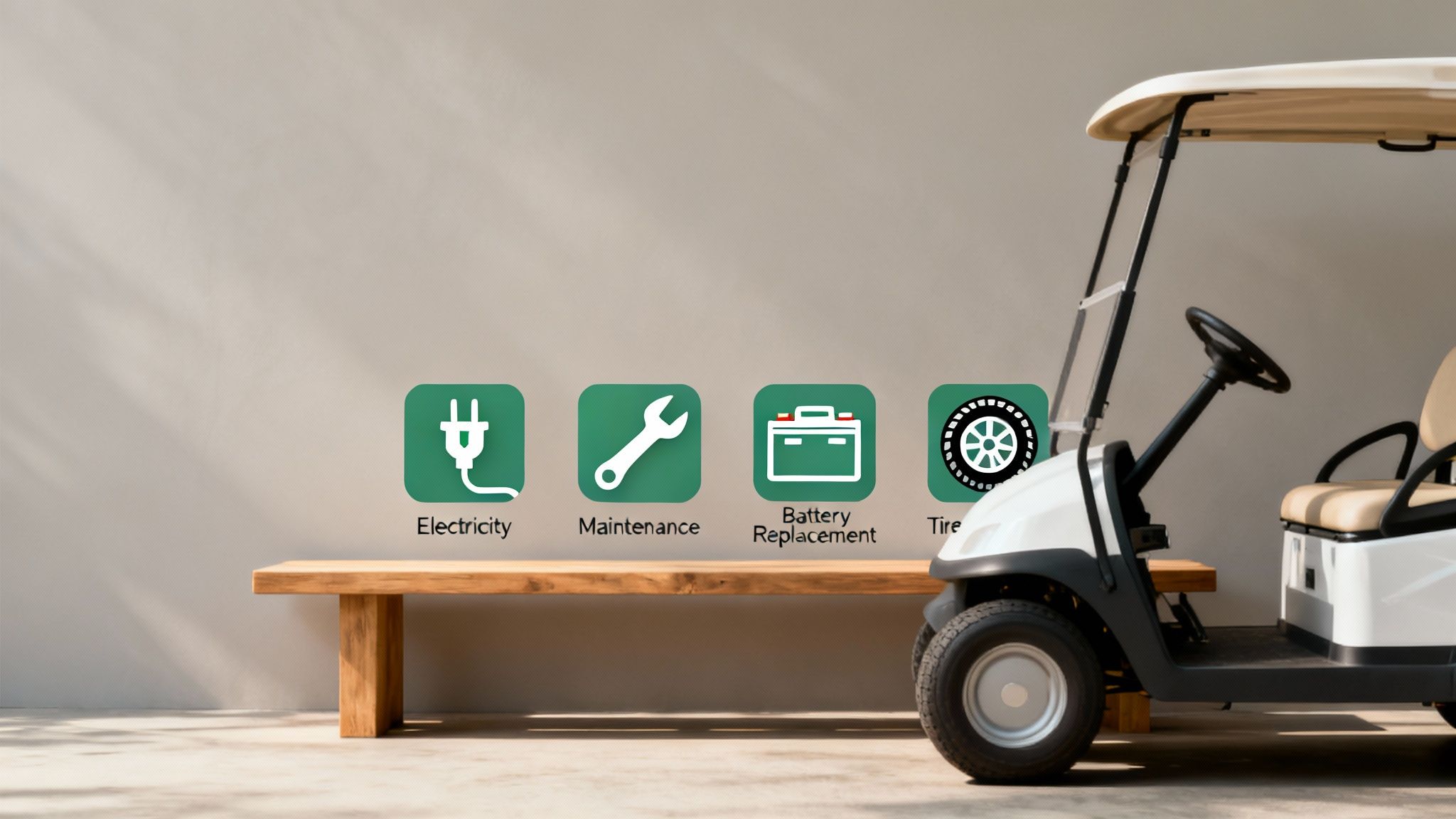
That initial excitement of getting a new electric golf cart is fantastic, but the price you pay upfront is only the beginning of the story. To really get a handle on the cost of an electric golf cart, you have to think about the total cost of ownership. These are the ongoing expenses that can sneak up on you if you haven't planned for them.
It's a lot like buying a house. The mortgage is the big number you focus on, but then there are property taxes, insurance, and the inevitable repairs. Your golf cart is no different; it has its own set of recurring costs that are just part of the deal.
Don't let that scare you, though. Knowing what to expect ahead of time means you can budget properly and make choices that will save you a lot of money and headaches down the line.
Routine Maintenance and Running Costs
Every vehicle needs some regular care to stay in great shape, and your electric golf cart is no exception. The great news is that electric models are much simpler than gas carts—forget about oil changes and spark plugs! Still, there are a few key things to keep an eye on.
Staying on top of this basic maintenance is what keeps your cart safe and extends its life. Here's what you can generally expect to pay for:
- Tire Care: You'll want to check the tire pressure and look for wear regularly. A new set of tires is something you'll need every few years, which usually runs between $200 and $400.
- Brake Checks: This is a huge safety item. Plan on having the brakes inspected annually. You might need occasional adjustments or new pads, which is standard procedure.
- Charging Costs: This is essentially your fuel bill, and it's incredibly cheap. A full charge for an electric cart typically costs between $0.50 and $1.50 in electricity, based on what you pay in your area.
Planning for these small, predictable costs is the best way to prevent big, expensive repairs later on. It ensures your cart is always ready to go when you are.
The Big One: Battery Replacement
By far, the single largest expense you'll encounter over the life of your cart is replacing the batteries. This is where your choice between lead-acid and lithium-ion technology really hits your wallet.
Traditional lead-acid batteries have a lower upfront cost, but they're not a "set it and forget it" solution. They need regular maintenance and will only last about 3 to 5 years. When they finally give out, a new set will cost you somewhere in the ballpark of $800 to $1,500.
On the other hand, modern lithium-ion batteries cost more when you buy the cart, but they are completely maintenance-free and can easily last 10 years or more. You pay more initially, but you skip the hassle and cost of replacing them every few years. It's crucial to see the full financial picture, which is why digging into the specifics of the golf cart battery replacement cost is a smart move for anyone considering a purchase.
This is a perfect example of how investing a bit more in better technology from the start can lead to a much lower total cost of ownership over time.
How Accessories and Customizations Drive Up Cost
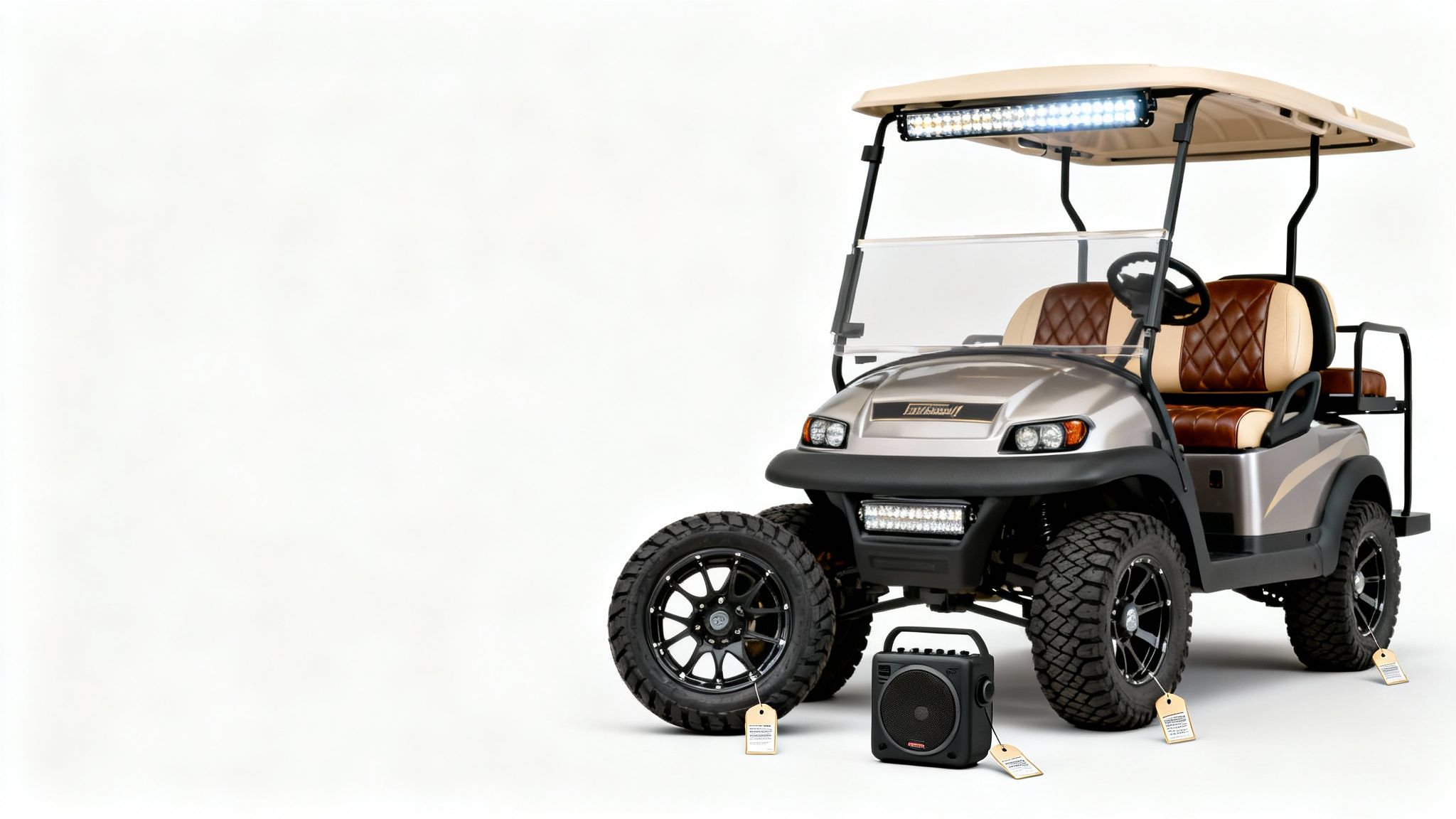
This is where a standard golf cart really starts to become your golf cart. The world of accessories and customizations is where the fun begins, but it's also the easiest place for the cost of an electric golf cart to creep up on you. Think of a base model cart as a blank canvas; every upgrade you add is another brushstroke that brings your vision to life—and adds to the final price tag.
Just like ticking the option boxes when buying a new car, these upgrades are what turn a basic utility vehicle into a personalized ride for the neighborhood or campsite. A simple add-on might only be a few hundred dollars, but a full-blown custom build can easily tack on thousands to your initial purchase. Knowing what these things cost ahead of time helps you decide what's a "must-have" versus a "nice-to-have."
From Functional Upgrades to Full Custom Builds
The range of available accessories is staggering, covering everything from critical safety gear to pure, head-turning luxury. Let's break down some of the most popular upgrades and what you can realistically expect to pay. You’ll see that even within a single category, there’s a huge price spectrum.
- Lift Kits, Wheels, and Tires: This is a big one. A lift kit gives your cart that aggressive, off-road look and makes room for bigger tires. A basic lift kit can start around $500, but once you add a high-performance kit, custom wheels, and beefy all-terrain tires, that figure can easily blow past $2,500.
- Premium Sound Systems: Who doesn't want tunes while they cruise? A simple portable Bluetooth speaker might only set you back $200. But if you're picturing a fully integrated, marine-grade sound system with multiple speakers and a subwoofer, you’re looking at a budget of $800 to over $2,000.
- LED Light Packages: While many carts come with standard headlights, custom lighting is a huge trend. Underbody glow kits, powerful light bars, and colorful LED accent strips can add anywhere from $300 to $1,000+ to the final bill.
Making Your Cart Street Legal
Planning to take your cart off private property and onto public roads? Then you'll need a street-legal kit. This isn't just one item; it's a whole package of safety components required by law. The exact rules can change depending on where you live, but these upgrades are non-negotiable for driving legally on the street.
Becoming "street legal" isn't just a suggestion; it's a mandatory set of upgrades for safety and compliance. These additions directly impact your final cost but are essential for anyone planning to leave private property.
A typical street-legal package will bundle several key components, each with its own cost:
- Headlights, Taillights, and Turn Signals: For seeing and being seen.
- Brake Lights: A must-have safety feature for driving with other vehicles.
- A Horn: To alert pedestrians and other drivers.
- Mirrors: You'll need both side-view and rearview mirrors.
- A Windshield: Usually has to be a specific DOT-approved type.
- Seat Belts: Required for every seating position.
You can often get these parts in a bundle, with installation, for somewhere between $500 and $1,500. If your dream involves cruising to the local store or visiting neighbors, you absolutely need to factor this into your budget from day one.
Why Your Battery Choice Is the Biggest Financial Decision You'll Make
When you’re trying to pin down the true cost of an electric golf cart, the battery isn't just another part—it’s the heart of the machine. It’s easily the single biggest factor that will shape your long-term expenses.
Think of it like picking an engine for a car. You could go for the cheaper option today, only to find yourself paying more down the road in fuel and constant repairs. Or, you could invest in a more efficient, premium engine that pays you back over time with reliability and lower running costs. That’s the exact choice you face with electric golf cart batteries.
You’re essentially choosing between two very different technologies: the old-school, traditional lead-acid battery and the modern, high-performance lithium-ion battery. The path you take will have a huge impact on your cart's performance, how much time you spend on maintenance, and ultimately, your bank account.
Lead-Acid: The Traditional Workhorse
For years, lead-acid batteries were the only game in town. They were the standard for decades, mainly because they were cheap to make, which helped keep the initial sticker price of a new golf cart down.
But that lower upfront cost is a bit of a trade-off. Lead-acid batteries demand a lot of attention over their lifetime. They're incredibly heavy, need regular maintenance (like checking and refilling water levels), and just don't last very long. You can realistically expect to replace a set of lead-acid batteries every 3 to 5 years, and that’s a big, recurring expense.
Lithium-Ion: The Modern Powerhouse
This is where the technology really takes a leap forward. A golf cart powered by a lithium-ion battery will definitely cost you more at the dealership, but the long-term financial picture is where it truly shines.
A lithium-ion battery is the perfect example of "you get what you pay for." That higher initial investment is quickly balanced out by having zero maintenance, noticeably better performance, and a lifespan that can be two or even three times longer than its lead-acid counterpart.
These batteries are much lighter, which improves handling and efficiency. They also charge a whole lot faster and provide consistent, full power right until the battery is empty—no more sluggish performance on the back nine. Best of all? They are completely maintenance-free and built to last 10 years or more. For a deeper look, our guide on the benefits of lithium golf cart batteries explains why this technology is quickly becoming the new industry standard.
This isn’t just happening in the golf cart world. The entire electric vehicle market has moved this way. Demand for lithium-ion batteries in the auto industry shot up by about 65% between 2021 and 2022 alone. That massive scale and investment benefit golf cart owners directly, giving us carts with better range and faster charging. You can read more about this industry-wide shift in the electric golf cart market report from Polaris Market Research.
To really see how these two options stack up financially, it helps to put them side-by-side.
Lead-Acid vs Lithium-Ion Battery Comparison
This table breaks down the key differences that affect both your wallet and your ownership experience over the long haul.
| Feature | Lead-Acid Batteries | Lithium-Ion Batteries |
|---|---|---|
| Upfront Cost | Lower (standard in base models) | Higher ($1,500 – $2,500+ premium) |
| Lifespan | 3-5 Years | 10+ Years |
| Maintenance | Requires regular watering and cleaning | Zero maintenance required |
| Performance | Power fades as battery drains | Consistent power output |
| Charging Time | 8-10 Hours | 2-4 Hours |
| Weight | Heavy (can be over 300 lbs) | Lightweight (usually under 100 lbs) |
When you look at the total cost of ownership over a decade, the lithium-powered cart almost always comes out ahead. You avoid the cost and hassle of replacing batteries every few years, saving you both money and headaches in the long run.
Calculating Your Total Cost of Ownership
To really get a handle on what an electric golf cart will cost you, you have to look past the sticker price. The true expense comes from its total cost of ownership, which gives you the full financial picture over the entire time you'll own it. It's the only way to see the genuine long-term value of your purchase.
Think of it as a simple math problem that wraps up all the expenses we've been talking about:
Purchase Price + Customizations + (Annual Maintenance x Years of Use) + Battery Replacements = Total Cost
When you use this framework, you can compare different models and realize that a cart with a higher upfront cost might actually end up saving you a significant amount of money down the road. Let's run the numbers on two common scenarios to see how this works in the real world.
Two Real-World Scenarios
To really drive this home, let’s compare a buyer focused on the lowest initial price with someone who’s investing in a modern cart for the long haul.
-
Scenario 1: The Budget Buyer: You find a used cart with traditional lead-acid batteries for $5,000. Over a 10-year period, you might spend $1,500 on routine maintenance. But the big cost is replacing those batteries twice, at $1,200 a pop. Your total cost after a decade comes out to $8,900.
-
Scenario 2: The Long-Term Investor: You opt for a brand-new cart with a modern lithium battery for $11,000. Maintenance over those same 10 years is about the same at $1,500. The key difference? No battery replacements are needed. Your total 10-year cost is $12,500.
At first glance, the budget option still seems cheaper. But the gap shrinks considerably when you factor in those recurring battery costs, and that doesn't even account for the hassle. As the infographic below shows, the battery you choose is the single biggest factor in this entire equation.
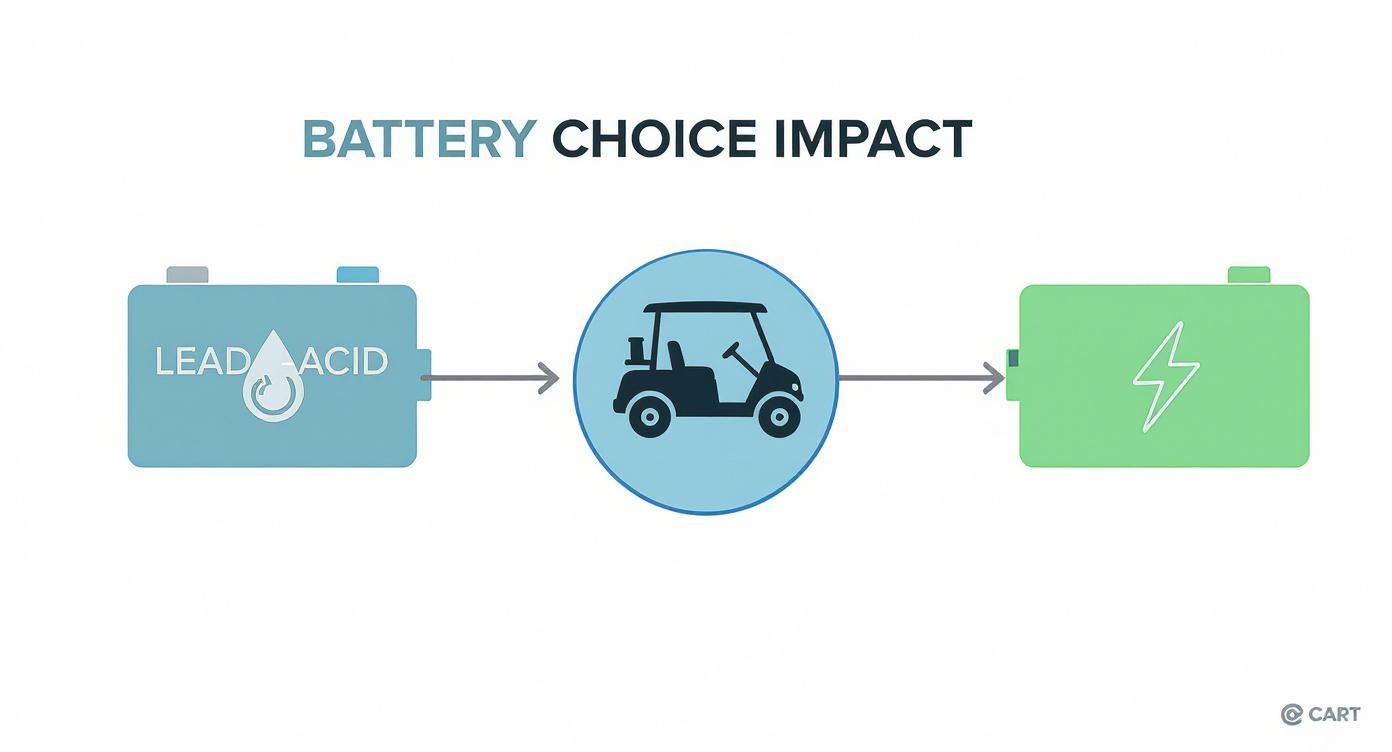
It’s pretty clear from the visual: while lead-acid gets you in the door for less, those repeating replacement costs make lithium a far more predictable—and often more economical—choice over time. This shift toward efficiency and long-term value is happening everywhere. In fact, the entire electric golf cart market was recently valued at around USD 1.55 billion globally. You can learn more about the expanding electric golf cart market on grandviewresearch.com.
Got More Questions? We've Got Answers
Even with all the numbers laid out, you probably still have a few things on your mind. Let's tackle some of the most common questions we get about what it really costs to own an electric golf cart. Think of this as filling in the last few pieces of the puzzle so you can feel great about your decision.
Is an Electric or a Gas Golf Cart Cheaper in the Long Run?
It's a classic showdown: electric versus gas. While a gas-powered cart might tempt you with a slightly lower price tag right off the lot, the electric model almost always wins the race when it comes to total ownership costs.
Just think about "fuel." You're comparing pennies on the dollar for a full charge versus the ever-climbing price of a gallon of gas. Plus, electric carts are mechanically simpler. There are no oil changes, no spark plugs to replace, and no filters to swap out. The big long-term expense is the battery pack, but even when you factor that in, the math usually shows the electric cart pulling ahead.
What's the Bill for Replacing Electric Golf Cart Batteries?
This one really depends on the battery technology you go with.
- Lead-Acid Batteries: The old-school standard. A full set will typically run you between $800 and $1,500. With proper care and maintenance, you can expect them to last about 3-5 years before they need to be replaced.
- Lithium-Ion Batteries: The modern powerhouse. You're looking at a higher initial investment, usually from $1,800 to over $3,000. The trade-off? They're built to last a decade or more with zero maintenance.
In the long game, a lithium-ion battery often proves to be the smarter financial move. You pay more upfront, but you avoid replacing the batteries two or three times over the cart's life.
How Much Does Insurance Bump Up the Total Cost?
Insurance is one of those costs that’s easy to forget but absolutely essential. If your cart is destined to live exclusively on your own private property, your homeowner's policy might offer some limited coverage. Check your policy to be sure.
But the moment you plan to drive on neighborhood roads or public streets, you'll almost certainly need a separate policy. This can cost anywhere from $100 to $400 per year. The final price depends on where you live, the value of your cart, and how much coverage you want. It's a small price to pay to protect your new ride and make sure you're street legal.
Ready to see what a premium electric vehicle with real long-term value looks like? The team at Solana EV can walk you through finding a street-legal cart that matches your style with all the modern tech you need. Come check out our custom vehicles and experience the difference for yourself.