
Thinking about buying a used golf cart? It’s a fantastic way to get a fun, practical vehicle for 40-60% less than a brand-new one. This guide is your roadmap to navigating the process like a pro, covering everything from the initial research and hands-on inspection to striking a great deal. Let's make sure you drive away with a gem, not someone else's headache.
Why Buying a Used Golf Cart Is a Savvy Investment
Going for a pre-owned golf cart is about much more than just saving a few bucks. It’s a smart play that delivers real value, gives a perfectly good machine a second life, and puts high-quality carts within reach for more people. Whether you need it for zipping around your community, managing a large property, or just for fun, a well-chosen used cart is a brilliant asset.
The market backs this up. The global used golf cart scene is a USD 976.6 million industry and it's still growing, with the U.S. market making up a whopping 95% of that revenue. This boom is driven by smart buyers in gated communities, retirement villages, and even industrial settings who appreciate the low upkeep and versatility these carts offer. You can dig deeper into the used golf cart market growth and its key drivers if you're curious about the trends.
The Core Advantages of a Pre-Owned Cart
As you start looking, you’ll find a few major perks that make buying used so appealing:
- Serious Cost Savings: This is the big one. A well-maintained cart with plenty of features can often be had for a fraction of the showroom price, freeing up cash for cool customizations or accessories.
- A Greener Choice: Opting for a used cart is an easy way to be eco-friendly. You’re extending the life of an existing vehicle, which cuts down on the environmental footprint tied to manufacturing and shipping a new one.
- Proven Reliability: Many of the best used carts come from golf course fleets. These machines were usually maintained on a strict schedule. They might have a lot of hours on them, but their service history often means they're mechanically solid and ready for a new home.
A smart buyer sees a used golf cart not just for what it is, but for what it can be. With a solid frame and motor, a few simple upgrades can transform a standard fleet cart into a personalized vehicle that perfectly suits your needs.
This guide will give you the confidence to inspect, test-drive, and negotiate like you’ve been doing it for years. But it’s also important to know when a used cart isn't the right move. If you're someone who absolutely needs a full warranty, the latest safety features, and guaranteed performance right out of the gate, a new street-legal option like a Solana EV could be the better long-term investment.
Let's quickly compare the two paths.
New vs Used Golf Cart A Quick Comparison
This table gives you a high-level look at the main trade-offs between buying a new versus a used golf cart, helping you decide which route is best for you.
| Consideration | Used Golf Cart | New Golf Cart |
|---|---|---|
| Initial Cost | Significantly lower (40-60% less) | Higher upfront investment |
| Warranty | Typically none, or a very limited dealer warranty | Full manufacturer's warranty (usually 2-4 years) |
| Condition | Varies widely; requires thorough inspection | Brand new, pristine condition |
| Technology | Older, may lack modern features like USB ports | Latest tech, safety features, and performance specs |
| Customization | Blank slate for DIY upgrades | Can be customized from the factory, but at a cost |
| Reliability | Dependent on previous use and maintenance | High reliability with no prior wear and tear |
Ultimately, both new and used carts have their place. A used cart is perfect for the budget-conscious buyer who doesn't mind a little inspection work, while a new cart offers peace of mind and the latest and greatest features.
Laying the Groundwork Before You Shop
The best deals on used golf carts aren't found on the lot—they're found long before you even start looking. The smartest buyers I know do their homework first. This prep work is your game plan, helping you figure out exactly what you need so you can ignore the distractions and focus on finding the right machine.
First things first, what's this cart's main job going to be? Think of it as a tool. You wouldn't buy a sledgehammer to hang a picture frame, right? The same logic applies here. Are you just cruising the smooth, paved streets of a retirement community, or do you need a workhorse that can handle a few acres of bumpy terrain?
Defining Your Primary Use Case
Be honest about the kind of ground you'll cover day-to-day. This one decision will point you toward either gas or electric and tell you what kind of suspension and tires you should be looking for.
- Neighborhood Cruiser: For quiet, short hops on pavement, an electric cart is a no-brainer. They’re silent, don't smell, and are incredibly simple to live with.
- Property Workhorse: If you’re hauling mulch, crossing fields, or tackling hills, a gas cart usually wins. It delivers consistent power and you don't have to worry about running out of juice far from an outlet.
- Golf Course Navigator: A standard electric "fleet" cart is literally built for this. Its design is perfectly suited for the stop-and-go rhythm of a round of golf.
I can't tell you how many people I've seen buy a cart that looks cool but is totally wrong for their lifestyle. That big, lifted off-roader with mud tires? It’s going to be a rough, inefficient ride on paved community paths. Get real about your actual needs.
Electric vs. Gas: The Great Debate
This is the first major fork in the road. There’s no single "better" option, only what's better for you.
An electric cart gives you that silent, smooth ride with zero fumes, which is perfect for neighborhood use. The maintenance is generally easier, too—no oil changes or engine work to worry about. The big catch? The batteries. Performance can sag as they get low, and replacing a dead battery pack is the single biggest expense you'll face. We're talking $800 to over $2,000.
On the flip side, a gas cart gives you consistent power and way more range. A quick fill-up at the pump and you're good to go, unlike the hours-long wait for an electric cart to charge. The trade-offs are obvious: engine noise, exhaust fumes, and more mechanical parts that will eventually need attention.
Know the Big Three Brands
When you start shopping, you’re almost guaranteed to run into three names over and over: Club Car, E-Z-GO, and Yamaha. Each has its own reputation, built over decades in the business.
- Club Car: These are famous for their aluminum frames that won't rust. If you live anywhere near the coast or in a humid climate, this is a massive advantage. They're widely considered the tanks of the golf cart world.
- E-Z-GO: You'll see these everywhere, which is great because parts are cheap and easy to find. They typically use steel frames, so get underneath and look for rust, especially on older models.
- Yamaha: Often praised for having the smoothest ride, thanks to the independent rear suspension they put on many of their carts. They make solid gas and electric models, so you can't go wrong either way.
Where to Find Your Used Golf Cart
Once you have a clear picture of what you want, it's time to start the hunt. Don't just look in one place—casting a wider net will almost always land you a better deal. As you search, you can also start thinking about future security. For instance, a great resource to check out is this New Zealand vehicle GPS tracker guide, which can give you ideas for protecting your new investment.
Here are the best places to look for listings:
- Local Dealers: They’re a good source for trade-ins and off-lease fleet carts that have usually been inspected and serviced. You might pay a bit more, but it often comes with peace of mind.
- Online Marketplaces: Sites like Facebook Marketplace and Craigslist are swimming with private seller listings. This is where the best bargains are, but it's completely "buyer beware." Your inspection has to be thorough.
- Community Bulletin Boards: In big golf or retirement communities, people often sell their carts directly to neighbors. These are frequently well-maintained, one-owner machines.
Your Essential Used Golf Cart Inspection Checklist
Alright, you've done your homework and found a promising cart. Now for the most important part of the entire process: the hands-on inspection. This is more than just a quick walk-around; it’s your chance to uncover potential deal-breakers and give yourself some solid negotiating leverage.
Think of yourself as a detective. You're looking for clues that tell the cart’s real story, not just the one the seller is telling you. A fresh coat of paint can easily hide some expensive problems lurking just beneath the surface.
The good news? You don't need to be a certified mechanic to do this right. A flashlight, maybe a cheap voltmeter, and a healthy dose of skepticism are all you really need to spot the most common issues. Let's break down exactly what to look for, piece by piece, so you can walk in with confidence.
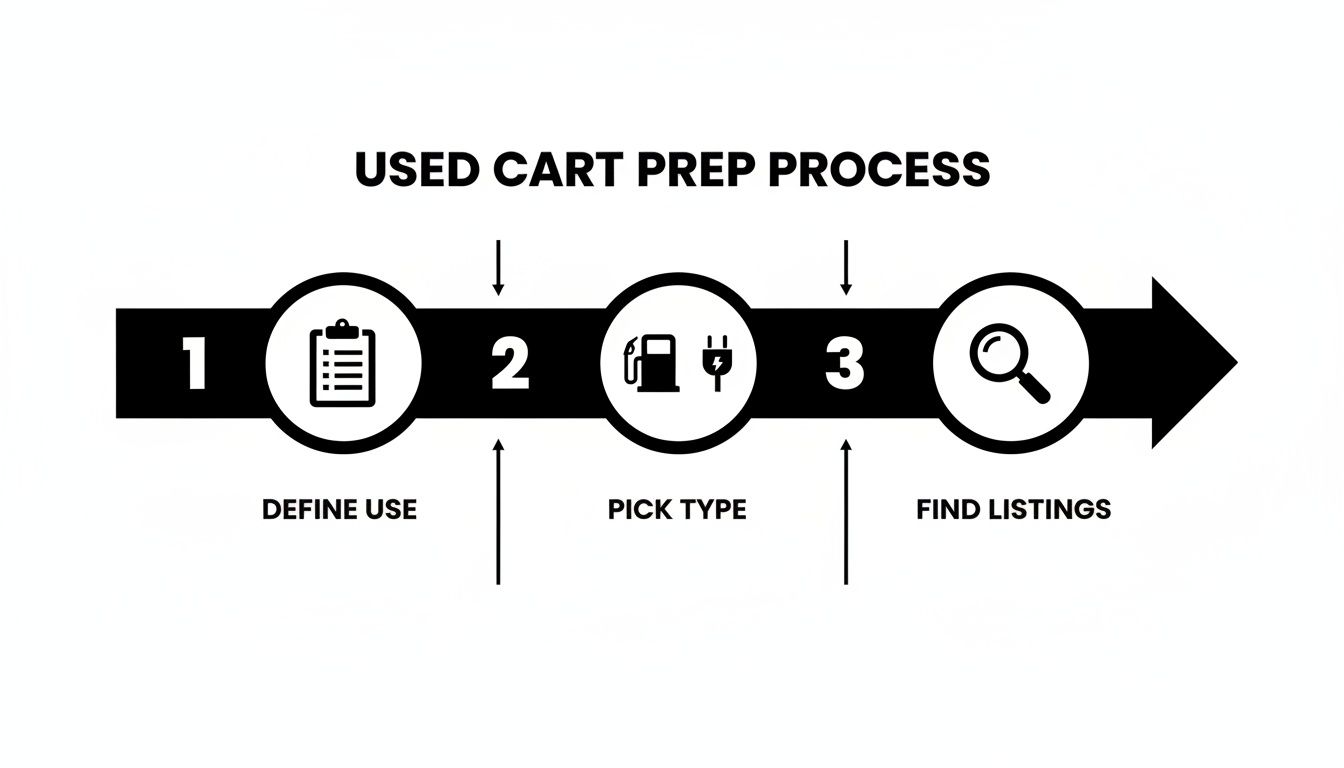
As you can see, a successful buy starts with smart prep work long before you’re standing in someone’s driveway.
Batteries: The Heartbeat of an Electric Cart
For any electric cart, the batteries are king. This is the single most expensive component to replace, often running anywhere from $800 to $2,000, so this is where you need to be ruthless with your inspection. Don't just take the seller's word on their condition—see for yourself.
Pop the seat and get a good look at the battery compartment. The first thing you should do is find the date codes. They’re usually stamped right into the plastic or on a sticker on top of each battery. A lead-acid battery pack typically lasts about 4-7 years. If the ones you're looking at are pushing five years or older, you should automatically plan on replacing them and factor that cost into your offer.
Next, look for obvious physical signs of neglect or failure.
- Corrosion: A bit of fuzzy, white, or blue buildup on the terminals is common, but heavy corrosion is a clear sign of poor maintenance.
- Bulging Cases: If the sides of the batteries look swollen or warped, walk away. This is a tell-tale sign of overcharging or internal failure.
- Leaking Acid: Scan for any wet spots or stains on or around the batteries. This means a case is cracked and compromised.
If you brought a voltmeter, this is its time to shine. Check each battery individually. A fully charged 6V battery should read about 6.3V, an 8V should be around 8.5V, and a 12V should show 12.7V. If you see a big difference in the readings between batteries, the pack is unbalanced and on its way out. For a much deeper look, our guide to understanding used golf cart batteries covers everything you need to know.
To help you stay focused during the walk-around, here’s a quick summary of the most important inspection points.
Inspection Hotspots At a Glance
| Component | What to Check | Major Red Flag |
|---|---|---|
| Batteries | Date codes, corrosion, physical swelling, voltage readings. | Bulging cases or batteries older than five years. |
| Motor | Unusual grinding, clunking, or whining noises. | Any loud, persistent noises during the test ride. |
| Frame | Rust (especially on steel frames), cracks near welds. | Fresh paint trying to hide rust or a shoddy repair. |
| Brakes | Spongy pedal feel, parking brake not holding. | Brake pedal goes to the floor with little resistance. |
| Tires | Uneven wear patterns, cracks on the sidewalls. | Heavy inside/outside wear, indicating alignment issues. |
This table isn't exhaustive, but it covers the big-ticket items that can turn a great deal into a money pit.
The Motor and Drivetrain: Listen for Trouble
Whether it's gas or electric, the motor is the muscle. Your ears are one of your best tools here.
On an electric cart, the motor should be nearly silent, giving off just a faint whine as it accelerates. Any loud grinding, clunking, or high-pitched squealing can point to worn-out bearings or other internal damage—repairs that get expensive fast.
For a gas cart, listen to how it starts. Does it fire right up, or does it crank and struggle? A healthy engine will idle smoothly without a lot of sputtering or shaking. With the engine running, look for any obvious oil leaks around the block or differential. A fresh drip is a clear warning sign.
The growing preference for electric carts isn't just a trend. Buyers, from golf resorts to planned communities, are choosing them to cut fuel costs by up to 80% over gas. What's more, the total cost of ownership is a huge draw, with maintenance for used carts averaging about 30% less per year than for new ones. This is exactly why a tough inspection matters—it ensures you actually get that long-term value.
Frame and Suspension: Checking the Cart's Skeleton
The frame is the foundation, and a bad one is a deal-breaker. Get down on the ground with your flashlight and really inspect the undercarriage. You’re looking for its two biggest enemies: rust and cracks.
Some brands have a natural advantage here. Club Car is famous for its rust-proof aluminum frames, which is a massive bonus. E-Z-GO and Yamaha typically use steel frames, so you'll want to check them very carefully, especially around weld points and any nooks where water could sit.
Be suspicious of any areas with fresh, mismatched paint. It’s often a lazy attempt to cover up a bad weld repair or some serious rust. While you're down there, give the suspension a look. Check for cracked leaf springs, shocks that are leaking fluid, or worn-out bushings. Grab each wheel and try to shake it back and forth—if there's a lot of play, it could signal bad wheel bearings.
Brakes, Tires, and Electrical Systems
Don’t let these "smaller" items slip by, as they're crucial for safety and can add up in replacement costs.
Start with the tires. Is the wear even, or are the inner/outer edges worn down? Uneven wear is a classic sign of a bad alignment, which could hint at bigger frame or suspension problems. Also, check the sidewalls for any cracking, which is a sign of dry rot. Those tires will need replacing soon.
Now, test the brakes. Give the cart a push by hand, then hop in and hit the pedal. It should feel firm and stop the cart decisively. If it feels spongy or goes straight to the floor, the brake system needs attention. Don’t forget the parking brake—engage it on a small slope and make sure it holds.
Finally, go through and test every single electrical component.
- Flip on the headlights (both high and low beams).
- Have someone check the taillights and brake lights.
- Test the turn signals and the horn.
- If there’s a battery meter, make sure it’s working.
Most electrical issues are minor, like a burned-out bulb or a faulty switch. But sometimes, they can point to a bigger wiring headache. It’s better to know exactly what you’re getting into before you start talking price.
What to Look For During the Test Drive
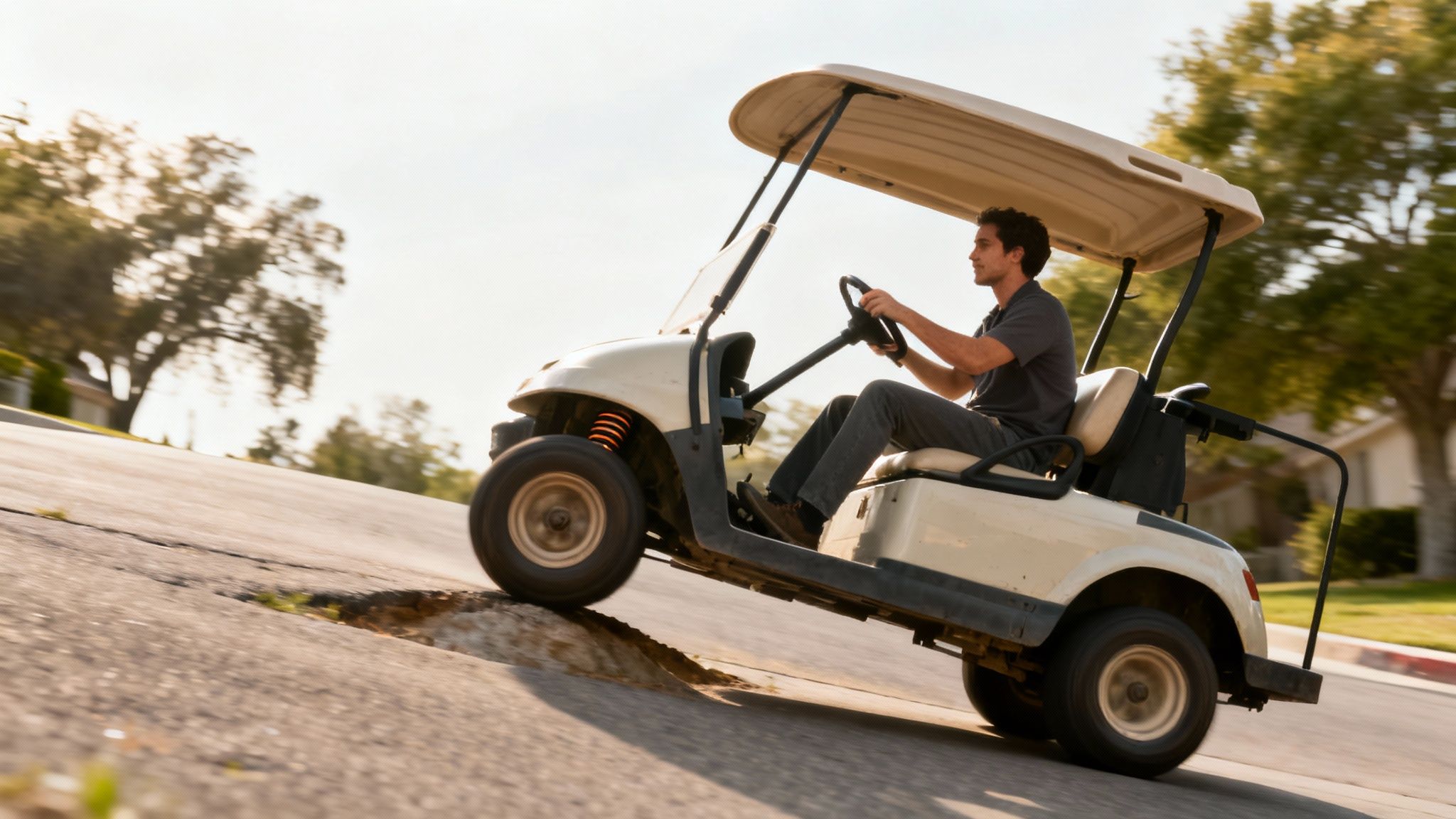
You can poke and prod a golf cart all day long, but the real truth comes out when you drive it. This is where you connect the dots between what you saw during the inspection and how the machine actually performs on the move. I can't stress this enough: never, ever buy a used cart without giving it a proper test drive. It's your single best chance to uncover issues the seller might not even know exist.
And I don't mean a casual lap around the driveway. You need to put the cart through its paces to really test its core components. Before you even turn the key, just sit in it. Does it feel right? Can you comfortably reach the pedals? A good fit matters more than you’d think for long-term enjoyment.
Feel Out the Acceleration and Power
Let's start on a flat, paved surface. As you press the accelerator, notice how the cart responds. It should be smooth, without any lurching or hesitation. An electric cart should deliver that power instantly and almost silently. With a gas model, you'll hear the engine kick in, but it should be a prompt engagement, not a sputtering cough.
Pay close attention to how it builds speed. A sluggish or weak feeling could point to anything from dying batteries in an electric model to a fuel delivery problem in a gas one. This is also your first opportunity to listen for strange noises that only pop up when the motor is under load.
Now for the real test: find a hill. This is the ultimate stress test for the motor and, particularly in an electric cart, the battery pack's health.
- Going Up: The cart needs to climb a decent incline without speed dropping off a cliff. If it seriously struggles or bogs down, that’s a massive red flag for the powertrain.
- Coming Down: On the way down, get a good feel for the brakes. They should bring you to a smooth, controlled stop. If the cart pulls hard to one side or you hear grinding, the brake system needs immediate attention.
The test drive is the final exam. A cart can look showroom-perfect but be hiding a failing controller or a worn-out clutch. Don't be timid—it’s better to discover a problem now than a week after you’ve paid for it.
Listen for Mechanical Clues
This is the time to be quiet and just listen. The sounds a golf cart makes—or doesn't make—can tell you a ton about its mechanical shape.
- A whine from the rear? If you hear a high-pitched whining sound from the back that gets louder with speed, you could be looking at a problem with the differential. That’s often an expensive fix.
- Clicking when you turn? A distinct clicking or popping from the front end while turning usually points to worn-out CV joints or tie rod ends.
- Squealing or grinding brakes? This one’s pretty obvious. A squeal might just be dust, but a grinding noise is a sure sign the brake pads or shoes are shot and need to be replaced right away.
Check the Steering and Suspension
The steering should feel tight and responsive, not loose and sloppy. There shouldn't be a lot of "play" in the wheel. If you find yourself constantly making small corrections just to drive in a straight line, you're likely dealing with an alignment issue or worn steering components.
Next, find some bumps. Seriously, a little uneven ground is your best friend for testing the suspension. This is critical if you plan to use the cart on anything other than perfect pavement. Go over a few bumps and listen for clunks or rattles. The ride should be firm but not overly harsh. If it feels like you're on a pogo stick or you hear loud bangs from underneath, the shocks or leaf springs are probably done for.
Verify the Paperwork and History
While you’re there, ask the seller if they have any service records. A stack of receipts for regular maintenance is a fantastic sign and can confirm important details, like how old the batteries really are.
You also need to find the Vehicle Identification Number (VIN). Look for a sticker or small metal plate, usually in the glove box, under the dash, or on the frame near the front. If you plan to register the cart or make it street-legal, this number is non-negotiable. A missing or altered VIN is an absolute deal-breaker. The VIN allows you to confirm the cart's exact year and model, making sure you’re getting what the seller claims.
Negotiating the Price and Closing the Deal
Alright, you've done the inspection, taken it for a spin, and now you're armed with valuable information. This is where you can save some serious money. It's not about being aggressive or trying to rip someone off; it’s about agreeing on a price that reflects the cart's true condition, warts and all.
Before you ever talk numbers, you need a realistic price range in your head. Hop on Facebook Marketplace, Craigslist, and check a few local dealer sites to see what similar carts are actually selling for. Look for the same make, model, and year. To get a feel for the bigger picture, our guide on how much a golf cart costs breaks down pricing for both new and used models, which is great for context.
Turning Your Findings into Leverage
That checklist you made during the inspection? It's now your best negotiating tool. You're not trying to pick a fight; you're just pointing out the real, tangible costs you'll have to eat after you buy it. This keeps the conversation focused on the cart, not personal feelings.
A good way to open the discussion is by being positive but direct: "The cart runs great, and I'm definitely interested. I did notice the batteries are from 2018, though, and I know I'll have to replace them soon. That's a big expense I need to factor in."
Here are the heavy hitters that give you the most leverage:
- Old Batteries: This is your ace in the hole. A new set of quality batteries can easily run $800 to $2,000. That's a huge bargaining chip.
- Worn Tires: Look for dry rot or bald spots. A quick Google search for a replacement set for that model gives you a real dollar figure to work with.
- The Little Things: Don't forget to add up the smaller stuff. A ripped seat, a busted headlight, a weak parking brake—these costs add up and should be reflected in the final price.
Pro Tip: Don't just point out problems; put a price tag on them. Saying, "A new set of Trojan batteries for this cart is about $950 installed," is far more powerful than a vague "the batteries are old." It anchors the negotiation in cold, hard facts.
Finalizing the Paperwork
Once you've shaken on a price, it's time to make it official. Never, ever close a deal on just a handshake, especially with a private seller. A little bit of paperwork protects everyone involved.
At a minimum, you need a Bill of Sale. Don't leave without it. This simple document should clearly state:
- Buyer and seller names and addresses
- The cart’s year, make, model, and Vehicle Identification Number (VIN)
- The final sale price
- Date of sale
- Signatures from both of you
If the cart has a title (which is common for newer carts or ones that were previously street-legal), make sure the seller signs it over to you properly. A clean title is an absolute must if you plan on registering it for the road later.
With signed papers and keys in your hand, you're officially the proud new owner. Congrats
When a New Street Legal Cart Is the Smarter Move
Navigating the used golf cart market can feel like a treasure hunt, but let's be honest—it’s not without its pitfalls. After you've spent hours inspecting aging batteries, poking around for hidden rust, and stressing about making a cart road-ready, a lot of buyers come to the same conclusion: the potential headaches just aren't worth the savings.
Sometimes, the smartest move is to invest in a brand-new, street-legal vehicle right from the start. This isn’t just about getting something shiny and new; it’s about buying certainty.
When you opt for a new cart, you completely sidestep the biggest risks of the used market. There are no surprise battery replacements looming a few months down the road. You also get to skip the complicated and often expensive process of retrofitting an old cart just to meet local Low-Speed Vehicle (LSV) requirements.
The Clear Advantages of Buying New
A new street-legal cart brings real, tangible benefits to the table that a used model just can't match. For one, the peace of mind that comes with a comprehensive manufacturer’s warranty is invaluable. If something goes wrong, you have a support system ready to help—not just another unexpected repair bill.
Modern safety is another huge factor. New vehicles are built from the ground up with features that are often just an afterthought on older, used carts.
- Integrated Lighting: Headlights, taillights, and turn signals are designed as a core part of the vehicle, not just bolted on later.
- Superior Braking Systems: You get the confidence of modern hydraulic or disc brakes for reliable, predictable stopping power.
- Reinforced Safety Structures: New models are engineered to meet current safety standards, offering better protection for you and your passengers.
The real value of a new street-legal cart is freedom from uncertainty. You get day-one reliability, a full warranty, and the knowledge that every single component is in perfect working order. For many people, that confidence is worth far more than the initial savings on a used vehicle.
Performance and Customization Built for You
Beyond safety, new vehicles just deliver a better overall experience. The battery technology is far more advanced, offering greater range and a longer lifespan than the typical lead-acid packs you'll find in most used carts. For anyone curious about the details, you can learn more about how a modern street legal golf cart is engineered for today's roads.
And maybe the best part? You get exactly what you want. Instead of inheriting someone else's choices and compromises, you get to customize your vehicle right from the factory. You choose the color, the seats, the wheels, and all the accessories that fit your lifestyle perfectly.
When you really weigh the long-term costs and potential frustrations of buying used, a new, purpose-built option like a Solana EV often emerges as the most intelligent investment you can make.
Common Questions About Buying a Used Golf Cart
When you start digging into the used golf cart market, a few questions always pop up. Getting solid answers to these is the key to making a smart buy and avoiding a money pit. Let's tackle the big ones I hear all the time.
How Old Is Too Old for a Cart?
This is a classic "it depends" situation, but I've found the sweet spot is often in the 5-10 year old range. Carts this age have taken their biggest depreciation hit but still have plenty of life left if they've been cared for.
Honestly, the model year is less important than the age of the batteries in an electric cart. A battery pack only lasts about 4-7 years, so a three-year-old cart with original, tired batteries can be a much worse deal than an eight-year-old cart that just got a brand-new set. Always prioritize the condition of the core components over the manufacture date.
What Is the Biggest Hidden Cost?
The batteries. No question about it.
A full replacement set of quality batteries will set you back anywhere from $800 to over $2,000. This one expense can completely wipe out the "great deal" you thought you were getting on the cart itself. It's the number one surprise cost that catches new buyers off guard.
Pro Tip: Always check the date codes stamped on the battery terminals. If they're more than four years old, you have to assume they're on borrowed time. Make this a primary negotiation point—it's a guaranteed upcoming expense.
Can I Make Any Golf Cart Street Legal?
Not a chance. The process to convert a standard golf cart into a street-legal Low-Speed Vehicle (LSV) is way more involved and expensive than most people think.
To be road-worthy, a cart needs a Vehicle Identification Number (VIN), proper lighting, turn signals, mirrors, seatbelts, and a host of other safety features. Retrofitting all this correctly is a major headache. You’re almost always better off buying a vehicle that was built to be an LSV from the factory.
And if you're just looking for more ways to enjoy golf at home, you could skip the cart hassle entirely by looking into things like installing an artificial turf putting green.
If you'd rather bypass the risks of the used market altogether, Solana EV builds brand-new, street-legal vehicles that come with modern performance, up-to-date safety features, and a full factory warranty. You can check out our models at https://solanaev.com and just enjoy the ride.