
A quality battery gauge for your golf cart isn't just a nice accessory—it's an essential upgrade that swaps guesswork for certainty. Think of it as a real fuel gauge for your electric ride. It tells you exactly how much juice you have left, so you never have to worry about getting stranded again.
This simple tool does more than just end "range anxiety." It's also one of the best things you can do to protect the long-term health of your expensive battery pack.
Why an Accurate Battery Gauge Is a Must-Have Upgrade

If you've ever owned a golf cart, you know that sinking feeling. You glance at the vague, factory-installed battery light and wonder, "Do I have enough power to get home?" That common "range anxiety" is more than just a nuisance; it often leads to situations that can seriously damage your batteries and leave you stuck.
A basic factory indicator is a lot like a car's dummy light. It only warns you of a problem when it's already too late.
An accurate, aftermarket battery gauge, on the other hand, gives you the clarity to plan your trips with confidence. It transforms your dashboard from a source of stress into a reliable command center, offering a precise, real-time look at your cart's remaining power.
The Problem vs. The Solution
It's amazing how a small dashboard device can solve so many common headaches for cart owners. A reliable battery meter provides clear solutions to the frustrations that come with vague, inaccurate factory indicators.
Here's a quick look at the problems you face without a good gauge and how an accurate one solves them:
| The Problem Without a Good Gauge | The Solution With an Accurate Gauge |
|---|---|
| Constant "range anxiety" and guesswork. | Plan trips with confidence, knowing your exact range. |
| Risk of getting stranded far from a charger. | Avoid unexpected power loss and costly tows. |
| Damaging batteries by running them too low. | Know precisely when to head back and recharge. |
| Shortening battery life with poor charging habits. | Develop charging routines that protect your investment. |
| Uncertainty about whether the cart is fully charged. | Confirm a full 100% charge to maximize performance. |
Simply put, a good gauge puts you back in control. It provides the information you need to operate your cart efficiently and protect its most vital component.
Protecting Your Most Valuable Asset
Let's be honest: your golf cart’s battery pack is its most expensive and critical part. The number one reason batteries fail prematurely is improper charging and discharging habits. Without an accurate way to monitor your battery's State of Charge (SOC), you’re flying blind and risking two major issues:
- Deep Discharging: Running your batteries until they're completely dead causes irreversible damage, especially to traditional lead-acid batteries. It drastically shortens their lifespan.
- Undercharging: If you consistently fail to bring your batteries back to a full charge, you'll slowly kill their capacity and performance over time.
An accurate gauge helps you avoid both problems. It shows you exactly when it's time to plug in and, just as importantly, when the charging cycle is truly complete.
By providing a clear, real-time view of your power reserves, a reliable battery meter empowers you to adopt charging habits that maximize battery health and can extend its operational life by years.
It Just Makes Financial Sense
Investing in a reliable battery gauge for your golf cart is a small price to pay to protect a much larger investment. The global market for golf cart batteries was valued at around USD 149.9 million in 2024, and that number is only going up as more people shift to electric transportation. This growth really highlights why advanced monitoring tools are so important for managing these valuable assets. You can read more about the golf cart battery market to see the industry trends for yourself.
A good gauge helps you avoid costly, premature battery replacements and the hassle of needing a tow. Whether you're managing a fleet of carts at a resort or just cruising your neighborhood, the benefits are crystal clear. You get peace of mind, you protect your investment, and you ensure your cart is always ready for the next adventure.
How a Battery Gauge Actually Knows How Much Juice Is Left
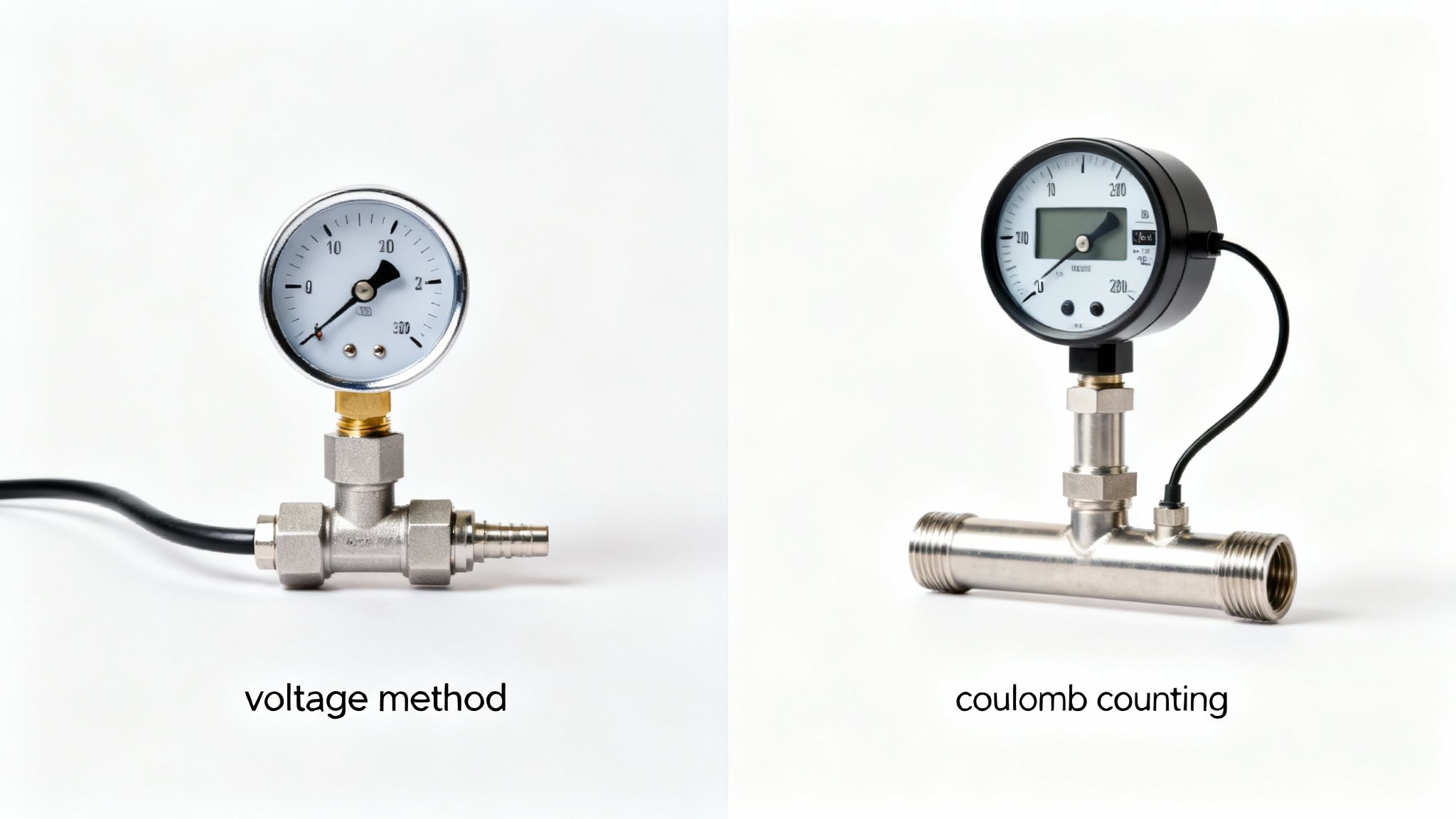
To really get why some gauges are rock-solid and others are basically guessing, we need to pop the hood and see how they tick. Every single battery gauge for a golf cart is trying to answer one question: what’s the battery's State of Charge (SOC)? Think of it as a simple percentage, just like the one on your phone, telling you how full the "tank" is.
But how they arrive at that percentage is where things get interesting. The methods can be worlds apart in terms of accuracy.
Let's use a simple analogy. Your cart's battery pack is a big water tank. The gauge's job is to tell you how much water is left. There are a couple of ways to do this—one is quick but unreliable, and the other is more involved but dead-on accurate.
The Guessing Game: Reading Voltage
The most basic way to estimate SOC is by measuring the battery's voltage. This is like trying to figure out how full our water tank is just by checking the water pressure at the spigot. When the tank is full, the pressure is high. As the water level drops, the pressure falls. Simple, right?
Well, not quite. This method has a huge flaw. If you suddenly crank the spigot wide open (the equivalent of flooring your cart up a hill), the pressure plummets, even if the tank is still nearly full. This effect is called voltage sag.
A voltage-based gauge gives a reading that’s constantly thrown off by what you’re doing. It might say you're at 80% when you’re cruising on a flat, then suddenly dive to 40% the second you accelerate. It’s almost impossible to trust.
This is exactly why so many factory-installed gauges feel so frustratingly vague, especially with lithium batteries, which hold their voltage incredibly steady right up until they're nearly empty.
The Accountant's Method: Counting Coulombs
A much smarter, more precise method is coulomb counting. Forget checking pressure. This is like installing a highly accurate flow meter on the pipes going into and out of our water tank. It meticulously tracks every single drop of water that goes in when you fill it and every drop that goes out when you use it.
This "bookkeeping" approach is made possible by a small but critical device called a shunt. A shunt is a special sensor installed on the main negative battery cable that precisely measures the current (amps) flowing in and out of the battery pack.
The gauge uses this real-time data to keep a perfect running tally of the energy consumed. It’s no longer guessing based on a jumpy side effect like voltage; it's tracking the actual energy itself. This is how modern SOC meters can give you that reliable 0-100% reading you can actually count on.
- During charging, the meter counts the amps flowing into the battery, adding to its total.
- While driving, it counts the amps flowing out of the battery, subtracting from the total.
- For precision, the best gauges even factor in things like charging efficiency and temperature to keep their calculations razor-sharp.
This detailed tracking is often handled by a small computer, either in the gauge itself or as part of a larger system. These concepts are very similar to what a full-blown Battery Management System does. You can dive deeper into that by checking out our guide on what a Battery Management System is. At the end of the day, coulomb counting is what transforms a gauge from a vague needle into a true fuel meter for your cart.
A Closer Look at the Different Types of Battery Gauges
Alright, now that we've covered the basics of voltage versus amp-counting, let's get into the hardware you'll actually be installing on your cart. Picking a battery gauge for a golf cart isn't just about what looks cool on your dash; it's about choosing the right technology for your battery pack and how you use your cart. The options run the gamut from simple, old-school needles to sophisticated monitors that give you the full story on your power system.
Think of it like the fuel gauge in your car. A basic gauge might just have a needle pointing somewhere between 'E' and 'F'. A more advanced system will tell you exactly how many miles you have left until empty. They both do the same job, but one gives you information you can actually act on.
The Old Guard: Analog Voltage Meters
First up is the most classic option: the analog voltage meter. You’ve seen these before—a physical needle that swings across a colored dial, usually with green, yellow, and red zones to show the charge. They’re simple, cheap, and you can get a rough idea of your status with just a quick glance.
But that simplicity is also its biggest problem. Since it only reads voltage, it falls victim to the voltage sag we talked about earlier. Every time you punch the accelerator or head up a hill, you'll see that needle dip, sometimes dramatically. It's more of a real-time power meter than a reliable fuel gauge, which can leave you guessing about how much range you really have left.
A Sharper Look: Digital Voltage Meters
Digital voltage meters seem like a solid upgrade. They ditch the sweeping needle for a crisp, numerical readout of your pack's voltage, like "48.5V". On the surface, this feels much more precise, and in a way, it is. You're getting an exact number instead of just a needle in a colored zone.
Don't be fooled by the modern display, though. Under the hood, it's the exact same technology as its analog cousin. It’s still just measuring voltage, which means it’s just as prone to giving you a misleading reading when the cart is under load. A digital meter is handy for troubleshooting, but it's not the reliable, everyday fuel gauge you're probably looking for.
The Bottom Line: Both analog and digital voltage meters are essentially making an educated guess about your battery's charge. They’re okay for checking if your pack is full when it's resting in the garage, but they’re notoriously inaccurate for predicting your remaining range while you're actually driving.
The Modern Solution: State of Charge (SOC) Percentage Meters
This is where things get interesting. State of Charge (SOC) meters are the real deal—true fuel gauges that give you a clear 0-100% reading you can count on. These smarter devices don't just glance at voltage. They use a more sophisticated method, typically coulomb counting with a device called a shunt, to track the actual energy moving in and out of your batteries.
Think of an SOC meter as a tiny accountant for your battery pack. It knows how much energy the pack holds when it's full, and it meticulously subtracts every bit of power you use. This gives you a stable, real-time percentage that doesn't lie, whether you're parked, cruising down a flat path, or climbing a steep incline.
This level of accuracy is becoming more and more important. While traditional lead-acid batteries still make up a huge chunk of the market—about 67.3% globally—lithium-ion is catching on fast. For lithium packs, a good SOC meter is non-negotiable because their voltage stays almost flat until they're nearly dead, making voltage-based gauges completely useless. You can see how the golf cart battery market is shifting to get a better sense of this trend.
Display Styles and Advanced Features
Beyond the core technology, you'll find modern SOC meters with a few different kinds of displays and features:
- LED Bar Graphs: A simple, visual row of lights that gives you an at-a-glance idea of your charge level.
- LCD/OLED Screens: These are the most informative, often showing much more than just the percentage. You'll frequently see:
- Real-time voltage
- Current draw in Amps
- Remaining Amp-Hours (Ah)
- Estimated time remaining at your current power draw
Ultimately, choosing the right battery gauge for your golf cart depends on what you need. If a rough estimate is good enough for your short trips around the neighborhood, a simple voltage meter might do the job. But if you want genuine peace of mind and the ability to properly manage your battery's health, an SOC percentage meter is the only way to go.
How to Choose the Right Battery Gauge for Your Cart
Picking the right battery gauge for your golf cart isn’t just about filling a hole in the dashboard. It’s about getting a reliable tool you can trust, one that won't leave you stranded a mile from home. The goal is to match the gauge to your cart's specific power system, and a little forethought here goes a long way.
Think of it like choosing the right tires for your car. You wouldn't put economy tires on a high-performance vehicle and expect good results. The same logic applies here; the right gauge ensures you get an accurate, useful reading every time.
This diagram breaks down the main types of gauges out there, from the simplest analog needles to the most precise digital readouts.
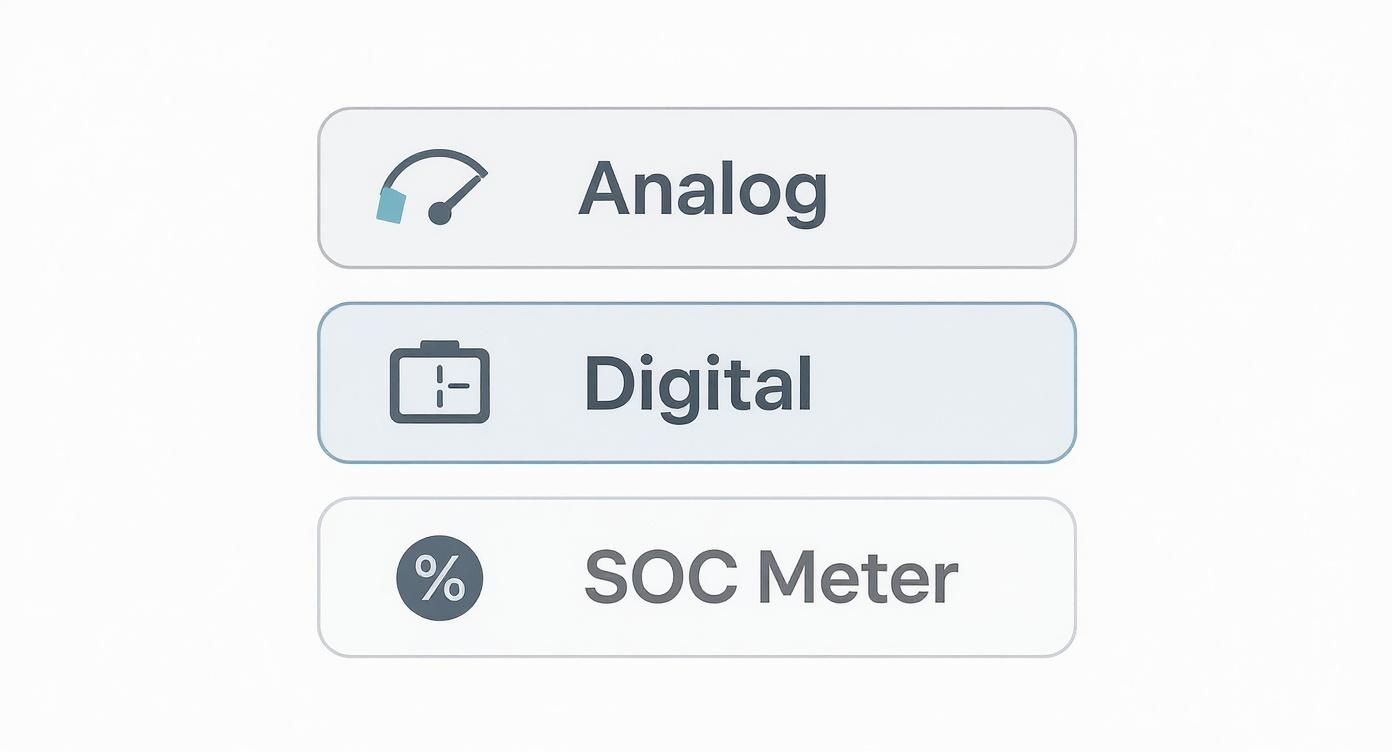
As you can see, the technology moves from basic voltage estimates to direct energy measurement, giving you a clearer and more accurate picture of what's happening in your battery pack.
Match the Gauge to Your Battery Chemistry
This is the single most important part of the equation. A gauge built for an old-school lead-acid battery will give you completely useless information if you’re running a modern lithium pack. They just don't speak the same language.
-
For Lead-Acid Batteries: These batteries have a nice, predictable voltage drop as they lose power. A simple voltage meter can track this decline and give you a reasonably good, though not perfect, estimate of your remaining charge.
-
For Lithium Batteries: Lithium is a different beast entirely. It holds its voltage high and steady until it's nearly empty, then drops off a cliff. A voltage gauge will read "100% full" for almost the entire ride, right up until your cart suddenly stops. For a lithium setup, a coulomb-counting State of Charge (SOC) meter is the only way to get an accurate reading.
If you've made the leap to a modern power source, your monitoring system needs to keep up. You can dive deeper into why this matters in our comprehensive guide to golf cart lithium batteries, which breaks down all the performance perks.
Confirm Your Cart's System Voltage
Next up: voltage. You absolutely have to match the gauge to your cart’s electrical system. Putting a 48V gauge on a 36V cart (or vice-versa) won't just give you crazy-wrong readings—it could fry the gauge itself.
Not sure what your system voltage is? Just count the number of batteries in your pack and multiply by their individual voltage. For example, six 8-volt batteries mean you have a 48V system. Simple as that.
Decide on Your Desired Accuracy and Display
So, what kind of information do you actually need? Your answer will depend on how you use your cart and what you're willing to spend.
-
Basic Accuracy: Just running to the mailbox and back? A simple digital voltage meter might be all you need. It's an affordable choice that gives you a general sense of your battery's health.
-
High Accuracy: If you're heading out for 18 holes, using your cart for work, or just want total peace of mind, an SOC percentage meter is the way to go. It works like a real fuel gauge, giving you a reliable 0-100% reading you can count on.
Don't forget about the display itself. Do you drive at night and need a backlit screen? Do you prefer a simple LED bar graph or a detailed LCD screen showing voltage, amps, and remaining amp-hours? These little features make a big difference in day-to-day usability.
Consider the Installation and Market Trends
Finally, think about getting it installed. A basic two-wire voltage meter is a pretty straightforward DIY job for most people. An advanced SOC meter, on the other hand, requires you to install a device called a shunt on the main negative battery cable. It's a bit more involved, so be honest with yourself about whether you want to tackle it or call in a pro.
As battery technology gets better, so do the tools to monitor it. The golf cart battery market is projected to jump from USD 158.0 million in 2025 to USD 267.3 million by 2035, and that growth is fueled by smarter, more efficient batteries. Picking a quality gauge today ensures your monitoring gear isn’t left in the dust.
To help you sort through the options, here's a quick checklist of what to look for.
Gauge Selection Checklist
This table breaks down the key features to help you decide what's most important for your specific needs when picking a battery gauge.
| Feature To Consider | Why It's Important | Ideal For… |
|---|---|---|
| Battery Chemistry | Gauges are calibrated for either Lead-Acid's voltage drop or Lithium's flat curve. A mismatch gives false readings. | Lead-Acid: Voltage Gauges Lithium: SOC % / Coulomb Counters |
| System Voltage | The gauge must match your cart's total voltage (e.g., 36V, 48V, 72V) for safety and accuracy. | Carts of any voltage, as long as the gauge's rating matches the system. |
| Accuracy Level | Determines how precisely you can trust the reading. SOC meters are far more accurate than voltage-based ones. | High Accuracy: Long-range users, fleet managers. Basic Accuracy: Casual, short-trip use. |
| Display Type | Affects readability in different conditions (day/night) and the amount of data shown at a glance. | Digital LCD: Data lovers. LED Bar: At-a-glance checks. Backlit: Nighttime drivers. |
| Installation | Ranges from a simple two-wire hookup to a more complex installation involving a current shunt. | Simple: DIY enthusiasts. Complex: Users comfortable with wiring or professional installers. |
Ultimately, the best gauge is the one that gives you the information you need, in a format you can easily use, and is fully compatible with your cart's power system. Taking the time to choose wisely pays off every time you turn the key.
A Look at the Installation Process

Putting a new battery gauge on your golf cart is a weekend project that pays off big time, giving you a real handle on your cart's range. While you should always follow the specific instructions that come with your new gauge, this overview will walk you through the key steps so you know exactly what you’re getting into. But first, let’s talk safety.
You’re dealing with a high-voltage electrical system, and you can’t afford to take shortcuts. Before you even think about touching a wire, you have to completely disconnect the battery pack. Flip the cart’s tow/run switch to "TOW," then physically unbolt the main negative and main positive cables from the battery bank. Seriously, don't skip this. It's the only way to ensure the system is dead and safe to work on.
Prep Work: Location, Location, Location
With the power safely off, your first decision is where to put the new gauge. You want it somewhere on the dash where you can see it easily without it becoming a distraction. Take a peek behind your chosen spot to make sure you won't be drilling into any existing wiring or a hidden support bracket.
Once you’ve found the perfect home for it, you'll need to run the wiring from the gauge down to the battery compartment. The best practice here is to follow the cart’s factory wiring harness. This path is already protected and out of the way. Use a few zip ties to secure the new wires alongside the old ones, keeping everything neat and preventing any future pinches or snags.
The Brains of the Operation: The Shunt
For a truly accurate State of Charge (SOC) meter, the shunt is the most important piece of the puzzle. This little device is the sensor that meticulously measures every single amp of electricity flowing out of—and back into—your battery pack. Think of it as the smart meter for your golf cart.
Getting the shunt installed correctly is absolutely critical for the gauge to work. Here’s the play-by-play:
- Find the Main Negative: Look for the thick, primary cable that connects the main negative terminal of your battery pack to the motor controller.
- Disconnect It: Unbolt this main negative cable from the battery terminal itself.
- Install the Shunt: Bolt the shunt directly onto that now-empty main negative battery terminal.
- Reconnect the Cable: Take the main negative cable you just removed and attach it to the other post on the shunt.
That’s it. Now, every drop of power has to flow through the shunt before it can get to the rest of the cart. This is what allows the gauge to keep a precise running tab on your energy consumption.
A Word of Caution: This is the one step you can't afford to mess up. A clean, tight connection at the shunt is non-negotiable for accurate readings. A loose connection will throw off your gauge and could even cause power issues.
The Final Connections and Setup
With the shunt wired in, you're on the home stretch. Connect the gauge's power wires directly to the battery pack—positive to the main positive terminal, negative to the main negative. Then, run the smaller data wire from the shunt up to the gauge display.
Now for the moment of truth. Reconnect your main battery cables, flip the tow switch back to "RUN," and turn the key. Your new gauge should light up. The last, and arguably most important, step is calibration. You have to program the gauge with your battery pack's specific details: its chemistry (lead-acid or lithium) and its total capacity in amp-hours (for example, 105Ah). This step syncs the gauge’s 0-100% display with your battery's actual capacity, giving you reliable readings you can finally count on.
Troubleshooting Common Battery Gauge Issues
Even the best battery gauge for a golf cart can act up now and then. But don't panic—most of the time, the fix is surprisingly simple. A wonky reading rarely means the gauge itself is toast. It's usually just a symptom of a minor issue with the wiring, calibration, or even how you're charging the cart.
Before you start tearing things apart, always check the basics. Make sure every connection is clean, tight, and free of corrosion, both on the battery terminals and on the back of the gauge. A single loose wire is the number one cause of a misbehaving meter and can make readings jump all over the place or just black out completely.
Gauge Is Stuck at 100%
So, your gauge is stuck on full, reading 100% even after you’ve driven around the neighborhood a few times. This is one of the most common head-scratchers, and it almost always points to an installation mistake, especially if you have a modern State of Charge (SOC) meter with a shunt.
The problem is almost certainly how the shunt is wired. If any of your cart's accessories—or even the main motor controller—are connected in a way that bypasses the shunt, the gauge can't "see" the power being drawn. In its view, no energy is leaving the battery, so it keeps telling you the tank is full.
- The Fix: Take a close look at the main negative terminal of your battery pack. The only wire connected to it should be the one running to the shunt. Every other negative wire from your cart must be attached to the other side of the shunt.
Readings Fluctuate Wildly
Is your battery percentage dropping from 90% to 50% every time you hit the accelerator up a hill, only to pop back up on flat ground? That’s a classic sign of voltage sag, and it's completely normal for a basic voltage-based meter. It’s not broken; it’s just showing you the immediate drop in battery voltage when the motor is working hard.
But if you have a higher-end SOC meter and see those kinds of erratic jumps, you likely have a poor connection. A wire that's just a little bit loose on the shunt, the battery terminals, or the gauge itself will cause inconsistent readings. Go back and double-check that everything is snug.
Key Takeaway: A jumping reading on a basic gauge is just how it works. A jumping reading on an advanced SOC meter is your cue to inspect all your wiring for loose or corroded connections.
Gauge Shows Empty but the Cart Still Runs
This one can be really frustrating. The gauge insists your battery is dead, but the cart is still zipping along just fine. This almost always happens because the gauge hasn't been properly calibrated for your specific battery pack.
The gauge is essentially using default "empty" and "full" settings that don't match what your batteries can actually hold. It’s especially common right after you install new batteries with a different amp-hour capacity than the old set. To get accurate readings, you have to tell the gauge the correct amp-hour rating of your new pack. This syncs its 0-100% scale to your battery's true capacity.
Proper calibration is a key part of smart power management. You can dive deeper into this by checking out our detailed guide on best practices for golf cart battery maintenance. Letting your cart complete a full charge cycle right after installation also helps the gauge learn the ropes and set an accurate baseline.
Frequently Asked Questions
When you start digging into golf cart upgrades, a few questions always seem to surface. Let’s tackle some of the most common ones about your battery gauge for golf cart so you can choose the right one and get it installed without any headaches.
Can I Use a 48V Gauge on a 36V System?
The short answer is a definite no. You absolutely must match your gauge's voltage to your cart's system voltage.
Think of it this way: using a 48V gauge on a 36V system is like trying to measure a small room with a yardstick that only starts at the 50-yard line. The readings you get will be completely wrong and, frankly, dangerous. A 48V gauge is calibrated for a much higher voltage range and can't make sense of the lower output from a 36V pack.
Before you buy anything, double-check your cart's total voltage. If you see six 8V batteries wired together, you’ve got a 48V system. Getting a gauge that's built for that specific number is non-negotiable for it to work correctly.
Why Is My Gauge Reading My New Lithium Battery Incorrectly?
This is a classic—and very frustrating—problem for anyone who’s just upgraded to lithium. The issue is that your old gauge was designed for the predictable, steady voltage decline of a lead-acid battery. As a lead-acid battery drains, its voltage drops at a nice, even pace that the gauge can easily track.
Lithium batteries are a different beast entirely. They have what's called a flat discharge curve. This means their voltage holds strong and steady right up until they're nearly empty, then it plummets suddenly.
Your old voltage-based gauge is completely fooled by this. It will likely show your battery is at or near 100% right up until the cart dies on you with no warning. You need a modern State of Charge (SOC) meter designed specifically for lithium chemistry to get an accurate reading.
What Is a Shunt and Why Do I Need One?
A shunt is a small, but incredibly important, sensor that’s essential for any truly accurate battery gauge. It's installed on the main negative battery cable, where it acts like a smart meter for your entire electrical system. Every amp of power that flows into or out of your battery pack has to pass through it.
By measuring the minuscule, predictable voltage drop across the shunt, a modern gauge can precisely track every bit of energy used. This method, often called "coulomb counting," is what gives you a reliable, real-world State of Charge percentage instead of a rough guess based on fluctuating battery voltage.
Ready to stop guessing how much range you have left? The advanced, street-legal electric vehicles from Solana EV come standard with clear, reliable monitoring systems, letting you just enjoy the ride. Discover a smarter way to drive with Solana.