
You're checking a resort cart before the morning rounds, and your insulated tumbler slides neatly into its holder. Then you reach for the parking brake and discover the handle is in the way. The cup fits, but the installation doesn't. That's the distinction that matters when choosing auto cup holders for golf carts and electric UTVs.
Table of Contents
- Why the Right Cup Holder Matters More Than You Think
- How Auto Cup Holders Actually Hold On
- Mounting Styles for Golf Carts and Electric UTVs
- Materials, Temperature Ratings, and Off-Road Durability
- The Oversized Tumbler Problem and Cabin Access
- Installing Auto Cup Holders on a Solana EV Cart
- Cleaning, Drainage, and Maintenance Schedules
- Choosing the Right Holder for Your Use Case
Why the Right Cup Holder Matters More Than You Think
A cup holder looks like a small accessory until it changes how someone uses the vehicle. A passenger has to hold a bottle through a gravel stretch. A driver can't lift a travel mug without catching its handle. Maintenance staff find sticky water trapped beneath a liner after washing the cart.
These aren't all sizing problems. They're fitment problems, involving the container, the mount, the surrounding cabin, and the conditions in which the vehicle operates. Buying a wider opening addresses only part of that combination.
Treat the Holder as Part of the Cabin
For a resort manager evaluating a cart, a useful inspection starts with ordinary tasks rather than a product specification. Sit in the driving position, operate the brake, reach the switches, and enter and exit with the intended drinkware installed. Have a passenger do the same.
Then consider the route. Acceleration, braking, and turning apply loads in different directions, while uneven pavement adds movement that a showroom demonstration won't reproduce. A holder that feels satisfactory beside the service counter still needs validation in the vehicle's intended environment.
Practical rule: Choose the location and the drinkware together. Don't buy a holder first and expect the cabin to accommodate it.
The history helps explain why expectations are so mixed. Early automotive beverage supports included passenger trays intended for use while stopped, while built-in holders became established equipment through later vehicle development, as described in AAA's history of the car cup holder.
Today's buyer expects much more than somewhere to park a drink. For neighborhood streets, resort paths, and gravel trails, a good choice must balance retention, access, and serviceability. More capacity isn't useful if the holder compromises any of those.
How Auto Cup Holders Actually Hold On
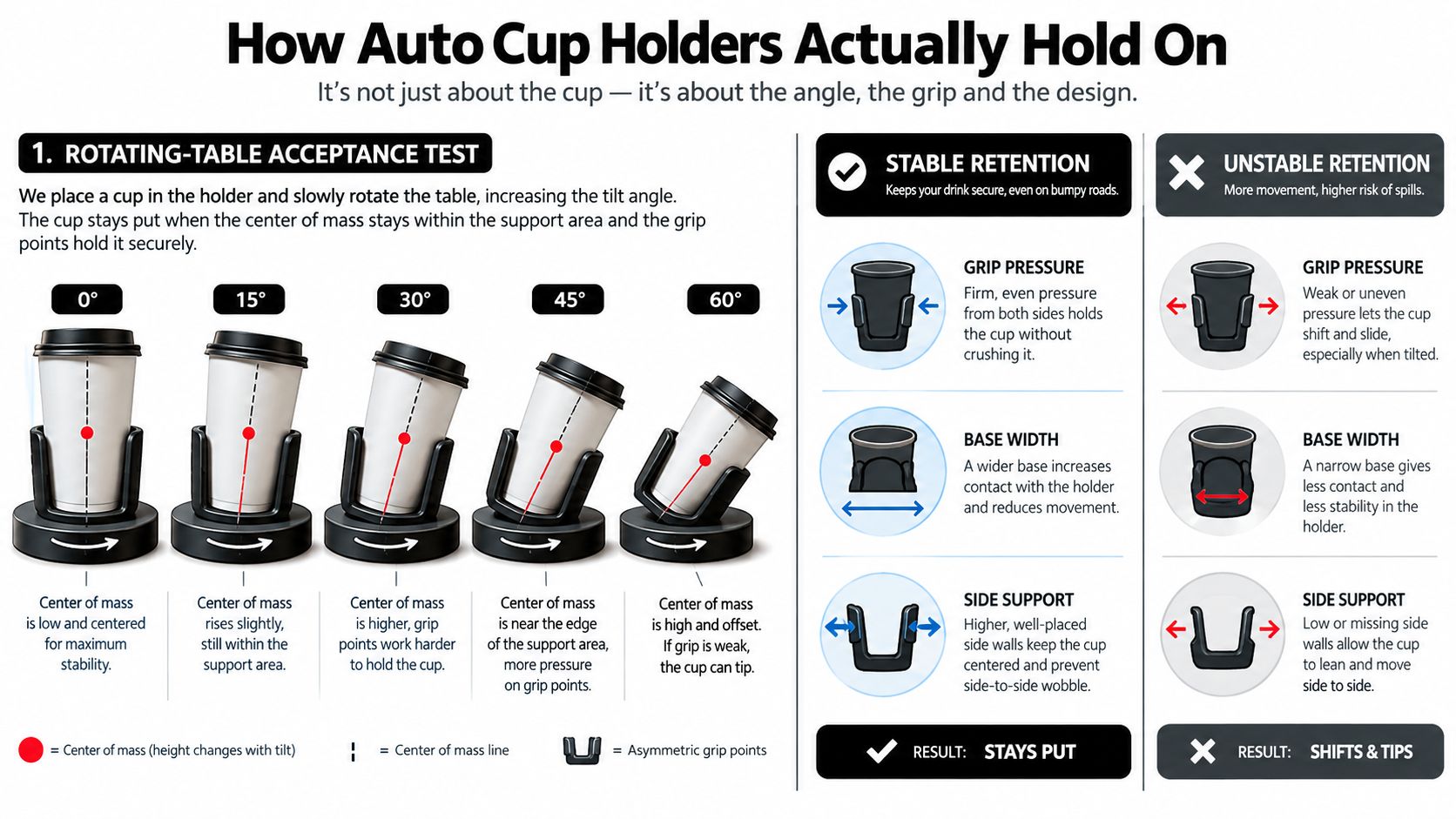
Diameter tells you whether a container enters the opening. It doesn't tell you whether the container stays upright. A tall bottle places its center of mass farther above the support, while a handled mug introduces asymmetric geometry. Both deserve more scrutiny than a short, straight-sided cup.
A published cup-holder retention test uses a rotating table to simulate acceleration, braking, and turning, with acceptance targets of no tipping before 0.8 g and no ejection before 1.0 g. Those are targets from that procedure, not proof that an untested accessory meets a universal certification.
The illustration highlights the relationship between support and container geometry.
Match the Retention Mechanism to the Container
A fixed well relies on its base and surrounding walls. During a turn, a closely supported cup bears against the wall; a narrow bottle inside a broad well has room to lean before receiving support.
Retractable arms or cradles adjust the contact position. They can accommodate different shapes, but check whether they contact a tapered tumbler firmly or merely touch its widest upper section.
An elastomer-grip insert adds compliant contact and friction. It can keep a bottle from rattling, but excessive grip makes removal awkward. The goal is controlled support, not the tightest possible squeeze.
Retention Design at a Glance
| Retention family | Best drinkware | One-handed use | Off-road weakness |
|---|---|---|---|
| Fixed well | Containers closely matching its shape | Straightforward when clearance is adequate | Loose bottles can lean or rattle |
| Retractable arm or cradle | Mixed sizes within its adjustment range | Depends on adjustment and release behavior | Moving joints need inspection |
| Elastomer grip | Bottles and tumblers matching the liner | Good when grip force is balanced | Worn or contaminated contact surfaces |
Test empty, partially filled, and filled containers. Liquid changes inertial loading, and fill level changes the effective center of gravity. Don't assume the result from an empty display tumbler represents a passenger's full drink.
Mounting Styles for Golf Carts and Electric UTVs
The best retention mechanism can still be wrong in the wrong location. Compare mounts from the seated position, with the actual cup installed, rather than judging an empty holder from outside the cart.
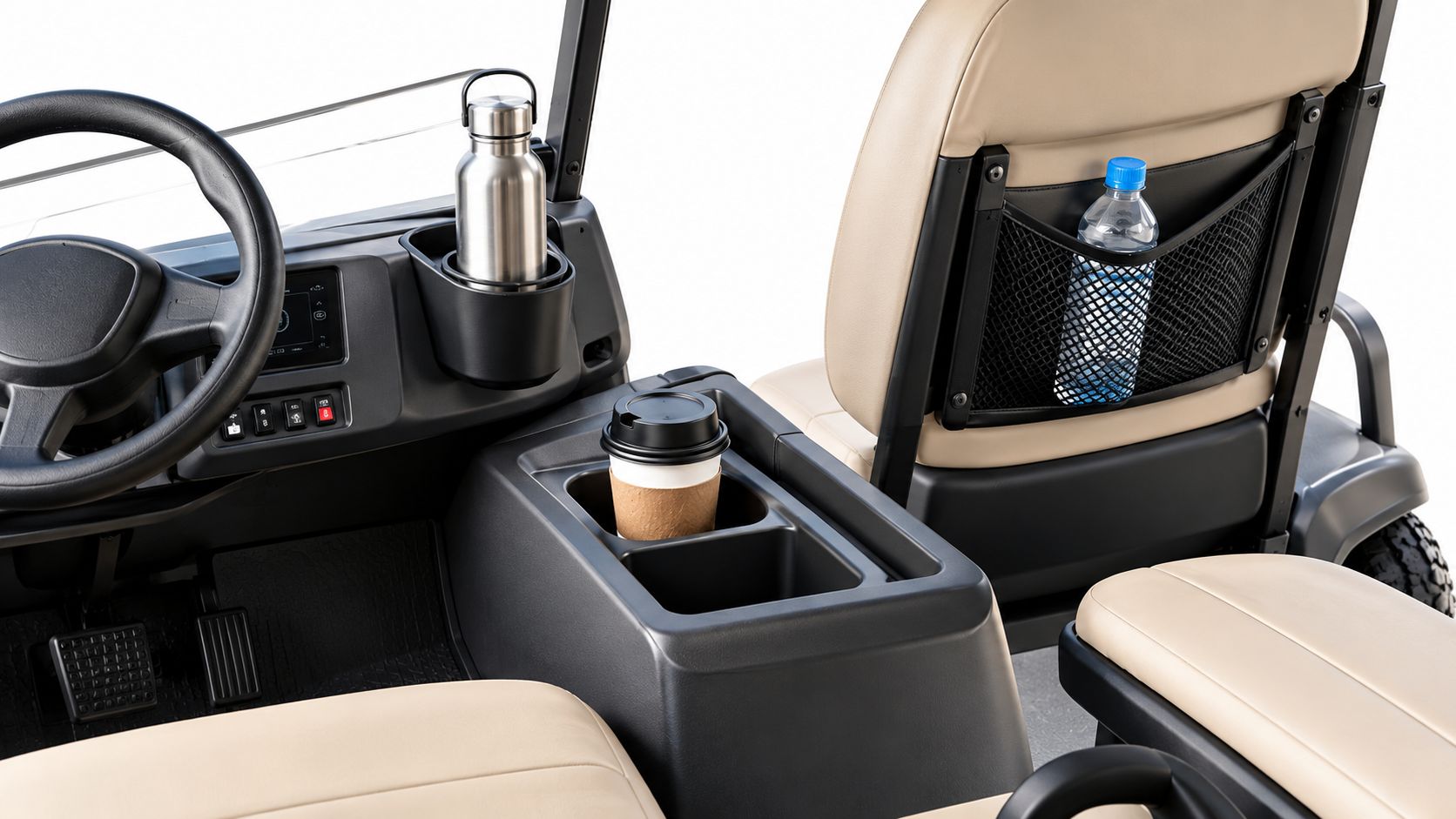
This cabin example shows why beverage storage needs to be considered alongside seating and other storage.
Compare Locations Before Hardware
Dash-mounted pods can provide convenient reach, but their installed height needs checking against switches and displays. Console wells keep the accessory contained within existing cabin space, provided the container doesn't occupy the brake or selector's operating envelope.
A seat-back net may suit passenger storage, but don't treat a flexible pouch as a validated beverage-retention device. Between-seat rail mounts offer another placement option, though occupants still need unobstructed access to seats and restraints.
For a rail-mounted drop-in holder, confirm that the clamp matches the rail profile and resists rotation. On an aluminum structure, the mounting method should follow vehicle and accessory guidance rather than relying on clamp pressure alone.
| Design approach | Retention consideration | One-handed use | Cleanability |
|---|---|---|---|
| Fixed | Evaluate the complete mounted assembly | No adjustment during use | Depends on access to the well |
| Removable | Check the locking interface | Should stay attached when lifting a cup | Easier access if removal is straightforward |
| Adjustable | Verify every intended position | Avoid settings that require attention while driving | Joints and recesses add cleaning work |
These are inspection criteria, not universal performance rankings. A removable holder with a secure lock can be preferable to a poorly mounted fixed one.
Reserve Space for Other Accessories
Include anything else planned for the dash or rail. A golf cart scorecard holder belongs in the same clearance assessment, rather than being added after the beverage mount has consumed the available space.
For a visual reference alongside your own cabin inspection:
For smooth-path service, convenient placement may decide between otherwise suitable mounts. For gravel duty, prioritize an attachment you can inspect, secure, and clean without dismantling surrounding trim.
Materials, Temperature Ratings, and Off-Road Durability
Separate the structural body from the contact surface. The body must maintain its shape and mounting integrity; the liner must remain compliant enough to grip the container. Asking a single material to do both jobs can create unnecessary compromises.
A technical cup-holder supplier reference identifies standard ABS at roughly 80°C and PC/ABS blends at approximately 110°C, describes TPU and silicone contact materials, and recommends about 5,000 expansion and retraction cycles for moving mechanisms. Treat those figures as selection and validation guidance, not a guarantee for every molded part.
The material comparison illustrates the different roles of rigid bodies and soft liners.

Ask for Assembly Evidence
A resin designation isn't an assembly test. Geometry, mounting stress, exposure, and the chosen liner all affect whether the finished holder remains usable. For an exposed cart or sun-heated dashboard, request information relevant to the actual installation environment.
- Thermal cycling: Check dimensional change, cracking, insertion force, and retention force before and after repeated hot/cold exposure.
- Mechanism endurance: Evaluate adjustable parts through their intended operating life, including looseness and binding.
- Contact surfaces: Inspect whether the liner retains elasticity and consistent contact after environmental exposure.
- Replacement access: Prefer an insert that can be replaced without removing a sound structural mount.
The retention thresholds discussed earlier answer a different question from temperature ratings. Retention testing evaluates container behavior under load; material validation evaluates whether the assembly can preserve that behavior after exposure and use. Neither substitutes for the other.
A holder that grips well when new hasn't yet demonstrated durable grip.
Don't pay for a higher-temperature material solely because its specification looks stronger. Select it for the expected environment, then validate the assembled holder. Likewise, a replaceable liner is valuable only if the replacement remains available and fits the original body correctly.
The Oversized Tumbler Problem and Cabin Access
Fits physically isn't the same as fits usably. A large tumbler can sit securely while preventing the driver from operating a nearby control through its full travel.
Reporting on J.D. Power's 2025 Initial Quality Study says cupholders that were difficult to use rose from the seventh to the third most-reported problem, among 227 measured issues, in a survey of 92,694 owners and lessees. The reporting identifies large Stanley- and Yeti-style drinkware as a source of interference with controls and console storage.
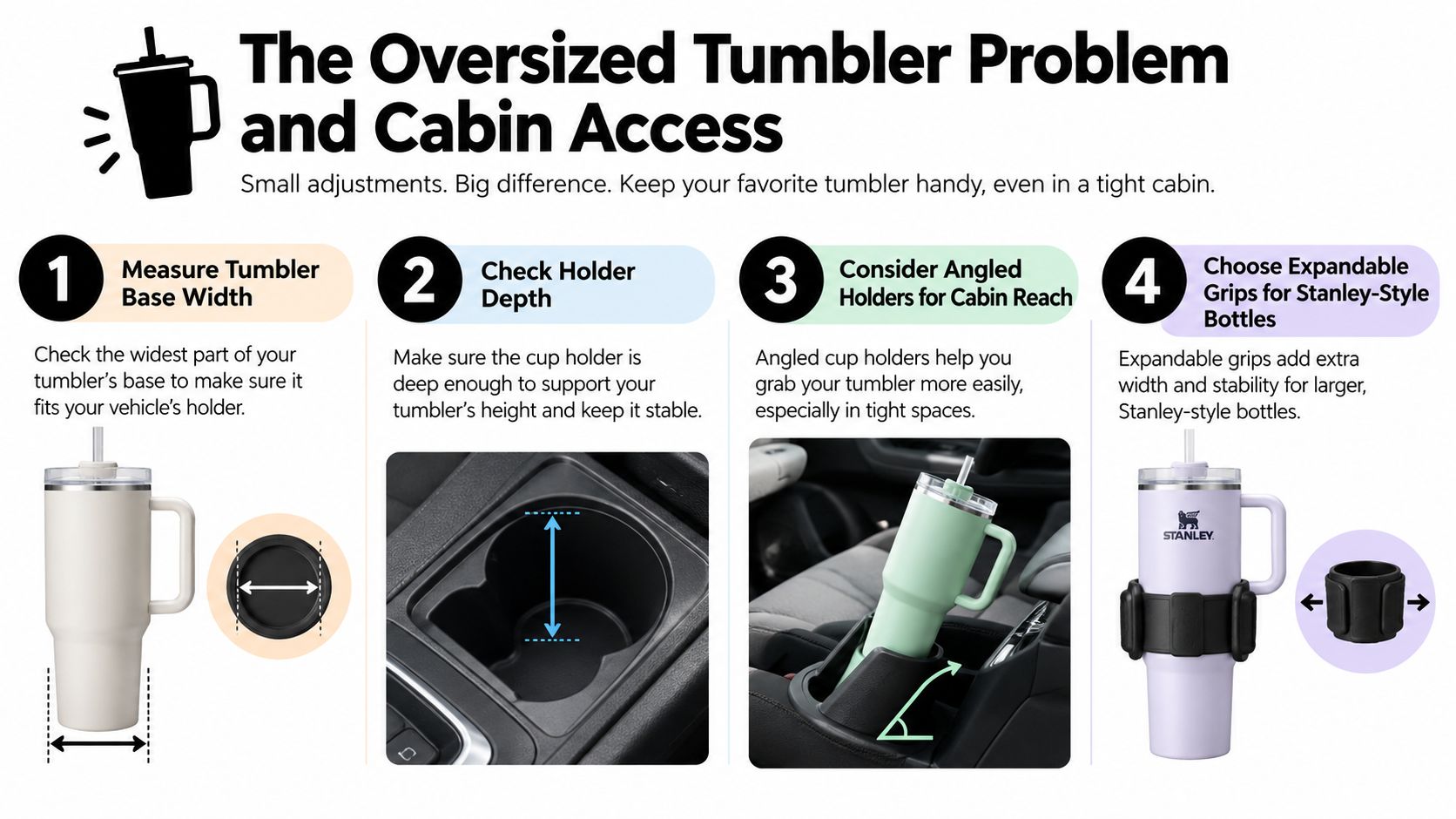
Use the sizing prompts below as a starting point, then check the complete cabin envelope.
Measure More Than the Base
Record base width, overall height, lid overhang, and handle projection with a tape measure or calipers. If you're considering a smaller everyday container, you can compare 12 oz tumbler sizes before measuring the specific model you intend to carry. Capacity labels alone aren't a fitment specification.
Check the surrounding golf cart dashboard layout with the cup installed. Include the parking brake, gear selector, steering movement, switches, display visibility, storage lids, and passenger entry space.
Use a Parked Access Test
- Control travel: Operate each adjacent control completely. Rotate the tumbler handle through plausible positions.
- Drink access: Open the lid and lift the container with one hand, without bracing it against nearby trim.
- Sightline: Check from the normal seated posture, not while leaning around the drink.
- Passenger clearance: Confirm that a knee, bag, or clothing won't catch the handle during entry and exit.
Mark each result clear, conditional, or unacceptable. Conditional means the setup works only with a particular orientation or restricted drink choice, something a shared fleet may struggle to maintain.
A wider adapter or angled mount deserves the same assessment. Either can solve base fit while creating a new interference problem above the holder.
Installing Auto Cup Holders on a Solana EV Cart
Start with the vehicle's service information and the accessory manufacturer's mounting instructions. Don't infer a permissible mounting load or fastener torque from the appearance of an aluminum panel. If the intended attachment point isn't documented, ask the dealer or manufacturer before drilling.
A useful preparation kit includes a tape measure, removable marking tape, inspection light, drill stop, deburring tool, and an appropriate torque wrench. The exact fasteners, hole dimensions, and reinforcement must come from the approved installation method, not a generic cup-holder guide.
Pre-Install Checklist
- Mock up the complete assembly. Hold the mount and intended container in position. Confirm the access checks before marking holes.
- Verify the support. Check the allowable accessory load and attachment method at that specific location, including any required backing plate.
- Inspect behind the surface. Identify wiring, concealed hardware, and components that could be damaged by drilling or fasteners.
- Plan electrical connections if needed. An illuminated or heated holder needs an approved supply, protection, and routing method. Don't splice into unidentified factory wiring.
- Confirm service access. Make sure liners, screws, and any release mechanism remain reachable after installation.
For installations involving sliding storage nearby, Everti's kitchen slide guide provides related reading for the broader storage project. Assess the slide's full travel separately; cup-holder clearance at rest isn't enough.
Drill Only After Approval
Mark the approved hole pattern and protect the surrounding finish. Use controlled drilling depth, remove swarf, and deburr the openings. Fit specified grommets wherever wiring passes through a panel, and apply any required edge protection or sealing.
Tighten hardware to the documented specification. Stop if the panel deforms or the bracket doesn't seat correctly; extra torque isn't a remedy for an unsuitable attachment.
Before release: Verify the installed assembly, not just the screws.
With the cart parked, check for mount movement using representative empty and filled drinkware. Repeat insertion, removal, and sightline checks, then conduct any operational verification under controlled conditions according to the applicable instructions. A hand shake test is a screening check, not a substitute for validated retention testing.
Cleaning, Drainage, and Maintenance Schedules
At a dealer's post-ride inspection, the useful question isn't whether the cup well looks clean from above. It's what remains beneath the insert and whether the mechanism still works. Treat this as a service-bay walkthrough, not a claim about a particular fleet's results.
Remove the container and any serviceable liner. Look for dried sugar along the base, sand behind grip tabs, sunscreen residue on contact surfaces, and mud around adjustable joints. Check the drain route before washing, so loosened debris does not move into a hidden cavity.
Match the Routine to the Construction
| Holder construction | Cleaning approach | Inspection concern |
|---|---|---|
| Fixed well | Wipe accessible walls, base, and corners | Residue trapped in inaccessible recesses |
| Removable liner | Remove and clean both liner and body | Incorrect reseating or damaged tabs |
| Drainable design | Clear the intended outlet and check discharge | Blockage or water directed onto equipment |
| Adjustable mechanism | Clean exposed joints as instructed | Binding, looseness, or retained grit |
Use a manufacturer-compatible cleaner and a soft cloth or brush. For dried sugary residue, soften it with an approved cleaning method rather than scraping the contact surface. Don't flood nearby switches or electronics to rinse a holder.
A Design News discussion of cup-holder engineering includes stability, one-handed insertion and removal, and interference with critical controls among evaluation criteria. Carry those criteria into maintenance: a clean holder that now requires both hands to release a bottle needs attention.
Set Condition-Based Service Triggers
- After muddy or wet use: Remove grit, check drainage, and dry serviceable parts before reassembly.
- During routine fleet preparation: Check attachment security, liner seating, unusual rattling, and mechanism movement.
- After substantial seasonal exposure: Inspect for cracks, permanent distortion, hardened liners, and changed removal effort.
- Before returning to service: Replace damaged parts and repeat the relevant functional checks.
The mechanism-cycle guidance discussed under materials is a validation target, not an automatic replacement deadline. Replace inserts according to condition and manufacturer instructions. A calendar reminder helps staff inspect consistently, but visible damage or changed behavior should trigger action sooner.
Choosing the Right Holder for Your Use Case
Choose auto cup holders by matching the route, drinkware, and maintenance capacity. A useful purchase specification names the approved mounting location, accepted container shapes, serviceable parts, and required clearance. That gives a dealer something concrete to verify.
Neighborhood and resort use generally favors an accessible fixed well with a compliant, removable liner, provided the intended drinkware passes the access checks. Prioritize quiet operation and straightforward cleaning rather than a complicated adjustment mechanism passengers won't use.
Mixed road and light-trail use calls for positive retention and a securely mounted body. An adjustable cradle may suit varied drinkware, but only if its joints remain accessible for inspection and its settings don't compromise cabin access.
Set Priorities Before Shopping
For dedicated off-road use, favor cleanable geometry, an appropriate drain route, replaceable contact surfaces, and an attachment method approved for the vehicle. Don't assume an accessory labeled heavy-duty has demonstrated any of those qualities.
When comparing accessories for golf carts, ask for fitment instructions and replacement-part information alongside the product description. A simple holder with documented compatibility is easier to evaluate than a feature-rich one with unclear mounting requirements.
- Bring the actual drinkware: Include handled mugs and tall bottles, not just a conveniently sized cup.
- Reject unresolved interference: Don't accept blocked controls in exchange for beverage capacity.
- Check ongoing support: Confirm that liners and mounting components can be sourced separately.
Common Replacement and Warranty Questions
When should the liner be replaced? Replace it when damage, hardening, permanent deformation, or changed grip prevents satisfactory operation, following the manufacturer's instructions.
Does installation affect warranty coverage? Ask the vehicle and accessory providers about the proposed installation before modifying panels or wiring. Don't assume an aftermarket mount is covered, or that every modification has the same warranty consequences.
Is a larger holder always better? No. Choose the smallest practical assembly that accommodates your intended drinkware without sacrificing access or serviceability.
Solana EV offers electric golf carts and UTVs for neighborhood, resort, and recreational use. Visit Solana EV to explore the vehicles and locate a dealer, then bring your usual tumbler and ask to check cup-holder fit, control clearance, and mounting options before choosing your setup.