
If you're shopping for a golf cart right now, there's a good chance you're focused on the visible stuff first. Seats, wheels, battery type, street-legal features, touchscreen, color, roof, maybe a rear seat kit. Owners do this. Dealers see it every day. Fleet buyers do it too, especially when they're replacing aging carts under pressure.
But the expensive decision usually sits underneath all of that. The frame determines how the cart ages, how it handles corrosion, how much weight the powertrain has to move, how accessories mount, and how painful repairs become after years of service. For coastal properties, resorts, gated communities, campuses, and buyers who plan to keep a cart for the long haul, the chassis isn't a detail. It's the investment.
An aluminum frame golf cart makes the most sense when you care about lifecycle value, not just sticker price. That means thinking like an owner, a service manager, or a fleet operator. What will this cart look like after years in humidity? What happens when you add bigger tires, enclosures, lights, and passenger weight? Can your local shop repair it correctly if it takes a hit? Those are the questions that separate a smart purchase from a costly one.
Table of Contents
- Why the Frame Is the Most Important Decision You Will Make
- The Engineering Behind an Aluminum Golf Cart Frame
- The Unmatched Advantages of an Aluminum Chassis
- Aluminum vs Steel A Head-to-Head Comparison
- How to Care for Your Aluminum Frame Cart
- A Buyer's Checklist for Specifying an Aluminum Frame Cart
- The Foundation of a Premium Driving Experience
- Frequently Asked Questions
Why the Frame Is the Most Important Decision You Will Make
A fleet manager at a coastal property usually learns the frame lesson the hard way. Carts may still run, but the understructure starts showing the fleet's true age. Rust around mounting points, extra coating work, seized hardware, accessory fitment issues, and more downtime than the spec sheet promised.
That matters more now because the market is getting larger and more electric-focused, not less. The global golf cart market is projected to grow from USD 3.28 billion in 2025 to USD 5.10 billion by 2032, with North America holding the largest share and electric carts projected to account for 60.0% of the market in 2025, according to golf cart market projections from Coherent Market Insights. In a market moving toward electric ownership, durability and low maintenance become more important because buyers expect the whole vehicle to age well, not just the battery system.
The frame drives the ownership experience
The frame sets the baseline for everything else:
- Corrosion exposure: Humidity, salt air, wash chemicals, and wet storage all attack a vehicle differently depending on the chassis material.
- Vehicle mass: Weight affects how much work the motor, battery, brakes, and suspension have to do.
- Accessory support: Roofs, enclosures, windshields, lights, rear seats, and lift kits all depend on the frame as their mounting foundation.
- Resale condition: Buyers inspect structure, not just cosmetics.
If you want to understand why this matters mechanically, start with vehicle curb weight and how it affects EV behavior. A golf cart is no different in principle. Every pound the chassis saves or adds changes what the rest of the system has to carry.
Practical rule: If you plan to own the cart longer than a short replacement cycle, the frame deserves more scrutiny than the upholstery.
Premium buyers often assume the battery is the whole story. It isn't. The battery determines stored energy. The frame determines how efficiently and reliably the vehicle uses it over time.
The Engineering Behind an Aluminum Golf Cart Frame
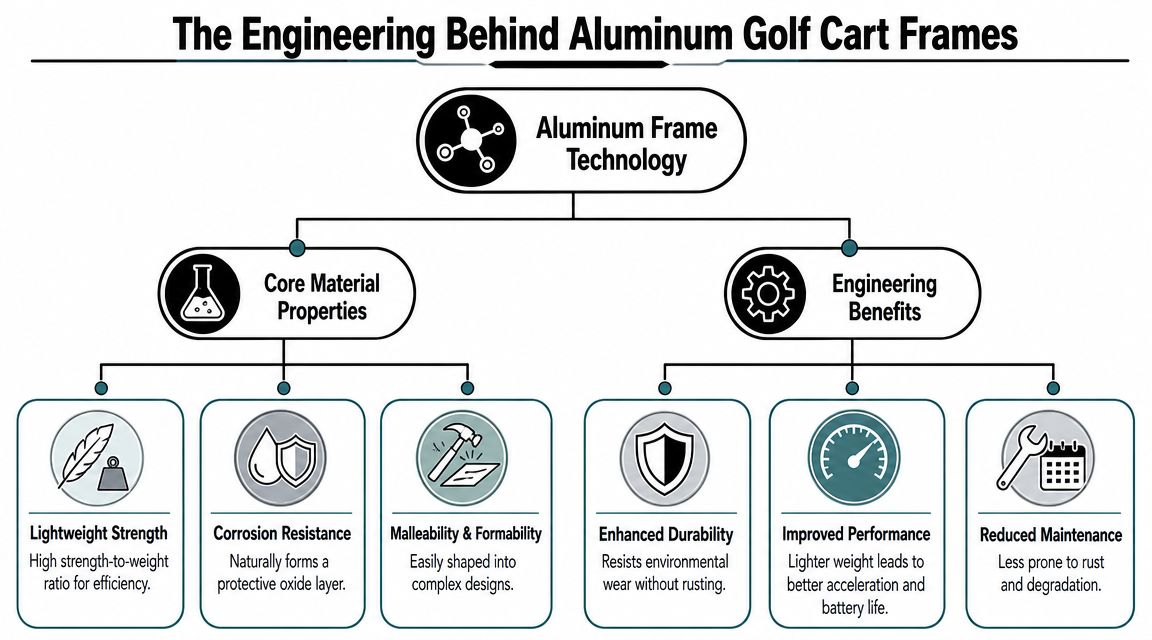
An aluminum golf cart frame isn't just a steel frame made from a different metal. It reflects a different engineering philosophy. The goal is to create a chassis that carries structural loads while keeping mass down and resisting the environmental damage that shortens vehicle life.
A simple analogy helps. Think of the difference between a quality aluminum bicycle frame and an older heavy steel cruiser. Both can be durable. But the lighter frame changes how the machine responds, how much effort it takes to move, and how it feels over years of use.
What aluminum is doing differently
Aluminum resists corrosion because it forms a natural oxide layer on its surface. In practical terms, that layer acts like a protective skin. Steel, by contrast, depends much more heavily on coatings and paint systems to keep rust from gaining ground after chips, scratches, and moisture exposure.
The golf cart industry has known this for a long time. Club Car introduced an aluminum-frame cart in 1958, a milestone noted in this golf cart history overview. That matters because it places aluminum chassis design in the early commercial phase of the industry, not as a recent marketing trend. The material earned its place by solving real durability problems.
Why chassis design matters beyond the metal
The frame is the load-bearing base for the body, seats, suspension, roof structure, and add-ons. Good aluminum chassis engineering depends on more than material selection. It depends on weld quality, stress-path design, mount location, fastener choice, and isolation between dissimilar metals.
A well-designed aluminum frame does three things at once:
- It carries static and dynamic loads without unnecessary weight.
- It resists environmental degradation in places where steel typically needs more protection.
- It gives dealers and owners a stable platform for accessories and service work.
Aluminum is not maintenance-free. It's corrosion-resistant when the material is used correctly and when the hardware attached to it is chosen correctly.
That's where experienced engineering shows up. A strong aluminum frame doesn't come from the brochure language. It comes from how the cart manages joint design, accessory loads, and long-term exposure around fasteners and brackets.
The Unmatched Advantages of an Aluminum Chassis
The strongest case for an aluminum frame golf cart isn't that it sounds premium. It's that the chassis can remove cost, labor, and friction from ownership over the years. That benefit shows up in three places most clearly.
Corrosion resistance changes ownership economics
In humid and coastal environments, corrosion isn't cosmetic for long. It starts at exposed points, hardware interfaces, brackets, and damage sites. Then it spreads into the kind of deterioration that makes a cart harder to maintain, less attractive to resell, and more expensive to keep in fleet rotation.
Aluminum's natural corrosion resistance is why it has stayed relevant in golf, resort, and community applications. Owners don't have to rely as heavily on coatings just to keep the frame itself viable. That doesn't mean you can neglect the vehicle, but it does mean the base structure begins with an advantage.
For fleets, that affects more than maintenance logs. It affects how long a cart stays presentable, how often it needs structural attention, and whether managers can keep units in service without chasing rust-related nuisance work.
Lower mass affects more than speed
One commonly cited advantage is weight. A market source describes Club Car's aluminum chassis as roughly 25% lighter than traditional steel frames, as noted in South Florida Golf Carts' discussion of the aluminum frame design.
That reduction matters because it changes system load across the cart:
- Acceleration improves: The motor moves less mass from a stop.
- Efficiency improves: The battery doesn't have to work as hard per trip.
- Suspension load drops: Springs, bushings, and dampers deal with less static and dynamic burden.
- Brake wear can ease: Less mass generally means less work during deceleration.
This is why engineers care about chassis mass even when buyers don't. Weight isn't isolated to performance. It influences the entire operating envelope.
TCO improves when the frame stops being a maintenance problem
A lower-maintenance frame can improve total cost of ownership because owners spend less time and money dealing with corrosion-related decline. That value is easiest to understand in fleets, but private owners benefit too. A cart that keeps its structure in better condition is usually easier to service, easier to clean up for resale, and easier to justify keeping longer.
Buyers often pay attention to battery chemistry and screen size. Over time, the frame usually determines whether the vehicle still feels like a good purchase.
This is also where premium positioning becomes rational rather than cosmetic. If the chassis stays cleaner, lighter, and structurally sound with less intervention, the owner isn't just buying a nicer material. The owner is buying fewer future headaches.
Aluminum vs Steel A Head-to-Head Comparison
Frame choice shows its real cost after a few seasons, not on delivery day. For a private owner, that can mean resale value, battery efficiency, and how the cart ages in storage. For a dealer or fleet manager, it affects service scheduling, repair routing, and how long a cart stays presentable in a rental or community setting.
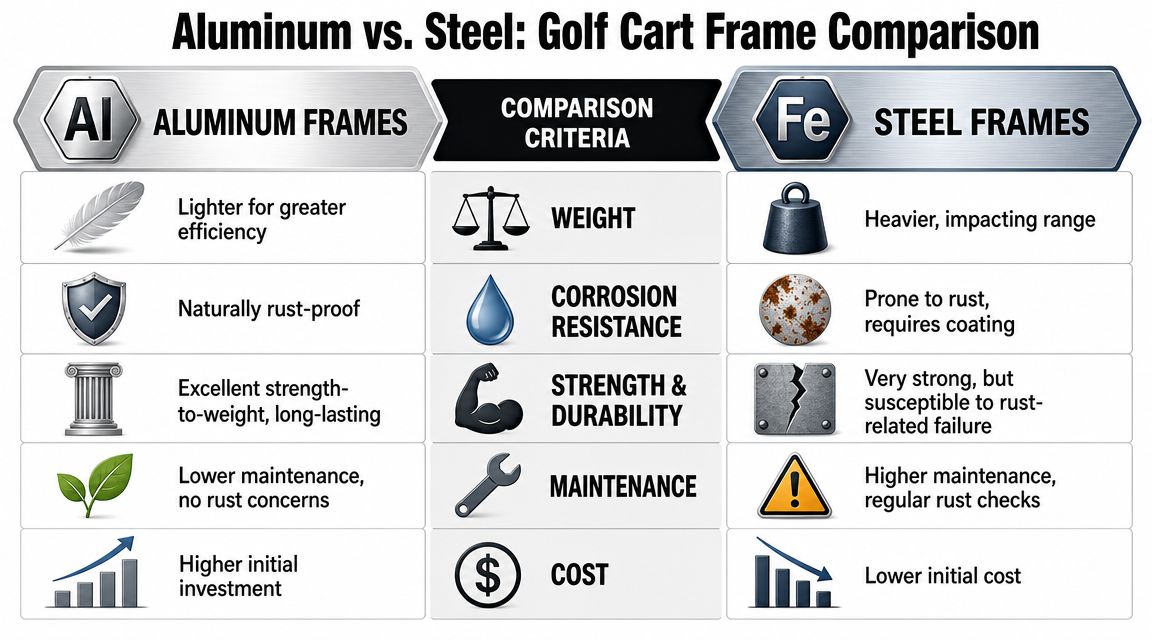
The chart below gives the fast comparison. The better decision usually comes from matching the material to the job.
Where aluminum wins
| Attribute | Aluminum Frame | Steel Frame |
|---|---|---|
| Weight | Lighter chassis that supports efficiency and responsiveness | Heavier structure that adds system load |
| Corrosion resistance | Strong natural corrosion resistance | More dependent on coatings and rust prevention |
| Maintenance burden | Lower frame-related corrosion upkeep | More likely to need coating attention over time |
| Humid or coastal use | Better suited to moisture and salt exposure | More vulnerable if coatings are compromised |
| Resale appeal | Often favored where long-term condition matters | Condition can fall faster if rust develops |
In practice, aluminum makes the strongest case in carts that live outdoors, run near the coast, or stay in service long enough for frame condition to matter. Buyers who evaluate ownership through a total cost of ownership framework for EVs usually see the trade clearly. A lower purchase price can be offset by more corrosion management, more cosmetic decline, and lower buyer confidence at resale.
There is another operational benefit that buyers often miss. A lighter frame gives you more margin before accessories start eating into performance. Add a rear seat kit, enclosure, larger wheels, sound system, or cargo box, and every extra pound works against range and ride quality. Aluminum does not eliminate that penalty, but it gives the cart a better starting point.
Solana EV is one current example of a manufacturer using an aluminum chassis for street-legal neighborhood transport, resort use, and recreational driving. That matters if you are comparing materials inside a broader premium EV spec instead of looking only at paint, seats, or screen size.
This walkthrough gives a useful visual overview before you dive deeper into specs:
Where steel still has an argument
Steel still earns consideration for one practical reason. It is often easier to repair locally after impact damage.
Many independent shops know steel straightening and welding well. Aluminum repair usually demands cleaner prep, different welding skill, and tighter process control. For fleets, that can mean longer downtime if the local market lacks qualified aluminum repair support. I tell operators to check service capability before they treat aluminum as an automatic win.
That trade-off is specifically noted in this discussion of aluminum frame repair complexity. The corrosion advantage is real. So is the possibility of a slower or more specialized repair path after a collision.
A practical decision guide looks like this:
- Choose aluminum when long ownership, outdoor storage, coastal exposure, resale condition, and lower frame maintenance carry more weight than the simplest collision repair path.
- Choose steel when the cart operates in a controlled environment and fast access to familiar repair shops matters more than long-term corrosion exposure.
- Question either option when the dealer cannot explain frame service support, approved accessories, or how added equipment will affect payload and range.
A frame is not just a material choice. It is a service strategy, a depreciation decision, and a statement about how the cart will be used over time.
How to Care for Your Aluminum Frame Cart
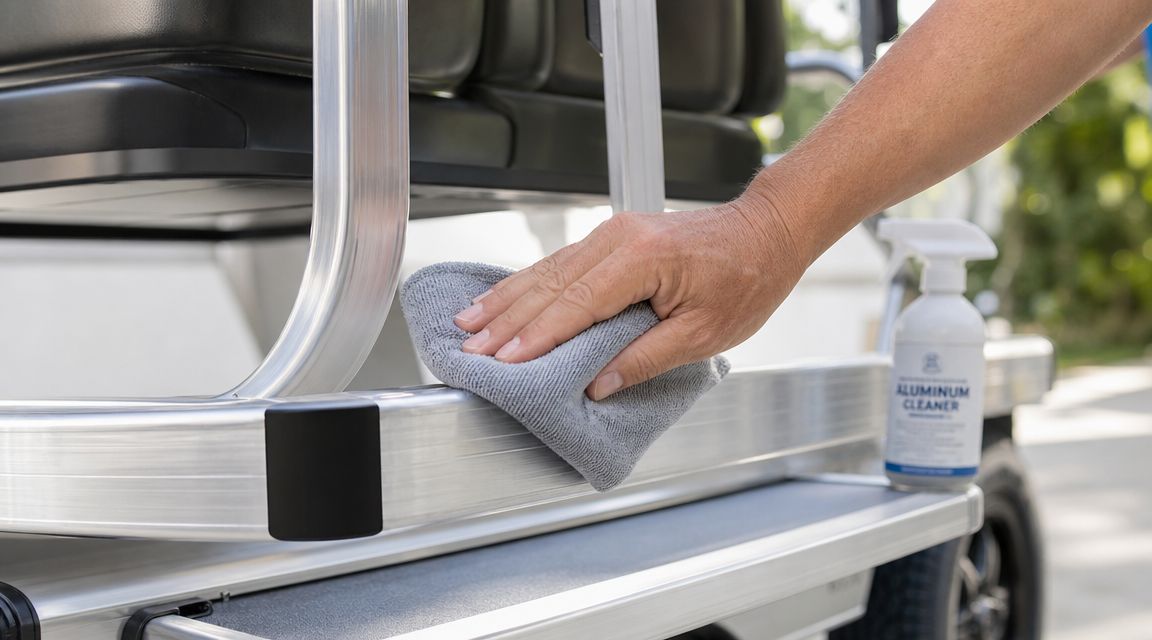
An aluminum frame golf cart needs less corrosion management than steel, but it doesn't need zero care. Owners who believe "rust-resistant" means "ignore it" usually create their own service problems.
What good maintenance looks like
Routine care is simple:
- Wash off salt and residue: If the cart lives near the coast or sees chemical exposure, rinse the underside and mounting areas regularly.
- Inspect hardware interfaces: Look where brackets, seat supports, roof mounts, and accessory fasteners meet the frame.
- Check impact points: Curbs, trailer ramps, and off-pavement use can damage coatings on attached components or deform brackets.
- Keep drains and low points clean: Dirt holds moisture where you don't want it.
The frame is the platform for the body, suspension, and accessories. Industry guidance notes that proper engineering around fastener isolation is important on aluminum frames, and that these frames can last over 10 years with proper care, as discussed in this guide to golf cart frame durability and customization.
Where owners get into trouble
Galvanic corrosion is the big one. In plain language, trouble starts when dissimilar metals contact each other in the presence of moisture or contamination. That often happens when someone installs steel hardware or accessories against aluminum without proper isolation.
Common mistakes include:
- Using the wrong fasteners after an accessory install.
- Mounting aftermarket parts carelessly at high-stress points.
- Ignoring chipped or scraped attachment areas after curb strikes or rough transport.
Shop-floor advice: Treat every accessory install as a chassis decision, not a bolt-on decision.
If you lift the cart, enclose it, or add rear seating, inspect those attachment points like structural parts. Because they are.
A Buyer's Checklist for Specifying an Aluminum Frame Cart
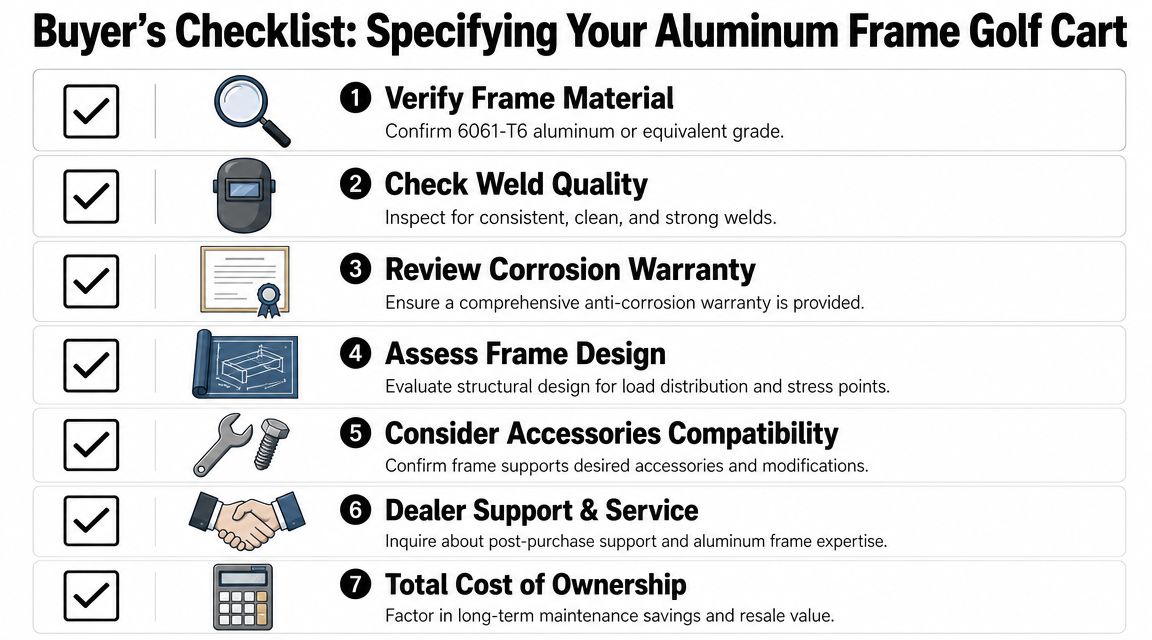
A smart buyer doesn't ask only what features are included. A smart buyer asks how the cart will age, how it will be serviced, and what happens after customization. That's where aluminum frame shopping gets serious.
Questions to ask before you buy
Bring this list with you:
Where will the cart live most of the time
Coastal home, resort, marina-adjacent property, dry inland neighborhood, campus fleet. Environment should drive frame choice.How much accessory weight is planned
Rear seats, enclosures, larger wheels and tires, audio, cargo kits, and street-legal equipment all change the load picture.Who will service the chassis locally
Ask the dealer whether their shop handles aluminum-specific repair and hardware practices.How is the frame set up for battery and accessory demands
If you're choosing a lithium-equipped vehicle, it helps to understand how golf cart lithium battery systems change ownership and maintenance.What is the expected holding period
A short-turn recreational toy and a long-term fleet asset should not be specified the same way.
Questions to ask the dealer after the sale
The second set of questions matters just as much:
| Ask about | Why it matters |
|---|---|
| Accessory mounting practices | Prevents poor installs that create corrosion or stress issues |
| Approved hardware | Reduces avoidable dissimilar-metal problems |
| Collision repair path | Tells you what happens if the cart takes damage |
| Parts availability | Helps reduce downtime |
| Cleaning recommendations | Protects finish and interfaces over time |
The right dealer conversation sounds technical, not theatrical. You want clear answers on mounts, load limits, repair process, and service support. If the discussion stays stuck on paint color and wheel style, keep asking harder questions.
The Foundation of a Premium Driving Experience
A premium cart doesn't start with the seat stitching or the display. It starts with the structure under your feet. The frame influences how the vehicle handles weather, weight, service, customization, and time.
That's why aluminum matters. It supports a longer-view ownership model built around durability, lower corrosion risk, and better lifecycle value. It also forces an honest conversation about trade-offs, especially repair complexity and the need to manage accessory loads properly.
For buyers who want a cart to hold up in real conditions, the chassis isn't a hidden component. It's the reason the vehicle still feels solid years later. That's the standard serious owners, dealers, and fleet managers should shop for.
Frequently Asked Questions
Is an aluminum frame golf cart worth the higher upfront cost
Usually, yes, if you're buying for long-term use, humid conditions, coastal exposure, or higher resale expectations. The stronger argument is lifecycle value, not initial invoice savings. If you're running a fleet or keeping the cart for years, fewer corrosion-related headaches can matter more than the purchase delta.
Can I still customize an aluminum frame cart heavily
Yes, but customization needs discipline. Aluminum frames support accessories well when the mounts, hardware, and load points are engineered correctly. Sloppy installs create avoidable problems. Good dealers understand this. Good owners insist on it.
Does a lighter frame always mean more electric range
Not automatically. A lighter aluminum chassis provides an efficiency advantage, but heavy accessories, larger tires, and road-use enclosures can offset those gains. That's one of the more overlooked issues in the street-legal and neighborhood EV segment, as noted in this discussion of accessory weight and range trade-offs.
If you want the benefit of the lighter frame, protect it. Don't erase the advantage with unnecessary mass, aggressive tire changes, or drag-heavy add-ons unless those features are central to how you'll use the cart.
If you're comparing carts and want to see how aluminum chassis design shows up in a real vehicle lineup, explore Solana EV and connect with a local dealer to evaluate frame construction, accessory compatibility, and street-legal options in person.