
You're comparing electric carts for a resort, a neighborhood, or a rough property road, and the salesperson points underneath: aluminum chassis. It sounds like a useful upgrade, but the price tag doesn't tell you whether it'll carry your passengers comfortably, survive repeated curb strikes, or get repaired locally after an accident. Understanding an aluminum chassis car or cart starts with the frame itself, then follows it through everyday driving, the repair shop, and eventually the recycling yard.
Table of Contents
- What an Aluminum Chassis Is and How It Is Built
- Aluminum Versus Steel on the Numbers
- How Lower Weight Changes Range and Handling
- Stiffness, Joints and Corrosion Trade-offs
- Repairing a Damaged Aluminum Chassis
- Match the Chassis to Your Use and Buy with Confidence
What an Aluminum Chassis Is and How It Is Built
The chassis is the vehicle's skeleton, much like a bicycle frame carries the rider, drivetrain, and luggage. On a golf cart or UTV, it supports the passengers, battery, motor, and suspension while keeping their mounting points in the correct relationship.
Don't confuse aluminum body panels with an aluminum chassis. A vehicle can have lightweight exterior panels over a steel frame, while another can use aluminum structural members underneath plastic bodywork. Passenger cars may also integrate their body and supporting structure rather than use a separate ladder-style frame.
The Parts You Can Identify
Look underneath a parked cart, without crawling under an unsupported vehicle, and locate these components:
- Side rails: The lengthwise members that carry loads between the front and rear of the vehicle.
- Crossmembers: The pieces joining the rails, supporting equipment and resisting frame distortion.
- Suspension mounts: The attachment points through which wheel forces enter the structure.
- Seat mounts: The connections supporting occupants and transferring their loads into the frame.
- Battery tray or enclosure: The structure holding the battery and protecting its mounting position.
- Motor mounts: The brackets and members that support the drive unit and resist its reaction forces.
Manufacturers can combine extruded profiles, castings, and formed sections, joining them with welds, adhesives, or mechanical fasteners. Extrusion resembles pushing dough through a shaped opening, except the finished metal profile becomes a structural member. Hollow, closed sections help engineers resist bending and twisting without filling the entire section with metal.
Material Is Only Part of the Design
Aluminum's appeal combines low mass with a protective surface oxide. That oxide helps resist corrosion, but it doesn't make every joint or exposed surface immune to damage.
For broader manufacturing context, American Additive Manufacturing automotive expertise offers a useful companion resource when exploring how automotive components are designed and produced. Don't assume every component described as aluminum uses the same manufacturing process.
Practical check: Identify the rails, mounts, and battery area, then ask what each must support. A chassis is a connected system, not simply a piece of lightweight metal.
Aluminum Versus Steel on the Numbers
The material numbers are simple. The translation to a cart is not. Read the table as a starting point, then check the qualifiers that decide whether the weight saving reaches the road.
Aluminum versus steel for chassis and body structures
| Property | Aluminum | Steel | What It Means for a Cart |
|---|---|---|---|
| Density | About one-third of steel | Reference material | Equal-volume pieces weigh substantially less |
| Young's modulus, or material stiffness | About 70 GPa | About 207 GPa | Geometry must compensate for lower material stiffness, according to the SAE technical paper on aluminum-structured vehicles |
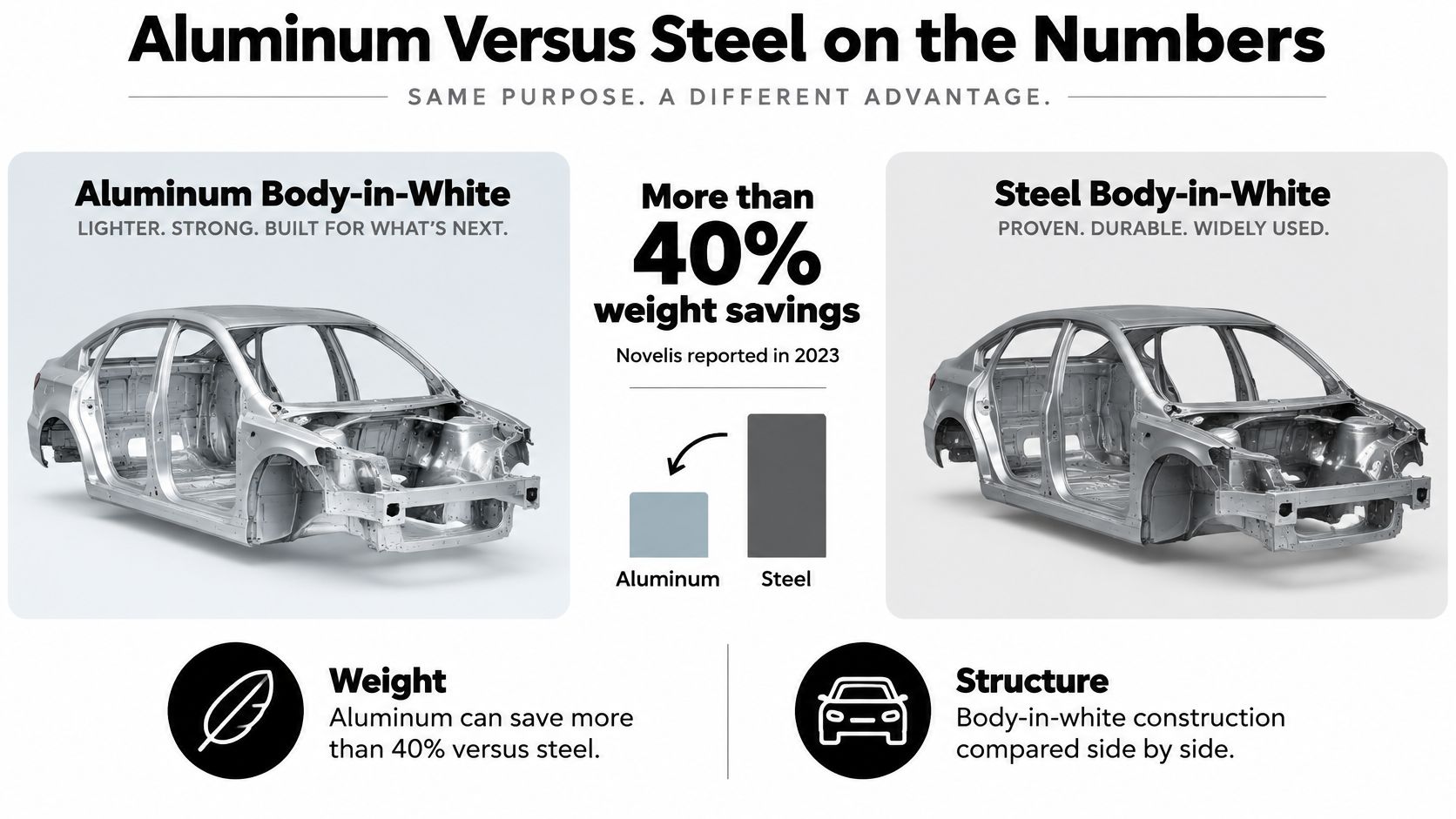
| Body-in-white weight | Typically more than 40% lighter | Baseline body-in-white | Whole-shell savings, as Novelis reported in 2023 |
| Full body test, Mercury Sable demonstration fleet | Body 173 kg, approximately 380 lb, lighter, about 47% less body mass | Equivalent steel body; steel Taurus SHO used for the driving comparison | Physical demonstration evidence from Ford's 1994 fleet, documented by Argonne National Laboratory |
| Corrosion behavior | Protective oxide layer; doesn't develop iron rust | Needs coating and paint protection | Inspect exposed joints in wet, coastal, and turf settings |
| Repair familiarity | Requires appropriate aluminum joining and repair skills | Familiar territory for many conventional shops | Confirm local structural-repair capability before buying |
The headline weight saving applies to a body-in-white, the assembled body structure before trim and other finished-vehicle equipment. It is not a promise that an entire cart will become equally lighter. Battery, motor, passengers, wheels, and accessories remain part of the operating mass.
How to Read the Comparison
Density is mass per volume. An equal-volume aluminum piece weighs about one-third as much as steel. Finished parts rarely stay equal-volume: engineers add ribs, thicker walls, or larger sections to meet stiffness and strength targets, so the vehicle-level saving is smaller than the raw density ratio suggests.
Young's modulus measures elastic stiffness. Aluminum at about 70 GPa flexes more than steel at about 207 GPa under the same shape and load. A shelf that sags under books and springs back when unloaded demonstrates elastic deformation. A shelf that stays bent has yielded. Designers compensate with geometry, such as deeper sections and closed profiles, rather than assuming the material alone will match steel.
The Mercury Sable demonstration matters because engineers built and drove real vehicles. It does not establish a golf cart's range, crash performance, or payload. Treat it as evidence that body structures can be built much lighter, not as a cart specification.
Corrosion and repair deserve separate attention from weight. A clean aluminum rail can hide a damaged joint, and a protected steel frame can remain serviceable for years. The weight table stops at material properties. The ownership story continues in the repair bay and at end of life, where labor skills and material recovery decide whether the weight saving pays back. Aluminum structural work requires the right training, separation from steel fasteners, and suitable joining methods. Many conventional shops are more familiar with steel.
For meaningful vehicle comparisons, distinguish chassis mass from vehicle curb weight. A lighter chassis is useful only when the complete vehicle meets its job, including passengers, battery, cargo, and accessories. Material resale value is a separate market. 2026 scrap steel rates in NZ track scrap metal prices, not the value of a working vehicle.
How Lower Weight Changes Range and Handling
Consider otherwise identical carts with the same battery, tires, motor settings, and passengers. Give one a heavier steel frame and the other a lighter aluminum chassis. The lighter vehicle requires less energy to accelerate to the same speed and climb the same hill.
That's an energy benefit, not a guarantee of a particular range increase. The U.S. Department of Energy's lightweight-materials summary states that a 10% reduction in vehicle weight can improve fuel economy by approximately 6% to 8%. That fuel-economy relationship explains the value of mass reduction, but it shouldn't be converted directly into an electric-cart range claim.
Where the Difference Shows Up
A resort cart repeatedly leaving reception, climbing to guest rooms, and stopping at service buildings spends energy accelerating and gaining elevation. Reducing vehicle mass can lower those demands without increasing battery capacity.
The distinction between propulsion and braking matters when reading a simple comparison graphic.
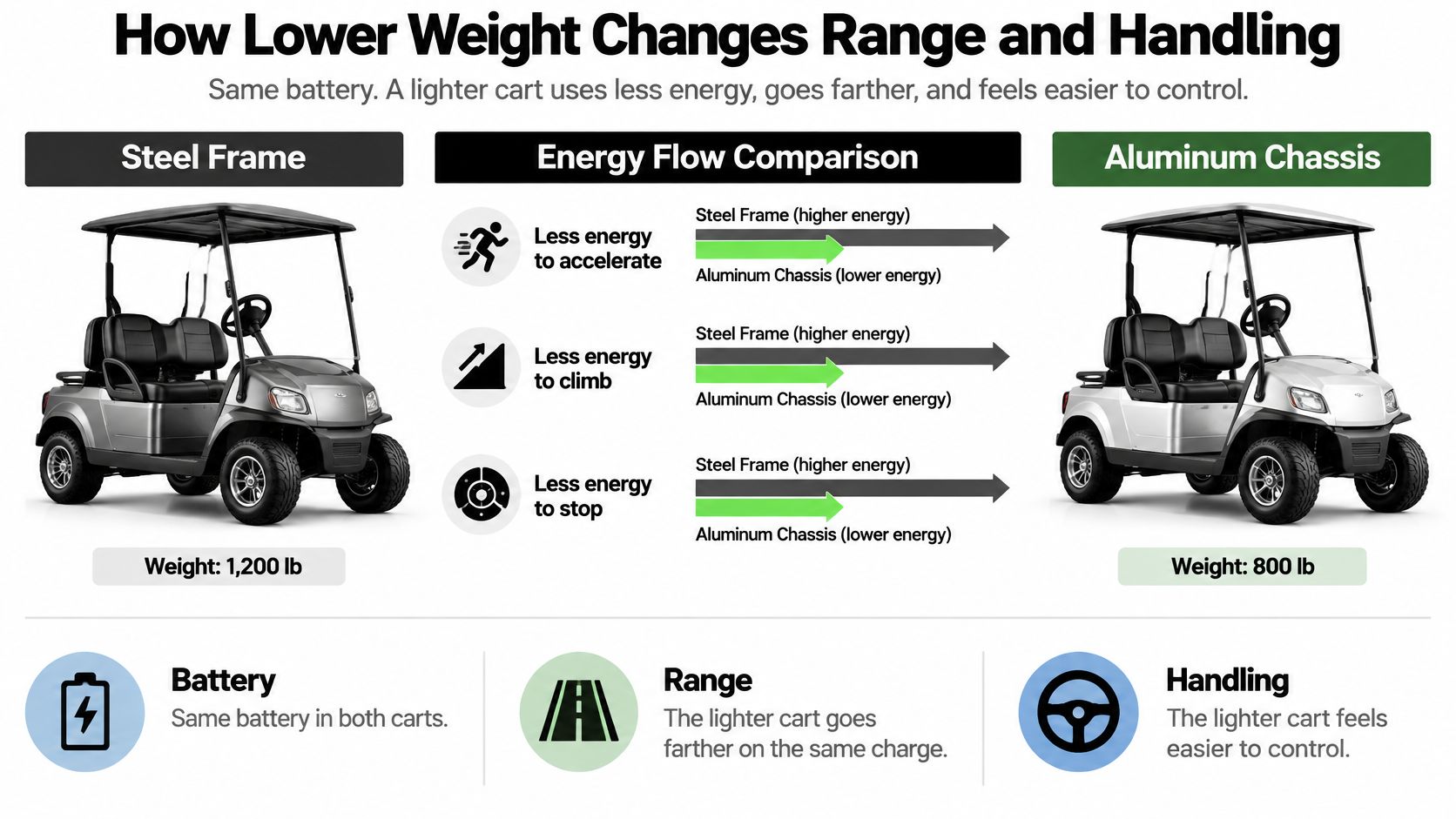
A lighter vehicle doesn't need battery energy to stop in the ordinary braking sense. Rather, the brakes have less kinetic energy to dissipate at the same speed. Regenerative braking may recover some energy, but it doesn't eliminate the energy cost of repeated acceleration.
Don't assume lower mass automatically produces shorter stopping distances or better handling. Tire grip, brake balance, suspension tuning, load placement, and the controller's settings all affect the result. A lighter frame also doesn't authorize extra passengers beyond the vehicle's approved rating.
Compare carts on your actual route with the same passenger load. An unloaded demonstration on flat pavement won't answer a loaded hill-climbing question.
A Worked Comparison Without a False Range Promise
Start with the manufacturer's complete-vehicle weights for comparable configurations. Subtract the lighter vehicle's weight from the heavier vehicle's weight, making sure the batteries, seating, roofs, and accessories match.
Then evaluate what that saving means for your work:
- For range: Use the same route and record energy consumption or remaining charge under comparable conditions.
- For payload: Compare the documented carrying ratings, not just the empty weights.
- For operating time: Include your actual stopping, climbing, and loading pattern.
An electric vehicle range calculator can help organize an estimate. Treat the result as a planning tool, then verify it with a loaded demonstration rather than pricing an upgrade around an assumed range gain.
Stiffness, Joints and Corrosion Trade-offs
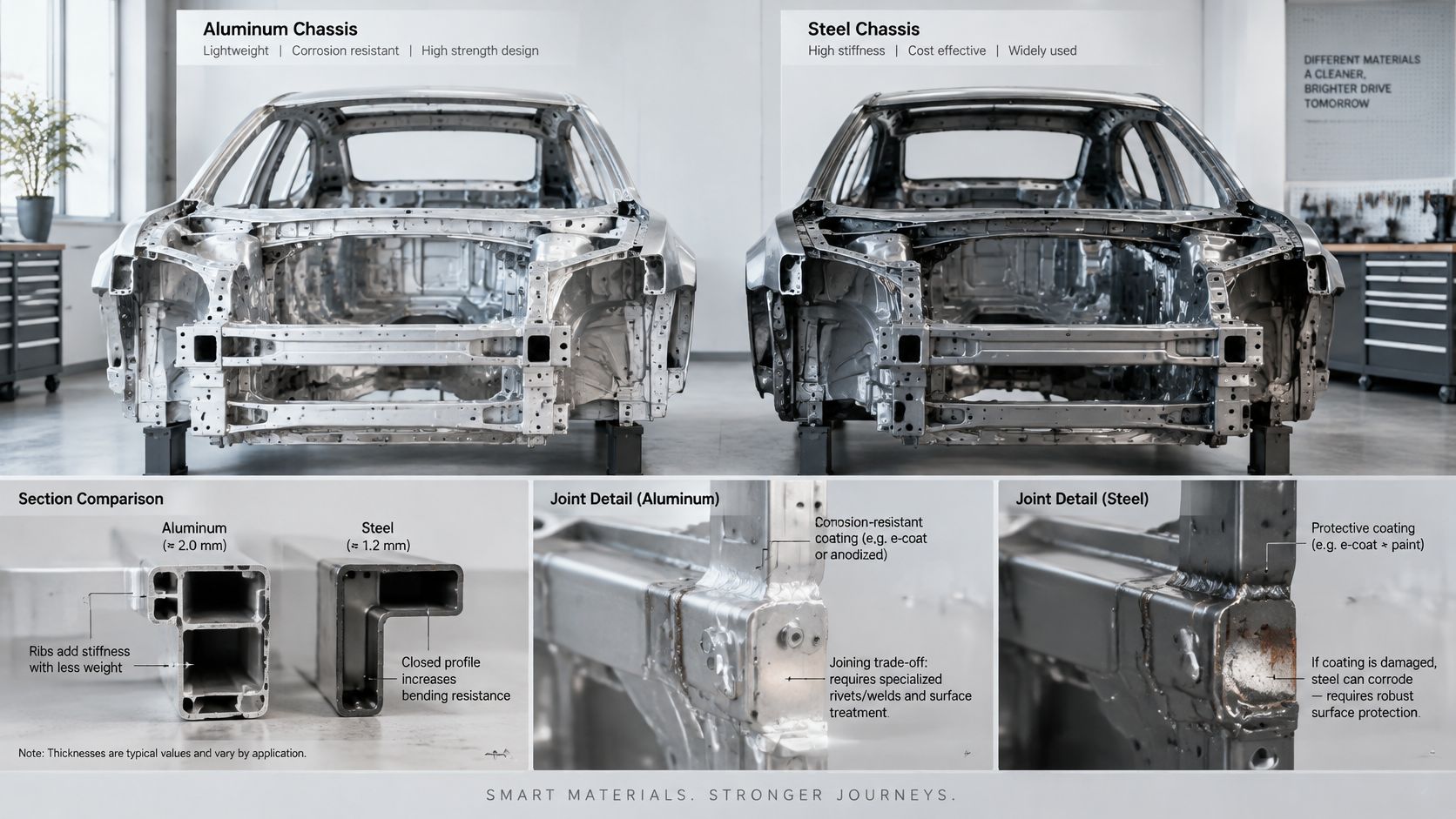
Aluminum isn't automatically stronger than steel. Strength, stiffness, and durability describe different things, and the finished structure must satisfy all of them. Engineers use deeper sections, ribs, thicker walls, or closed profiles to control movement without abandoning the weight-saving goal.
Twisting is especially important around suspension and battery mounts. Think of holding opposite corners of a shallow cardboard tray: the tray can distort even though none of its individual edges has broken. A chassis needs a layout that controls that kind of movement under uneven wheel loads.
The construction comparison below helps distinguish material choice from section shape and connection design.
Connections Need Their Own Engineering
Welding can soften aluminum near the weld and introduce distortion. Those effects make alloy selection, welding procedure, and structural layout important, particularly where a bracket repeatedly transfers suspension loads.
A technical study of aluminum joining methods describes how rivet-bonded joints can outperform rivets alone in static strength and fatigue performance. In the studied configurations, adhesive spreads load across the joint while the fasteners provide clamping and mechanical redundancy.
Fatigue means progressive damage under repeated loading. A bracket can develop a crack after repeated bumps even when no individual impact appears severe. An attractive weld bead or neatly installed rivet isn't, by itself, proof of validated durability.
Corrosion Protection Starts at the Interface
When aluminum and steel contact each other in a wet, electrically conductive environment, galvanic corrosion can attack the aluminum. Appropriate isolation, sealants, coatings, and drainage matter most around fasteners and mixed-material connections.
Exterior finish care is a separate task. The APEX NANO by Titan Coatings guide provides context on paint protection, but paint-care products aren't substitutes for engineered isolation inside a structural joint.
Before accepting a chassis, concentrate on:
- Mount support: Ask for documented validation of suspension, seat, and battery attachment areas.
- Joint condition: Look for cracked sealant, loose fasteners, displaced joints, or visible cracking.
- Metal separation: Check that specified washers, sleeves, coatings, and sealing materials remain intact.
Don't retorque fasteners or add sealant indiscriminately. Use the manufacturer's procedure so an attempted improvement doesn't disturb a designed joint.
Repairing a Damaged Aluminum Chassis
Damage patterns and typical repair routes for an aluminum chassis
| Damage Pattern | Typical Repair Route | What to Check Before Accepting |
|---|---|---|
| Cosmetic scrape or dent without frame change | Surface repair and touch-up after confirming it's nonstructural | Specified fastener torque and coating seal around the spot |
| Low-speed impact around 15 km/h, Thatcham car-structure test | No structural damage in that test | Suspension-mount alignment and wheel geometry |
| Hard impact around 25 km/h, Thatcham car-structure test | Full component replacement in that test | Availability of the approved replacement component |
| Repeated curb or pothole strikes | Inspect brackets and connections for fatigue cracks | Weld and bond-line condition at crossmembers |
| Rollover or trailer-loading damage | Measure the frame before considering straightening | Dimensions against manufacturer specifications |
| Aluminum touching steel after repair | Restore specified isolation with suitable spacers or coatings | Corrosion around fasteners and completeness of isolation |
The impact-speed examples come from Thatcham Research testing of aluminum mega-cast car structures, reported by Repairer Driven News, which describes no structural damage at 15 km/h and full component replacement at 25 km/h. They aren't golf-cart repair thresholds. Impact direction, contact point, and structural architecture can change the outcome.
The useful lesson is that repairability is designed into the structure. A replaceable component may offer a practical repair route, whereas damage spanning an integrated assembly may require much more extensive replacement.
What a Capable Shop Should Establish
A general service dealer may handle brakes and batteries without having the equipment or authorization for structural aluminum repair. The shop needs the manufacturer's repair instructions, suitable measuring equipment, and technicians trained for the prescribed joining methods.
Don't authorize heating, pulling, or welding merely because the same technique worked on a steel frame. Bonded and riveted assemblies may require specific removal tools, surface preparation, replacement fasteners, and adhesive curing conditions. Some damaged members must be replaced rather than straightened.
An acceptable repair restores the specified dimensions and connections. Making the wheels look straight isn't enough.
Before You Approve the Work
- Photograph the damage. Capture the impact area, underbody, wheel positions, and visible identification labels before disassembly.
- Confirm the shop's capability. Ask who will measure the structure and which manufacturer procedure governs the repair.
- Verify replacement parts. Get the component identification, approval status, and availability in writing before authorizing removal.
- Request a measured final check. After a significant impact, obtain documentation of frame dimensions and relevant wheel alignment.
For our vehicles, using official Solana EV parts keeps the factory warranty safe. Non-approved substitutions can complicate a claim, so keep parts invoices and repair records. If an insurer is involved, confirm its documentation requirements before the shop starts work.
Match the Chassis to Your Use and Buy with Confidence
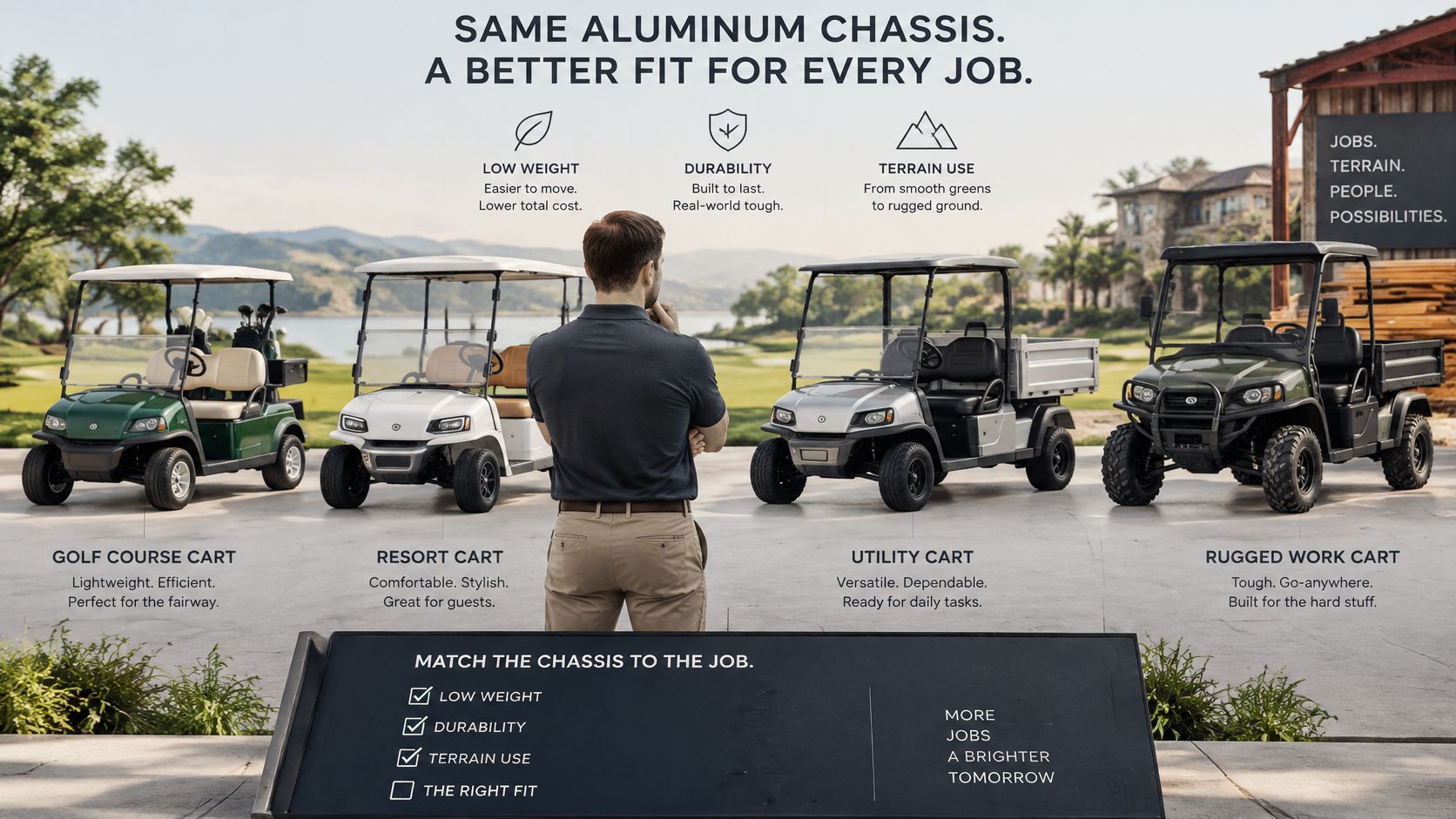
An aluminum chassis that suits a paved resort loop isn't automatically the best choice for rough-terrain hauling. Rank your operating requirements before comparing materials. The most useful specification is the one that addresses your actual load, route, or repair constraint.
Chassis priorities by use case
| Use Case | Chassis Priority | Watch For |
|---|---|---|
| Golf course or resort cart | Low weight and a smooth ride | Payload and daily stop-start wear |
| Gated-community street-legal cart | Stiffness and required legal equipment for the area | Missing lighting or safety equipment |
| Off-road or rough-terrain UTV | Torsional stiffness at suspension points | Fatigue at brackets and repeated impacts |
| Fleet with frequent loading | Payload rating and frame strength | Repair turnaround and parts availability |
For a golf course or resort, request a demonstration with passengers and service equipment aboard. Check passenger comfort over the route's joints and surface changes rather than assuming chassis material determines ride quality.
A gated-community buyer needs a vehicle configured for the roads where it'll operate. Confirm the applicable local requirements and the exact equipment included in the quoted vehicle, rather than treating a street-legal description as permission to use every road.
Different configurations serve different jobs, even when their frames share a material.
Prioritize the Load and the Recovery Plan
For an off-road UTV, ask what terrain and loading the manufacturer has validated. Pay attention to ground clearance, exposed brackets, and the consequences of a wheel dropping into a rut.
For a working fleet, evaluate downtime alongside purchase price. A replaceable member offers limited practical value if nobody can obtain it or perform the approved repair locally. Understand payload capacity before adding passengers, cargo, and accessories to the same vehicle.
Follow the Metal to End of Life
Recyclable doesn't necessarily mean recycled into an equivalent structural component. An Aluminium China industry overview describes secondary-aluminum use alongside the difficulties caused by mixed-alloy scrap. A chassis has a more credible recovery pathway when dismantlers can identify its alloys and separate incompatible materials.
Ask about accessible battery removal, detachable steel components, and alloy identification. Adhesives and coatings may complicate separation, so a general recycling claim shouldn't replace an explanation of who will accept the dismantled frame.
Questions to Take to the Dealer
- Material and construction: Which chassis alloy and joining methods does this exact configuration use?
- Mount validation: What documentation supports the suspension and battery mounting design?
- Rated load: Where is the vehicle's approved carrying rating documented?
- Local repair: Can the dealer measure a damaged frame locally, and who performs structural work?
- Parts access: Are structural replacement parts supplied individually and stocked?
- Warranty protection: Which approved parts and repair procedures preserve the warranty?
- End-of-life recovery: Does the manufacturer provide alloy labeling, dismantling information, or a take-back option?
Take this list to a dealer and compare the answers in person before deciding. Ask to see documentation and inspect the vehicle underneath, not just review the equipment brochure.
Our XA 4P and XA 6P models use lightweight aluminum chassis, and we offer a Street Legal, DOT Compliant Safety Package on Solana carts. Our parts and accessories catalog includes genuine OEM components, soft enclosures, LED lighting upgrades, and custom wheel packages. Visit Solana EV to explore the vehicles and locate a dealer where you can compare configurations, inspect the chassis, and discuss your route and repair needs.