
You're standing on a dealership lot with the hood of a used electric UTV open, while the salesperson waits for you to finish looking. The tires are clean, the body panels photograph well, and the display shows fewer operating hours than expected. The important question is not whether it looks ready to work. It's whether the battery, controller, charger, title, and software history support the price.
A used electric UTV can be an excellent fit for farms, resorts, campuses, gated communities, contractors, and private property. Utility applications represented more than 55% of electric UTV revenue in 2023, while North America generated approximately 90% of that revenue, according to electric UTV market analysis from Global Market Insights. That practical demand makes condition assessment more important than a quick recreational test drive. A machine that worked gentle property routes may have a much healthier battery than one with fewer hours that spent its life hauling loads in heat.
Table of Contents
- What a Smart Used Electric UTV Inspection Actually Looks Like
- The Physical Walkaround Before You Touch the Battery
- Battery Health and Drivetrain Diagnostics That Matter Most
- Paperwork, Title, and Warranty Transfer Essentials
- Used Electric UTV Price Benchmarks for 2026
- Negotiation Tactics That Work on Electric UTV Sellers
- Your Final Pre-Purchase Checklist Before You Sign
What a Smart Used Electric UTV Inspection Actually Looks Like
Start with the vehicle powered down. Ask the seller not to preheat, precharge, or move it before you arrive. A cold inspection gives you a better chance of identifying weak auxiliary batteries, charging faults, warning lights, and unusual startup behavior before the vehicle has had time to hide them.
Use a four-phase process:
- Walkaround: Inspect the frame, enclosure, suspension, tires, charge port, wiring, and accessories.
- Battery and drivetrain diagnostics: Read the battery-management system, review fault codes, and test the motor and reduction drive under load.
- Paperwork verification: Match the VIN, title, service history, charger, warranty records, and lien status.
- Price-to-condition comparison: Compare the actual configuration and documented condition with similar listings, then price unresolved risks into your offer.
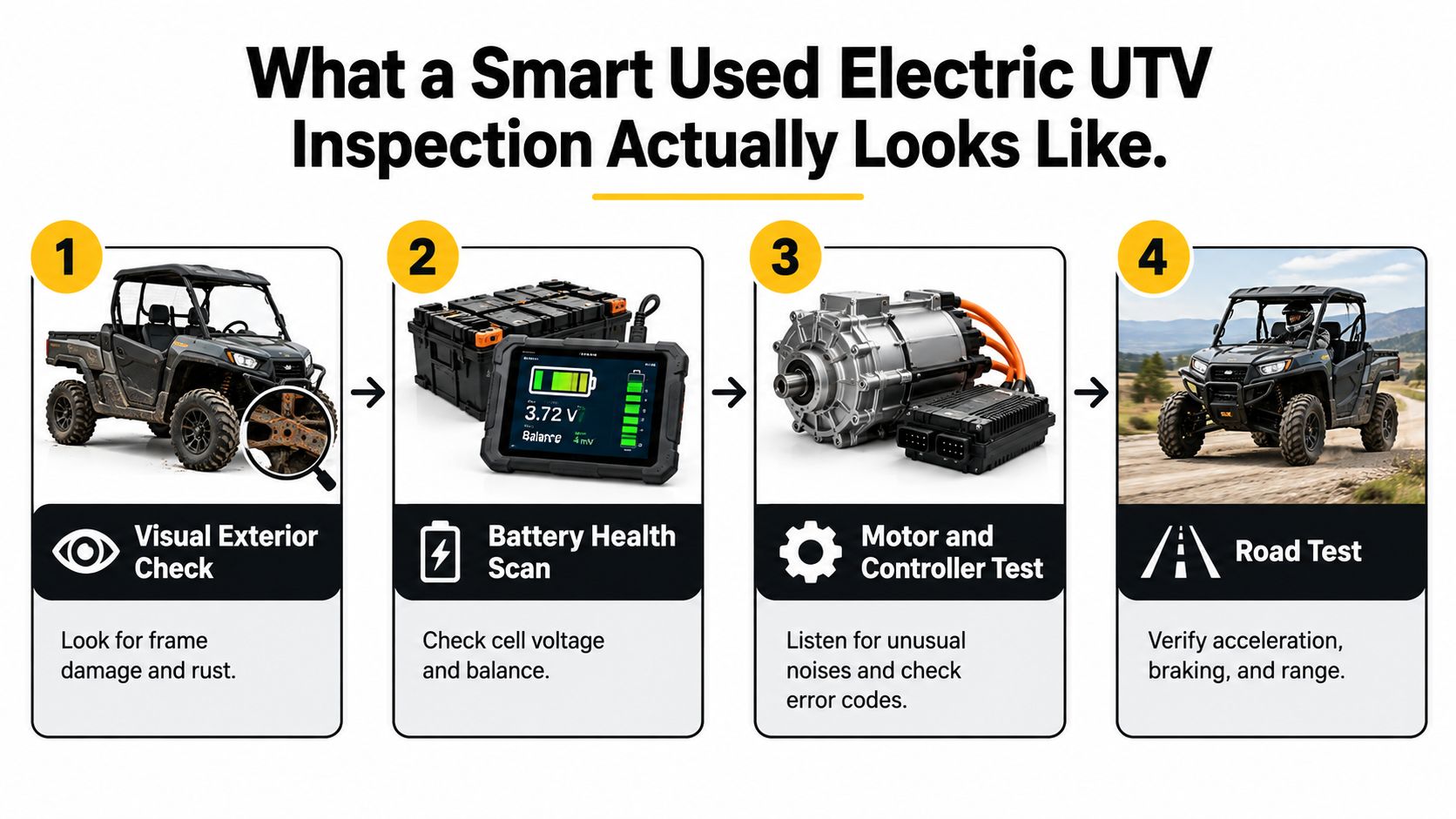
Bring the right equipment
A flashlight and notepad are basic requirements. Add an OBD-II adapter that works with the manufacturer's diagnostic app, or arrange access to the dealer service menu. Bring a phone charger, gloves, and a way to record the VIN and diagnostic screens. A thermal camera can help identify unusual heat around battery connections, contactors, chargers, or power electronics, though it won't replace a proper battery report.
A serious inspection takes enough time to examine the vehicle without pressure. If a seller insists that a quick drive is all you need, treat that as a reason to slow down. Driving impressions create emotional momentum. Buyers often feel the acceleration, enjoy the quiet operation, and start excusing warning signs they would have rejected before the test ride.
Practical rule: Inspect first, drive second, negotiate third. Never let a smooth test drive substitute for battery and paperwork evidence.
The installed base of electric ATV and UTV models was still selective when a peer-reviewed analysis of the electric ATV and UTV market was published. That history matters in the used market because early vehicles can differ sharply from newer ones in battery chemistry, software support, drivetrain calibration, and replacement-part availability.
The Physical Walkaround Before You Touch the Battery
Begin underneath, not at the dashboard. Look across the frame rails, crossmembers, mounting points, and skid plates for bends, fresh paint, deep scrapes, cracked welds, or crushed sections. A UTV that worked over rocks may have cosmetic damage, but deformation around suspension or battery mounts deserves professional review.
Check the suspension bushings, ball joints, tie-rod ends, CV boots, and wheel bearings. Lift each corner if the seller permits it, then rotate and rock the wheel. Excess play, clicking, torn boots, or grease thrown around a joint can indicate hard use that the hour meter doesn't explain.
Read the electric-specific clues
The charge port receives repeated mechanical stress. Inspect the pins, latch, cover, and surrounding plastic for looseness, heat discoloration, corrosion, or signs that the connector has been forced into position. Follow high-voltage and low-voltage cables near articulating suspension points, steering components, and underbody brackets. Chafing at those locations can become a serious electrical fault.
Examine the battery enclosure for dents, distorted seams, missing fasteners, water intrusion, or staining around vents and seals. Look for discolored plastic, blistered labels, brittle insulation, or localized soot that could suggest an overheated connection. On a liquid-cooled system, coolant residue matters. On the reduction boxes, gear-lube leakage matters. Because there's no engine, the underside is easier to read, and mystery fluid should not be dismissed as normal grime.
Tires can reveal alignment and load history. Check the date code, sidewall damage, shoulder wear, cupping, and tread differences across the axle. Regenerative braking can mask some drivetrain wear during a short drive, but it won't hide uneven tire wear caused by alignment, bent components, or chronic overloading. If the UTV is intended for paved routes or neighborhood use, review the requirements for street-legal UTV tires before treating the current tire setup as acceptable.
Test every control before the road test
Reserve about ten minutes for lights, indicators, horn, wipers, windshield accessories, bed controls, winch, selectable drive modes, parking brake, and charging equipment. Turn each item on and off while watching for flickering, delayed response, or dashboard faults. Aftermarket controllers, motors, lifted suspension, battery conversions, and nonstandard chargers can complicate diagnostics and may affect warranty support.
Battery Health and Drivetrain Diagnostics That Matter Most
The battery-management-system report is usually the highest-value document in a used electric UTV transaction. Ask the seller to show the report from the manufacturer's app or dealer service menu, with the vehicle identified by VIN or serial number. A screenshot with no vehicle identity is weaker evidence than a report generated while the UTV is present.
Review the reported state of health, usable capacity, cell or module balance, charge history when available, temperature readings, and stored fault codes. A generic used-EV benchmark describes state of health above 90% as strong for a three-year-old vehicle, while a result below 85% deserves caution, according to the used-EV ownership and battery guidance cited in the market brief. That benchmark isn't a direct UTV standard. Pack size, cooling design, storage temperature, work-cycle intensity, and charging habits can produce different results.
Translate the report into working range
A high state-of-health figure doesn't guarantee useful range if the vehicle has a software fault, an incorrectly calibrated display, or excessive rolling resistance. Conduct a loaded test on the same terrain where the buyer expects to work. Note the starting charge, payload, drive mode, ambient conditions, and ending charge. A short, unloaded loop proves very little.
Pay attention to cell or module imbalance at rest and under load. The manufacturer's specifications should determine what is acceptable, because different systems report balance differently. A widening spread under acceleration, a sudden state-of-charge drop, or a warning that appears only after sustained load deserves a written explanation and a repair estimate.
Low operating hours don't automatically indicate a healthy pack. A UTV stored at a high state of charge in hot conditions, repeatedly fast-charged, or left nearly empty for extended periods may age differently from a higher-hour vehicle used regularly and stored correctly. Ask whether the pack was replaced, opened, rebalanced, reconditioned, or merely reset in software. A reset dashboard is not the same as restored capacity.
| Battery State of Health | Practical Meaning | Buyer Action |
|---|---|---|
| Above 90% | Strong result for a three-year-old vehicle under the generic used-EV benchmark, subject to UTV-specific conditions | Proceed if the report, loaded test, and warranty records agree |
| 85% to 90% | Usable capacity may be sound, but the remaining margin needs to match the intended workload | Negotiate around documented range and future battery risk |
| Below 85% | Caution is warranted under the generic benchmark, and the result requires model-specific interpretation | Require a professional assessment, replacement pricing, or a substantial risk adjustment |
| Unreported or inconsistent | The largest battery variable remains unknown | Treat the missing report as a condition issue, not as proof of health |
The 12-volt auxiliary battery still fails like a conventional lead-acid unit. Check resting voltage, terminal condition, startup behavior, and whether the DC-to-DC system replenishes it correctly. Then listen to the traction motor under acceleration and regeneration. Bearing noise, pulsing, inconsistent regenerative braking, clunks from the reduction drive, or contaminated gear lubricant can turn a seemingly healthy UTV into an expensive project. For ownership habits after purchase, use a practical battery care guide rather than relying on the seller's verbal assurances.
Paperwork, Title, and Warranty Transfer Essentials
A diagnostic scan tells you how the vehicle behaves today. Documents tell you what happened before today. Start by photographing the VIN plate and comparing it with the manufacturer statement of origin, title, registration, and any service documents. The numbers must match exactly, including characters that are easy to confuse.
Run a lien check through the appropriate state DMV or a reputable national service. Request a vehicle history report that can identify accident records, fleet use, salvage branding, or repeated ownership changes. A clean appearance doesn't clear a title problem, and a seller's authority to sell should be established before money changes hands.
Request the complete ownership file
Ask for the original purchase invoice, maintenance records, charger documentation, diagnostic printouts, battery work orders, and records of software updates. If the seller says the battery was replaced, ask for the invoice and the serial number of the replacement pack. If the charger is missing, record that as a condition issue because compatibility and charging speed affect practical usability.
Confirm warranty transferability directly with the manufacturer or authorized dealer. Read the terms for the battery, motor, controller, charger, and other high-value components. Check whether coverage follows the vehicle, whether the next owner must register the transfer, and whether the remaining coverage changes with age or use.
Registration can be just as important as ownership. Determine whether the UTV is titled for off-road use, registered for a street-legal conversion, or being sold with equipment that still requires inspection. Don't assume that lights, mirrors, belts, or a windshield automatically make a vehicle legal in your jurisdiction. Requirements vary by state and local authority.
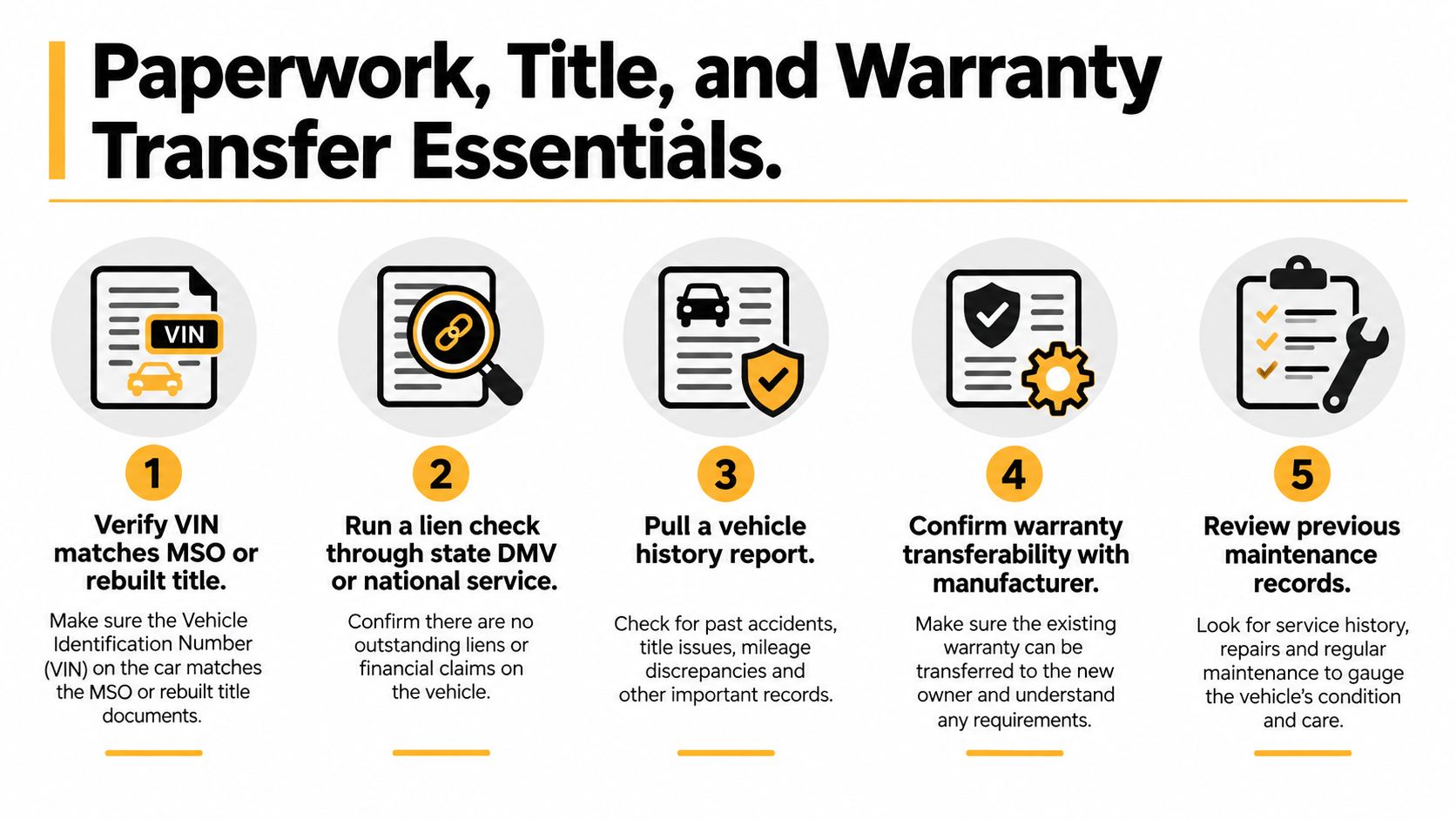
Paperwork red flags: Missing MSO, an out-of-state title with no transport trail, a recent transfer into an LLC, mismatched VIN records, or refusal to share diagnostic reports should pause the transaction.
For buyers evaluating incentives or ownership costs, review the requirements in this electric UTV tax credit resource only after confirming that the vehicle and transaction qualify. Never assign value to a claimed credit until the eligibility rules and filing responsibility are documented.
Used Electric UTV Price Benchmarks for 2026
A realistic 2026 price for a used electric UTV depends on more than age and hours. Battery capacity, payload rating, seating configuration, charger type, drive modes, warranty status, tires, enclosure condition, accessories, and software support can move the value in opposite directions. A low-hour work unit with a questionable pack may be worth less than a higher-hour recreational unit with documented capacity and clean service records.
The supplied market evidence establishes expansion in electric off-road vehicles, but it doesn't provide verified used-UTV transaction bands. I won't turn unverified listing impressions into fabricated price targets. Use the table below as a comparison framework, then populate it with current dealer, auction, and private-party examples for the exact model and battery configuration.
| Category | Low Hours / Recent | Mid Hours / Aged | High Hours / Older |
|---|---|---|---|
| Light-duty recreational electric UTV | Compare recent, lightly used examples with matching battery and charger | Discount for age, wear, reduced warranty, and missing records | Value depends heavily on battery report, parts support, and replacement feasibility |
| Work-focused electric UTV | Compare cargo, payload, towing, and fleet-ready equipment | Price in bed wear, suspension fatigue, work-cycle history, and pack condition | Require documented battery capacity and a clear repair budget before purchase |
| Performance or premium electric UTV | Compare output, seating, battery size, software, and included accessories | Separate cosmetic upgrades from verified mechanical value | Treat unsupported modifications and battery uncertainty as major deductions |
Build an apples-to-apples comparison
Collect listings that match the same battery size, seating layout, drive package, charger, and included accessories. Separate asking prices from completed sales whenever possible. Auction results can show wholesale risk, dealer listings may include preparation or warranty value, and private-party sales often transfer more inspection responsibility to the buyer.
A listing priced dramatically below comparable examples deserves more investigation, not instant approval. Check whether the seller omitted the charger, disclosed a weak battery, has a branded title, or is describing a converted vehicle as factory electric. If you're comparing electric mobility options beyond UTVs, a Caddie Wheel vs Alphard review can help clarify how different use cases affect the equipment decision, but it isn't a substitute for comparing like-for-like UTVs.
Your price worksheet should contain three figures: the value of a properly documented vehicle, the cost of immediate repairs, and the financial exposure if the battery or controller fails. The offer should reflect all three, not just the seller's advertised number.
Negotiation Tactics That Work on Electric UTV Sellers
“Your battery report shows 82% state of health, and the charger isn't included. I'm not pricing this like a documented, ready-to-work unit. Show me your out-the-door figure, including every fee, and I'll decide whether the risk fits.”
That statement works better than “I think it's overpriced” because it connects the offer to observable conditions. The buyer has identified a measurable battery concern, a missing component, and a request for the actual transaction total. The seller now has to respond to evidence rather than emotion.
Lead with the expensive uncertainty
Start with the issue that could create the largest future bill. Depending on the vehicle, that may be an undocumented battery, a controller fault, a damaged enclosure, or a title problem. Stack smaller findings afterward:
- Battery report: Ask for a manufacturer-generated report and a loaded test if the report is missing or inconsistent.
- Charger condition: Deduct for an absent, incompatible, damaged, or non-factory charger.
- Software support: Ask whether the vehicle can still receive diagnostics, updates, and replacement controllers through an authorized channel.
- Mechanical wear: Document tire damage, suspension play, CV boot tears, bearing noise, and reduction-box leaks.
- Paperwork: Price in the time and cost required to correct registration, title, lien, or street-use issues.
Request the dealer's complete out-the-door figure before discussing a trade-in, monthly payment, or financing method. A low monthly payment can distract from preparation fees, document charges, delivery costs, and accessories added after the advertised price. Get the vehicle description, VIN, included equipment, battery condition, and final amount in writing.
A seller can dispute your valuation. They can't easily dispute a photograph of a damaged charge port or a diagnostic report generated on their vehicle.
Use comparable listings that match the configuration. Be prepared to walk if the seller won't allow diagnostics, refuses to verify the VIN, or relies on verbal promises about battery health. Thin inventory doesn't make every unit scarce enough to justify hidden risk. Sign only after the agreed condition, included charger, warranty transfer, title status, and final price appear in the purchase documents.
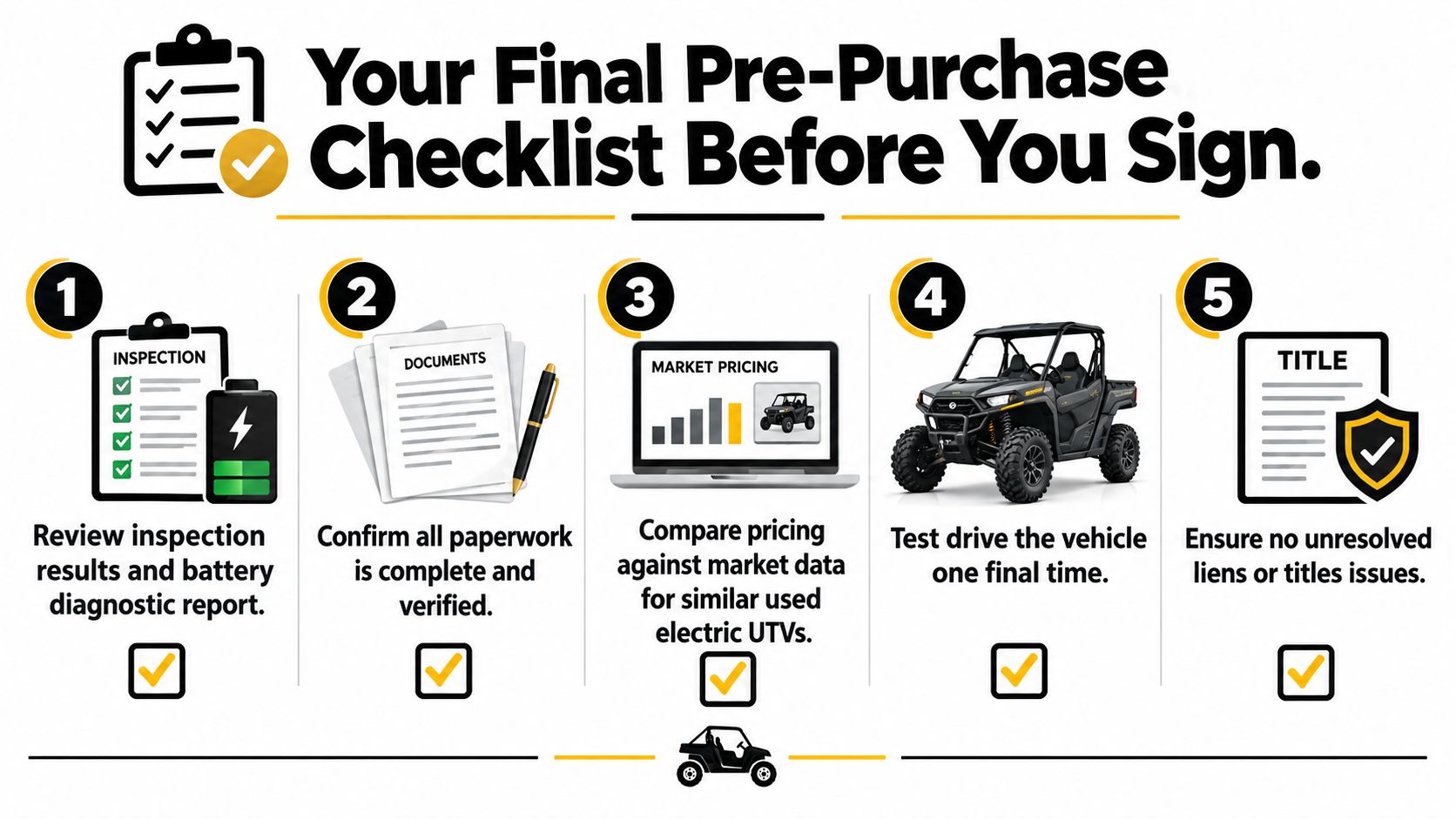
Your Final Pre-Purchase Checklist Before You Sign
Use the same sequence for every listing, even when the seller wants to start with a drive. Consistency prevents a polished body, strong acceleration, or an urgent sales pitch from controlling the decision.
Run the checks in this order
- Cold-start check: Record the resting voltage of the 12-volt system, inspect the dashboard during startup, and note any warning messages.
- BMS review: Obtain the battery report, confirm the vehicle identity, examine state of health and cell or module balance, and ask about stored faults.
- Physical inspection: Recheck the frame, battery enclosure, charge port, cables, suspension, CV boots, bearings, tires, and fluid leaks.
- Loaded test drive: Test acceleration, braking, steering, regenerative braking, selectable modes, and range behavior with realistic load where safe.
- Document verification: Match the VIN to the title and MSO, complete the lien check, review service records, and confirm warranty transfer.
- Price comparison: Compare the exact configuration with current market examples and deduct the cost of documented repairs or unresolved uncertainty.
- Written agreement: Put battery condition, charger, accessories, title status, warranty commitments, and the final out-the-door price in writing.
Choose a clear decision category
A pass means the battery evidence, physical condition, documents, test drive, and price all support the intended job. A conditional pass means one or more risks are understood, priced, and recorded in writing. A walk-away means the seller won't provide the evidence needed to estimate the risk, or the required repair exceeds the value of the deal.
The cheapest unit on the lot often stops being cheap once you add a charger, tires, title work, software support, or battery repairs. The best used electric UTV decision is the one where you can explain what you bought, what remains covered, and what the machine should do on the route or property where you'll use it.
Use the sequence every time: cold vehicle, physical condition, battery data, loaded drive, paperwork, market comparison, written terms. Don't reverse that order because the seller has already warmed up the vehicle or prepared a payment quote.
Solana EV offers electric UTVs for work and recreational applications, including the Model G Utility and other configurations suited to properties, resorts, and neighborhood environments. Review the available vehicles and use cases at Solana EV before comparing a new model against the battery, software, and ownership risks of an electric UTV used.