
A charger can look like a simple box with a cable, right up until a cart refuses to move before a busy weekend. A resort fleet may have vehicles parked neatly in a staging area, yet several can still be unavailable because the charger doesn't match the battery chemistry, the pack sat at a low state of charge, or the replacement charger can't restore energy quickly enough for the day's schedule.
That failure changes the buying question. An electric golf cart battery charger isn't just an accessory. It's part of the vehicle's energy system, and its voltage, current, charging profile, connector, and safety features affect uptime, battery condition, and operating cost. The right choice depends on who uses the cart, how often it runs, and which Solana EV configuration sits in the garage, depot, or dealership.
Table of Contents
- The Moment a Charger Choice Actually Matters
- How an Electric Golf Cart Battery Charger Actually Works
- Charger Types and Battery Chemistry Profiles
- Charging Times and Real-World Efficiency
- Safe Charging and Long-Term Battery Maintenance
- Matching Chargers to Your Use Case and Solana EV Model
- A Practical Charger Checklist Before You Buy
The Moment a Charger Choice Actually Matters
Friday afternoon at a desert resort, the assistant fleet manager walks through the staging area and finds three carts that won't be ready for the tournament the next morning. The batteries were charged with the wrong profile, the vehicles spent the winter at a low state of charge, and the replacement chargers arriving Monday were sized for occasional household use rather than repeated fleet turnaround.
None of those problems looks dramatic at first. A charger still plugs into the cart. A status light still comes on. But a mismatched charger can leave a battery undercharged, stress the cells, or create a charging cycle that doesn't fit the fleet's schedule. By the time a driver notices reduced range, the charger decision has already become a maintenance and availability problem.
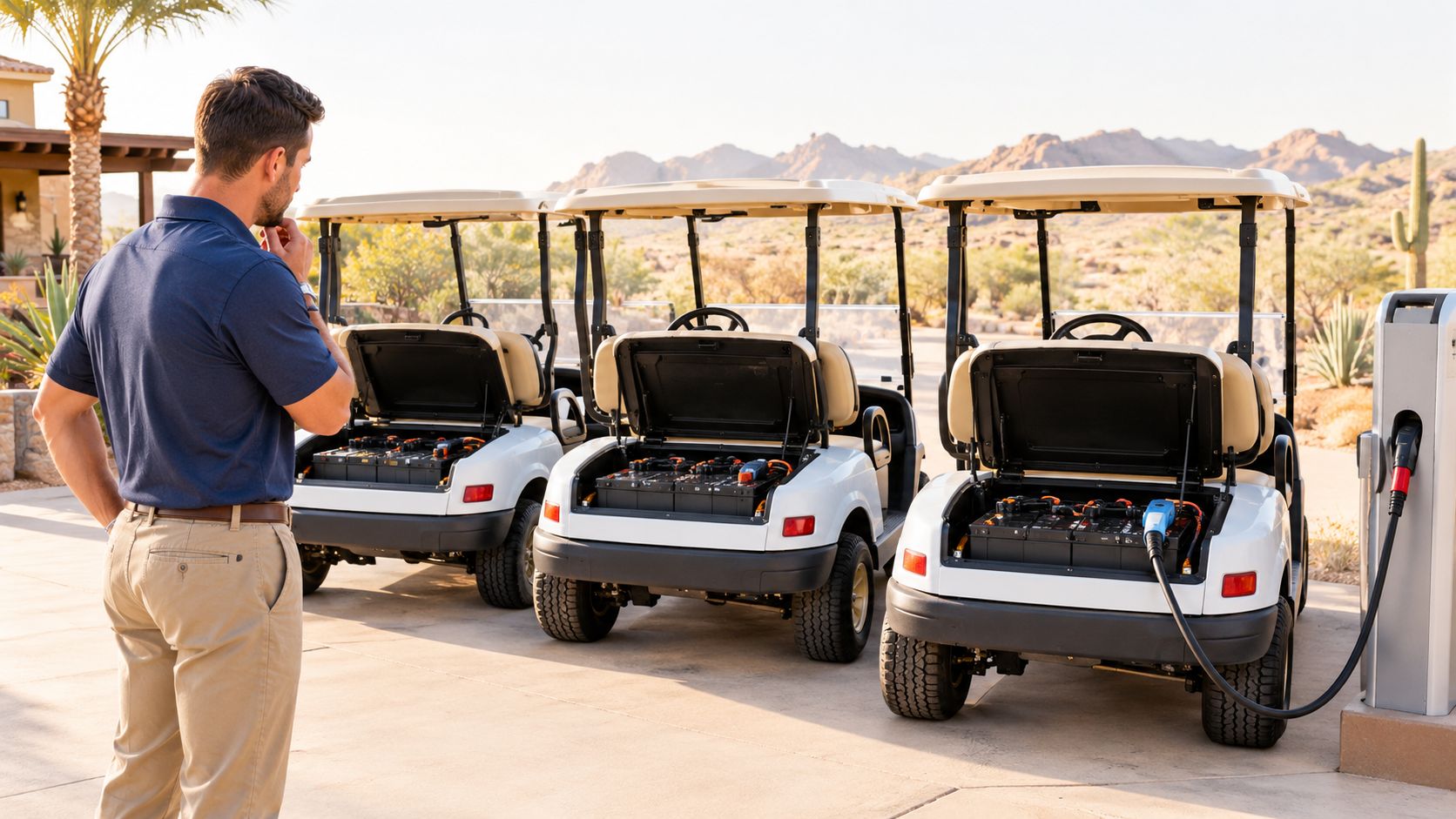
Fleet lesson: A cart is only as useful as the complete charging system supporting it.
The same issue appears in less obvious settings:
- A gated-community household may need dependable overnight charging, but not the fastest possible output.
- A resort fleet manager may need rapid turnaround between busy operating periods.
- A dealership buyer may need several profile options and connectors while preparing different vehicles for delivery.
The charger must match more than the cart's brand. You need to confirm the battery voltage, chemistry, capacity, connector, and intended duty cycle. A 48V lithium pack and a 48V lead-acid pack share a voltage label, but they don't necessarily accept the same charging behavior.
This guide explains the electrical terms first, then compares charger families, chemistry profiles, recharge expectations, safety practices, and buyer profiles. The final recommendation is not a generic shopping list. It connects the charger decision to the way a Solana EV model is used, whether that means resort transportation, neighborhood driving, or dealership preparation.
How an Electric Golf Cart Battery Charger Actually Works
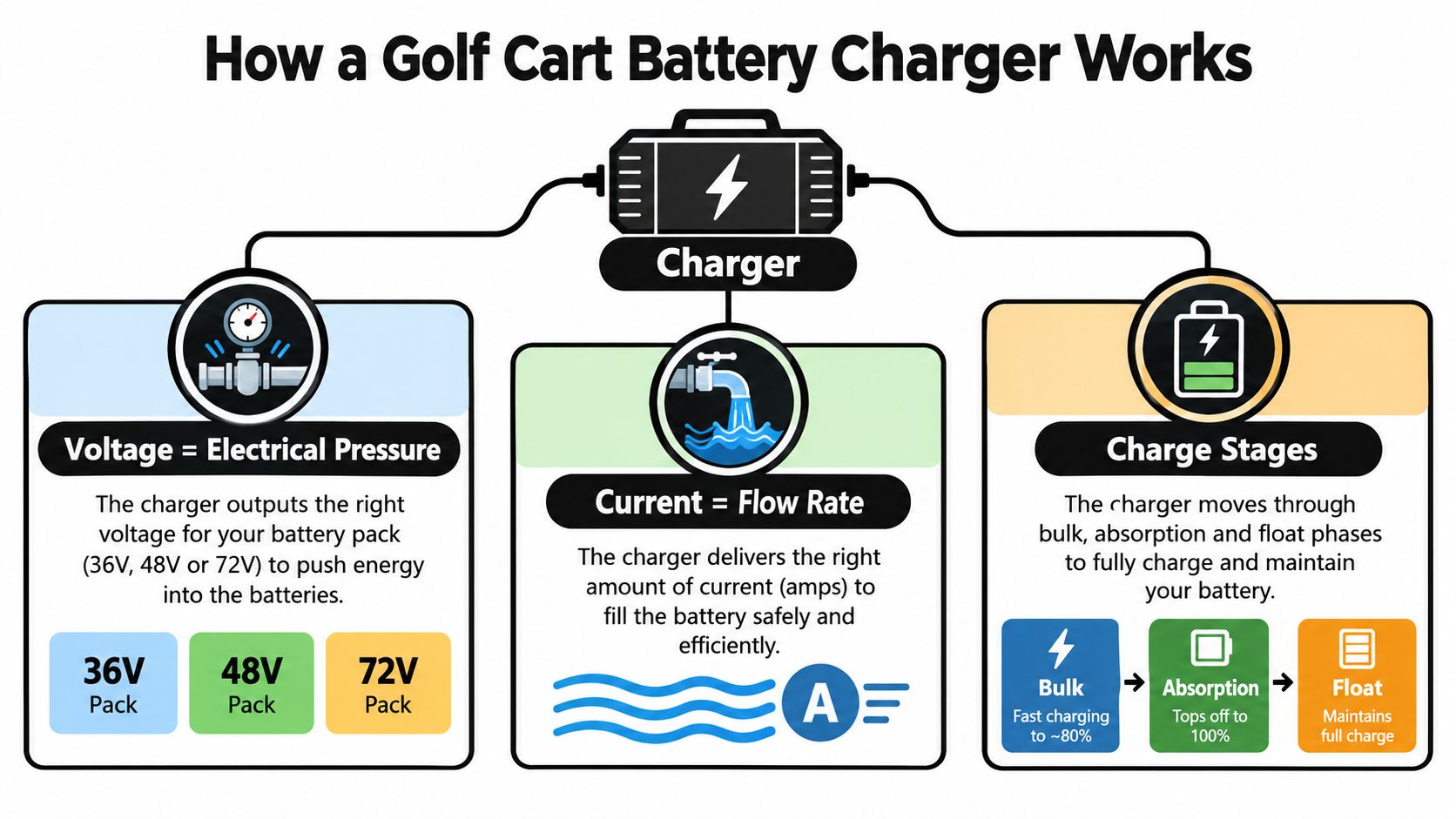
Start with three terms. Voltage is electrical pressure. Amperage is the rate at which electricity flows. Amp-hours describe the battery bank's storage capacity.
A garden hose makes the relationship easier to picture. Voltage is the pressure behind the water. Amperage is the width or flow rate of the hose. Amp-hours are the size of the rain barrel you're filling. A 15A charger can fill a 100Ah battery bank, but a 25A charger moves more current during the bulk stage, assuming the battery and charger are designed to work together.
Golf carts commonly use battery systems built around 36V, 48V, and 72V configurations. The charger must be designed for the bank's voltage, not merely connected because its plug appears to fit. A charger with the wrong voltage can fail to charge correctly or create a hazardous condition.
Onboard and offboard designs
An onboard charger stays mounted inside the vehicle. It draws power through an external AC connection, so the operator doesn't need to carry a separate charger between storage and charging locations. This arrangement can suit fleets with fixed parking positions and regular charging routines.
An offboard charger remains outside the cart and connects through the vehicle's charging port. It can be easier to replace or share between compatible vehicles, but the connector, voltage, and charging profile still need to match. A familiar plug shape isn't proof of compatibility.
The charger changes wall power into the direct current the battery stores. A basic unit may deliver power with limited control. A smart unit monitors the charging process and adjusts output as the battery approaches full charge.
Why charging has stages
Lead-acid systems commonly use Bulk, Absorption, and Float stages. Bulk sends stronger current into a depleted pack. Absorption holds the voltage near its target while the current tapers. Float maintains charge at a lower level.
Lithium iron phosphate, or LiFePO4, follows a different constant-current, constant-voltage pattern. It generally shouldn't be held on a lead-acid-style float stage or subjected to equalization. The battery management system, or BMS, helps protect the pack, but it doesn't turn an incompatible charger into a suitable one.
For a deeper explanation of how the battery management system monitors and protects a pack, see Solana EV's battery management system guide.
A useful way to remember the sequence is simple:
- Voltage identifies the pressure the pack expects.
- Amperage influences how quickly the charger can refill it.
- Amp-hours indicate how much energy the pack can hold.
- The profile determines how the charger behaves as the pack fills.
Those four details become the fitment test for any Solana EV configuration. If one is wrong, the charger may be electrically unsuitable even when the cart powers on normally.
Charger Types and Battery Chemistry Profiles
A resort fleet may charge carts overnight in a maintenance bay, while a gated-community household may need predictable charging after daily errands. A dealership buyer must support several battery options without presenting an unsafe match. Those profiles make charger selection a fitment decision, not a generic accessory purchase.
Three charger families appear most often. A conventional ferro-resonant charger uses transformer-based hardware and may follow a relatively fixed charging pattern. Its design is familiar and sturdy, though it senses battery conditions less precisely than newer equipment.
A basic automatic charger adds shutoff or control logic. A modern multi-stage smart charger uses programmed settings for different chemistries, reduces current near full charge, and responds to pack conditions. That control matters for carts used repeatedly by resorts and gated communities, where an unsuitable charging pattern can affect availability and battery life.
| Charger Type | Flooded Lead-Acid | AGM / Gel | LiFePO4 | Typical Output |
|---|---|---|---|---|
| Ferro-resonant | Often compatible when correctly rated | Requires the correct profile | Generally unsuitable without a lithium program | Commonly within the 10A–30A range |
| Basic automatic | Suitable when programmed for the battery | Suitable only with a matching sealed-lead profile | Not automatically compatible | Commonly within the 10A–30A range |
| Multi-stage smart | Supports Bulk, Absorption, Float, and possible equalization | Uses a controlled sealed-lead profile | Uses a strict CC-CV lithium profile | Commonly within the 10A–30A range |
Lead-acid isn't one single category
Flooded lead-acid batteries hold liquid electrolyte and usually require a multi-stage profile. Their routine may include equalization, followed by careful maintenance. AGM and gel batteries are sealed designs with different charging tolerances, so a flooded-battery equalization setting may be unsuitable.
A charger set for wet cells can undercharge an LFP pack because its voltage and end-of-charge behavior differ. A lithium setting can overheat or damage lead-acid batteries. Buyers planning responsible handling of worn-out packs can consult the Reworx Recycling lead acid guide.
Match output to the battery bank
A practical starting point is charger output near 10% of the battery bank's amp-hour rating. Golf cart chargers commonly fall within the 10A–30A range for 24V, 36V, 48V, and 72V packs, as described in this golf cart charger selection guide. Higher output can shorten the bulk portion of charging, while excessive current can create heat and reduce battery life.
A 48V, 100Ah pack generally fits the logic of a 10A to 20A charger, provided the manufacturer approves that range and the profile matches the chemistry. A Solana EV dealership buyer should verify the label and documentation for each configuration. For lithium options, the Solana EV golf cart lithium battery resource provides relevant battery information before a charger is selected.
Charging Times and Real-World Efficiency
Charging time depends on the missing amp-hours, charger output, battery chemistry, temperature, cable condition, and the taper near full charge. A useful estimate divides the capacity being restored by charger amperage, then allows for charging losses and the controlled final stage.
Consider a 48V, 105Ah lead-acid pack returning from 50% depth of discharge. About half of its rated capacity must be restored, with additional time needed because charging is not perfectly efficient. A 15A charger supplies that energy more slowly than a 25A charger. The higher-output unit can improve turnaround during the bulk stage, yet its current decreases before the battery reaches full charge.
A 48V, 60Ah LFP pack with a 20A charger follows a different pattern. Lithium charging can remain more consistent through much of the cycle before tapering under its constant-current, constant-voltage program. The battery maker's approved charge current sets the limit.
A working estimate
The table uses the basic relationship between capacity and current as an operating estimate, not a guarantee. Battery age, charger programming, temperature, and connection condition can all change the result.
| Pack Setup | Charger Output | Time from 50% DoD | Time from 80% DoD |
|---|---|---|---|
| 48V, 105Ah lead-acid | 15A | About 4 hours of bulk-equivalent time, plus absorption and losses | About 6 hours of bulk-equivalent time, plus absorption and losses |
| 48V, 105Ah lead-acid | 25A | About 2 hours of bulk-equivalent time, plus absorption and losses | About 3.5 hours of bulk-equivalent time, plus absorption and losses |
| 48V, 60Ah LiFePO4 | 20A | About 1.5 hours of constant-current-equivalent time, plus taper | About 2.5 hours of constant-current-equivalent time, plus taper |
These arithmetic illustrations use the stated pack sizes and charger outputs. They do not promise a specific recharge time. Lead-acid charging may add a substantial absorption period, while lithium charging uses current taper as the end-of-charge signal. The battery maker's instructions override any general estimate.
Where the clock gets lost
Some charging energy becomes heat in the charger, wiring, connectors, and battery. Cold-soaked batteries can accept charge differently from batteries operating at moderate temperatures. Long or damaged cables increase resistance, while a corroded connector can reduce the useful current reaching the pack.
Operational rule: Size a charger for the time window you have, not the ideal time printed on a specification sheet.
A household that parks a cart after dinner and uses it the next day may have enough time for a standard automatic unit. A resort fleet operating between tee sheets needs to examine the C-rate, calculated by dividing charger amperage by battery amp-hours, along with the number of vehicles charging at once. Dealership buyers preparing a Solana EV for either customer should match the charger to the selected pack and expected turnaround. Faster charging only helps when the battery chemistry and thermal limits support that output.
Safe Charging and Long-Term Battery Maintenance
A charger can be electrically correct and still create problems if the charging area is damp, crowded, or poorly ventilated. Park the cart in a dry location with clear airflow, keep combustible materials away, and use an outlet protected by the appropriate safety device for the installation. Never cover a working charger with towels, storage bags, or anything that blocks its vents.
Before each cycle, inspect the AC cord, DC lead, plug, and cart receptacle. Frayed insulation, bent contacts, melted plastic, or visible corrosion requires attention before charging. A loose or corroded connector adds resistance, producing heat and reducing the current that reaches the battery. That can make a sound charger appear unreliable.
Protect the battery chemistry
Charger settings must match the battery chemistry. A lead-acid profile on an LFP pack can apply unsuitable voltage behavior, maintain an inappropriate float stage, or trigger equalization that lithium cells should not receive. Use a charger programmed for the pack and approved by its battery supplier.
Flooded lead-acid batteries need a different maintenance routine. Check electrolyte levels according to the battery maker's instructions, add distilled water where specified, and inspect the cells after charging or equalization because gas production can change water levels. AGM and gel batteries should not be handled like open flooded cells.
Build a storage routine
A cart parked during the off-season still needs a charging plan. Clean and dry the connection, check the battery's state of charge, and follow the manufacturer's storage instructions. Leaving a charger connected for weeks is not automatically safe. Maintenance modes can help, provided the charger suits the battery, has clear airflow, and remains in good condition.
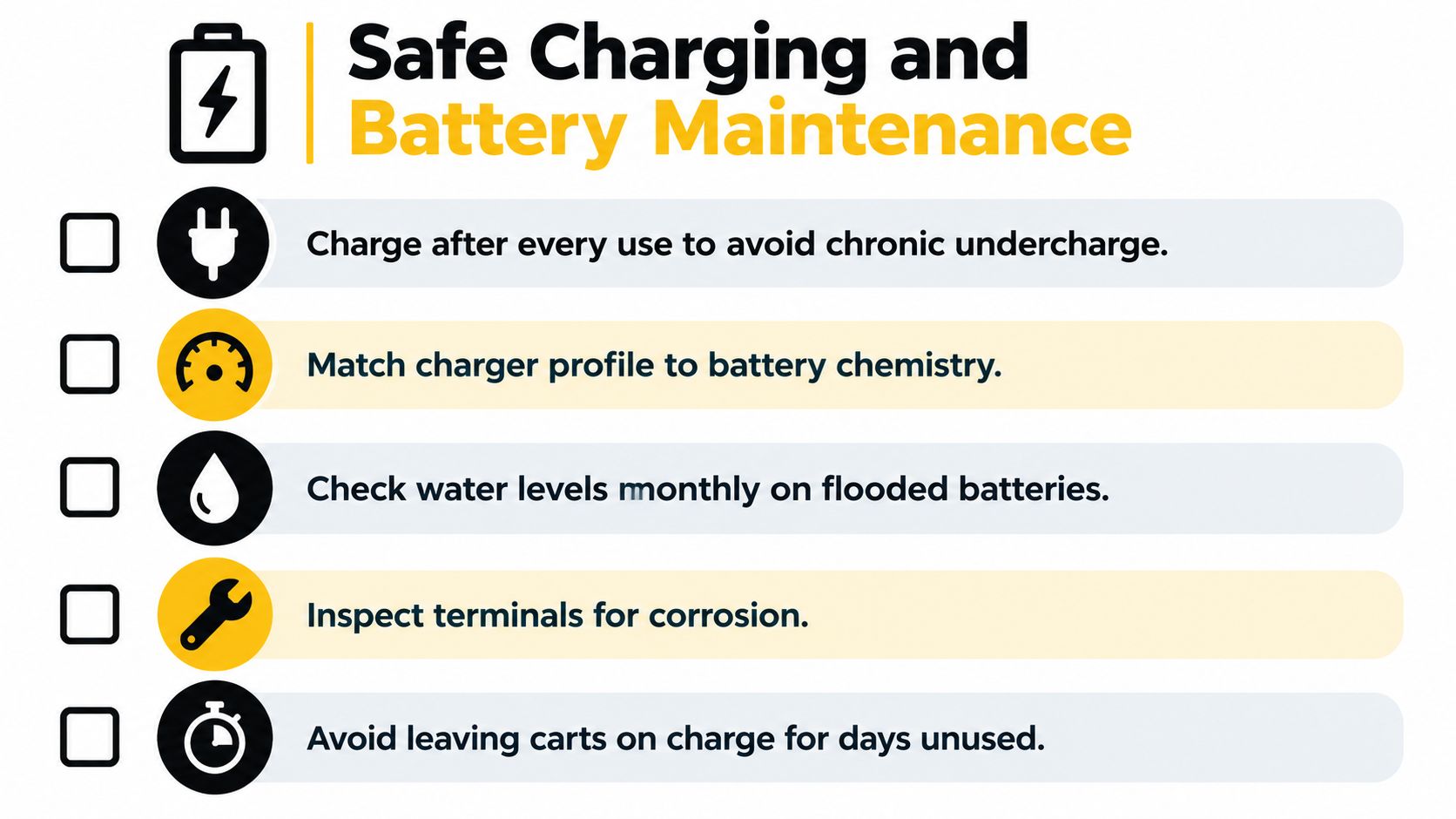
Use this routine for fleet or HOA storage:
- Before charging: Check the outlet, cords, plug, receptacle, and visible battery condition.
- During charging: Keep ventilation openings clear and watch for unusual heat, odor, buzzing, or error lights.
- After charging: Follow the manufacturer's guidance for disconnecting, water checks, and inspection.
- Before extended storage: Clean terminals, protect the cart from moisture, and confirm the correct maintenance mode.
- At return to service: Test the charger and verify that the battery reaches its expected end-of-charge state.
Automatic shutoff and float maintenance can reduce charging risks, but they do not replace chemistry matching or inspection. Resort fleet managers should add these checks to vehicle turnaround procedures. Gated-community households can include them in seasonal storage, while dealership buyers should verify the charger before delivering each Solana EV. The GolfRider charger FAQ offers practical guidance on charger behavior and the risks of leaving equipment connected too long.
Matching Chargers to Your Use Case and Solana EV Model
The right charger changes with the operating pattern. A resort fleet manager should prioritize predictable turnaround, durable connectors, and a smart profile that matches the installed battery pack. A gated-community owner usually cares more about simple overnight operation, quiet use, and a charger that can remain safely integrated into a regular household routine.
Dealership buyers face a different problem. They may prepare vehicles with different voltage, chemistry, and connector requirements, so a single universal assumption can create fitment errors. A bench charger with selectable profiles may be more useful than a fast charger designed around one permanent configuration.
Three buyer profiles
Resort and hospitality fleets often benefit from onboard smart chargers sized for the approved LFP pack and the fleet's available charging window. Higher output can help when vehicles must return to service quickly, but the battery documentation must support the selected current.
Gated-community households may find a standard automatic charger suitable when the cart completes shorter local trips and has a long parking period between uses. A 15A unit can be reasonable for a compatible pack when rapid turnaround isn't part of the daily routine.
Dealerships should verify each vehicle before delivery. A multi-profile charger can support preparation work, but it still needs the correct connector, voltage setting, and battery-specific program for each cart.
| Buyer Profile | Solana EV Model | Recommended Charger | Profile Type |
|---|---|---|---|
| Resort fleet | Gold line | Onboard smart charger sized to the installed pack | Lithium-specific or approved lead-acid profile |
| Gated-community household | Platinum line | Standard automatic charger matched to voltage and capacity | Chemistry-specific automatic profile |
| Dealership | Side-by-side UTV line | Selectable-profile bench or service charger | OEM-approved profile with compatible connector |
The model family is only the starting point. Confirm the exact battery specification and connector on the vehicle ordered, especially when comparing Gold, Platinum, and side-by-side UTV configurations. A 48V golf cart charger guide can help frame the voltage and connection checks, but the vehicle and battery documentation should make the final call.
Solana EV offers street-legal golf carts and electric UTVs, including the Solana XA 4P, XA 6P, F, and G, so the practical charger decision belongs in the vehicle specification process rather than after delivery. Treat the charger as part of the selected system, alongside the battery, connector, and intended duty cycle.
A Practical Charger Checklist Before You Buy
A charger decision changes with the buyer's routine. A resort fleet manager needs predictable turnaround across many vehicles. A gated-community household may value gentle overnight charging. A dealership needs a unit that can prepare different carts without confusing battery settings. Use the checklist below before ordering a charger for a Solana EV configuration.
Five checks that prevent expensive mismatches
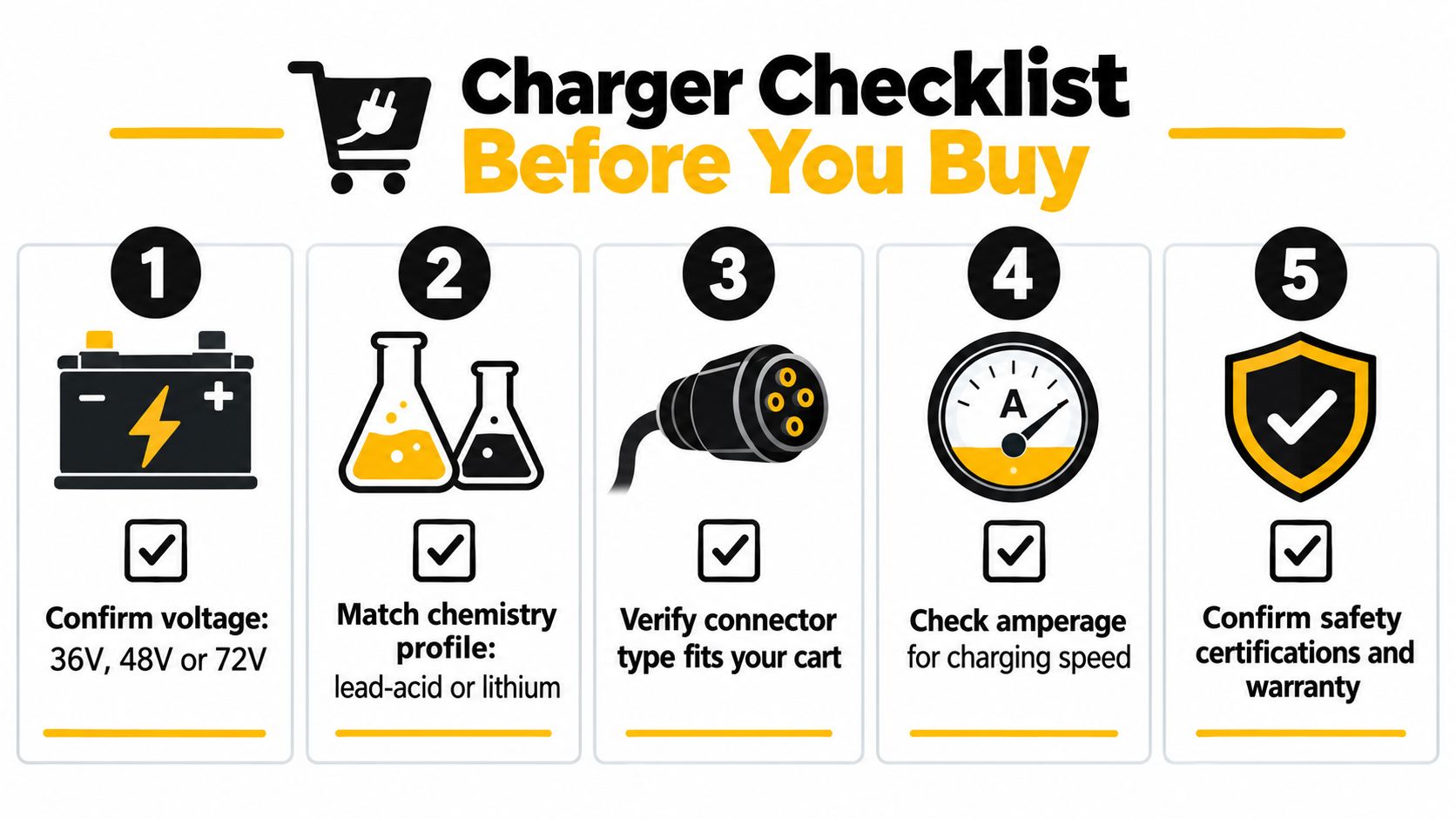
Confirm voltage and chemistry. Read the battery label and verify whether the system is 36V, 48V, or 72V. Identify flooded lead-acid, AGM, gel, or LiFePO4 batteries. The charger must support both the system voltage and the battery chemistry.
Verify the physical connection. Match the charger connector to the vehicle's charging receptacle. Confirm whether the Solana EV configuration uses an onboard or offboard arrangement. A plug that looks similar may still have incompatible wiring or pin assignments.
Size current for the schedule. A private owner with a long overnight charging window may suit a lower-current unit. A resort fleet with short gaps between rounds needs a faster setup, provided the battery, wiring, and charging profile support it. The schedule should determine charger output, not the output rating alone.
Check protection and service terms. Look for safety certification, weather resistance suited to the installation, thermal protection, clear fault indicators, and useful warranty coverage. For a fleet or dealership, also check service access and replacement availability.
Compare ownership cost. Include energy use, battery care, connector replacement, service time, and expected operating demands. A lower purchase price offers little value if the charger creates downtime or contributes to early battery replacement.
Apply the checks to the vehicle's work:
- Flooded lead-acid batteries need an automatic charger with the correct lead-acid profile and maintenance routine.
- LiFePO4 batteries need a lithium-specific CC-CV profile approved for the battery.
- Shared depots may need charging cabinets or managed infrastructure, with the site's electrical capacity confirmed first.
- Dealership preparation calls for OEM-programmed units with suitable connectors and diagnostic information.
Before delivery, document the match between the battery label, charger specification, connector, and operating schedule. Solana EV provides vehicle options for neighborhood, resort, and off-road use, including the XA 4P, XA 6P, F, and G. Review the exact configuration and charging requirements, then visit Solana EV to explore the lineup and identify the appropriate next step for the purchase.